Search This Blog

Showing posts with label games. Show all posts

Friday, 4 July 2025

The Stop Killing Games Initiative


The EU petition https://eci.ec.europa.eu/045/public/#/screen/home

The UK petition https://petition.parliament.uk/petitions/702074

For awhile now I've noticed an alarming trend in the marketplace. Big content platforms in music, videogames, film and television, ebooks etc. Are increasingly embracing a model that eliminates ownership of products and replaces them with a model where customers pay a corporation for access for a limited time. The terms of that access are determined soleley by the company.

That's a terrible practice that ia actively detremental to society. If it becomes the norm or worse the standard we'll find ourselves living in a world where culture, entertainment and educational materials can be withheld and removed at the discretion of a small number of anonymous companies. That's a lot of power over the mass of society.

What can the solution be? Well, the dismantling of the capitalist system and its tenedency to centralise capital and power.

That's only way to root out this and many other social ailments, but that will take time, is there anything we can do on the short term?

Well, yes there is, I know of two such measures currently working there way through.

A group of activists in the EU and UK have setup a campaign to promote consumer protection reforms in those territories.

The campaigns are under the banner of Stop Killing Games (SKG). The campaign is currently using two petitions one in the UK via the UK Gov platform, and the second an EU wide citizens Initiative

Their website and wikipedia page have more detail about their aims and history. To summarise.

"Stop Killing Games" is a consumer movement started to challenge the legality of publishers destroying video games they have sold to customers. An increasing number of video games are sold effectively as goods - with no stated expiration date - but designed to be completely unplayable as soon as support from the publisher ends. This practice is a form of planned obsolescence and is not only detrimental to customers, but makes preservation effectively impossible. Furthermore, the legality of this practice is largely untested in many countries.


Over the past year, we have succesfully escalated complaints on this problem to consumer agencies in France, Germany, and Australia, and have brought forth petitions for new law on this problem to various countries. A list of the actions taken to date can be viewed here. As of 2025, most consumer action on this matter has concluded and we are awaiting decisions on it from several governments. However, there are a few remaining avenues left where people can participate if they are eligible:

I'm a sceptic of petitions as a vehicle for wide reaching change, but I also beleive in right of use, re-use repair etc, of things and oppose Intellectual Property and property in general. Besides, what SKG are asking for is not a big change. I know this because I already play several dead games that were saved by their fans, including MMO's like Star Wars Galaxies. If these initiatives suceed 100% it will mean that games companies develop an end of life plan and stop taking action to prevent consumers from keeping abandonware alive.

And in addition these aren't the typical Change.org petitions either. Both of these came out of open government initiatives and are designed to give citizens a small say on policy. If a UK Gov or EU Citizen's Initiative pass there thresholds they are gauranteed a response and public debate. And these petitioms are being promoted by a groupnof volunteers who are active in producing information and lobbying and consulting with politicians and regulating bodies.

So, the chances of these succeeding at least partially is high provided they can make it across the thresholds by the deadline. So, I'm happy to support these intiatives so long as it doesn't distract from my main goals.

 Oh, and speaking of deadlines, both are up this month, July 2025. The UK petition ends on the 14th of July, while the EU one lasts a bit longer ending on the 31st of July. 

Good news, at time of writing both have passed their signature thresholds. Though more signatures is still advised as in addition to making a bigger impact and statement via increased support there is a danger that some signatures will be discounted due to errors and such. 

Another cause for concern I've seen in the EU is people not wanting to give their information up, as the requirements for signature validation differ amongst the member states with some of them being quite high. I completely understand the concern, but the issue is that this is backwards, the EU already has that information in its system and so does the national government. They already have that information in their records. 

Sunday, 13 April 2025

The threads that connect Murray Bookchin to Death Stranding


 Over the past week or so, I've been reading The Next Revolution (NR), a collection of essays by Murray Bookchin, and talking to a friend whose been playing the 2019 game Death Stranding (DS). I enjoyed my time with the game when I played through it just over a year ago, and aside from some notes, I'm enjoying the read of NR. Since both are on my I've noticed some parallels and threads or strands if you will connecting the two.

 A quick summary, DS is a game set in the aftermath of an apocalyptic event where humanity is reduced to a scattering of small settlements ranging from tiny one or two person shelters to cities that are roughly a few blocks in size with a central depot and maybe a dock. You play Sam the courier and guide him on his journey, exploring the land and delivering packages.

Murray Bookchin was a lifelong revolutionary theorist committed to answering the question of how to overcome capitalism and build a better society in its place. Bookchin went through many schools of thought, from Marxism to Anarchism to a new idea he sometimes called Libertarian Municipalism/Communalism or Ecological Communalism. But throughout his journey, his commitment to centreing ecological questions remained constant. If you were on social media in 2016-19, you may remember the meme "Google Murray Bookchin!" that was indeed about the same man.

The world of DS is one where renewable power is omnipresent and recycling of material is the driver of manufacturing, but that's not quite what I have in mind when I think of the parallels between the two works. What caught my mind is Bookchin's arguments in favour of a confederation of communes to replace capitalist and state society. A common argument against alternatives to capitalism concerns the impossibility of such a society working in practice. How can disparate communities get along and work out common problems or share without some outside authority to compel them to do so? A common response has been to stress self-sufficiency of each collective or commune, in which case it just isn't rational to fight and squabble as it won't lead to any benefits but will still require many costs in time, energy and resources. If a system of self-sufficient societies is feasible, then I suppose that would be an answer, personally I don't think it is possible to achieve a system where every single community is self-sufficient in every detail, but assuming it is possible I think that's a strong incentive for isolation and extreme localism. Bookchin is also sceptical of such a possibility, his answer is rooted in that co-dependency of communities. In this Communalist alternative, Communes will Federate or Confederate together for mutual need and benefit.

 A crucial element in giving reality to confederalism is the interdependence of communities for an authentic mutualism based on shared resources, production, and policymaking. If one community is not obliged to count on another or others generally to satisfy important material needs and realize common political goals in such a way that it is interlinked to a greater whole, exclusivity and parochialism are genuine possibilities. Only insofar as we recognize that confederation must be conceived as an extension of a form of participatory administration—by means of confederal networks—can decentralization and localism prevent the communities that compose larger bodies of association from withdrawing into themselves at the expense of wider areas of human consociation.
Essay 4: The Meaning of Confederalism

In short, this society will work together because its material needs compel it and its material structure is the most rational way of fulfilling those compulsions. 

In Death Stranding, a version of this social structure plays out. The scattered outposts of humanity seem to be sufficient alone for the bare necessities of survival and existence, but they all lack in specific equipment, resources and the things that make life fulfilling. Sam the main character is a courier and in this society it is the courier's role to take needed supplies from those who have, to those who need. In return, the people Sam helps give him more tools and resources to improve his work and survival in the wilderness and agree to actively participate in a network of exchange and support with the other settlements by joining the Chiral network (I'll explain what that is later). It's mutual assistance for collective benefit, they all prosper the more their dependence and connections with each other deepens and the network eventually grows from one isolated corner to a vast region. Some people will join up relatively quickly in gratitude for Sam's efforts and the benefits that collaboration brings, but others take more convincing or in another way negotiation through deeds.

To take one example, the character Elder, an old man who lives alone on top of a hill. He has needs that can't be provided at his camp, but he is wary of joining the network that Sam is recruiting for, so he is reluctant to sign up, he co-operates with Sam to an extent and is eventually won over by the delivery of medicine and other positive experiences and the potential benefits joining gives him. In return, he produces unique equipment and resources for Sam.

If Sam fails to deliver medication in time, Elder will die and the benefits of his joining will be denied to you.


 This communal interdependence being the groundwork of social interactions based on collaboration is also reinforced by the multiplayer aspects. While playing the game, other players can interact with you in the game world. This can just be emoting to each other, trading (exchange of materials) gifting items, or working collaboratively to make traversing the extremely hostile terrain more manageable and fun. 

One example stands out in my mind. To make travelling the vast distances of the world and its rivers, crevices and jagged rocks more manageable, there is a road network. However, it hasn't been built yet, that's your job should you choose to do it. There is a network of 3d printers that with enough material will build the road in sections. 

The world of DS is harsh and difficult, especially when balancing kilos of equipment and material on your back. So a road that is smooth and level is an obvious advantage, but the resources required is a barrier, especially in the early game. I spent a long while scrapping together the resources needed for the first part of the road. I still remember how my elation at seeing the printer conjure up a road deflated once I saw just how little of the road it had constructed and how big the map was. Building that on my own would be time-consuming and not fun. So, I gave up on it and focused on my missions and hauling cargo over rocks and streams, dodging scavengers. 

While I was doing that, three other players popped into my world and pooled enough resources to build enough of the road to connect the first sub-region of the world. This drastically cut down my travel time, and made it safer, and more enjoyable as I could now ride my three wheeled back or boxy truck without worrying about hitting a ditch. It even charged my vehicles' battery, boosting its range when I had to go off the grid. It's also when the multiplayer and the message of DS clicked for me. Having understood the message and mechanics of the game, working for everyone benefits everyone, I found more enjoyment in the game and made sure to put any surplus material into other road building nodes or storage boxes. This is just one example of many I could give, ranging from sheltering from a snow storm to placing ladders to help others cross rivers.

The Stranding.
Borders, countries, governments—it’s all bullshit. Least that’s how it was, and maybe always will be, but…if you really believe that there chiral network of yours can bring people together, no matter what walls stand between ‘em, then spread it all over. But you damn well better make sure that you do right by each and every American—only then can you ask them to do right by the UCA. That’s the social contract, and don’t you ever forget it.
I’m taking a chance on you, Bridges, not because I believe in you and yours, but because I want to. Don’t let me down again.
Email from Elder

It's not however a perfect depiction of Bookchin's new society. The Chiral network is not a representation of an egalitarian confederation of like-minded communities, it's run by the remnants of the United States Government, and they've tasked Sam with expanding it as part of a plan to "rebuild America". This rump USA is the central node and foundation of the network of settlements. The disparity between the cities which are the main production hubs and the smaller settlements is also a divergence. Bookchin unlike some ecological thinkers believes cities have their place, albeit in a very different organisational structure and much smaller than cities in our present world. A Communalist Death Stranding would drop the USA as a relic and instead of a few cities and dozens of one and two person shelters would restructure it to say a dozen communities of similar size. Perhaps retaining a handful of the isolated one or two person shelters as a contrast and representation of the dangers of refusing to adapt.

Sunday, 25 August 2024

Everything to Play For Review


Marijam Didžgalvytė (Marijam Did) has a book coming out in Autumn called Everything to Play For, How Videogames are Changing the World (EPF). I was one of the lucky few to be given an advance copy. My deadline for getting my notes into shape was extremely tight but I found the book an engaging read, EPF is a mix of autobiography, artistic review and criticism, sociological research, consumer activism, history of workplace organising and appeal for further activism and resistance to build a better gaming industry as part of a better society for everyone.

The book covers plenty of ground, and despite its grand scope EPF is newbie friendly - gaming terms are explained when they first appear in the text. Did’s target audience appears to be people who are committed left wingers of one stripe or other but are not into games or are sceptical of them and possibly even hostile to them. There are several passages lamenting the arbitrary treatment of games compared to film, art, literature etc. While every game terminology and technology is explained left wing terminology is only explained if it’s somewhat obscure. For example, the Situationist concept of Derive (Drift) is explained for the reader but Did’s usage of Historical Materialism is not.

I share Did’s frustrations on common left wing disdain for games and the blind spots that come with it. I’ve experienced the disapproval and belittling attitude first hand and I’ve been trying to chip away at that wall of disinterest for some time in my own small way. I was surprised when Organise expressed interest both in my writing and commentary about games in general as that is not a typical response for an older established platform. Film, music and literature are staples of left wing critical commentary, and entire schools of thought have risen to prominence pondering the impact of these media institutions on the minds of the working masses, but videogames are still shut out of those conversations. EPF’s publisher is Verso books, which is both another positive sign of change and a good platform to reach the audience of sceptics. Did makes an effective case that to ignore one of the largest industries on the planet is to seriously undermine any strategy for resistance to capitalism and hinders attempts to construct a world that is free from the exploitation and violence of infinite growth and productivity improvements.

The games industry is a major contributor to land clearance, modern slavery, resource depletion and pollution. If we wish to stop hyper-exploitation in the Democratic Republic of the Congo and other regions of the world we can’t limit ourselves to illegal logging and conflict diamonds, we have to challenge the role of tech and game companies in cobalt and other mineral mining. Tens of thousands of people around the world are employed in the games industry and just like their fellow workers on the docks, in the fields and factories they are exploited, overworked, underpaid, harassed sexually, bullied, fired on short or no notice, and through their labour create products that they will not own and will enrich someone else. Their struggles are just as worthy of moral and practical support.

Ignorance of these areas also presents the danger of sleep walking into a trap as the cultural, social and psychological effects of the lessons learnt in the gaming industry seep out into areas of our society and personal lives that at a glance are completely separate from the world of point winning and level climbing. Gamification is marketing buzzword, but annoyingly and dangerously it’s a buzzword that describes a real process that has proven time and again to be quite effective, at least effective at generating profit. The impact that the logic of video games being exported outside its traditional sphere is something we don’t fully understand yet as the process is still in early stages, but its quickly becoming inescapable even for those who have never touched a joystick and only use keyboards and mice for writing emails and browsing videos of cats being random. My audio book and podcasts apps recently added medals and experience points as an example of the future fast approaching.

All of these issues and more are summarised and examined in EPF, there’s lot of blood, sweat and tears that go into making plumbers jump up and down and hedgehogs collect shiny rings, and sadly that is often literal. I’ve never experienced crunch time developing a video game but I’ve experienced similar conditions in a factory, and its mind, body, and soul draining work, so I can empathise with conditions for game developers. There’s plenty to critique and lament in gaming spaces and the industry that shapes it right now, and EPF could easily have been another entry in the growing left wing genre of political pessimism, pointing out and cataloguing at length the many faults of the world as it is and then despairing about how insurmountable it all is. Thankfully EPF is not like that, although it does catalogue the many faults of the world as it is. It also credits the successes, games that engage politically with their players and raise awareness of issues, the growth of video game and tech worker unions, independent developers and games co-operatives that are experimenting with new ways of working that promote sustainability, collaboration and equability in compensation and decision making. EPF couples these positives with outlines of a potential better future for gaming that more support from the wider left could assist in making a reality sooner.

EPFs vision of a possible future is not a blueprint and there are parts of the puzzle that remain unanswered by the end of the conclusion. To me that isn’t a detriment; the history of the schools of socialism is littered with impressive schematics that breakdown and become obsolete within a year. The remaining ambiguities in EPF leave room for independent thought, and there were points in the text where Did asked a question and while reading I thought of a rough outline of an answer or potential avenue for discussion and examination. I really hope that in the near future I will find enough time to start writing some of them.

I’m not in the target demographic (well I am partially in that demographic - I am convinced that we need a revolutionary overhaul of society after all), but I’m not new to games and I doubt anyone who reads Red & Black Gamers would need the definition for a LAN party. If that’s the case should you still read EPF? I would hope that I’ve already answered that question, but just in case I’ll be blunt: yes, yes you should. I consider myself a well-informed gamer who has documented issues within the industry and supported early attempts at resistance, and yet I’ve learnt quite a bit, both new examples and some more information or another perspective on cases and incidents I was already aware of. To pick just one example I was aware of the game Dead Cells, but was not familiar with its studio Motion Twin nor that it is open about its support for Anarcho-Syndicalism.

“Follow games industry unions on social media and support their calls for action. Enjoy and encourage artistic experimentations in this field and support smaller creators. Do not dismiss political action within these spaces as isolated aberrations, but engage with them, give them merit, be curious.”

Is it a perfect book? No, but I don’t believe those exist and my negative notes were trivial, so I won’t bother including them as just mentioning them would give them greater weight than they merit. I think EPF is good contribution to the discourse about video games and I hope it proves to be a successful step in the process of getting video games as an industry, and as a subject for criticism, resistance and improvement out of the lefty sin bin and into the mainstream. Getting it on the bookshelf is a good start.■

Reddebrek
You can find more of Reddebreks writing and reviews on their website: reddebreksbowl.blogspot.com


Pre-orders of "Everything to Play For" are available from Verso Books with 20% off, £13.60 paper book / £8 Ebook which shipping commencing on 17 September.

Monday, 6 May 2024

Iron Front Simulator: Social Democracy vs Fascism


An example of the Social Democratic Party's propaganda between the wars
"Help Protect this house, Republic, Freedom, Give your vote to
the Social Democratic Party!"

"Such a general development cannot be attributed to the false tactics of any single party or to the mistakes of individual leaders. On the contrary, the conduct of individual leaders is determined largely by the sentiments of the people as a whole. It would be erroneous, however, to regard the sentiments of the moment as reflecting the natural make-up and character of the people. They are merely the consequence of the special circumstances which have brought about this profound degradation of the entire nation."

- Karl Kautsky, Hitlerism and Social Democracy, 1934

A friend shared a game they had found on Itch.io Social Democracy: An Alternative History. For brevity and clarity, I'll be referring to the game as SDA. The game's premise is quite intriguing, the year is 1928 and your task is to block the rise of German Fascism through the Social Democratic Party (SPD). The game runs in the browser, loads quickly and works very well on desktop computer and smartphone. I discovered it yesterday and have clocked over ten play throughs, most of which were on normal, but then It tried out easy to explore more paths and options. There is a hard mode which I haven't touched as beating the game on normal is extremely difficult, my one clear win was on easy after figuring out the most likely outcomes of several dead end paths.

 The game is played through text with period photographs, political posters and music recorded at the time, it keeps the User Interface concise and works really well at building atmosphere and immersing you in that world. The game can be played entirely through one tab, though checking its library is recommended both to explain the personalities and factions and to provide you with some feedback on the impact of your actions.

It turns out that even with foreknowledge of the period and the threat posed by Hitler and the Nazi party, stopping them is very difficult. Most of my games ended with Germany plunged into civil war, though I take some comfort that Hitler and Papen are not in total control of Germany, perhaps World War II can still be avoided. The Kautsky quotation at the top pops up at the start of every new game, after several attempts I think it's an excellent opener to the game. Since the player is essentially a time-traveller, the task should be easy, but the "obvious" solutions are off the table, this isn't a Hitler assassination simulation it's a Social Democracy simulation. 

You have to stop Hitler whilst remaining true to the ideology and goals of the SPD in the late 1920s. Yes, there was a time when the SPD took a firm and bloody hand to defend the German Republic from insurrectionary threats, but that was in the early days, the enemies were Communists, Anarchists and former party members and the people tasked with executions and street fighting the Reichswehr and Freikorps no longer reply to the SPD's letters and are fraternising with the SA and Stahlhelm (Paramilitary group for the German Nationalist pro-Kaiser DNVP, and also the first organisation in Germany to adopt the banner of Fascism). For years, the party has pushed for a "normal" bourgeois parliamentary way of doing things. Essentially, the SPD saved itself on Monday, but as a consequence doomed itself on Saturday.

You don't have much room to manoeuvre, yes the SPD has its own security paramilitary the Reichsbanner and then later the Iron Front, but these are dwarfed by the SA, Stahlhelm and Communist RFB (Red Front Fighters), the SPD has control of the Prussian state and has a good chance at joining the government and accessing state ministries, but institutions employ thousands in layers of responsibility and the state administrations are full of the traditional supporters of the German right, relying on them to target your enemies is not a sound strategy.

And that's just at turn one, the Wall Street crash is coming, as is the Presidential elections and a clash over the governorship of Prussia. There are many examples of the special circumstances getting in the way of the best laid plans. Using the typical methods of the SPD in the late 1920s is insufficient as a response to the far right, the only paths that can give a chance at victory are the paths that break heavily with recorded history. Building bridges with the Communist Party helps resist Nazi attacks, as does pursuing a radical restructuring of the party and an ambitious economic intervention program, though there are many barriers on those paths to derail you before the final showdown.

I think SDA is useful at showing the player a more accurate picture of party politics. Amongst the left-wing there is an obsession with the party structure, it's treated like the missing ingredient in an equation, get the party form and program right and the rest falls into place more or less. This is a major factor of the "splitting" phenomenon -though not the only one, as this also afflicts groups that aren't interested in the party form- and why elections in Europe are often contested by multiple parties with similar names, branding and ways of speaking, and why meaningful collaboration between these supposedly similar groups is so rare. They can't work together as equals because they all view each other as fundamentally wrong, and giving ground is compounding the error. And that's looking at the modern day, in the period of the Weimar Republic these parties not only split and rivalled each other over personality and position, they had all in living memory fought each other in pitched battles and street fighting and murder are still common occurrences. 

Building a broad front is extremely difficult, and the paid functionaries of the state have their own agendas and views on how things should be run. And there are factions within the party who must be appeased and convinced, the other parties have their own plans and the international situation is almost completely out of the hands of the party leadership even when they form a government. And that's just for the bourgeois democratic state, looking at the role of the party in building a new state or alternative system and the potential for control and co-ordinated action diminishes further.

Autumn Chen the games' developer has proven that it is on paper possible for a social democratic movement to stop a fascist threat, and at the same time shown that they almost certainly will fail to do so, as to effectively defeat the far right vision of government and society requires that movement to act in a manner that forces it to transform into a new more radical and disruptive form with little in the way of political logic driving that change. Playing SDA reminded me of my time playing Suzerain both in what it was teaching me and the tools it used to create a player experience. I don't do numerical or star scores, but SDA is one of my favourite games of this year.

Saturday, 13 April 2024

Literal Wargaming notes on War of Heroes

A truck bombing mission


 So, there's a game on the app store that lets you actively support a side in a conflict, literal wargaming.

  Myanmar (still commonly called Burma) is a nation with a very long history of violent conflict, within its borders there are dozens of wars that date back to 1948 if not earlier. Despite that February 2021 is still considered a low point for Myanmar's political stability, this was when the military Junta (Tatmadaw) that has ruled the country for most of its history as an independent nation abandoned its strategy of limited reform and collaboration with civilian politicians and launched a coup to overthrow Aung Saan Su Kyi, since that time opposition spread across the country and due to the open use of military force many opponents started arming themselves, now in 2024 seemingly the entirety of the nation is in the grip of a civil war.

The ethnic minority and regional groups that were already in conflict with the Junta gained new recruits and multiple new factions sprung up, it's a very confusing conflict to keep track of. Just have a look at this map.


Every shade of colour represents territory under the control of a different group and that does not include every force participating, some are operating in areas too remote to be independently verified or are working as part of an umbrella alliance of other groups.

Tatmadaw has been a brutal force in Myanmar for decades, enforced conscription, racketeering, rape, murder, ethnic cleansing, bombing of civilians, slavery, human trafficking, alliances with organised crime, drug trafficking, deals with international conglomerates, and that was before it was faced with this massive wave of resistance. Its response has more bombings, more enforced conscriptions, more murder, more airstrikes on villages and townships. 

The opposition has been forced to get creative, in the early days I saw brief videos of small groups using 3D printed guns to drive-by small police check points, and plant homemade bombs on remote trails to ambush patrols. There's also been an explosion in cultural resistance, Anarchist punk music has exploded in popularity in the country, Rebel Riot is a personal favourite.

And there is also now an official mobile game created by a supporter of the People's Defence Forces (PDFs). It's called War of Heroes (WOH) its available now on IOS and Android. The PDF is an umbrella grouping of resistance to the Tatmadaw it varies in strength, capabilities and tactics throughout much of the nation. The mobile game has the player join the PDF and work their way up the ranks, carrying more and more effective attacks on the Tatmadaw's forces through a series of missions.

It was built out of unity store assets, is available in English and a Myanmar language (my limited knowledge of the country is showing here, I have no idea which language, I just know they have many) the game is free and supported by advertising, it's developed by one individual Ko Toot (not his real name) and playing this game in Myanmar will get you in serious trouble with the Tatmadaw.

Ko Toot was motivated to join the resistance and use his IT skills to develop this game after the army detained several people he knew arbitrarily.

"They had never done a single criminal thing in their lives," said Ko Toot of the couple, who were detained for supporting the pro-democracy movement.

He didn't know what had happened to them. The BBC only recently established the woman was released within a day, but the man was held for about a year and a half.

After their arrest, Ko Toot then heard the military had detained the wife and infant daughter of a pro-democracy activist it had been unable to locate.

"Imagine you are a young child and you grow up inside a dirty, stressful and sadistic prison, and you have no idea what's going on. It made my blood boil."

BBC  

In addition to being a propaganda boost for the resistance by letting players get revenge on their oppressors, the game raises funds for them as well. I have a low opinion of mobile games that use advertising to make money, but I was surprised how restrained WOH was, you watch adverts to get ammunition one ad=30 bullets, these are mostly needed for the battle missions which eat up quite a few rounds on later missions as the number of soldiers explodes.

You and eventually some AI support take on the army in the woods

Apart from battle missions there are also drive-bys, mine ambushes, assassination missions and later (around mission 45) there are some stealth and tank destruction missions. The game gets into a loop of battle mission then another mission then another battle mission for a while. It started to wear thin at mission 33, but then something strange happened, there was a cutscene, and then there were Zombies, zombie soldiers to be exact, so now there were two variations on the battle missions added to the mix. There's also an upgrade system, a login gives a coin (one per day) which can be spent on an attribute like health, reload speed etc.


I don't think this game will win awards for design, though development by one person in an active conflict who is targeted by the ruling government deserves some respect. I first downloaded the game several months ago, and it's been updated and improved regularly. When I first played the game, all light sources had opaque cones of purple, now they're using more natural light effects. There was also an auto aim system for the battle missions that didn't work, that has now been removed. 

And yes this a literal propaganda game raising funds for a side in a conflict, knowing that worries me, in this particular case I don't have any sympathy for the Tatmadaw they've had their reckoning coming for a long time, but it's not a good omen for the future. We've been slowly heading in this direction for some years, militaries around the world have been incorporating games into their outreach and training programs for years, America's Army is an obvious example, a game created to raise the profile of the United States Army and encourage enlistment, I'm not optimistic about the future. WOH seems to be a success, it's managed to stay on the App and Google Play Store in some version or other for a while and according to Ko Toot has raised thousands of dollars for the real PDFs. The Tatmadaw is also losing ground by the day, I discovered WOH by reading the BBC article written in August 2023, since then every week there's been another Tatmadaw defeat, often quite a serious one, in October three powerful armies ended their ceasefire, united in the Three Brothers Alliance, and launched an offensive that within weeks defeated the Myanmar and captured half of Shan state including the border crossings with China and most humiliatingly ceased a city controlled by organised crime families closely aligned with the Junta and freed thousands of slaves and repatriated many of them to their home countries.

Currently, observers claim that the Junta has lost control of 60% of the country, and they keep losing important border crossings and townships. WOH's part in this conflict is small, but it is playing a part. I'm sure others will be paying attention to its success.


Saturday, 4 March 2023

How being President made me a better Radical - a review of Suzerain


 Over the past week I've been playing Suzerain, a sort of choose your own adventure political simulation game. Released in 2020 by Torpor Games, I totally missed it until browsing a recommended for you tab during a sale. The aim of the game is for the player to take on the mantle of President of the nation of Sordland, a country with a very complex and bleak political history, complete with revolutions, military coups, civil wars and deposed monarchs. The game treats it all very seriously, with many of the people and cultures and organisations being similar but not copies of our own world during the early days of the Cold War. The game is set in 1953 by its own calendar and the technology and development and political situation of the world tally with that.

Once a decision is made you cannot reload and undo it, you'll have to start a whole new game if you really need to change course. The game starts with a profile builder for your character and a timeline of events in Sordland's recent history. Throughout you are given some options to choose from about certain actions and beliefs, this is largely to help the player build a picture of the character Anton Rayne, but some of the options do come up and have some bearing in the game. Eventually the timeline shifts to documenting Anton's rise to the Presidency, and the game proper starts with your inauguration.

The goal is to essentially survive as President and depending on player decisions stay alive until the conclusion of your first (only?) term. At the start you are given some options, economic outlook, pro-market or pro-planned economy, which sector of government to prioritise, defence, health etc. and which of the worlds two superpowers to develop closer ties or to push for a third path.  The prologue is there to give you a rough plan of who you wish to be as a person and a President. I chose to stick to that plan as closely as possible with deviations being forced upon me. I ended the game as partially successful reformer who had been swept up in the CSP, the game's version of the Warsaw Pact.

The game is very gripping, my first play through was over 11 hours which I played over a week. I needed to spread it over several days because otherwise I would've just done nothing but play the game until it ended. The world of Suzerain is full of characters, institutions, nations, cultures, religions, and so on. There is a codex for nearly everything referenced in the game and its information can be useful at certain parts of the game. It took 11 hours to play the game, just reading a file of the codex entries alone will had several more hours. But, you don't need to be overly familiar with the games codex to be successful, its an asset, but not a vital one, you can still complete a play-through with some thought and a strong sense of what you want to achieve.

The music is also a strong point of the game. Most of the games action is through text boxes so the soundtrack had to work hard to deliver on setting appropriate moods. After playing the game I bought the soundtrack and have listened to it quite a bit. The tracks were composed by James Spence and they're fantastic, Suspense the track that often accompanied the stressed and important political meetings made me feel like biting my nails, a habit I broke years ago, and Past which covers more reflective episodes had me looking back on my own life.

 It does allow you scope to play radically differently, I ended the game as a mostly clean democrat who leaned left and had made some ground to support minorities and averted an invasion from a powerful neighbour. Looking at the achievements on Steam, I can see that I could've done the exact opposite, become a brutal and corrupt despot, or overthrown in yet another civil war, and many points in between. And crucially, the developments largely made sense, there were times when bombshells were dropped in my lap, but once the smoke cleared and I learnt more about those events they also made sense. I understood why my opposition, oligarchs, foreign powers, conservatives and nationalists, were out to get me. I didn't particularly sympathise with their views but they had reasons for doing what they were doing. 

Sordland is to put it bluntly a mess. Its been ruled by a military strongman whose shadow still looms over everything, it is technically a democratic state but its constitution was devise with the explicit intention of maintaining strong central authority, and the ruling party the United Sordland Party (USP) has ruled unquestioned since the end of the civil war. You are the current leader of the USP which is both a blessing and a curse. And a failed reformist administration provoked a major economic recession, and there's a powerful and active nationalist movement even more fanatically devoted to the ruling ideology than the USP, violent extremist groups and at least one regional power looking to change the map for good. And that's just on day one. For a text based game that moves from one backroom meeting to the next its surprisingly eventful.

Which brings me to this games most important teaching moment. No matter how strong my mandate or how dirty I fought or how pure my ideals, I could not carry out fundamental change to the system. The best I could do was push through some reforms, and that had to be watered down when I faced intractable opposition. If I kept pushing things to there limit, at best all my reforms would fail, and I would probably be done for, or attacked by a foreign power. The Anarchist criticism of power isn't that bad people can hold power, it is power itself that is the issue. Being President of a nation is not a blank check to do whatever you wish so we just have to make sure the best person gets the top job and all is well. Presidents et al are constrained by other forces and circumstance, compromises have to be made and no matter what the system continues grinding on. And Suzerain teaches this important lesson at every step on the road. 

I promised to expand healthcare during my first term, but we were in the middle of a severe recession inherited from past administrations, and the oligarchs and the ultra conservative political elite had already threatened me repeatedly. So, I expanded funding for the courts and created an anti-corruption force to tackle corruption but also to investigate both factions, healthcare had to make do with what resources it had. Later I was able to find enough money to combat a Polio outbreak and make prescription medicine free, but that put Sordland in debt and hindered the overall economic recovery. This is just one example, it simply isn't possible to achieve everything you promise the electorate. Which is also a lesson we are taught in the real world time after time. Dictator or Democrat, there is not one leader in world history whose legacy doesn't have many stains and broken promises. 

Usually, in political commentary the reaction to this is to lambast the individual leader or their network of advisers. And occasionally the criticism will expand to include the whole political party or coalition and very rarely during the time of political revolution the whole governmental mechanism will be condemned. Its obvious that some senior politicians are actively corrupt or promise well beyond their means to deliver, do I need to cite an example? I'm sure every reader can think of a dozen examples at least and some will be unique to their background. But Suzerain goes further than this, you can be an angel and work beyond the limits to achieve your vision, its a video game after all, even if Anton Rayne gets shot the player will be fine. It just won't be enough, forces outside your control with their own wills, desires and concerns will clash with you, even allied and friendly ones.

I have no idea if this was the intended message of Suzerain's developers Torpor Games. Though I find it difficult to see any other intended message. Especially when attending the games version of the United Nations the AN. The AN meeting is essentially where all of the foreign policy tangles you've tried to smooth out come to ahead. One after another Rayne and his counterparts in the other nations ascend to the podium and give their views, the words and specific goals of each speaker are different but the forms and structure are the same. They each outline their grievances with each other, often at opposite sides of the same tensions, each one is selective in their arguments and uses high talk of ideals to cloak pragmatic demands, and each one has a point. There is no `good guy` there, they all are equally to blame for causing these tensions and are all equally blameless since they are the inheritors and responders to past and current tensions beyond their control. Even your nation Sordland behaves in much the same way, or at least my Sordland did. 

There were dialogue options to stress peace and co-operation, but I just didn't see the point in choosing any of them, it was far too late for any such talk to make a difference. By that point I had a neighbour actively trying to provoke a war with me and building a nuclear weapons program, I had also signed Sordland into the CSP a powerful block of nations and its leader had already started modernising Sordland's military. I had already been pressured into taking a side in regional and global conflict that seemed about to rip open any day. And I had seen no evidence from the other heads of government that neutral appeal would work at all in advancing Sordland's benefit.

I had set out with the goal of staying independent and maintaining peace and treating everyone fairly but the events of the game forced me to make serious compromises on nearly every front. Which is also a testament to the games excellent writing, its a video game, I could've have at any point said `to hell with it` and played how I wished damning the consequences and just booting up a new game when the sword finally dropped on my head. But, I just couldn't play like that, I cared what those close to me felt about me and wanted to collaborate with them. And I actively viewed several characters in contempt and looked forward to arranging their downfall and felt cheated in the cases where I could never catch them. And for the bigger picture I struggled to do the best I could with the limited resources I had while doing my best to keep all those plates spinning.  

This is how I ended up.


Friday, 20 January 2023

Ukraine War Stories


 Ukraine has a large IT sector including game development. Many companies and teams have been disrupted and even destroyed by the Russian Federation's invasion in February 2022. It shouldn't be surprising that some of these game devs in Ukraine would turn to their skills and make something dealing with those events. Conflict creates an explosion in every other art form, protest music, graffiti, photography, novels and memoirs, and past conflicts do get depicted in video game form. Though its still rare for one to be made about an ongoing conflict in the early days of the fighting.

Ukraine War Stories (UWS) was released on Steam on the 18th of October by Starni Games. I was not familiar with them until last Winter, looking them up they seem to operate exclusively on the Steam platform and have previously released a series of games called Strategic Mind. Before tackling the game its best to address in the Elephant in the room. This game was made as propaganda to encourage sympathy for the people of Ukraine. Its released for free and has many language options, propaganda is a term that is loaded with negative associations, but it doesn't automatically mean its dishonest. The game is open about its intentions and point and view, and while the events and characters are fictional they all have basis in fact. On the game's start screen their is a page dedicated to showing the sources for all the events it depicts.

 Its open in its intentions, its transparent and shows the evidence it uses to inform narrative decisions. I don't have a problem with this. Ukrainians have a right to express themselves and deal with traumatic events in anyway they choose and the team working on this game have taken steps to ensure that the game is educational and stays close to accurate depictions of events. It at no point tries to present a "Russian" view of the conflict, but it doesn't have to. If a Russian game dev team wished to make such a game and they showed the same level of fact checking and transparency I wouldn't begrudge its existence.

UWS is a visual novel type of game with a simple resource and morale system, where the player progresses through three narrative scenarios set in three different parts of Ukraine, Hostomel, Bucha and Mariupol. These names should be enough to alert the player that they will be experiencing some horrific scenes, but just in case that isn't clear the game documents sexual violence, torture, psychological torture, and crimes against humanity and war. Its not a pleasant experience. I have completed all three scenarios at the time of writing this, there are multiple endings depending on choices and the management of resources but I don't want to play again, it left me feeling very raw and vulnerable.

The Russian characters unsurprisingly do not come across very well, they're all military and they're essentially brutal thugs. Unfortunately their behaviour tallies very closely with the sources and investigations into the conduct of the Russian military including in the towns and cities the game is set. I say unfortunately not because of the damage done to a nebulous concept of "honour" but because this means that while playing you are reminded that when a drunken Russian volunteer leer at a young woman, or a Kadyrovite (Chechen loyal to Chechen pro Russian leader Akhmat Kadyrov) beats a teenager for not answering a question he couldn't understand fast enough, these aren't like the zombies and mutants in a typical survival horror game, these scenes represent real events and real victims. If UWS had been made before the invasion I would've written it off as Ukrainian-ultra nationalist propaganda, but the links section and my own knowledge of the conduct of this war dispel that. 

To give just one example, in the Bucha episode of the game there is a collaborator who goes around talking to the Russian Armed Forces and was a supporter of the Russian World concept. He was based on a real person and his fate matches that of his real life counter part. If there had been no war and a game had this character I would scoff at how unbelievable it is that a person could walk through the rubble of his home town and praise and support an army that was seizing his neighbours, but it happened.

 There's an argument in games design that video games should always be enjoyable to play, UWS is an assault on that concept. I would not wish to make the acquaintance of anyone who would play this game for escapism or thrills. The characters while a little clunky at the beginning grow into human beings with complex thoughts and needs and no matter how good a player is at managing morale and resources they all go through a form of hell along with friends and loved ones. I suppose the question is why make this game? The developers of UWS use their Steam developer update system to keep their fans informed about conditions for civilians outside of the combat zone with their discussion of power cuts and having to source generators and heating for their building. The game is open about attracting support for Ukrainians, in addition to the page documenting their sources there is a `support UA` page that has links to many charities working to support refugees and other victims of the ongoing conflict. 

However, for me there is another reason why UWS deserves to be played, though I would recommend taking some precautions to prepare for it and keep in mind the extreme content it deals with. I'm fortunate enough not to know what its like to live under occupation, some of my family live in Northern Ireland during the Troubles so I have some knowledge of what that might look like, but in my own life I very rarely have to deal with the police and authorities never mind a conflict in my vicinity. This is unusual as many parts of the world are not so fortunate. In the UK and Europe we treat the people who face these horrific catastrophes very poorly. As societies we begrudgingly allow a minority of them safe harbour in our nations, donate through private and government agencies to organisations offering support closer to the battle lines, and use soft power to encourage the belligerent parties to eventually give peace a change through a drawn out process of de-escalation. 

Ukraine has been held up or criticised as an exception, and while its true that the level of direct support from the USA, UK and EU has been greater than other victims of aggression around the world I wouldn't say its been without drawbacks. In the UK while a home stay policy was implemented the government refuses to wave visa requirements for Ukrainian refugees a requirement that has delayed thousands from finding safety, and the EU is constantly struggling with certain member states (mainly Hungary) delaying or weakening its initiatives and support. And in general while sympathy remains high I've noticed that the tendency to view Ukrainians as somehow different from "normal people" remains as a source of distance.

But the ordinary people who suffer most from these crises are viewed as abstract numbers and burdens to be suffered. UWS offers an opportunity to close the distance a bit and see what an ordinary Grandfather, a teenage boy and a Doctor experience when nation states resort to naked force to achieve their ends. Since I have no direct experience to compare UWS too I can't say with certainty that it gets it 100% right, but it has left me thinking a lot more about people in Ukraine and other parts of the world a lot more than I do usually. Though I do know some Ukrainians from before the war so that has also helped me move beyond national categories and numbers on charts.

 The point I'm trying to make is that war is awful, and the injuries it creates go further and run deeper than most realise. But war continues to happen and yet much art dealing with war as a subject quite often glorifies and glamourises it. Especially in video games, some of my favourite games have you single handedly take on the entire armed forces of Bad-Guyania, without qualms. So, as horrible as games like UWS are to experience I think it occupies an important position. Its closer to This War of Mine in its effects and intentions and while it feels wrong to say I'm glad This War of Mine and Ukraine War Stories exist, since they were inspired by real atrocities and trauma, I think if we're every going to seriously challenge the system that encourages and perpetuates militarism and conflict works like them will play an important part in convincing the population that its important we do.

A quick note:

Steam Russia does not allow Ukraine War Stories to be accessed despite a full Russian language version being available. This is a great shame as I've seen what Russian official media and much of its unofficial Telegram channel media says about the conflict. Ukraine War Stories could do a lot to puncture that veil and expose a Russian audience to more information.

Saturday, 5 November 2022

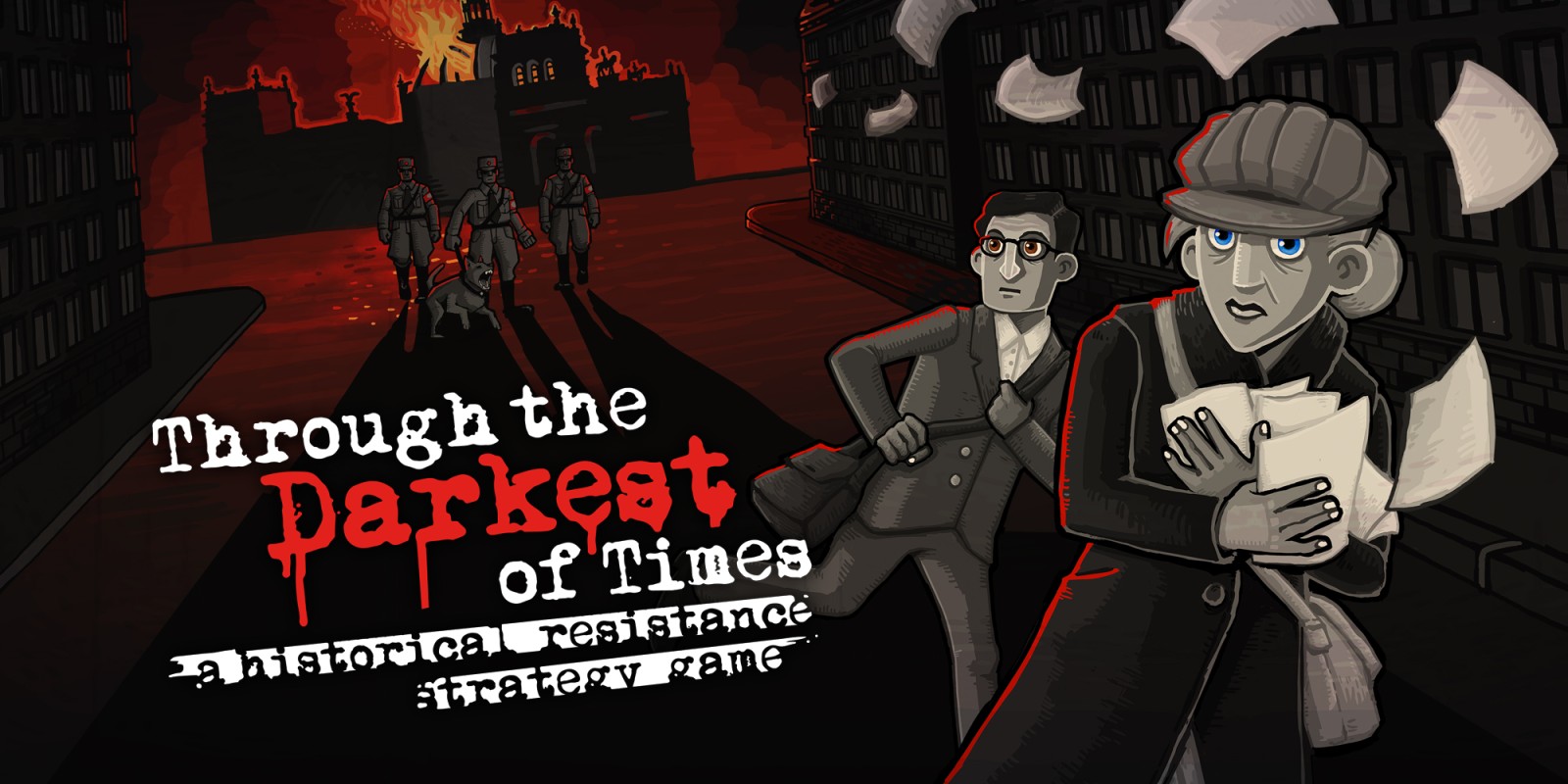
Through the Darkest of Times


I've had some time on my hands and an old laptop which makes very alarming noises when it runs Fallout New Vegas, so I've been passing the time playing games that are less demanding technically. I tried Through the Darkest of Times: a Historical Resistance Strategy Game, and essentially stayed in my seat until the credits were rolling. 

Darkest of Times, is quite gripping once its stuck its claws into you. WWII is a saturated market in fiction, but a game about the activities of a civilian resistance cell in the heart of Nazi Germany is ground less trampled. The setting is Berlin with rare travels beyond, and the timeline is January 1933 to August 1945, the birth and death of Nazi Germany. There are two modes though they're the same at their core, Resistance is the games harder difficulty, there is more pressure from the police and members of the group will leave if morale collapses. Story mode, is the easier difficulty, it removes the members leaving the group if morale is too poor but you can still lose members and the game if your characters morale gets too low. Its a turn based strategy game, you pick your character who is the leader of a small resistance group, the maximum membership is five. Each turn lasts a week and the opportunities and risks for your group change constantly. Your character and the members can be very diverse, politically and economically, and these traits can alter gameplay and some of the random events of the story. 

For an example, my group was mostly a coalition of Anarchist manual workers, social democrat servants, and a Communist metal worker. This meant we found appealing for support from workers and unionists pretty easy but struggled when developing contacts in the Christian and conservative circles. Also the communist fled early in the game to escape the crackdowns on communists. In one of my playthroughs a member was a lesbian and we briefly explored the growing atmosphere of violent oppression against Weimar's homosexual subculture. The timeline of Germany is fixed, it follows the actual events very closely and each turn presents you with three headlines about events that happened in that week in history. 

Occasionally your character will take part in story events, and every turn your group will have a brief discussion about life in Berlin and sometimes these will have choices and consequences for your group and its members. The goal of the game is simple, survive and cause as much trouble for the Nazi regime as possible. You have many opportunities to do this, anti-Nazi meetings, book smuggling, leafleting, hiding persecuted citizens, exchanging information with journalists and intelligence services, prison breaks, sabotage, raiding SA and army supplies etc. The difficulties lie in both the repressive arms of the Nazi state, the SA, police, Gestapo etc, and even more in maintaining a balance of resources, morale and activity. 

The two main resources needed are money and supporters, money is used to buy goods and services from contacts, while support opens up new opportunities for action in Berlin's neighbourhoods. Morale, is the morale of your character and the group, the clever thing about this mechanic is that since you are a small group operating in the shadows of a strong and powerful totalitarian regime, morale is constantly draining. Your groups commentary and story segments make it clear that you are a tiny island in a growing sea of nationalist frenzy. To stem the tied of morale collapse you must engage in constant and effective action. Painting the walls of a workers district with anti-Nazi slogans won't bring down the Third Reich, but it'll cause a stir and make your partisans feel better.

Of course, defiance of Hitler is extremely dangerous, so the more your partisans act, the more surveillance and injuries they're likely to suffer, so you have to manage your team wisely, not just by assigning the best suited to the task but also have some members cool their heels for awhile or go into hiding overwise they become more of a hinderance than a help. 

A key feeling while playing Darkest of Times was frustration. That isn't a bug its a feature. Even in Story mode it is very difficult to carry out effective actions. Actions that could cause severe damage like sabotaging the Olympic propaganda campaign will require a lot of special equipment that can only be sourced from many difficult tasks, and the deadlines between chapters is tight. Often you can get trapped in this cycle of limited actions while staying out of the clutches of the Gestapo. The game is loosely based on the existence of German civilian resistance groups in Nazi Germany. They are overlooked in the great narratives of WWII because they found it very, very difficult to perform even token acts of resistance and often paid for these with their lives.

As far as I'm aware no matter what choices you make and how lucky the random events are to you, there is no ending where you successfully derail the Nazi party regime and its plans for conquest. You can sting them a little and intervene for the better in some small ways, and you pay dearly for these achievements. Its a frustrating game, and a sad game, but quite moving, I found myself bitterly disappointed when I couldn't talk the neighbours children out of joining the Hitler Youth, and felt elated when I managed to provide a refuge for a Jewish family, or assisted a strike of indentured labourers. Pick your battles and hope for the best. 

Thursday, 28 October 2021

Freedom Fighters and War Games


Recently I've had a massive increase in free time and a major reduction in income, so I've been playing old games again. When I was younger I really liked Freedom Fighters, a 2003 squad based game. The setting is an alternative Cold War where the Soviet Union has successfully conquered the United States. The aim of the game is to liberate New York and drive out the invaders.

Now, Freedom Fighters is part of a proud tradition in Cold War fiction, where the Soviet Union is a powerful force for evil and oppression but aside from the flag and the red stars has no real political resemblance to the actual Soviet Union as it existed. They don't talk about socialism or the works of Lenin, you could swap them out with any generic imperial power. It also has a slightly cynical satirical edge to its humour. It's not a serious game with a serious political message other than freedom is good and invading other nations is bad.

 At the time it was heavily acclaimed for exceptionally good squad AI, they would largely do what you told them, and would be very effective if you ordered them about appropriately. It also had an interesting approach to levels, each level was broken into multiple blocks with the objective being the destruction of all Soviet army forces within them. The unique twist was that you couldn't or at least weren't supposed to boot up the level and then just shoot your way to the end, walking over a pile of corpses. The game wanted you to act like an underdog urban guerrilla. 

Playing it again, it reminded me a lot of a controversial military theory called Foco theory or Foquismo. Foquismo has largely faded from memory, but there was a time in the 1960s-80s in the midst of the Cold War where it was a popular strategy that inspired dozens of small groups of revolutionaries in Latin America and other parts. It's closely associated with Che Guevara, but was codified by Regis Debray, in the years before he became a comfortable member of the French establishment and adviser to French governments. Debray was an admirer of Guevara and based his military ideas on the experience of Guevara, which confuses me a bit because the Cuban revolution doesn't really reflect the ideas of Foquismo, but that's a discussion for another day.

Anyway, the way the game's combat mechanics work seems like it was originally designed as a training tool for a school of Foquista soldiers. Obviously that isn't the case and its just a coincidence, but nevertheless the parallels were striking to me.

A brief summary (simplified) of Foquismo:

  1. It is possible for a small band of dedicated and skilled armed fighters to defeat a standing army.
  2. By fighting against the army of a regime, this group can inspire and ignite a popular uprising.
  3. This means that the Foco, the Guerrilla army has replaced the party as the revolutionary vanguard and can exhilarate and establish the necessary conditions for social change and revolutionary struggle.

Again this is a simplification, Debray and every other advocate of Foquismo I've encountered added more to it and some qualifiers. A common one is that this strategy is only viable for "developing" nations with a still small proletariat, or in colonial and immediately-post colonial societies whose rulers haven't had time to cement their rule and establish their legitimacy fully. But these three points are what distinguish Foquismo from more orthodox Leninist and Maoist military strategy. 

How did it work? Well to cut it short, terribly. They failed everywhere they tried, the People's Revolutionary Army in Argentina were exterminated, and the military used their failed campaign as justification to launch a general war of extermination against all dissident groups.

But of course Freedom Fighters isn't real, it's a video game, so things turn out a bit better for the Foco there. After the tutorial level you meet a skilled survivor called Mr, Jones who takes you to an already prepared base area hidden in the sewers. From there, you plan your counter-attacks. Each block is divided into three or four sections with detailed locations of Soviet forces, their checkpoints, armouries etc. What's interesting is that these sections while split into sublevels still have an effect on each other. Say you find yourself ripped apart by a Soviet Hind and cannot advance further, checking the map will reveal that in another section there is a helicopter refuelling station, moving to that part and blowing it up means the Hinds are no longer an issue. Or perhaps you keep getting spotted by snipers and patrols at night, in another section there's an electrical substation that's powering the search lights. 

Instead of just marching to point A to point B, the game wants you to stay mobile using the sewers to constantly move between areas picking vulnerable enemy positions and thus whittle down their strength before finally driving them out of the area. Foquismo like most over theories on Guerrilla warfare stress the need for the outnumbered Guerrillas to stay moving and pick their battles, only taking on fights they should win. The weapons are either improvised, a wrench, a Molotov cocktail or taken from the enemy. 

The way it handles squads is close to the logic of Foquismo. In addition to a green health bar, there is a yellow bar, this yellow bar is called charisma, and it governs how many freedom fighters you can recruit into your squad. You get charisma from fulfilling objectives, i.e. inspiring the population with your military exploits. In later levels you will find wounded Soviet soldiers, by healing them they come over to your side. This shows how the guerrillas have been inflicting more damage on the occupiers and have successfully demoralised some of the enemy troops.

Narratively speaking this is also mirrored, as you go on completing missions you become known as the "Freedom Phantom" a mythic hero who inspires the downtrodden. At one point in the game, your characters' brother leaves the base and New York as part of a mission to link up with other groups of freedom fighters to escalate the fighting into a general uprising.

 The final act of the game involves the freedom fighters seizing a Soviet run TV channel and broadcasting messages to launch an uprising throughout New York. Then launching a final assault on the Soviet army base on Governors Island. You've gone from a tiny band of committed fighters to seizing most of the territory and leading a popular revolt.

 And that's it, apart from an unlockable bonus level fighting on the Statue of Liberty, that is where the game ends. It never got a sequel or follow up, so we have no idea how the freedom phantom handled the fallout.


Monday, 4 October 2021

Thatcher’s Tech Base | Red & Black Gamers

 This is a copy of my review for Organise! Magazine's Red & Black Gamers section.


Thatcher’s Tech Base (TTB) is a Doom II modification that was released on Friday the 24th of September, with the help of the websites how to install guide after ten minutes of downloading and extracting I managed to get the game working. Six hours later I had made it to the end screen and a sequel hook. My final runtime was just over an hour, the other five hours were me reloading after dying. I’ve enjoyed Doom, Doom II and Wolfenstein 3D for years, ever since I found them installed on a computer in my town’s internet cafe. Though sadly I was never very good at them, so if you were an old school Doom pro you’ll probably beat my time, and if you’re not a pro then copy my strategy of saving in rare moments of peace from slaughtering everything in a room.

TTB feels like Doom II, its pacing, its maze and gauntlet mix for level design, the soundtrack is original but aside from a few tunes inspired by old British patriotic jingles like Land of Hope and Glory are just like the soundtrack to the original Doom II. The webpage has a bandcamp that plays some of the tracks and I’ve been listening to them while writing this. The levels are covered and I do mean covered in detailed sprite work that’s gory and gross, and full of highly detailed 1980s propaganda posters and graffiti. The only parts of the game that show that it's a 2020's modification and not from the 1990s (when shareware mods were common) are the things it does that were simply impossible back then. Other than a short opening section in a demon prison where Thatcher and her acolytes have escaped, the entirety of the game including boss battles and secrets is in one level. That’s over an hours worth of gameplay with dozens of unique assets with no loading in between. The sprite work that covers the walls of this world is just too crisp and clear for an older machine to have run, you can read most of the gravity and text on the vote Tory posters.

The plot is very simple, Thatcher has gained control of a part of hell and is attempting to return and bring an army of demons and party activists with her. Its the players task to go to the tenth circle of hell ie. The United Kingdom of Great Britain and Northern Ireland to stop her. The demonic horde is quite diverse, most of the roster of enemies from Doom II are here but have been given a light blue makeover. Jokes aside the world of TTB does look like a hell version of the late 1980s/1990s UK. Apart from some very brief text boxes the old Doom games told their stories through environmental design and TTB maintains that tradition. You can tell Thatcher has escaped because the prison at the beginning has a lot of corpses of guards and busted open cells and damaged machinery. You can tell you’re getting closer to the final confrontation the more closely the scenery resembles a Tory party HQ and the British government. The final showdown with a Cyber Thatcher (see the box art) is in the House of Commons complete with both aisles full of sycophants willing to fight to the death to protect her.

Though this does mean that the game has a target audience of people who are already intimately familiar with the legacy of the Thatcher’s government and her successors, something the game acknowledges by being dedicated to them, and since this is a modification of a licensed property, instead of payment which is illegal due to copyright law, the game devs at Doom Daddy Digital recommend that you donate to one of several charities on their webpage. The charities are ISWO support for Mining families, Stonewall, The Hillsborough Justice Campaign, ICTJ The International Center for Transitional Justice, Living Rent, and the Scottish Refugee Council. This might at first glance seem a bit of random list but they all represent some of the victims of the Thatcher government, Mining communities were ripped apart and occupied for over a year, queer Britons were left to die through AIDs with the UK government only taking action once it had definitely started affecting heterosexuals, but even after that gay people were still criminalised and scapegoated (Ed. Google Section 28), Hillsborough was of course where the police managed to kill 97 Liverpool FC fans, which was covered up by the government in 1989 and to this day the families of the deceased are still battling government indifference and inertia, the ICTJ campaigns to expose systematic human rights abuses and given that Thatcher’s administration escalated the conflict in Northern Ireland and turned parts of Britain into militarised states. Living Rent is one of the many groups dealing with the ugly aftermath of one of the Conservative government’s flagship policies, mass selling off of council housing and deregulation of the housing market, and the Scottish Refugee Council, well in addition to using Scotland as a test bed for most of their reactionary policies before rolling them out to the rest of the UK, the Tory party of the 1980s was also openly hostile to refugees, which to be fair is an example of the continuity of British government rather than a break with tradition.

I’m old enough to remember the lingering effects of the Conservative governments of the 1980s and 1990s partly because the Labour governments that followed did very little to change or counter act that legacy. So I ate everything TTB was serving me. I understood that the NUM stickers on the walls were about the 1984-85 Miners strike, I understood the graffiti that were references to the IRA and the fighting in Northern Ireland, I understood why the 1% health pick ups are milk cartoons and why the words “you’ve snatched some milk” flash on the screen when you pick them up. I also chuckled a little when I noticed that the evil base full of dripping acid and exploding barrels has health and safety at work signs. And I understood what the red baiting vote Tory posters were getting at. But I don’t think that’ll be easily understood by someone playing this without that prior knowledge.


To take just one example, there’s a really clever part of the level that’s a BBC communications room, in it there are two banks of monitors with images of the UK and groups of blue uniformed soldiers at the desks. I enjoyed seeing this, but if you didn’t know just how overtly pro government the BBC was during this period and how the Conservative party used it to manipulate the population I think a lot of the messaging is lost. I do wonder what a Doom completionist who plays TTB with no real knowledge of Thatcher but loves the game and its modding scene would think. Hopefully the strengths of the game and the sheer never ending examples of just how hated Thatcher and the Tory party were will pique their curiosity and they’ll learn more about it when they’ve made it to the end screen or gotten a 100% of the secrets. On my first full playthrough I only managed 11% of secrets, and there’s an entire path of the level locked behind a series of doors that needed a red key card to access which I never even saw, so after finishing I dived back in, though I will probably have to wait for someone else to write up a walkthrough.

In summary, if you like the old Doom games you should play this game its in the top tier of mods and games inspired by them. If you remember the Thatcher administration and its austerity and police state actions, you should play this game even if you don’t like Doom games. It’ll take a few minutes for you to adjust but once you’ve got the hang of using a Winchester rifle and grabbed the Trident missile launcher you will find some catharsis. If neither applies to you, I would still say give the game a go, even if the game play doesn’t click and you don’t come away with an in-depth understanding of the damage the combination neoliberal economics and patriotic traditionalism and respect for authority can do to a people, you will at least get a taste of how varied and visceral the resistance to it was.


Reddebrek
www.reddebreksbowl.blogspot.com

You can learn more about Thatcher's Tech Base and play it yourself via their Github.
https://thatchers-techbase.github.io/


Bonus Screenshot gallery 


Popular Posts