Armand Guerra's 1914 film commemoration of the 1871 Paris Commune (this is the first part of two, the second part was not concluded because of the outbreak of WW1). The last two minutes of the film includes footage by Armand Guerra of a 1911 gathering of some surviving revolutionaries of the Paris Commune, including the anarchist Nathalie Lemel
But the film is silent and quite degraded at parts. There are also several very high quality restoration that come with soundtracks but all of them only had the French intertitles. So I took the English captions, edited and retimed them and turned them into subtitles for the better version.
(Jean-Patrick Annequin, La Châtre, Indre ; "La Commune",
Bulteno de la Asocio de la Amikoj de la Komunumo
de Parizo - 1871 ;
2006 Automne-Hiver numero 29 ;
elfrancigis Petro Levi.)
La Komunumo de Parizo de 1871 estas la referenco en la historio de
la laborista movado por la formo de registaro alprenita kaj la
estigitaj promesoj. Por realigi la tiel deziratan socian kaj
demokratan Respublikon, ĝi elpensis novaĵojn sur la tereno de la
laborista demokratio kaj organizado. Oni estas vere konvinkita, ke la
principoj proklamitaj de la Komunumo de Parizo estas ankoraŭ hodiaŭ
aktualaj - kaj tiaj ili estas pli ol iam ajn -, ĉar ĝia skizo de
vere nova, egaleca kaj frateca socio restas konkreta utopio :
fundamente estas, ke oni havu klaran konscion de tiuj grandaj
principoj, kiuj ne povis koruptiĝi, sed ke oni apliku ilin en la
spirito dezirita de la Komunumanoj. Ni restu simple ĉe la du grandaj
unuaj urĝaj taskoj, kiujn la Komunumo de Parizo difinis al si.
Unue, instali la rektan demokration. Tiu de la komunumanoj ripozis
sur la imperativa kaj nuligebla mandato. Tiu formo de rekta
demokratio havas nenion komunan kun ia ajn partoprena demokratio, kiu
metas la civitanojn antaŭ falsan agliberecon kaj neniel donas al ili
la rimedon denunci la mandatajn perfidojn : ne ekzistas demokratio,
krom tiu, kiu kontrolas la povon, kaj la popolo estas la demokratio.
Tia estis la senco de la alvoko de la 23a de marto 1871, kiu postulis
la emancipon de la laboristoj. Ankoraŭ pli hodiaŭ, la imperativa
kaj nuligebla mandato esas necesa kaj ĉia rekta demokratio estas konceptebla nur kun tiu kondiĉo, ke konstante la ricevintoj de
mandatoj publike respondas al la demandoj de la donintoj, aŭ pli
koncize la demokratio ne bezonas kvalifikon.
Poste disvolvi la laboristan mastrumadon. La Komunumo situis,
certe, en la kadro de la naskiĝanta kapitalismo, sed kapitalismo kun
bone markitaj karakterizoj, kiu nur estis la bazo de la nuna
tutmondiĝinta kapitalismo. La interklasa kontraŭstaro, kiun la
membroj de la Unua Internacio tiel bone perceptis, estas tute certe
la nuna realo : organizo, kiu havas konstantan, perforteman,
senanimstatan klaskonscion, estas ja MEDEF (franca mastra movado).
Nenio povas ligi laboriston al mastro, hieraŭ kiel hodiaŭ, kaj la
laborista klaso en la vasta senco de la vorto memkompreneble
kontraŭas la "reformojn" volitajn de sinsekvaj registaroj, ne pro
nostalgio pri pasinteco aŭ nekapableco evolui (ankaŭ laboristo ja
pensas) sed simple ĉar tiuj "reformoj" kontraŭas la interesojn de
la laborista klaso kaj detruas fundamentajn sociajn akiritaĵojn :
laborista klaso, kiu plu apogas sin sur strikoj (la Internacio
komprenis tion) por defendi sian laboron kaj sian rajton, sed kiun jam
de jaroj regule perfidas multaj sindikataj responduloj aŭ forlasas
politikaj tiel nomataj "progresistaj" gvidistoj. La sindikata tiel
politika kiel financa sendependeco estas nepra, ĉar ĉia subordigo
pereigus la sindikatismon : la laboristaj federaciaj ĉambroj de 1871
estis la ekzemplo mem de la laborista mobilizo kaj de la
sendependeco. La rifuzo de ĉia formo de asocio kapitalo/laboro estis
la forta principo de la Internaciistoj kaj Komunumanoj, ĉar tia
asocio ĉiam nur havis unu saman finan celon : fari, ke la laboristoj
kunmastrumu la kapitalisman profiton. Léo Fränkel (leo frenkel),
voĉdonelektita kiel gvidanto de labordelegitaro, asertis dum unu el
la multaj kunsidoj de la Komunumo, ke "oni devas apliki ĉian justan
socian decidon ... sen la zorgo konsulti la mastrojn". La Komunumanoj
ne havis la tempon finstarigi la laboristajn kooperativajn societojn
kun funkciado antipoda de la kunmastrumado mastroj/laboristoj, kiun
oni nun volus instali. Kio nun okazas en Argentino kaj Brazilo, kun
tio, ke la laboristoj okupas fabrikojn kaj refunkciigas ilin,
pasiigus la Internaciistojn, kiuj serĉis novan manieron produkti kaj
konsumi : la ekzemplo de la specifa funkciado de la fabriko Zanon pri
tio estas simbolo. Ni repensu pri la laborista registaro de la
Komunumo kaj ĝiaj envojigoj. Kian diferencon prezentas la nuna
kunteksto ? Nenian ! Ĉu nun ne plu estas subprematoj kaj subpremantoj,
profitantoj, kiuj plu ekspluatas la laboranton ? Pensi la malon estas
konduki la laboristan movadon al absoluta senelirejo. La Komunumo
certe konsistis el multaj tendencoj, sed la deklaro de la 19a de
aprilo 1871 idealigis la komunuman strukturon kiel bazon de la rekta
demokratio. Ĝi hodiaŭ estas ankoraŭ pli celkonforma ĉar ĝi
estas strukturo de maksimuma proksimeco, sed oni provas malaperigi
ĝin pretekste de struktursimpligo : ankaŭ la Federacio de Komunumoj,
pri kiu la Komunumanoj tiom revis, estas nia defendinda heredaĵo,
kaj ĝi restas tute moderna. Fideleco al la idealoj de la Komunumo
neprigas, ke oni portu ilin hodiaŭ tiaj, kiaj ili estis proponitaj
en 1871 : ili estas plene aktualaj, realistaj kaj realigeblaj nur se
oni pensas kun certeco, ke la kapitalismo kontraŭas la kolektivan
feliĉon, sed ke tiu feliĉo plu restas nova ideo.
El Sennaciulo, februaro 2007 The Paris Commune of 1871, Thinking about the Commune today by Jeanne-Patrick Annequin
The Paris Commune of 1871 is the reference in the labour movement for the formation of a government and the promises it made. To realise the desired social and democratic republic, it created new methods on the terrain of workers democracy and organisation. I am truly convinced that the principle proclamations of the Paris Commune are still relevant today - and that they are more so now than at any other time - because its outline of a truly new egalitarian and fraternal society remain a concrete utopia. Fundamentally it is necessary that we have a clear awareness of those great principles which cannot be corrupted, and apply them in the spirit desired by the Communards. Let's just stick with the two big tasks that the Paris Commune set itself.
Firstly the installation of direct democracy. That of the Communal delegates rested on the imperative and recallable mandate. This form of democracy has nothing in common with any kind of participatory democracy which places before the citizens a false freedom and will not give them the means to denounce mandated betrayals. Democracy does not exist, other than one that controls power, and the people are democracy. That was the meaning of the call on the 23rd of March 1871, which demanded the emancipation of the workers. Still more today, the imperative and recallable mandate is necessary and all direct democracy is conceivable only on condition that the mandated members constantly respond to the questions of the voters, or more precisely, democracy does not need qualification.
Then developing workers management. The Commune is situated certainly in the frame of the birth of capitalism, but capitalism with well marked characteristics which were only the basis of modern global capitalism. The inter class opposition which the members of the first international well percieved, is definitely the present reality. An organisation that has a constant, violent, and disenfranchised class consciousness is the MDEF (French bosses movement).
No one can unite a worker to his boss, yesterday or today, and the working class in the fullest sense of the word of course opposes the "reforms" of successive governments. Not because of nostalgia for past times or an inability to evolve ( a worker also thinks so) but simply because those "reforms" are against the interests of the working class and destroys fundamental social gains. The working class who continue to rely upon strikes (the International understood this) to defend their work and to defend their rights. But which for many years has been betrayed by many union leaders or abandoned by so called "progressive" leaders. For the union as much political and financial independence as possible is necessary because all subordination will destroy syndicalism/trade unionism[1]. The Federal Chamber of Labour Societies of 1871 were the example of workers self mobilisation and independence. The refusal of all kinds of association between workers and bosses was the strong principle of the internationalists and Communards, because that type of association always has the same final goal. To make the workers collaborate with management for the capitalist profit. Léo Fränkel (Leo Frankel[2]) elected as leader of a workers delegation asserted during one of the many meetings of the Commune that "we have to apply every kind of just social decision without bothering to consult the bosses". The Communards did not have enough time to finish establishing the co-operative societies which functioned as the opposite of the co-management between workers and bosses, which we would like to install now. What is happening now in Argentina and Brazil with workers occupying factories and taking them over would impassion the Internationalists who searched for new methods of production and consumption. The specific example of the Zanon factory[3] is a symbol of this. Let us rethink the working government of the Commune and its pathways. What kinds of differences are in the present context? None! Are there no longer oppressed and oppressors, profiteers who continue to exploit workers? Thinking the opposite is to lead the workers movement to an impasse. The Commune certainly consisted of many tendencies, but the declaration of the 19th of April 1871 idealised the Communal structure as the base of direct democracy. Today it is still more purpose-oriented for it is a structure of maximum closeness, but an attempt is made to remove it on the pretext of structural simplification. Also the Federation of Communes, which the Communards dreamed of is our defensible heritage, and it remains totally modern. Fidelity to the Commune's principles does not require them to be carried out today as they were proposed in 1871. They are fully current, realistic and realisable only if we think that capitalism is against collective happiness, but in that happiness is a new idea.
_________________________________________________
1: In Esperanto and French and many other languages the word for labour union is Syndicate, which makes it difficult at times to distinguish when a speaker is talking about syndicalism a specific version of labour organising or just trade unions in general. I'm not sure which he means here.
2: Hungarian born social democrat who collaborated for several years with Ferdinand Lassalle in the German states. He was in Paris during the outbreak of the Franco-Prussian war and joined the National Guard, he was elected to the Commune on the 26th of March 1871. He survived the Commune and worked in London and the Hapsburg Empire until his death in Paris in 1896.
3: Argentinian ceramics factory, occupied by its workers during the 2001 financial crisis.
This from a radio program that runs on the BBC called Great Lives, essentially a series of audio biographies on people chosen by the guests. This episode on the life of Louise Michel was chosen by Paul Mason, this was in 2013 before he reminded us all that he is firmly a social democrat. He the host and the other guest Professor Carolyn Eichner author of Surmounting the Barricades Women and the Paris Commune.
Link https://youtu.be/yIv3P1p47Ro
Its very comprehensive and covers her life from childhood to working as a teacher, to the Commune and her time in exile and her return to France.
Louise Michel
Great Lives
Transcript.
Matthew Paris Show Host:
Our Great Life this week was known as the “Red Virgin of
Motmartre” the “Red She-wolf” and “Bonne-Louise”, she’s also been called the
“Grande dame of Anarchy”.And she used
the pseudonym Clémence. But she had a
name, it was Louise Michel. She was a school teacher, writer, orator,
anthropologist, Anarchist and cat lover.
Born 1830 in Haute-Marne, died in 1905 in Marseille. Here’s
one of her poems.
I have seen criminals and whores
And spoken with them,
Now I inquire if you believe them
Made as now they are
To drag their rags in blood and mire
Preordained an evil race,
You to whom all men are prey
Have made them what they are today.
Louise Michel has been nominated by the television
journalist and writer Paul Mason. Newsnight’s business and industry
correspondent, Paul was born in 1960 in Leigh near Wigan, the son of a miner.
His books include Live Working or Die
Fighting; How the Working Class Went Global, and more recently Why its Kicking Off Everywhere: The New
Global Revolutions. Paul what’s so great about Louise Michel?
Paul Mason:
Well Matthew the Paris Commune of 1871 is probably the most
crucial event in nineteenth century working class history, and what happened to
women in it is one of the most interesting stories and the woman at the centre
of that story is Louise Michel. She was a revolutionary, she was a fighter she fought
you know with a rifle in her hand. And to me represents a kind of lost tradition
on the left which is about principle, which is about passion and which is also about
slight surrealism, her memoirs are full of dream like sequences that you don’t
expect to read in the work of somebody whose spent their entire life in and out
of jail fighting the system.
Matthew Paris:
Our guest expert is Professor Carolyn Eichner of the University
of Wisconsin Milwaukee, author of Surmounting
the Barricades: Women and the Paris Commune. Carolyn let’s set Louise Michel
in the context of French History before start to look at her own history. This was
a pretty important and strange moment wasn’t it?
Carolyn Eichner:
Yes, it was, the Paris Commune was a Revolutionary Civil War
which came at the end of the Franco-Prussian war. The working classes of Paris
rose up and threw off a reactionary republican government and were able to keep
them at bay for 72 days. And as Paul said it’s an incredibly important moment
in working class history of the 19th century, and on the Left it has
absolutely been lionised, canonised, considered to be a golden, golden moment and
on the Right is considered to be one of the worst historical moments of the
century.
Matthew Paris:
Let’s look at her now, she’s right at the centre of all
this, and let me ask you Carolyn, what was her background?
Carolyn Eichner:
She was born in 1830 in the Haute-Marne, her mother was a servant
in a wealthy home, and her father was most likely the son of the family who
owned the chateau. And the owners of the Chateau the Demahis family raised her
as their granddaughter. But a marginalised granddaughter, they educated her,
they fed her, clothed her, treated her as a granddaughter but she was still the
illegitimate child of the family. So, she grew up in a slightly privileged yet
marginalised position.
Matthew Paris:
It’s notable Paul, in all the Great Lives I’ve done and I’ve
done quite a few now how many the lives of people who- in whose childhood there
was some kind of strange disjunction, there was something very odd happened,
and this is obviously the case in her life.
Paul Mason:
Yes, I think with Louise Michel her own account of the
childhood is very interesting because she’s living in a world of make believe. In
this castle that’s gone to seed because the family itself is partly ruined, and
the castle is partly ruined. And she kind of wonders around it collecting the
skulls of birds, and animals she’s an intelligent young girl, and I think
educates herself. She has access through her family to the educated world of
the mid-19th century French elite. And so, when she leaves that to
become a young teacher, she very quickly was writing poetry at a young adult
and sending it to Victor Hugo.
And that and there is evidence that she met Hugo very early
on and remained inspired by him, so this is not somebody detached from mainstream
French culture, she’s she’s plunged straight into it at the first opportunity.
Matthew Paris:
So, Carolyn she decided to become a teacher, why?
Carolyn Eichner:
There were very few career options available for women in the
19th or most of the 20th century, and becoming a teacher
was a way that a woman could support herself and still be considered a legitimate
member of society.
Matthew Paris:
And she couldn’t get into a state school because she wouldn’t
swear allegiance to Napoleon is that right? The Third?
Carolyn Eichner:
Right, she was opposed to Napoleon III from a fairly early
age.
Matthew Paris:
She opened her own school Paul.
Paul Mason:
Yes, she gets to Montmartre, at the time it is a slum in the
north of Paris. And Louise Michel opened a series of private schools aimed at
the children of the poor. Interestingly she was also one of the few teachers as
far as we can tell who was prepared to teach people with severe learning
difficulties. And she tried to teach them in the same classes as the kids who
were not disabled.
Louise Michel’s classroom must have been an amazing place because
she filled it with animals, pictures, music, quite like 1960s Primary school. But
very, very different to the rote learning the 19th century French
education had become.
Matthew Paris:
One of the things that’s already striking me about her is
that she was a woman who from the earliest age took everything from first
principles. Not all those kinds of rules and assumptions, do you see what I
mean?
Carolyn Eichner:
She really was quite an iconoclast, she lived her life
exactly as she thought it should be lived. And that meant that the choice of
not marrying, which made her subject to all sorts of speculation about her
sexuality. Many critics mentioned her looks and criticised her looks, which was
not unusual for women in the public eye to be subjected to rather intensely
negative critiques of their appearance. And then the logic that well she must
be a revolutionary, an activist, an unmarried person because she’s ugly.
Matthew Paris:
We’ve pictures of her in front of us now, and I wouldn’t call
her ugly, you could say it’s a plain face, but it’s terrifically striking. A thin
woman, a strong serious face, what do you think of her appearance Paul? What
would it say to you?
Paul Mason:
Well, she is a loner, she is a thinker, there’s not a speck
of make-up. Her nickname was the Red Virgin, you can see a severity about her,
in her face. When she was on trial after the Commune, one of the witnesses described
her as being dark-haired, high forehead, quite small. And she objected, she
said “In fact I am quite tall”.
Carolyn Eichner:
Later in life she had a female companion Charlotte Vau-velle who she was constantly with for years
and of course there was all sorts of speculation about that, but there really is
no way of knowing you know whether she would be what we would call a lesbian, a
term that wouldn’t have existed then. Or whether she just really felt she was
married to the revolution, and to the idea of bringing about social revolution.
Matthew Paris:
Let’s talk about that revolution, let’s talk about the Commune.
What were the background circumstances?
Carolyn Eichner:
The Franco-Prussian war preceded the Commune, and this was a
situation where the Prussians laid siege to Paris. And ultimately the French
government surrendered to Prussia because they were more frightened of the
working-class Parisians then they were of the Prussians.
Paul Mason:
And remember at this point one of the things that Napoleon III
had done was call up the workers of Paris into a National Guard. Based street
by street, so they had their rifles their uniforms and their military training on
their doorstep. And when the time came for the Republican Government to say you
know we surrendered, so let’s collect all the cannons that the National Guard
have bought and um are currently looking after. And that was the moment that
the revolution started.
Matthew Paris:
And here is her description of that moment.
I descended the hill
My rifle under my coat
Shouting treason! In the rising dawn
The people heard the alarm
We climbed the hill
Believing we would die for liberty
We were as risen from the earth
Our deaths would free Paris
Between us and the army
The women had thrown themselves on the cannons and machine guns
The soldiers stood immobile
When General Lecomte commanded them to fire on the crowd
A subordinate officer broke ranks and cried surrender!
The soldiers obeyed,
The revolution was made
So on March the 18th 1871 the people in charge of
Paris where the Central Committee of the National Guard, they had to decide
what to do, they could carry on fighting the retreating army or they could set
up their own Commune. Which Paul is what they did.
Paul Mason:
They called elections to a Commune, and let’s remember what
Commune meant in this regard. It meant like the GLC of London it was a City Government,
and Paris hadn’t been allowed to have a city government under the dictatorship
for a very good reason. Everybody knew what the political makeup of that
government would be. And within a week the army had cleared out and you have
elections and you have basically a city government set up.
Matthew Paris:
Here is her description of that moment.
The proclamation of the Commune was splendid
Their names were announced
An immense cry arose
Vive la Commune!
The drums beat a salvo, the artillery shook the ground
In the name of the people the Commune is proclaimed
Carolyn, these were not revolutionaries in the, in the
modern sense of the word, in fact Karl Marx was against the whole idea wasn’t
he?
Carolyn Eichner:
Yes, Marx thought that it was premature, but some of them
definitely were revolutionaries. And many others of them were working-class
people who were completely fed up with the kind of repression and marginalisation
they had faced. And this was very much the case for women also. So, in certain
respects it was like a festival, because there was a sense that the working-class
government had finally taken power. There was free Opera, there was music in
the streets it was very much of a festival kind of atmosphere.
There were public meetings throughout Paris almost daily in
which thousands of people attended and really got to practice there opposition
to government.
Matthew Paris:
But Paul, what did these people want? Louise Michel was becoming
prominent among them, what was her plan?
Paul Mason:
What most of them wanted was what was called the Social
Republic, they wanted a democratic republic and they wanted it to have social
justice as its key deliverable. So that meant ending starvation, ending
poverty, ending the criminalisation of women. They’re thinking they’ll have the
Social Republic, that means an anti-clerical Republic, it means one where
Cooperatives are set up and facilitated by the state. And one in which there is
above all personal freedom, I think the Commune remains, and of course Karl
Marx later recognised this, the first experiment in successful self-government
by a working-class community.
This is the important thing about it, and of course in the
last days and Louise Michel is among the people who do this, as they fought to survive,
they did adopt extreme measures that later allowed moderate socialist
propagandists to say that well they were crazy, killing priests etc.
Matthew Paris:
What was Michel doing during this period? What was her role?
Carolyn Eichner:
She was involved in the Women’s Vigilance Committee, she was
also involved in the Men’s Vigilance Committee, and the vigilance was essential
since the city was under siege by the French government. She was involved in
some of the political clubs and these were working-class clubs that met in
churches, which was a real appropriation of space and power. These were very
much grassroots organisations, she fought on the battlefield and then
ultimately on the barricades in the final week when there was street fighting.
Paul Mason:
One of the pictures of her is in a man’s uniform, and there’s
a reason for that, she wanted to fight. We that before the Commune had even started,
she used to go to fairgrounds to do target practice. So, she did fight and she
was involved in a number of engagements, one at Clamart station in the south of
Paris another one at Issy.
Matthew Paris:
Louise later claimed that during the 72 days of the Commune
she never went to bed. She was with the Communards when they made their last
stand in the cemetery of Montmartre. After the fall of the Commune she was
arrested and she was officially Prisoner Number One.
Apparently, the noise
from the firing squads while other Communards were being killed led to complaints
from the neighbours, so the soldiers started bayonetting the prisoners to death
instead. Altogether there were about 25,000 men women and children executed. Among
them Louise’s dear friend Théophile Ferré.
She dedicated a farewell poem to him. The Red Carnations Oeillets
Rouges.
If I go to the black cemetery brother
Throw on your sister as a final hope
Some red carnations in bloom
In the last days of Empire when the people were awakening
It was your smile, red carnation
That told us all was being reborn
Today go blossom in the shadow of the black and sad prisons
Go flower by the sombre captive
And tell him truly that we love him
Tell him that through fleeting time everything belongs to the future
That the livid proud conqueror can die more surely
Than the conquered
Paul you’ve suggested that the ideology of the Paris Commune
has been hijacked by historians of the left to explain later developments of
Marxism-Leninism. If it doesn’t what does it explain? What’s its real
significance?
Paul Mason:
For me Louise Michel and the Commune she was part of almost
the sort of uber case study of what happens when workers make revolutions
without people like Bolsheviks to help/hinder them. I think the Commune remains
because above all of its personal and its sexual politics, so far in advance of
the 20th century. You know one of the things we remember Louise for,
she fought for the rights of all women.
Paul Mason:
Was she a feminist, do you think Carolyn?
Carolyn Eichner:
Yes absolutely, she was absolutely a feminist. And the term
feminism did not come into use until the 1880s, but if one defines feminism as
a movement for gender equity, Louise Michel was absolutely a feminist.
Matthew Paris:
In December 1871 Louise Michel was brought before the 6th
Council of War, charged with offences including trying to overthrow the
government, encouraging citizens to arm themselves and herself using weapons
and wearing a military uniform. When she was asked if she had anything to say
in her defence, she’s said to have replied
Since it seems that every heart that beats for freedom has no right to
anything
But a little lump of lead I demand my share. If you let me live, I
shall never cease to cry for vengeance
And I shall avenge my brothers. If you are not cowards kill me!
If you are not cowards kill me. That’s an extraordinary speech
Paul, do we believe that that is what she said? Is in character?
Paul Mason:
I think it’s what she said and what she meant because she is
in a state of grieving. Even reading her memoirs written twenty-thirty years
later that grieving never stops. The dreamlike quality of the memoir comes from
the fact that she’s seen a massacre. And when we as modern journalists cover
massacres, we’re all to aware of what that does to people’s psychology for
decades beyond that.
You know there were piles of bodies in the streets, she
writes constantly about the Hecatomb, the mass grave. That’s an image that’s in
her writing till the day she dies. So yeah, she’s ready to die, she knows what
the future holds, and that is deportation.
Matthew Paris:
Why didn’t they kill her? When she said kill me, why was she
transported to New Caledonia as her sentence when she was such a leader of the
rebels?
Carolyn Eichner:
It’s an excellent question, and most likely because they did
not want to make her a martyr. She had such a following which did only grow,
but she was charismatic, heroic, mythical and the French state must have recognised
that making her a martyr would have been a larger problem.
Matthew Paris:
Then four months in a ship the Virginie on the way to New
Caledonia, which is an island off Australia. How long did she spend there?
Carolyn Eichner:
She was there for seven years. Her experience there was that
of most of the Communards who were sent to New Caledonia, which was that they
were basically dumped there and left to fend for themselves. Including constructing
their own habitations, getting their own food, these were urban people, New Caledonia
now one would think oh this is a tropical paradise, but when one reads the
memoirs of the people who were there it was very hot, there were malarial
mosquitoes, dengue fever. The conditions were extremely difficult and brutal,
and she was among a small number of women who were sent there and very much
left to fend for themselves.
Matthew Paris:
And she did fend for herself, she didn’t just vegetate she
ended up teaching the native people the Kanaks, she ended up teaching the
children of the colonists, she got to know and respect the indigenous culture. She
wrote a rather poetic treatise about their language, their island and their
culture and here’s part of it.
It is night, it was hot during the day and the coolness is good.
The tribe stretched out beneath the coconut palms, near the huts
Listens to the tales of the storyteller and the breakers in the
distance tell tales as well.
The storyteller half-asleep half-awake tells while dreaming stories
that we listen to while dreaming.
One would think that it is the branches of the coconut tree that move
in the air
But its fruit bats, let them fly away in peace.
This evening the tribe is not hungry, here come drops of rain,
But they are hot, they feel good as they fall on us lying here on the grass
From which we feel the heat of the earth rise.
The white man’s borders are far away, very far away
This is the land of the Fathers.
Paul I’m fascinated by this completely new chapter. There are
three or four lives here aren’t there?
Paul Mason:
Yes, I mean let’s remember why the French state sent people
to New Caledonia. It thought it wouldn’t just imprison the Communards it would
force them by having to remake their lives amid stone age people to reconsider their
ideas. And the effect on many of them was depression, of course many of those
people, urban people lived in a tiny neighbourhood of Paris all their lives,
suddenly they’re in the wilderness.
Louise Michel fought it by being creative. This is the
period where she’s constantly writing novels, plays, all kinds of lost work and
she becomes and amateur anthropologist. She sets out from almost day one to
engage with the New Caledonian indigenous people. And once she’s done that, she
ends up going to their villages, she ends up- she takes her notebook, she
writes down their songs and their folktales and publishes -actually while she’s
even on the island- the first edition of the Chanson de geste book is published
in Paris.
So, she’s doing anthropology but what they don’t know of
course is she’s also radicalising them. When the time comes for the Kanaks to revolt,
she’s given them her red scarf that she’s kept hidden since the days of the
Commune and is one of the few French prisoners who is whole heartedly in favour
of the Kanak revolt.
Matthew Paris:
The white man’s borders are far away, very far away she
wrote, but she went back to the white man’s borders she returned to Paris in 1880
after an amnesty had been granted to the Communards. She was met at the station
by a crowd of about 7,000 people shouting “Vive Louise Michel! Vive La Commune!”
How had she become so famous and so popular on the other side of the world
during this period Carolyn?
Carolyn Eichner:
Her legacy of the time during the Commune and her activism
prior to the Commune just continued to grow and amplify in her absence. And then
she was continuing to write and to send her manuscripts back to Paris, things
were published and she had become in some ways really transformed by the
experience in New Caledonia. Now she had actively advocated anti-imperialism, she
continued to push for social revolution, and one other thing that had very much
come out of her experience after the Commune was that she had become an Anarchist.
And this sort of transformation had occurred on the boat on
the way to New Caledonia. So in New Caledonia she was also thinking and writing
about Anarchism and about how the failure of the Commune meant a redirection or
real grassroots efforts for revolution. And she had become this enormous
personality, thousands of people met her at the station and then even thousands
more came to a talk she gave immediately after that. And that sort of set the
situation for the subsequent decades.
Matthew Paris:
And she went back to being a revolutionary agitator. So, it
was probably inevitable that she would get locked away again. Why? What did she
do?
Paul Mason:
In 1883 she leads a bread riot, carrying a black flag now
through the streets of Paris, there was violence at the end of that
demonstration she is charged and imprisoned for three years. This already a
woman who has spent two and a half years after the Commune in a French prison,
then seven years on the island and now she’s back in prison.
I think what is important about this though is that by the
1880s you’ve got the emergence of an almost modern style French labour
movement. You’ve got unions, you’ve got self help societies, Louise Michel
thinks that this is all rubbish. And she wants to carry on the dream of
activating the slum dwelling poorest classes. That’s what she’s doing on that
bread riot, she sees her task as being to radicalise and ignite the poor.
Matthew Paris:
Paul Lafargue visited her in prison in 1885 and recorded
that conversation.
I’m not complaining, to tell you the truth I’ve had to put up with
worse.
I’ve found a happiness in prison I never knew when I was free.
I have time to study, and I take advantage of it.
When I was free, I had my classes, 150 students or more, it wasn’t
enough for me to live on since two thirds of them didn’t pay me.
I had to give lessons in grammar, music, history a little bit of
everything until ten or eleven o’clock in the evening.
And when I went home, I went to sleep exhausted, unable to do anything.
At the time I would have given years of my life in order to have time
to give over to study.
Here in St Lazare I have time for myself, a lot of time and I’m happy
about this.
I read, I study I’ve learned several languages.
Two years after she was let out of prison, she was shot in a
theatre Carolyn.
Carolyn Eichner:
She was giving a political speech, and someone in the crowd
stood up and shot her in the head, but it just barely grazed her head. And she
recovered fully, and she refused to prosecute the shooter, saying that he was
just clearly someone who didn’t understand what she meant, what her intentions
were and she wanted to speak with him she spoke with the man and allowed him to
go free. And this of course fed into the idea of her as the saintly figure.
Matthew Paris:
She spent some years in London, what did she do in London
Paul?
Paul Mason:
We don’t know everything she did in London but she did a lot
of philanthropy, she became known as the “good woman” I think she was going
around the East End giving away food. She constantly gave away everything that
was sent to her actually clothes, dresses, books. But the other thing she did
was to form a school with a fellow Anarchist and survivor of the Commune in quite
a posh part of London. Recently research has managed to unearth some of the
prospectus and syllabus and its quite you know radical.
But surprise, surprise a bomb was found in the school, nobody
was prosecuted but the school did close thereafter. We don’t know who put the bomb
there, we don’t think it was Louise Michel and her cohorts, it might have been
a police sting, or one of their more radical- you know there were lots of
radical Anarchists around Louise Michel all the time by the 1880s and 90s.
Matthew Paris:
And she carried on lecturing not just all over France, she
went to Algeria, and on a trip to Algeria she fell seriously ill. Back in
Marseilles she died.
Carolyn Eichner:
Yes, she had wanted to go to Algeria to advocate for an
uprising against the French Imperial government. And she managed to do this
though she was in ill health she travelled around and spoke against the French
government, spoke against religion, spoke against militarism and essentially
this tour ended her life. She died shortly thereafter.
Matthew Paris:
Let’s give Louise Michel one more chance to convert us all
to Anarchism. In all her writing there’s no paragraph more powerful than this
one.
There are millions of us who don’t give a damn for authority because we
have seen how little the many edged tool of power accomplishes.
We have watched throats cut to gain it, it is supposed to be the Jade axe
that travels from island to island in Oceania.
No! Power monopolised is evil.
Matthew Paris:
Paul, in your book about working-class history you end with
a mention of Louise Michel. I’d like you to read that last bit.
Paul Mason:
I have seen the young Louise Michel dancing to a samba band in
a field outside Glen Eagle’s summit. Her face was painted and she was wearing
pink fairy wings, she still has a lot to learn.
Matthew Paris:
Paul Mason, thank you for sharing with us your enthusiasm
for the extraordinary Louise Michel. Carolyn Eichner thank you for joining us. And
from me Matthew Paris until next week goodbye.
"Never had a Revolution more surprised the revolutionaries" Benoit Malon
A few days ago twitter user Jehu provided a crystal clear example of a really poor arguing style that is sadly very common in political debate and squabbling. That is a form of guilt by association, here we have Jehu blaming Bakunin for the Paris Commune and its subsequent defeat. The evidence is that Bakunin called for a workers insurrection and in March of 1871 the Parisian working class districts rose up, ousted their government and proclaimed a city wide Commune.
The problem here is that its merely an allegation, there's no substantive proof to any of it. This was the start of a 250+ tweet thread and in not one of them does Jehu provide by explanation or a link any proof that Bakunin led the workers of Paris to anything. There's two very serious flaws here, the first is that this is a complete misrepresentation of Paris in 1870-71 and the events that led to the founding of the Commune, and its not even an accurate summary of Bakunin's advocacy of insurrection. I'll deal with the second first quickly.
Bakunin didn't urge the workers of Paris to rise up against their government, he urged all workers to rise up against all governments. For example in 1870 during the Franco-Prussian war he denounced the German Social Democrats for trying to build a national coalition of German workers and its plans for building a German state precisely because this would hinder the ability of German workers to fight a class war in alliance with the workers of other nations.
If, in case of conflict between two states, the workers would act in
accordance with Article 1 of the social-democratic program, they would,
against their better inclinations, be joining their own bourgeoisie
against their fellow workers in a foreign country. They would thereby
sacrifice the international solidarity of the workers to the national
patriotism of the State. This is exactly what the German workers are now
doing in the Franco-Prussian War. As long as the German workers seek to
set up a national state – even the freest People’s State – they will
inevitably and utterly sacrifice the freedom of the people to the glory
of the State, socialism to politics, justice and international
brotherhood to patriotism. It is impossible to go in two different
directions at the same time. Socialism and social revolution involve the
destruction of the State: – consequently, those who want a state must
sacrifice the economic emancipation of the masses to the political
monopoly of a privileged party.
Now the example here is particular, the workers of the German states, but its still linked to the need for an international workers revolt. He was consistent on the need for working class internationalism even when speaking about individual sections of it.
So even on the superficial man said something, then thing like that happened level this is an incorrect argument. Now onto the heart of the matter.
There is absolutely no evidence that Bakunin was a major influence on the workers of Paris in 1870-71. There was an Anarchist and an insurrectionist current active at that time in Paris that did have influence and support amongst some of the population but the Anarchists were supporters of Proudhon's Mutualism, (in most historical texts they're referred to as Proudhonists), and the Insurrectionists were supporters of the Communist Auguste Blanqui. Bakunin's supporters were part of the French section of the International Workingmen's Association (IWMA) and at that time they sat and organised with the other tendencies within it including the supporters of Marx. Officially the view of Marx held the most weight within the group and they as an organisation urged the workers of Paris to be restrained and patient.
Though a few like Eugene Varlin did take part in anti government demonstrations.
Blanqui on the other hand was an enthusiastic supporter of insurrection, and quite an influence on the Commune. He was declared in absentia because he was in prison the President of the Commune, his supporters were elected to it, and the Commune was willing to trade all of its hostages for Blanqui, the government of Theirs declined.
His believe in the power of insurrection by a small revolutionary elite was so great that he tried to engineer an insurrection on the 14th of August 1870. It failed very quickly, because it had no support, Balnqui and his members were literally expecting the army and the workers of the district of Belleville to join his armed demonstration. It didn't work. The uprising against the Bonaparte regime three weeks later (September fourth 1870) doesn't seem to have had any instigation from the Blanqui current, though he did become notable in the insurrection of October 31st as one of a group of revolutionaries who briefly toppled the government before troops loyal to General Trochu restored power to the "Government of National Defence". His constant pushing for armed insurrection was considered dangerous enough to get on the most wanted list, and he was arrested on the 17th of March a whole day before the insurrection that lead to the creation of the Paris Commune.
So we know that Blanqui was a tireless advocate of insurrection and was present at several abortive attempts before March 18th 1871. And yet there is no evidence that Blanqui had much of an impact on that day either. Blanqui was quite curious for a Communist, he believed the working classes couldn't achieve revolution on their own and had to be lead by a small elite of the enlightened middle class. And I do mean small, I've seen one figure put the party membership as high as 800 in 1868 with a few fellow travellers, and that was all in Paris. That's the reason why the insurrection in August was a failure Blanqui and his comrades had just assumed the workers of Paris would rally to them once they started the insurrection, they didn't actually know that the workers would support them. It may seem contradictory given how prominent the Blanquists were once the Commune got going but its easy to explain. Blanqui had spent most of his life denouncing a series of governments that were seen as corrupt and brutal, and championing the poor. He had also tried multiple times to topple these governments and took part in these attempts at uprising taking on great risks and suffered many punishments, spending over half his life in various prisons.
To quote from one of his many court appearances:
I am accused of having said to 30 million French people, Proletarians like myself, that they have the right to live... Yes, there is a war between the rich and the poor, but the rich have brought it on themselves because they are the aggressors... These privileged people live in luxury from the sweat of the Proletariat.
As such Blanqui the man was well known to political circles and had a lot of respect, but his methods and the groups paternalistic ideology doomed it to futility. Its no accident that Blanqui and his party did better in the October insurrection and the Paris Commune, these were general revolts with the support of other groups and individuals, while solo attempts at action like in August fizzled out very quickly.
So if Blanqui and Bakunin didn't lead the working class to slaughter, who did? The answer is simply no one. The Paris Commune is one of those events that's been celebrated by so many (Marx, Bakunin, Kropotkin, Trotsky, CLR James, Gluckstein, etc) that it's easy to forget how it actually happened.
How it Actually Happened
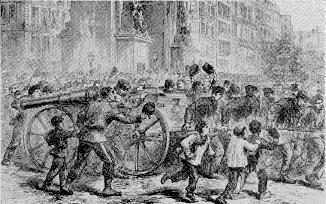
On the 18th of March 1871 the people of Paris awoke to find a hostile army had seized the heights of Montmartre, they captured and killed several guardsmen and were busy trying to seize the cannons on the heights and thus disarm the defences of the city. The army was lead by a General who was known to have carried out massacres in French cities under his control. Of course this wasn't the triumphant Prussians, they were the French army lead by General Clément-Thomas and the massacres he was infamous for happened in Paris in 1848.
Alarmed the workers of the Montmartre district -many of whom were women and children not exactly typical acolytes of radical political insurrectionist cells- rose up with what weapons they could muster and attacked this threat. Fortunately the rank and file of this army refused the orders to fire and the opposition collapsed. The Generals Clément-Thomas and Lacomte who had ordered his troops to fire on the workers of Montmartre were executed instead.
The revolt spread from Montmarte, the National Guard threw its support behind it and the standing army left in Paris either fled or surrendered, soon a demonstrators and guardsmen had occupied the abandoned government buildings and the Commune was declared. While its possible that Bakunin and Blanqui and Marx and Proudhon et al may have inspired some Parisian workers before hand there is no escaping the simple fact that the insurrection was an act of defence against an already hostile and murderous regime. No one lead the workers of Montmartre on the 18th of March they discovered a threat and defended themselves, and in the process toppled what was left of the government. The only conspiracy was the secret plans by the French General Staff to reinforce their hold on Paris. It caught everyone by surprise. The quote at the top comes from the socialist Benoit Malon, who was in Paris at the time and would serve on the Commune Council.
The IWMA the organisation that included Marx and Bakunin and their supporters in Paris, was caught so unaware by the events that the first official comments by the organisation were made on the 23rd five days later.
Funnily enough what the user Jehu, is doing is just what the reactionary press did to Marx in the aftermath of the Commune. He was repeatedly accused of planning an insurrection and of being responsible for the damage and bloodshed that followed. He responded to these allegations in an interview with a reporter from the New York World.
I: And the last uprising in Paris? Dr. Marx: First of all I would
ask you to prove that there was any kind of a conspiracy and that
everything which occurred was not simply the inevitable result of the
existing circumstances. And even if we assume that there was a
conspiracy, I would still ask you to prove to me that the International
Association took part in it.
I: The presence of so many members of the Association in the Commune.
Dr. Marx: Then it could just as
easily have been a conspiracy of Freemasons, for their individual part
in it was not small by any means. I really would not be surprised if the
Pope did try to push the whole uprising onto their account. But let us
try to find another explanation. The uprising in Paris was carried out
by the Parisian workers. The most capable workers must therefore have
been the ones who led it and carried it out; yet the most capable
workers are also members of the International Association. But
nevertheless, the Association need not be responsible for their actions
in any way.
I: The world will look at it
through different eyes. People are talking about secret instructions
from London and even about financial assistance.Can it be maintained
that the allegedly open activity of the Association rules out any secret
communications?
Dr. Marx: Has there ever been
an association which carried out its work without having confidential as
well as open communications? But to speak of secret instructions from
London as if it were a question of decrees in questions of belief and
morals, emanating from some centre of papal rule and intrigue, would be
to completely misunderstand the nature of the International. This would
presuppose a centralised form of government in the International; in
reality, however, the organizational form of the International gives the
greatest scope to the working class; it is more of a union or an
association than a centre of command.
The allegation of a conspiracy regardless of alleged mastermind is just a form of red baiting, by blaming internal dissent on outside agitators. So we should be very wary of those who use this tactic especially when corroborating evidence is not forthcoming.
Conclusion
Does this matter outside of this narrow subject? I would say yes, what the press of the 1870's and Jehu are doing is a form of guilt by association to discredit a view or tendency they don't like. You may think its a bit silly comparing an international press to one user on twitter and I agree, but like I said at the beginning this is just one example of very common practice in discourse. Its not really the size of the influence or even the subject at hand, I just picked this one because I know a lot about the Paris Commune so its easy for me to show the problems with it here.
This practice when used actively strangles debate and education. It actively spreads disinformation and makes it harder to learn lessons from the past. This doesn't help anyone at all. Even if you hate Marx or Bakunin or just disapprove of insurrection in general this tactic doesn't help you, you don't learn anything much about either you just get some emotional reassurance.

 Posts
Posts


.jpeg)


