Search This Blog

Showing posts with label USSR. Show all posts

Sunday, 14 December 2025

Anarĥiismo (A. Borovoj) - Anarchism


"No social ideal, from the point of view of anarchism, could be referred to as absolute in a sense that supposes it’s the crown of human wisdom, the end of social and ethical quest of man." Alexei Borovoj Anarchism, 1918.

Alexei Borovoi was a Russian Anarchist, teacher and writer. Born in 1875 he spent much of his life articulating an individualist anarchism and giving lectures on anarchist thought. During the Russian Revolution he remained active and was a founding member of the Unions of of Workers of Intellectual Labour, a union for doctors and teachers and the Union of Ideological Propaganda of Anarchism a group whose purpose was the spreading of Anarchist ideas. He edited both organisations newspapers.

The Bolsheviks shut both organisations down, Borovoi continued to teach until 1922 when he was stripped of his professorship and banned from teaching. In 1929 he was arrested and exiled to Vyaltka, he spent the last years of his life in minor clerical posts. He died in 1935. 

In his time Borovoi was a very popular figure in Russia, university students lodged a mass petition for an intellectual debate on Anarchism vs Marxism with Borovoi representing the Anarchists, while Bhukarin and Lunarchasky were to be his opposition. The debates never happened though as the Bolshevik central government cancelled them. Unfortunately in our present time and Anglocentric world Borovoi is an obscure figure, there are only scraps of information about him, the Esperanto wikipedia has more information than then the English language entry, and I can find just one short piece by him on the Anarchist library, Anarchism and Law, so I hope translation of this short piece (not to be confused with the book of the same name) will help correct that in a small way.

Anarĥiismo (A. Borovoj)

Anarchism by A. Borovoj.


Is there in the sphere of modern socio-politics and ideas an idea as indefinite, contradictory and at the same time exciting to all, as anarchism? 

Here, full of irresistible attraction, here full of terror and disgust, the synonym of perfect harmony and fraternal unity, the symbol of the destruction of faith and fratricidal infighting, the triumph of freedom and justice, the feast of unbridled passions and arbitrariness, anarchism stands as a great enigma, stirring by its name immense feats of human love and explosions of obscure [2] vile passions, all are called the same.

And anarchism, affirming freedom, fighting against any form of despotism, regardless of the mask it hides behind, cannot but rise up against the excessive distortions of it, against the identification of revolutionary creation with the destruction of faith, of anarchic rebellion with the abominable dance of savages. Where do these arbitrary contradictory understandings of anarchism come from?

1-e. No socio-political thought can fit neatly into ready-made, finished formulas. Life is so full, elastic, and versatile that no dogma can forge chains can forge chains to restrain freedom of expression for long. It elementally outgrows the most fearless inventions of the wise, it puts aside the experienced, the old, buries the laws and theories, disregarding their logical harmony and the perfection of their constructions.

2-e. Despite the general conviction, the socio-political vivid idea is not so much the fruit of abstract speculations, the truth obtained through "reason", as the object of belief, conditioned by the profound originality of an individual.

In every human being, and the richer the individuality, the more strongly it manifests itself as an ever-living tendency towards the acceptance and understanding of definite truths. It may be modified according to time and place, environment, fashion, but the psychophysical originality of the individuality is its main source. Not expressed in terms of logic, it stands behind external argumentation and it decides the matter.

 The citizen of modern cultural society can freely, handily, draw from the rich treasury of human thought. Various worldviews, hostile and close to each other, are equally presented with great brilliance and talent, and despite all this, in addition to the external, obvious for all reasons, there are the internal, inconsiderable, powerfully drawing us to the acceptance and confession of one truth and to the equally passionate denial of the other. Never before has one religious teaching, one philosophical system, one socio-political institution united all people. This is impossible and unnecessary. Namely, this absence in humanity of one faith is the best evidence of the multifaceted nature of human nature and at the same time - the hopelessness of the claims of an individual, party, class, state, nation, to say - the whole truth.

 3-e. Anarchism has not yet had historical experience. One can speak of the history of anarchist thought, of the history of anarchist groups, communities, and individual attempts, but it is premature to speak of the social experience of anarchism. Conservatism and liberalism, as forms of socio-political thought, have deep living roots.

 They were not born of the cabinet meditations of scientists, nor of the disputes of progressive circles, but of real life interests. From the stage of separate attempts they had long since passed into the form of practical experience, had defined the politics of classes, had more than once taken the destinies of nations into their own hands; in a word, they had a long and complicated history.

 In the last half of the 19th century we can already speak not only of socialist vision, but also of socialist practice. The theoretical demands of Socialism began to be embodied in the real politics of the proletariat. And now we already have extensive socialist experience, because under the banner of socialism the ranks of modern workers' parties are being founded.

 Anarchism was not yet a real policy.
Separate pages of the International, small circles, colonies of intellectuals and some facts from the history of the workers' and especially peasant movement, that is all that can be called a particularly anarchist experience. The traditional aversion to "organization" and "collective discipline" has slowed down anarchism from playing a significant role in the development of the workers' movement. Anarcho-syndicalism is the phenomenon of recent years and in the history of anarchism it has opened a completely new page.

 4-e. Finally, one must pay attention to the abnormality, both of anarchist thinking itself, and of anarchist behavior. The socio-political philosophy of liberalism and socialism is based on the experience of a defined legality. The birth and development of class consciousness for them are the results of defined historical premises.

 On the contrary, anarchism, despite the proclamations of its leaders - Bakunin, Kropotkin and others - has always been outside historicism, being in its sociological concepts a methodology inherited from the rationalist teachings about "natural man", "state of nature", "natural law". In its assertions, society did not have an independent existence; it is a mechanical aggregate of free, self-defining "individuals".

 Anarchism was not and until recently did not claim to be the philosophy of any class. It was a philosophy of the creatively self-defining individual. It knew no formulas that bound the individual, acknowledging for everyone the unrestricted right of criticism.

 Hence the boundless diversity of statements of particular shades, currents in anarchism or even of particular anarchists, which with difficulty allows us to establish at least general lines of the worldview common to all of them.
But as for the "rules" of conduct, in fact, up to now there have been and are absent.
These are the general causes that have slowed down and that still continue to slow down the recognition of the nature of anarchism and the establishment of its constitutional recognitions.

Alexei Borovi 1924. 


Anarĥiismo
De A. Borovoj [1]

Ĉu estas en la sfero de l’modernaj socie-politikaj kaj ideoj ideo tiom nedifinita, kontraŭdireca kaj samtempe ĉiujn emociiganta, kiel anarĥiismo ?
Jen plena de nekontraŭstarebla allogo, jen plena de teruro kaj abomeno, la sinonimo de l’perfekta harmonio kaj frata unuiĝo, la simbolo de fi-detruado kaj fratmortiga batalado, triumfo de libereco kaj justeco, festenado de senbridigitaj pasioj kaj arbitreco, la anarĥiismo staras kiel granda enigmo agitanta kaj per ĝia nomo oni samnomas grandegajn heroaĵojn de homamo kaj eksplodojn de obskuraj [2] malnoblaj pasioj.
Kaj anarĥiismo konfirmanta la liberecon, batalanta kontraŭ iu ajn formo de despotismo, sin ŝirmanta per iu ajn masko, ne povas ne ekstari kontraŭ troegaj kripligoj de ĝi, kontraŭ samsencigo de l’revolucia kreado kun fi-detruado, de l’anarĥia ribeleco kun abomenega dancado de sovaĝuloj.
De kio devenas tiuj arbitraj kontraŭdiraj komprenadoj de anarĥiismo ?
1-e. Ĉiu socie-politika penso ne enmetiĝas tutece en la pretajn, finitajn formulojn. La vivo estas tiel plena, elasta, diversflanka, ke neniuj dogmaj katenoj povas kunforĝi por-longe la liberecon de ĝiaj celadoj. Elementece ĝi superkreskas la plej maltimajn elpensaĵojn de l’saĝeguloj, ĝi demetas la travivitaĵon, la malnovan, entombigas la leĝojn kaj teoriojn, malatentante ilian logikan harmonieco kaj perfektecon de iliaj konstruoj.
2-e. Spite la ĝenerala konvinko, la socie-politika vividearo estas ne tiom la frukto de l’abstraktaj spekulativoj, la vero, akirita per « racio », kion la objekto de l’ kredo, kondiĉata de l’profunda originaleco de individuo.

En ĉiu hom-estaĵo, kaj ju pli riĉa estas individueco, per des pli granda forto tio montriĝas ĉiam vivas emiĝo al la akcepto kaj kompreno de l’difinitaj veroj. Ĝi povas esti modifata laŭ la tempo kaj loko, medio, modo, sed psikofizika originalec’ de l’ individueco, estas ĝia ĉefa fonto. Ne esprimata en la terminoj de l’ logiko ĝi staras post la ekstera argumentado kaj ĝi decidas la aferon.
La civitano de l’ kultura socio moderna povas libere, plenmane ĉerpi el la riĉegaj trezorujoj de l’homa penso. Diversaj mondkomprenoj, malamikaj kaj proksimaj unu de alia estas egale prezentitaj kun granda brilo kaj talento kaj malgraŭ ĉio-ĉi, krom la eksteraj, evidentaj por ĉiuj kaŭzoj, estas la internaj, neprikonsidereblaj, potence nin tirantaj al la akcepto kaj konfeso de unu vero kaj al la same pasia malkonfeso de l’alia. Ankoraŭ neniam, unu religia instruo, unu filozofia sistemo, unu socie-politika institucio kunigis ĉiujn homojn. Tio estas neebla kaj malbezona. Nome tiu-ĉi malesto en la homaro de unu kredo estas la plej bona atestilo de multfaceteco de l’homnaturo kaj kune -senespereco de l’pretendoj de individuo, partio, klaso, ŝtato, nacio, diri- la tutan veron.
3-e. Anarĥiismo ankoraŭ ne havis historian sperton. Oni povas paroli pri historio de l’anarĥia penso, pri historio de l’anarĥiaj grupoj, kolonioj, apartaj ekprovoj, sed pri socia sperto de anarĥiismo paroli estas antaŭtempe. La konservatismo kaj liberalismo, kiel formoj de l’socie-politika pensado, havas profundajn vivajn radikojn.
Ne kabineta meditado de scienculoj, ne disputoj de l’progresemaj rondoj ilin naskis, sed realaj vivinteresoj. El stado de l’apartaj ekprovoj ili jam delonge transiris en la formon de praktika spertado, difinis la politikon de klasoj, ne unufoje prenis en siajn manojn la sortojn de l’nacioj ; unuvorte havis longan implikitan historion.
En lasta duono de 19a jarcento ni jam povas paroli ne nur pri socialisma vididearo, sed ankaŭ pri socialisma praktiko. La teoriaj postulaĵoj de Socialismo komencis enkorpiĝi en la reala politiko de l’ proletariaro. Kaj nun ni jam havas grandan socialisman spertadon, ĉar sub flago de socialismo fondiĝas la vico de l’modernaj laboristaj partioj.
Anarĥiismo ankoraŭ ne estis reala politiko.
Apartaj paĝoj de Internacio, rondetoj, inteligentulaj kolonioj kaj iuj faktoj el la historio de laborista kaj precipe kamparana movado, jen ĉio, kion oni povas nomi precipe anarĥiisma spertado. La tradicia abomenado al la « organiziteco » kaj « kolektiva disciplino » malakcelis al la anarĥiismo ludi iom atentindan rolon en la disvolviĝo de laborista movado. La Anarĥii-sindikalismo estas la fenomeno de lastaj jaroj kaj en la historio de l’anarĥiismo ĝi malfermis tute novan paĝon.
4-e. Fine, oni devas atenti la malnormalecon, kiel de l’anarĥiista pensado mem, tiel de l’anarĥiista konduto. La socie-politika filozofio de l’liberalismo kaj socialismo baziĝas sur la konfeso de l’difinita laŭleĝeco. La naskiĝo kaj disvolviĝo de l’klaskonscio por ili estas rezultaĵoj de l’difinitaj historiaj premisoj.


Male, la anarĥiismo eĉ malgraŭ la proklamoj de ĝiaj gvidantoj -BakuninKropotkin kaj aliaj- ĉiam estis ekster historiismo, estante en siaj sociologiaj konceptoj metodologia heredanto de l’racionalismaj instruoj pri « natura homo », « natura stato », « natura juro ». En ĝiaj asertoj la socio ne havis memstaran ekzistadon ; ĝi estas mekanika agregato de liberaj, sindifinantaj « individuoj ».
La anarĥiismo ne estis kaj ĝis lasta tempo ne pretendis esti la filozofio de iu klaso. Ĝi estis filozofio de l’kreece sindifinanta individuo. Ĝi ne sciis devigantajn la individuon formulojn, konfesante por ĉiu neniel limigitan rajton de kritiko.
Pro tio estas tiu senlima diverseco de l’deklaroj de apartaj nuancoj, fluoj en la anarfiiismo aŭ eĉ de apartaj anarfiiistoj, kiu kun la penego lasas starigi kvankam ĝeneralajn liniojn de l’komuna por ĉiuj ili mondpririgardo.
Sed koncerne la « regulojn » de l’konduto, fakte ĝis nun tiuj ne estis kaj malestas.
Jen la ĝeneralaj kaŭzoj malakcelintaj kaj kiuj ankoraŭ daŭras malakceli la ekkonon de l’naturo de anarĥiismo kaj starigon de ĝiaj konstituciaj rekonigiloj.

Tradukis el rusa lingo A. Pikilhavski (2333).
Sennacieca Revuo n° 4 (45) Januaro 1924, p. 9.


Saturday, 15 March 2025

Through a Glass Rosily


Through a Glass Rosily

by George Orwell, Tribune, 23 November 1945

The recent article by Tribune’s Vienna correspondent[1] provoked a spate of angry letters which, besides calling him a fool and a liar and making other charges of what one might call a routine nature, also carried the very serious implication that he ought to have kept silent even if he knew that he was speaking the truth. He himself made a brief answer in Tribune, but the question involved is so important that it is worth discussing it at greater length.

Whenever A and B are in opposition to one another, anyone who attacks or criticises A is accused of aiding and abetting B. And it is often true, objectively and on a short-term analysis, that he is making things easier for B. Therefore, say the supporters of A, shut up and don’t criticise: or at least criticise “constructively”, which in practice always means favourably. And from this it is only a short step to arguing that the suppression and distortion of known facts is the highest duty of a journalist.

Now, if one divides the world into A and B and assumes that A represents progress and B reaction, it is just arguable that no fact detrimental to A ought ever to be revealed. But before making this claim one ought to realise where it leads. What do we mean by reaction? I suppose it would be agreed that Nazi Germany represented reaction in its worst form or one of its worst. Well, the people in this country who gave most ammunition to the Nazi propagandists during the war are exactly the ones who tell us that it is “objectively” pro-Fascist to criticise the USSR. I am not referring to the Communists during their anti-war phase: I am referring to the Left as a whole. By and large, the Nazi radio got more material from the British left-wing press than from that of the Right. And it could hardly be otherwise, for it is chiefly in the left-wing press that serious criticism of British institutions is to be found. Every revelation about slums or social inequality, every attack on the leaders of the Tory Party, every denunciation of British imperialism, was a gift for Goebbels. And not necessarily a worthless gift, for German propaganda about “British plutocracy” had considerable effect in neutral countries, especially in the earlier part of the war.

Here are two examples of the kind of source from which the Axis propagandists were liable to take their material. The Japanese, in one of their English-speaking magazines in China, serialised Briffault’s Decline and Fall of the British Empire. Briffault, if not actually a Communist, was vehemently pro-Soviet, and the book incidentally contained some cracks at the Japanese themselves; but from the Japanese point of view this didn’t matter, since the main tendency of the book was anti-British. About the same time the German radio broadcast shortened versions of books which they considered damaging to British prestige. Among others they broadcast E.M. Forster’s A Passage to India. And so far as I know they didn’t even have to resort to dishonest quotation. Just because the book was essentially truthful, it could be made to serve the purposes of Fascist propaganda. According to Blake,

A truth that’s told with bad intent
Beats all the lies you can invent,

and anyone who has seen his own statements coming back at him on the Axis radio will feel the force of this. Indeed, anyone who has ever written in defence of unpopular causes or been the witness of events which are likely to cause controversy, knows the fearful temptation to distort or suppress the facts, simply because any honest statement will contain revelations which can be made use of by unscrupulous opponents. But what one has to consider are the long-term effects. In the long run, can the cause of progress be served by lies, or can it not? The readers who attacked Tribune’s Vienna correspondent so violently accused him of untruthfulness, but they also seemed to imply that the facts he brought forward ought not to be published even if true. 100, 000 rape cases in Vienna are not a good advertisement for the Soviet regime: therefore, even if they have happened, don’t mention them. Anglo-Russian relations are more likely to prosper if inconvenient facts are kept dark.

The trouble is that if you lie to people, their reaction is all the more violent when the truth leaks out, as it is apt to do in the end. Here is an example of untruthful propaganda coming home to roost. Many English people of goodwill draw from the left-wing press an unduly favourable picture of the Indian Congress Party. They not only believe it to be in the right (as it is), but are also apt to imagine that it is a sort of left-wing organisation with democratic and internationalist aims. Such people, if they are suddenly confronted with an actual, flesh-and-blood Indian Nationalist, are liable to recoil into the attitudes of a Blimp. I have seen this happen a number of times. And it is the same with pro-Soviet propaganda. Those who have swallowed it whole are always in danger of a sudden revulsion in which they may reject the whole idea of Socialism. In this and other ways I should say that the net effect of Communist and near-Communist propaganda has been simply to retard the cause of Socialism, though it may have temporarily aided Russian foreign policy.

There are always the most excellent, high-minded reasons for concealing the truth, and these reasons are brought forward in almost the same words by supporters of the most diverse causes. I have had writings of my own kept out of print because it was feared that the Russians would not like them, and I have had others kept out of print because they attacked British imperialism and might be quoted by anti-British Americans. We are told now that any frank criticism of the Stalin regime will “increase Russian suspicions”, but it is only seven years since we were being told (in some cases by the same newspapers) that frank criticism of the Nazi regime would increase Hitler’s suspicions. As late as 1941, some of the Catholic papers declared that the presence of Labour Ministers in the British Government increased Franco’s suspicions and made him incline more towards the Axis. Looking back, it is possible to see that if only the British and American peoples had grasped in 1933 or thereabouts what Hitler stood for, war might have been averted. Similarly, the first step towards decent Anglo-Russian relations is the dropping of illusions. In principle most people would agree to this: but the dropping of illusions means the publication of facts, and facts are apt to be unpleasant.

The whole argument that one mustn’t speak plainly because it “plays into the hands of” this or that sinister influence is dishonest, in the sense that people only use it when it suits them. As I have pointed out, those who are most concerned about playing into the hands of the Tories were least concerned about playing into the hands of the Nazis. The Catholics who said “Don’t offend Franco because it helps Hitler” had been more or less consciously helping Hitler for years beforehand. Beneath this argument there always lies the intention to do propaganda for some single sectional interest, and to browbeat critics into silence by telling them that they are “objectively” reactionary. It is a tempting manœuvre, and I have used it myself more than once, but it is dishonest. I think one is less likely to use it if one remembers that the advantages of a lie are always short-lived. So often it seems a positive duty to suppress or colour the facts! And yet genuine progress can only happen through increasing enlightenment, which means the continuous destruction of myths.

Meanwhile, there is a curious backhanded tribute to the values of liberalism in the fact that the opponents of free speech write letters to Tribune at all. “Don’t criticise,” such people are in effect saying: “don’t reveal inconvenient facts. Don’t play into the hands of the enemy!” Yet they themselves are attacking Tribune’s policy with all the violence at their command. Does it not occur to them that if the principles they advocate were put into practice, their letters would never get printed?

[footnote 1]: When Tribune's Vienna correspondent had reported the appalling conditions in the city and, quite truthfully, described the monstrous behaviour of some of the Russian occupying troops, several readers protested against what they called “this slander” on the Red army.

Thursday, 6 March 2025

News from Zengakuren


ZENGAKUREN, the All-Japan Federation of Autonomous Student Bodies is a mass revolutionary organisation, with a militant tradition of struggle against American Imperialism and the Japanese ruling class. In 1960, it organised strikes and continuous demonstrations, in which many were wounded, outside the Tokyo Diet, against the Ratification of the Japanese – US Security Treaty. These reached such an intensity that the US Government thought it advisable to cancel a proposed Eisenhower visit to Japan.


The Zengakuren have recently called for the establishment of an anti-war International. They are supported in this by the Committee of 100, the Student Peace Union in the US, the Socialist Students Organization of West Germany and many other organizations opposed to both American and Russian tests. On August 17, 1962, representatives of the Zengakuren, including Nemoto, their President, attended the Leningrad Conference of the International Union of Students. On their way, they had demonstrated in Red Square against all nuclear tests. They had been arrested, then released and `closely watched during the remainder of their stay`.


We publish below an extract from Zengakuren Information Bulletin No.3, describing their discussions with representatives of the Soviet Student Council (SSC):


Soviet Student Council (SSC): Are you fighting against the nuclear testing of any nation other than the USSR? Do you realize that the Soviet Union is not the first country to engage in nuclear tests?


Zengakuren: We are engaged in a militant mass struggle against American nuclear tests. Our slogan in this struggle is, `Against tests of USA and USSR`. We oppose any nuclear activity by any country, be it England, France or China. Of course, we are fighting against the nuclear armament of Japan. You who sponsor the I.U.S. Congress should have known such a well-known fact.


SSC: Granted, but what country began the first nuclear tests and how many times were such tests carried out before the Soviet Union began?


Zengakuren: That is of no consequence. We accuse all countries engaged in testing of promoting the arms race and of suppressing the working class and people.


SSC: We are glad to hear that you oppose the American nuclear tests and can appreciate your stand against these tests. We lost millions of lives in World War II. This tragedy was due to the fact that our military forces were weaker than those of the Fascists. We do not want to be the second Hiroshima. If during the war Japan had had nuclear weapons at their disposal, the tragedy of Hiroshima would not have occurred.


Zengakuren: We oppose your dangerous view. According to your logic, you encourage the Japanese Imperialists to arm themselves with nuclear weapons. Do you really think that this is an effective way to stop the nuclear race and to prevent nuclear war?


SSC: The best way to prevent war is obviously total disarmament, but the next best procedure is to continue Soviet nuclear tests.


Zengakuren: Your policy, based on such a philosophy, wields an immeasurably harmful influence on the anti-war struggle of the working class. Do you know the slogan that is being used in Tokyo, New York and London to fight N-tests? `Against tests by the US and USSR`. These students and workers attempt to obtain peace not with nuclear weapons but by their own struggles.


SSC: You believe that if the Soviet Union stopped its tests, the working class movement would increase in strength and the imperialists’ tests would stop. We cannot be sure of such an outcome.


Zengakuren: Are you suggesting that the workers of the world stop their struggles and support Soviet testing? By holding such a view, you cause dissension among the workers of the world and make them oppose each other. The workers must unite. Soviet nuclear testing does not support peace. It provides America with an excuse to continue their tests and intensify the arms race. Any nuclear testing suppresses the workers of the world and subjects them to the domination of the ruling class. Aren’t you yourselves the slaves of nuclear weapons?

SSC: We can appreciate your point of view, but we are of totally different opinions.


Zengakuren: The justice of our views will be borne out by the continuation of the world-wide struggle against N-tests.


SSC: Your opinion sounds quite sincere; continue your work as you like, but don’t forget that you are in the USSR now.


Saturday, 8 February 2025

AGAINST ALL BOMBS by Ken Weller


Text of a leaflet distributed in Moscow by supporters of the Committee of 100


AGAINST ALL BOMBS


The campaign in Britain against nuclear weapons is beginning to turn towards the working class. As it does so, it will create an increasing challenge to the capitalist state.


This marks a development both in the activities and in the consciousness of the Campaign. It is a genuine turn to the masses of ordinary workers, not the bureaucracies of the Labour and Trade Union movements. Already, as a result of this emphasis, we have seen the beginnings of industrial action against the bomb. Workers directly involved have refused to handle nuclear cargoes. Others have held token strikes.


THE BOMB IN CLASS SOCIETY


More and more people in the campaign are seeing the deeper implications of working class action against the bomb. The class which dominates production controls society. It decides policy and, despite the democratic facade, enforces it through its state apparatus. Until the ordinary people are free in production, they cannot have any effective say in the decisions of war and peace, life and death. Only a society with inhuman relations in production could produce these monstrous weapons.


But the USSR has the same monstrous weapons. Should this not be different if your society is fundamentally different from ours? We know the means of production are nationalised. But Marx himself insisted that it is the `relations of production` (the relations between men and men at work) which determine the class nature of society1. The property relations might reflect these relations of production or might serve to mask them.


THE RUSSIAN REVOLUTION


What has happened to your Revolution that your leaders should threaten the workers of other lands with these weapons? What has happened to the internationalist ideals of October?


The Revolution made sweeping changes in the property relations. But it did not solve the central contradiction of class society, that between rulers and ruled in production.


It was never the policy of the Bolsheviks to allow the workers to take over power in production itself. In 1921 Lenin wrote: `It is absolutely essential that all authority in the factories should be concentrated in the hands of management. Under these circumstances, any direct intervention by trade unions in the management of enterprises should be regarded as positively harmful and impermissible`. This typifies the whole ideology and practice of the Party in this period. Here were the roots of Stalinism.


From this viewpoint, the USSR has essentially the same relations of production as Britain or America. The Russian worker has to get up in the morning when the alarm clock rings. The time is not of his choosing. Someone else has decided what he shall produce, how much, and at what cost to himself. Has he chosen to have Sputniks rather than butter?


Both and East and West management makes all the plans, and seeks to reduce the worker to a standard unit in them. It consciously removes variety and decision making from his job, and subjects him to the ruthless tempo of machines. In Marxist terms, he is alienated. And any opposition to this system brings him up against the forces of the State, which, again, are beyond his control.


Is this a State that is `beginning to whither away from the moment of Revolution`? Or is it a kernel of the Socialist programme that has withered away?


INTERNATIONAL ACTION


In Britain our protests bring us up against our State forces too. When a mass demonstration tried to immobilise a NATO base at Wethersfield last December, six of our members were gaoled for long periods. Many others have been arrested on similar demonstrations.


We have also protested against the Russian H-tests, which threaten workers all over the world with `socialist` leukaemia. Our bourgeois police have protected your Embassy against us, and arrested hundreds of demonstrators.


Our struggle is the struggle for new relationships in production and in society. Both East and West, privileged protected by their State machines manage production and parcel out the social product. They try to protect these privileges against their greedy neighbours.


That is what the H-bomb defends. But workers gain nothing by assisting in protecting their own rulers against others. We must have faith only in ourselves, in our ability to transform society. We extend our hands in solidarity with the working people of Russia, over the heads of our rulers and yours. We have already taken up this struggle: it is yours too. Together we must ACT – OR WE SHALL PERISH TOGETHER.


WORKERS OF THE WORLD UNITE!


The Committee of 100 exists to organise mass civil disobedience and resistance against the production, testing and threatened use of nuclear weapons. Its basis is in rank-and-file action, not in politicians’ manoeuvres.


Its Industrial Sub-Committee seeks to develop these ideas among ordinary workers. Its first leaflet stated: `Workers make the weapons of mass destruction, transport them, handle them, install them. They supply and equip those who use them. When they no longer accept to do so, the politicians will have to fight their own wars`.


The Sub-Committee is composed of workers in the Docks, in road and rail transport, and in the Engineering, Building and Printing industries.


Published on behalf of the Industrial Sub-Committee of the London Committee of 100, by Ken Weller (Engineering Shop Steward), 37, Queens Mansions, North Road, London N.7


THAT LEAFLET


`Solidarity` feels the full text of the leaflet distributed (in Russian) at the recent World Disarmament Congress in Moscow, should go on record, in view of the widespread repercussions (and deliberate lies) it has evoked.


The following notes are based on a report by Dave Picton, one of the members of the London Committee of 100, who took the leaflets to Moscow.


On July 10, two of us gave out the first batch of leaflets in Gorky Street. They were taken eagerly and folded away in inside pockets…. Because of the litter laws. After we had distributed quite a number we were stopped by three `volunteer auxiliary militia`, who only became friendly after a passer-by that we were Congress delegates. The first (administrative) reflex had been to arrest us. The second (equally administrative) reflex had been to be friendly to an official foreign delegation. Obviously a dialectical contradiction. Neither reflex was related to the content of what we were distributing. That kind of response only took place later, at a higher level.


We also distributed the leaflet at a factory gate. It was an engineering works, in the suburbs. We distributed as the workers were returning from dinner break. The leaflets were again all taken and pocketed.


We also distributed the leaflet through letter boxes in a nearby block of workers’ flats. A second `block of flats` we entered turned out to be a police station. We decided not to stay.


Certain members of the British delegation became quite hostile after reading the leaflet. Late one night, one of the delegates found a woman in his room. His opinion of the Conference Arrangements Committee soared… till he found she was English – and that she was tearing up his leaflets. `Any method is justified against you people!`, she claimed. Unfortunately for her she had found the wrong leaflet.


The Chairman of the Soviet Peace Committee (Mr. Korneichuk) at one point asked for an assurance that the leaflets would no longer be distributed, despite an earlier agreement that we could put our case by any means we chose.


`The Guardian` gave the best coverage. A front-page article titled `Heresy in Moscow` by Victor Zorza (12.7.62) quoted nearly all of the text which it called `the most direct challenge to official Soviet policies and ideas to have been presented to the Soviet man in the street since freedom of speech died under Stalin`. The article referred with glee to the `blasphemy of blaming Lenin, the best refuge of the reformed Khruschevites, for ideas Stalin put into practice`.


In general the Press reports on the leafleting and on the demonstration in Red Square were remarkably sympathetic. Only Peter Simple, in the `Daily Telegraph` (13.7.62) objected to a `direct incitement to revolution in the Communist world`. He believed that `a campaign of illegal opposition to one government, on one issue, was being exploited by those who want to organise illegal opposition to all governments, on all issues. The anarchist face of the CND is beginning to show`.


This enthusiasm for the Committee’s activities in Moscow was only matched by the same newspapers’ hostility to the Committee’s activities in England. This discrepency was quickly pointed out by `The Daily Worker` (16.7.62), by Arnold Kettle in a letter to `The Guardian`(20.7.62), etc.,etc. There was however another side to this particular coin. Committee of 100 demonstrations in this country have been praised to the skies by the Soviet Press and Radio. The `The Daily Worker` had also offered encouragements, from a safe distance. But now `Pravda` (18.7.62) screamed at the `people who act like thieves`, the `smart Alecks` who discussed `offensive subjects` and `thrust provocative, slanderous, leaflets` at passers-by. And the `Daily Worker` had hysterics about the `insulting, anti-socialist diatribe` and `the distribution of such outrageous lies` by an `irresponsible group`. Readers of both papers had to contain their curiosity about the nature of the lies so violently denounced. Not a line, not a single word of the leaflet was quoted.


During the Congress the text of the leaflet was beamed into Russia in twelve different Soviet languages. Many journals of the socialist and peace movement quoted it extensively. The full text has been republished and circulated by various organisations, including an (intendedly!) private employers’ information service. It has been translated and distributed in France and circulated in Japanese by members of the Zengakuren2. Copies have gone to Australia, Belgium, Bolivia, Canada, Denmark, Germany, Ireland, Italy and other countries. At least 3 batches have been used in different parts of Yugoslavia. In Helsinki, at the `World Youth Congress`, there was a punch-up on the distributors of the leaflets by members of the Rumanian delegation. Zengakuren representatives, including their President, Itoshi Nemoto, later demonstrated in Red Square, on August 6. Their bulletin No.3 (September ‘62) states this was `inspired by the activities of the Committee 100` and was `our first attempt to appeal to and unite with the workers and people of the USSR`. They attempted to distribute leaflets and were `beaten and dragged behind the Lenin mausoleum, and detained there for an hour`.


1`The sum total of the relations of production constitutes the economic structure of society, the real foundation on which arise legal and political superstructures`. K. Marx and F. Engels, Collected Works, vol.13, p. 6-7, Moscow 1959.

2All-Japan Federation of Autonomous Student Bodies.

Thursday, 13 June 2024

The Weakest Defence of Leon Trotsky I can muster


Daily Mail 1925, Trotsky returns to work in the Communist Party
 

I don't care for Leon Trotsky, I don't agree with his ideas, I don't care for his writing, and the anecdotes of him as a person leave me unmoved. I certainly don't approve of his tenure in government*. Nevertheless, Leon Trotsky is blessed in that many of his critics are some of the worst people around and their arguments are just awful. This includes the antisemites who peddled anti-Jewish conspiracies, but I'm mainly talking about his most vocal critics, the Stalinists and their offspring. 

While he was still alive, Trotsky and his apostles were libelled heavily in the Moscow affiliated press and this legacy has evolved to the present where Leon Trotsky the man might as well be a fictional character, a mythological dragon that must be slain by the virtuous Knight on his quest to saving the Kingdom from calamity.

People just make up any bad thing about him. My stance is why bother? Leon Trotsky the real person had plenty of evidence for his condemnation, but I'm in danger of wandering from my point. I'm not particularly interested in defending Trotsky, his open defenders are just as bad as his Stalinist accusers. Unfortunately, The false staining of Trotsky sets a precedent, if they can get away with making up crimes and accusations with Trotsky who is both comparatively well-known, well-documented and in some small circles well liked, then the many other revolutionaries of the period who weren't so fortunate have no chance of being taken as they were.

An artists impression of the "Merciless retribution" Trotsky ordered in Astrakhan and elsewhere.


Outsiders are often puzzled by the sheer volume of hatred thrown Trotsky's way, how could one man deserve a brutal murder and decades of teeth-gnashing? For Stalin and his offspring, Trotsky became a sort of Anti-Christ figure, he opposed the correct teachings (usually scoffing over utopian idealistic world revolution) and the correct leader (Stalin and occasionally Lenin when the accuser has read a few approved histories of the Communist Party of the Soviet Union) and as such he became the number 1 enemy. In the 1930s, Trotsky was denounced as a spy for the Nazi party and the small cluster of Trot parties were publicly denounced as "Trostky-Fascists". This line would be used in 1937 in Spain to justify the fratricidal campaign of extermination against the P.O.U.M. who were neither Fascist collaborators nor even Trotskyists, Trotsky had little to do with that party and what few followers in Spain he did have belonged to much smaller groups such as the Bolshevik-Leninists. 

The witchhunt against the POUMists was carried out in order to show that both inside and outside Russia the friends of Trotsky, Zinoviev, Kamenev, Bukharin, etc. were a gang of counterrevolutionaries, agents of fascism, enemies of the people, and traitors to the fatherland, who had to be shot in whatever country or region. And also in order that the suspicious should put aside their objections. It was not Stalin’s personal phobia that caused the extermination of the old guard – the case of Spain proved it. Here, in a democratic country, ruled by a Popular Front, here too they were being unmasked and executed as traitors. I grasped the political ‘motive’ easily. What I didn’t imagine – I was not long in finding out – was the criminal lengths to which the GPU’s henchmen were capable of going in the struggle against the men of the ideological opposition.

How the NKVD framed the POUM.

And the sad truth is that the false accusations instead of weakening as our access to sources improves, it seems to have got worse. I now see self-declared "Marxist-Leninist Revolutionaries" and "Maoist Cadre" repeat total fables that even the gutter red press didn't stoop to. Many seem to have genuinely convinced themselves that the arch-traitor Trotsky moved to Mexico City as some kind of evil plan to corrupt and destroy the USSR. 

So, I'll address that in the hopes I can to puncture a few of these balloons of ignorance. Lenin as we know died in 1924, his health had been deteriorating for several years prior to that, which meant leadership of the Communist party and the Nation(s) of the Soviet Union increasingly fell to the collective leadership of its highest positions. Alas, they all hated each other, differences of opinion and personality quickly grew into factional disputes and struggles, with Trotsky eventually losing out to Stalin. Before Stalin's anointment as the personification of socialism, Trotsky spent several years increasingly on the outs. In 1925, he was manoeuvred out of his position at the People's Commissariat for War, ending his military career and cutting off access to the powerful military establishment. Shortly after, he was given three comparatively minor chairmanships for the Concessions Committee and both the electro-technical and scientific-technical board. In his autobiography, Trotsky puts a brave face on this time, claiming he was taking a break from politics and that he threw himself into his new work.

It didn't work out for him, in that same book he accuses Stalin and Molotov of actively sabotaging his new positions and by 1926 Trotsky is trying to take back power by allying with Zinoviev and Kamenev. Well, according to Trotsky, they crawled back to him after opposing him earlier. Did I mention that I'm not a fan of Trotsky's writing or character? This marriage of convenience also collapses, with Stalin gaining even more ground, Trotsky blames this partially on a high temperature, I struggle to give Trotsky the benefit of the doubt in his own words, but I have also made the mistake of giving a presentation while burning up, and he did take a trip to Berlin for treatment so while I won't go so far as to call Trotsky's warm brow his opponents "most steadfast ally" it certainly wouldn't have helped. 

To cut the story short, Trotsky survived both his temperature and his political defeat in 1927, his punishment initially was internal exile in Almaty in Qazaqstan. But not for long, on the 31st of January 1928 he was kicked out of the Soviet Union and his time wandering the globe began. His allies Zinoviev, Kamenev etc and his followers who remained in the country would in time experience the full weight of the repressive machinery that they had built. By the time of the great purges 1936-38, most of them would be executed. Trotsky would not be too far behind. On the 20th of August 1940, Operation Duck was successfully completed, the Spanish NKVD agent Ramon Mercader beat Trotsky to death with an ice axe, which is different from an ice pick which is commonly credited as the murder weapon.

The Ice Axe in question

 Its poetic that Trotsky's face was eaten by a Leopard he fed and nurtured. Trotsky was more than willing to send secret policemen and firing squads against his own Trotsky-Fascists. But, that's often not what's happening when you see a meme celebrating making "his ears burn". The sad truth is while there are differences between Trotskyism and Stalinism and Leninism and Maoism, there isn't that much water between them. To all them the Soviet Union with its secret police, political courts, dictatorship of officials and expansionism are vehicles for revolutionary transformation. Both Trotsky and Stalin were involved in the invasion and occupation of Ukraine, both were heavily involved in the failed invasion of Poland, Stalin's actions in particular are often seen as key to their defeat in that war. There's lots of hot air about World Revolution vs Socialism in One Country but the actual differences between these two doctrines is rarely brought up and often I get the impression the two sides don't even know what their own position is in depth. 

No tears for Trotsky, no need to lie about him either.

* It's usually at this point that Trotskyists start downplaying and belittling the Kronstadt Commune, even though I did not mention it. It's quite annoying to be on the receiving end of this pre-emptive revisionism, though I find bringing up the massacres in Astrakhan shut them up.

Sunday, 26 May 2024

Text of the Soviet acknowledgment of the existence of secret agreements with Nazi Germany


The below text was originally used as an appendix to a longer essay on great power diplomacy in the inter war years. I am reproducing here as a standalone, as experience has taught me that the people who would benefit the most from it seldom bother to get to the end of that work once they realise where it's going.


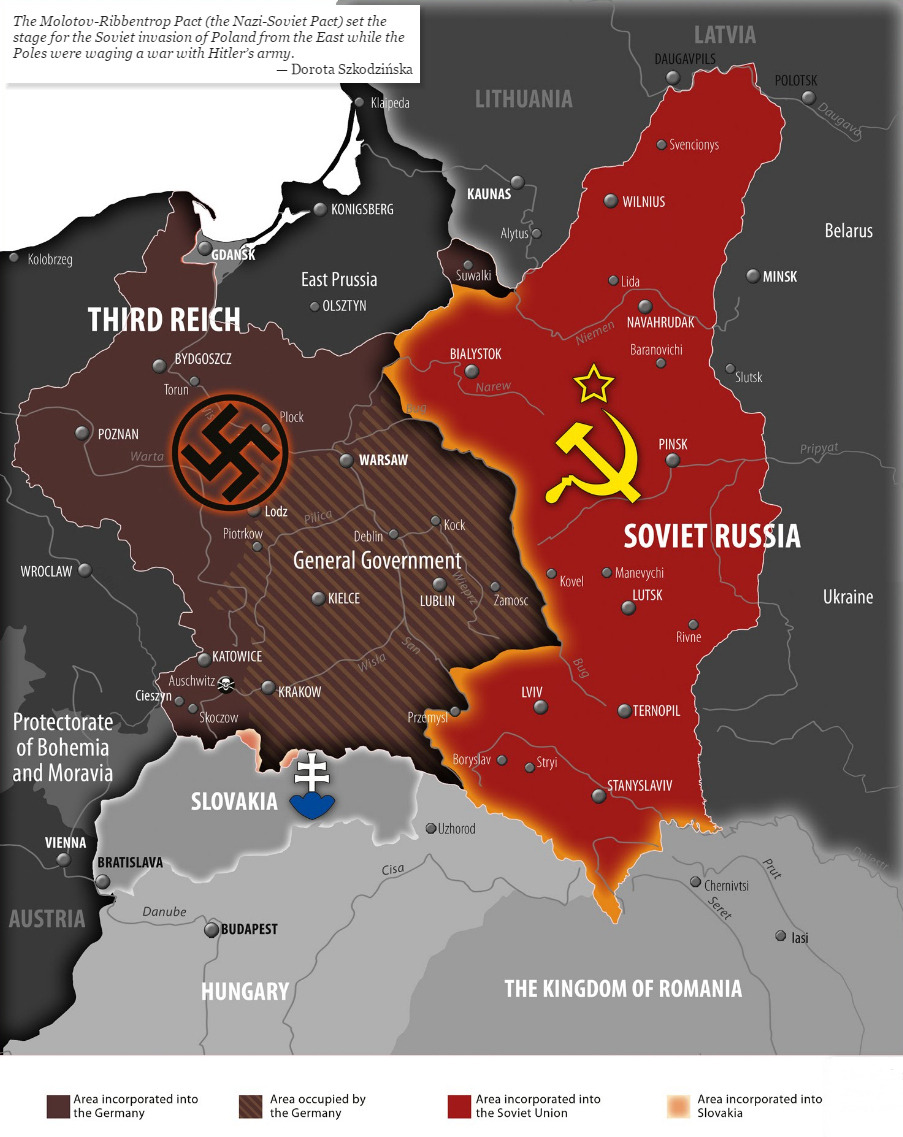
This is a translation of the official report of the Soviet government into the Molotov-Ribbentrop talks and the agreements signed between the Soviet Union and Nazi Germany. One fact I would stress that this report glosses over is timing, the talks were concluded on the 23rd of August 1939, the German invasion of Poland started on the 1st of September 1939, and the Soviet invasion eastern Poland began on the 17th of September, both operations were planned well in advance, that's a tight deadline for both powers if no serious moves were made in that direction prior to the successful conclusion of the talks, and also interestingly enough before the treaty became legally binding on the Soviet side as the document notes that the 24th of September was the date that the agreement came into force. 

The talks between the Soviet Union, Britain and France which the text does mention ended on the 2nd of August, which also suggests strongly that there were some parallel overtures given the quick turnaround. These talks are written off in popular history due to the low level of delegation presented by Britain and France, we know that Stalin and the Soviet leadership were offended by the conduct of the British and French governments, but the talks continued for some time. The straw that broke the camel's back for the Soviet government was the rejection of their request to station troops in Poland and Romania. Precisely why the Soviet government thought British and French negotiators had the authority to approve that request for nations that they did not represent and were not present for the talks is not clear to me. Regardless, as soon as that was rebuffed, the talks were ended.


CONGRESS OF PEOPLE'S DEPUTIES OF THE USSR
DECISION
of December 24, 1989 N 979-1
ON POLITICAL AND LEGAL EVALUATION
OF THE SOVIET-GERMAN NON-AGGRESSION PACT
FROM 1939
 

1. The Congress of People's Deputies of the USSR takes note of the conclusions of the commission on political and legal evaluation of the Soviet-German non-aggression treaty of August 23, 1939.
 

2. The Congress of People's Deputies of the USSR agrees with the opinion of the Commission that the Non-Aggression Treaty with Germany was concluded in a critical international situation, in the face of increasing danger of aggression by Fascism in Europe and Japanese militarism in Asia, and had as one of its aims to take away from the USSR the threat of an impending war. Ultimately, this goal was not achieved, and the miscalculations associated with the presence of German obligations to the USSR, exacerbated the consequences of treacherous Nazi aggression. At this time, the country was faced with difficult choices.
The obligations under the treaty came into force immediately after its signing, although the treaty itself was subject to approval by the Supreme Soviet of the USSR. The decree of ratification was adopted in Moscow on August 31, and the instruments of ratification were exchanged on September 24, 1939.
 

3. The Congress considers that the contents of that treaty were not incompatible with the rules of international law and the treaty practice of States in making treaty settlements of this kind. But both at the conclusion of the treaty and at its ratification the fact was concealed that simultaneously with the treaty a "secret additional protocol" had been signed, delimiting the "spheres of interests" of the contracting parties from the Baltic Sea to the Black Sea, from Finland to Bessarabia.
The originals of the protocol have not been found in Soviet or foreign archives. However, the graphological, phototechnical and lexical examination of the copies, maps and other documents, the correspondence of the subsequent events to the content of the protocol confirm the fact of its signing and existence.

4. The Congress of People's Deputies of the USSR hereby certifies that the Treaty of Non-Aggression of August 23, 1939, and the Treaty of Friendship and Boundary between the USSR and Germany concluded on September 28th of that year, as well as other Soviet-German agreements, in accordance with the rules of international law, lost force at the moment of the German attack on the USSR, that is June 22, 1941.
 

5. The Congress states that the Protocol of August 23, 1939, and other secret protocols signed with Germany in 1939-1941, both in method of drafting and in content, were a departure from the Leninist principles of Soviet foreign policy. Delimitation of "spheres of interest" of the USSR and Germany and other actions taken in them were from the legal point of view in contradiction with the sovereignty and independence of a number of third countries.
The Congress notes that at that time the relations of the USSR with Latvia, Lithuania and Estonia were regulated by a system of treaties. According to the peace treaties of 1920 and the non-aggression treaties of 1926-1933, their parties undertook to respect each other's sovereignty and territorial integrity and inviolability in all circumstances. The Soviet Union had similar obligations towards Poland and Finland.
 

6. The Congress states that the negotiations with Germany on secret protocols were conducted by Stalin and Molotov in secret from the Soviet people, the Central Committee of the All-Union Communist Party (b) and the entire Party, the Supreme Soviet and the USSR Government, these protocols were excluded from the ratification procedures. Thus, the decision to sign them was, in substance and form, an act of personal power, and in no way reflected the will of the Soviet people, who are not responsible for this conspiracy.
 

7. The Congress of People's Deputies of the USSR condemns the signing of the "secret additional protocol" of August 23, 1939 and other secret agreements with Germany. The Congress recognizes the secret protocols as legally invalid and null and void from the moment of their signing.
The protocols did not create a new legal basis for relations between the Soviet Union and third countries, but were used by Stalin and his entourage to issue ultimatums and exert forceful pressure on other states in violation of the legal obligations undertaken before them.


8. The Congress of People's Deputies of the USSR assumes that awareness of the complex and contradictory past is part of the process of perestroika, designed to provide every people of the Soviet Union with opportunities for free and equal development in an integral, interdependent world and expanding mutual understanding.
Chairman
Chairman of the Supreme Soviet of the USSR
M. GORBACHEV

[Translated from Russian by DeepL, bolding my own]

Friday, 8 September 2023

The Death of Stalinism in Bohemia


This short sequence says more about early 90s Eastern Europe than entire forests of books.
I'm reading a book on the history of censorship in animation. The book covers many well known examples and also documents some lesser known ones. It also covers the filmography of Jan Švankmajer, a Czech director and animator who serves as an example of what it was like to work in the film industry in the Warsaw Pact. To get a film or program funded, scripts had to be approved by the responsible bureaucrats, Jan Švankmajer had some success for a time getting projects off the ground, but it eventually he got a reputation for making films that were pessimistic and individualistic, in short, bad art in the opinion of the Communist Party.

Jan Švankmajer is a committed Surrealist. In the popular parlance, surrealism is just an adjective to describe work that's odd. A painting that doesn't look much like something or a play that plays with the fourth wall or a film that has a sequence that breaks the rules of conventional cinema will be described as surrealist. However, the original Surrealists were a group of political radicals closely associated with Anarchism and libertarian socialism. It's this political Surrealism that Švankmajer was inspired by.

The opposition force Švankmajer to find new work as a puppet maker and painter. Fortunately for Jan Švankmajer he was noticed by the West German film industry who introduced his work to the rest of Western Europe. Several financiers including the UK's Channel Four and the BBC made overtures to fund some of his projects, which meant the Czechoslovak film authorities reluctantly allow him to return, though opposition continued. Jan Švankmajer's film Alice, an adaption of Alice in Wonderland, was made while he was supposed to be working on a different film and was only allowed to be completed after a bitter dispute in which the foreign funders threatened to withdraw if Alice wasn't completed. 

So, with all those headaches, it's not surprising that once the regime collapsed in 1989 that Švankmajer would take the opportunity to comment on its demise. In 1990, with assistance from the BBC, he released a ten-minute animated short titled The Death of Stalinism in Bohemia. I've wanted to see this film for some time after seeing clips of his Alice. And now thanks to a YouTube channel I got my chance. It's simply excellent, the imagery is striking, the claymation animation is not only interesting to watch on its own, but it makes many of the film's points in itself. There's a sequence where clay workers in flat caps and overalls, the men who populated every Soviet poster from 1918-91 created via moulds, going through an assembly line and then hanged, after which their bodies fall into a bucket and turn back into clay which is then moulded back into workers which go back on the line and so on and so on, meanwhile the film juxtaposes imagery from Czechoslovakia's Five-Year plans with the production targets getting higher and higher. 

Practically every sequence is like this, the imagery and transitions and movements work together to make the point crystal clear even if you can't read Czech. I could describe the entire ten-minute run time, the crumpling up of posters of old Czechoslovak/Soviet leaders followed by uncrumpling those posters to reveal their replacements, meet the new boss, mostly the same as the old, as a quick example. But I'll restrain myself and just discuss what for me is the most important sequence, the film has a bookend sequence, it starts with a creaky old Stalin bust having surgery, his skull is cut open to reveal his brain, the surgeon plunges both hands into the gory matter and pulls out a smaller bust of Klement Gottwald, ardent Czech Stalinist and leader of the 1948 coup that established the Communist party dictatorship. After cleaning up the blood and tying off the umbilical cord, the Gottwald bust comes to life, the birth of Stalinism in Bohemia. At the end of the film the chronology has entered the late 80s and the soundtrack is full of jubilant crowds and photographs of mass demonstrations in the streets. While this is going on, the hands that have been controlling everything throughout the film start painting everything with the Czech national flag. A new coat of paint on rusty equipment, including an old and dirty Stalin bust. This Czech national flag Stalin bust undergoes the same surgery and those hands plunge back into the brain matter, but the film ends before we can see what emerges from it. 

The film is open about its existence as a form of Agitprop, agitational propaganda and Švankmajer has stated that he thought the film would age very quickly because it's a direct commentary upon current events  "Despite the fact that this film emerged along the same path of imagination as all my other films, I never pretended that it was anything more than propaganda. Therefore, I think it is a film which will age more quickly than any of the others." To call a film Agitprop or propaganda is to insult in conventional circles. Art is supposed to rise above petty political statements, this film is the best rebuttal to that assumption I've come across so far. Removing the politics from this film is to leave it an empty husk, its politics is its art.

Most political film animated or otherwise are frankly quite blunt and simplistic, there's a bad guy who demonstrates all the qualities the makers criticize, the good people eventually triumph etc. Here the villain is a system, it isn't the death of Stalin in Bohemia, it's the Death of Stalinism in Bohemia with a question mark. Stalin died in 1953 just days before Klement Gottwald died oddly enough. And even Stalin is manipulated by the hands of the unseen operator of the system, who is still around in 1990 and working hard to mutate into a more politically acceptable Czechoslovak national form to continue its work.

The scepticism wasn't some paranoia from an artist who thinks too much, either. The book I'm reading that reminded me to look up Švankmajer's work was published in the middle of the 1990s several years after The Death of Stalinism, was released. It includes comments by Czech filmmakers that things haven't changed completely, many of the old Communist party bureaucrats were still in positions of power in the industry and not all of them had adapted to the changing times. Which is what the Stalin bust with the flag paint was about, the collapse of the old regimes removed some of the most high profile and infamous personalities, but left thousands of lower level authorities in place, and it was an open question just how far these authorities would be willing to change. 

And of course, the reason much of the imagery is obvious despite cultural distance is that much of what is odious about the Stalinist regimes of Eastern Europe can be found in Western European capitalism. I've worked in factories with grimy walls covered in propaganda posters while sweating and aching to fill ridiculous quotas. The secret police are gone, but the regular police are quite capable of repression, the governing institutions are just as invested in keeping the population passive through a combination of restrictions and distractions.

 I've been to Czechia and Slovakia, so I'm under no illusion that these two things are the same, there are differences, just not as much as the propagandists of both systems would like us to believe.

Tuesday, 1 August 2023

Text of the Soviet acknowledgment of the existence of secret agreements with Nazi Germany


Text of the Soviet acknowledgment of the existence of secret agreements with Nazi Germany

CONGRESS OF PEOPLE'S DEPUTIES OF THE USSR
DECISION
of December 24, 1989 N 979-1
ON POLITICAL AND LEGAL EVALUATION
OF THE SOVIET-GERMAN NON-AGGRESSION PACT
FROM 1939
 

1. The Congress of People's Deputies of the USSR takes note of the conclusions of the commission on political and legal evaluation of the Soviet-German non-aggression treaty of August 23, 1939.
 

2. The Congress of People's Deputies of the USSR agrees with the opinion of the Commission that the Non-Aggression Treaty with Germany was concluded in a critical international situation, in the face of increasing danger of aggression by Fascism in Europe and Japanese militarism in Asia, and had as one of its aims to take away from the USSR the threat of an impending war. Ultimately, this goal was not achieved, and the miscalculations associated with the presence of German obligations to the USSR, exacerbated the consequences of treacherous Nazi aggression. At this time the country was faced with difficult choices.
The obligations under the treaty came into force immediately after its signing, although the treaty itself was subject to approval by the Supreme Soviet of the USSR. The decree of ratification was adopted in Moscow on August 31, and the instruments of ratification were exchanged on September 24, 1939.
 

3. The Congress considers that the contents of that treaty were not incompatible with the rules of international law and the treaty practice of States in making treaty settlements of this kind. But both at the conclusion of the treaty and at its ratification the fact was concealed that simultaneously with the treaty a "secret additional protocol" had been signed, delimiting the "spheres of interests" of the contracting parties from the Baltic Sea to the Black Sea, from Finland to Bessarabia.
The originals of the protocol have not been found in Soviet or foreign archives. However the graphological, phototechnical and lexical examination of the copies, maps and other documents, the correspondence of the subsequent events to the content of the protocol confirm the fact of its signing and existence.

4. The Congress of People's Deputies of the USSR hereby certifies that the Treaty of Non-Aggression of August 23, 1939, and the Treaty of Friendship and Boundary between the USSR and Germany concluded on September 28th of that year, as well as other Soviet-German agreements, in accordance with the rules of international law, lost force at the moment of the German attack on the USSR, that is June 22, 1941.
 

5. The Congress states that the Protocol of August 23, 1939, and other secret protocols signed with Germany in 1939-1941, both in method of drafting and in content, were a departure from the Leninist principles of Soviet foreign policy. Delimitation of "spheres of interest" of the USSR and Germany and other actions taken in them were from the legal point of view in contradiction with the sovereignty and independence of a number of third countries.
The Congress notes that at that time the relations of the USSR with Latvia, Lithuania and Estonia were regulated by a system of treaties. According to the peace treaties of 1920 and the non-aggression treaties of 1926-1933, their parties undertook to respect each other's sovereignty and territorial integrity and inviolability in all circumstances. The Soviet Union had similar obligations towards Poland and Finland.
 

6. The Congress states that the negotiations with Germany on secret protocols were conducted by Stalin and Molotov in secret from the Soviet people, the Central Committee of the All-Union Communist Party (b) and the entire Party, the Supreme Soviet and the USSR Government, these protocols were excluded from the ratification procedures. Thus, the decision to sign them was, in substance and form, an act of personal power, and in no way reflected the will of the Soviet people, who are not responsible for this conspiracy.
 

7. The Congress of People's Deputies of the USSR condemns the signing of the "secret additional protocol" of August 23, 1939 and other secret agreements with Germany. The Congress recognizes the secret protocols as legally invalid and null and void from the moment of their signing.
The protocols did not create a new legal basis for relations between the Soviet Union and third countries, but were used by Stalin and his entourage to issue ultimatums and exert forceful pressure on other states in violation of the legal obligations undertaken before them.


8. The Congress of People's Deputies of the USSR assumes that awareness of the complex and contradictory past is part of the process of perestroika, designed to provide every people of the Soviet Union with opportunities for free and equal development in an integral, interdependent world and expanding mutual understanding.
Chairman
Chairman of the Supreme Soviet of the USSR
M. GORBACHEV

[Translated from Russian by DeepL, bolding my own]

Monday, 13 March 2023

Real Politik in the interwar years


Over the past several years I've noticed some worrying trends among pop history effectively popularising myths to the point they obscure and even deny some heavily documented events. One of them concerns foreign policy in the interwar years, especially concerning policies on dealing with Nazi Germany. Its somewhat understandable, this period is quite infamous for some dramatic shifts in international affairs. Even the name the Interwar period is misleading, I don't think Ethiopians or Chinese or the Spanish would agree that the years between World War I and World War II were particularly peaceful to take just a handful of examples.

I'll outline a general version of the argument that I find is increasingly common, every advocate I've encountered has there own personal spin so this'll be a bit of a generalisation but it'll cover the main thrusts.

The Molotov-Ribbentrop pact (M-R) is not proof that the Soviet Union and Nazi Germany collaborated with each other in alliance, it was merely an attempt by the USSR to gain time to defeat Nazi Germany later. Anyway, Stalin had to take that deal as Britain and France had turned down his attempts to ally with the west against the fascists. But the west preferred to appease fascism and tried to use it to attack communism.

Like all good lies there's a few strands of truth weaved into it for credibility sake. I'll start with acknowledging those bits so we can move on to the really dangerous stuff. The decision to negotiate with Nazi Germany was motivated by self interest, and it is true that earlier in the decade the Soviet Union had pursued a collective security initiative including approaches to the British and French governments, its also true that Britain and France especially under certain administrations had little appetite for working with the Soviet Union. Its also true that a strategy of appeasement was promoted.

However, this reading and most of the variations of it I've encountered usually leave out quite a bit of important context, either because they don't know, they haven't bothered to study a really complex and confusing period of history, or they are aware but know attempting to account for further context opens their standpoint up to more scrutiny and commentary than they wish to experience. 

To take an example, many emphasis the Soviet Union's motives as opposition to fascism, but I don't believe ideological stripes mattered at all. Because a key partner in the USSR's collective security against Germany strategy was Fascist Italy. 

Meanwhile, 1933 was an important year for Moscow’s relations with Rome and for its newly declared policy of collective security designed to contain both Adolf Hitler and the Japanese. In May, Italy and the USSR signed an economic accord, and in September they signed a Treaty of Neutrality, Friendship, and Nonaggression. A series of military exchanges and favorable press comment punctuated their good relations.(22) On October 27, Ambassador Vladimir Potemkin told Deputy Foreign Minister Fulvio Suvich that Germany was trying to conclude an agreement with Japan at Soviet expense. Distrusting Britain in East Asia, the Soviets wished to forge a pact among themselves, the French, Italians, and Americans to defend China against Japan.(23) 
https://libcom.org/article/soviet-appeasement-collective-security-and-italo-ethiopian-war-1935-and-1936

Courting of Italy was also done by Britain and France, though at times Britain was more reluctant and even hostile to Italy over tensions between both nations over spheres of interest in their colonies. This courting of Mussolini may seem odd looking back, not only because Mussolini was a Fascist dictator, he is also regarded as a clown and a failure. Well Mussolini was concerned about Germany uniting with Austria and having a direct land border with Italy, so in the 1930s his government was willing to work with other powers to limit German expansion. During the 1934 July putsch, a coup attempt by the Austrian Nazi party against the ruling Austrofascist party (yes that is correct, a civil war between Nazis and Fascists) Mussolini built up his forces in the Brenner pass and publicly warned Germany not to invade Austria. Hitler publicly declared he had no intention of doing so and disavowed the coup which quickly collapsed afterwards. So yes, there was a time when Nazi Germany was so vulnerable that Mussolini made Hitler blink.

Eventually this courting of Mussolini brokedown once Hitler made him a better offer. In addition to courting Mussolini, the Soviet Union did secure an agreement with the French Republic. In 1932 both nations had established a non-aggression pact and then in 1935 had developed their relationship further with the signing of a military accord, the Franco-Soviet Treaty of Mutual Assistance. As military alliances go its considered weak, the accord didn't automatically mean war with one was war with the other, and it required consultation with other powers including Britain and Italy and the League of Nations. 

But it did mean that any nation wishing to pursue military objectives against one would have to take into account the response from the other. And it did establish a framework for further co-operation, with French support the Soviet Union signed a similar agreement with Czechoslovakia which is why Stalin is represented in the famous cartoon about the Munich agreement.


 The connections between France and the Soviet Union is the reason why so many French politicians like Édouard Marie Herriot disgraced themselves by denying famine in the Soviet Union. While the two powers grew closer rumours about starvation in Ukraine and the south of Russia had begun to circulate internationally. Which cause some backlash other the government's decision to ally with a brutal dictatorship, hence the need to deny.

The importance of the relationship is also seen as an explanation for the Spanish Republican government's lack of support for independence amongst Spain's African colonies, as anti-colonial revolt would threaten French interests in their African colonies and in Morocco.

In particular, the U.S.S.R. is in alliance with France, a capitalist-imperialist country. The alliance is of little use to Russia unless French capitalism is strong, therefore Communist policy in France has got to be anti-revolutionary. This means not only that French Communists now march behind the tricolour and sing the Marseillaise, but, what is more important, that they have had to drop all effective agitation in the French colonies. It is less than three years since Thorez, the Secretary of the French Communist Party, was declaring that the French workers would never be bamboozled into fighting against their German comrades(4); he is now one of the loudest-lunged patriots in France. The clue to the behaviour of the Communist Party in any country is the military relation of that country,actual or potential, towards the U.S.S.R. In England, for instance, the position is still uncertain, hence the English Communist Party is still hostile to the National Government,and, ostensibly, opposed to rearmament. If, however, Great Britain enters into an alliance or military understanding with the U.S.S.R., the English Communist, like the French Communist, will have no choice but to become a good patriot and imperialist; there are premonitory signs of this already. In Spain the Communist ‘line’ was undoubtedly influenced by the fact that France, Russia's ally, would strongly object to a revolutionary neighbour and would raise heaven and earth to prevent the liberation of Spanish Morocco.
https://files.libcom.org/files/Homage%20to%20Catalonia%20-%20George%20Orwell.pdf

France however, is democratic, well they have elections, and so the government of France and its priorities changed. By 1938 the government led by Édouard Daladier no longer held much faith in the pact and instead put his faith in further collaboration with Britain and Neville Chamberlain, the pact wound up that same year.

So, I think we can see why the popular version is misleading, it frames the issue as a desperate Stalin on one side and a totally unresponsive if not actively malicious Western powers. The truth is much less emotional, most European powers were concerned with the potential threat of Germany (The Franco-Soviet pact specified a hostile European power) and looked to building a network of alliance to contain it. The Soviet Union had some success in this with Italy and France, but neither panned out in the long-term due to changing  circumstances and the strategic goals of one or more of the powers. 

Now, there is something of an Elephant in the room, so far we've barely mentioned Britain. Britain and the Soviet Union's relationship in the 1930s could accurately be described as poor. The Royal Navy wasn't shelling Kronstadt and Leningrad and the Soviet army was massing on the border of Persia waiting for the right time to launch an offensive into India, but there wasn't much love lost between the two. Given that the British Empire was one of the earliest powers to recognise the Soviet Union and establish diplomatic agreements with it, the fraying in the 1930s has a lot to do with the political leadership of the United Kingdom at the time. Especially Neville Chamberlain, he had a very poor view of the Soviet Union,

 “I must confess to the most profound distrust of Russia. I have no belief whatever in her ability to maintain an effective offensive, even if she wanted to. And I distrust her motives, which seem to me to have little connection with our ideas of liberty,”
Neville Chamberlain's letter to a friend in March 1939

He even viewed the Labour party with so much contempt, that Oliver Stanley a fellow cabinet member (this was before Chamberlain became Prime Minister) had to tell him to tone down his attitude and respect them as the official opposition. "Stanley begged me to remember that I was addressing a meeting of gentlemen. I always gave him the impression, he said, when I spoke in the House of Commons, that I looked on the Labour Party as dirt."

His views on the Soviet Union were not atypical amongst the British Conservative Party of the time. Even the minority who advocated reaching an accommodation with the Soviet Union like Winston Churchill were open and aggressive anti-Reds. So, not a promising start to a Europe wide anti-German alliance. There is also the issue of Chamberlain's advocacy for Appeasement, in the UK the words Chamberlain and Appeasement are practically the same. The decision not to confront Germany over Austria and the Czech crisis, and his PR disaster that was the "Peace for our time" speech effectively destroyed his reputation. 

However, appeasement has been greatly distorted. Chamberlain in addition to being an Appeaser was a booster for war preparations. "the merest scaremongering; disgraceful in a statesman of Mr Chamberlain's responsible position, to suggest that more millions of money needed to be spent on armaments." said Arthur Greenwood Labour deputy leader in 1935. The appeasement strategy had two potential objectives if it gave Hitler enough to get him to cease pushing for more territory than more than worth sacrificing some tens of thousands of foreigners. But if that didn't work, it would buy time for the British Empire to expand its war preparation work. Arms spending increased significantly under Neville's time as Prime Minister, especially for the Royal Air Force. He was also in charge of the government that extended guarantees to Poland, guarantees that led to a declaration of war against Germany in September 1939 in response to its aggression against Poland.

There has been some small revisionist history to defend Neville Chamberlain's performance and I don't agree with them. I think his actions were ultimately abhorrent and contributed to the start of World War II, or at least the version of the war we got. But he was ultimately guilty of doing what Stalin was doing, looking to deal with Germany and buy time for their own powers defence and security at the expense of others. 

Chamberlain's willingness to compromise even extended to his contempt for the Soviet Union, there was in 1939 finally some movement between Britain and France to establish an agreement with the Soviet Union. Essentially his cabinet and strong favourable polling for a French-Anglo-Soviet pact pushed him and Daladier to pursue it. It didn't go very well, from June 15th to the 2nd of August preliminary talks between the three had agreed to extend each other and other nations bordering or close to Germany, Poland, Belgium, Estonia, Latvia, Romania, Lithuania, Greece, Turkey etc, of support should they face aggression from Germany. But once the talks reached the stage of discussing military missions and co-operation they soon collapsed.

Problems arouse almost immediately as soon as the delegations arrived in Moscow. The Soviet Union were represented by Klimet Voroshilov Marshal of the Soviet Army and Defence Minister for the Soviet Union, while Britain was represented by Admiral Reginald Drax and the French by General Aimé Doumenc both of whom were minor military officials in comparison to the Soviet delegation. The situation degraded even further when neither Drax nor Doumenc were authorised to make decisions without consultation and approval from their governments. 

The Soviet government came to the conclusion that the talks were not serious initiatives and looked elsewhere. The fruitless talks were officially ended on the 21st of August, two days later on the 23rd of August the Soviet government announced that it had come to an agreement with Germany and had signed what became known as the Molotov-Ribbentrop pact. 

And that is usually where the pop-history enjoyer declares case closed. The West wasn't played silly games and a frustrated Soviet Union had to turn elsewhere and in desperation made a deal with the devil for pragmatic means. But again if we actually look a little deeper many questions arise and refuse to go away. Two days is a suspiciously short amount of time to hold and conclude a diplomatic accord, the technological level of communications, the distance and the layers of bureaucracy and protocol would take weeks if not months to work through just to get diplomats to meet each other. The doomed British, French Soviet talks took several months before breaking down with no agreement.

Indeed talks between the two nations over a closer relationship had begun earlier in 1939 almost as soon as Maksim Litvinov the advocate of collective security had been replaced by Vyacheslav Molotov.

 More positively, Astakhov paid an unusual visit to the Bulgarian Ambassador in Berlin on June 14 to inform him (and apparently the Germans as well) that the USSR "was vacillating between three possibilities, namely the conclusion of the pact with England and France, a further dilatory treatment of the pact negotiations, and a rapprochement with Germany. This last possibility, with which ideological considerations would not have to become involved, was closest to the desires of the Soviet Union."
Feeding the German Eagle: Soviet Economic Aid to Nazi Germany in 1939-41, pg 47

In addition the talks between Britain, France and the Soviet Union collapsed other the Soviet insistence on military access on Polish territory. 

Moreover, the negotiations stalled immediately after Voroshilov had asked if Poland and Romania would let the Red Army through their territories to fight Germany. Drax and Doumenc didn’t have the competency to answer such a principal question – of course, Poland and Romania would not agree. “Stalin believed that those states were just puppets and that Britain and France could force them to agree – but it was more complicated than that and led to London and Paris failing to convince Warsaw that the USSR was any better than Germany,” Budnitsky notes.

Voroshilov was quite brief. “The Soviet mission considers that without a positive answer to this question all the efforts to enter into a military convention are doomed to failure,” he said, inviting Drax and Doumenc to enjoy their time in Moscow instead. The fruitless talks were officially halted on Aug. 21, 1939.
https://www.rbth.com/history/331039-ussr-britain-france-talks-wwii

This demand was made at a talk without a Polish delegation and was asked of two representatives who had no way of agreeing to it. The Polish for their part had been adamant that they would not agree to let the Soviet Union a nation it had serious territorial disputes with put troops within its borders, and for good reason. Instead the Soviet government made an agreement with the foreign power that was more than happy to let them station troops within Poland.

There's also another issue that I find rather worrying. Multiple advocates for the M-R pact are insistent that it wasn't a big deal as it was only a "Non-Aggression" agreement. And yes the official name for the M-R pact was the German-Soviet Nonaggression pact the name Molotov-Ribbentropp pact was a nickname that stuck. It was also described as the Nazi-Soviet pact and the Hitler-Stalin pact, but M-R is the name that proved the more popular. And the public version presented to the world seems to conform to what we would think such an agreement would entail.

The terms of the German-Soviet Nonaggression Pact were briefly as follows: the two countries agreed not to attack each other, either independently or in conjunction with other powers; not to support any third power that might attack the other party to the pact; to remain in consultation with each other upon questions touching their common interests; not to join any group of powers directly or indirectly threatening one of the two parties; to solve all differences between the two by negotiation or arbitration. The pact was to last for 10 years, with automatic extension for another 5 years unless either party gave notice to terminate it 1 year before its expiration.

 However, the key word is public. The M-R pact also entailed three additional agreements that were kept secret from the international community. The first of the protocols was agreed on the same day as the public M-R pact, 23rd of August 1939, that divided Eastern Europe into Soviet and German spheres of influence. It broke Poland between the two powers and agreed the Baltic states and Finland were to be Soviet areas, and also discussed the possibility of Bessarabia being broken off from the Kingdom of Romania. Then on the 28th of September 1939 a second secret protocol was signed finalising the division of Poland and looked at the division of Lithuania, and officially consinged Bessarabia to the Soviet sphere, a third and final protocol was signed on the 10th of January 1941 in which Germany agreed to waive its claims to Lithuania in exchange for payment from the Soviet Union the occupying power.

This map shows the differences between the agreed and actual divisions of Europe.

So, the M-R pact was not simply a statement of non-aggression it involved quite a bit of aggression. I usually don't resort to the dictionary, but this is a rare case where I think it is useful to clear up genuine confusion if there is in fact any.

alliance, in international relations, a formal agreement between two or more states for mutual support in case of war. Contemporary alliances provide for combined action on the part of two or more independent states and are generally defensive in nature, obligating allies to join forces if one or more of them is attacked by another state or coalition. Although alliances may be informal, they are typically formalized by a treaty of alliance, the most critical clauses of which are those that define the casus foederis, or the circumstances under which the treaty obligates an ally to aid a fellow member.
https://www.britannica.com/topic/alliance-politics

On the 1st of September 1939 the German army attacked Poland, this was the start of the invasion of Poland by Germany, the Slovak Republic and the Soviet Union. On the 17th of September the Soviet army began its offensive operations in Poland violating the Soviet-Poland Nonaggression pact signed in 1932. Attacked on all sides including an uprising by the Organisation of Ukrainian Nationalists the Polish military resisted until the 6th of October. The Soviet and German military met at Brest-Litovsk (modern day Brest in Belarus) held a joint victory parade and the German army hand over control of the city to the Soviet authorities. 

German officers Generalleutnant Mauritz von Wiktorin (left), General der Panzertruppe Heinz Guderian (centre) and Soviet Kombrig Semyon Krivoshein (right) standing on the platform 

The scene was captured on film

In addition to the joint invasion of Poland when the Soviet Union attacked Finland in November of that same year Nazi Germany officially took a stance of neutrality regarding the two nations. While actively supporting the Soviet invasion by taking action to cut off support for Finland including seizing war material sent by Mussolini.

As there was some pro-Finnish agitation in the Scandinavian countries, they were warned by Berlin ‘not to listen to the blandishments of League of Nations evangelists and British extremists’. [42] Thus any hopes the Finnish government might at first have had of German help vanished. On 8 December the Finnish Minister in Rome had confided to Ciano that Germany ‘had supplied arms to Finland from the booty captured during the Polish campaign’, [43] but on 12 December Hitler yielded to the Naval General Staff’s request for a ‘clear-cut policy’ towards Finland and for the suspension of arms deliveries there. [44] The shipment of arms to Sweden was to be stopped unless the Swedish government gave a written guarantee that they would not be transferred to Finland. [45] A few aircraft ordered from Italy before the war and on their way to Helsinki were seized in Germany. [46] At his second meeting with Molotov in Berlin (13 November 1940), Hitler pointed out that ‘during the Russo – Finnish war, despite the danger that Allied bases might be established in Scandinavia, Germany had meticulously kept her obligations toward Russia’ and that ‘in this connection she had even gone so far as to deny to the Finnish President the use of a German cable for a radio address to America’.
https://www.marxists.org/history/ussr/great-patriotic-war/soviet-german-pact/tasca/ch6.htm

And beyond the military sphere the intelligence services of the two powers, the German Gestapo and Soviet NKVD, both brutal secret police forces co-operated on dealing with internal dissent in their new territories.


Both parties will tolerate in their territories no Polish agitation which affects the territories of the other party. They will suppress in their territories all beginnings of such agitation and inform each other concerning suitable measures for this purpose.

— Secret Supplementary Protocol (2), German-Soviet Boundary and Friendship Treaty 28 September 1939

The co-operation involved the transfer of prisoners of war and actions against Polish resistance groups. And most bizarrely the Soviet Union began handing over many German Communists who had escaped persecution in Germany and Austria.

And yet they get them, to the Gestapo’s great delight. Eighty antifascists before the 1939 Hitler–Stalin Pact, more than 200 (out of 350 deportees) afterward. Only now do the Germans press for deportations, stressing the mutual friendly relations between the German Reich and the USSR. There is no evidence of other pressure, nor of any “reciprocation” to follow. The Nazis give the numbers, the Soviets supply the names. The antifascists are sacrificed not according to some overarching principle of political calculus nor as currency in an exchange but rather as a kind of gift.
https://thereader.mitpress.mit.edu/the-nazi-soviet-pact-a-betrayal-of-communists-by-communists/

So, we have two direct examples of the two powers effectively collaborating in military and strategic aims. But as the timeline of the secret protocols 1939-1941 demonstrates, the M-R pact was a step along the path of the relationship. In addition there were not one but two economic treaties, the German-Soviet Credit agreement signed in May 1939 and the German-Soviet Commercial agreement (1940). These treaties expanded trade in materials and economic co-operation between the two powers. By 1941 when the German broke off ties by invading the Soviet Union the trade had been worth

  • 1,500,000 metric tons (1,700,000 short tons; 1,500,000 long tons) of grains
  • 820,000 metric tons (900,000 short tons; 810,000 long tons) of oil
  • 180,000 metric tons (200,000 short tons; 180,000 long tons) of cotton
  • 130,000 metric tons (140,000 short tons; 130,000 long tons) of manganese
  • 180,000 metric tons (200,000 short tons; 180,000 long tons) of phosphates
  • 18,000 metric tons (20,000 short tons; 18,000 long tons) of chrome ore
  • 16,000 metric tons (18,000 short tons; 16,000 long tons) of rubber
  • 91,000 metric tons (100,000 short tons; 90,000 long tons) of soybeans
  • 450,000 metric tons (500,000 short tons; 440,000 long tons) of iron ores
  • 270,000 metric tons (300,000 short tons; 270,000 long tons) of scrap metal and pig iron
  • 200,000 kilograms (440,000 lb) of platinum

Total USSR imports June 1941 German stocks June 1941 (without USSR imports) October 1941 German stocks October 1941 (without USSR imports)
Oil products 827 (912; 814) 1,220 (1,350; 1,210) 397 (438; 391) 821 (905; 808) −6.4 (−7; −6.3)
Rubber 17.1 (18.8; 16.8) 12.5 (13.8; 12.3) −4.4 (−4.9; −4.4) 11.0 (12.1; 10.8) −6.1 (−6.7; −6.0)
Manganese 171.9 (189.5; 169.2) 186 (205; 183) 14.1 (15.5; 13.8) 150 (170; 150) −17.7 (−19.5; −17.4)
Grain 1,485.2 (1,637.1; 1,461.7) 1,253 (1,381; 1,233) −232.3 (−256.1; −228.7) 690 (761; 679) −794.8 (−876.1; −782.2)
*German stocks in thousands of metric tons (short tons; long tons) (with and without USSR imports-October 1941 aggregate)

https://en.wikipedia.org/wiki/German%E2%80%93Soviet_Commercial_Agreement_(1940) 

 In addition to business interests much of the trade was considered vital to outlast the British Naval blockade that threatened vital German military resources. By 1941 with the conquest of France, Denmark and Norway and guaranteed co-operation from Sweden Hitler believed Germany was no longer dependent on the material supplied by the Soviet Union and a quick victory would mean only a brief disruption in any case.

The Soviet Union also got quite a lot out of those agreements too of course. 

Both Admiralties discussed ‘practical agreements’ for the supply of fuel to German submarines and the use of the ‘northern sea-route’ [69] by German ships. The German Admiralty was very keen on this last point and negotiations began towards the end of December 1939. [70] On 6 February 1940, the German Naval Attaché in Moscow announced that the Russians were willing to allow a German auxiliary cruiser, ‘Ship 45’, [71] to sail to the Far East by the ‘Siberian route’. A temporary stiffening of Molotov’s attitude at the beginning of April seemed to bring them back to where they started, [72] but preparations for the voyage were eventually resumed ‘with Russia’s cooperation’ [73] and ‘Ship 45’ sailed on 12 August 1940, ‘by the Siberian sea-route, with Russian help’. [74] The German auxiliary cruiser was thus able to cross the Pacific without risk and there raid British ships as a privateer. For their part, the Germans handed over the Lützow to the Russians, [75] and in the Leningrad shipyards technicians took over the construction or repair of some of the big ships of the Soviet navy. In November 1940, Admiral Raeder was convinced that Russia would not attack Germany on the grounds that she ‘was starting to build up her navy with the help of Germany’. [76] They were still working together in May 1941. In a memorandum of the 15th of this month Schnurre stated that: ... construction of the cruiser L in Leningrad is proceeding according to plan, with German supplies coming in as scheduled. Approximately 70 German engineers and fitters are working on the cruiser in Leningrad under the direction of Admiral Feige.
https://www.marxists.org/history/ussr/great-patriotic-war/soviet-german-pact/tasca/ch6.htm

 The nature of these agreements both economic and strategically important is very similar to the collaboration of American and British and French businessmen in the same years. (see https://libcom.org/article/how-allied-multinationals-supplied-nazi-germany-throughout-world-war-ii).

 Economic agreements and strategic interventions have an air of cold detachment, what is often confused for pragmatism or "realpolitik". But both powers were left with a big issue concerning their abrupt realignment after years of casting each other as a sought of anti-christ like entity. How to explain this to their own populations? The archives of Pravda,  the Communist party newspaper has preserved some examples of this push. Consider this article, written during the Soviet occupation of Estonia.


 POLITICAL MOOD IN ESTONIA, Pravda, 28 May 1940 TALLINN, 27 May (special correspondent of "Pravda"), (7/14) Recent events in Europe have attracted a lot of attention from various segments of the Estonian population. In contrast to most of the Estonian newspapers, a certain part of the Estonian intelligentsia regards the occupation by the Germans of Denmark in Norway, their invasion of the Netherlands and Belgium as aggression, as the enslavement of small nations. This part of the intelligentsia preaches a loyal attitude towards England and expresses hatred towards Germany and everything German. In commercial circles, the judgment prevails that it was more profitable to trade with England than with Germany, and that English goods are better than German ones. On May 10, the Tallinn Post newspaper (an edition of the Uus Eesti newspaper) published a feuilleton in which the poor quality of German goods was denounced. That part of the Estonian intelligentsia that is hostile to Germany is spreading rumours that the friendship between Germany and the USSR is fragile and short-lived, that a war between the two countries is inevitable, which will bring suffering to the Estonian people. Some of the people who propagate such sentiments are connected by various threads to the British and American embassies. They can also be found among editorial staff of newspaper "Päevaleht". University of Tartu is also a place where pro-English propaganda is carried out.
translation source.


And there's another strange example of close co-operation between Nazi Germany and the Soviet Union, which concerns the Comintern. This organisation was tasked with handling the international Communist movement, or at least the Communist movement that looked to Moscow for leadership. This proved to be a problem as the Communist Party of Great Britain and the French Communist Party had been actively pushing the lines formulated in response to the Spanish Civil War, extreme patriotism and appeals for their governments to take a firm hand against Germany.

But on 14 September something else happened: the Daily Worker received a press telegram from the Soviet Union saying it was a robber war on both sides. Pollitt suppressed this telegram because it was against the line of the 2 September manifesto. However, at the next day’s meeting of the party’s Political Bureau, Dutt, ever responsive to his master’s voice, said the line would have to be revised. Indeed, Stalin had already given orders to that effect, in a private chat with Dimitrov on 7 September; Dimitrov had handed the word down to the Comintern Secretariat, which had approved his theses on 9 September, instructing the Communist Parties of France, Britain, Belgium and the USA in particular that they must immediately correct their political line.
https://www.marxists.org/history/etol/revhist/backiss/vol3/no4/revking.html

The new line was now as the French Communist Party promoted in the winter of 1939 was "The war conducted by the Anglo-French coalition was Imperialist for a certain period, insofar as the coalition was pursuing imperialist ends, had prepared for war, and had worked to bring it about" (see https://www.jstor.org/stable/260642?read-now=1#page_scan_tab_contents ) I highlighted the last part to draw attention to a discrepancy in the line. At the time of the M-R pact the official position of the Soviet Union which was repeated by its supporters was that WWII was the result of the Imperialist actions of the Allies against Germany, and they had been working to prepare for such an action for some time. Contrast this to the original argument at the beginning were the modern supporters of Soviet foreign policy, that the M-R had to be signed because the Western Allies failed to take any step to prevent the rise of German militarism. The imperialism of Britain and France was the official justification the Soviet Union gave for its occupation of the Baltic states. 

«[…] it had become necessary to put an end to all the intrigues by which England and France had tried to sow discord and mistrust between Germany and the Soviet Union in the Baltic States. […]Lithuanian border was evidently inadequately guarded. The Soviet Government would, therefore, if requested, assist the Lithuanian Government in guarding its borders.»
Telegram by Molotov

The French Communist Party was so active in pushing the new line attacking Franco Imperialism and defending the M-R pact for preventing war while Nazi Germany was marching in the direction of Paris. The French Communist Party exploited its reputation in the French resistance for decades after the war ended. But while members of the party had fought in the clandestine underground since the beginning of the German occupation, the party itself did not join the resistance struggle until June 1941. If that date seems familiar that was when Nazi Germany ended its period of co-operation with the Soviet Union by launching a massive and brutal invasion of the Soviet Union.

One final point to consider. In its last days the Union of Soviet Socialist Republics had attempted a partial reckoning with the many skeletons in its closet. Thousands of socialists who had been persecuted, tortured and even executed were "rehabilitated", which was the government term for an official admittance of mistakes and wrongful treatment by the government, a secular mea culpa. In 1989 this process reached the M-R pact. In December of that year Alexander Yakovlev, Communist party historian and Politburo member submitted a report to the Congress of People's Deputies of the Soviet Union, the highest governing body of the USSR. The report acknowledged the existence of the secret protocols ending decades of official denial. In response Mikhail Gorbachev denounced the actions of Soviet government (see appendix).

Conclusion

What is the point of all this? Well, aside from challenging a popular narrative that doesn't have much to stand on, I hope to make something clear. What the years just before 1939 show us is that there were no heroes, neither the Soviet Union nor the Western European powers come out of that period with a clean record. They all, including Mussolini came to the conclusion that a powerful and ambitious Germany probably wasn't a good omen for them and looked into ways of checking that threat. The issue though was that none of the powers were willing to risk their own self interest, they would make commitments up to a point but would not stick their necks out for others unless they were absolutely forced to. The Soviet Union was willing to abandon the anti-fascist struggle and collaborate with the British and French Empires, but was not willing to give up its desires to expand into its neighbours. The French were willing to work with the Soviet Union but weren't willing to risk instability in its colonial empire and so on. 

Meanwhile Germany was willing to work with the hated Judeo-bolsheviks if it would secure the material it needed for its strategic aims. I think too many people read to much into the word alliance, for many they seem to think it means a long term relationship or genuine fraternal bonds. And that just isn't true, alliances are often temporary and can be made with nations who shouldn't be compatible, an example would be the USA and Israel supporting Iran during its war with Iraq. There is a counter pop-myth that frames the M-R pact and wider Soviet-German relationship as proof of a genuine desire of Stalin to work with Nazi Germany on a deeper level, but that has very little in the way of evidence either.

The failures of the 1930s European powers in preventing the Second World War are the result of the failures of real politik and pragmatic attempts to maximise gain for the lowest costs. There are no friends amongst nations, when push came to shove for the Chinese, Ethiopians, Czechs, Austrians, Spanish, Baltic peoples etc. The great powers were no friends to them either and sold them out when it looked risky. The only reason the Poles weren't added to that list was thanks to timing, Britain and France's war preparations were largely complete and they were more confident and even then France scaled back its military operations on Germany's western borders which allowed the German army to concentrate on Poland. Even at that late date the Western Allies were prioritising their own security against a potential German offensive over providing effective support for the Poles dealing with their actual offensive.

Appendix: Text of the Soviet acknowledgment of the existence of secret agreements with Nazi Germany

CONGRESS OF PEOPLE'S DEPUTIES OF THE USSR
DECISION
of December 24, 1989 N 979-1
ON POLITICAL AND LEGAL EVALUATION
OF THE SOVIET-GERMAN NON-AGGRESSION PACT
FROM 1939
 

1. The Congress of People's Deputies of the USSR takes note of the conclusions of the commission on political and legal evaluation of the Soviet-German non-aggression treaty of August 23, 1939.
 

2. The Congress of People's Deputies of the USSR agrees with the opinion of the Commission that the Non-Aggression Treaty with Germany was concluded in a critical international situation, in the face of increasing danger of aggression by Fascism in Europe and Japanese militarism in Asia, and had as one of its aims to take away from the USSR the threat of an impending war. Ultimately, this goal was not achieved, and the miscalculations associated with the presence of German obligations to the USSR, exacerbated the consequences of treacherous Nazi aggression. At this time the country was faced with difficult choices.
The obligations under the treaty came into force immediately after its signing, although the treaty itself was subject to approval by the Supreme Soviet of the USSR. The decree of ratification was adopted in Moscow on August 31, and the instruments of ratification were exchanged on September 24, 1939.
 

3. The Congress considers that the contents of that treaty were not incompatible with the rules of international law and the treaty practice of States in making treaty settlements of this kind. But both at the conclusion of the treaty and at its ratification the fact was concealed that simultaneously with the treaty a "secret additional protocol" had been signed, delimiting the "spheres of interests" of the contracting parties from the Baltic Sea to the Black Sea, from Finland to Bessarabia.
The originals of the protocol have not been found in Soviet or foreign archives. However the graphological, phototechnical and lexical examination of the copies, maps and other documents, the correspondence of the subsequent events to the content of the protocol confirm the fact of its signing and existence.

4. The Congress of People's Deputies of the USSR hereby certifies that the Treaty of Non-Aggression of August 23, 1939, and the Treaty of Friendship and Boundary between the USSR and Germany concluded on September 28th of that year, as well as other Soviet-German agreements, in accordance with the rules of international law, lost force at the moment of the German attack on the USSR, that is June 22, 1941.
 

5. The Congress states that the Protocol of August 23, 1939, and other secret protocols signed with Germany in 1939-1941, both in method of drafting and in content, were a departure from the Leninist principles of Soviet foreign policy. Delimitation of "spheres of interest" of the USSR and Germany and other actions taken in them were from the legal point of view in contradiction with the sovereignty and independence of a number of third countries.
The Congress notes that at that time the relations of the USSR with Latvia, Lithuania and Estonia were regulated by a system of treaties. According to the peace treaties of 1920 and the non-aggression treaties of 1926-1933, their parties undertook to respect each other's sovereignty and territorial integrity and inviolability in all circumstances. The Soviet Union had similar obligations towards Poland and Finland.
 

6. The Congress states that the negotiations with Germany on secret protocols were conducted by Stalin and Molotov in secret from the Soviet people, the Central Committee of the All-Union Communist Party (b) and the entire Party, the Supreme Soviet and the USSR Government, these protocols were excluded from the ratification procedures. Thus the decision to sign them was, in substance and form, an act of personal power, and in no way reflected the will of the Soviet people, who are not responsible for this conspiracy.
 

7. The Congress of People's Deputies of the USSR condemns the signing of the "secret additional protocol" of August 23, 1939 and other secret agreements with Germany. The Congress recognizes the secret protocols as legally invalid and null and void from the moment of their signing.
The protocols did not create a new legal basis for relations between the Soviet Union and third countries, but were used by Stalin and his entourage to issue ultimatums and exert forceful pressure on other states in violation of the legal obligations undertaken before them.


8. The Congress of People's Deputies of the USSR assumes that awareness of the complex and contradictory past is part of the process of perestroika, designed to provide every people of the Soviet Union with opportunities for free and equal development in an integral, interdependent world and expanding mutual understanding.
Chairman
Chairman of the Supreme Soviet of the USSR
M. GORBACHEV

[Translated from Russian by DeepL, bolding my own]

Popular Posts