Over the past several years I've noticed some worrying trends among pop history effectively popularising myths to the point they obscure and even deny some heavily documented events. One of them concerns foreign policy in the interwar years, especially concerning policies on dealing with Nazi Germany. Its somewhat understandable, this period is quite infamous for some dramatic shifts in international affairs. Even the name the Interwar period is misleading, I don't think Ethiopians or Chinese or the Spanish would agree that the years between World War I and World War II were particularly peaceful to take just a handful of examples.
I'll outline a general version of the argument that I find is increasingly common, every advocate I've encountered has there own personal spin so this'll be a bit of a generalisation but it'll cover the main thrusts.
The Molotov-Ribbentrop pact (M-R) is not proof that the Soviet Union and Nazi Germany collaborated with each other in alliance, it was merely an attempt by the USSR to gain time to defeat Nazi Germany later. Anyway, Stalin had to take that deal as Britain and France had turned down his attempts to ally with the west against the fascists. But the west preferred to appease fascism and tried to use it to attack communism.
Like all good lies there's a few strands of truth weaved into it for credibility sake. I'll start with acknowledging those bits so we can move on to the really dangerous stuff. The decision to negotiate with Nazi Germany was motivated by self interest, and it is true that earlier in the decade the Soviet Union had pursued a collective security initiative including approaches to the British and French governments, its also true that Britain and France especially under certain administrations had little appetite for working with the Soviet Union. Its also true that a strategy of appeasement was promoted.
However, this reading and most of the variations of it I've encountered usually leave out quite a bit of important context, either because they don't know, they haven't bothered to study a really complex and confusing period of history, or they are aware but know attempting to account for further context opens their standpoint up to more scrutiny and commentary than they wish to experience.
To take an example, many emphasis the Soviet Union's motives as opposition to fascism, but I don't believe ideological stripes mattered at all. Because a key partner in the USSR's collective security against Germany strategy was Fascist Italy.
Meanwhile, 1933 was an important year for Moscow’s relations with Rome
and for its newly declared policy of collective security designed to
contain both Adolf Hitler and the Japanese. In May, Italy and the USSR
signed an economic accord, and in September they signed a Treaty of
Neutrality, Friendship, and Nonaggression. A series of military
exchanges and favorable press comment punctuated their good
relations.(22) On October 27, Ambassador Vladimir Potemkin told Deputy
Foreign Minister Fulvio Suvich that Germany was trying to conclude an
agreement with Japan at Soviet expense. Distrusting Britain in East
Asia, the Soviets wished to forge a pact among themselves, the French,
Italians, and Americans to defend China against Japan.(23)
https://libcom.org/article/soviet-appeasement-collective-security-and-italo-ethiopian-war-1935-and-1936
Courting of Italy was also done by Britain and France, though at times Britain was more reluctant and even hostile to Italy over tensions between both nations over spheres of interest in their colonies. This courting of Mussolini may seem odd looking back, not only because Mussolini was a Fascist dictator, he is also regarded as a clown and a failure. Well Mussolini was concerned about Germany uniting with Austria and having a direct land border with Italy, so in the 1930s his government was willing to work with other powers to limit German expansion. During the 1934 July putsch, a coup attempt by the Austrian Nazi party against the ruling Austrofascist party (yes that is correct, a civil war between Nazis and Fascists) Mussolini built up his forces in the Brenner pass and publicly warned Germany not to invade Austria. Hitler publicly declared he had no intention of doing so and disavowed the coup which quickly collapsed afterwards. So yes, there was a time when Nazi Germany was so vulnerable that Mussolini made Hitler blink.
Eventually this courting of Mussolini brokedown once Hitler made him a better offer. In addition to courting Mussolini, the Soviet Union did secure an agreement with the French Republic. In 1932 both nations had established a non-aggression pact and then in 1935 had developed their relationship further with the signing of a military accord, the Franco-Soviet Treaty of Mutual Assistance. As military alliances go its considered weak, the accord didn't automatically mean war with one was war with the other, and it required consultation with other powers including Britain and Italy and the League of Nations.
But it did mean that any nation wishing to pursue military objectives against one would have to take into account the response from the other. And it did establish a framework for further co-operation, with French support the Soviet Union signed a similar agreement with Czechoslovakia which is why Stalin is represented in the famous cartoon about the Munich agreement.
The connections between France and the Soviet Union is the reason why so many French politicians like Édouard Marie Herriot disgraced themselves by denying famine in the Soviet Union. While the two powers grew closer rumours about starvation in
Ukraine and the south of Russia had begun to circulate internationally. Which cause some backlash other the government's decision to ally with a brutal dictatorship, hence the need to deny.
The importance of the relationship is also seen as an explanation for the Spanish Republican government's lack of support for independence amongst Spain's African colonies, as anti-colonial revolt would threaten French interests in their African colonies and in Morocco.
In particular, the U.S.S.R. is in alliance with France, a capitalist-imperialist country. The alliance is of little use to Russia unless French capitalism is strong, therefore Communist policy in France has got to be anti-revolutionary. This means not only that French Communists now march behind the tricolour and sing the Marseillaise, but, what is more important, that they have had to drop all effective agitation in the French colonies. It is less than three years since Thorez, the Secretary of the French Communist Party, was declaring that the French workers would never be bamboozled into fighting against their German comrades(4); he is now one of the loudest-lunged patriots in France. The clue to the behaviour of the Communist Party in any country is the military relation of that country,actual or potential, towards the U.S.S.R. In England, for instance, the position is still uncertain, hence the English Communist Party is still hostile to the National Government,and, ostensibly, opposed to rearmament. If, however, Great Britain enters into an alliance or military understanding with the U.S.S.R., the English Communist, like the French Communist, will have no choice but to become a good patriot and imperialist; there are premonitory signs of this already. In Spain the Communist ‘line’ was undoubtedly influenced by the fact that France, Russia's ally, would strongly object to a revolutionary neighbour and would raise heaven and earth to prevent the liberation of Spanish Morocco.
https://files.libcom.org/files/Homage%20to%20Catalonia%20-%20George%20Orwell.pdf
France however, is democratic, well they have elections, and so the government of France and its priorities changed. By 1938 the government led by Édouard Daladier no longer held much faith in the pact and instead put his faith in further collaboration with Britain and Neville Chamberlain, the pact wound up that same year.
So, I think we can see why the popular version is misleading, it frames the issue as a desperate Stalin on one side and a totally unresponsive if not actively malicious Western powers. The truth is much less emotional, most European powers were concerned with the potential threat of Germany (The Franco-Soviet pact specified a hostile European power) and looked to building a network of alliance to contain it. The Soviet Union had some success in this with Italy and France, but neither panned out in the long-term due to changing circumstances and the strategic goals of one or more of the powers.
Now, there is something of an Elephant in the room, so far we've barely mentioned Britain. Britain and the Soviet Union's relationship in the 1930s could accurately be described as poor. The Royal Navy wasn't shelling Kronstadt and Leningrad and the Soviet army was massing on the border of Persia waiting for the right time to launch an offensive into India, but there wasn't much love lost between the two. Given that the British Empire was one of the earliest powers to recognise the Soviet Union and establish diplomatic agreements with it, the fraying in the 1930s has a lot to do with the political leadership of the United Kingdom at the time. Especially Neville Chamberlain, he had a very poor view of the Soviet Union,
“I must confess to the most profound distrust of Russia. I have no belief whatever in her ability to maintain an effective offensive, even if she wanted to. And I distrust her motives, which seem to me to have little connection with our ideas of liberty,”
Neville Chamberlain's letter to a friend in March 1939
He even viewed the Labour party with so much contempt, that Oliver Stanley a fellow cabinet member (this was before Chamberlain became Prime Minister) had to tell him to tone down his attitude and respect them as the official opposition. "Stanley begged me to remember that I was addressing a meeting of gentlemen. I always gave him the impression, he said, when I spoke in the House of Commons, that I looked on the Labour Party as dirt."
His views on the Soviet Union were not atypical amongst the British Conservative Party of the time. Even the minority who advocated reaching an accommodation with the Soviet Union like Winston Churchill were open and aggressive anti-Reds. So, not a promising start to a Europe wide anti-German alliance. There is also the issue of Chamberlain's advocacy for Appeasement, in the UK the words Chamberlain and Appeasement are practically the same. The decision not to confront Germany over Austria and the Czech crisis, and his PR disaster that was the "Peace for our time" speech effectively destroyed his reputation.
However, appeasement has been greatly distorted. Chamberlain in addition to being an Appeaser was a booster for war preparations. "the merest scaremongering; disgraceful in a statesman of Mr Chamberlain's responsible position, to suggest that more millions of money needed to be spent on armaments." said Arthur Greenwood Labour deputy leader in 1935. The appeasement strategy had two potential objectives if it gave Hitler enough to get him to cease pushing for more territory than more than worth sacrificing some tens of thousands of foreigners. But if that didn't work, it would buy time for the British Empire to expand its war preparation work. Arms spending increased significantly under Neville's time as Prime Minister, especially for the Royal Air Force. He was also in charge of the government that extended guarantees to Poland, guarantees that led to a declaration of war against Germany in September 1939 in response to its aggression against Poland.
There has been some small revisionist history to defend Neville Chamberlain's performance and I don't agree with them. I think his actions were ultimately abhorrent and contributed to the start of World War II, or at least the version of the war we got. But he was ultimately guilty of doing what Stalin was doing, looking to deal with Germany and buy time for their own powers defence and security at the expense of others.
Chamberlain's willingness to compromise even extended to his contempt for the Soviet Union, there was in 1939 finally some movement between Britain and France to establish an agreement with the Soviet Union. Essentially his cabinet and strong favourable polling for a French-Anglo-Soviet pact pushed him and Daladier to pursue it. It didn't go very well, from June 15th to the 2nd of August preliminary talks between the three had agreed to extend each other and other nations bordering or close to Germany, Poland, Belgium, Estonia, Latvia, Romania, Lithuania, Greece, Turkey etc, of support should they face aggression from Germany. But once the talks reached the stage of discussing military missions and co-operation they soon collapsed.
Problems arouse almost immediately as soon as the delegations arrived in Moscow. The Soviet Union were represented by Klimet Voroshilov Marshal of the Soviet Army and Defence Minister for the Soviet Union, while Britain was represented by Admiral Reginald Drax and the French by General Aimé Doumenc both of whom were minor military officials in comparison to the Soviet delegation. The situation degraded even further when neither Drax nor Doumenc were authorised to make decisions without consultation and approval from their governments.
The Soviet government came to the conclusion that the talks were not serious initiatives and looked elsewhere. The fruitless talks were officially ended on the 21st of August, two days later on the 23rd of August the Soviet government announced that it had come to an agreement with Germany and had signed what became known as the Molotov-Ribbentrop pact.

And that is usually where the pop-history enjoyer declares case closed. The West wasn't played silly games and a frustrated Soviet Union had to turn elsewhere and in desperation made a deal with the devil for pragmatic means. But again if we actually look a little deeper many questions arise and refuse to go away. Two days is a suspiciously short amount of time to hold and conclude a diplomatic accord, the technological level of communications, the distance and the layers of bureaucracy and protocol would take weeks if not months to work through just to get diplomats to meet each other. The doomed British, French Soviet talks took several months before breaking down with no agreement.
Indeed talks between the two nations over a closer relationship had begun earlier in 1939 almost as soon as Maksim Litvinov the advocate of collective security had been replaced by Vyacheslav Molotov.
More positively, Astakhov paid an unusual visit to the Bulgarian Ambassador in Berlin on June 14 to inform him (and apparently the Germans as well) that the USSR "was vacillating between three possibilities, namely the conclusion of the pact with England and France, a further dilatory treatment of the pact negotiations, and a rapprochement with Germany. This last possibility, with which ideological considerations would not have to become involved, was closest to the desires of the Soviet Union."
Feeding the German Eagle: Soviet Economic Aid to Nazi Germany in 1939-41, pg 47
In addition the talks between Britain, France and the Soviet Union collapsed other the Soviet insistence on military access on Polish territory.
Moreover, the negotiations stalled immediately after Voroshilov had asked if Poland and Romania would let the Red Army through their territories to fight Germany. Drax and Doumenc didn’t have the competency to answer such a principal question – of course, Poland and Romania would not agree. “Stalin believed that those states were just puppets and that Britain and France could force them to agree – but it was more complicated than that and led to London and Paris failing to convince Warsaw that the USSR was any better than Germany,” Budnitsky notes.
Voroshilov was quite brief. “The Soviet mission considers that without a positive answer to this question all the efforts to enter into a military convention are doomed to failure,” he said, inviting Drax and Doumenc to enjoy their time in Moscow instead. The fruitless talks were officially halted on Aug. 21, 1939.
https://www.rbth.com/history/331039-ussr-britain-france-talks-wwii
This demand was made at a talk without a Polish delegation and was asked of two representatives who had no way of agreeing to it. The Polish for their part had been adamant that they would not agree to let the Soviet Union a nation it had serious territorial disputes with put troops within its borders, and for good reason. Instead the Soviet government made an agreement with the foreign power that was more than happy to let them station troops within Poland.
There's also another issue that I find rather worrying. Multiple advocates for the M-R pact are insistent that it wasn't a big deal as it was only a "Non-Aggression" agreement. And yes the official name for the M-R pact was the German-Soviet Nonaggression pact the name Molotov-Ribbentropp pact was a nickname that stuck. It was also described as the Nazi-Soviet pact and the Hitler-Stalin pact, but M-R is the name that proved the more popular. And the public version presented to the world seems to conform to what we would think such an agreement would entail.
The terms of the German-Soviet Nonaggression Pact were briefly as follows: the two countries agreed not to attack each other, either independently or in conjunction with other powers; not to support any third power that might attack the other party to the pact; to remain in consultation with each other upon questions touching their common interests; not to join any group of powers directly or indirectly threatening one of the two parties; to solve all differences between the two by negotiation or arbitration. The pact was to last for 10 years, with automatic extension for another 5 years unless either party gave notice to terminate it 1 year before its expiration.
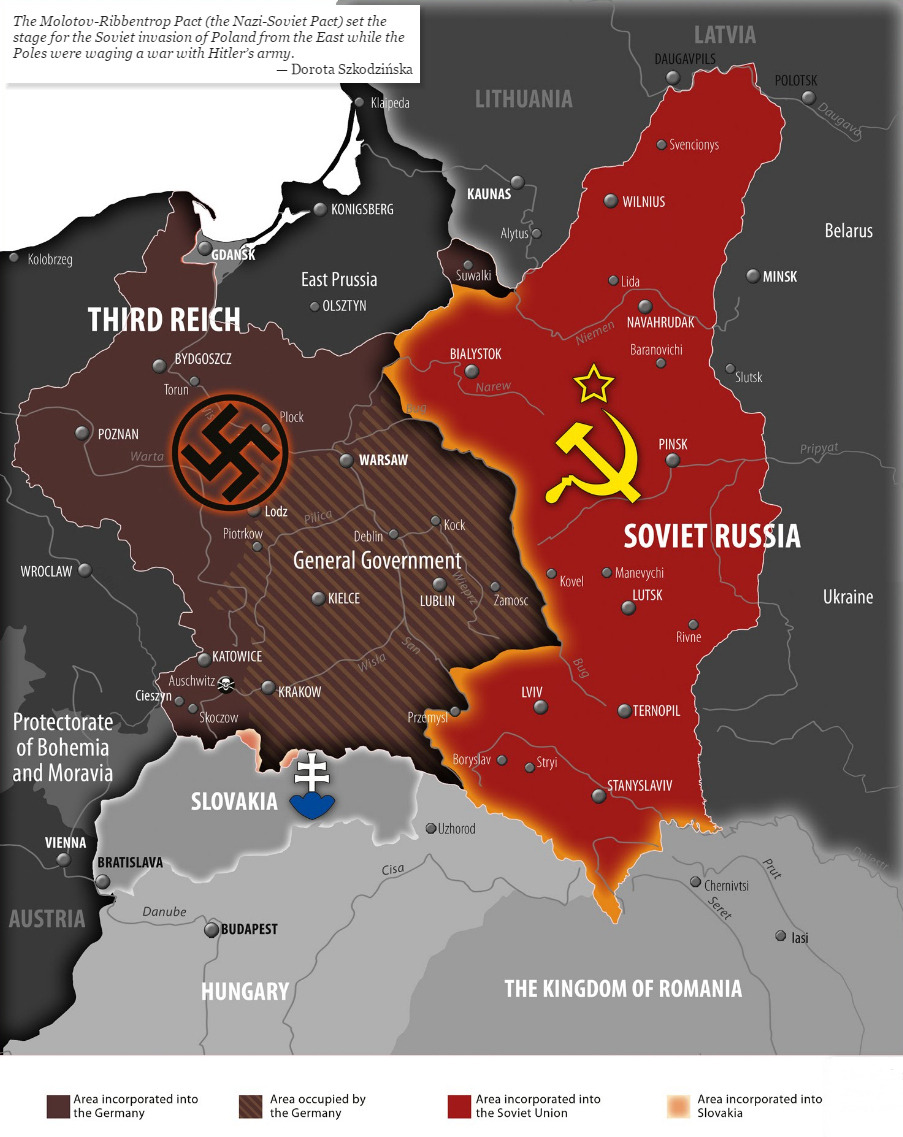
However, the key word is public. The M-R pact also entailed three additional agreements that were kept secret from the international community. The first of the protocols was agreed on the same day as the public M-R pact, 23rd of August 1939, that divided Eastern Europe into Soviet and German spheres of influence. It broke Poland between the two powers and agreed the Baltic states and Finland were to be Soviet areas, and also discussed the possibility of Bessarabia being broken off from the Kingdom of Romania. Then on the 28th of September 1939 a second secret protocol was signed finalising the division of Poland and looked at the division of Lithuania, and officially consinged Bessarabia to the Soviet sphere, a third and final protocol was signed on the 10th of January 1941 in which Germany agreed to waive its claims to Lithuania in exchange for payment from the Soviet Union the occupying power.
 |
| This map shows the differences between the agreed and actual divisions of Europe. |
|
So, the M-R pact was not simply a statement of non-aggression it involved quite a bit of aggression. I usually don't resort to the dictionary, but this is a rare case where I think it is useful to clear up genuine confusion if there is in fact any.
alliance, in international relations, a formal agreement between two or more states for mutual support in case of war. Contemporary alliances provide for combined action on the part of two or more independent states and are generally defensive in nature, obligating allies to join forces if one or more of them is attacked by another state or coalition. Although alliances may be informal, they are typically formalized by a treaty of alliance, the most critical clauses of which are those that define the casus foederis, or the circumstances under which the treaty obligates an ally to aid a fellow member.
https://www.britannica.com/topic/alliance-politics
On the 1st of September 1939 the German army attacked Poland, this was the start of the invasion of Poland by Germany, the Slovak Republic and the Soviet Union. On the 17th of September the Soviet army began its offensive operations in Poland violating the Soviet-Poland Nonaggression pact signed in 1932. Attacked on all sides including an uprising by the Organisation of Ukrainian Nationalists the Polish military resisted until the 6th of October. The Soviet and German military met at Brest-Litovsk (modern day Brest in Belarus) held a joint victory parade and the German army hand over control of the city to the Soviet authorities.
 |
| German officers Generalleutnant Mauritz von Wiktorin (left), General der Panzertruppe Heinz Guderian (centre) and Soviet Kombrig Semyon Krivoshein (right) standing on the platform | |
The scene was captured on film.
In addition to the joint invasion of Poland when the Soviet Union attacked Finland in November of that same year Nazi Germany officially took a stance of neutrality regarding the two nations. While actively supporting the Soviet invasion by taking action to cut off support for Finland including seizing war material sent by Mussolini.
As there was some pro-Finnish agitation in the Scandinavian
countries, they were warned by Berlin ‘not to listen to the
blandishments of League of Nations evangelists and British extremists’. [42]
Thus any hopes the Finnish government might at first have had of German
help vanished. On 8 December the Finnish Minister in Rome had confided
to Ciano that Germany ‘had supplied arms to Finland from the booty
captured during the Polish campaign’, [43]
but on 12 December Hitler yielded to the Naval General Staff’s request
for a ‘clear-cut policy’ towards Finland and for the suspension of arms
deliveries there. [44]
The shipment of arms to Sweden was to be stopped unless the Swedish
government gave a written guarantee that they would not be transferred
to Finland. [45] A few aircraft ordered from Italy before the war and on their way to Helsinki were seized in Germany. [46]
At his second meeting with Molotov in Berlin (13 November 1940),
Hitler pointed out that ‘during the Russo – Finnish war, despite the
danger that Allied bases might be established in Scandinavia, Germany
had meticulously kept her obligations toward Russia’ and that ‘in this
connection she had even gone so far as to deny to the Finnish President
the use of a German cable for a radio address to America’.
https://www.marxists.org/history/ussr/great-patriotic-war/soviet-german-pact/tasca/ch6.htm
And beyond the military sphere the intelligence services of the two powers, the German Gestapo and Soviet NKVD, both brutal secret police forces co-operated on dealing with internal dissent in their new territories.
Both parties will tolerate in their
territories no Polish agitation which affects the territories of the
other party. They will suppress in their territories all beginnings of
such agitation and inform each other concerning suitable measures for
this purpose.
— Secret Supplementary Protocol (2), German-Soviet Boundary and Friendship Treaty 28 September 1939
The co-operation involved the transfer of prisoners of war and actions against Polish resistance groups. And most bizarrely the Soviet Union began handing over many German Communists who had escaped persecution in Germany and Austria.
And yet they get them, to the Gestapo’s great delight. Eighty
antifascists before the 1939 Hitler–Stalin Pact, more than 200 (out of
350 deportees) afterward. Only now do the Germans press for
deportations, stressing the mutual friendly relations between the German Reich and the USSR.
There is no evidence of other pressure, nor of any “reciprocation” to
follow. The Nazis give the numbers, the Soviets supply the names. The
antifascists are sacrificed not according to some overarching principle
of political calculus nor as currency in an exchange but rather as a
kind of gift.
https://thereader.mitpress.mit.edu/the-nazi-soviet-pact-a-betrayal-of-communists-by-communists/
So, we have two direct examples of the two powers effectively collaborating in military and strategic aims. But as the timeline of the secret protocols 1939-1941 demonstrates, the M-R pact was a step along the path of the relationship. In addition there were not one but two economic treaties, the German-Soviet Credit agreement signed in May 1939 and the German-Soviet Commercial agreement (1940). These treaties expanded trade in materials and economic co-operation between the two powers. By 1941 when the German broke off ties by invading the Soviet Union the trade had been worth
- 1,500,000 metric tons (1,700,000 short tons; 1,500,000 long tons) of grains
- 820,000 metric tons (900,000 short tons; 810,000 long tons) of oil
- 180,000 metric tons (200,000 short tons; 180,000 long tons) of cotton
- 130,000 metric tons (140,000 short tons; 130,000 long tons) of manganese
- 180,000 metric tons (200,000 short tons; 180,000 long tons) of phosphates
- 18,000 metric tons (20,000 short tons; 18,000 long tons) of chrome ore
- 16,000 metric tons (18,000 short tons; 16,000 long tons) of rubber
- 91,000 metric tons (100,000 short tons; 90,000 long tons) of soybeans
- 450,000 metric tons (500,000 short tons; 440,000 long tons) of iron ores
- 270,000 metric tons (300,000 short tons; 270,000 long tons) of scrap metal and pig iron
- 200,000 kilograms (440,000 lb) of platinum
|
Total USSR imports |
June 1941 German stocks |
June 1941 (without USSR imports) |
October 1941 German stocks |
October 1941 (without USSR imports)
|
|---|
| Oil products |
827 (912; 814) |
1,220 (1,350; 1,210) |
397 (438; 391) |
821 (905; 808) |
−6.4 (−7; −6.3)
|
| Rubber |
17.1 (18.8; 16.8) |
12.5 (13.8; 12.3) |
−4.4 (−4.9; −4.4) |
11.0 (12.1; 10.8) |
−6.1 (−6.7; −6.0)
|
| Manganese |
171.9 (189.5; 169.2) |
186 (205; 183) |
14.1 (15.5; 13.8) |
150 (170; 150) |
−17.7 (−19.5; −17.4)
|
| Grain |
1,485.2 (1,637.1; 1,461.7) |
1,253 (1,381; 1,233) |
−232.3 (−256.1; −228.7) |
690 (761; 679) |
−794.8 (−876.1; −782.2)
|
| *German stocks in thousands of metric tons (short tons; long tons) (with and without USSR imports-October 1941 aggregate)
|
https://en.wikipedia.org/wiki/German%E2%80%93Soviet_Commercial_Agreement_(1940)
In addition to business interests much of the trade was considered vital to outlast the British Naval blockade that threatened vital German military resources. By 1941 with the conquest of France, Denmark and Norway and guaranteed co-operation from Sweden Hitler believed Germany was no longer dependent on the material supplied by the Soviet Union and a quick victory would mean only a brief disruption in any case.
The Soviet Union also got quite a lot out of those agreements too of course.
Both Admiralties discussed ‘practical agreements’ for the supply of
fuel to German submarines and the use of the ‘northern sea-route’ [69]
by German ships. The German Admiralty was very keen on this last point
and negotiations began towards the end of December 1939. [70]
On 6 February 1940, the German Naval Attaché in Moscow announced that
the Russians were willing to allow a German auxiliary cruiser, ‘Ship
45’, [71]
to sail to the Far East by the ‘Siberian route’. A temporary stiffening
of Molotov’s attitude at the beginning of April seemed to bring them
back to where they started, [72] but preparations for the voyage were eventually resumed ‘with Russia’s cooperation’ [73] and ‘Ship 45’ sailed on 12 August 1940, ‘by the Siberian sea-route, with Russian help’. [74]
The German auxiliary cruiser was thus able to cross the Pacific without
risk and there raid British ships as a privateer. For their part, the
Germans handed over the Lützow to the Russians, [75]
and in the Leningrad shipyards technicians took over the construction
or repair of some of the big ships of the Soviet navy. In November 1940,
Admiral Raeder was convinced that Russia would not attack Germany on
the grounds that she ‘was starting to build up her navy with the help of
Germany’. [76] They were still working together in May 1941. In a memorandum of the 15th of this month Schnurre stated that:
... construction of the cruiser L in
Leningrad is proceeding according to plan, with German supplies coming
in as scheduled. Approximately 70 German engineers and fitters are
working on the cruiser in Leningrad under the direction of Admiral
Feige.
https://www.marxists.org/history/ussr/great-patriotic-war/soviet-german-pact/tasca/ch6.htm
The nature of these agreements both economic and strategically important is very similar to the collaboration of American and British and French businessmen in the same years. (see https://libcom.org/article/how-allied-multinationals-supplied-nazi-germany-throughout-world-war-ii).
Economic agreements and strategic interventions have an air of cold detachment, what is often confused for pragmatism or "realpolitik". But both powers were left with a big issue concerning their abrupt realignment after years of casting each other as a sought of anti-christ like entity. How to explain this to their own populations? The archives of Pravda, the Communist party newspaper has preserved some examples of this push. Consider this article, written during the Soviet occupation of Estonia.

POLITICAL MOOD IN ESTONIA, Pravda, 28 May 1940
TALLINN, 27 May (special correspondent of "Pravda"), (7/14) Recent events in Europe have attracted a lot of attention from various segments of the Estonian population. In contrast to most of the Estonian newspapers, a certain part of the Estonian intelligentsia regards the occupation by the Germans of Denmark in Norway, their invasion of the Netherlands and Belgium as aggression, as the enslavement of small nations.
This part of the intelligentsia preaches a loyal attitude towards England and expresses hatred towards Germany and everything German. In commercial circles, the judgment prevails that it was more profitable to trade with England than with Germany, and that English goods are better than German ones. On May 10, the Tallinn Post newspaper (an edition of the Uus Eesti newspaper) published a feuilleton in which the poor quality of German goods was denounced. That part of the Estonian intelligentsia that is hostile to Germany is spreading rumours that the friendship between Germany and the USSR is fragile and short-lived, that a war between the two countries is inevitable, which will bring suffering to the Estonian people. Some of the people who propagate such sentiments are connected by various threads to the British and American embassies. They can also be found among editorial staff of newspaper "Päevaleht". University of Tartu is also a place where pro-English propaganda is carried out.
translation source.
And there's another strange example of close co-operation between Nazi Germany and the Soviet Union, which concerns the Comintern. This organisation was tasked with handling the international Communist movement, or at least the Communist movement that looked to Moscow for leadership. This proved to be a problem as the Communist Party of Great Britain and the French Communist Party had been actively pushing the lines formulated in response to the Spanish Civil War, extreme patriotism and appeals for their governments to take a firm hand against Germany.
But on 14 September something else happened: the Daily Worker
received a press telegram from the Soviet Union saying it was a robber
war on both sides. Pollitt suppressed this telegram because it was
against the line of the 2 September manifesto. However, at the next
day’s meeting of the party’s Political Bureau, Dutt, ever responsive to
his master’s voice, said the line would have to be revised. Indeed,
Stalin had already given orders to that effect, in a private chat with
Dimitrov on 7 September; Dimitrov had handed the word down to the
Comintern Secretariat, which had approved his theses on 9 September,
instructing the Communist Parties of France, Britain, Belgium and the
USA in particular that they must immediately correct their political
line.
https://www.marxists.org/history/etol/revhist/backiss/vol3/no4/revking.html
The new line was now as the French Communist Party promoted in the winter of 1939 was "The war conducted by the Anglo-French coalition was Imperialist for a certain period, insofar as the coalition was pursuing imperialist ends, had prepared for war, and had worked to bring it about" (see https://www.jstor.org/stable/260642?read-now=1#page_scan_tab_contents ) I highlighted the last part to draw attention to a discrepancy in the line. At the time of the M-R pact the official position of the Soviet Union which was repeated by its supporters was that WWII was the result of the Imperialist actions of the Allies against Germany, and they had been working to prepare for such an action for some time. Contrast this to the original argument at the beginning were the modern supporters of Soviet foreign policy, that the M-R had to be signed because the Western Allies failed to take any step to prevent the rise of German militarism. The imperialism of Britain and France was the official justification the Soviet Union gave for its occupation of the Baltic states.
«[…] it had become necessary to put an end to all the intrigues by which
England and France had tried to sow discord and mistrust between
Germany and the Soviet Union in the Baltic States.
[…]Lithuanian border was evidently inadequately guarded. The Soviet
Government would, therefore, if requested, assist the Lithuanian
Government in guarding its borders.»
Telegram by Molotov

The French Communist Party was so active in pushing the new line attacking Franco Imperialism and defending the M-R pact for preventing war while Nazi Germany was marching in the direction of Paris. The French Communist Party exploited its reputation in the French resistance for decades after the war ended. But while members of the party had fought in the clandestine underground since the beginning of the German occupation, the party itself did not join the resistance struggle until June 1941. If that date seems familiar that was when Nazi Germany ended its period of co-operation with the Soviet Union by launching a massive and brutal invasion of the Soviet Union.
One final point to consider. In its last days the Union of Soviet Socialist Republics had attempted a partial reckoning with the many skeletons in its closet. Thousands of socialists who had been persecuted, tortured and even executed were "rehabilitated", which was the government term for an official admittance of mistakes and wrongful treatment by the government, a secular mea culpa. In 1989 this process reached the M-R pact. In December of that year Alexander Yakovlev, Communist party historian and Politburo member submitted a report to the Congress of People's Deputies of the Soviet Union, the highest governing body of the USSR. The report acknowledged the existence of the secret protocols ending decades of official denial. In response Mikhail Gorbachev denounced the actions of Soviet government (see appendix).
Conclusion
What is the point of all this? Well, aside from challenging a popular narrative that doesn't have much to stand on, I hope to make something clear. What the years just before 1939 show us is that there were no heroes, neither the Soviet Union nor the Western European powers come out of that period with a clean record. They all, including Mussolini came to the conclusion that a powerful and ambitious Germany probably wasn't a good omen for them and looked into ways of checking that threat. The issue though was that none of the powers were willing to risk their own self interest, they would make commitments up to a point but would not stick their necks out for others unless they were absolutely forced to. The Soviet Union was willing to abandon the anti-fascist struggle and collaborate with the British and French Empires, but was not willing to give up its desires to expand into its neighbours. The French were willing to work with the Soviet Union but weren't willing to risk instability in its colonial empire and so on.
Meanwhile Germany was willing to work with the hated Judeo-bolsheviks if it would secure the material it needed for its strategic aims. I think too many people read to much into the word alliance, for many they seem to think it means a long term relationship or genuine fraternal bonds. And that just isn't true, alliances are often temporary and can be made with nations who shouldn't be compatible, an example would be the USA and Israel supporting Iran during its war with Iraq. There is a counter pop-myth that frames the M-R pact and wider Soviet-German relationship as proof of a genuine desire of Stalin to work with Nazi Germany on a deeper level, but that has very little in the way of evidence either.
The failures of the 1930s European powers in preventing the Second World War are the result of the failures of real politik and pragmatic attempts to maximise gain for the lowest costs. There are no friends amongst nations, when push came to shove for the Chinese, Ethiopians, Czechs, Austrians, Spanish, Baltic peoples etc. The great powers were no friends to them either and sold them out when it looked risky. The only reason the Poles weren't added to that list was thanks to timing, Britain and France's war preparations were largely complete and they were more confident and even then France scaled back its military operations on Germany's western borders which allowed the German army to concentrate on Poland. Even at that late date the Western Allies were prioritising their own security against a potential German offensive over providing effective support for the Poles dealing with their actual offensive.
Appendix: Text of the Soviet acknowledgment of the existence of secret agreements with Nazi Germany
CONGRESS OF PEOPLE'S DEPUTIES OF THE USSR
DECISION
of
December 24, 1989 N 979-1
ON POLITICAL AND LEGAL EVALUATION
OF
THE SOVIET-GERMAN NON-AGGRESSION PACT
FROM 1939
1. The
Congress of People's Deputies of the USSR takes note of the
conclusions of the commission on political and legal evaluation of
the Soviet-German non-aggression treaty of August 23, 1939.
2.
The Congress of People's Deputies of the USSR agrees with the opinion
of the Commission that the Non-Aggression Treaty with Germany was
concluded in a critical international situation, in the face of
increasing danger of aggression by Fascism in Europe and Japanese
militarism in Asia, and had as one of its aims to take away from the
USSR the threat of an impending war. Ultimately, this goal was not
achieved, and the miscalculations associated with the presence of
German obligations to the USSR, exacerbated the consequences of
treacherous Nazi aggression. At this time the country was faced with
difficult choices.
The obligations under the treaty came into
force immediately after its signing, although the treaty itself was
subject to approval by the Supreme Soviet of the USSR. The decree of
ratification was adopted in Moscow on August 31, and the instruments
of ratification were exchanged on September 24, 1939.
3. The
Congress considers that the contents of that treaty were not
incompatible with the rules of international law and the treaty
practice of States in making treaty settlements of this kind. But
both at the conclusion of the treaty and at its ratification the fact
was concealed that simultaneously with the treaty a "secret
additional protocol" had been signed, delimiting the "spheres
of interests" of the contracting parties from the Baltic Sea to
the Black Sea, from Finland to Bessarabia.
The originals of the
protocol have not been found in Soviet or foreign archives. However
the graphological, phototechnical and lexical examination of the
copies, maps and other documents, the correspondence of the
subsequent events to the content of the protocol confirm the fact of
its signing and existence.
4. The Congress of
People's Deputies of the USSR hereby certifies that the Treaty of
Non-Aggression of August 23, 1939, and the Treaty of Friendship and
Boundary between the USSR and Germany concluded on September 28th of
that year, as well as other Soviet-German agreements, in accordance
with the rules of international law, lost force at the moment of the
German attack on the USSR, that is June 22, 1941.
5. The
Congress states that the Protocol of August 23, 1939, and other
secret protocols signed with Germany in 1939-1941, both in method of
drafting and in content, were a departure from the Leninist
principles of Soviet foreign policy. Delimitation of "spheres of
interest" of the USSR and Germany and other actions taken in
them were from the legal point of view in contradiction with the
sovereignty and independence of a number of third countries.
The
Congress notes that at that time the relations of the USSR with
Latvia, Lithuania and Estonia were regulated by a system of treaties.
According to the peace treaties of 1920 and the non-aggression
treaties of 1926-1933, their parties undertook to respect each
other's sovereignty and territorial integrity and inviolability in
all circumstances. The Soviet Union had similar obligations towards
Poland and Finland.
6. The Congress states that the negotiations
with Germany on secret protocols were conducted by Stalin and Molotov
in secret from the Soviet people, the Central Committee of the
All-Union Communist Party (b) and the entire Party, the Supreme
Soviet and the USSR Government, these protocols were excluded from
the ratification procedures. Thus the decision to sign them was, in
substance and form, an act of personal power, and in no way reflected
the will of the Soviet people, who are not responsible for this
conspiracy.
7. The Congress of People's Deputies of the USSR
condemns the signing of the "secret additional protocol" of
August 23, 1939 and other secret agreements with Germany. The
Congress recognizes the secret protocols as legally invalid and null
and void from the moment of their signing.
The protocols did not
create a new legal basis for relations between the Soviet Union and
third countries, but were used by Stalin and his entourage to issue
ultimatums and exert forceful pressure on other states in violation
of the legal obligations undertaken before them.
8. The Congress
of People's Deputies of the USSR assumes that awareness of the
complex and contradictory past is part of the process of perestroika,
designed to provide every people of the Soviet Union with
opportunities for free and equal development in an integral,
interdependent world and expanding mutual
understanding.
Chairman
Chairman of the Supreme Soviet of
the USSR
M. GORBACHEV
[Translated from Russian by DeepL, bolding my own]

 Posts
Posts






 La plej granda sekreto de
la internacia aktivado kaj sukcesoj de PSEK estis la t.n. persontaga,
sendeviza interŝanĝo, kio signifis ke partopreno de unu eksterlandano
dum unu tago de PSEK-aranĝo egalis al la partopreno de unu PSEK-ano en
eksterlanda aranĝo. Ni havis multajn partnerojn de tiaj interŝanĝoj. La
plej grava kaj la plej ofte uzata estis la PSEK/GEJ kontrakto, sed ni
havis apartajn kontraktojn kun: TEJO, JEFO, JES, JEB, ĈEJ, BEJ, HEJ, NEJ
kaj KCE en Svislando.
La plej granda sekreto de
la internacia aktivado kaj sukcesoj de PSEK estis la t.n. persontaga,
sendeviza interŝanĝo, kio signifis ke partopreno de unu eksterlandano
dum unu tago de PSEK-aranĝo egalis al la partopreno de unu PSEK-ano en
eksterlanda aranĝo. Ni havis multajn partnerojn de tiaj interŝanĝoj. La
plej grava kaj la plej ofte uzata estis la PSEK/GEJ kontrakto, sed ni
havis apartajn kontraktojn kun: TEJO, JEFO, JES, JEB, ĈEJ, BEJ, HEJ, NEJ
kaj KCE en Svislando..jpeg)


