Search This Blog

Showing posts with label Nationalism. Show all posts

Friday, 14 February 2025

Al Amal First Edition


Friends in the CNT-AIT (France) have sent me the first edition of Al Amal (Hope) a bimonthly newsletter produced by Sudanese anarchists organised under the Sudan Anarchist Gathering. 

At their request I am reproducing its contents here, the pdf of the English version can be downloaded here.

In addition to English there is a section written in Arabic script, I will be copying that here as well but can't guarantee it'll be free of typographical errors, please see the pdf for the original.

If you'd like to know more, support their work or sign up for the next the instalment then read the following information.

This bimonthly is issued jointly by the Sudan Anarchist Gathering,
CNT-AIT France and their friends. If you want to receive the next
issues, please contact us : contact@cnt-ait.info
If you want to support financially the Sudan Anarchist Gathering,
you can use our paypal
https://www.paypal.com/paypalme/cntait1
(please validate “Sending ‘money to an individual’ to pay less bank
charges) Send an email to contact@cnt-ait.info to inform us of the
donation and also so that we can keep you informed of its use.

Bimonthly (January-February 2025) , #1


Why Would You Become an Anarchist in Sudan?

 
This question has always haunted me at many moments in a
country of ideological, cultural, ethnic, tribal, and political
diversity—where countless choices exist, yet none can be
freely made. The moment you are born, your identity in Sudan
is determined by religion, while your tribe plays a crucial role
in shaping your culture and even your fate.
To become an anarchist in Sudan, you must have already
escaped all these imposed identities and the suffocating
constraints that push us into the furnace of the state.
Sudan is a country where war, crises, and disease have never
ceased. Its people, saturated with military, religious, and tribal
ideologies, serve as perfect fuel to ignite conflicts.
In such a country, I have always looked at my life with
amazement. Our struggles often resemble action films—
perhaps bizarre or unbelievable to outsiders—where survival
means constantly fleeing from warring factions, dodging a hail
of bullets fired directly at you. Bullets of the state, religion,
tribe, sect, and armed factions.


Choosing to be an anarchist is an expression of true awareness
of the failures of these systems. It is a consciousness that
pushes you to the limits of both practical struggle and the
deeply complex human experience. And this path leads to only
two possible outcomes: you either survive as a true
revolutionary resister, or you are consumed by the spiral of
power.
Just as authority in Sudan takes many forms, so does
opposition. There are political resistance movements, parties,
mercenary armed groups, so-called revolutionary and liberal
militias built on tribal structures, and cultural factions engaged
in deep propaganda-driven authoritarianism.
These intertwined hierarchies form the crises of Sudanese
peoples. Sudan is, in reality, a collection of small peoples
trapped within a state that wields brutal power, recognizing no
human rights beyond its own interests.
Furthermore, the ideology of extremist Islamists has been
another tool for deepening ignorance and backwardness in
Sudan.


Striving to confront all of this as a lone anarchist is like fighting
as a wolf among packs of hyenas. If they find a single weakness
in you, it will mean your inevitable destruction.
The path forward begins with seeking out those who share your
ideas, developing them, and offering them knowledge and
education. As an anarchist, you carry the feeling that wherever
you are, and whatever your capacity, your mission is to spread
freedom. The price of that freedom may be high—it may even
cost you your life. Yet, all of this is just a small contribution to
the scale of liberation that people need to live a dignified
human life.

 Freedom is the highest state of being, and anarchism shows us
how to achieve and practice it.
Freedom is not just a poetic word to express aspirations—it is
an effort, a commitment to being free with yourself and others,
and a struggle to make freedom a reality. To be an anarchist is
a blessing that cannot be monopolized or hidden. To be free is
to be an anarchist, and to be an anarchist is to be free.
— Fawaz Murtada


 Sudan: they are not satisfied with this
blood !

 
After nearly two years of war, the truths and objectives of
this war are becoming increasingly clear: the aim is simply
to crush the revolution. Bashir’s recent speech, in which he
referred to the revolutionaries as "scoundrels," reflects the
typical rhetoric of Islamists when describing young
revolutionaries. He further accused them of wanting to
return with violence and bloodshed, referring to the
beginning of retaliatory operations—something the cadres
of the Islamist terrorist movement have threatened since the
war began.


They do not see the Janjaweed as their enemy; in fact, they
have convinced themselves that this war has already been
decided in their favor. But how can they claim victory when
the Sudanese people are dead, wounded, displaced, or
missing? I wonder how such individuals can even be human
like us. These are the same people who killed the people
from the start, divided them, sold off the nation’s resources,
and then murdered them in cold blood.
I do not know the extent of the destruction they wish to
achieve, but I now realize that if new campaigns of
oppression emerge, we must rise up, renew our commitment
to our martyrs, and resist them until our very last breath.
#TheRevolutionLivesOn, you scoundrels.

 Standing against the Rapid Support
Forces (RSF) does not imply siding with
the state


Standing against the Rapid Support Forces (RSF) does not
imply siding with the state, especially for forces that foresaw
the trajectory of this war from the outset. However, today,
propaganda directed against revolutionary forces seeks to
distort and dilute their longstanding opposition to the
existence of this mafia since its inception. The divisive
policies for Sudan, which the RSF has been accelerating
more aggressively than the state itself, reveal the true
intentions this institution has tried to impose through force
and coups.

I want to highlight the nature of the discourse by leaders of
the armed forces, such as the rhetoric we've witnessed
regarding the newly formed militias under the pretext of
fighting the RSF. These narratives have paved the way for
the establishment of a peculiar belief in the military
weakness of the state’s armed forces. This, in turn, opens the
door wide for the emergence of more armies and armed
groups. This is the policy of the state's mafia, characterized
by revoltingly sentimental speeches that in no way reflect
the sacrifices of the Sudanese people.

Reconciliation with, and the honoring of, those who have
killed the people—effectively giving them a platform—
does not fall short of the crimes they committed. Instead, it
reinforces these crimes and motivates further genocides.
The popular forces must begin to build a counterforce to
combat the propaganda of both the RSF mafia and the
Islamist mafia, through direct confrontation of the lies that
accumulate and exacerbate crises, the consequences of
which fall solely on the people.

The struggle in Sudan transcends the conventional historical
forms of resistance, such as armed struggle in military
policies or civil activism through union-building, protests,
and political advocacy.

Sudan’s unique context has given rise to diverse forms of
struggle, shaped by the multifaceted nature of oppression.
This diversity reflects the country’s complexity, even in its
injustices. However, anarchists stand out in their deep
examination of a critical issue rooted in the fabric of
Sudanese society: tribalism—a force more regressive and
extreme than nationalism itself.

For decades, Sudanese anarchists have critically analyzed
the role of tribalism and its dominance, tracing its impact
from the early days of small warring tribal states, through
the colonial era’s reliance on tribal alliances, to its current
status as a driving force behind Sudan’s persistent conflicts.
While tribalism remains central to the ongoing war and its
continuation, Sudanese political forces often address this
issue with hesitance, constrained by either political ties to
tribes or fear of confronting tribal authority.

To shed light on this neglected issue, comrade Fawaz
Murtada will explore the anarchist perspective on the history
and impact of tribalism in Sudan through a series of articles.

 The Tribe and the State : An Attempt to
Analyze Authoritarian Conflict in
Sudan from an Anarchist Perspective


This is an attempt from my humble self to explain the
authoritarian conflict in Sudan from my point of view as an
anarchist born in Sudan, drawing from my knowledge of its
conflicts.


Before British colonialism, Sudan did not know a unified
state but rather consisted of small states and kingdoms
governed by tribal, ethnic, or clan systems, such as the
Kingdom of Wadai, the Nubians, the Nuba Mountains’
kingdoms, and many others.


Sudan itself is divided into regions that bear significant
cultural and social differences, making it difficult to
compare with any other state.


The north of Sudan, for example, is inhabited by the
remnants of Nubian kingdoms whose people share cultural
ties across the border with Egypt, extending to Aswan.
In eastern Sudan, you will find the Beja tribes, Beni Amer,
and Hadendowa, who have deep connections with Eritrea
and Ethiopia.


Darfur, too, is divided into north and south regions, with
significant cultural and ethnic differences. These areas also
have connections with Chad and the Central African
Republic.


The large kingdoms that the colonial powers tried to unite
in pursuit of wealth, given Sudan’s riches in gold and fertile
lands suitable for cotton cultivation at the time, remain at the
heart of international disputes over Sudanese resources
today. Colonial powers were unable to assimilate these
communities into a single entity; instead, they applied
policies that resulted in the separation of the north and south,
as is still evident today.


All of this shows that, despite the revolutions that sought to
expel the colonizers and unify the Sudanese kingdoms and
communities, the tribal control system has remained
dominant and in control to this day. This is one of the
anarchist perspectives we will try to apply to our reality,
aiming to deconstruct it through this lens.


Tribe and State


The tribe is a miniature form of social authority that
possesses its own authoritarian culture and is governed by
the authority of a tribal leader or chief, characterized by a
hereditary transfer of leadership in most cases. It has been
and continues to be the main obstacle in transforming the
Sudanese people from a center of tribal conflict, violence,
and immersion in ignorance and backwardness to a better
stage.


Colonialism contributed to shaping hostilities between
tribes by distinguishing some from others and arming them,
granting them state authority, which formed complex
coalitions of diverse human groups in even the simplest
communal matters.

 The transition from tribe to nationhood has
not occurred in Sudan, leaving us at a late
stage of self-organizational advancement.
Even in the form of the modern
state post-independence in Sudan, tribal
systems and local administrations still control
the state in one way or another, paving the
way for the spread of racism, tribal conflicts,
and civil wars.

The contemporary problem of Sudan, which
is exploited by imperialist forces to control its
strategic location and vast resources, is the
formation of armed movements and militias
based on ethnic and racial grounds in an
attempt to divide and fragment the country
for easier control.

Today, we find that Sudan has seven armed
armies that have started fighting among
themselves, and it is only a matter of time
before chaos engulfs the entire country or it
disintegrates. It is essential to combat the
tribal mindset within the people, just as it is
important to fight against nationalist ideas
that lead to ongoing civil wars.

To be continued …An anarchist from Sudan.

(AIT) ﺣﻥ ﺍﻻﺗﺣﺎﺩ ﺍﻟﻧﻘﺎﺑﻲ ﺍﻟﺩﻭﻟﻲ، ﺟﻣﻌﻳﺔﺍﻟﺷﻐﻳﻠﺔ ﺍﻟﻌﺎﻟﻣﻳﺔ 


ﻟﻘﺪ ﻛﻨﺎ ﺩﺍﺋﻤًﺎ ﺃﻭﻟﺌﻚ ﺍﻟﺬﻳﻦ ﻳﻌﻤﻠﻮﻥ ﺑﺘﻀﺎﻣﻦ، ﺑﺎﺳﺘﺨﺪﺍﻡ ﺍﻟﻤﺴﺎﻋﺪﺓ ﺍﻟﻤﺘﺒﺎﺩﻟﺔ، ﻭﺗﻌﺰﻳﺰ
ﺍﻹﺩﺍﺭﺓ ﺍﻟﺬﺍﺗﻴﺔ.
ﻧﺤﻦ ﺃﻭﻟﺌﻚ ﺍﻟﺬﻳﻦ ﺗﻌﻠﻤﻮﺍ ﻣﺎ ﻳﺘﻄﻠﺒﻪ ﺍﻟﻜﻔﺎﺡ ﻟﻠﺤﺼﻮﻝ ﻋﻠﻰ ﻗﻄﻌﺔ ﺧﺒﺰ. ﺃﻭﻟﺌﻚ ﺍﻟﺬﻳﻦ
ﻟﻢ ﻳﺘﻤﻜﻨﻮﺍ ﻣﻦ ﺍﻟﻘﺮﺍءﺓ ﺃﻭ ﺍﻟﻜﺘﺎﺑﺔ، ﻟﻜﻨﻬﻢ ﻋﺮﻓﻮﺍ ﺑﻮﺿﻮﺡ ﻣﻦ ﻫﻮ ﺍﻟﻌﺪﻭ.
ﻧﺤﻦ ﺃﻭﻟﺌﻚ ﺍﻟﺬﻳﻦ ﻳﺘﺤﺪﻭﻥ ﻟﻴﻜﻮﻧﻮﺍ ﺃﻗﻮﻯ ﻣﻦ ﺃﻭﻟﺌﻚ ﺍﻟﺬﻳﻦ ﻳﻀﺎﻳﻘﻮﻧﻨﺎ، ﺍﻟﺬﻳﻦ
ﻳﻔﺼﻠﻮﻧﻨﺎ، ﺍﻟﺬﻳﻦ ﻳﻄﺮﺩﻭﻧﻨﺎ، ﺍﻟﺬﻳﻦ ﻳﻄﻠﻘﻮﻥ ﻋﻠﻴﻨﺎ ﺍﻟﺮﺻﺎﺹ، ﺍﻟﺬﻳﻦ ﻳﺴﺠﻨﻮﻧﻨﺎ
ﻭﻳﻌﺬﺑﻮﻧﻨﺎ.
ﻧﺤﻦ ﺃﻭﻟﺌﻚ ﺍﻟﺬﻳﻦ ﻳﻌﻠﻤﻮﻥ ﺃﻥ ﺍﻟﻨﻘﺎﺑﺔ ﻟﻴﺴﺖ ﺍﺷﺘﺮﺍﻛًﺎ ﻓﻲ ﻣﺴﺘﺸﺎﺭ ﻗﺎﻧﻮﻧﻲ ﺃﻭ ﻣﺰﻭﺩ
ﺑﻤﺤﺎﻣﻴﻦ ﺭﺧﻴﺼﻴﻦ، ﻭﺃﻥ ﺍﻻﺗﺤﺎﺩ ﻟﻴﺲ ﻓﺘﺢﺍﻣﺘﻴﺎﺯ ﺗﺠﺎﺭﻱ، ﻭﺃﻥ ﺍﻻﺗﻔﺎﻗﺎﺕ ﺑﻴﻦ
ﺍﻟﺮﻓﺎﻕ ﻟﻴﺴﺖ ﺃﻭﺍﻣﺮ، ﻭﺃﻥ ﺍﻟﻘﻮﺓ ﺗﻜﻤﻦ ﻓﻲ ﺍﻟﺜﻘﺔ ﻭﺃﻥ ﺍﻷﻓﻜﺎﺭ ﺗﺄﺗﻲ ﻗﺒﻞ ﺍﻟﺸﻌﺎﺭﺍﺕ
ﻭﺍﻟﺸﻌﺎﺭﺍﺕ ﺍﻟﺘﺠﺎﺭﻳﺔ.
ﻧﺤﻦ ﻧﻌﻤﻞ ﻭﻧﻘﺮﺭ ﺑﺄﻧﻔﺴﻨﺎ، ﻭﻟﻬﺬﺍ ﻧﺤﻦ ﻻ ﻧﻜﻮﻥ ﺃﺑﺪًﺍ ﻭﺣﺪﻧﺎ، ﺑﻔﻀﻞ ﺍﻟﺮﺍﺑﻂ ﻏﻴﺮ
ﺍﻟﻘﺎﺑﻞ ﻟﻠﺘﺠﺰﺋﺔ ﺍﻟﺬﻱ ﻳﻮﺣﺪ ﻧﻀﺎﻻﺕ ﺍﻟﻌﻤﺎﻝ ﻭﺍﻟﻤﺠﺘﻤﻌﺎﺕ ﻣﻦ ﺟﻤﻴﻊ ﺃﻧﺤﺎء ﺍﻟﻌﺎ.ﻟﻢ
ﻧﺤﻦ ﺃﻭﻟﺌﻚ ﺍﻟﺬﻳﻦ ﻳﻀﻌﻮﻥ ﺍﻷﺧﻼﻕ ﻗﺒﻞ ﺍﻟﺠﻤﺎﻟﻴﺎﺕ ﻭﺍﻟﻤﺒﺎﺩﺉ ﻗﺒﻞ ﺍﻟﻤﺼﺎﻟﺢ.
ﻧﺤﻦ،
ﻧﺤﻦ ﺍﻻﺗﺤﺎﺩ ﺍﻟﻨﻘﺎﺑﻲ ﺍﻟﺪﻭﻟﻲ،AIT

 ﺇﻟﻰ ﻁﻐﺎﺓ ﺍﻟﻌﺎﻟﻡ–ﺃﺑﻭ ﺍﻟﻘﺎﺳﻡ ﺍﻟﺷﺎﺑﻰ
ﺃﻻ ﺃﻳﻬﺎ ﺍﻟﻅﺎﻟﻡ ﺍﻟﻣﺳﺗﺑﺩ
ﺣﺑﻳﺏ ﺍﻟﻅﻼﻡ ﻋﺩﻭ ﺍﻟﺣﻳﺎﻩ
ﺳﺧﺭﺕ ﺑﺄﻧﺎﺕ ﺷﻌﺏ ﺿﻌﻳﻑ
ﻭ ﻛﻔﻙ ﻣﺧﺿﻭﺑﺔ ﻣﻥ ﺩﻣﺎﻩ
ﻭ ﺳﺭﺕﺗﺷﻭﻩ ﺳﺣﺭ ﺍﻟﻭﺟﻭﺩ
ﻭ ﺗﺑﺫﺭ ﺷﻭﻙ ﺍﻻﺳﻰ ﻓﻲ ﺭﺑﺎﻩ
ﺭﻭﻳﺩﻙ ﻻ ﻳﺧﺩﻋﻙ ﺍﻟﺭﺑﻳﻊ
ﻭ ﺻﺣﻭ ﺍﻟﻔﺿﺎء ﻭ ﺿﻭء ﺍﻟﺻﺑﺎﺡ
ﻓﻔﻲ ﺍﻻﻓﻖ ﺍﻟﺭﺣﺏ ﻫﻭﻝ ﺍﻟﻅﻼﻡ
ﻭ ﻗﺻﻑ ﺍﻟﺭﻋﻭﺩ ﻭ ﻋﺻﻑ ﺍﻟﺭﻳﺎﺡ
ﺣﺫﺍﺭ ﻓﺗﺣﺕ ﺍﻟﺭﻣﺎﺩ ﺍﻟﻠﻬﻳﺏ
ﻭ ﻣﻥ ﻳﺑﺫﺭ ﺍﻟﺷﻭﻙ ﻳﺟﻥ ﺍﻟﺟﺭﺍﺡ
ﺗﺄﻣﻝ ﻫﻧﺎﻟﻙ ﺃﻧﻰ ﺣﺻﺩﺕ ﺭﺅﻭﺱ ﺍﻟﻭﺭﻯ ﻭ ﺯﻫﻭﺭ ﺍﻷﻣﻝ
ﻭ ﺭﻭﻳﺕﺑﺎﻟﺩﻡ ﻗﻠﺏ ﺍﻟﺗﺭﺍﺏ ﺃﺷﺭﺑﺗﻪ ﺍﻟﺩﻣﻊ ﺣﺗﻰ ﺛﻣﻝ
ﺳﻳﺟﺭﻓﻙ ﺳﻳﻝ ﺍﻟﺩﻣﺎء 
ﻭ ﻳﺄﻛﻠﻙ ﺍﻟﻌﺎﺻﻑ ﺍﻟﻣﺷﺗﻌﻝ

 ﻣﻜﺘﺒﺔ ﺍﻟﻘﻄﺔ ﺍﻟﺴﻮﺩﺍء: ﻣﻦ ﻧﺤﻦ؟
ﻣﻦ ﻧﺤﻦ ﻣﻜﺘﺒﺔ ﺍﻟﻘﻂ ﺍﻷﺳﻮﺩ ﺍﻻﻟﻜﺘﺮﻭﻧﻴﺔ ﻫﻲ ﻣﻜﺘﺒﺔ ﺍﻟﻜﺘﺮﻭﻧﻴﺔ ﺟﻤﺎﻋﻴﺔ ﺗﻬﺪﻑ ﺇﻟﻰ
ﺍﻟﻤﺮﺋﻴﺔ ﺍﻟﻤﻮﺍﺩ ﻭﺗﻮﻓﻴﺮ ﺍﻟﻜﺘﺮﻭﻧﻲ، ﺑﺸﻜﻞ ﺍﻟﺜﻮﺭﻳﺔ ﺍﻟﺘﺤﺮﺭﻳﺔ ﺍﻟﻜﺘﺐ ﻧﺸﺮ
ﻭﺍﻟﻤﺴﻤﻮﻋﺔ. ﺃﺳﺲ ﻫﺬﻩ ﺍﻟﻤﻜﺘﺒﺔ ﻣﺠﻤﻮﻋﺔ ﻣﻦ ﺍﻷﻧﺎﺭﻛﻴﻴﻦ )ﺍﻟﻼﺳﻠﻄﻮﻳﻴﻦ( ﺍﻳﻤﺎﻧﺎ
ﺑﻤﺎ ﻳﻬﺪﻓﻮﻥ ﺍﻟﻴﻪ ﻟﺬﺍ ﺗﺘﻮﻓﺮ ﺍﻟﻤﻮﺍﺩ ﻋﻠﻰ ﺍﻟﻤﻮﻗﻊ ﺑﺸﻜﻞ ﻣﺠﺎﻧﻲ. ﺍﻟﻤﻜﺘﺒﺔ ﺗﻘﺪﻡ ﺍﻷﺩﺏ
ﺍﻷﻧﺎﺭﻛﻲ ﻭﺗﻨﺘﻈﻢ ﻭﻓﻘﺎ ﻟﻠﻤﺒﺎﺩﺉ ﺍﻷﻧﺎﺭﻛﻴﺔ. ﺗﺘﺨﺬ ﺍﻟﻘﺮﺍﺭﺍﺕ ﻓﻲ ﺍﻟﻤﻜﺘﺒﺔ ﺑﺸﻜﻞ
ﺩﻳﻤﻘﺮﺍﻁﻲ ﻓﻲ ﻛﺎﻓﺔ ﺍﻟﻤﻮﺍﺿﻴﻊ ﺍﻟﻤﺘﻌﻠﻘﺔ ﻓﻲ ﺗﻮﺯﻳﻊ ﻛﺎﻓﺔ ﺍﻷﻋﻤﺎﻝ. ﺇﻧﻨﺎ ﻻ ﻧﻬﺪﻑ
ﻟﻠﺮﺑﺢ ﺑﻞ ﺗﻮﻓﻴﺮ ﺍﻷﺩﺏ ﺍﻟﺘﺤﺮﺭﻱ ﺑﺎﻟﻠﻐﺔ ﺍﻟﻌﺮﺑﻴﺔ ﻋﻠﻰ ﺍﻟﺸﺒﻜﺔ ﺍﻻﻟﻜﺘﺮﻭﻧﻴﺔ. ﺇﻧﻨﺎ
ﻧﺄﻣﻞ ﺃﻥ ﻧﻮﺳﻊ ﻫﺬﺍ ﺍﻟﻤﺸﺮﻭﻉ ﻭﻓﻘﺎ ﻟﻘﺪﺭﺍﺕ ﺍﻟﻤﺘﻄﻮﻋﻴﻦ ﻓﻲ ﺍﻟﻤﻜﺘﺒﺔ ﻭﺃﻥ ﻧﺼﻞ ﺇﻟﻰ
ﺣﺪ ﻁﺒﺎﻋﺔ ﻭﺗﻮﺯﻳﻊ ﺍﻷﺩﺏ ﺍﻟﺘﺤﺮﺭﻱ ﺍﻟﺬﻱ ﻧﻀﻌﻪ، ﻟﺬﺍ ﻭﺿﻌﻨﺎ ﻣﻮﺍﺩﻧﺎ ﻓﻲ ﺧﺪﻣﺔ
ﻛﺎﻓﺔ ﺍﻷﻓﺮﺍﺩ ﻭﺍﻟﻤﺠﻤﻮﻋﺎﺕ ﻓﻲ ﺍﻟﻌﺎﻟﻢ ﺍﻟﻌﺮﺑﻲ ﻭﺍﻟﻌﺎﻟﻢ ﺣﻴﺚ ﻳﻤﻜﻨﻬﻢ ﻁﺒﺎﻋﺔ ﻭﺗﻮﺯﻳﻊ
ﻣﺎ ﻧﺼﺪﺭ ﻭﻓﻘﺎ ﻟﺸﺮﻭﻁ ﺍﻟﻤﺸﺎﻉ ﺍﻻﺑﺪﺍﻋﻲ ﺍﻟﺬﻱ ﻳﺴﺎﻋﺪﻧﺎ ﻋﻠﻰ ﺍﻳﺼﺎﻝ ﻋﻤﻠﻨﺎ ﺇﻟﻰ
ﺃﻛﺒﺮ ﻋﺪﺩ ﻣﻤﻜﻦ ﻣﻦ ﺍﻟﻨﺎﺱ. ﻳﺘﻢ ﺗﺤﺪﻳﺚ ﺍﻟﻤﻮﻗﻊ ﺍﻻﻟﻜﺘﺮﻭﻧﻲ ﻭﻓﻘﺎ ﻟﻠﺤﺎﺟﺔ ﻭﻭﻓﻘﺎ
ﻟﻠﺮﺅﻯ ﺍﻟﺠﺪﻳﺪﺓ ﻟﻠﻤﺘﻄﻮﻋﻴﻦ، ﻭﻟﻜﻦ ﻫﺬﺍ ﻻ ﻳﻨﻔﻲ ﺍﻟﺘﻮﺍﺻﻞ ﺍﻟﻤﺴﺘﻤﺮ ﻣﻊ ﺟﻤﻴﻊ
ﺍﻟﺰﻭﺍﺭ ﻭﺍﻟﻘﺮﺍء ﻓﻲ ﺃﻱ ﻭﻗﺖ ﻛﺎﻥ. ﻛﻤﺎ ﺃﻧﻪ ﻳﻤﻜﻦ ﻣﺘﺎﺑﻌﺔ ﻧﺸﺎﻁﺘﻨﺎ ﻋﻠﻰ ﺻﻔﺤﺘﻨﺎ
ﻋﻠﻰ ﻣﻮﻗﻊ ﺍﻟﺘﻮﺍﺻﻞ ﺍﻻﺟﺘﻤﺎﻋﻲ ﺍﻟﻔﻴﺲ ﺑﻮﻙ، ﻭﺣﻴﺚ ﻳﺘﻢ ﻧﺸﺮ ﺍﻟﻤﻘﺎﻻﺕ ﺍﻟﻤﺘﺮﺟﻤﺔ
ﺍﻟﻤﻮﻗﻊ ﺣﻴﺚ ﻻ ﺗﻮﺿﻊ ﺗﻠﻚ ﺍﻟﻤﻘﺎﻻﺕ ﻋﻠﻰ ﺍﻟﻤﺘﻌﻠﻘﺔ ﺑﺎﻟﻔﻜﺮ ﺍﻟﻼﺳﻠﻄﻮﻱ
ﺍﻻﻟﻜﺘﺮﻭﻧﻲ، ﻭﺃﺣﻴﺎﻧﺎ ﻗﺪ ﻧﺠﻤﻊ ﻋﺪﺩ ﻣﻦ ﺍﻟﻤﻘﺎﻻﺕ ﻓﻲ ﻛﺘﻴﺒﺎﺕ ﻭﻛﺘﺐ ﻣﻨﻈﻤﺔ.
ﻓﻲ ﺣﺎﻝ ﻭﺟﻮﺩ ﺃﻱ ﺳﺆﺍﻝ، ﺍﻗﺘﺮﺍﺡ، ﻁﻠﺐ، ﻣﺸﻜﻠﺔ، ﻣﺴﺎﻫﻤﺔ، ﺃﻭ ﻓﻲ ﺣﺎﻝ ﺍﻟﺮﻏﺒﺔ
ﻓﻲ ﺗﻄﻮﻉ ﻣﻌﻨﺎ ﺗﻮﺍﺻﻞ ﻣﻌﻨﺎ ﻋﺒﺮ ﺍﻟﺒﺮﻳﺪ ﺍﻻﻟﻜﺘﺮﻭﻧﻲ:

ﻣﻦ ﺃﺟﻞ ﻣﺴﺘﻘﺒﻞ ﻳﺒﻨی ﻣﻦ ﻗﺒﻠﻨﺎ ﻧﺤﻦ ﺟﻤﻴﻌﺎ

ﺍﻷﺳﺋﻠﺔ ﻭﺍﻷﺟﻭﺑﺔ ﺣﻭﻝ ﺍﻷﻧﺎﺭکﻳﺔ

ﻫﺬﺍ ﺍﻟﻜﺘﻴﺐ ﺗﻢ ﺗﺼﻤﻴﻤﻪ ﺑﻮﺍﺳﻄﺔRebel City، ﻣﺠﻤﻮﻋﺔ ﺃﻧﺎﺭکﻲ ﺓ ﻣﻦ ﺑﺮﻳﺘﺎﻧﻴﺎ ﻟﻨﺪﻥ.
ﻧﺤﻦ ﻧﻘﻮﻡ ﺑﻨﺸﺮ ﻛﺘﻴﺒﺎﺕ ﻭ ﻣﻨﺸﻮﺭﺍﺕ ﺇﺧﺒﺎﺭﻳﻪ ﻋﻦ ﺗﻨﻈﻴﻢ ﺍﻟﻤﺠﺘﻤﻊ ﻭ ﺍﻷﻧﺎﺭکﻴﺔﻭ ﻧﻘﻮﻡ ﺑﺰﻳﺎﺭﺓ ﺍﻟﻤﺪﺍﺭﺱ
ﻭ ﺍﻟﻤﻌﺎﻫﺪ ﺍﻟﺘﻌﻠﻴﻤﻴﻪ ﻟﻨﺘﺤﺪﺙ ﻋﻦ ﺃﻓﻜﺎﺭﻧﺎ ﻣﻊ ﺍﻟﺸﺒﺎﺏ .
ﺃﺛﻨﺎء ﻣﻨﺎﻗﺸﺎﺗﻨﺎ ﻣﻊ ﺍﻟﻄﻼﺏ ﺗﻄﻔﻮ ﻟﻠﺴﻄﺢ ﻛﺜﻴﺮ ﻣﻦ ﺍﻷﺳﺌﻠﺔ، ﻟﺬﻟﻚ ﺑﺎﺩﺭﻧﺎ ﺑﻌﻤﻞ ﻛﺘﻴﺐ ﻟﻺﺟﺎﺑﺔ ﻋﻦ
ﺑﻌﺾ ﻫﺬﻩ ﺍﻷﺳﺌﻠﺔ، ﺇﺟﺎﺑﺎﺕ ﺗﻢ ﺍﻟﺘﺤﺼﻞ ﻋﻠﻴﻬﺎ ﻣﻦ ﻣﺨﺘﻠﻒ ﺍﻷﺷﺨﺎﺹ ﻭ ﻧﺄﻣﻞ ﺃﻥ ﺗﻮﻓﺮ ﺭﻛﻴﺰﻩ ﻭﺍﺿﺤﺔ
ﻋﻦ ﻛﻴﻒ ﻳﻤﻜﻨﻨﺎ ﺃﻥ ﻧﺼﻨﻊ ﻣﺠﺘﻤﻊ ﺃﻓﻀﻞ ﺑﺘﻨﻈﻴﻢ ﺍﻧﻔﺴﻨﺎ ﻭﻓﻘﺎ ﻟﻠﻤﺒﺎﺩﺉ ﺍﻷﻧﺎﺭکﻴﺔ .
ﻫﺬﺍ ﺍﻟﻜﺘﻴﺐ ﻣﺠﺰء ﺇﻟﻰ ﺛﻼﺛﺔ ﺃﻗﺴﺎﻡ. ﺍﻷﻭﻝ " ﻣﺎ ﻫﻲ ﺍﻷﻧﺎﺭکﻴﺔ؟ " ﻫﺬﺍ ﺍﻟﺠﺰء ﻳﺸﺮﺡ ﻓﻜﺮﺓ ﺍﻷﻧﺎﺭکﻴﺔ ﻭ
ﻓﻴﻢ ﺗﺨﺘﻠﻒ ﻋﻦ ﺳﺎﺋﺮ ﺍﻷﻧﻈﻤﺔ ﺍﻷﺧﺮﻯ .
ﺍﻟﺜﺎﻧﻲ“ﻛﻴﻒ ﻳﺒﺪﻭ ﺍﻟﻤﺠﺘﻤﻊ ﺍﻷﻧﺎﺭﻛﻲ؟”ﻫﺬﺍ ﺍﻟﺠﺰء ﻳﺮﻳﻨﺎ ﻛﻴﻔﻴﺔ ﺗﻄﺒﻴﻖ ﻣﺒﺎﺩﻱء ﺍﻷﻧﺎﺭکﻴﺔ ﻓﻣﺨﺘﻠﻒ ﻲ
ﺃﺟﺰﺍء ﺍﻟﻤﺠﺘﻤﻊ.
ﺍﻟﺜﺎﻟﺚ”ﻛﻴﻒ ﻳﻤﻜﻨﻦ ﺍﺗﺤﻘﻴﻖ ﺫﻟﻚ؟”ﻫﺬﺍ ﺍﻟﺴﺆﺍﻝ ﻣﻄﺮﻭﺡ ﻋﻠﻰ ﺍﻟﺠﻤﻴﻊ، ﻛﻴﻒ ﻳﻤﻜﻨﻨﺎ ﺍﻟﺒﺪء ﺑﺘﻨﻈﻴﻢ
ﺃﻧﻔﺴﻨﺎ ﺣﺘﻰ ﻧﺼﻨﻊ ﻋﺎﻟﻤﺎ ﺃﻓﻀﻞ؟

Wednesday, 26 July 2023

Bakunin for anti-Imperialists by Arthur Lehning


Author Biography

Paul Arthur Müller-Lehning (1899-2000), born in Utrecht,
the Netherlands, was an anarchist and syndicalist from
the 1920s. Involved in the Anti-Militarist Bureau and the
syndicalist International Workingmen’s Association, he
fled Nazi Germany for the Netherlands in 1933. In 1935, he
helped found the International Institute for Social History
(IISH), which includes the Mikhail Bakunin archives, and
the Karl Marx / Friedrich Engels papers. In 1940, he fled
to Britain when the Nazis invaded. He retained some
influence after his return to Europe. A prolific writer and
editor, his masterwork was the edited works of Bakunin,
published in French in 1976.


The Use of Reading Bakunin for Anti-Imperialists

On imperialism itself, [Mikhail] Bakunin [1814-1876] has nothing specifically
to say. That is not strange, because imperialism in its modern form had not
yet appeared; besides, opposition to imperialism by a revolutionary is a rather
obvious thing. But I think Bakunin’s writings can be useful to anti-imperialists
in several ways. Firstly, on account of the general view held by Bakunin about
the essence of the revolutionary struggle and his conceptions about federalism
and the state. Secondly, on account of his activities in the eighteen forties.


As far as the last point is concerned, it is clear that I don’t wish to stress it too
much. All historical parallels can be abusive. However, it is not abusive to point
out the similarities between various kinds of Nineteenth Century nationalism
and anti-imperialism in our time. This is not only because a great deal of today’s
anti-imperialist fight is carried out on nationalist platforms, but also on account
of the intensity with which the banner of then and that of today monopolise
the attention of men with radical consciousness. In this respect, Bakunin has
important things to say.

Bakunin from Nationalism to Anarchism

Bakunin’s so-called “revolutionary Pan-Slavism” in the 1840s is usually
misunderstood. In his famous Appeal to the Slavs (1848) he advocated a coalition
between the Slavs of Austria, the Hungarians and the democratic Germans in
order to liquidate the Austrian Empire and to coalesce with the Poles for an
independent Poland and a revolution in Russia. He hoped that a Slav Federation
would encourage the Slavs to take part in the struggle the revolution was waging
throughout Europe. The social liberation of the masses and the emancipation
of the suppressed nationalities should, in the view he then held, lead to
a universal federation of European republics.


After the failure of the Polish insurrection [for independence – Ed.] of 1863,
however, Bakunin no longer believed in using the banner of nationalism
for social revolutionary aims. By 1864 he had definitely formulated the
philosophical, political and socialist ideas which are associated with his name.
From then on he would defend social revolution on an international scale, and
reject every form of nationalism. Nationality is not a principle, he wrote, it is
a fact, as legitimate as individuality. But neither peace nor the unification of
Europe would be possible as long as the centralized states continued to exist.

Fighting Imperialism, but not through
Nationalism


The point I wish to make is that yesterday’s nationalist faith, like the anti-
imperialist dedication of many present-day revolutionaries, though deserving
our admiration, can be insidious and lead to dangerously wrong conclusions –
such as that by putting an end to imperialist domination the revolution will be
achieved and the way towards socialism be paved.


No one will deny the importance of analysing modern forms of imperialism,
but it is not less important to be cautious about the methods to be used in this
fight if one wants to prevent replacing imperialist domination by a national
form of exploitation and despotism. This, of course, involves the fundamental
question of what means to employ to achieve the aim of socialism and freedom;
and experience allows us to say that the end of imperialism and the destruction
of capitalism in a given country does not necessarily solve the problem of
oppression.


We may ask meaningfully the capital question whether the instauration of some
kind of revolutionary state brings us any nearer to a real socialist society. I don’t
intend to try to answer it here, only to insist that it is not an academic question
as much as it seems. Few people will deny the fact that in the so-called socialist
countries the state is not withering away, but there might still be some who
think that their regimes may easier pave its way. This, however, may be doubted
in the light of the dominating trend of these countries and in that of the history
of the last five decades.

Imperialism and Statism Versus Socialism


Bakunin’s view has importance also in that it does not see a break between
nationalism and imperialism, state domination inland and abroad. Marx and
the Marxists considered imperialism primarily as a consequence of capitalism,
Bakunin saw it as a consequence of strong states and centralized power.
Obviously, there are imperialist campaigns in the twentieth century that cannot
be explained in terms of economic forces. Although Bakunin agreed with most
of the Marxist analysis of the economic system, he did not believe that socialism
could be achieved by centralizing power, in which hand it ever was.
Modern capitalist production and banking speculation, Bakunin wrote, demand
for their full development, an advanced centralised state apparatus. The modern
state is necessarily a military state in its aims, and a military state is driven on
by the very same logic, to become a conquering state. A strong state can only
have one foundation: military and bureaucratic centralisation. Every state, even
if dressed up in the most liberal and democratic form, is necessarily based upon
domination and violence, that is upon despotism – concealed despotism, but not
less dangerous.


For Bakunin, equality without liberty was an irredeemable fraud, “perpetuated
by deceivers to deceive fools”. Equality must be created by “the spontaneous
organisation of the work and the common property of the manufacturing
associations and by the equally spontaneous federation of the communities,
not by the supreme and paternal activity of the state”. Equality without liberty
meant for him the despotism of the state, and in his opinion the state cannot
survive for a single day without “possessing an exploiting and privileged class:
the bureaucracy”. The conspiracy of Babeuf and all similar attempts to establish
a socialist society were bound to fail, because in all these systems equality
was associated with the power and authority of the state and in consequence
excluded liberty.


The most sinister alliance imaginable would combine socialism and absolutism
– that is to say, the aspirations of the people for economic liberation and material
prosperity with dictatorship and the concentration of all political and social
forces in the state:

“May the future preserve us from the benevolence of despotism, and
may it also save us from the damaging and stultifying consequences of
authoritarian, doctrinaire or institutional socialism. Let us be socialists,
but let us never become sheep. Let us seek justice, complete political,
economic and social justice, but without any sacrifice of liberty. There
can be no life, no humanity without liberty, and a form of socialism
which excluded liberty or did not accept it as a basis and as the only
creative principle, would lead us straight back to slavery and bestiality”.

People’s Power or State Power

For these reasons, Bakunin opposed the belief that a social revolution can be
decreed and organised by a dictatorship or by a constituent assembly set up
by a political revolution. Only after the abolition of the state – the first, the
essential condition for real freedom – can society be reorganized, but not from
above, not according to some visionary plan, nor by decrees spewed forth by
some dictatorial power. This would simply lead, again, to the establishment of
a state and to the formation of a ruling “aristocracy”, i.e. a whole class of people
who have nothing in common with the masses and who will begin to exploit
and suppress the people all over again, under the pretence of acting in the
general interest, or in order to save the state. “The victory of the Jacobins or
the Blanquists [bourgeois and socialist revolutionaries advocating dictatorship
– Ed.] would mean the death of the revolution”.


The Great [French] Revolution, which for the first time in history had proclaimed
the liberty of citizens and men, by making itself the heir of the monarchy which it
had destroyed, revived at the same time this negation of all liberty, centralisation
and omnipotence of the state. “Seventy-five years of sad and harsh experience”,
Bakunin wrote to a Frenchman in 1868:

“spent in sterile tossing between a freedom that was several times
recovered and always lost again, and state despotism ever more victorious,
have proved to France and the world that in 1793 your Girondins were
right against your Jacobins. Robespierre, Saint-Just, Carnot, Couthon,
Cambon and so many other citizens of the Montagne were great
and pure patriots, but it is nonetheless true that they established the
machine of government, that formidable centralisation of the state,
which made the military dictatorship of Napoleon I possible, natural,
necessary, and which, having survived all subsequent revolutions, by no
means diminished but rather preserved, cosseted and developed by the
Restoration and by the July Monarchy as by the Republic of 1848, was
bound to lead ultimately to the destruction of all your liberties”.

Democracy from Below: Collectives, Assemblies,

Delegates, Militias


A radical revolution can only be brought about by an attack on the institutions
and by the destruction of property and its associate, the state. Then it will not
be necessary to destroy people and thereby provoke the inevitable reaction
which the massacre of the people always causes in every society.


That is, for Bakunin, the great secret of revolution. It must begin with the
dissolution of the state; the disbanding of the army and the police; the abolition
of the courts; the burning of all bonds, bills and securities; the repeal of those
bourgeois laws which sanction private property, and their replacement by
expropriation. The entire social capital – including public buildings, raw
materials, the property owned by church and state – should be put in the hands
of the workers’ organizations. At the outbreak of the revolution the community
should be organized by the “Permanent Federation of the Barricades”. The
council of the revolutionary community should consist of one or two delegates
from each barricade, one from each street or suburb; these deputies, with a
binding mandate, should always be responsible, and subject to recall.


Bakunin did not mean that there could be a revolution without violence, but
that this should be directed against institutions rather than against persons.
The revolution should, however, not develop a new authority, i.e. the right to
coerce. Those who carry out the repression will do so with the approval of the
revolutionaries; this is the only legitimation for violence should be short and
not lead to an organization invested with authority to repress. In all his writings
Bakunin rejected the idea of a “revolutionary government”, of “Committees of
Public Safety”, including the so-called “dictatorship of the proletariat”. For such
a new authority, such a “proletarian state”, in theory representing the workers,
would lead in practice to a new ruling class.


Revolution means to overthrow the state, because social revolution must put an
end to the old system of organization based upon violence, giving full liberty to
the masses, groups, communes and associations, and likewise to the individuals
themselves. It would destroy once and for all the historic cause of all violence,
the power and the very existence of the state, the downfall of which will carry
down with it all the iniquities of juridical right and all the falsehoods of the
various religious cults, that simply are the consecration, ideal as well as real, of
all the violence represented, guaranteed and furthered by the state.

The Need for the Revolutionary Idea


Poverty and despondency are not sufficient to provoke a social revolution. They
may lead to local revolts, but are inadequate to arouse whole masses of people.
Only when the people are stirred by a universal idea evolving from the depths
of the folk instinct and clariϐied by events and experience, when people have a
general idea of their rights, revolution can take place.


One cannot aim at destruction without having at least a remote conception of
the new order that should succeed to the one extent; and the more vividly that
future is visualized, the more powerful is the force of destruction. The nearer
such visualization approaches the truth, that is the more it conforms to the
necessary development of the actual social world, the more salutary are the
results of destructive action, determined not only by the degree of its intensity
but also by the means it takes to reach the positive ideal. Exploitation and
oppression are not merely economic and political, and would therefore not be
automatically abolished by a conquest of political power and the organization of
the new economic system. They have one common source: authority.


Bakunin held the view that every dictatorship could have no aim but that of
self-perpetuation and that it could beget only slavery in the people tolerating it.
Freedom can only be created by freedom. The new social organization should
be set up by the free integration of workers’ associations, villages, communes
and regions from below upwards, conforming to the needs and instincts of the
people.

Globalisation from Below


That was what Bakunin meant by federalism. Smaller groups should federate into
greater units. Of course he was well aware that a certain economic centralization
was inevitable, as a consequence of the development of large scale production,
but he rejected the view that these problems could only be solved by political
centralisation. He insisted on the need of collective ownership of property and
argued that if the authoritarian state, with its unnatural centralisation, would
become the basis of social organisation, the unavoidable result would be the
destruction of the liberty of individual man and of smaller groups, and this
would lead to new exploitation and to endless wars.


In Bakunin’s theory, free productive associations, having become their own
masters, would expand one day beyond national frontiers and form one vast
economic federation, with a parliament informed by detailed statistics on
a world scale, that would decide and distribute the output of world industry
among the various countries, so that there would be no longer or hardly ever
industrial crisis, stagnation, disasters and waste of capital: human labour,
emancipation, each and every man would regenerate the world.

Working Class and Peasant Revolution


Contrary to Marx, Bakunin generally regarded the peasants as a revolutionary
force, though historically the essential role belonged to the proletarians of the
cities. In his Letters to a Frenchman, written two months after the outbreak
of the Franco-Prussian war [1870] and in which Bakunin exposed his views
on the way the revolutionary movement had to take, he gave practical advice
how to overcome the antagonism between workers and peasants. Their fatal
antagonism had to be eliminated, otherwise the revolution would be paralysed.
It would be necessary to undermine in fact, and not in words, the authority of
the state.


Bakunin advocated that delegates should be sent to the villages to promote a
revolutionary movement amongst the peasants. Communism or collectivism
should not be imposed on them, even if the workers had enough power to do so,
because such an authoritarian communism would need the regularly organized
violence of the state, and this would lead to the re-establishment of authority
and a new privileged class. The revolutionary authorities – and there should
be as few of them as possible – must promote the revolution not by issuing
decrees but by stirring the masses to action. They must under no circumstances
foist any artiϐicial organisation whatsoever upon the masses. On the contrary,
they should foster the self-organisation of the masses into autonomous bodies,
federated from the bottom upward.

States are not progressive forces


Bakunin differed from Marx and Engels not only with regard to the role of the
Slavs, but also in his appreciation of the political future of Europe, and he was
far from agreeing with them that [Prince Otto von] Bismarck [Prussian founder
of the German Empire – Ed.] and Victor Emmanuel [King of Italy – Ed.] in their
striving towards unification of their respective countries did useful work for
socialism. On 20 July 1870 Marx wrote to Engels: “If the Prussians are victorious
the centralization of state power will be useful to the centralisation of the
German working class”. And a few weeks later Engels replied that Bismarck
now, as in 1866, did “a part of our job”.


National unity with its consequences of political and economic centralisation
was, in the opinion of Marx, a prerequisite of socialism. According to Marxian
dialectics, the capture of the centralised state by a working class organized in
a political party would open up towards socialism and the ultimate “withering
away” of the state. In this context, the predominance of Marx’s theory, that
is his conception of this historical process, became itself an element and a
precondition of this process.


Bakunin understood this basic concept perfectly well but did not agree
with it. “What has made us reject this system”, he wrote, pointing to
revolutionary authorities, liberty directed from above, “is that it leads directly
to the establishment of a new set of great national states, would be separate
and necessarily rivals and hostile to each other, and to the negation of
internationalism”.


Bakunin feared that this development would lead to a new Caesarism [a
militaristic order headed by a strongman, involving a cult of personality – Ed.],
and after the Franco-Prussian War he predicted an era of ceaseless wars and
the danger of a Prusso-Germanisation of Europe. Two years before his death
he wrote: “Bismarckism, that is militarism, the police and financial monopoly
merged into a single whole, namely the modern state, is everywhere victorious.
Conceivably, this powerful and scientific negation of all that is human may
continue triumphant for another ten or fifteen years”.


Certainly, this triumph has been rampant for more than a century, and is still
very much alive.

Mikhail Bakunin Biography

A world-famous revolutionary, Bakunin was involved in
pro-democracy and anti-imperialist movements in the
1840s. Jailed in 1849, he was sentenced to death twice,
in both cases commuted to life imprisonment. After long,
brutal years in various prisons, he was exiled to Siberia.
After a dramatic escape in 1861, he made his way to
Western Europe. Here he was increasingly involved in the
rising workers’ and socialist movement. In the International
Workingmen’s Association, founded 1864, he helped found
the anarchist and syndicalist movement, clashing with
Karl Marx. Bakunin always retained his deep opposition
to imperialism. As an anarchist, however, he insisted it be
combined with a revolutionary class struggle to create a
self-managed, international, free, socialist and stateless
society from below. Otherwise, independence would be
hijacked by local ruling classes, the masses left in chains
and still exploited.


Plain text version created from a pamphlet scanned by Zabalaza.

Wednesday, 7 December 2022

Farha


I watched Farha, as a film its very good. The sets, locations costumes and acting are very convincing, I could say I enjoyed the movie very much, but that feels wrong. Fahra is about a young Palestinian girl trapped in the nightmare that was 1948s Nakba, the massive campaign of violence that destroyed many Palestinian communities. So it feels wrong to use wordslike enjoyment and liked. The beginning of the film was pleasant enough seeing Fahra and the village children playing in the last days of the Mandate, but the conflict isn't far a way and many sequences are brutal and extremely unpleasant to watch. 

I recommend watching it, but only if you're in an appropriate mood to do so, its hard viewing. I wasn't planning on watching it, I had not heard about it until yesterday. I was browsing social media when I saw the tail end of the argument about it. Several screenshots of article titles and journalists reacting very hostilely to it. In particular I remember a screenshot of some journalist I didn't recognise making a statement that pushed to seek out the film. I've tried finding it again but that's an impossible task so from memory it went like "I have no issue with criticism of Israel. I just don't like seeing all Jews being depicted as bloodthirsty monsters" or words to that effect. 

That comment decided me for a couple of reasons, firstly I doubted that Netflix would stream a film that did depict all Jewish people as monsters, but more seriously because I understand the sentiment. I also really don't like it when communities and groups I'm connected to or feel connected to are shown to do horrible things. But, here's the issue its a film about the Nakba, and is based on the accounts of a survivor of the Nakba who ended up in a refugee camp in Syria.

From the credits of the film

After watching the film I looked up background details, and found that the director Darin J. Sallam was told of the account by her own mother. So while I can understand not liking how the Israeli soldiers are shown to be behaving, in fact I would be alarmed to encounter someone who wasn't disturbed by their behaviour. Like all films based on true accounts the film adds or changes details, unless we get a recording we'll never know for sure that the real Farha or Radiyyeh saw the murder of a family of refugees while the officer cracked jokes about it. But even if that's an embellishment, we do know the depiction of how the soldiers are behaving was accurate to the time, not only because of the testimonies of the Palestinians, 800,000 refugees is a lot of witnesses, but also the testimony of Jewish people and Isrealis. 

One of the most popular entries on this very site is a 1948 open letter to the New York Times by Albert Einstein, Hannah Arendt and a dozen other prominent Jewish people denouncing the campaign of terror being carried out in the villages. 

A shocking example was their behavior in the Arab village of Deir Yassin. This village, off the main roads and surrounded by Jewish lands, had taken no part in the war, and had even fought off Arab bands who wanted to use the village as their base. On April 9 (The New York Times), terrorist bands attacked this peaceful village, which was not a military objective in the fighting, killed most of its inhabitants—240 men, women and children— and kept a few of them alive to parade as captives through the streets of Jerusalem. Most of the Jewish community was horrified at the deed, and the Jewish Agency sent a telegram of apology to King Abdullah of Trans-Jordan. But the terrorists, far from being ashamed of their act, were proud of this massacre', publicized it widely, and invited all the foreign correspondents present in the country to view the heaped corpses and the general havoc at Dein Yassin. The Deir Yassin incident exemplifies the character and actions of the Freedom Party. Within the Jewish community they have preached an admixture of ultranationalism, religious mysticism, and racial superiority.

Bolding my own.

And as time has gone on, more and more accounts have surfaced of similar atrocities in the other 400 villages that were attacked and pillaged.

“The Jewish soldiers who took part in the massacre also reported horrific scenes: babies whose skulls were cracked open, women raped or burned alive in houses, and men stabbed to death,” the historian Ilan Pappe wrote in his book, “The Ethnic Cleansing of Palestine,” describing accounts of a massacre that took place in the Palestinian village of Dawaymeh.

The Intercept 

So even if the Israeli militants weren't present in the original story they're conistant with the period.

And while I can't be 100% certain of every word in the reaction I did note it said Jews, and not Israelis. Which is an interesting substitution. Not every Jewish person is Israeli, and to be blunt not every Israeli citizen is Jewish, there's strong overlap but the Venn diagram isn't a circle. In Fahra there are less than a dozen onscreen Israeli characters. They're all armed and they're pretty nasty people doing horrible things, but I would argue that has more to do with them being members of a radical military organisation that's open aim was to expand its borders by driving out its neighbours, then being Jewish. I don't have to qoute the Einstein-Arendt letter again do I?

I do understand why Israelis don't like this movie and wish to belittle and minimise it. While there was an existing Israeli movement and identity, and a network of communities in the Mandate it was the military campaigns of 1948 that cemented the existence of Isreal as a nation state. This means that the campaigns of violence were integral to its establishment and its founding myth. So acknowledging the darker parts of those episodes is an attack on the nation itself.

But that's just nationalism. There is nothing unique about Israel and its national history nor its people's sensitivity to criticism. Americans venerate their war of independence and founding fathers and really don't like people talking about slavery, and wars with the natives. British nationalists take pride in the Empire but will not be pleasant if the conversation goes beyond train travel and military vigour. Irish nationalists love the 1916-22 generation of heroes but will not welcome an accurate accounting for the campaigns of terror by the Free State. Algerian nationalists are proud of their nation's hard won battles against the domination of the French, but aren't interested in discussion the legacy of independent Algeria's discrimination and forced expulsions of its minority populations that were deemed not Algerian nor loyal enough to stay.

Keep going with the nationalist group of your choice, it does not matter which one you pick it never ends. If watching Farha makes you feel targetted then the problem isn't the movie, the problem is nationalism and the divisions and misery it causes. 

Palestinians are allowed to explore and come to terms with their traumas and their history just as Israelis and everyone else is. I've seen comments by Palestinians praising the film for helping them do that which to me is the best praise it can get.


This is a perfect summary of the emotional experience of Farha.

Wednesday, 12 October 2022

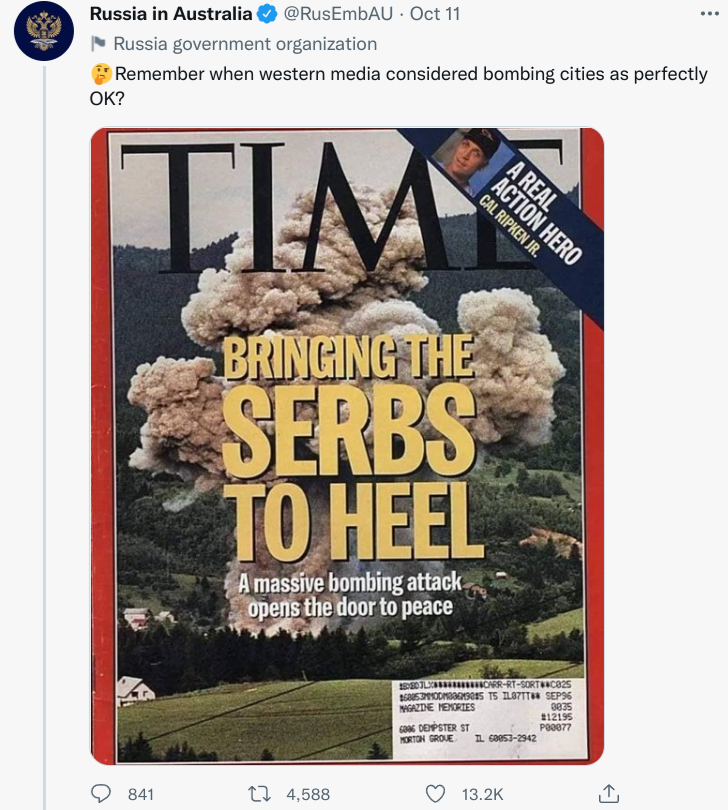
Regarding that Time magazine cover from the 1990s - Or condemning NATO for clipping the wings of greater Serbia

 The war in Ukraine is being fought online as well as in Ukraine. The Russian Federation is keen to deflect attention from its targeting of civilians, and the discovery of mass graves and torture sites in areas formerly occupied by its military. Fortunately for the successors of TASS, it has several decades of material to pull from and an eager audience.

One of the richest veins strangely has been to re-ignite the Yugoslav conflicts of the 1990s. And for even more audaciousness doing so by backing the expansionist nationalism of the Serbian far right. If you're even passingly familiar with that period and those clashes this would seem like a terrible strategy, but it's found fertile ground. Sympathy for the Serbian nationalist movement isn't a new phenomena its been around since the 1990, but it was relegated to the fringes. It was hard to maintain credibility when the Serb paramilitaries massacring Bosniaks in Bijeljina had taken a photography with them and let him take photographs of their executions and then proudly displayed them.

But we now live in the future, and those wars are in the past, so without the constant drip feed of fresh atrocities and military manoeuvres its easy for propagandists to play fast and loose. For example, you may have seen an infamous Time magazine cover.


I get why this is so often chosen by Cyber Chetniks. Its naked jingoism is offensive, and in a vacuum I can see plenty of people who have no interest in Serbia but are to a degree pro peace being vulnerable to this and similar messaging. For example, several Russian embassies have been using this to accuse nations condemning their barrage of cities hypocritical. 

Well, the thing about this cover is that while it is obnoxiously celebrating military action, its supporting the destruction of a military outpost that had that same struck a market in Sarajevo killing 43 and wounded over 80 more. 

A man with no arm came into my shop, the blood gushing from his stump. Then he ran away. I saw the torso of a woman. She was still moving, but her legs were gone. The other day I saw something similar in a film. A beast cut a man in two, torso and legs. One was a movie, the other is our reality here in Bosnia. We are like a flock of little chickens squeezed into this cage of a town, chirping for help.

This was just one event during the siege of Sarajevo, a siege that lasted 1,425 days. But you don't have to take my word for it. Time has helpfully arranged an online archive for its catalogue and this issue can be found quite easily. Here's the link for the issue and page for the article attached to the cover image https://time.com/vault/issue/1995-09-11/page/52/

Another example of this strategy gained traction earlier in the war, fans of Serbian football club Red Star Belgrade unfurled a banner


Which looks great and pacific, but the give away is its inclusion of Republic of Srpska 1995 and Yugoslavia 1999. The former refers to the territory carved out of Bosnia & Herzegovina through ethnic cleansing. And Yugoslavia 1999 of course refers to the conflict in Kosovo where Serbian military tried to maintain control of that territory by reducing the population of Albanian Kosovans. 

Red Star Belgrade, was founded during Tito's rule and was originally tied to imagery of Communist Partisans. But since then it has moved over to Serbian nationalist politics. The Serbian Unity Party was founded by a former president of its fan club Željko Ražnatović more commonly known as Arkan. Arkan had a shady past with organised crime and in the 1990s led his own paramilitary unit the Serbian Volunteer Guard (SVG) also more popularly known as Arkan's Tigers. 

Arkan with members of the SVG and a stolen Tiger

The SVG fought in Croatia and in Bosnia, and the group carried out numerous atrocities, including participating in the Bjeljina massacre. SVG recruited heavily from Red Star's terraces. Red Star weren't the only Serbian football club to recruit volunteers for the paramilitaries but they were the biggest and do have a well earned reputation for being the most violent football fans in Europe. 

In 1997 Arkan was indicted for war crimes, in 1999 he was again indicted 24 crimes against humanity by the International Criminal Tribunal for the Former Yugoslavia. He was assassinated in 2000. In addition Red Star Belgrade's main sponsor is Gazprom Neft, Russia's third largest oil company. So, while the message may be good, I have a hard time buying that it is genuine. 

You can oppose war and interventionism in general or this particular case, you can even be openly pro Russian Federation if you wish, without mourning the Serbian far right and lying about its brutal campaigns of genocide. 

Indeed, it is such an easy thing to do that I am forced to conclude that those who have to resort to this method are motivated either;

  1. Ignorance, and ignorance in the extreme. Anyone sharing images from Serb nationalist sources or that Time magazine cover must know nothing about the conflicts that ripped apart the Balkans, and given how easy it is to lookup must not care much about it really.
  2. Genuine sympathy for genocidal nationalism.
Either way I'd advise treating this as a canary in a coal mine situation. Anyone peddling these narratives should be treated like a toxic hazard.

Addendum

The break up of Yugoslavia was a bitter and complex conflict, it was also heavily documented and so there are many resources available to make sense of it. In an effort to help explain the complexities of the break up of Yugoslavia to an audience unaware, here are several documentaries dealing with it and its aftermath.

The Death of Yugoslavia

This documentary series recounted the conflict from the late 1980s to 1997. It interviewed dozens of political and military leaders from all sides including Milosevic and Radovan Karadžić. It uncovers and accuses multiple heads of government of complicity in crimes against humanity including the treatment of Bosniak prisoners by Croatian forces, and packs up every point with footage from multiple sources.


Belgrade Radio Warriors - Turn on, Tune in, Slob out


Documentary on independent Belgrade radio station B-92 and Serbian's who lived through this period and opposed Milosevic's government. Life in Belgrade during the 1990s. 


Frontline Football

Covers the 2006 clash between Serbia and Bosnia for the World cup qualifier. It covers the aftermath of the conflict and the connections between football and nationalism including Red Star Belgrade.


Monday, 6 September 2021

Militants and Militaries


1913: The People's Army training, organisation founded by East End Suffragettes to defend demonstrations and Union pickets.

 "War is the continuation of politics by other means." - Carl Von Clausewitz

 Disclaimer: I am not in any way advocating readers carry out any of the things being mentioned or discussed. I trust in that people know their own situations and what is the most appropriate actions for themselves to take, and wouldn't dream of lecturing from afar on important subjects such as defence. This is merely a discussion of a more philosophical nature, about the role of martial matters and institutions in governance, and the state, and how this can shed some light on the nature and function of social phenomena and relationship such as discipline and hierarchy to give just some examples.


There's a discussion thread about militias and militaries, I started writing a response, then realised it had ballooned in length and also only bore tangential relevance to the discussion and the questions being asked. So instead of posting a wall of text in there I thought it'd be more polite and more useful to expand my thoughts into this.

 [quote]This militia vs. military question was inspired by a comment from a Marxist-Leninist that I got on one of my youtube videos:
Quote:


    but do you actually think that militia forces could stand against modern state militaries? Anarchists' rejection of state power and proffesional armies is a severe military handicap [/quote]


This bit is what got me to start typing away. I've seen this type of argument a lot, but it doesn't make much sense to me. Professional state armies, which for clarity’s sake is essentially the modern national army used by most nation states that exist on the planet at this present time, are designed to fight other professional state armies. The biggest victim of the modern military force is other modern military forces. They're very bad at fighting anything else, this is why asymmetric warfare became an inescapable buzzword after the invasion of Iraq and fighting in Afghanistan continued long after the formal Taliban military had been crippled. This also why Special Forces are called Special, they're supposed to be better than the regular military at fighting in ways that aren't typical. The American Green Berets were founded to fight irregular forces in terrain that made typical field battles impossible. Interestingly, the Special Air Service and Special Boat Service (SAS and SBS) were formed to fight modern state militaries by taking advantage of these weaknesses, though it took awhile for the SAS to learn how to do this as its first operations during World War II ended very badly.

The early history of the SAS Regiment could be described perhaps as heroically incompetent. The Regiment's official birthday is given as 16 November, 1941, when sixty men were dropped behind enemy lines in North Africa with the mission of locating and destroying a Libyan airfield. Of these sixty just over twenty made it back to base – without having found their target, let alone destroying it. The first real action was even more disastrous. Then, in February 1941, thirty-six men of the 11th SAS were dropped in Northern Italy and within a short time all of them had been captured or had surrendered – some to unarmed peasants. David Stirling was himself captured in 1943 by a German dentist and spent the rest of the war in a POW camp. The SAS Regiment did, however, fight bravely behind enemy lines working with the various Resistance networks and Special Operations Executive in Occupied Europe knowing full well that Hitler had personally ordered that no SAS soldier was to be taken alive.

Stuart Christie's the Golden Road to Samarkind

 Though eventually they got better at it, though the targets had shifted from fighting the Axis and towards combating national liberation movements. 


The Special Air Service Regiment had proved its worth behind enemy lines in the Second World War and its structure was ideally suited for the type of warfare that was to be the hallmark of all liberation struggles. It was a go-anywhere unit that specialised in counterinsurgency campaigns and was specially trained in psychological warfare to secure the popularity of the colonialist powers. The ‘born again’ SAS emerged in Malaya under the command of an extreme rightwing staff officer, J.M. ‘Mad Mike’ Calvert
 

 Ibid

Point is, state militaries aren't very good at fighting things that aren't their exact mirror and need additional support, but even then with the creation of special forces and allowing some years of practical experience to recalibrate it's still quite a chequered list of results. The Green Berets didn't win Vietnam for the Americans, the Malayan and Kenyan uprisings had to be contained by concentration camp systems, and political compromises with local elites, the ambush and assassination missions of the British special forces while damaging did not win the day.

Vietnam is also a very important case study in military matters that is often overlooked or misunderstood by mythology. The North Vietnamese Army, NVA was a thoroughly modern and well led and well-equipped military, it lost every battle it fought against the United States military, and the US military despite its string of victories over the NVA failed to best the Ho Chi Minh National Liberation Front's (NLF though more commonly known as the Viet Cong) irregular warfare. While the NLF also did not manage to smash American forces on the battlefield, they kept the conflict going and tied down and then wore down the American military. This attrition was a major factor in the breakdown of discipline of American forces that increasingly crippled their ability to fight, by the 1970s a significant portion of the American military in Vietnam and a growing number in bases elsewhere were mutinying, and some open revolts had occurred. 

The morale, discipline and battleworthiness of the U.S. Armed Forces are, with a few salient exceptions, lower and worse than at anytime in this century and possibly in the history of the United States.

By every conceivable indicator, our army that now remains in Vietnam is in a state approaching collapse, with individual units avoiding or having _refused_ combat, murdering their officers and non commissioned officers, drug-ridden, and dispirited where not near mutinous.

Elsewhere than Vietnam, the situation is nearly as serious.

Report on the state of the US military by Marine Colonel Robert D. Heinl Jr.

Most victories against non-traditional militaries (from rival replacement state irregular armies, to militia bands, to terrorist cells etc) happen either when the opposition is transitioning into a professional military (more on this below), or through logistical superiority, the state can afford to just use manpower or material in a lengthy war of attrition, and to be blunt if a movement can't sustain a terrorist cell, guerrilla army or militia column during a struggle there is zero chance they could've done that with traditional military which is far more wasteful of resources. Or just luck, this does happen in war, sometimes you get lucky and stumble upon a weak point.

You also can't really look at military organisation in isolation to the rest of the economic and social structure. If you want or need a professional military you need a state and economy to match, and once you have that you aren't really revolutionary any more. Discussion of the Spanish Civil War often revolves around the militarisation of the militias, but what's often overlooked is that this is a symptom of a much deeper conflict. From the beginning, the opposition to Franco was split irreconcilably between the Republic and the Collectives. The two can't coexist, so once the Communist Party of Spain and the Soviet Union chose to support the Republic over the Council of Aragon and the collectives, that showdown was inevitable.

It's not an accident that Democratic revolts were fought in the beginning with democratic (well more so than usual) forces and that once a centralising authority established itself these democratic tendencies were clipped and replaced. 

The New Model Army had its democratic agitators pushed out or locked up once Cromwell and the parliamentarians (mostly landowners and merchants, with a few Gentlemen and Lords) had secured control of the situation. The New Model Army then stopped looking very new and was used as a force for conquest and oppression. This is not an accident, had the New Model Army maintained its original composition and organisation the campaigns in Ireland could not have been fought, too many regiments were opposed to it and wanted to push even harder for further domestic reform.

A book I highly recommend on this subject of military organisation reflecting or rather driving social and economic relations to match it is Michael Howard's War in European History. It's a history of warfare in Europe, but instead of focussing on battles and generals its focus is on structural reforms and how European society had to adapt and change to support these new military institutions and forces. 

But to abstract war from the environment in which it is fought and study its techniques as one would those of a game is to ignore a dimension essential to the understanding, not simply of the wars themselves but of the societies which fought them.


Maoist military doctrine is essentially just a blueprint for state building, which is probably why of all the socialistic schools, it's been one of the more popular amongst the national liberation movement struggles. Its stages of people's war trace how you're supposed to take an irregular force made up of passionate volunteers and build it into a functioning professional military in anticipation of taking control of the state.

Stage One: The revolutionary forces must establish a defensible base area which allows the organisation to be streamlined and centralised.

Stage two: The organisation must spread to other areas with the aim of establishing a stalemate or equilibrium which will allow time to gather the resources needed to strengthen the people's army, and meanwhile start implementing policies that subvert and weaken the government in vulnerable areas.

Stage Three: capture and consolidation of the nation's key infrastructure and defeat of the official government's remaining forces, replacing the government with the new "revolutionary" one.

It's usually between stages two and three that Maoist movements fail to achieve their goals and either lose or recede back into stage one. The Shining Path of Peru claimed at their height in the early 1990s to be at the second stage and were close to moving onto stage three, when their leader Guzman was discovered and arrested and the entire movement collapsed into a handful of isolated bands hiding in the remote parts of the country before they too were captured or surrendered. 

Different Maoist groups and non Maoists like a handful of IRA leaders in the 1980s have given their own spins on the basic plan i.e. "adapting them to local conditions", but essentially the more you control, the more you act like a professional government and the more your armed forces resemble a professional military. The People's Liberation Army was officially founded in 1948 though officially it traces its history back into the 1920s claiming to be the successor to the Communist party's first armed wing. So far the strategy has had a very good record at building largish militant forces, but a very poor one in terms of conquest of power, the two victories being mainland China during the aftermath of World War II, which shouldn't invalidate their success and achievements, but it does raise the question of the validity of this strategy when groups adopt it when they aren't operating in a similar context. And Nepal, but the latter is controversial even amongst Maoists whether it counts as a successful example of People's War. 

The point I'm slowly stumbling towards here is there is no actual magic blueprint to success once social conflict becomes militarised. All we can say for certain is that the state is no magic solution, even in the cases where state organisation and its conventional military do succeed in the struggle for power, than we're left with just a change in managers, and not much more to show for all the death and misery caused.

Sunday, 16 August 2020

The Significance of Sinn Fein Psychological, Political, and Economic. J R White

The Significance of Sinn Fein

Psychological, Political, and Economic.

J R White
(Published Martin Lester, Ltd, Dublin 1919.)


(AUTHOR'S NOTE: This paper was written about Christmas, 1918, shortly after Sinn Fein's triumph in the recent election. The letter of the prophecy that the British Government would not hesitate to suppress by force a rival assembly in Dublin has been falsified by events. The accuracy of several other forecasts, however, is already manifest.)

PSYCHOLOGICAL

PSYCHOLOGY is the science of the soul. The soul for the purposes of the present article means the sum of the powers and faculties in a human being, by which he feels and thinks and acts. Can we get some grasp of the relation of these faculties to each other in an individual and then apply them to present conditions in Ireland in such a way that both the race and individuals may understand themselves and their inter-connection better? I think we can.

The most elementary psychological division in an individual is between his sub-consciousness and surface consciousness. By the former I mean here not so much those freakish powers of memory and prevision, which are manifested in mediumistic or hypnotic trance, as the whole sum of instincts and tendencies which are inherited, or, at any rate, inborn in the individual, which are so much part of him that he may be quite unconscious of them, and is certainly unconscious of how they arose. By the latter I mean those beliefs, opinions, tendencies, and habits of reasoning which are formed by contact with outer environment, which depend on outer experience and observation, and may be in direct opposition to inner instinctive emotion.

Happy and rare is the man in whom the two consciousness are reconciled and harmonious, who finds, or makes, his outer environment the expression of his deepest instincts and desires. As the world is now, indeed, any such complete reconciliation is impossible for any man or woman in whose sub-consciousness there well up deep and creative emotions.

The sub-conscious soul life is checked and thwarted by environment. People of strong feeling must try to remould it nearer to the heart's desire. Immovable, by the effort of a few solitary individuals, the best of these are forced to compromise, or, failing that, shatter to bits, not the world, but themselves. The revolt against environment to be effective must be collective.

We see to-day two main kinds of collective revolt, that of subject races and subject classes. They may be (indeed, generally are) quite distinct. A class may revolt against the pressure of a social system, although the race of which it forms part has evolved that system as part of its character and culture. Or a race may revolt without formulating any distinct class protest. The race revolt corresponds to the subconsciousness, drawing its impetus from inborn racial instinct. The class revolt is an affair of the surface consciousness, concerned with the modification or reconstruction of external conditions. Where the two revolts unite in one the whole National Being is engaged.

But what is the relation between the two aspects of revolt thus fused, differing as they do in their motive and inspiration. W. H. Myers has defined genius as a "subliminal uprush," that is to say, the emergence of elements which remain latent below the threshold of consciousness in less gifted men into harmonious fusion with the reasoning and expressive powers of the surface personality. Where such harmonious fusion is absent we have not genius, but madness or hysteria. It would seem, therefore, that the inborn race-inspiration of Ireland, which Sinn Fein represents, has got to be harmonised with the conclusion and demands of Irish Labour, drawn from and directed towards external environment. Failing that, Labour's efforts will lack the subliminal element of genius, and Sinn Fein be in danger of lapsing into hysteria.

The Irish race is pre-eminently intuitive, that is to say, it feels its conclusions rather than thinks them, and often proceeds direct from feeling to action, which subsequent events fully justify, though reasoned calculation would have condemned. Its genius in this respect rests on a radical difference of psychology, a sealed book to John Bull, and to all peoples devoid of the education of untamed suffering necessary to read it.

In civilised life, as we know it, it is usual to base mental conclusions on actually observable facts or their easily predictable consequences. Practical men and nations sneer at the colouring of thought by emotion, and consider that practical thought should confine itself to hard external facts. The conflict of this outlook with the Christian teaching that the Kingdom of Heaven is within and cometh not by observation should be obvious; but to those who resent the implication that Christianity is concerned with practical affairs or that it is man's business to establish the kingdom without as well as within, it may be well to point out that the teaching of elementary psychology is equally plain. The limitation of thought to the data of external experience implies stagnation. Mere knowledge taken alone is a matter of receiving, not of initiating. Feeling makes the movement with which knowledge deals. The intellect by itself moves nothing, and the quest of reality, though it may be greatly assisted thereby, would never be undertaken by the intellect alone. Without emotion, will would he dormant and the intellect lapse into a mere calculating machine. The whole of man's environment is built up, however short it fall of the mark, at the spur of emotion in search of his happiness and well being. To deny the place of emotion, therefore, as an element in constructive thought is to cut off the stream of life from its source. Consciousness is always trying to run ahead of the data of reason as given in the past and present. The soul of Man, while it feels there is more to love and more to know, can never be satisfied by turning over all possible rearrangements and combinations of its effort up to date. It must make a new effort, to create by its own intensity something nearer to the heart's desire, To deny the reasonableness of emotion is to give no rational sanction for the condition of progress. So much for the criticism sometimes seen in the English press that Sinn Fein is an emotion not a policy. What has already been said and what follows is an attempt to show in its true light the vast significance of Sinn Fein's function in re-introducing pure emotion as a factor in Western world-politics.

The longer dwelt on, the deeper does that significance become. It will be more fully unfolded in the political and economic sections of this paper. Before leaving the psychological, however, some aspects of national emotion as a cohesive force as well as a driving force may be noted. The individual can only trace the roots of his own tendencies in the past history of the race to which he belongs. Sinn Fein and the Gaelic League, therefore, in isolating the national spirit from foreign influences and reviving the national past, not only enhance the consciousness of each individual, but bring to bear a great combining force to weld individuals together. Quot hommes tot sententiae may be roughly translated "as many opinions as there are minds to form them." The intellectual element can neither initiate nor spontaneously combine. This is the explanation why anti-militarists and international socialists, however clear their intellectual grasp of their tenets, succumbed and fell into line with the predatory emotions of the few in their respective countries. The binding-force of a common emotion was too weak until the opening of the great dynamo in Russia. For good or ill, not intellect but emotion is the element of agreement and combination among men, whether their combination is that of wolves who hunt their prey, or of bees who make their honey in common.

Two great emotional forces make for this unity in Ireland, her nationality and her religion, and since they are neither of them aggressive and predatory, and both of them dependent on attraction rather than compulsion, her unity is spontaneous, and so proof against external force, and her influence is the great bulwark against the dominance of the brute combination resting on compulsion in the Western world.

In conclusion of this section: the functions of Sinn Fein and Irish Labour have been compared to the dual functions of the mind, receiving its material from the inner or sub-consciousness on the one hand and external environment on the other. Sinn Fein seeks to restore the soul, Labour to recreate the body. Will soul and body fit? Whitman's line springs to my pen. "I swear to you the body is the soul." Irish Labour is in tune with that great uncompromising movement of the world's workers, which prepares a freer body for all and each of the nations of the world. In the past the soul has assumed an air of some superiority to the body, in dogma, in untested moral dictation, in the subordination of economics to politics But this is the day of the resurrection of the flesh, the uprising of the despised mass of humanity condemned to bodily labour and denied a self-directing soul. In freeing their bodies so shall they free the souls of themselves and all of us who were pitiably less in that we thought ourselves greater than they. Let the seekers for the soul of Ireland observe this new up-heaving body of Labour with deference, for in it lies a new world soul, and Ireland's own.

POLITICAL

The connection between politics and economics is so close that the division between them must be one of careful definition to avoid being one of loose thinking. In treating, therefore, of the political aspect of Sinn Fein, as distinct from the economic, I propose to call politics all movements based on the tacit acceptance of the continuance of the basis of Government with which we are at present familiar. This may be described as Parliamentarianism, democratic in form, in that the opinions of the people, or a great majority of them are nominally reflected in the legislation imposed on them, or, at least, in the election of the legislators. Whether the present method is or can be democratic in substance may transpire as I proceed, and the relation of Ireland to politics, her great and growing disabilities may serve to point the distinction between "democratic" politics and economics in the sense I employ the word. If political forms, as I hold, are dissolving for lack of economic substance, observation of the process of dissolution will serve to clear the issue, and help to reveal economics as the basis of the politics of the future. It is not, of course, to be inferred that there has been no economic basis to politics as we have known them; far from it. But the instability of that basis has been the cause of the instability of the whole world-order and the terrific upheaval which it has just undergone. That things cannot resettle on the old basis would seem to be a sufficiently obvious, even respectable, opinion, for has not Mr. Lloyd George told us to look for "fundamental reconstruction." But the principle of the new foundation, and wherein it differs from the old, is far to seek in the utterances of English politicians. Ireland's aloofness from the recent World War has certainly not been imputed to her for righteousness outside her own borders. Yet, perhaps, this aloofness may be explicable by other reasons than callous indifference to the rights of small nations other than her own. She may have felt herself planted on the new foundation which Mr. Lloyd George omits to define, and been wisely, even altruistically, anxious to conserve it for the benefit of society at large. "Fundamental reconstruction" is handicapped if all the foundations are in the melting pot together. In the general collapse of those built upon the sand, any house with even a partial foundation of rock has the more need to stand.

What, then, is the justification for the attitude expressed in the phrase: "It is not Ireland's war." When the outbreak of the war violently threw society off its balance, the sluice gates built by democracy for its own protection were destroyed, and the current of the people's force was guided into the various streams of bellicose nationalism. Despite an intellectual realisation of the seeds of World War contained in the Capitalistic system, the great majority of International Socialists succumbed at the first blast of the trumpet, and the Internationale ceased to be anything but a name. The psychological reason for this collapse has already been given, that the combining power of emotion was on the side of race and overbore the intellectual grasp of a doctrine not yet ingrained in the subconsciousness. But why did Ireland's racial emotion enable her to stand firm? In the answer to this question lies the key of the door between Anglo Irish politics and world-economics. It was not necessary for Ireland to have so much as heard the word Socialism to have a healthy distrust of Imperialism and pierce the disguise of its blandishments. And Imperialism is at once the father and the child of Capitalism. So Ireland fought without talking for the ideals which most of the Socialists talked about while fighting for their opposite. But since this Section sets out to deal with the political significance of Sinn Fein, let us get to the point and say at once that Sinn Fein's political function can only be not only to break the political link with Westminster, but to abrogate politics on the basis with which we are familiar. And since the formation of the new basis can hardly lie with other than industrial organisation in the first place, we believe the function of Sinn Fein to be to encourage and co-ordinate such organisation. There are half a dozen insuperable reasons why Ireland's united emancipation as a nation must attend a programme world-wide and man-deep in its appeal, disintegrating from within the enemies that are invincible from without, and welding into one the separate elements of her own being in a manner that Sinn Fein alone can never achieve. Take the question of Ulster. Speaking as an Ulsterman with up-to-date knowledge of Ulster conditions, I assert that the only chance of combining the two racially distinct sections of Ireland is a programme which will make the liberation of Ireland arise automatically from the emancipation of the Irish workers. It is necessary to find something to unite the soul of Ireland, North and South, to prevent the partition of her body. National emancipation arising .out of human emancipation was the ideal which worked the combination in '98, and it must be the same again. But if any are sanguine enough to believe that a population of somewhat unimaginative Scotch Protestants will embrace the ideals of Celtic nationality simply because it is Celtic, let them do so. Let us follow the recent development of that nationality itself in its struggle for freedom, and see if any but the explanations of two Socialists, Connolly and Karl Marx, will fit the past and present facts or provide for the conquest of future obstacles. What is the position of Ireland today? To quote the Belfast Newsletter - "With regard to Ireland, the election has cleared the air. It is now an open issue between the maintenance of the Union and an Independent Irish Republic." And in the new Westminster Parliament there is now a clear majority of Unionists over every other Party. There are also, I am informed, 8o,ooo British troops in Ireland. Glancing abroad we find Mr. Daniels proclaiming the need of a supreme American navy, M. Clemencean declaring himself a realist and planning that the war to end war shall in no way disturb the old game of military preparedness; not to mention the unanimous intention to make Germany pay, after an armistice signed on the basis of no annexations and no indemnities, to the tune of something approaching the total national debts of the principal allied belligerents. These facts are worth mention, as indicating that the temper of the world's present rulers and their aims are not such as depend on moral persuasion themselves, or offer rosy prospects for its success as the sole weapon of their opponents. Nevertheless, no man is more convinced than the writer that an Independent Irish Republic has got to be and will be, the present English Government's refusal, notwithstanding. But how? How was Ireland solidified into the Western bulwark against servile Imperialism? By a rising, of which the driving force was the Labour Citizen Army. How was the great Capitalistic menace of conscription defeated? By a strike of Irish Labour. I have no wish to minimise the part played by other sections of the community, but I believe I give honour where honour is due to the class that has been and must continue to be the corner-stone of Ireland's resistance and liberation. The facts, so far, fit Connolly's theory that in the struggle for liberty of any subject nation the owning and employing class are forced by economic pressure to make terms with the oppressor with whom and whose system they become linked by a hundred golden threads of investments and the like. Thus, the onus of the struggle is thrown more and more on the working class. But what of Sinn Fein? I reply the vast majority of Sinn Fein do belong to the working class in the widest sense of the term, and that in so far as they are unable to exercise alone a force greater than aeroplanes and machine guns they will be compelled to unite with the workers who can exercise such a force or relinquish their object. Ireland has in the recent election disavowed the class that has made terms with the oppressor. Sinn Fein stands for the principle of no compromise in their stead. But assuming the disappointment of hopes in President Wilson, where shall Sinn Fein look for the accomplishment of that principle in practice? Sinn Fein must buy its Socialistic education, but any instructed Socialist could foretell that Ireland has nothing to hope from President Wilson, granting him, for the sake of argument, the best intentions in the world. Mr. Wilson is not a divine being, but the President of a Capitalistic Republic, and any League of Nations under the patronage of Capitalistic Governments can only be a league of exploiting rulers against exploited peoples, from which Ireland can expect nothing but reinforced coercion, for, to quote Connolly again, the cause of oppressed nations and oppressed classes is one and the same.

Thus it is that the really instructed International Socialist is the best and only practical Nationalist. Karl Marx declares that the struggle of the proletariat against the bourgeoisie, though international in substance, must first be national in form, as the proletariat must first settle accounts with the bourgeoisie each in its own country. Lucky for Ireland, she has settled that account with the ballot box instead of the bayonet. She now is near presenting an united front against the English bourgeoisie, with their eternally irreconcilable ideas. Here a remark attributed to Jaures is apposite: La classe ouvrire Brillanique c'est une classe bourgeoise (The English working class is a bourgeois class), and so as long as they are fed with the crumbs of their master's exploitations, the mass of them seems likely to remain. But the crumbs will run out, and there is a small but virile minority, not the Pacifists, who are tired of crumbs already.

To return to my statement that Sinn Fein's function was transitional. The policy of abstention from Westminster is excellent as far as it goes. The question is, can it go any further in the direction of setting up any form of "Parliamentary" Government in College Green, and would it be in the line of progress if it could? I answer both in the negative. It is as little to be supposed that the British Government, as at present constituted, will hesitate to suppress by force a rival assembly in Dublin, as that the Irish people will be overawed or thwarted by that force. They will simply be driven to other means against which The force is powerless, less invitingly simple, but infinitely more stable than a Parliament on the bourgeois model A true self-determination of a whole people cannot be achieved under the forms of Government that have heretofore passed for democracy.

Parliamentarianism, as it has been spoke, is as obsolete as a wooden plough. Democracy was the watchword with which the bourgeoisie obtained power. By the same watchword they seek to hold it. They mean by democracy that the people should vote, and work, and pay for them; their democracy is far more outraged by its concrete fulfilment as in Russia than by its abstract denial as in the old Germany. Even were Sinn Fein bourgeois in feeling or aim, as it emphatically is not, nothing but concrete democracy can possess the attractive or resisting power to realise Sinn Fein's undoubted aim of an Independent Ireland. Concrete democracy means the abolition of wage-slavery, which in Ireland, more even than in most countries, because of the numerical weakness of Labour, would be postponed, sine die, by any Parliament. The abolition of wage slavery, the workers' independence, can no more be achieved through an Irish Parliament in the first place than Irish Independence could have been achieved through an English one. The only education for liberty is liberty, taken possession of and practised. Sinn Fein intends rightly to deny the substance of English rule by refusing to pay taxes. So must the workers deny the substance of Capitalist rule by refusing to pay profits. And so far from this refusal to pay profits being a separate issue from Ireland's national independence, it is on that refusal that her united freedom must depend. The ascendancy caste in Ulster are the fortified outposts of England's rule in Ireland, and well are they rewarded for their position of honour. Ulster is the profiteer's paradise. Labour, except in Belfast, and largely even there, is almost unorganised. There are engineers in Ballymena today getting 31s a week, when the Belfast rate where this trade is organised is £3 12S. So intense has been the ignorance and bigotry, that not long since in Ballymena Labour organisers had to get police protection back to the station after attempting to address a meeting on purely Labour matters. But this very abnormal backwardness is the very factor making for revolutionary progress. Psychology is a science as exact or more exact than physics. If water accumulates to a certain level in a reservoir and is excluded from a dammed off area it will rush in with redoubled force when the dam is removed, and the level of the water in the excluded area will rise temporarily above the remainder. The emancipation of Labour has reached a certain level in all the world except Ulster. Ulster is becoming aware of the fact slowly but surely. Her workers have not yet realised that they have dammed themselves off from the twentieth century b their concentration on damning the Pope, but, then, they have not yet fully realised the existence of the 20th century any more than the non-existence of the Pontiff of their imagination. I submit that the actuality of the former must oust from their consciousness the phantasm of the latter, that this realisation of injurious illusion must come with a sudden impetus in proportion to their distance below the level of the time spirit. Their very lack of organisation combined with the force of belated indignation, will tend to make them skip the stage of trade-union organisation for sops and assert the reality which their Protestant spirit has been perverted to obscure and deny, the self-acting freedom of each individual in the collectivity. In other words, the abolition of a wage-slave class, and the control of industry by its creators.

Ireland has a greater task than the setting up of a bourgeois democracy on the English model, for she herself is the scene of the exposure of that democracy's deep-rooted fraudulence. Under it, the gang possessing economic and political control abrogate democracy as soon as they see their control threatened, and prepare to throw machine-gun bullets when they can no longer throw dust in the people's eyes. It should not be necessary to offer further proof of this to Irishmen. The Lame gun-running, the Curragh mutiny, the wholesale arrest of Sinn Fein leaders, and their imprisonment at this moment are proof enough.

The continuance of subject classes and nations is too necessary to bourgeois society for Governments representing that society to permit their genuinely democratic emancipation. In Ireland they have repeatedly abrogated it themselves and supported and rewarded its abrogation by their "fortified outposts." In Russia they demand and are endeavouring to enforce that the working class should withdraw from the concrete democracy they have conquered to reconquer it by abstract democratic means. The Bolsheviks are tyrants and anarchists who suppressed the constituent assembly, and Russia must be rescued for democracy, which means the restoration of Capitalistic industry and the recovery of their interest for a host of cosmopolitan fundholders. We all know the force of habit, and a social order is infinitely more tenacious of its habits than an individual. The forms of Government reflect the social habits of life. Any fundamental change in the economic order of a State must create for itself a new form of Government, and insistence on the old form is a subtle but utterly disingenuous means of smothering the new order at birth, of spoiling the new wine by pouring it into old bottles.

So much for the sacredness of constituent assemblies, called into being before a fundamental and progressive change has had time to leaven the habits of a people and create a governmental form to express itself.

We thank, therefore, both Sinn Fein for separating Ireland from the form of Parliamentarianism which has hitherto blessed us, and the British Government for its determination to prevent us saddling ourselves with a native version of the same blessing. Between them they help us to build better than they know. They keep open the field and compel the preparation of some form of Government based on the sure foundation of contact with the actual lives of the people, and expressive of their needs. And if such Government should develop on the lines of the Russian Soviets, it will be from no unreflective imitation, but because the said Soviets are the natural means for co-ordinating the social activities of free men and supplying their common necessities.

ECONOMIC

At the commencement of the "political" section of this paper, I defined as politics all movements based on the tacit acceptance of the continuance of the basis of politics with which we are at present familiar. Throughout the section in question I attempted to show the instability of that basis, and to indicate the subsidence on to a new foundation already in progress. But the representatives of the unstable equilibrium who did not shrink from the war are not likely to shrink from maintaining it if they can by means of the peace. A Capitalistic peace is indeed a far greater menace than a Capitalistic war, for the latter separates its authors into hostile camps, and promotes enquiry among their victims as to the causes for which they are asked to die. Whereas the former bids fair to substitute for the unstable balance of power between Capitalistic States a League of Governments foisted by armed force on the bewildered and unrepresented peoples of the world. The discredited secret diplomacies of Europe, or such of them as have not been overthrown by revolution, band themselves together to prevent the revolution of their own States and promote counter-revolution in the others. This amiable intention is advanced to within measurable distance of realisation under a thickening screen of camouflage about brotherhood and altruism, amid the plaudits of all the Broadbents of Anglo-Saxondom on both sides the Atlantic. When an indiscreet Latin gives the show away by advocating the old militarism pure and simple, they drown his words with their hosannas and go on diverting the troops from the Eastern battleground to Russia. It is high time for Ireland to realise that the stupefied people are entrusting the old gang of their overpaid and under-controlled servants with an enormously enhanced power to enforce their will and instead of becoming infected with that stupefaction, to consider what she is going to do about it.

It is no longer with England alone that Ireland has to reckon, but with a League of Allied Nations, banded to defend and continue the Capitalistic system. Ireland must restate her national position in international terms, and she has only to think it out to be able to do so in a way which will at once integrate her nationhood and disintegrate the national and inter-national cohesion of her foes. In pointing to England as the sole enemy, Sinn Fein may be said to be right for the past, but wrong for the future, for there are two Englands rapidly separating into hostile camps along economic lines. Ireland suffered in the past at England's hands the simplest form of economic subjection - the conquest and confiscation of her land. By the superimposition of the feudal system of land tenure on the Irish clan system of communal ownership, the land passed into the hands of the few and with it the basis of all the means of subsistence. The dispossession of the many is the first step in their enslavement, and the worldwide exploitation of Labour to day is the logical outcome of the system of private ownership and hereditary lordship of land. By victory in the Land War the Irish farmers may be said to have pulled out the roots of the feudal system, but not to have destroyed its poisonous fruits. The restoration of the land to those who work it is only the first round in the contest between Capital and Labour, and there is a danger that the winning of the first round may be a positive handicap to success in the second, if the comparative prosperity of the farmers tends to make them unite to enforce the status quo on the labourers. Here we have an example of the way in which material prosperity can militate against spiritual freedom, and it may be well to clear our minds on the subject. The spiritual life of a nation is not something apart from its material welfare.

Just the reverse. It is that form of self-expression which ensures the vital and material well being of the whole of a nation. Materialism means the assertion by a part of interests incompatible with those of the whole. From this definition we may pass to see how spiritual in the fullest sense of the word is Ireland's destiny, for her national emancipation has awaited through the centuries the dawn of the day of liberation for the whole of Europe, perhaps for the whole world. Sinn Fein points rightly to England as the introducer of a disease foreign to Irish life. But does Sinn Fein realise that since the disease has become worldwide the cure must be worldwide, too. In Russia the disease has been diagnosed as a cancer of worldwide extension, and so far as the authority of the Bolshevik Government extends the cancer has been cut out. That authority is steadily extending till we have a leader in the Times, headed "Bolshevik Imperialism." The uprising of the workers of the world against that very Capitalism which is the underlying cause of England's stranglehold on Ireland, both for strategic and economic reasons, moves on apace. Did Sinn Fein grasp this, we believe it would look less to the President of a Capitalistic Republic and more to the principles which alone have power to dissolve Ireland's chains.

The war after the war is in full blast, and it is in very truth the war to end war by removing the tension of unstable social equilibrium in every country which is transmitted to their external relations. Abolish commercial competition, and you will thereby abolish the race of competitive armaments, which is its reflection.

Let us examine the special position of Ireland in view of the present paramount influence of the Sinn Fein Party with regard to the world class-war. The class-war is a reality which cannot be conjured away by denial or asserting, what is true, that it is morally deplorable. Its removal must attend first its recognition by the social mind and then the elimination of the perfectly definite facts which give it being. These facts in the main are three: (i) The private possession of land, factories, and raw material; (ii) the increment to private persons, directly or indirectly of the profits of what is privately owned, in the shape of rent or interest, and (iii) the confused mind and incomplete organisation of the workers, which keeps them in subjection as wage slaves, and unable to demand and distribute for themselves among themselves their full share of the profits they create.

In most industries to-day the industrial side is sufficiently in the hands of the workers for its actual operation, to enable them, were they sufficiently awake, to assume control and run it themselves. But the industrial is only one aspect. There is also the clerical and administrative. In a country where the clerical and official classes make common cause with the industrial workers, the inauguration of production for general use as opposed to production for profit would be far easier than in a country where as, so far, in England the clerks and officials throw in their lot with the owners and employers. Given, then, that close alliance between Sinn Fein and Irish Labour, which seems obligatory in face of the common enemy, unless each wishes to be defeated in detail, the number of clerks and civil servants in Sinn Fein are a factor making for the mitigation of the class-war by throwing weight enough to win a bloodless victory on to one side. And the confusion inseparable from a purely proletarian revolution with the class of trained administrative ability in the other camp might well be avoided.

This point may be further illustrated by reference to the controversy now raging in England around the Whitley Councils. For the benefit of the uninformed, these Councils are being set up for the meeting of employers and workers round one table to discuss jointly the conditions of employment of the latter. Such questions as hours of labour, appointment of foremen, and even introduction of machinery are covered by their terms of reference, which, however, exclude any admission of the workers' representatives to the counting-house side of the business, such as the obtaining of raw material, the making of contracts, distribution of goods, or allotment of profits. The advanced wing of English Labour is opposed to the whole Whitley scheme, holding, not without reason, that the contact of the workers' representatives with the employers on the Councils would result in the sapping of their class loyalty in exactly the same manner as has already been notorious among Trades Union officials. Men like the Shop Steward leaders argue that to accept the limitation of the Council's reference to conditions of wage-slavery is to compromise the principle of demand for full control. No doubt, the Councils will be accepted by the great body of English workers and the result, which the clear-sighted foresee will ensue, that the workers will thereby assist in riveting the chains of wage-slavery on themselves. Unless the administrative and manual sides of industry make a joint effort for control, the admission of the manual workers to a share in the regulation of their toil is calculated only to secure their consent to their own subjection.

Sinn Fein is rejecting the principle of the Whitley Councils as applied to Anglo-Irish relations. It refuses to sit around the same table at Westminster with the "bosses," and it does well. But does it realise that attached to the centre of English Government is the great part of the economic fabric of Ireland, and that the more complete the severance from England, the more pressing is the need to organise Ireland on an alternative economic base. We predict for Sinn Fein a testing by fire of its leaders and supporters. Those that emerge true to the principle of independence will do so convinced of the need to found that independence with its roots in the soil of Ireland's emancipated and co-ordinated agriculture and industry. The soil is not yet prepared. Ireland cannot be independent while she is still dependent on English and West British capital. But for success, the success that is surely coming, Ireland's independence must rest four-square on the overthrow of Capitalism, native or foreign, co-operative production in agriculture and industry, co-ordinated distribution, and such local and central Government as will facilitate production and distribution at home and regulate exchanges abroad.

Popular Posts