ZENGAKUREN, the All-Japan Federation of Autonomous Student Bodies is
a mass revolutionary organisation, with a militant tradition of
struggle against American Imperialism and the Japanese ruling class.
In 1960, it organised strikes and continuous demonstrations, in which
many were wounded, outside the Tokyo Diet, against the Ratification
of the Japanese – US Security Treaty. These reached such an
intensity that the US Government thought it advisable to cancel a
proposed Eisenhower visit to Japan.
The Zengakuren have
recently called for the establishment of an anti-war International.
They are supported in this by the Committee of 100, the Student Peace
Union in the US, the Socialist Students Organization of West Germany
and many other organizations opposed to both American and Russian
tests. On August 17, 1962, representatives of the Zengakuren,
including Nemoto, their President, attended the Leningrad Conference
of the International Union of Students. On their way, they had
demonstrated in Red Square against all nuclear tests. They had been
arrested, then released and `closely watched during the remainder of
their stay`.
We publish below an
extract from Zengakuren Information Bulletin No.3, describing their
discussions with representatives of the Soviet Student Council (SSC):
Soviet Student
Council (SSC): Are you
fighting against the nuclear testing of any nation other than the
USSR? Do you realize that the Soviet Union is not the first country
to engage in nuclear tests?
Zengakuren:
We are engaged in a militant mass struggle against American nuclear
tests. Our slogan in this struggle is, `Against tests of USA and
USSR`. We oppose any nuclear activity by any country, be it England,
France or China. Of course, we are fighting against the nuclear
armament of Japan. You who sponsor the I.U.S. Congress should have
known such a well-known fact.
SSC:
Granted, but what country began the first nuclear tests and how many
times were such tests carried out before the Soviet Union began?
Zengakuren:
That is of no consequence. We accuse all countries engaged in testing
of promoting the arms race and of suppressing the working class and
people.
SSC:
We are glad to hear that you oppose the American nuclear tests and
can appreciate your stand against these tests. We lost millions of
lives in World War II. This tragedy was due to the fact that our
military forces were weaker than those of the Fascists. We do not
want to be the second Hiroshima. If during the war Japan had had
nuclear weapons at their disposal, the tragedy of Hiroshima would not
have occurred.
Zengakuren:
We oppose your dangerous view. According to your logic, you encourage
the Japanese Imperialists to arm themselves with nuclear weapons. Do
you really think that this is an effective way to stop the nuclear
race and to prevent nuclear war?
SSC:
The best way to prevent war is obviously total disarmament, but the
next best procedure is to continue Soviet nuclear tests.
Zengakuren:
Your policy, based on such a philosophy, wields an immeasurably
harmful influence on the anti-war struggle of the working class. Do
you know the slogan that is being used in Tokyo, New York and London
to fight N-tests? `Against
tests by the US and USSR`. These students and workers attempt to
obtain peace not with nuclear weapons but by their own struggles.
SSC:
You believe that if the Soviet Union stopped its tests, the working
class movement would increase in strength and the imperialists’
tests would stop. We cannot be sure of such an outcome.
Zengakuren:
Are you suggesting that the workers of the world stop their struggles
and support Soviet testing? By holding such a view, you cause
dissension among the workers of the world and make them oppose each
other. The workers must unite. Soviet nuclear testing does not
support peace. It provides America with an excuse to continue their
tests and intensify the arms race. Any nuclear testing suppresses the
workers of the world and subjects them to the domination of the
ruling class. Aren’t you yourselves the slaves of nuclear weapons?
SSC:
We can appreciate your point of view, but we are of totally different
opinions.
Zengakuren:
The justice of our views will be borne out by the continuation of the
world-wide struggle against N-tests.
SSC:
Your opinion sounds quite sincere; continue your work as you like,
but don’t forget that you are in the USSR now.
The following is a commentary by George Orwell on the intellectual backing for dictatorship and oppression. It is in reaction to the 1945 publication of Arthur Koestler's book The Yogi and the Cossack, which is a collection of essays.
It first appeared in the September 1946 issue of Politics.
THERE is a theory which has not yet been accurately formulated or given a name, but which is very widely accepted and is brought forward whenever it is necessary to justify some action which conflicts with the sense of decency of the average human being. It might be called, until some better name is found, the Theory of Catastrophic Gradualism. According to this theory, nothing is ever achieved without bloodshed, lies, tyranny and injustice, but on the other hand no considerable change for the better is to be expected as the result of even the greatest upheaval. History necessarily proceeds by calamities, but each succeeding age will be as bad, or nearly as bad, as the last.
One must not protest against purges, deportations, secret police forces and so forth because this is the price that has to be paid for progress: but on the other hand “human nature” will always see to it that progress is slow or even imperceptible. If you object to dictatorship you are a reactionary, but if you expect dictatorship to produce good results you are a sentimentalist.
At present this theory is most often used to justify the Stalin régime in the USSR, but it obviously could be— and, given appropriate circumstances, would be— used to justify other forms of totalitarianism. It has gained ground as a result of the failure of the Russian Revolution— failure, that is, in the sense that the Revolution has not fulfilled the hopes that it aroused twenty-five years ago. In the name of Socialism the Russian régime has committed almost every crime that can be imagined, but at the same time its evolution is away from Socialism, unless one re-defines that word in terms that no Socialist of 1917 would have accepted. To those who admit these facts, only two courses are open. One is simply to repudiate the whole theory of totalitarian ism, which few English intellectuals have the courage to do; the other is to fall back on Catastrophic Gradualism. The formula usually employed is “You can’t make an omelette without breaking eggs.” And if one replies, “Yes, but where is the omelette?”, the answer is likely to be: “Oh well, you can’t expect everything to happen all in a moment.”
Naturally this argument is pushed backward into history, the design being to show that every advance was achieved at the cost of atrocious crimes, and could not have been achieved otherwise. The instance generally used is the over throw of feudalism by the bourgeoisie, which is supposed to foreshadow the overthrow of Capitalism by Socialism in our own age. Capitalism, it is argued, was once a progressive force, and therefore its crimes were justified, or at least were unimportant. Thus, in a recent number of the New Statesman, Mr. Kingsley Martin, reproaching Arthur Koestler for not possessing a true “historical perspective,” compared Stalin with Henry VIII. Stalin, he admitted, had done terrible things, but on balance he had served the cause of progress, and a few million “liquidations” must not be allowed to obscure this fact. Similarly, Henry VIII’s character left much to be desired, but after all he had made possible the rise of Capitalism, and therefore on balance could be regarded as a friend of humanity.
Now, Henry VIII has not a very close resemblance to Stalin; Cromwell would provide a better analogy; but, granting Henry VIII the importance given to him by Mr. Martin, where does this argument lead? Henry VIII made possible the rise of Capitalism, which led to the horrors of the Industrial Revolution and thence to a cycle of enormous wars, the next of which may well destroy civilization altogether. So, telescoping the process, we can put it like this: “Everything is to be forgiven to Henry VIII, because it was ultimately he who enabled us to blow ourselves to pieces with atomic bombs.” You are led into similar absurdities if you make Stalin responsible for our present condition and the future which appears to lie before us, and at the same time insist that his policies must be supported. The motives of those English intellectuals who support the Russian dictatorship are, T think, different from what they publicly admit, but it is logical to condone tyranny and massacre if one assumes that progress is inevitable. If each epoch is as a matter of course better than the last, then any crime or any folly that pushes the historical process for ward can be justified. Between, roughly, 1750 and 1930 one could be forgiven for imagining that progress of a solid, measurable kind was taking place. Latterly, this has become more and more difficult, whence the theory of Catastrophic Gradualism. Crime follows crime, one ruling class replaces another, the Tower of Babel rises and falls, but one mustn’t resist the process— indeed, one must be ready to applaud any piece of scoundrelism that comes off— be cause in some mystical way, in the sight of God, or perhaps in the sight of Marx, this is Progress. The alternative would be to stop and consider (a) to what extent as history pre determined? and, (b) what is meant by progress? At this point one has to call in the Yogi to correct the Commissar.
In his much-discussed essay, Koestler is generally assumed to have come down heavily on the side of the Yogi. Actually, if one assumes the Yogi and the Commissar to be at opposite points of the scale, Koestler is somewhat nearer to the Commissar’s end. He believes in action, in violence where necessary, in government, and consequently in the shifts and compromises that are inseparable from government. He supported the war, and the Popular Front before it. Since the appearance of Fascism he has struggled against it to the best of his ability, and for many years he was a member of the Communist Party. The long chapter in his book in which he criticises the USSR is even vitiated by a lingering loyalty to his old party and by a resulting tendency to make all bad developments date from the rise of Stalin: whereas one ought, I believe, to admit that all the seeds of evil were there from the start and that things would not have been substantially different if Lenin or Trotsky had remained in control. No one is less likely than Koestler to claim that we can put everything right by watching our navels in California. Nor is he claiming, as religious thinkers usually do, that a “change of heart” must come before any genuine political improvement. To quote his own words:
“Neither the saint nor the revolutionary can save us; only the synthesis of the two. Whether we are capable of achieving it I do not know. But if the answer is in the negative, there seems to- be no reasonable hope of preventing the destruction of European civilization, either by total war’s successor Absolute War, or by Byzantine conquest— within the next few decades.”
That is to say, the “change of heart” must happen, but it is not really happening unless at each step it issues in action. On the other hand, no change in the structure of society can by itself effect a real improvement. Socialism used to be defined as “common ownership of the means of production,” but it is now seen that if common ownership means no more than centralised control, it merely paves the way for a new form of oligarchy. Centralised control is a necessary pre-condition of Socialism, but it no more produces Socialism than my typewriter would of itself produce this article I am writing. Throughout history, one revolution after another— although usually producing a temporary relief, such as a sick man gets by turning over in bed—has simply led to a change of masters, because no serious effort has been made to eliminate the power instinct: or if such an effort has been made, it has been made only by the saint, the Yogi, the man who saves his own soul at the expense of ignoring the community. In the minds of active revolutionaries, at any rate the ones who “got there,” the longing for a just society has always been fatally mixed up with the intention to secure power for themselves.
Koestler says that we must learn once again the technique of contemplation, which “remains the only source of guidance in ethical dilemmas where the rule-of-thumb criteria of social utility fail.” By “contemplation” he means “the will not to will,” the conquest of the desire for power. The practical men have led us to the edge of the abyss, and the intellectuals in whom acceptance of power politics has killed first the moral sense, and then the sense of reality, are urging us to march rapidly forward without changing direction. Koestler maintains that history is not at all moments pre determined, but that there are turning-points at which humanity is free to choose the better or the worse road. One such turning-point (which had not appeared when he wrote the book), is the Atomic Bomb. Either we renounce it, or it destroys us. But renouncing it is both a moral effort and a political effort. Koestler calls for “a new fraternity in a new spiritual climate, whose leaders are tied by a vow of poverty to share the life of the masses, and debarred by the laws of the fraternity from attaining unchecked power”; he adds, “if this seems utopian, then Socialism is a utopia.” It may not even be a utopia— its very name may in a couple of generations have ceased to be a memory— unless we can escape from the folly of “realism.” But that will not hap pen without a change in the individual heart. To that ex tent, though no further, the Yogi is right as against the Commissar.
Text of a leaflet distributed in Moscow by supporters of the
Committee of 100
AGAINST
ALL BOMBS
The
campaign in Britain against nuclear weapons is beginning to turn
towards the working class. As it does so, it will create an
increasing challenge to the capitalist state.
This
marks a development both in the activities and in the consciousness
of the Campaign. It is a genuine turn to the masses of ordinary
workers, not the bureaucracies of the Labour and Trade Union
movements. Already, as a result of this emphasis, we have seen the
beginnings of industrial action against the bomb. Workers directly
involved have refused to handle nuclear cargoes. Others have held
token strikes.
THE
BOMB IN CLASS SOCIETY
More and more people in the campaign are seeing the deeper
implications of working class action against the bomb. The class
which dominates production controls society. It decides policy and,
despite the democratic facade, enforces it through its state
apparatus. Until the ordinary people are free in production, they
cannot have any effective say in the decisions of war and peace, life
and death. Only a society with inhuman relations in production could
produce these monstrous weapons.
But the USSR has the same monstrous weapons. Should this not be
different if your society is fundamentally different from
ours? We know the means of production are nationalised. But Marx
himself insisted that it is the `relations of production` (the
relations between men and men at work) which determine the class
nature of society1.
The property relations might reflect these relations of production or
might serve to mask them.
THE
RUSSIAN REVOLUTION
What has happened to your Revolution that your leaders should
threaten the workers of other lands with these weapons? What has
happened to the internationalist ideals of October?
The Revolution made sweeping changes in the property relations. But
it did not solve the central contradiction of class society, that
between rulers and ruled in production.
It was never the policy of the Bolsheviks to allow the workers to
take over power in production itself. In 1921 Lenin wrote: `It is
absolutely essential that all authority in the factories should be
concentrated in the hands of management. Under these circumstances,
any direct intervention by trade unions in the management of
enterprises should be regarded as positively harmful and
impermissible`. This typifies the whole ideology and practice of the
Party in this period. Here were the roots of Stalinism.
From this viewpoint, the USSR has essentially the same relations of
production as Britain or America. The Russian worker has to get up in
the morning when the alarm clock rings. The time is not of his
choosing. Someone else has decided what he shall produce, how
much, and at what cost to himself. Has he chosen to have
Sputniks rather than butter?
Both and East and West management makes all the plans, and seeks to
reduce the worker to a standard unit in them. It consciously removes
variety and decision making from his job, and subjects him to the
ruthless tempo of machines. In Marxist terms, he is alienated. And
any opposition to this system brings him up against the forces of the
State, which, again, are beyond his control.
Is this a State that is `beginning to whither away from the moment of
Revolution`? Or is it a kernel of the Socialist programme that has
withered away?
INTERNATIONAL ACTION
In Britain our protests bring us up against our State forces too.
When a mass demonstration tried to immobilise a NATO base at
Wethersfield last December, six of our members were gaoled for long
periods. Many others have been arrested on similar demonstrations.
We have also protested against the Russian H-tests, which threaten
workers all over the world with `socialist` leukaemia. Our bourgeois
police have protected your Embassy against us, and arrested hundreds
of demonstrators.
Our struggle is the struggle for new relationships in production and
in society. Both East and West, privileged protected by their State
machines manage production and parcel out the social product. They
try to protect these privileges against their greedy neighbours.
That is what the H-bomb defends. But workers gain nothing by
assisting in protecting their own rulers against others. We must have
faith only in ourselves, in our ability to transform society. We
extend our hands in solidarity with the working people of Russia,
over the heads of our rulers and yours. We have already taken up this
struggle: it is yours too. Together we must ACT – OR WE SHALL
PERISH TOGETHER.
WORKERS
OF THE WORLD UNITE!
The Committee of 100 exists to organise mass civil disobedience and
resistance against the production, testing and threatened use of
nuclear weapons. Its basis is in rank-and-file action, not in
politicians’ manoeuvres.
Its Industrial Sub-Committee seeks to develop these ideas among
ordinary workers. Its first leaflet stated: `Workers make the weapons
of mass destruction, transport them, handle them, install them. They
supply and equip those who use them. When they no longer accept to do
so, the politicians will have to fight their own wars`.
The Sub-Committee is composed of workers in the Docks, in road and
rail transport, and in the Engineering, Building and Printing
industries.
Published on behalf of the Industrial Sub-Committee of the London
Committee of 100, by Ken Weller (Engineering Shop Steward), 37,
Queens Mansions, North Road, London N.7
THAT LEAFLET
`Solidarity`
feels the full text of the leaflet distributed (in Russian) at the
recent World Disarmament Congress in Moscow, should go on record, in
view of the widespread repercussions (and deliberate lies) it has
evoked.
The
following notes are based on a report by Dave Picton, one of the
members of the London Committee of 100, who took the leaflets to
Moscow.
On
July 10, two of us gave out the first batch of leaflets in Gorky
Street. They were taken eagerly and folded away in inside pockets….
Because of the litter laws. After we had distributed quite a number
we were stopped by three `volunteer auxiliary
militia`,
who only became friendly after a passer-by that we were Congress
delegates. The first (administrative) reflex had been to arrest us.
The second (equally administrative) reflex had been to be friendly to
an official foreign delegation. Obviously a dialectical
contradiction. Neither reflex was related to the content of what we
were distributing. That kind of response only took place later, at a
higher level.
We
also distributed the leaflet at a factory gate. It was an engineering
works, in the suburbs. We distributed as the workers were returning
from dinner break. The leaflets were again all taken and pocketed.
We
also distributed the leaflet through letter boxes in a nearby block
of workers’ flats. A second `block of flats` we entered turned out
to be a police station. We decided not to stay.
Certain
members of the British delegation became quite hostile after reading
the leaflet. Late one night, one of the delegates found a woman in
his room. His opinion of the Conference Arrangements Committee
soared… till he found she was English – and that she was tearing
up his leaflets. `Any method is justified against you people!`, she
claimed. Unfortunately for her she had found the wrong leaflet.
The
Chairman of the Soviet Peace Committee (Mr. Korneichuk) at one point
asked for an assurance that the leaflets would no longer be
distributed, despite an earlier agreement that we could put our case
by any means we chose.
`The
Guardian` gave the best
coverage. A front-page article titled `Heresy in Moscow` by Victor
Zorza (12.7.62) quoted nearly all of the text which it called `the
most direct challenge to official Soviet policies and ideas to have
been presented to the Soviet man in the street since freedom of
speech died under Stalin`. The article referred with glee to the
`blasphemy of blaming Lenin, the best refuge of the reformed
Khruschevites, for ideas Stalin put into practice`.
In
general the Press reports on the leafleting and on the demonstration
in Red Square were remarkably sympathetic. Only Peter Simple, in the
`Daily Telegraph`
(13.7.62) objected to a `direct incitement to revolution in the
Communist world`. He believed that `a campaign of illegal opposition
to one government, on one issue, was being exploited by those who
want to organise illegal opposition to all governments, on all
issues. The anarchist face of the CND is beginning to show`.
This
enthusiasm for the Committee’s activities in Moscow was only
matched by the same newspapers’ hostility to the Committee’s
activities in England. This
discrepency was quickly pointed out by `The Daily Worker`
(16.7.62), by Arnold Kettle in a letter to `The
Guardian`(20.7.62), etc.,etc.
There was however another side to this particular coin. Committee of
100 demonstrations in this country have been praised to the skies by
the Soviet Press and Radio. The `The Daily Worker`
had also offered encouragements, from a safe distance. But now
`Pravda` (18.7.62)
screamed at the `people who act like thieves`, the `smart Alecks` who
discussed `offensive subjects` and `thrust provocative, slanderous,
leaflets` at passers-by. And the `Daily Worker`
had hysterics about the `insulting, anti-socialist diatribe` and `the
distribution of such outrageous lies` by an `irresponsible group`.
Readers of both papers had to contain their curiosity about the
nature of the lies so violently denounced. Not a line, not a single
word of the leaflet was quoted.
During
the Congress the text of the leaflet was beamed into Russia in twelve
different Soviet languages. Many journals of the socialist and peace
movement quoted it extensively. The full text has been republished
and circulated by various organisations, including an (intendedly!)
private employers’ information service. It has been translated and
distributed in France and circulated in Japanese by members of the
Zengakuren2.
Copies have gone to
Australia, Belgium, Bolivia, Canada, Denmark, Germany, Ireland, Italy
and other countries. At
least 3 batches have been used in different parts of Yugoslavia. In
Helsinki, at the `World Youth Congress`, there was a punch-up on the
distributors of the leaflets by members of the Rumanian delegation.
Zengakuren representatives, including their President, Itoshi Nemoto,
later demonstrated in Red Square, on August 6. Their bulletin No.3
(September ‘62) states this was `inspired by the activities of the
Committee 100` and was `our first attempt to appeal to and unite with
the workers and people of the USSR`. They attempted to distribute
leaflets and were `beaten and dragged behind the Lenin mausoleum, and
detained there for an hour`.
1`The
sum total of the relations of production constitutes the economic
structure of society, the real foundation on which arise legal and
political superstructures`. K. Marx and F. Engels, Collected
Works, vol.13, p. 6-7,
Moscow 1959.
2All-Japan
Federation of Autonomous Student Bodies.
Here is the text of the letter written by Archbishop Oscar Romero to then US President Jimmy Carter urging him to cease supporting military and police death squads in El Salvador and to reaffirm his stated commitments to human rights. A month after writing this letter, Oscar Romero was gunned down by agents of the Junta on the 24th of March 1980.
In the last few days, news has appeared in the national press that
worries me greatly. According to the reports your government is studying
the possibility of economic and military support and assistance to the
present junta government.
Because you are a Christian and because you have shown that you want
to defend human rights, I venture to set forth for you my pastoral point
of view concerning this news and to make a request.
I am very worried by the news that the government of the United
States is studying a form of abetting the arming of EI Salvador by
sending military teams and advisors to "train three Salvadoran
batallions in logistics, communications and intelligence." If this
information from the newspapers is correct, the contribution of your
government, instead of promoting greater justice and peace in EI
Salvador, will without doubt sharpen the injustice and repression
against the organizations of the people who repeatedly have been
struggling to gain respect for their most fundamental human rights.
The present junta government and above all the armed forces and
security forces unfortunately have not demonstrated their capacity to
resolve, in political and structural practice, the grave national
problems. In general they have only reverted to repressive violence,
producing a total of deaths and injuries much greater than in the recent
military regimes whose systematic violation of human rights was
denounced by the Inter-American Committee on Human Rights.
The brutal form in which the security forces recently attacked and
assassinated the occupiers of the headquarters of the Christian
Democratic party in spite of what appears to be the lack of
authorization for this operation from the junta government and the party
is an indication that the junta and the party do not govern the
country, but that political power is in the hands of the unscrupulous
military who only know how to repress the people and promote the
interests of the Salvadoran oligarchy.
"As archbishop of the Archdiocese of San Salvador I have an
obligation to see that faith and justice reign in my country, (so) I ask
you, if you truly want to defend human rights, to prohibit the giving
of this military aid to the Salvadoran government."
If it is true that last November "a group of six Americans were in EI
Salvador...providing$200,000 in gasmasks and flak jackets and
instructing about their use against demonstrators," you yourself should
be informed that it is evident since then that the security forces, with
better personal protection and efficiency, have repressed the people
even more violently using lethal weapons.
For this reason, given that as a Salvadoran and as archbishop of the
Archdiocese of San Salvador I have an obligation to see that faith and
justice reign in my country, I ask you, if you truly want to defend
human rights, to prohibit the giving of this military aid to the
Salvadoran government Guarantee that your government will not intervene
directly or indirectly with military, economic, diplomatic or other
pressures to determine the destiny of the Salvadoran people.
In these moments we are living through a grave economic and political
crisis in our country, but it is certain that it is increasingly the
people who are awakening and organizing and have begun to prepare
themselves to manage and be responsible for the future of EI Salvador.
Only they are capable of overcoming the crisis.
It would be unjust and deplorable if the intrusion of foreign powers
were to frustrate the Salvadoran people, were to repress them and block
their autonomous decisions about the economic and political path that
our country ought to follow. It would violate a right which we Latin
American bishops meeting in Puebla publicly recognized when we said:
"The legitimate self-determination of our people that permits them to
organize according to their own genius and the march of their history
and to cooperate in a new international order." I hope that your
religious sentiments and your feelings for the defense of human rights
will move you to accept my petition, avoiding by this action worse
bloodshed in this suffering country.
PICKET OF POLISH CONSULATE: (BUCKINGHAM TERRACE; CORNER OF GREAT WESTERN ROAD AND QUEEN MARGARET DRIVE) (NEAREST UNDERGROUND: HILLHEAD)
END THE STRIKE-BREAKING POLISH COAL EXPORTS!
END THE SUPPRESSION OF FREE TRADE UNIONISM IN POLAND!
WEDNESDAY, 24TH OCTOBER, 5.30PM - 6.30 PM
SPONSORED BY (to date)
Glasgow
Polish Solidarity Committee; Castlemilk Miners Support Committee;
Glasgow University Miners Support Committee; Glasgow University
(Students) Miners Support Committee; Muirkirk Strike Committee
(Ayrshire); Pollock Constituency Labour Party; Cathcart Constituency
Labour Party; Stirling Constituency Labour Party; Queen's Park/Crosshill
Labour Party; Glasgow University Labour Club; Glasgow District Labour
Councillors; Jim Craigen MP; John Maxton MP; Denis Canavan MP;
`Critique` Editorial Board; Stuart McLennan (CPSA National Executive
Committee); Carol Thomson (Society of Civil and Public Servants, DHSS
West of Scotland branch editor); Davey Graham (TGWU branch secretary,
Newlands Bus Garage); Rowland Sheret (Chairperson, Stirling Trades
Council); Alan Pow (Secretary, Stirling Trades Council); Hamilton CLP.
(All individuals in personal capacity)
At
a time when the entire Labour and trade union movement is rallying to
the support of the miners, exports of coal from Poland to this country
have rocketed and are now running at 316% of their normal level. This is
a major boost for the Tories' strike-breaking efforts.
Solidarnosc,
on the other hand, the free trade union banned by the Polish government
in the name of `socialism`, has repeatedly expressed its support for
the striking miners in its underground radio broadcasts and official
statements.
Show your
opposition to the Polish strike-breaking coal exports and the
continuing oppression of Solidarnosc by supporting this picket. Bring
placards and your union/Labour Party banner.
A
statement signed by the above bodies calling on the Polish government
to "declare a moratorium on coal exports during the present sufferings
of the British miners" will be handed in to the consulate at the picket.
Prime Minister Margaret Thatcher meeting key economic ally General Jaruzelski dictator of the People's Republic of Poland
I saw one of those strange "Why I left the left" type posts on Twitter the other day, one of those that go "In my rebellious youth I used to be X, but now I'm older and wiser" type messages that go onto to establish that they probably never were X and its coin flip whether they were never really committed to it or just making it up as a cheap rhetorical device. In this particular case, it was a twitter stalinist explaining how they were once an anarchist and are now, thanks to Historical Materialism, ™ seen the sterile light of Marxism-Leninism-whateverism.
It got me thinking of my dear stepdad and his life. I knew him as a sweet and mild man with a doddy sense of humour, but in his youth in the 70s and early 80s he was a punk rocker with a bright blue Mohawk and went on demos and protests to ban the bomb and end unemployment. One day I asked what had changed and explained. It started with getting a regular job, nothing like the monotony of wage labour to eat a way at your vitality and free expression!
This job was with British Sugar, he worked at a depot loading freight and then unloading them. The job was not great, if you've done manual work in factories or in logistics you'll know, it's monotonous and tiring, but it was steady employment, and he cracked on, he always had a reputation for being a grafter. No, the reason this job lead to a complete change in outlook and attitude for him was because one day he noticed something odd, the sugar he was unloading was the same sugar he had been loading for hours on end. The sugar was untouched the only difference was that it was covered in customs marks from the Soviet Union, the USSR was an importer of British Beet sugar as trade between Western and Eastern Europe was extensive and grew throughout the period.
You might be wondering why this would be a source of epiphany, well for shipments in Tons to cross international borders and work in a cycle as regularly as it did had to be a corruption scheme. And what made it worse was for millions of Tons of goods to be used in this manner required the active participation of officials on both sides, at least that's how he saw it. Keep in mind this was the Cold War where people walked around with the threat of Nuclear annihilation, and yet both the Thatcher's Britain and the Soviet Union, supposedly irreconcilable enemies and totally alien societies were wasting hours of labour and millions of Pounds/Rubles lining the pockets of minor officials.
In effect, he was given direct, first-hand proof that the world he lived in and believed was a con. And he wasn't wrong, it goes beyond sugar, contrary to popular myths that North American Neo-Stalinists and Regan mourners keep a live the powers that be were willing to make money out of the international working class (this part editorialising here, he never used this kind of language) and so all this talk of revolution was nothing but hot air.
I've chosen the image above for an important reason, that is Margaret Thatcher and General Jaruzelski, apart from a photo-op the connections ran so deep that in 1984-5 when Thatcher was fighting to destroy the Miners and then the wider British Workers Movement she turned to Apartheid South Africa and "Communist Poland" for help. Coal Mining was the backbone of the Polish economy for many years, and they could deliver.
“UK imports of Polish house coal have been running at almost double
their usual rate since the beginning of the year. If the strike had not
taken place about 130,000 tonnes of Polish house coal would have been
imported this year. But traders say that so far 100,000 tonnes have
been landed, and the final total for the year to likely to be 200.000
tonnes. Cawoods, part of the Redland Group, based at Cheltenham,
confirmed yesterday that it had placed an order for 30,000 tonnes of
domestic coal. It had purchased individual cargoes of Polish coal
previously but this is its first long term contract.” (17th May 1984) Financial Times, sourced from https://ukrainesolidaritycampaign.org/2015/04/12/how-stalinism-helped-defeat-the-great-miners-strike-in-1984-85/
It couldn't be more clear, the Actual Existing Record of Actually Existing Socialism is one of scabbing on and international scale, during the Miners Strike the arch Cold Warrior Thatcher was vulnerable like never before, and yet the vanguard of world socialism just took advantage to double their pre-existing contracts.
My step-dad held several jobs learning the trades before jacking it all in to become a self-employed Handyman, he ended his work life as a window cleaner enjoying the lack of a boss and the freedom to tell abusive customers where to stick it. Not a viable path to emancipation for the dispossessed but it was he own personal victory on a system that took him and the rest of us for a mug.
This short sequence says more about early 90s Eastern Europe than entire forests of books.
I'm reading a book on the history of censorship in animation. The book covers many well known examples and also documents some lesser known ones. It also covers the filmography of Jan Švankmajer, a Czech director and animator who serves as an example of what it was like to work in the film industry in the Warsaw Pact. To get a film or program funded, scripts had to be approved by the responsible bureaucrats, Jan Švankmajer had some success for a time getting projects off the ground, but it eventually he got a reputation for making films that were pessimistic and individualistic, in short, bad art in the opinion of the Communist Party.
Jan Švankmajer is a committed Surrealist. In the popular parlance, surrealism is just an adjective to describe work that's odd. A painting that doesn't look much like something or a play that plays with the fourth wall or a film that has a sequence that breaks the rules of conventional cinema will be described as surrealist. However, the original Surrealists were a group of political radicals closely associated with Anarchism and libertarian socialism. It's this political Surrealism that Švankmajer was inspired by.
The opposition force Švankmajer to find new work as a puppet maker and painter. Fortunately for Jan Švankmajer he was noticed by the West German film industry who introduced his work to the rest of Western Europe. Several financiers including the UK's Channel Four and the BBC made overtures to fund some of his projects, which meant the Czechoslovak film authorities reluctantly allow him to return, though opposition continued. Jan Švankmajer's film Alice, an adaption of Alice in Wonderland, was made while he was supposed to be working on a different film and was only allowed to be completed after a bitter dispute in which the foreign funders threatened to withdraw if Alice wasn't completed.
So, with all those headaches, it's not surprising that once the regime collapsed in 1989 that Švankmajer would take the opportunity to comment on its demise. In 1990, with assistance from the BBC, he released a ten-minute animated short titled The Death of Stalinism in Bohemia. I've wanted to see this film for some time after seeing clips of his Alice. And now thanks to a YouTube channel I got my chance. It's simply excellent, the imagery is striking, the claymation animation is not only interesting to watch on its own, but it makes many of the film's points in itself. There's a sequence where clay workers in flat caps and overalls, the men who populated every Soviet poster from 1918-91 created via moulds, going through an assembly line and then hanged, after which their bodies fall into a bucket and turn back into clay which is then moulded back into workers which go back on the line and so on and so on, meanwhile the film juxtaposes imagery from Czechoslovakia's Five-Year plans with the production targets getting higher and higher.
Practically every sequence is like this, the imagery and transitions and movements work together to make the point crystal clear even if you can't read Czech. I could describe the entire ten-minute run time, the crumpling up of posters of old Czechoslovak/Soviet leaders followed by uncrumpling those posters to reveal their replacements, meet the new boss, mostly the same as the old, as a quick example. But I'll restrain myself and just discuss what for me is the most important sequence, the film has a bookend sequence, it starts with a creaky old Stalin bust having surgery, his skull is cut open to reveal his brain, the surgeon plunges both hands into the gory matter and pulls out a smaller bust of Klement Gottwald, ardent Czech Stalinist and leader of the 1948 coup that established the Communist party dictatorship. After cleaning up the blood and tying off the umbilical cord, the Gottwald bust comes to life, the birth of Stalinism in Bohemia. At the end of the film the chronology has entered the late 80s and the soundtrack is full of jubilant crowds and photographs of mass demonstrations in the streets. While this is going on, the hands that have been controlling everything throughout the film start painting everything with the Czech national flag. A new coat of paint on rusty equipment, including an old and dirty Stalin bust. This Czech national flag Stalin bust undergoes the same surgery and those hands plunge back into the brain matter, but the film ends before we can see what emerges from it.
The film is open about its existence as a form of Agitprop,
agitational propaganda and Švankmajer has stated that he thought the
film would age very quickly because it's a direct commentary upon
current events "Despite the fact that this film
emerged along the same path of imagination as all my other films, I
never pretended that it was anything more than propaganda. Therefore, I
think it is a film which will age more quickly than any of the others." To call a film Agitprop or propaganda is to insult in conventional circles. Art is supposed to rise above petty political statements, this film is the best rebuttal to that assumption I've come across so far. Removing the politics from this film is to leave it an empty husk, its politics is its art.
Most political film animated or otherwise are frankly quite blunt and simplistic, there's a bad guy who demonstrates all the qualities the makers criticize, the good people eventually triumph etc. Here the villain is a system, it isn't the death of Stalin in Bohemia, it's the Death of Stalinism in Bohemia with a question mark. Stalin died in 1953 just days before Klement Gottwald died oddly enough. And even Stalin is manipulated by the hands of the unseen operator of the system, who is still around in 1990 and working hard to mutate into a more politically acceptable Czechoslovak national form to continue its work.
The scepticism wasn't some paranoia from an artist who thinks too much, either. The book I'm reading that reminded me to look up Švankmajer's work was published in the middle of the 1990s several years after The Death of Stalinism, was released. It includes comments by Czech filmmakers that things haven't changed completely, many of the old Communist party bureaucrats were still in positions of power in the industry and not all of them had adapted to the changing times. Which is what the Stalin bust with the flag paint was about, the collapse of the old regimes removed some of the most high profile and infamous personalities, but left thousands of lower level authorities in place, and it was an open question just how far these authorities would be willing to change.
And of course, the reason much of the imagery is obvious despite cultural distance is that much of what is odious about the Stalinist regimes of Eastern Europe can be found in Western European capitalism. I've worked in factories with grimy walls covered in propaganda posters while sweating and aching to fill ridiculous quotas. The secret police are gone, but the regular police are quite capable of repression, the governing institutions are just as invested in keeping the population passive through a combination of restrictions and distractions.
I've been to Czechia and Slovakia, so I'm under no illusion that these two things are the same, there are differences, just not as much as the propagandists of both systems would like us to believe.
Esperanto kaj Socialismo? pri la movado sur la "alia flanko"(1), is a short piece of historical information about the Esperanto movement in the Eastern Bloc during the Cold War period. The author Detlev Blanke grew up in East Germany and was an active promoter of Esperanto at the time so the work is largely autobiographical. I won't pretend this isn't a text written for a small niche, but if you're interested in Esperanto enough to read works written in the language there is some value and interest to be found in these pages even if you had no interest in socialism or Eastern Europe.
I of course, am interested in both subjects, so I had a lot to digest. I would say an sperta komencanto, or a beginner with some experience should find the text readable with maybe a few pauses to consult a dictionary. A passage from the introduction struck me as interesting, most of the text was taken from a lecture and expanded with more detail. The subject of the lecture was about ideology and its relationship to Esperanto, and focused on what is commonly referred to as the "socialismaj landoj" socialist countries. Meaning of course nations controlled by Communist parties such as the Soviet Union and the People's Republic of Poland. But the extent to which these nations were socialist has been contested. Detlev Blanke has since come to the conclusion that these nations including the one he grew up didn't live up to those titles. He thinks that a more accurate description would be "soclandoj" a word I have a hard time translating into English. I suppose Socialette countries would be the most accurate way to do it. What he's done is reduced socialism to its root or germ, these nations didn't build a socialist society but Blanke believes the intention and aspiration to do so was genuine and had things developed differently they might have succeeded.
Its a bit like how a novelette isn't just a short story, but a short story that has the potential to become a full novel. For example Stephen King's Cycle of the Werewolf, it has a full story structure and could be expanded into a longer work, and was though for film with the novelette being the foundation of the script for Silver Bullet.
Esperanto and Socialism's main thrust is a history of the development of the officially approved Esperanto movement in East Germany and its connections with the wider "socialist" or more accurately pro-Soviet Union nations and their approved Esperanto movements. The text is acronym heavy and many names are called up but the layout limits the potential confusion. While the details of the benefits of working with the government will make some Esperantists envious, multiple school courses, subsidised travel, funding for diverse publications, conferences attended by important people etc. Blanke makes clear that these came at costs. The Esperantists of Eastern Europe had to conform to the limits of accepted behaviour and discussion. The Soviet Union was a major obstacle in this regard. Stalin's brutal repressions targeted the Soviet Esperantist movement, and while many of them were posthumously "rehabilitated" it was still a sore subject to give publicity to criticism of Stalin's rule in Brezhnev's Soviet Union. Another issue was language imperialism. This is a subject familiar to most Esperantists, and it wasn't much different on the other side of the Berlin Wall. The main difference was instead of having to contend with the popularity of English or French they had to deal with the pre-eminence of Russian. In addition to competing with Russian for space in international communications criticism of linguistic domination of Russian was also a contentious topic.
The limits on what could be discussed and obstinacy on behalf of the bureaucracy that controlled East Germany were issues that couldn't be tackled without direct opposition to the government, which given that these were all dictatorial societies with extensive police powers wasn't advisable. Still, the Esperantists of Eastern Europe were able to rebuild movements shattered by the Nazis and Stalin, and later Nicolae Ceaușescu who cracked down on Esperanto in the 1980s, and were able to make some space for international discussion, culture and debate and promotion of peace in international affairs.
During the post war years the Esperanto movement was strong in several nations within the Soviet Bloc, especially Poland. Esperanto gave people a chance for international contacts, even beyond the Iron Curtain. But at the same time the Esperanto movement was used by their ruling regimes for propaganda, observation and control by the state. Jarek Parzyszek tells us of his experiences within the Polish student movemnt.
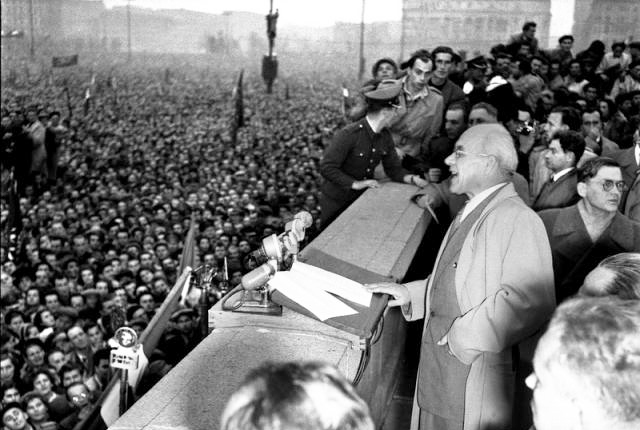
Władysław Gomułka, speaking to the masses in Warsaw in 1956. During the early days of his rule he was quite popular. However, by the end of the 1960s he had launched anti-Jewish campaigns to silence critics, he was deposed as party leader following popular protests in 1970.
Founded in 1972 in Zakopane South Poland, the Polish Student Esperanto Committee was a successful attempt to co-ordinate the activities of several independent - educational, scientific, cultural and tourist - groups and clubs which were operating in many Polish university cities. The organisational and financial base for the majority of these clubs was the Association of Polish Students (APS).
Polish student Esperanto clubs started appearing in Universities after the fall of the Bierut regime, (so after 1956). For Poles, after the death of Bierut, it seemed that together with Właysław Gomułka we would have a new and better era. New magazines appeared, a few authors who had been banned before were allowed to publish their books or put on shows, the role of the National (Underground) Army could be publicly remembered for a few years, a few intellectuals were allowed to travel beyond Eastern Europe- but this freedom soon disappeared.
The majority of the Esperanto clubs collaborated with, or were entirely dependent upon the APS. In the 1960s and 70s the vast majority of students belonged to the APS, which in fact monopolised the organisational activity of Polish students so that almost all interest groups had to establish some kind of official relationship with the APS. It should be noted that there were no other official youth organisations. The state "took care" to ensure that youth organisations did not drift in the "wrong" direction.
In addition to the department for youth attached to the Central Committee of the communist party (Polish United Workers Party) which was led by a special secretary on the "right" path for youth activities, there were responsibilities for the division of finances, approval of passports ("lending passports") for travel, censorship officers, central office in Warsaw and others in the provinces, police (called militia) and secret state services, with thousands of secret collaborators who reported on various fields of social activity.
The control was also maintained officially, through inspections of the individual organisations on a local and national level.
From my almost 10 years of Esperanto Activism in the People's Republic of Poland, I knew from direct experience that the Polish Esperanto movement, and the student movement in particular was monitored and controlled by the state.
Of course, it was not just the Polish Esperanto students who were monitored and controlled, quite the contrary. During the 1980s (and apparently also in the 1970s) Poland was the "Least free" of all the Socialist nations. During and after the "state of war" our friends from the DDR, Soviet Union, Bulgaria, Romania, Czechoslovakia, were frightened to or could not visit us except as part of a limited number of groups that were organised by the Komsomol, FDJ etc.
The Polish Student Esperanto Committee was never an independent organisation, in fact it was not even an organisation from a legal point of view. It was a central representation of Polish student-Esperantists, consisting of one representative from each functioning student circle / club. As most Esperanto student circles and clubs had the word "scientific" in their name, PSEK served on the Scientific Committee of the Main Council of the Polish Students' Association.
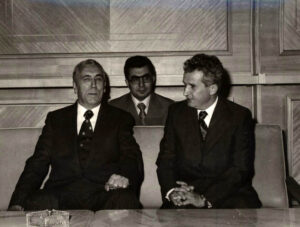
Edward Gierek (with an unknown interpreter) together with Nicolae Ceausescu, was the communist party leader of Poland from 1970-1980.
In fact, this "scientific" character was often just an official "cover", a pretext for receiving state grants for "scientific and educational" events on various topics such as peace, the cosmos, Lenin's legacy, etc., for publications and research visits. Although a number of student circles have actually succeeded in researching Esperanto, interlinguistics and international language communication: for example, the University of Warsaw, led by Ryszard Rokicki (second PSEK president), Barbara Jędrzejczyk (later Rokicka) and Jerzy Leyk.
Warsawians were holding Scientific Interlinguistic Seminars (later: Symposia) in the early 1970s. Successful SISs in the 1980s were organized by the PSEK Academic Center, which operated at the PSEK, bringing together PSEK activists who published post-symposium materials and separate interlinguistic notebooks. ACI's main drivers were Barbara and Ryszard Rokicki.
The second centre was the student scientific circle in the city of Łódź, which, in collaboration with APS, organized international conferences on international language communication at the University of Łódź,, publishing rich bilingual post-conference materials. The main driving force behind these conferences was the fourth PSEK president, Tadeusz Ejsmont, who received his doctorate in Esperanto from the University of Łódź, in 1982. The first PSEK president (Władysław Stec) came from Łódź, and served for two terms.
PSEK has been active not only in science but also in culture. Already before the PSEK era, with the help of the Polish Students' Association, Marek Pietrzak founded the Polish Esperanto Youth in 1958, and he edited for a long time the cultural-educational magazine TAMEN (However), published first in Toruń (1959-60), then in Wrocław (1960-64) and finally in Warsaw (1965-67). A Student Gazette was published in the late 1980s and early 1990s by PSEK, edited by Jarosław Miklasz from Bydgoszcz and co-edited by the editorial team i.a. Krzysztof Łobacz, Elżbieta Malik and Jarosław Parzyszek.
Successes in the cultural field were cultivated by PSEK sons: the Esperanto Cultural Society in Poznań (founded by Paweł Janowczyk, Zbigniew Kornicki, Andrzej Naglak, Alicja Lech and continued by Leszek Lewandowski) and in Zielona Góra until 1992 at the Green Mountain Cooperative, led by Jerzy Rządzki who earlier founded and directed Student Esperanto Theatre and held theatre and cultural festivals in and around Zielona Góra. The theatre stars Dorota Świerstok (now Polaczek), Mira Rządzka, Leszek Lewandowski and Anna Szumska (now Hanna Szczęsna).
For several years, the Esperanto Cultural Society had collaborated with the APS Cultural Commission by publishing some interesting volumes, such as the collection of poems I am Only a Woman by Anna Świrszczyńska translated by Tomasz Chmielik, Doktryna Zamenhofa by Jarosław Parzyszek and Esperanto i nauka by Dr. Leszek Kordylewski .
PSEK's main inspiration, however, was neither science nor culture, but travel. Thanks to the APS umbrella, PSEK delegates traveled en masse to international Esperanto events, mainly in Europe but not only, for example in 1981 to Brazil and in 1986 to the Israeli IJK in Neurim traveled 4 PSEK representatives. Such trips abroad were much more complicated and financially unaffordable for PEJ members, which is why PSEK members often represented Poland on the TEJO Committee and were sometimes even TEJO board members (Jan Koszmaluk, Jarosław Parzyszek).
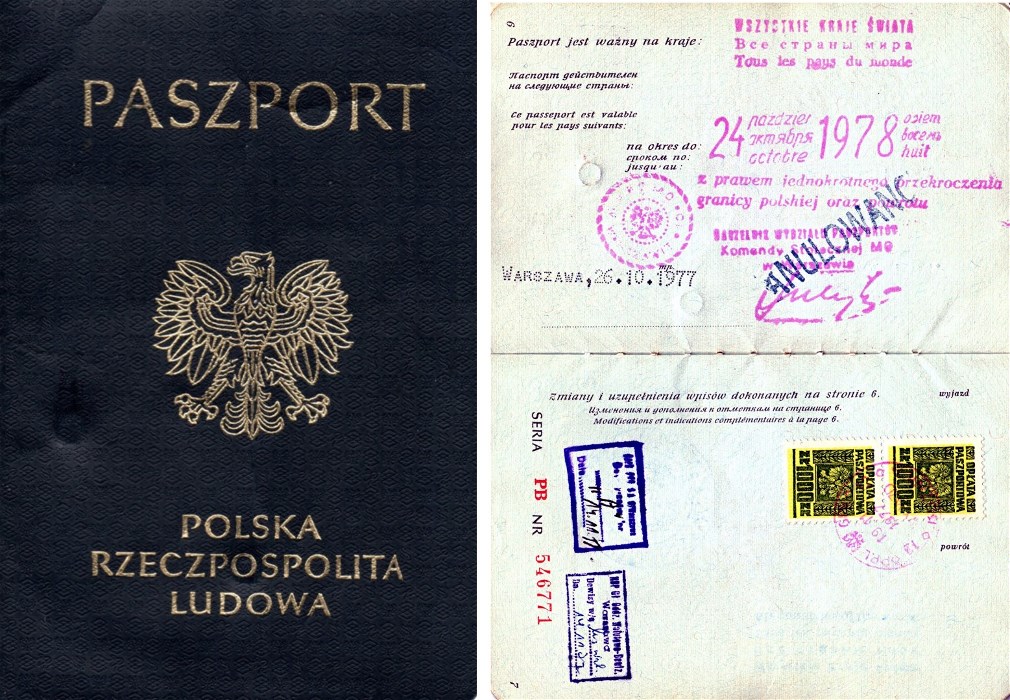
Passport of the Polish People's Republic, photo Jerzy Kuśmider
In the People's Republic of Poland there were three categories of passports, which were then not the property of the citizens but of the state, and the state could kindly allow its citizens to borrow a passport to travel abroad. At the APS Central Office, at 9 Ordynacka Street in Warsaw, there was a passport depot with direct contact with the Ministry of the Interior.
For a formal trip, a semi-private passport (with the letter "B") was issued, which made it possible to travel only to socialist countries, or with a special stamp allowed to travel to all states of the world. The APS Passport Deposit also helped get visas to capitalist countries.
The local (regional) passport offices also "lent" passports to student-Esperantists, based on the official invitation letters with additional letters of recommendation on the official paper of the Polish Students' Association. One could and sometimes did get a passport without such a letter, but that route was usually longer and more uncertain.
The PSEK delegates had to write and quickly deliver official reports to APS after the official visits. Some of the reports, possibly all of them, were forwarded to the Ministry of the Interior and / or its local offices. Sometimes, in addition to the "official" (formally public) report, delegates were asked for separate, secret reports.
For example, in 1986 I was invited by the then PSEK President and TEJO Board Member to attend a TEJO / KER Seminar at the European Youth Center in Strasbourg. Then, fearing the aftermath, I refused to prepare such a report and in the end did not travel to the seminar, but Poland was represented by two other people.
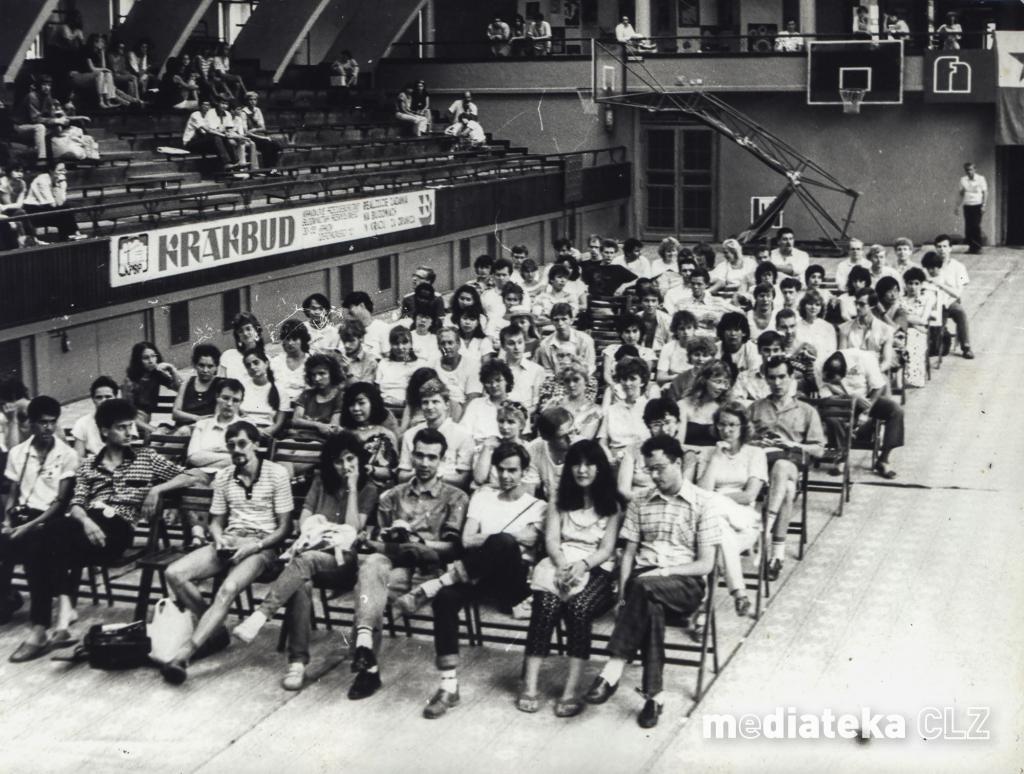
The International Youth Congress in Krakow, 1987, photo: Mediateko CLZ
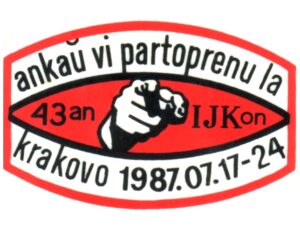
However, I had to have contacts with this service before and during the 43rd IJK in Krakow: I, as PSEK president and LKK vice-president, was responsible for the official invitations of the foreigners and delivered the lists of the guests to the ministry, reported on the program and the congressional publications. Some certainly remember the panic before the IJK inauguration, when the secret agent demanded that I add to the list of participants a 6-person list of the "citizens" of West Berlin who, according to official doctrine, were not citizens of the Federal Republic of Germany (West Germany), but of a separate "state".
Then together with some LKK members we collected the anti-regime leaflets which, during the excursion day of the Krakow IJK, were scattered by one of the Polish IJK participants.
We, me and some other LKK members, knew that in the IJK congress hall (Wisła sports hall) in Krakow the congress from above, was constantly observed by some secret officials. One of these officials also contacted me during the 72nd World Congress in Warsaw, where I was in charge of the youth program. He was not interested in the World Congress program but in the informal talks.
The biggest secret of PSEK's international activity and success was the so-called day-to-day, non-foreign exchange communications which meant that the participation of one foreigner during one day of a PSEK event was equal to the participation of one PSEK member in a foreign event. We have had many partners from such exchanges. The most important and most frequently used was the PSEK / GEJ contract, but we had separate contracts with: TEJO, JEFO, JES, JEB, ĈEJ, BEJ, HEJ, NEJ and KCE in Switzerland.
The international history of the PSEK ended after the fall of the People's Republic of Poland. Firstly, due to the economic crisis, the non-communist government of Mazowiecki / Balcerowicz almost completely cancelled state subsidies, secondly the citizens were given the right to travel freely and finally became holders of passports for the whole world, thirdly our Esperanto partners cancelled the contracts of currency exchange.
In 1992 in Gdańsk took place the 14th Student Summer Esperanto Meeting (the first 12 SER took place in Toruń) and the jubilee seminar and ball of PSEK, organized by the last PSEK president, Adam Cholewiński, and attended by among others the first PSEK- President Władysław Stec and I. To my knowledge this was the last arrangement and the end of PSEK history.
PSEK survives somewhat through ARKONES - Art Confrontations in Esperanto, which first took place in 1979 in Poznań.
La
Esperanto-movado dum kelkaj postmilitaj jardekoj estis forta en kelkaj
landoj de la tiama sovetia bloko, kaj precipe en Pollando. Esperanto
donis ŝancon pri internaciaj kontaktoj eĉ trans la fera kurteno.
Samtempe la Esperanto-movado estis uzata de la regantoj por propagando,
observata kaj kontrolata de la ŝtato. Jarek Parzyszek rakontas pri siaj
spertoj en la pola studenta movado.
Władysław
Gomułka parolas al popolamaso en Varsovio en oktobro 1956. Dum la
komenca periodo de sia regado li estis tre populara. Fine de la 1960-aj
jaroj li iniciatis kontraŭjudan kampanjon por silentigi kritikajn
voĉojn. Li perdis sian partiestran postenon lige kun popolaj protestoj
en 1970.
Fondita
en Zakopane, suda Pollando, en 1972, Pola Studenta Esperanto-Komitato
estis sukcesa provo kunordigi la agadon de sendependaj studentaj –
edukaj, sciencaj, kulturaj kaj turismaj Esperanto-rondoj kaj kluboj,
kiuj funkciadis en multaj polaj universitataj urboj. La organiza kaj
financa bazo por la plimulto de la rondoj estis Asocio de Polaj
Studentoj (APS).
Studentaj
polaj esperantistaj kluboj kaj rondoj ekaperis en la polaj
universitatoj post la falo de Bierut-reĝimo (do post 1956). Por poloj,
post la morto de Bierut, ŝajnis ke kune kun Właysław Gomułka venis nova,
pli bona epoko: aperis novaj revuoj, kelkaj pli frue malpermesitaj
autoroj rajtis aperigi siajn librojn aŭ prezenti spektaklojn, oni povis
dum kelkaj jaroj publike rememori la rolon de la Landa (subtera) Armeo,
multaj intelektuloj rajtis vojaĝi ne nur al Orienta Europo – sed tiu
”libereco” rapide finiĝis.
La
plej multaj el la esperantistaj rondoj kunlaboris kun aŭ eĉ fakte
funkciis nur danke al APS. En la 60-aj kaj en la 70-aj jaroj granda
plimulto de polaj studentoj apartenis al APS, kiu fakte monopoligis la
organizan aktivadon de polaj studentoj tiel ke preskaŭ ĉiuj
interesgrupoj devis elekti formon de oficiala kunlaboro kun APS.
Substrekendas, ke oficiale ne ekzistis aliaj junularaj organizaĵoj. La
ŝtato ”zorgis”, ke la junularaj organizaĵoj ne fordrivu en ”malĝusta”
direkto.
Krom
la departemento pri junularo en la Centra Komitato de la komunista
partio (Pola Ununiĝinta Laborista Partio), gvidata de aparta sekretario
pri la “ĝusta” direkto de junulara aktivado, zorgis financaj ŝtatoservoj
dividantaj subvenciojn, pasportoservoj donantaj permesojn (“pruntantaj”
pasportojn) por vojaĝi, cenzur-oficejoj: centra en Varsovio kaj
vojevodiaj, polico (nomata milicja) kaj sekretaj ŝtataj servoj, kun
miloj da sekretaj kunlaborantoj, kiuj raportadis pri diversaj kampoj de
socia aktivado.
La kontrolado okazadis ankaŭ oficiale, interne de la unuopaj organizaĵoj lok- kaj landnivele.
El mia preskaŭ 10-jara sperto de
Esperanto-aktivado en Pola Popola Respubliko mi praktike scias ke la
pola Esperanto-movado, precipe la studenta, estis observata kaj
kontrolata de la ŝtato.
Kompreneble
ne nur polaj studentoj-esperantistoj estis observataj kaj kontrolataj ‒
tute kontraŭe. Dum la 1980-aj (kaj ŝajne ankau dum la 1970-aj) jaroj
Pollando estis ”la plej libera” inter la socialismaj landoj. Dum kaj
post la ”milita stato” (1981-84) niaj amikoj el GDR, Sovetunio,
Bulgario, Rumanio, Ĉeĥoslovakio, timis aŭ ne povis viziti Pollandon,
escepte de nombre limigitaj grupoj, organizitaj de Komsomol, FDJ kaj
tiel plu.
Pola
Studenta Esperanto-Komitato neniam estis sendependa organizaĵo, ĝi
fakte eĉ ne estis organizaĵo laŭ jura vidpunkto. Ĝi estis centra
reprezentantaro de polaj studentoj-esperantistoj, konsistanta el po unu
reprezentanto de ĉiu funkcianta studenta rondo/klubo. Ĉar la plej multaj
studentaj Esperanto-rondoj kaj kluboj havis en sia nomo la vorton
”scienca”, PSEK funkciis ĉe la Scienca Komisiono de la Ĉefa Konsilio de
Asocio de Polaj Studentoj.
Fakte
tiu ”scienca” karaktero estis plej ofte nur oficiala ”nomkovraĵo”,
preteksto por ricevadi ŝtatajn subvenciojn por ”sciencaj kaj edukaj”
aranĝoj pri diversaj temoj kiel paco, Kosmo, Lenin-heredaĵo ktp., por
eldonaĵoj kaj esplorvizitoj. Fakte kelkaj studentaj rondoj efektive
sukcesis sciencigi la esploradon pri Esperanto, interlingvistiko kaj
internacia lingva komunikado: ekzemple tiu de la varsovia universitato,
gvidata interalie de Ryszard Rokicki (la dua PSEK-prezidanto), Barbara
Jędrzejczyk (poste Rokicka) kaj Jerzy Leyk.
Edward Gierek (ĉi tie kune kun nekonata interpretisto kaj Nicolae Ceauşescu) estis la partiestro en Pollando ekde 1970 ĝis 1980.
La
varsovianoj jam komence de la 70-aj jaroj okazigadis Sciencajn
Interlingvistikajn Seminariojn (poste: Simpoziojn). Grandsukcesaj SIS-oj
en la 80-aj jaroj estis aranĝitaj de Akademia Centro Interlingvistika,
funkcianta ĉe PSEK, ariganta PSEK-eksaktivulojn, kiu eldonadis
postsimpoziajn materialojn kaj apartajn interlingvistikajn kajerojn. La
ĉefmotoroj de ACI estis Barbara kaj Ryszard Rokicki.
Dua centro estis la
studenta scienca rondo en la urbo Łódź, kiu, kunlabore kun APS,
organizis ĉe la Lodza Universitato internaciajn konferencojn pri
internacia lingva komunikado, eldonante riĉenhavajn postkonferencajn
materialojn dulingve. La ĉefa motoro de tiuj konferencoj estis la kvara
PSEK-prezidanto Tadeusz Ejsmont, kiu en 1982 doktoriĝis pri Esperanto ĉe
la Lodza Universitato. El Lodzo venis kaj tie vivas la unua
PSEK-prezidanto (dum du oficperiodoj), Władysław Stec.
PSEK
aktivadis ne nur sciencterene, sed ankaŭ kulture. Jam antaŭ la
PSEK-epoko, helpe de Asocio de Polaj Studentoj, Marek Pietrzak fondis en
1958 Polan Esperanto-Junularon, kaj li longe redaktis la
kulturan-edukan revuon TAMEN, eldonatan unue en Toruń (1959-60), poste
en Vroclavo (1960-64) kaj fine en Varsovio (1965-67). Fine de la 80-aj
kaj komence de la 90-aj jaroj de PSEK estis eldonata Studenta Gazeto,
kiun ĉefredaktis Jarosław Miklasz el Bydgoszcz kaj en la redaktoteamo
kunlaboris i.a. Krzysztof Łobacz, Elżbieta Malik kaj Jarosław Parzyszek.
Sukcesojn
kulturkampe kultivis PSEK-filoj: Esperanta Kultura Societo en Poznań
(fondita de Paweł Janowczyk, Zbigniew Kornicki, Andrzej Naglak, Alicja
Lech kaj daŭrigata de Leszek Lewandowski) kaj en Zielona Góra ĝis 1992
Kooperativo Verda Monto, gvidata de Jerzy Rządzki, kiu pli frue fondis
kaj gvidis Studentan Esperanto-Teatron kaj okazigadis en kaj apud
Zielona Góra teatro- kaj kulturfestivalojn. En tiu teatro la ĉefrolojn
plenumis interalie Dorota Świerstok (nun Polaczek), Mira Rządzka, Leszek
Lewandowski kaj Anna Szumska (nun Hanna Szczęsna).
Esperanto-Kultura
Societo dum kelkaj jaroj kunlaboris kun la Kultura Komisiono de APS
eldonante kelkajn interesajn volumetojn, ekzemple la poemkolekton Mi estas nur virino de Anna Świrszczyńska en traduko de Tomasz Chmielik, Doktryna Zamenhofa de Jarosław Parzyszek kaj Esperanto i nauka de d-ro Leszek Kordylewski.
La ĉefa inspiro de PSEK tamen estis
nek scienco nek kulturo, sed vojaĝoj. Dank’ al la APS-ombrelo
PSEK-delegitoj amase vojaĝadis al internaciaj Esperanto-aranĝoj, ĉefe en
Eŭropo sed ne nur, ekzemple en 1981 al Brazilo kaj en 1986 al la
israela IJK en Neurim veturis 4 PSEK-reprezentantoj. Tiaj eksterlandaj
vojaĝoj estis multe pli komplikaj kaj finance nepageblaj por PEJ-anoj,
pro tio ofte PSEK-anoj reprezentis Pollandon en TEJO-Komitato kaj foje
eĉ estis TEJO-estraranoj (Jan Koszmaluk, Jarosław Parzyszek).
Pasporto de Pola Popola Respubliko. Foto: Jerzy Kuśmider
En
la Pola Popola Respubliko ekzistis tri kategorioj de pasportoj, kiuj
tiam ne estis propraĵo de la civitanoj sed de la ŝtato, kaj la ŝtato
povis afable permesi al siaj civitanoj pruntepreni pasporton por vojaĝi
eksterlanden. En la Centra Oficejo de APS, ĉe la strato Ordynacka 9 en
Varsovio, funkciis pasporto-deponejo kun rekta kontakto kun la
Ministerio pri Internaj Aferoj.
Por
oficala vojaĝo oni ricevis duonprivatan pasporton (kun la litero ”B”),
kiu ebligis vojaĝi nur al socialismaj landoj, aŭ kun speciala stampo
rajtigis vojaĝi al ĉiuj ŝtatoj de la mondo. La Pasporta Deponejo de APS
helpis ankaŭ ricevi vizojn al t.n. kapitalismaj landoj.
Ankaŭ
la lokaj (vojevodiaj) pasportoficejoj “pruntis” pasportojn al
studentoj-esperantistoj, surbaze de la oficialaj invitleteroj kun
aldonaj rekomendoleteroj sur la oficiala papero de Asocio de Polaj
Studentoj. Oni povis kaj foje sukcesis ricevi pasporton sen tia letero,
sed tiu vojo kutime estis pli longdaŭra kaj necerta.
La
PSEK-delegitoj devis post la oficialaj vizitoj verki kaj rapide liveri
al APS oficialajn raportojn. Parto de la raportoj, eble eĉ ĉiuj, estis
plusendataj al la ministerio pri internaj aferoj aŭ/kaj ties lokaj
oficejoj. Foje, krom la ”oficiala” (formale publika) raporto la
delegitoj estis petataj pri apartaj, sekretaj raportoj.
Ekzemple en 1986 de mi, tiama
prezidanto de PSEK kaj estrarano de TEJO, invitita partopreni TEJO/KER
Seminarion en la Eŭropa Junulara Centro en Strasburgo, oni ‒ funkciulo
de sekreta servo ‒ postulis apartan raporton pri la neoficialaj okazaĵoj
kaj interparoloj en Strasburgo. Tiam, timante la postsekvojn, mi
rifuzis prepari tian raporton kaj finfine ne veturis al la seminario,
sed Pollandon reprezentis du aliaj homoj.
Kun
tiu servo mi tamen devis havi kontaktojn antaŭ kaj dum la 43-a IJK en
Krakovo: mi, kiel PSEK-prezidanto kaj LKK-vicprezidanto respondecis pri
la oficialaj invitoj de la eksterlandanoj kaj liveradis la listojn de la
invititoj al la ministerio, krome mi raportis pri la programo kaj la
kongresaj eldonaĵoj. Kelkaj certe memoras la panikon antaŭ la
IJK-inaŭguro, kiam la sekreta agento postulis de mi aldoni al la
kongreslibra listo de la partoprenantoj 6-personan liston de la
“civitanoj” de Okcidenta Berlino, kiuj laŭ la oficiala doktrino ne estis
civitanoj de la Federacia Respubliko Germanio, sed de aparta “ŝtato”.
Poste
kune kun kelkaj LKK-anoj ni kolektis la kontraŭreĝimajn foliojn kiujn,
dum la ekskursotago de la Krakova IJK, disĵetis unu el la polaj
IJK-partoprenantoj.
Ni,
mi kaj kelkaj aliaj LKK-anoj, sciis ke en la IJK-kongresejo (la
sporthalo de Wisła) en Krakovo la kongreson de supre, senĉese observadis
kelkaj sekretaj funkciuloj. Unu el tiuj funkciuloj kontaktis min ankaǔ
dum la 72-a UK en Varsovio, kie mi respondecis pri la junualara
programo. Lin interesis ne la UK-programo sed la neoficialaj
interparoloj.
La plej granda sekreto de
la internacia aktivado kaj sukcesoj de PSEK estis la t.n. persontaga,
sendeviza interŝanĝo, kio signifis ke partopreno de unu eksterlandano
dum unu tago de PSEK-aranĝo egalis al la partopreno de unu PSEK-ano en
eksterlanda aranĝo. Ni havis multajn partnerojn de tiaj interŝanĝoj. La
plej grava kaj la plej ofte uzata estis la PSEK/GEJ kontrakto, sed ni
havis apartajn kontraktojn kun: TEJO, JEFO, JES, JEB, ĈEJ, BEJ, HEJ, NEJ
kaj KCE en Svislando.
La
internacia historio de PSEK finiĝis post la falo de la Pola Popola
Respubliko. Unue, pro la ekonomia krizo, la nekomunista registaro de
Mazowiecki/Balcerowicz preskaŭ komplete nuligis la ŝtatajn subvenciojn,
due la civitanoj ricevis la rajton libere vojaĝi kaj finfine fariĝis
posedantoj de pasportoj por la tuta mondo, trie niaj Esperanto-partneroj
nuligis la kontraktojn pri la sendeviza interŝanĝo.
En
1992 en Gdańsk okazis la 14-a Studenta Somera Esperanto-Renkonto (la
unuaj 12 SER okazadis en Toruń) kaj la jubilea seminario kaj balo de
PSEK, kiun organizis la lasta PSEK-prezidanto, Adam Cholewiński, kaj
partoprenis interalie la unua PSEK-prezidanto Władysław Stec kaj mi. Laŭ
mia scio tiu estis la lasta aranĝo kaj la fino de la PSEK-historio.
Iom postvivas PSEK pere de ARKONES – Artaj Konfrontoj en Esperanto, kiu unafoje okazis en 1979 en Poznań.

 Posts
Posts




 La plej granda sekreto de
la internacia aktivado kaj sukcesoj de PSEK estis la t.n. persontaga,
sendeviza interŝanĝo, kio signifis ke partopreno de unu eksterlandano
dum unu tago de PSEK-aranĝo egalis al la partopreno de unu PSEK-ano en
eksterlanda aranĝo. Ni havis multajn partnerojn de tiaj interŝanĝoj. La
plej grava kaj la plej ofte uzata estis la PSEK/GEJ kontrakto, sed ni
havis apartajn kontraktojn kun: TEJO, JEFO, JES, JEB, ĈEJ, BEJ, HEJ, NEJ
kaj KCE en Svislando.
La plej granda sekreto de
la internacia aktivado kaj sukcesoj de PSEK estis la t.n. persontaga,
sendeviza interŝanĝo, kio signifis ke partopreno de unu eksterlandano
dum unu tago de PSEK-aranĝo egalis al la partopreno de unu PSEK-ano en
eksterlanda aranĝo. Ni havis multajn partnerojn de tiaj interŝanĝoj. La
plej grava kaj la plej ofte uzata estis la PSEK/GEJ kontrakto, sed ni
havis apartajn kontraktojn kun: TEJO, JEFO, JES, JEB, ĈEJ, BEJ, HEJ, NEJ
kaj KCE en Svislando..jpeg)


