Search This Blog

Showing posts with label Germany. Show all posts

Monday, 28 October 2024

How Hitler Came to Power - Kaj la nazioj prenis la potencon


Key figures in Hitler's rise to power, Left to right, Dietrich Klagges, Alfred Hugenberg, Paul von Hindenburg and Franz von Papen

A translation of Johann Chapoutot's article for Le Monde Diplomatique


Contrary to the popular belief, Adolph Hitler was not empowered by a popular vote. Instead, his rise was thanks to frequent parliamentary crisis and moral panics exploited by a press controlled by a far right magnate and the willing support of key industrialists and bankers. They all shared a desire to break the electoral momentum of the left and kill the social state.

 The installation of the Nazis on the 30th of January 1933 was the gravest trauma to the conscience of every democrat. In the West Germany was a nation of high culture, science, research and technology, full of music, literature and philosophical glory and Nobel Prizes. It was also proudly the country with the oldest and most well-organised left wing movement in the world. With large Social Democratic and Communist Trade Unions and parties to match, who through their activism in the case of the Social Democratic Party (SPD) or the mere fact of its existence in regard to the Communist Party (KPD) managed to establish an advanced social democratic system by 1918-1919. But by 1920 the "Weimar Coalition" established by the SPD, German Democratic Party (DPP) and the Catholic Centre Party (DZP) had weakened electorally and was quickly replaced by moderate or right wing majorities, who strived to undo the progressive measure and social gains. In addition, the Social Democratic President Friedrich Ebert died in the middle of his mandate and was replaced in 1925 by the living fossil, the General Field Marshal Paul von Hindenburg, although in accordance with the law he swore loyalty to the Constitution and kept that oath.

The Treaty of Versailles and the contempt it inspired in many nations and costly economic reparations did not create an auspicious international situation. Despite that background, the German Democratic, Liberal and Parliamentary Republic worked to develop a democratic culture through regular balloting at the national level, within the federal states and through interparty dialogue. In fact, it was a coalition of the right and left headed by Gustav Stresemann (DVP, right wing) which in the Autumn of 1923 confronted the Occupation of the Ruhr, hyperinflation and the collapse of the German currency. This same coalition also faced several insurrections (Rhineland separatists tried to copy the Bolshevik revolution, and a failed putsch by Nazis in Bavaria). Once again since the 28th of June 1928 another grand coalition of parties helmed by Herman Muller (SPD) ran the German government. The great economic crisis (Wall Street crash) struck Germany in the Autumn of 1929. Its intensity destroyed the government when the right wing parties pushed for budget austerity while the left pushed for increasing unemployment benefits.

When no party could succeed in building a parliamentary majority, a small circle of advisers to the President, military officers, large landowners, industrialists and bankers, moved to alter normal constitutional practice and carried out a sort of permanent coup supported by the personal prestige and importance of Hindenburg.  The right ruled through Presidential cabinets, often ignoring the Reichstag. Indeed, Article 48.2[1] of the 1919 Constitution permitted the head of state to enact laws by decree, even though this practice undermined democratic customs. It was supposed to be used only in periods of extreme danger, Ebert had used it often between 1919-23 to confront Communist and right wing insurrections. Now it was being used to push through budgetary measures that were extremely anti-social, cutting assistance for the unemployed and other welfare programs, and sector wide cuts to minimum wages.


Rebuilding the Army

In the opinion of the circle around the President, Brüning had made serious by continuing with austerity, his policy of transferring vast tracts of uncultivated lands in Germany's east as much of that land belonged to Germany's major landowners. Hindenburg was one of them: the majority of his social circle consisted of Junkers the landed nobility of Prussia and members of the army. In addition, there were tactical disagreements on how to handle the National Socialist Workers Party (NSDAP), after a failed attempt to negotiate with the Nazis Brüning decided to outlaw them by a decree passed in April 1932, this decree targetted the Nazis paramilitary groups the Storm troopers (SA) and the SS. General Kurt von Schleicher a high ranking military officer with influence in the Hindenburg clique disagreed with this policy, he considered the Nazi armed forces essential to defeat the Communists in the streets and rebuild the German army. In the brownshirt wearing street fighters, he saw high quality "human material" for the new German army the military high command dreamed of.  That dream looked more realistic in 1932 after the reparation payments mandated by Versailles had ended and there was renewed hope that a relaxation of the cap on troop numbers of the Reichswehr (the new name of the German armed forces) that limited it to 100,000 men would soon follow. Secret intrigues, behind the scenes meetings, secret contacts and plots made behind the back of Brüning to weaken him and General Wilhelm Groener the Minister for Defence and the Internal Security, both were targetted due to their support for a ban on the Nazi paramilitary groups. In June 1932 these intrigues succeeded in toppling Brüning's Administration and nominating a new Chancellor Von Papan, as well as a new Cabinet in record time!

 Papen was almost a political unknown: A member of Zentrum, (the Centre party) he was a Landtag deputy for the Prussian state parliament, Prussia was the most important state within the German Federal system, but Papen was discreet in method. An Aristocrat, ex-officer and businessman, he also had contacts and influence, he was also a member of the Herrenklub, a private members club whose membership were powerful and well-connected right wing businessman, state functionaries and military officers. To Schleicher he seemed the perfect figurehead ("I do not want a head, but a hat" he once said regarding this question of governance) to carry out his work of collaboration with the Nazis. Papen fulfilled this task by making the SA and SS legal once again, though when the Nazis carried out a massacre in the Summer of 1932, murdering over a hundred left-wing activists and sympathisers and some passers-by using bullets and clubs Papen was forced to pass a special decree outlawing political violence which specifically carried an unappealable death sentence. Regarding economic and social policy he had his own ideas: he continued the dismantling of welfare policies and supported economic subsidies and tax cuts for major companies, he carried out these policies under another law by decree on the 5th of September 1932. Papen, together with his circle of conspirators which including one of the "Great theorists" of Conservative Revolution Edgard Jung and Carl Schmitt[2], considered ending the system of parilamentary democracy in Germany entirely. After the dissolution of the Reichstag and the election of the 31st of July 1933 this right wing clique expreienced severe opposition, the Nazis held 230 deputies around a hundred more seats than previously. Papen's government lost a confidence vote and his government fell by an overwhelming majority, elections were once again held in Germany.

The attempt to keep the Nazis under control

The next election which was held on the 6th of November showed the continuance of the decline of the liberal right, but just as important the Nazis lost 36 deputies to the DNVP (German National People's Party, an extreme conservative party). The DNVP was also a far right party whose leader Alfred Hugenberg was even more anti-worker than Hitler, just not as charismatic. He was also much older than Hitler and in every respect lived like the shameless bourgeois and held extreme reactionary views throughout his life. He was a racist, an antisemite and a German ultranationalist. A former President of the Krupp firm, he had been a vocal advocate of German territorial expansion and the colonisation of Polish lands before the First World War. After the War he became a mass media magnate, purchasing twelve newspapers including weeklies and monthlies, and a film studio (Deulig, renamed UFA) which produced a newsreel service to show in the cinemas before the films. By standardising the contents of his media mouthpieces (to reduce costs and sure up ideological coherence) Hugenberg succeeded in distressing the German population and stimulating a moral panic over "Cultural Bolshevism" the Herald of homosexuality, modern art, feminism, and the corruption of youth, and the spectre of "Judeo-Bolshevism" a greedy force set on the ceasing of private property and the destruction of Christianity. Hugenberg radicalised the right wing of Germany and legitimised the Nazi party. A defender of the unification of the Right, in 1929 he associated with NSDAP members as part of a campaign against the Young Plan (a plan to restructure the remaining reparations) by uniting the right wing parties in a campaign through a popular referendum. Later, he created the Harzburg Front, a short-lived political alliance which proved in October 1931 that the Nazis were now respectable enough to appear alongside the worthy representatives of the banks, industry, military and the traditional right.

In November 1932 the right was hesitating over choosing the best way forward to maintaining the existing social order and make Germany a military power again, while also confronting what was in their eyes the most serious danger: the growth of the Communist party's voting base. Which continued to grow in the Autumn of 1932 while Nazi support declined. 

By August 1932 in the aftermath of an election that was aa disaster for Papen's government the Hindenburg right were left with two choices. The first option was to bring the Nazis fully into the coalition of state administration, something which Brüning had already proposed at the start of 1932 and which Papen now offered again to Hitler. The Problem: Since the Nazi party was the largest in the Reichstag, a fact reinforced by the elections in November, Hitler demanded the position of Chancellor in the proposed new government, this was something that Hindenburg opposed on principle, Hitler was pushing for a cabinet filled exclusively with Nazi party appointments while Hindenburg desired a broad coalition of the German right. Hindenburg also personally disliked Hitler, too Austrian for his Prussian character, an upstart Corporal who lacked deference for his Field Marshal rank, too bombastic and Catholic for Hindenburg's restrained and Protestant nature etc. The second option was to once again dissolve parliament (the third time in less than six months!) and hold another undated call for elections in violation of article 25 of the Constitution which outlined a maximum period of 60 days to hold new elections[3]. Meanwhile the Government continued to carry out its policy by resorting exclusively to law by decree. In the event of strong extra-parliamentary opposition (strikes, street demonstrations, insurrections) a state of emergency would be declared with the army tasked with restoring order. But in December 1932 the Army declared that it was incapable of handling the threat posed by the Communists and Nazis if a foreign power chose to invade as well.

But, there was a third option. General Kurt von Schleicher, Chancellor since the 3rd of December 1932 proposed adopting a political programe that was social and nationalistic to convince Gregor Strasser the Nazi party number 2 to join the governing colation. Strasser had been disatisfied with his position within the party and the decline in support for the Nazis with voters and the Unions. He also returned to Brüning's old plan of using agrarian reform to combat unemployment, which angered Hindenburg and his closest advisers. Papen supported intrigues against Schleicher with the help of landowners, bankers and industrialists, who had been publicly advocating Hitler be given the Chancellorship since the 19th of November 1932. On the 4th of January 1933, a secret meeting was held by the banker Kurt von Schröder, the meeting decided upon organising a new goverment of the Right, Hitler as Chancellor, Papen as Vice Chancellor. The government would promote a "National politics" and oppose "Anti-national elements" and support private business interests. For over a year and a half Hitler had repeated meetings with important businessmen to reassure them that the Nazi party was not a social party and certainly not a socialist one, he was in fact the leader of political party that believed in re-armament, economic growth and the conquest of new markets in the East.

This was the chosen solution to the crisis. On noon on the 30th of January 1933 the new government took its oaths in front of Hindenburg who had been won over by the promise of Papen to keep Hitler under control and by the fact that since 1930 there were already three State goverments within Germany established through coalitions of the Nazis and the wider right[4]. On the 31st of January Hindenburg signed another decree for dissolution and call for what he hoped would be the last election. The democratic government of Article 48.2 would die and be replaced by a new openly Authoritarian government, one in which the traditional German Right, (Liberals and National Conservatives) and the Nazis unanimously desired. 

Johan Chapotout


 1: Art. 48. If a state fails to perform the duties imposed upon it by the federal constitution or by federal law, the President . . may enforce performance with the aid of the armed forces.
If public order and security are seriously disturbed or endangered within the Federation, the President . . may take all necessary steps for their restoration, intervening, if need be, with the aid of the armed forces. For the said purpose he may suspend for the time being, either wholly or in part, the fundamental rights described in Articles 114, 115, 117, 118, 123, 124, and 153.

2: A lifelong advocate of authoritarianism and dictatorship, Schmitt became a leading and active supporter of the Nazi party and its legal system. After WWII, Schmitt refused to work with denazification policies and retained link's with Fascist Spain.

3: Art. 25. The President of the Federation may dissolve the Reichstag, but only once for any one cause.
The general election is held not later than on the sixtieth day after dissolution.

4: Five Federal states had Nazi governments before Hitler's rise to power nationally, I'm not sure which three are referenced here though I believe they would be the Free State of Mecklenburg-Schwerin, the Free State of Brunswick, and the Free State of Thuringia, it was also the governor of Brunswick Dietrich Klagges who suceeded in granting Hitler German citizenship clearing several constitutional barriers to his participation in German politics.


Monday, 6 May 2024

Iron Front Simulator: Social Democracy vs Fascism


An example of the Social Democratic Party's propaganda between the wars
"Help Protect this house, Republic, Freedom, Give your vote to
the Social Democratic Party!"

"Such a general development cannot be attributed to the false tactics of any single party or to the mistakes of individual leaders. On the contrary, the conduct of individual leaders is determined largely by the sentiments of the people as a whole. It would be erroneous, however, to regard the sentiments of the moment as reflecting the natural make-up and character of the people. They are merely the consequence of the special circumstances which have brought about this profound degradation of the entire nation."

- Karl Kautsky, Hitlerism and Social Democracy, 1934

A friend shared a game they had found on Itch.io Social Democracy: An Alternative History. For brevity and clarity, I'll be referring to the game as SDA. The game's premise is quite intriguing, the year is 1928 and your task is to block the rise of German Fascism through the Social Democratic Party (SPD). The game runs in the browser, loads quickly and works very well on desktop computer and smartphone. I discovered it yesterday and have clocked over ten play throughs, most of which were on normal, but then It tried out easy to explore more paths and options. There is a hard mode which I haven't touched as beating the game on normal is extremely difficult, my one clear win was on easy after figuring out the most likely outcomes of several dead end paths.

 The game is played through text with period photographs, political posters and music recorded at the time, it keeps the User Interface concise and works really well at building atmosphere and immersing you in that world. The game can be played entirely through one tab, though checking its library is recommended both to explain the personalities and factions and to provide you with some feedback on the impact of your actions.

It turns out that even with foreknowledge of the period and the threat posed by Hitler and the Nazi party, stopping them is very difficult. Most of my games ended with Germany plunged into civil war, though I take some comfort that Hitler and Papen are not in total control of Germany, perhaps World War II can still be avoided. The Kautsky quotation at the top pops up at the start of every new game, after several attempts I think it's an excellent opener to the game. Since the player is essentially a time-traveller, the task should be easy, but the "obvious" solutions are off the table, this isn't a Hitler assassination simulation it's a Social Democracy simulation. 

You have to stop Hitler whilst remaining true to the ideology and goals of the SPD in the late 1920s. Yes, there was a time when the SPD took a firm and bloody hand to defend the German Republic from insurrectionary threats, but that was in the early days, the enemies were Communists, Anarchists and former party members and the people tasked with executions and street fighting the Reichswehr and Freikorps no longer reply to the SPD's letters and are fraternising with the SA and Stahlhelm (Paramilitary group for the German Nationalist pro-Kaiser DNVP, and also the first organisation in Germany to adopt the banner of Fascism). For years, the party has pushed for a "normal" bourgeois parliamentary way of doing things. Essentially, the SPD saved itself on Monday, but as a consequence doomed itself on Saturday.

You don't have much room to manoeuvre, yes the SPD has its own security paramilitary the Reichsbanner and then later the Iron Front, but these are dwarfed by the SA, Stahlhelm and Communist RFB (Red Front Fighters), the SPD has control of the Prussian state and has a good chance at joining the government and accessing state ministries, but institutions employ thousands in layers of responsibility and the state administrations are full of the traditional supporters of the German right, relying on them to target your enemies is not a sound strategy.

And that's just at turn one, the Wall Street crash is coming, as is the Presidential elections and a clash over the governorship of Prussia. There are many examples of the special circumstances getting in the way of the best laid plans. Using the typical methods of the SPD in the late 1920s is insufficient as a response to the far right, the only paths that can give a chance at victory are the paths that break heavily with recorded history. Building bridges with the Communist Party helps resist Nazi attacks, as does pursuing a radical restructuring of the party and an ambitious economic intervention program, though there are many barriers on those paths to derail you before the final showdown.

I think SDA is useful at showing the player a more accurate picture of party politics. Amongst the left-wing there is an obsession with the party structure, it's treated like the missing ingredient in an equation, get the party form and program right and the rest falls into place more or less. This is a major factor of the "splitting" phenomenon -though not the only one, as this also afflicts groups that aren't interested in the party form- and why elections in Europe are often contested by multiple parties with similar names, branding and ways of speaking, and why meaningful collaboration between these supposedly similar groups is so rare. They can't work together as equals because they all view each other as fundamentally wrong, and giving ground is compounding the error. And that's looking at the modern day, in the period of the Weimar Republic these parties not only split and rivalled each other over personality and position, they had all in living memory fought each other in pitched battles and street fighting and murder are still common occurrences. 

Building a broad front is extremely difficult, and the paid functionaries of the state have their own agendas and views on how things should be run. And there are factions within the party who must be appeased and convinced, the other parties have their own plans and the international situation is almost completely out of the hands of the party leadership even when they form a government. And that's just for the bourgeois democratic state, looking at the role of the party in building a new state or alternative system and the potential for control and co-ordinated action diminishes further.

Autumn Chen the games' developer has proven that it is on paper possible for a social democratic movement to stop a fascist threat, and at the same time shown that they almost certainly will fail to do so, as to effectively defeat the far right vision of government and society requires that movement to act in a manner that forces it to transform into a new more radical and disruptive form with little in the way of political logic driving that change. Playing SDA reminded me of my time playing Suzerain both in what it was teaching me and the tools it used to create a player experience. I don't do numerical or star scores, but SDA is one of my favourite games of this year.

Tuesday, 4 July 2023

The ISK [Militant Socialist International] and its relationship to Vegetarianism and Esperanto


The ISK [Militant Socialist 

International] and its relationship to

 Vegetarianism and Esperanto


Text of a lecture for the Vegan Meeting in Castle Gresilion Paris on the 2018-05-11.

  1. ISK

  2. Vegetarianism in the ISK: History according to End the Slaughter!

  3. ISK, Esperanto and SAT

  4. Sources

[Note; While translating the first section of Gary Mickle's text I discovered that most of the first section had already been translated into English and was being used as the English wikipedia page entry for the ISK. So I used that and translated the parts that were not in it. Section 1's Political ideas through to the end is my translation. Reddebrek]

1. ISK

The Internationale Sozialistische Kampfbund (ISK) was a socialist split from the Social Democratic Party (SPD) during the Weimar Republic period, and it was active in the resistance against National Socialism (Nazism). Internationally it used the names Militant Socialist International (in English), Internationale Militante Socialiste (in French) and in Esperanto the name Internacio de Socialista Kunbatalo.

History

Founded in 1925 the ISK was the political organisation and platform for a circle that had gathered around the philosophy of Göttingen Leonard Nelson and his collaborator Minna Specht. It was preceded by an organization the International Socialist Youth League (ISJ) that arose in the context of the youth movement of the turn of the century, founded by Nelson and Specht in 1917 with the support of Albert Einstein. Leonard Nelson, philosophically speaking heavily tied to Neo-Kantianism- wanted to become a University Professor whose political impact surpassed the limits of the University. He was a defender of an ethically motivated, anti-clerical, anti-Marxist, but also anti-democratic oriented socialism, which included strict compulsory adherence to animal protection and vegetarianism. Nelson decided to found the ISK, after the ISJ were expelled from both the Communist Party (KPD) in 1922 and the SPD in 1925.


The ISK took over the ISYL's publishing label, Öffentliches Leben, which published the ISK newsletter beginning January 1, 1926. Beginning January 1929, an edition in Esperanto was added, and in April, a small circulation quarterly in English was added as well. It was usually eight pages and editions ran an average of 5,000 to 6,000 copies. Nelson moved his main published works there as well, his philosophical and political series Öffentliches Leben and his 1904 treatises, "Abhandlungen der Fries’schen Schule, Neue Folge", re-reasoned with mathematician Gerhard Hessenberg and physiologist Karl Kaiser, and which, after Nelson's death, was continued by Nobel Prize winner Otto Meyerhof, sociologist Franz Oppenheimer and Minna Specht until 1937.

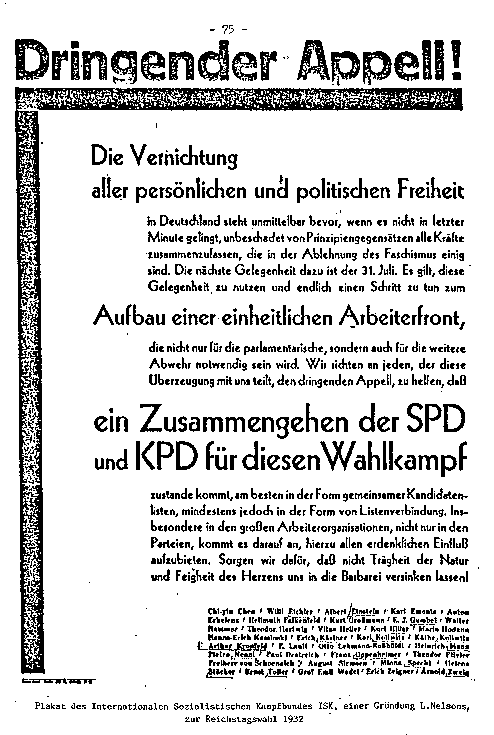
With the growing electoral success of the Nazis at the end of the Weimar Republic, the ISK founded the newspaper, Der Funke to confront the situation. Of particular note was the "Urgent Call for Unity" (Dringender Appell für die Einheit) regarding the July 1932 federal election. It appeared in the newspaper and on placards all over Berlin. Calling for unity and support of the SPD and the KPD in order to thwart further gains by the Nazis, it was signed by 33 leading German intellectuals, including scientists Albert Einstein, Franz Oppenheimer, Emil Gumbel, Arthur Kronfeld, the artist Käthe Kollwitz, writers Kurt Hiller, Erich Kästner, Heinrich Mann, Ernst Toller and Arnold Zweig and many others.[3]

The ISK continued to work in the resistance after the 1933 Nazi ban. The ISK had destroyed all written party records and until 1938, remained undetected, while the larger parties, the KPD and SPD, were being battered by massive arrests. The ISK was therefore able to continue its resistance work, helping political refugees leave the country, conducting sabotage and distributing leaflets. In 1938, however, a wave of arrests hit the ISK.[4] A main focus of the work was the attempt to build a clandestine trade union, the Unabhängige Sozialistische Gewerkschaft ("Independent Socialist Union"), which also supported the Internationale Transport Workers' Federation.[5] The ISK's best known act of resistance was the sabotage of the opening of the Reichsautobahn on May 19, 1935. The night before Hitler's trip to inaugurate the new highway, ISK activists wrote anti-Hitler slogans, such as "Hitler = War" and "Down with Hitler", on all the bridges along the route between Frankfurt am Main and Darmstadt, where he was to travel.[6] The Nazi propaganda film produced of the event had to be edited numerous times.

In exile, the ISK also published the Reinhart Briefe ("Reinhart Letters") and Sozialistische Warte, which were then smuggled into Germany. Because of their factual and unpolemical reporting, these were valued by various members of the German Resistance. The ISK was linked with the Socialist Vanguard Group in England and the Internationale Militante Socialiste in France.

ISK members after 1945

After World War II, the ISK was merged into the SPD on December 10, 1945 after talks between Willi Eichler, chairman of the ISK and Kurt Schumacher, then chairman of the SPD. Most of the former ISK members then joined the SPD.[5]

One prominent member of the ISK, Ludwig Gehm, was later the national vice chairman of the Committee of Formerly Persecuted Social Democrats (Arbeitsgemeinschaft ehemals verfolgter Sozialdemokraten) and a Frankfurt am Main city council member from the SPD. Eichler, who was chairman of the ISK for many years, represented the SPD in the Bundestag from 1949 to 1953 and is considered one of the main authors of the Godesberg Program. Alfred Kubel was a member of the Lower Saxony state government for many years and was Ministerpräsident from 1970 to 1976. Hamburger ISK member Hellmut Kalbitzer was elected to the Bundestag several times, served in the Hamburg Bürgerschaft and from 1958 to 1962, was vice president of the European Parliament. Fritz Eberhard, who was in the ISK until 1939, was a member of the Parlamentarischer Rat ("Parliamentary Council") and was involved in writing the postwar constitution, including the right to conscientious objector status in the new laws of the Federal Republic of Germany.

Eichler also published a monthly magazine from 1946 until his death in 1971, Geist und Tat, which was devoted to "rights, freedom and culture" and he had a publishing house, Europäische Verlagsanstalt until the 1960s.

Structure

The ISK never set out to amass a large membership, but rather to become an active and hard-hitting organization. Membership requirements for prospective candidates included adherence to a certain ethical socialism that were more stringent than for the major parties.

  • Members were to abstain from nicotine, alcohol and meat, were to be absolutely punctual and orderly, and because of the anti-clerical position of the organization, withdrawal from church affiliation was mandatory

  • Participation in a trade union, the ISK and the labor movement was general requirement for members (eliminating passive membership)

  • Instead of a membership fee, there was a "Party tax," which all members with an income over 150 Reichsmarks had to pay

The ISK never had more than 300 members, largely because of the strict requirements for membership. These members were organized into 32 local groups. However, its political work involved sympathizers, between 600 and 1,000 in 1933. A survey in 1929 revealed that 85% of ISK members were under 35 years of age.

Chairmen of the ISK (formerly, the ISYL)

  • 1922–1927, Leonard Nelson and Minna Specht

  • 1927–1945, Willi Eichler and Minna Specht

From 1924 to 1933, the ISK (and its forerunner, the ISYL) maintained its rural school, the Walkemühle in the Adelshausen quarter of Melsungen, Hesse and from 1931 to 1933, its own newspaper, Der Funke, both of which were banned by the Nazis.

Political Ideas

The relationship between the rank and file ISK membership and its founder and chief ideologue Leonard Nelson has been described as a “personal cult”. Nelson rejected the democratic principle, in which the majority decision is to be treated as rational. In its place he used what he called a rational-leader-principle, which has some obvious problematic elements. Nelson promoted the concept of a rational dictatorship, believing that it was possible to ascertain in an objective manner what needed to be done. The ethics of science would become the foundation of a politics of science. Nelson believed that science could show what is just, i.e. in accordance with moral law, so the rational individual who has a keen enough grasp of science will know the moral and intellectually best ways to run society they must be free from limits. An all-powerful state should carry out any and all reforms deemed necessary.

Nelson opposed the Marxist teachings of the historical necessity of capitalism to the development of socialism and communism. Instead he promoted human responsibility and the necessity of a “moral compass”. He based these beliefs in his readings of Immanuel Kant.

Since its creation ISK was strictly anti-nationalist and anti-militarist. During the war Eichler publicly expressed opposition to the dogma of national sovereignty. The ISK also practiced sexual equality amongst its membership by promoting equality of rights for women.

The group promoted a mix of non-authoritarian and authoritarian structures within its orbit. On the one hand its educational service Walkemühle instructed both adults and youths on the importance of critical thinking and some of the latest concepts of the time. While on the other hand ISK described the training of civil servants as an example of authoritarianism.


Poster of the “Internationaler Sozialistischer Kampfbund” (ISK), a foundation of
Leonard Nelsons for the parliament elections in 1932. Signed by Kronfeld, Albert Einstein
and Franz Oppenheimer and well known artists like Kurt Hiller, Erich Kästner, Karl and
Käthe Kollwitz, Heinrich Mann, Ernst Toller and Arnold Zweig.


2. Vegetarianism in the ISK and the anti-Fascist Resistance


As described, a vegetarian way of life was a mandatory membership condition in ISK. Through its publications it propagated vegetarianism in Germany and abroad. It organized group visits in slaughterhouses to convince the workers to renounce their work and the other violent ways humans relate to animals. Willi Eichler ISK co-president since 1927 documents one of these visits in his 1926 essay “Even Vegetarians?” Recently that essay has been circulated again by social democrats acting in the group Sozis für Tiere (Social Democrats for animals). Willi Eichler would join the SPD in the aftermath of the Second World War and moderate his politics. He led the commission that developed the social democratic Program of Godesberg (accepted in 1959), in which the idea of socialism appeared only in a very diluted form, and which many later regarded as a road map for the right-wing in that party. I could not find out if he remained a lifelong vegetarian.

Nelson agreed with Eichler: "A worker who wishes more than a guarantee he will not become a capitalist and for whom the fight against all exploitation is a serious matter, he does not bow before the pressure of public opinion toward the habit of exploiting harmless animals, he does not participate in the daily millionfold murder."

The resistance activity of the ISK against the Nazi rule was effective, if we consider the enormous difficulties and the small membership. Cunning means were applied, and one of them made use of vegetarianism - more on that later.

At the beginning of Nazi rule, the ISK formulated 4 objectives for resistance activity: information, propaganda, anti-Nazi actions, and security for the group. One means was illegal leafleting. The Nazis held elections of worker representatives in companies, admitting only "suitable" candidates. The ISK campaigned for a vote of no confidence against all candidates - until the Nazis gave up on the elections in 1936 due to the lack of popular support for their picked candidates. (Only 50-60% voted for the official list.) Also in 1936, ISK members also collected money in workplaces for the resistance in Spain.


At the inauguration of a highway, it was discovered that the bridges were painted overnight with chemicals that can be seen only when daylight hits them, and the speaker systems had been sabotaged. Two SS members were later executed for insufficient vigilance. Invisible paint, which is visible in daylight, was also used for to daub slogans on the pavement, using suitcases with a special mechanism. A grassy hill next to the Berlin railway was chosen for an action using fertilizer poured from canisters. After a few weeks the hill was marked with the slogan "Nieder mit Hitler" [Death to Hitler].

The ISK also discussed a plan to kill Hitler via a suicide attack, but the plan was opposed by some members and did not go beyond discussions.

The anti-Nazi activity included a set of vegetarian restaurants, which ISK members operated in several cities and used for clandestine purposes. Some had opened before 1933, the remainder opened after the rise to power from the Nazis. Large restaurants were founded in Berlin, Hamburg, Frankfurt am Main and Bochum. According to one report, the Hamburg restaurant prepared 120 lunches a day.

They were often led by women, but both men and women worked in them. The working day was long and the pay low. The restaurants served several purposes: to provide work to the unemployed, to generate a profit that was used for resistance activity, enable contact between resistance agents in a relatively unsuspicious place, serve as bases for production and distribution of illegal printing material etc. However, they also served for promote vegetarianism.

A wave of arrests in 1937 forced many restaurant workers to flee abroad or to live in hiding. Two fugitives founded vegetarian restaurants in Paris and London. The restaurant in Paris became a contact point for exiled Germans and was also a source of funds. The same for the restaurant in London. There they were supported by a group linked to Nelson inside the Labour Party, the Socialist Vanguard Group, the British affiliate to the Militant Socialist International (ISK).

Here is a somewhat extensive quote from a document from the City Archives of Göttingen, which captures the atmosphere of the era and also paints a picture of the spread of vegetarianism in Germany at the time and the political implications of it, e.g. the spread of the legend about Hitler being “Vegetarian”:

Next to the premises of the ISK in the city, the vegetarian restaurant can be seen, operated by the mother of Fritz and Helmut Schmalz on Weenderstraße 71/72. August Schmalz was member in the ISK since 1927; she had already led vegetarian cooking courses in the Walkemühle. Vegetarian restaurants were a financial pillar of the organization, although more profitable and useful for that purpose were the restaurants in the bigger cities like Berlin, Hamburg (Anna Kothe worked there since 1934, who for a long time worked in the headquarters in Göttingen as a housekeeper), Cologne or Frankfurt. Auguste Schmalz's vegetarian luncheonette has been around since at least 1931 and was a regular meeting place. Hannah Vogt recalled: “I remember a place in Weender Straße – which was led by the mother of trade unionist Fritz Schmalz – where everyone had a vegetarian lunch. Many of them regularly met there.” Since spring of 1933 the premises were observed, however the police failed to prove that the guests of the Schmalz lunchroom participated in anti government discussions.
The income opportunities that opened up with such a restaurant also attracted the greedy gaze of the "Volksgenossen" [Nazi term, roughly means People’s comrades, used as a term for correct i.e. Nazi behaviour]. In a letter to the rector of the university at the end of October 1933, someone proposed a remedy against an urgent lack of food for the students. He said that among the 4,000 students there are at least 150 vegetarians, "who now wish to live according to the way of life of our people's chancellor", but can't, because "the only vegetarian lunch place here (...) is run by the ex-communist Schmalz". According to the writer, he even makes an advertisement by posting it on the blackboard of the auditorium, despite the fact that it is possible to prove, "that the students are being influenced by propaganda there, acting at that in a very refined manner”. The author of the letter thought his “most noble task to provide the students of the University of Göttingen with the cheapest high-quality food, in accordance with the new theory of nutrition". Of course he hoped for the support from the rector for his "valuable idea, also represented by Hitler, Rudolf Hess, Göbbels (!) and even many professors in Göttingen". Schmalz's lunchroom survived despite these attacks and denouncements at least until the beginning of the war.


3. ISK, Esperanto and SAT

The ISK attempted to spread beyond the borders of Germany in their early days and adopted Esperanto as one of the means to achieve this.

Registered in bibliographies is the edition of the quarterly Esperanto-language Organo de Internacio de Socialista Kunbatalo since 1929 (before the appearance of a similar publication in English). After the Autumn of 1933 it appeared in Paris under the name The Critical Observer: magazine of politics and culture. It continued to be published until the end of 1939 if not longer. Hermann Platiel was credited as its editor after the move to Paris, but its possible that he occupied that position earlier.

The ISK published a daily newspaper Der Funke [The Spark] for 14 months, between 1932-01-01 and 1933-02-17. Then it was banned. The release necessitated great sacrifices, inevitable for such a small organization. Notable in it is the striving for a working class united front against the looming fascism and the very critical reporting on nationalism in general. The complete journal collection is now archived online. There you can find three kindly written articles about SAT and its congress from 1932 in Stuttgart. Although one would expect that their author would be Hermann Platiel, the authors used initials ("M. H.", "Rpt.", "O. W.") do not match that assumption.

Some excerpts from the articles:


Party political neutrality among the Worker Esperantists (from Der Funke 1932-06-05) In the Esperanto Labour movement, whose most important, global organization is SAT (World Anti-national Association), the party political disputes, especially between the CP and the SP, was not missing. In Germany there are already in many cities separate communist and social democratic Esperanto groups. All the more gratifying that the president of SAT, Lanti, who also publishes the Esperanto newspaper Sennaciulo, stands entirely on the ground of the party political neutrality of SAT. In an open letter to many SAT members he assumes a position against the communist attempts to link SAT to a definite political program, by which the CP wants to secure for itself a better foundation for its domination. The CP wants first, that SAT compels all members to recognize Marxism as “the correct basis on which the firm unity of the proletarian Esperantists can be founded".
[…]
In addition, Lanti quite rightly throws back the opinion that non-Marxist viewpoints such as those of Nelson, Kropotkin or Gesell should remain undiscussed in the newspaper, because "the vast majority of organized workers recognize Marxism as the theoretical basis for their class struggle”. That is totally incorrect - let's think about England, Spain or India!
[…]
It is desirable that Lanti's positions continue to be guiding SAT and its newspaper, so that the very desirable propaganda for Esperanto as an international means of understanding, especially as a tool for a fighting working class should not be hindered by a dogmatic and party-politically narrow framework.
We greet the Esperantists in Stuttgart [title originally in Esperanto] (from Der Funke 1932-08-06) In the second week of August, the 12th congress of ... SAT meets in Stuttgart. […]
SAT for two reasons is particularly called to work on the creation of the socialist united front: Its members are linked by the bond of a common language. […] SAT also fulfills an important prerequisite for the collaboration in the creation of united front of the various workers parties. The management of SAT has been resisting firmly and successfully for years against the disrespect of party political neutrality within the Association. [...]
The working Esperantists in Stuttgart (from Der Funke 1932-09-01) The 12th congress of the world association of working Esperantists (SAT) 250 comrades from 12 countries participated despite the bad economic situation.
[…]
The most important result of the congress was the re-securing of the party political neutrality of SAT.
[…]
Also the efforts to change the current structure of SAT – a union of all the proletarian Esperantists without regard to their nationality or race - by associating national associations, were unanimously rejected.
With the exception of the proposers, all the comrades emphasized the necessity right now, of a front between the workers and the growing wave of nationalism, not only emphasizing the international connectedness of the proletariat, but also to practically realize it, for which purpose the present stateless organizational form offers the best basis.
[...]

Its known that Hermann Platiel was both an ISK and SAT member. Born in 1896 (or possibly 1886) and died in 1980, Platiel was hired as an administrator for the SAT office in Leipzig from the 8th of May 1929 until 1932. In Leipzig he also led the local ISK branch. After Lanti stood down from the post it was Platiel who became the President and Director of SAT from 1933-35. SAT published his text History of the schism in the Workers Esperanto-Movement: Documentation which shows the causes and responsibilities and prepares the foundation for united action. He then became the secretary of the French Esperanto section of ISK 1938-39. I do not know if he has been active in SAT since the 40s or maintained any relationship with Esperanto at all. Petro Levi who joined SAT shortly after the war does not remember seeing him when I asked, and I was not able to find anything online, though of course there are still other sources to check,

In 1943 he illegally fled to Switzerland, and worked for the "Schweizer Hilfswerk" (Swiss Relief Fund) and wrote reports for the London foreign leadership of ISK. Before the escape to Switzerland he was located in the southern French city of Montauban, to which he fled from the internment camp in Gurs. There he married with well-known ISK member Nora Platiel (née Block). In 1949 they settled in the German city of Kassel, where Nora began a career as a court jurist and then a representative of the Hesse parliament (for the SPD). Hermann worked as a director of a theatre in Kassel, according to reports with great commitment.

This summary of facts about ISK's relations with Esperanto and especially with SAT is very incomplete. Further research would be worthwhile. Research in the archive of SAT in Paris should provide insights about that, also about Hermann Platiel personally, and would answer the question whether he and possibly others ISK members played a role in the then Vegetarian Section of SAT, which we can guess, but do not know now.


4. Sources

• Das Schlachten beenden!, Verlag Graswurzelrevolution, Nettersheim 2010 [GWR estas

monata ĵurnalo kaj eldonejo dediĉitaj al senperforta anarkiismo, kun ekologia emfazo kaj

simpatianta kun veganismo; pli ĉe www.graswurzel.net]

• Heiner Lindner: Um etwas zu erreichen, muss man sich etwas vornehmen, von dem man

glaubt, dass es unmöglich sei – Der Internationale Sozialistische Kampf-Bund (ISK) und

seine Publikationen, Friedrich-Ebert-Stiftung 2006, http://library.fes.de/pdf-

files/historiker/03535.pdf

• Vikipedio germanlingva: ISK, Nora Platiel kaj esperantlingva pri Hermann Platiel

• urba arkivejo de Göttingen: http://www.stadtarchiv.goettingen.de/widerstand/texte/isk-

goettingen_1933-1935.html

Gary Mickle

Translated into English by Reddebrek

Monday, 13 March 2023

Real Politik in the interwar years


Over the past several years I've noticed some worrying trends among pop history effectively popularising myths to the point they obscure and even deny some heavily documented events. One of them concerns foreign policy in the interwar years, especially concerning policies on dealing with Nazi Germany. Its somewhat understandable, this period is quite infamous for some dramatic shifts in international affairs. Even the name the Interwar period is misleading, I don't think Ethiopians or Chinese or the Spanish would agree that the years between World War I and World War II were particularly peaceful to take just a handful of examples.

I'll outline a general version of the argument that I find is increasingly common, every advocate I've encountered has there own personal spin so this'll be a bit of a generalisation but it'll cover the main thrusts.

The Molotov-Ribbentrop pact (M-R) is not proof that the Soviet Union and Nazi Germany collaborated with each other in alliance, it was merely an attempt by the USSR to gain time to defeat Nazi Germany later. Anyway, Stalin had to take that deal as Britain and France had turned down his attempts to ally with the west against the fascists. But the west preferred to appease fascism and tried to use it to attack communism.

Like all good lies there's a few strands of truth weaved into it for credibility sake. I'll start with acknowledging those bits so we can move on to the really dangerous stuff. The decision to negotiate with Nazi Germany was motivated by self interest, and it is true that earlier in the decade the Soviet Union had pursued a collective security initiative including approaches to the British and French governments, its also true that Britain and France especially under certain administrations had little appetite for working with the Soviet Union. Its also true that a strategy of appeasement was promoted.

However, this reading and most of the variations of it I've encountered usually leave out quite a bit of important context, either because they don't know, they haven't bothered to study a really complex and confusing period of history, or they are aware but know attempting to account for further context opens their standpoint up to more scrutiny and commentary than they wish to experience. 

To take an example, many emphasis the Soviet Union's motives as opposition to fascism, but I don't believe ideological stripes mattered at all. Because a key partner in the USSR's collective security against Germany strategy was Fascist Italy. 

Meanwhile, 1933 was an important year for Moscow’s relations with Rome and for its newly declared policy of collective security designed to contain both Adolf Hitler and the Japanese. In May, Italy and the USSR signed an economic accord, and in September they signed a Treaty of Neutrality, Friendship, and Nonaggression. A series of military exchanges and favorable press comment punctuated their good relations.(22) On October 27, Ambassador Vladimir Potemkin told Deputy Foreign Minister Fulvio Suvich that Germany was trying to conclude an agreement with Japan at Soviet expense. Distrusting Britain in East Asia, the Soviets wished to forge a pact among themselves, the French, Italians, and Americans to defend China against Japan.(23) 
https://libcom.org/article/soviet-appeasement-collective-security-and-italo-ethiopian-war-1935-and-1936

Courting of Italy was also done by Britain and France, though at times Britain was more reluctant and even hostile to Italy over tensions between both nations over spheres of interest in their colonies. This courting of Mussolini may seem odd looking back, not only because Mussolini was a Fascist dictator, he is also regarded as a clown and a failure. Well Mussolini was concerned about Germany uniting with Austria and having a direct land border with Italy, so in the 1930s his government was willing to work with other powers to limit German expansion. During the 1934 July putsch, a coup attempt by the Austrian Nazi party against the ruling Austrofascist party (yes that is correct, a civil war between Nazis and Fascists) Mussolini built up his forces in the Brenner pass and publicly warned Germany not to invade Austria. Hitler publicly declared he had no intention of doing so and disavowed the coup which quickly collapsed afterwards. So yes, there was a time when Nazi Germany was so vulnerable that Mussolini made Hitler blink.

Eventually this courting of Mussolini brokedown once Hitler made him a better offer. In addition to courting Mussolini, the Soviet Union did secure an agreement with the French Republic. In 1932 both nations had established a non-aggression pact and then in 1935 had developed their relationship further with the signing of a military accord, the Franco-Soviet Treaty of Mutual Assistance. As military alliances go its considered weak, the accord didn't automatically mean war with one was war with the other, and it required consultation with other powers including Britain and Italy and the League of Nations. 

But it did mean that any nation wishing to pursue military objectives against one would have to take into account the response from the other. And it did establish a framework for further co-operation, with French support the Soviet Union signed a similar agreement with Czechoslovakia which is why Stalin is represented in the famous cartoon about the Munich agreement.


 The connections between France and the Soviet Union is the reason why so many French politicians like Édouard Marie Herriot disgraced themselves by denying famine in the Soviet Union. While the two powers grew closer rumours about starvation in Ukraine and the south of Russia had begun to circulate internationally. Which cause some backlash other the government's decision to ally with a brutal dictatorship, hence the need to deny.

The importance of the relationship is also seen as an explanation for the Spanish Republican government's lack of support for independence amongst Spain's African colonies, as anti-colonial revolt would threaten French interests in their African colonies and in Morocco.

In particular, the U.S.S.R. is in alliance with France, a capitalist-imperialist country. The alliance is of little use to Russia unless French capitalism is strong, therefore Communist policy in France has got to be anti-revolutionary. This means not only that French Communists now march behind the tricolour and sing the Marseillaise, but, what is more important, that they have had to drop all effective agitation in the French colonies. It is less than three years since Thorez, the Secretary of the French Communist Party, was declaring that the French workers would never be bamboozled into fighting against their German comrades(4); he is now one of the loudest-lunged patriots in France. The clue to the behaviour of the Communist Party in any country is the military relation of that country,actual or potential, towards the U.S.S.R. In England, for instance, the position is still uncertain, hence the English Communist Party is still hostile to the National Government,and, ostensibly, opposed to rearmament. If, however, Great Britain enters into an alliance or military understanding with the U.S.S.R., the English Communist, like the French Communist, will have no choice but to become a good patriot and imperialist; there are premonitory signs of this already. In Spain the Communist ‘line’ was undoubtedly influenced by the fact that France, Russia's ally, would strongly object to a revolutionary neighbour and would raise heaven and earth to prevent the liberation of Spanish Morocco.
https://files.libcom.org/files/Homage%20to%20Catalonia%20-%20George%20Orwell.pdf

France however, is democratic, well they have elections, and so the government of France and its priorities changed. By 1938 the government led by Édouard Daladier no longer held much faith in the pact and instead put his faith in further collaboration with Britain and Neville Chamberlain, the pact wound up that same year.

So, I think we can see why the popular version is misleading, it frames the issue as a desperate Stalin on one side and a totally unresponsive if not actively malicious Western powers. The truth is much less emotional, most European powers were concerned with the potential threat of Germany (The Franco-Soviet pact specified a hostile European power) and looked to building a network of alliance to contain it. The Soviet Union had some success in this with Italy and France, but neither panned out in the long-term due to changing  circumstances and the strategic goals of one or more of the powers. 

Now, there is something of an Elephant in the room, so far we've barely mentioned Britain. Britain and the Soviet Union's relationship in the 1930s could accurately be described as poor. The Royal Navy wasn't shelling Kronstadt and Leningrad and the Soviet army was massing on the border of Persia waiting for the right time to launch an offensive into India, but there wasn't much love lost between the two. Given that the British Empire was one of the earliest powers to recognise the Soviet Union and establish diplomatic agreements with it, the fraying in the 1930s has a lot to do with the political leadership of the United Kingdom at the time. Especially Neville Chamberlain, he had a very poor view of the Soviet Union,

 “I must confess to the most profound distrust of Russia. I have no belief whatever in her ability to maintain an effective offensive, even if she wanted to. And I distrust her motives, which seem to me to have little connection with our ideas of liberty,”
Neville Chamberlain's letter to a friend in March 1939

He even viewed the Labour party with so much contempt, that Oliver Stanley a fellow cabinet member (this was before Chamberlain became Prime Minister) had to tell him to tone down his attitude and respect them as the official opposition. "Stanley begged me to remember that I was addressing a meeting of gentlemen. I always gave him the impression, he said, when I spoke in the House of Commons, that I looked on the Labour Party as dirt."

His views on the Soviet Union were not atypical amongst the British Conservative Party of the time. Even the minority who advocated reaching an accommodation with the Soviet Union like Winston Churchill were open and aggressive anti-Reds. So, not a promising start to a Europe wide anti-German alliance. There is also the issue of Chamberlain's advocacy for Appeasement, in the UK the words Chamberlain and Appeasement are practically the same. The decision not to confront Germany over Austria and the Czech crisis, and his PR disaster that was the "Peace for our time" speech effectively destroyed his reputation. 

However, appeasement has been greatly distorted. Chamberlain in addition to being an Appeaser was a booster for war preparations. "the merest scaremongering; disgraceful in a statesman of Mr Chamberlain's responsible position, to suggest that more millions of money needed to be spent on armaments." said Arthur Greenwood Labour deputy leader in 1935. The appeasement strategy had two potential objectives if it gave Hitler enough to get him to cease pushing for more territory than more than worth sacrificing some tens of thousands of foreigners. But if that didn't work, it would buy time for the British Empire to expand its war preparation work. Arms spending increased significantly under Neville's time as Prime Minister, especially for the Royal Air Force. He was also in charge of the government that extended guarantees to Poland, guarantees that led to a declaration of war against Germany in September 1939 in response to its aggression against Poland.

There has been some small revisionist history to defend Neville Chamberlain's performance and I don't agree with them. I think his actions were ultimately abhorrent and contributed to the start of World War II, or at least the version of the war we got. But he was ultimately guilty of doing what Stalin was doing, looking to deal with Germany and buy time for their own powers defence and security at the expense of others. 

Chamberlain's willingness to compromise even extended to his contempt for the Soviet Union, there was in 1939 finally some movement between Britain and France to establish an agreement with the Soviet Union. Essentially his cabinet and strong favourable polling for a French-Anglo-Soviet pact pushed him and Daladier to pursue it. It didn't go very well, from June 15th to the 2nd of August preliminary talks between the three had agreed to extend each other and other nations bordering or close to Germany, Poland, Belgium, Estonia, Latvia, Romania, Lithuania, Greece, Turkey etc, of support should they face aggression from Germany. But once the talks reached the stage of discussing military missions and co-operation they soon collapsed.

Problems arouse almost immediately as soon as the delegations arrived in Moscow. The Soviet Union were represented by Klimet Voroshilov Marshal of the Soviet Army and Defence Minister for the Soviet Union, while Britain was represented by Admiral Reginald Drax and the French by General Aimé Doumenc both of whom were minor military officials in comparison to the Soviet delegation. The situation degraded even further when neither Drax nor Doumenc were authorised to make decisions without consultation and approval from their governments. 

The Soviet government came to the conclusion that the talks were not serious initiatives and looked elsewhere. The fruitless talks were officially ended on the 21st of August, two days later on the 23rd of August the Soviet government announced that it had come to an agreement with Germany and had signed what became known as the Molotov-Ribbentrop pact. 

And that is usually where the pop-history enjoyer declares case closed. The West wasn't played silly games and a frustrated Soviet Union had to turn elsewhere and in desperation made a deal with the devil for pragmatic means. But again if we actually look a little deeper many questions arise and refuse to go away. Two days is a suspiciously short amount of time to hold and conclude a diplomatic accord, the technological level of communications, the distance and the layers of bureaucracy and protocol would take weeks if not months to work through just to get diplomats to meet each other. The doomed British, French Soviet talks took several months before breaking down with no agreement.

Indeed talks between the two nations over a closer relationship had begun earlier in 1939 almost as soon as Maksim Litvinov the advocate of collective security had been replaced by Vyacheslav Molotov.

 More positively, Astakhov paid an unusual visit to the Bulgarian Ambassador in Berlin on June 14 to inform him (and apparently the Germans as well) that the USSR "was vacillating between three possibilities, namely the conclusion of the pact with England and France, a further dilatory treatment of the pact negotiations, and a rapprochement with Germany. This last possibility, with which ideological considerations would not have to become involved, was closest to the desires of the Soviet Union."
Feeding the German Eagle: Soviet Economic Aid to Nazi Germany in 1939-41, pg 47

In addition the talks between Britain, France and the Soviet Union collapsed other the Soviet insistence on military access on Polish territory. 

Moreover, the negotiations stalled immediately after Voroshilov had asked if Poland and Romania would let the Red Army through their territories to fight Germany. Drax and Doumenc didn’t have the competency to answer such a principal question – of course, Poland and Romania would not agree. “Stalin believed that those states were just puppets and that Britain and France could force them to agree – but it was more complicated than that and led to London and Paris failing to convince Warsaw that the USSR was any better than Germany,” Budnitsky notes.

Voroshilov was quite brief. “The Soviet mission considers that without a positive answer to this question all the efforts to enter into a military convention are doomed to failure,” he said, inviting Drax and Doumenc to enjoy their time in Moscow instead. The fruitless talks were officially halted on Aug. 21, 1939.
https://www.rbth.com/history/331039-ussr-britain-france-talks-wwii

This demand was made at a talk without a Polish delegation and was asked of two representatives who had no way of agreeing to it. The Polish for their part had been adamant that they would not agree to let the Soviet Union a nation it had serious territorial disputes with put troops within its borders, and for good reason. Instead the Soviet government made an agreement with the foreign power that was more than happy to let them station troops within Poland.

There's also another issue that I find rather worrying. Multiple advocates for the M-R pact are insistent that it wasn't a big deal as it was only a "Non-Aggression" agreement. And yes the official name for the M-R pact was the German-Soviet Nonaggression pact the name Molotov-Ribbentropp pact was a nickname that stuck. It was also described as the Nazi-Soviet pact and the Hitler-Stalin pact, but M-R is the name that proved the more popular. And the public version presented to the world seems to conform to what we would think such an agreement would entail.

The terms of the German-Soviet Nonaggression Pact were briefly as follows: the two countries agreed not to attack each other, either independently or in conjunction with other powers; not to support any third power that might attack the other party to the pact; to remain in consultation with each other upon questions touching their common interests; not to join any group of powers directly or indirectly threatening one of the two parties; to solve all differences between the two by negotiation or arbitration. The pact was to last for 10 years, with automatic extension for another 5 years unless either party gave notice to terminate it 1 year before its expiration.

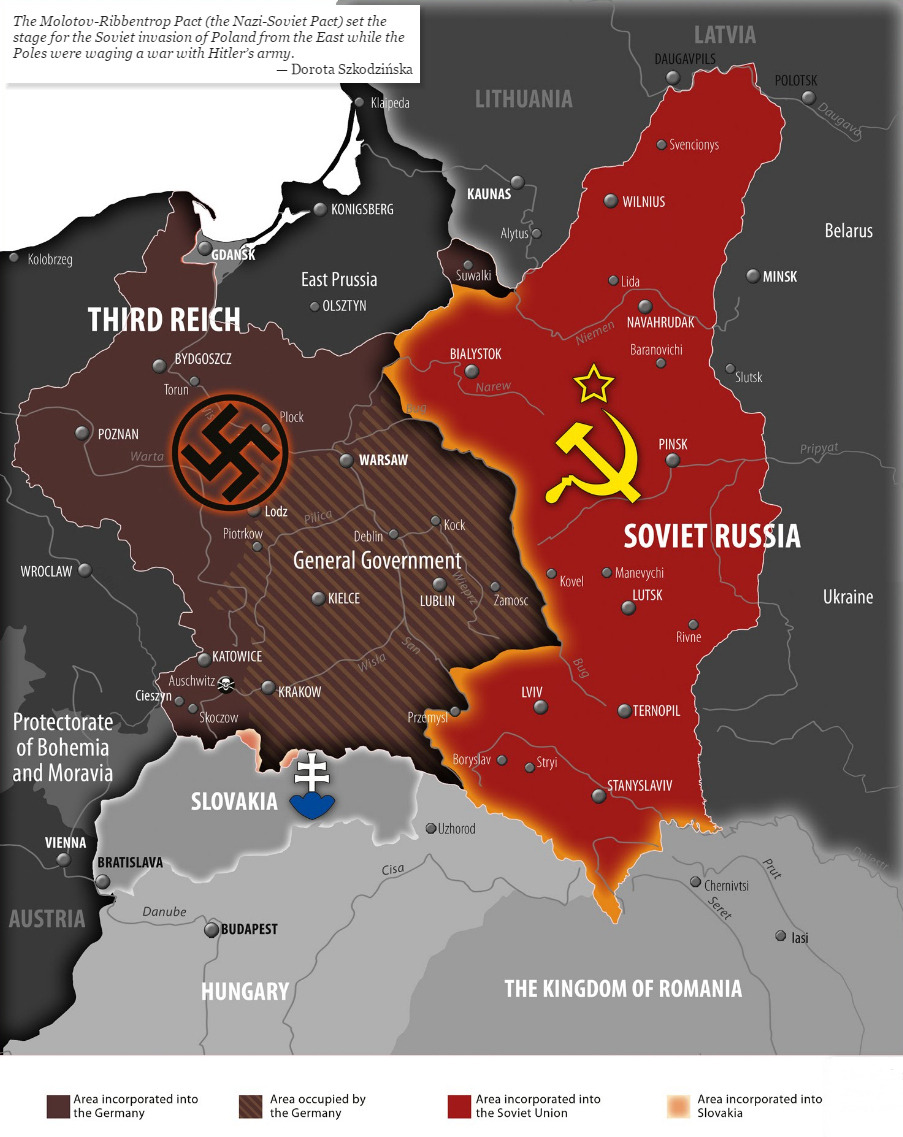
 However, the key word is public. The M-R pact also entailed three additional agreements that were kept secret from the international community. The first of the protocols was agreed on the same day as the public M-R pact, 23rd of August 1939, that divided Eastern Europe into Soviet and German spheres of influence. It broke Poland between the two powers and agreed the Baltic states and Finland were to be Soviet areas, and also discussed the possibility of Bessarabia being broken off from the Kingdom of Romania. Then on the 28th of September 1939 a second secret protocol was signed finalising the division of Poland and looked at the division of Lithuania, and officially consinged Bessarabia to the Soviet sphere, a third and final protocol was signed on the 10th of January 1941 in which Germany agreed to waive its claims to Lithuania in exchange for payment from the Soviet Union the occupying power.

This map shows the differences between the agreed and actual divisions of Europe.

So, the M-R pact was not simply a statement of non-aggression it involved quite a bit of aggression. I usually don't resort to the dictionary, but this is a rare case where I think it is useful to clear up genuine confusion if there is in fact any.

alliance, in international relations, a formal agreement between two or more states for mutual support in case of war. Contemporary alliances provide for combined action on the part of two or more independent states and are generally defensive in nature, obligating allies to join forces if one or more of them is attacked by another state or coalition. Although alliances may be informal, they are typically formalized by a treaty of alliance, the most critical clauses of which are those that define the casus foederis, or the circumstances under which the treaty obligates an ally to aid a fellow member.
https://www.britannica.com/topic/alliance-politics

On the 1st of September 1939 the German army attacked Poland, this was the start of the invasion of Poland by Germany, the Slovak Republic and the Soviet Union. On the 17th of September the Soviet army began its offensive operations in Poland violating the Soviet-Poland Nonaggression pact signed in 1932. Attacked on all sides including an uprising by the Organisation of Ukrainian Nationalists the Polish military resisted until the 6th of October. The Soviet and German military met at Brest-Litovsk (modern day Brest in Belarus) held a joint victory parade and the German army hand over control of the city to the Soviet authorities. 

German officers Generalleutnant Mauritz von Wiktorin (left), General der Panzertruppe Heinz Guderian (centre) and Soviet Kombrig Semyon Krivoshein (right) standing on the platform 

The scene was captured on film

In addition to the joint invasion of Poland when the Soviet Union attacked Finland in November of that same year Nazi Germany officially took a stance of neutrality regarding the two nations. While actively supporting the Soviet invasion by taking action to cut off support for Finland including seizing war material sent by Mussolini.

As there was some pro-Finnish agitation in the Scandinavian countries, they were warned by Berlin ‘not to listen to the blandishments of League of Nations evangelists and British extremists’. [42] Thus any hopes the Finnish government might at first have had of German help vanished. On 8 December the Finnish Minister in Rome had confided to Ciano that Germany ‘had supplied arms to Finland from the booty captured during the Polish campaign’, [43] but on 12 December Hitler yielded to the Naval General Staff’s request for a ‘clear-cut policy’ towards Finland and for the suspension of arms deliveries there. [44] The shipment of arms to Sweden was to be stopped unless the Swedish government gave a written guarantee that they would not be transferred to Finland. [45] A few aircraft ordered from Italy before the war and on their way to Helsinki were seized in Germany. [46] At his second meeting with Molotov in Berlin (13 November 1940), Hitler pointed out that ‘during the Russo – Finnish war, despite the danger that Allied bases might be established in Scandinavia, Germany had meticulously kept her obligations toward Russia’ and that ‘in this connection she had even gone so far as to deny to the Finnish President the use of a German cable for a radio address to America’.
https://www.marxists.org/history/ussr/great-patriotic-war/soviet-german-pact/tasca/ch6.htm

And beyond the military sphere the intelligence services of the two powers, the German Gestapo and Soviet NKVD, both brutal secret police forces co-operated on dealing with internal dissent in their new territories.


Both parties will tolerate in their territories no Polish agitation which affects the territories of the other party. They will suppress in their territories all beginnings of such agitation and inform each other concerning suitable measures for this purpose.

— Secret Supplementary Protocol (2), German-Soviet Boundary and Friendship Treaty 28 September 1939

The co-operation involved the transfer of prisoners of war and actions against Polish resistance groups. And most bizarrely the Soviet Union began handing over many German Communists who had escaped persecution in Germany and Austria.

And yet they get them, to the Gestapo’s great delight. Eighty antifascists before the 1939 Hitler–Stalin Pact, more than 200 (out of 350 deportees) afterward. Only now do the Germans press for deportations, stressing the mutual friendly relations between the German Reich and the USSR. There is no evidence of other pressure, nor of any “reciprocation” to follow. The Nazis give the numbers, the Soviets supply the names. The antifascists are sacrificed not according to some overarching principle of political calculus nor as currency in an exchange but rather as a kind of gift.
https://thereader.mitpress.mit.edu/the-nazi-soviet-pact-a-betrayal-of-communists-by-communists/

So, we have two direct examples of the two powers effectively collaborating in military and strategic aims. But as the timeline of the secret protocols 1939-1941 demonstrates, the M-R pact was a step along the path of the relationship. In addition there were not one but two economic treaties, the German-Soviet Credit agreement signed in May 1939 and the German-Soviet Commercial agreement (1940). These treaties expanded trade in materials and economic co-operation between the two powers. By 1941 when the German broke off ties by invading the Soviet Union the trade had been worth

  • 1,500,000 metric tons (1,700,000 short tons; 1,500,000 long tons) of grains
  • 820,000 metric tons (900,000 short tons; 810,000 long tons) of oil
  • 180,000 metric tons (200,000 short tons; 180,000 long tons) of cotton
  • 130,000 metric tons (140,000 short tons; 130,000 long tons) of manganese
  • 180,000 metric tons (200,000 short tons; 180,000 long tons) of phosphates
  • 18,000 metric tons (20,000 short tons; 18,000 long tons) of chrome ore
  • 16,000 metric tons (18,000 short tons; 16,000 long tons) of rubber
  • 91,000 metric tons (100,000 short tons; 90,000 long tons) of soybeans
  • 450,000 metric tons (500,000 short tons; 440,000 long tons) of iron ores
  • 270,000 metric tons (300,000 short tons; 270,000 long tons) of scrap metal and pig iron
  • 200,000 kilograms (440,000 lb) of platinum

Total USSR imports June 1941 German stocks June 1941 (without USSR imports) October 1941 German stocks October 1941 (without USSR imports)
Oil products 827 (912; 814) 1,220 (1,350; 1,210) 397 (438; 391) 821 (905; 808) −6.4 (−7; −6.3)
Rubber 17.1 (18.8; 16.8) 12.5 (13.8; 12.3) −4.4 (−4.9; −4.4) 11.0 (12.1; 10.8) −6.1 (−6.7; −6.0)
Manganese 171.9 (189.5; 169.2) 186 (205; 183) 14.1 (15.5; 13.8) 150 (170; 150) −17.7 (−19.5; −17.4)
Grain 1,485.2 (1,637.1; 1,461.7) 1,253 (1,381; 1,233) −232.3 (−256.1; −228.7) 690 (761; 679) −794.8 (−876.1; −782.2)
*German stocks in thousands of metric tons (short tons; long tons) (with and without USSR imports-October 1941 aggregate)

https://en.wikipedia.org/wiki/German%E2%80%93Soviet_Commercial_Agreement_(1940) 

 In addition to business interests much of the trade was considered vital to outlast the British Naval blockade that threatened vital German military resources. By 1941 with the conquest of France, Denmark and Norway and guaranteed co-operation from Sweden Hitler believed Germany was no longer dependent on the material supplied by the Soviet Union and a quick victory would mean only a brief disruption in any case.

The Soviet Union also got quite a lot out of those agreements too of course. 

Both Admiralties discussed ‘practical agreements’ for the supply of fuel to German submarines and the use of the ‘northern sea-route’ [69] by German ships. The German Admiralty was very keen on this last point and negotiations began towards the end of December 1939. [70] On 6 February 1940, the German Naval Attaché in Moscow announced that the Russians were willing to allow a German auxiliary cruiser, ‘Ship 45’, [71] to sail to the Far East by the ‘Siberian route’. A temporary stiffening of Molotov’s attitude at the beginning of April seemed to bring them back to where they started, [72] but preparations for the voyage were eventually resumed ‘with Russia’s cooperation’ [73] and ‘Ship 45’ sailed on 12 August 1940, ‘by the Siberian sea-route, with Russian help’. [74] The German auxiliary cruiser was thus able to cross the Pacific without risk and there raid British ships as a privateer. For their part, the Germans handed over the Lützow to the Russians, [75] and in the Leningrad shipyards technicians took over the construction or repair of some of the big ships of the Soviet navy. In November 1940, Admiral Raeder was convinced that Russia would not attack Germany on the grounds that she ‘was starting to build up her navy with the help of Germany’. [76] They were still working together in May 1941. In a memorandum of the 15th of this month Schnurre stated that: ... construction of the cruiser L in Leningrad is proceeding according to plan, with German supplies coming in as scheduled. Approximately 70 German engineers and fitters are working on the cruiser in Leningrad under the direction of Admiral Feige.
https://www.marxists.org/history/ussr/great-patriotic-war/soviet-german-pact/tasca/ch6.htm

 The nature of these agreements both economic and strategically important is very similar to the collaboration of American and British and French businessmen in the same years. (see https://libcom.org/article/how-allied-multinationals-supplied-nazi-germany-throughout-world-war-ii).

 Economic agreements and strategic interventions have an air of cold detachment, what is often confused for pragmatism or "realpolitik". But both powers were left with a big issue concerning their abrupt realignment after years of casting each other as a sought of anti-christ like entity. How to explain this to their own populations? The archives of Pravda,  the Communist party newspaper has preserved some examples of this push. Consider this article, written during the Soviet occupation of Estonia.


 POLITICAL MOOD IN ESTONIA, Pravda, 28 May 1940 TALLINN, 27 May (special correspondent of "Pravda"), (7/14) Recent events in Europe have attracted a lot of attention from various segments of the Estonian population. In contrast to most of the Estonian newspapers, a certain part of the Estonian intelligentsia regards the occupation by the Germans of Denmark in Norway, their invasion of the Netherlands and Belgium as aggression, as the enslavement of small nations. This part of the intelligentsia preaches a loyal attitude towards England and expresses hatred towards Germany and everything German. In commercial circles, the judgment prevails that it was more profitable to trade with England than with Germany, and that English goods are better than German ones. On May 10, the Tallinn Post newspaper (an edition of the Uus Eesti newspaper) published a feuilleton in which the poor quality of German goods was denounced. That part of the Estonian intelligentsia that is hostile to Germany is spreading rumours that the friendship between Germany and the USSR is fragile and short-lived, that a war between the two countries is inevitable, which will bring suffering to the Estonian people. Some of the people who propagate such sentiments are connected by various threads to the British and American embassies. They can also be found among editorial staff of newspaper "Päevaleht". University of Tartu is also a place where pro-English propaganda is carried out.
translation source.


And there's another strange example of close co-operation between Nazi Germany and the Soviet Union, which concerns the Comintern. This organisation was tasked with handling the international Communist movement, or at least the Communist movement that looked to Moscow for leadership. This proved to be a problem as the Communist Party of Great Britain and the French Communist Party had been actively pushing the lines formulated in response to the Spanish Civil War, extreme patriotism and appeals for their governments to take a firm hand against Germany.

But on 14 September something else happened: the Daily Worker received a press telegram from the Soviet Union saying it was a robber war on both sides. Pollitt suppressed this telegram because it was against the line of the 2 September manifesto. However, at the next day’s meeting of the party’s Political Bureau, Dutt, ever responsive to his master’s voice, said the line would have to be revised. Indeed, Stalin had already given orders to that effect, in a private chat with Dimitrov on 7 September; Dimitrov had handed the word down to the Comintern Secretariat, which had approved his theses on 9 September, instructing the Communist Parties of France, Britain, Belgium and the USA in particular that they must immediately correct their political line.
https://www.marxists.org/history/etol/revhist/backiss/vol3/no4/revking.html

The new line was now as the French Communist Party promoted in the winter of 1939 was "The war conducted by the Anglo-French coalition was Imperialist for a certain period, insofar as the coalition was pursuing imperialist ends, had prepared for war, and had worked to bring it about" (see https://www.jstor.org/stable/260642?read-now=1#page_scan_tab_contents ) I highlighted the last part to draw attention to a discrepancy in the line. At the time of the M-R pact the official position of the Soviet Union which was repeated by its supporters was that WWII was the result of the Imperialist actions of the Allies against Germany, and they had been working to prepare for such an action for some time. Contrast this to the original argument at the beginning were the modern supporters of Soviet foreign policy, that the M-R had to be signed because the Western Allies failed to take any step to prevent the rise of German militarism. The imperialism of Britain and France was the official justification the Soviet Union gave for its occupation of the Baltic states. 

«[…] it had become necessary to put an end to all the intrigues by which England and France had tried to sow discord and mistrust between Germany and the Soviet Union in the Baltic States. […]Lithuanian border was evidently inadequately guarded. The Soviet Government would, therefore, if requested, assist the Lithuanian Government in guarding its borders.»
Telegram by Molotov

The French Communist Party was so active in pushing the new line attacking Franco Imperialism and defending the M-R pact for preventing war while Nazi Germany was marching in the direction of Paris. The French Communist Party exploited its reputation in the French resistance for decades after the war ended. But while members of the party had fought in the clandestine underground since the beginning of the German occupation, the party itself did not join the resistance struggle until June 1941. If that date seems familiar that was when Nazi Germany ended its period of co-operation with the Soviet Union by launching a massive and brutal invasion of the Soviet Union.

One final point to consider. In its last days the Union of Soviet Socialist Republics had attempted a partial reckoning with the many skeletons in its closet. Thousands of socialists who had been persecuted, tortured and even executed were "rehabilitated", which was the government term for an official admittance of mistakes and wrongful treatment by the government, a secular mea culpa. In 1989 this process reached the M-R pact. In December of that year Alexander Yakovlev, Communist party historian and Politburo member submitted a report to the Congress of People's Deputies of the Soviet Union, the highest governing body of the USSR. The report acknowledged the existence of the secret protocols ending decades of official denial. In response Mikhail Gorbachev denounced the actions of Soviet government (see appendix).

Conclusion

What is the point of all this? Well, aside from challenging a popular narrative that doesn't have much to stand on, I hope to make something clear. What the years just before 1939 show us is that there were no heroes, neither the Soviet Union nor the Western European powers come out of that period with a clean record. They all, including Mussolini came to the conclusion that a powerful and ambitious Germany probably wasn't a good omen for them and looked into ways of checking that threat. The issue though was that none of the powers were willing to risk their own self interest, they would make commitments up to a point but would not stick their necks out for others unless they were absolutely forced to. The Soviet Union was willing to abandon the anti-fascist struggle and collaborate with the British and French Empires, but was not willing to give up its desires to expand into its neighbours. The French were willing to work with the Soviet Union but weren't willing to risk instability in its colonial empire and so on. 

Meanwhile Germany was willing to work with the hated Judeo-bolsheviks if it would secure the material it needed for its strategic aims. I think too many people read to much into the word alliance, for many they seem to think it means a long term relationship or genuine fraternal bonds. And that just isn't true, alliances are often temporary and can be made with nations who shouldn't be compatible, an example would be the USA and Israel supporting Iran during its war with Iraq. There is a counter pop-myth that frames the M-R pact and wider Soviet-German relationship as proof of a genuine desire of Stalin to work with Nazi Germany on a deeper level, but that has very little in the way of evidence either.

The failures of the 1930s European powers in preventing the Second World War are the result of the failures of real politik and pragmatic attempts to maximise gain for the lowest costs. There are no friends amongst nations, when push came to shove for the Chinese, Ethiopians, Czechs, Austrians, Spanish, Baltic peoples etc. The great powers were no friends to them either and sold them out when it looked risky. The only reason the Poles weren't added to that list was thanks to timing, Britain and France's war preparations were largely complete and they were more confident and even then France scaled back its military operations on Germany's western borders which allowed the German army to concentrate on Poland. Even at that late date the Western Allies were prioritising their own security against a potential German offensive over providing effective support for the Poles dealing with their actual offensive.

Appendix: Text of the Soviet acknowledgment of the existence of secret agreements with Nazi Germany

CONGRESS OF PEOPLE'S DEPUTIES OF THE USSR
DECISION
of December 24, 1989 N 979-1
ON POLITICAL AND LEGAL EVALUATION
OF THE SOVIET-GERMAN NON-AGGRESSION PACT
FROM 1939
 

1. The Congress of People's Deputies of the USSR takes note of the conclusions of the commission on political and legal evaluation of the Soviet-German non-aggression treaty of August 23, 1939.
 

2. The Congress of People's Deputies of the USSR agrees with the opinion of the Commission that the Non-Aggression Treaty with Germany was concluded in a critical international situation, in the face of increasing danger of aggression by Fascism in Europe and Japanese militarism in Asia, and had as one of its aims to take away from the USSR the threat of an impending war. Ultimately, this goal was not achieved, and the miscalculations associated with the presence of German obligations to the USSR, exacerbated the consequences of treacherous Nazi aggression. At this time the country was faced with difficult choices.
The obligations under the treaty came into force immediately after its signing, although the treaty itself was subject to approval by the Supreme Soviet of the USSR. The decree of ratification was adopted in Moscow on August 31, and the instruments of ratification were exchanged on September 24, 1939.
 

3. The Congress considers that the contents of that treaty were not incompatible with the rules of international law and the treaty practice of States in making treaty settlements of this kind. But both at the conclusion of the treaty and at its ratification the fact was concealed that simultaneously with the treaty a "secret additional protocol" had been signed, delimiting the "spheres of interests" of the contracting parties from the Baltic Sea to the Black Sea, from Finland to Bessarabia.
The originals of the protocol have not been found in Soviet or foreign archives. However the graphological, phototechnical and lexical examination of the copies, maps and other documents, the correspondence of the subsequent events to the content of the protocol confirm the fact of its signing and existence.

4. The Congress of People's Deputies of the USSR hereby certifies that the Treaty of Non-Aggression of August 23, 1939, and the Treaty of Friendship and Boundary between the USSR and Germany concluded on September 28th of that year, as well as other Soviet-German agreements, in accordance with the rules of international law, lost force at the moment of the German attack on the USSR, that is June 22, 1941.
 

5. The Congress states that the Protocol of August 23, 1939, and other secret protocols signed with Germany in 1939-1941, both in method of drafting and in content, were a departure from the Leninist principles of Soviet foreign policy. Delimitation of "spheres of interest" of the USSR and Germany and other actions taken in them were from the legal point of view in contradiction with the sovereignty and independence of a number of third countries.
The Congress notes that at that time the relations of the USSR with Latvia, Lithuania and Estonia were regulated by a system of treaties. According to the peace treaties of 1920 and the non-aggression treaties of 1926-1933, their parties undertook to respect each other's sovereignty and territorial integrity and inviolability in all circumstances. The Soviet Union had similar obligations towards Poland and Finland.
 

6. The Congress states that the negotiations with Germany on secret protocols were conducted by Stalin and Molotov in secret from the Soviet people, the Central Committee of the All-Union Communist Party (b) and the entire Party, the Supreme Soviet and the USSR Government, these protocols were excluded from the ratification procedures. Thus the decision to sign them was, in substance and form, an act of personal power, and in no way reflected the will of the Soviet people, who are not responsible for this conspiracy.
 

7. The Congress of People's Deputies of the USSR condemns the signing of the "secret additional protocol" of August 23, 1939 and other secret agreements with Germany. The Congress recognizes the secret protocols as legally invalid and null and void from the moment of their signing.
The protocols did not create a new legal basis for relations between the Soviet Union and third countries, but were used by Stalin and his entourage to issue ultimatums and exert forceful pressure on other states in violation of the legal obligations undertaken before them.


8. The Congress of People's Deputies of the USSR assumes that awareness of the complex and contradictory past is part of the process of perestroika, designed to provide every people of the Soviet Union with opportunities for free and equal development in an integral, interdependent world and expanding mutual understanding.
Chairman
Chairman of the Supreme Soviet of the USSR
M. GORBACHEV

[Translated from Russian by DeepL, bolding my own]

Popular Posts