Search This Blog

Showing posts with label Republicanism. Show all posts

Monday, 30 September 2024

A History of the king's Bodyguard


 Last month I was invited to a lecture held by a local History society, the speaker was a member of the King's Yeomanry (whose full title is King's Guard of the Yeoman of the Guard), which functions as his bodyguard, though nowadays the police and army do much of the grunt work of guarding the Monarch. It was well attended, as a republican I have no interest in the pomp and "grandeur" of the Royal family and its institutions, but I do enjoy history, and I was curious to see how someone who has devoted themselves fully to it acts and what case they'd put forward. I decided I wouldn't ask hostile questions, if I did ask a question it would be purely for clarity. In the end, he answered most of my questions before I asked them.

The speaker is a former Army serviceman and from a Yorkshire Mining town, there's a stereotype of Yorkies being a bunch of militant socialists, I've experienced enough of them to know that isn't true, though it was still a little weird to reconcile that accent and attitude with constant deference to privileged poshos. Just seemed wrong to me. The historical part of the talk was quite interesting, the King's bodyguard was first established in the aftermath of the death of Richard III at Bosworth field, the victorious Henry VII was quite shaken seeing Richard hacked to pieces and resolved not to let that happen to him. So, in effect, one of the most important institutions in a system of unquestioned obedience was started by a rebel and regicide.

The talk continued up to the present day, some interesting titbits include that despite serving under several Queen's Mary, Elizabeth I, Anne, Victoria etc. It wasn't until Elizabeth II that they changed the rules to call themselves protectors of the Queen. Another bit I found interesting was that the reason why a deceased Monarch's coffin is carried by the Grenadine Guard and not the King's Yeomanry is because they dropped Queen Victoria's dear Albert, and thus lost that "privilege". Another interesting bit that caught my ear was that up to 1830 civilians were allowed to purchase positions within the Yeomanry and used it as a source of enrichment, either by getting the King's ear or by paying attention at court and profiting through insider information. The speaker did not give specific examples of this corruption, but he did mention expeditions to Australia and the Virginia Colonies were influenced by this system, which was a brief reminder that the Monarchy was an active and key participant in the Imperial expansion with its evils of war, plunder, slavery etc. Afterwards membership of the Yeoman of the Guard was restricted to serving military, first the army then eventually expanding over the years to include all branches of the Armed Forces, eventually expanding to allow service women to join.

Currently, the membership of the Yeoman of the Guard is around 200 members, including a number of retired and pensioned members. The speaker wanted us all to appreciate that the money for the Guard comes directly from the King, not the government, not the public, but the King personally. Of course, this raises the question of where the King gets his money from, but I promised not to start an argument. We all know where the King gets his money from, either the British public, or his massive commercial holdings, which he has thanks to the British government so again the British public, or straight up dodgy dealings with foreign super wealthy.

 But a fraction of this money goes to the Guard for their service, though there is a difference between retired and pensioned, only 14 Yeomen have a pensioned paid by the King, the rest don't get anything until one of the fourteen die. That's not my words, that was the speaker's words. Again, I could've asked him why the King doesn't pension all retired Yeoman's since ceremonial duties aside they are still expected to get a bullet or dagger for him. But again I held my tongue, and as reward received even more evidence of the King's penny-pinching and ingratitude.

Eventually we got to the part where Elizabeth II died and the funeral arrangements. It was quite brutal, the Speaker and his fellow Yeomanry had to work 24-hour shifts fulfilling all the requirements of the ceremony. If you're wondering how they managed that, they worked on a rotation basis with a break every hour, but they couldn't leave or get proper rest because they would be needed to go stand by a door or a corner of a room or next to some painting or artefact or crowd management. In addition, they had nowhere to sleep when they did get some time off. He showed us photographs of them slumped in chairs because Mice would run over them if they slept on the floor. The death of Elizabeth II was an important event in the history of the Monarchy and yet despite the thousands of flunkies working overtime to get the event just right, no one thought to get some of the hundreds of unused rooms in the palace prepped for rest. 

Or perhaps, they just didn't care, while he was telling us anecdotes about the funeral he recounted one where the new King Charles came into the rodent infested room full of exhausted Guardsmen slumped in chairs and made no effort to improve their lot. The whole talk gave me feelings like I was in another world, this man was gushing about the Monarchy, but he never said anything I would consider worthy of praise or admiration. The Monarchy at best seemed distant from him even when he was in the room with them, and at worst completely uninterested in his welfare or the service he was providing. His sword forged by Wilkinson's Sword was nice, it put my 1934 German Policeman's Sabre to shame, and his uniform that resembled a Beef Eaters looked fancy, but I imagine it's a nightmare to clean, my old Cadet dress uniform was, and it was made in the 20th century. But apart from getting to go to some Royal Garden parties, which the majority of them have no King in attendance, there wasn't anything he said that I could even parse as reason for any of this nonsense to continue to exist. I did not even get a sense that he liked, and respected the current King Charles, he and his wife had a couple anecdotes about Charles's mother that seem like they were supposed to be endearing but when Charles was mentioned it was purely as an acknowledgement that he is the current holder of office.

 It was an interesting talk, but my object to understand what lies within the minds of the Crown polishers remains elusive.


This was unrelated but while writing this I found this poster in an Archive

Monday, 19 September 2022

The People's Nan?


 A key pillar of the queen's personal popularity has been the construction of the image of a benevolent old matriarch. Whichever royal correspondent or press secretary came up with this idea deserved a raise, but given how the Windsors treat their staff probably got nothing. It's a new trick and was unthinkable with previous monarchs it was too undignified and brought the sovereign too close to the commoners, but queen liz the nation's grandma worked very well.

I've encountered many people who are at best indifferent to aristocracy and some who are openly against it as a concept and have genuine loathing for individual members, Charles, Andrew etc. who are taking the death of this 96 year old really badly. 

It never worked for me though, even as a child I thought the soundbites on the news  about the nation's grandmother were empty. The reason is because the queen was one of the few people in the world my actual grandmother openly disliked. She thought it was absurd and offensive that one family should not only get a free ride off the backs of everyone but to be fawned over too really got at her. My Nana came to the UK after WWII with her husband to find work, she had to raise eleven children by herself often relying on the produce of a small plot and a chicken coop to ensure everyone was fed. I genuinely don't understand how she did it, keeping 13 people fed and clothed alone at a time when there were no modern efficient appliances and with frequent moving across Britain and Ireland. The past really is another world.

Despite everything she was a kind and caring woman, apart from Liz 2 the only people I can recall her expressing open contempt for were weapons manufacturers and governments that enabled them and were keen to start wars[1]. I miss her dearly and often. I do not miss Elizabeth 2, on the contrary I'm already sick of her half way through the mandated mourning period. And I would also note that when my Nana did pass away the outpouring of grief and sympathy had no coercion or social obligation, it was completely genuine. I used to find this line of propaganda laughable, I now find it offensive. Queen Elizabeth 2 was not my grandmother, but if she were then she would have been a rubbish one. The kind that never bothered with her family and expected them to make all the efforts, who never gave out presents or sweets and spent her fortune on indulgent trips and stubbornly refused to leave her ridiculously outdated and drafty mansion(s). Furthermore, when she did pass on she had the cheek to stick us with an expensive burial to arrange and the unsurprising but still insulting news that all of the inheritance of her vast estates is going exclusively to her chosen favourites, the same weird sycophantic cousins she spoiled rotten while alive. 

Where are my humbugs and Werthers originals Liz?


___________________________________________________________________

1: I can see her now, watching the news footage of aerial bombardment and tank formations cursing that the folk in charge always find money for bullets.

Tuesday, 13 September 2022

Republicans being arrested in the UK


image from here
There's sporadic news of republicans being arrested and detained outside royal properties and at the roadsides as the former queens coffin winds its way through the country. We're in the weird stage where the king is being proclaimed so there are a lot of gatherings by local dignitaries and functionaries in strange centuries old formal attire.

It hasn't been going well but better than the pessimists amongst the royal correspondents feared. The queen was very popular, even with populations who really should know better. Charles though? Not remotely. For decades his popular image has been the butt of many jokes about the absurdity of a grown man spending decades doing nothing but waiting for his mum to die. I've laughed and made up jokes about him actively murdering her to speed it along. And this is the common image of him when he manages to stay out of the scandal papers.

When he has been caught out you add embarrassing sexts to his consort, an affair and messy divorce with the very popular Dianna, and the occasional tax free donation from shady foreign businessmen and it doesn't make for enthusiastic subjects. So I'm not surprised there have been a handful of demonstrations of discontent. Am a bit surprised to see arrests and charges brought up, not because of any ideas about traditional British values, but because this kind of heavy handed and transparent attacks on freedom of protest and speech seems exactly the sort of thing to revive a more militant anti-monarchist movement and confront the public with a choice, royal prestige or personal freedom and I think large numbers will pick the latter.

Even when Elizabeth II was on the throne and quite popular her reign rested on fragile foundations, the best guarantee was to cultivate a atmosphere of passive acceptance and to keep everyone from looking to closely at the reality even for the purposes of defence. Typically the crown relied on the soft power of social disapproval to sap challenges to its existence and tried to avoid the topic as much as possible. The republican movement in the UK is very anaemic but its membership grows every time their is any lengthy display of royalty including those weddings and jubilees. One of the few positive developments I witnessed in the last years of the queens reign was the isolated voices on the chat show circuits talking about how they didn't see any reason for the monarchies existence in clear terms and their opposition who are so unused to having to justify their prejudices flailing quite badly to come up with anything. This may seem strange but that hadn't happened before. Previously anti-monarchists were ever ignored entirely or presented as fringe eccentrics.

I went to Thailand in 2019, I thought I was prepared for the cult of personality over the king but I was not. On a tour of a Bhuddist pagoda one of our group asked a question about the current king's new wife, the tour guide looked over his shoulder and didn't answer until he was sure no one else was around and then politely asked us all to refrain from asking questions about the current royal household, historical kings like Rama V were fine but not the one whose portrait adorns all public places. He explained that questions like that put him in a difficult place and he could be forced to appear at a police station for questioning and lose his job. That's what a monarchy afraid of even light criticism looks like, and if trends continue we could be heading that way pretty soon.

"A Monarchy that cannot survive some booing and a few pieces of cardboard is pretty flimsy thing, isn't it?"


Friday, 9 September 2022

Uncommon Sense - scattered thoughts on Constitutions and Monarchy


Elizabeth II has died, which isn't news to most people given the global media blitz. I'm not really that interested in this development, I typed up a short bit and got bored after about three paragraphs. What's more interesting to me though is the concept of constitutional monarchy in general and its role in governance. Viewed from the outside it's easy to write off as just another anachronism but currently there are over 30 nations with variations on this system, so it must have something going for it.

I've been active in republican circles for a few years, I rarely bother to bring up this topic here, as I assume its one of the few topics that would have universal agreement that all aristocratic systems should be shown the door. But given that I can't escape it for at least another week I might as well take the opportunity to get this down. Arguments from supporters of monarchy are usually not much to worry about, they tend to come in two varieties, a strange D&D - or Game of Thrones if you're more familiar - fantastical traditionalism or just nakedly bizarre sycophancy. 

I've encountered one exception, and its the constitutional monarchy makes for stable governance. I'll let Emma Ashford senior fellow at the Stimson Center (whatever that is) outline it.

A constitutional monarchy is one of the best systems of government available. The monarch has little-to-no real power, but fills the role of figurehead and acts as a constitutional block, making it harder for demagogues and would-be dictators to abuse their power.

Why this definition? Honestly, just because its the most recent version I've come across. I'm not exaggerating when I say I've seen variations of this argument over a hundred times. Usually there will be a link to an article or graph showing the standards of living in Western Europe. Essentially the argument is that out of all the various systems of government that the human race has tried across the globe and throughout time, the one that's delivered the best results have been constitutional monarchies.


The annoying thing to this argument is that there is some truth to it. I think it's undeniable that this system has strong advantages, but those advantages are not for the people or subjects, the benefits lay with those who make up the governors of society. Regarding the system used in the UK and other European nations as they're the ones I'm most familiar with, the Crown is an important anchor for the system. Most critics of monarchy call these kings and queens political figureheads, and in most cases this is correct though many critics jump to the conclusion that this makes them largely superficial and can be ignored if the individuals in the fancy hats are behaving themselves,which I feel is a mistake.

In my view I believe these figureheads are key features of the wider political order and have proven to be invaluable in buffering them from systemic opposition. You may think I'm referring to their popularity, but I think that's only part of it. The popularity of the crown is the work of propaganda, not just through the media but through all branches of society. This level of manufactured (I do not mean fake here) popularity can be achieved for political leaders of all kinds. I've seen Americans treat current and former Presidents with the same reverence British royalists treat the Windsors, and the French have a complex relationship to De Gaulle in a way that's not dissimilar to dynastic legacies. And practically every dictator is criticised for trying to get their people to love and worship them. 

And this propaganda can also back fire, there have been several occasions where the Crown was extremely unpopular in British history, Victoria had to dodge several assassins and the death of princess Dianna and that infamous televised interview with Prince Andrew stick out as obvious examples. 

In the UK the crown is officially an unelected, and unaccountable but quiet head of state, while the legislative and executive functions of the state are handled by parliament. This means that all the really unpopular actions of government, taxes, war, service cuts, laws etc, are handled by the elected politicians with the Crown providing a rubber stamp function. This essentially channels discontent at parliament since they're the ones causing problems while the rest of the British system appears to be functioning as intended. And since parliament is elected the easiest and quickest way to address pressing current issues isn't fundamental reform or revolutionary action, its voting for the opposition to replace the Prime Minister. Or at least that's what appears to be the easiest and quickest way to get things done in this system.

It's also worth keeping in mind how the UK monarchy became constitutional. Originally the Kingdoms of England and Scotland had very powerful Kings with little in the way of checks and balances and sharing of power. Events forced these two kingdoms and the later combined kingdom to adapt and make room. Magna Carta, the Civil Wars and the Glorious Revolution were noticeable flash points that set the course for constitutional rule. But these moves while popular with the commoners were directed and controlled largely by other powerful groups, the Barons and the landed gentry, and the slower push to strengthen parliament at the expense of the aristocrats over the 1700s-1900s was pushed heavily by the rising class of industrialists. So it doesn't really surprised me that a political process dominated by these groups produced a system where they more or less coexist and overlap.

Now I don't think this is the only reason why Norway and the UK and the Netherlands are more politically stable than other countries, but I think its a factor in explaining inertia. To take an anecdotal example, I don't like paying taxes and in the UK the monarch is the head of the tax services the HM in HMRC, but if the monarchy is abolished the tax system would still work as before, so my best bet is to support the dismantling of the whole social and economic order and support the creation of a new one, but this is difficult, takes a long time and is very dangerous and dependent on the involvement of others. I can also vote for a rival party with a taxation policy I find less egregious. 

This inertia gives the system some time to sink in and develop, which adds tradition and custom to the tools of governance. I don't find either particularly compelling but quite a few people do respond positively to both, and after a few years have passed there's a strong impression of inevitability that's very difficult to counter. I don't just mean in questions of how the state should be run and how its head is chosen, I've found this to be the case generally when trying to advocate for change of any kind. If what we're opposing has been around for a length of time the biggest obstacle to getting people onboard is this sense of inevitability, even if they already agree that change is needed. 

I know I'm speaking generally here, despite this pressure valve there have been times when many constitutional monarchies have faced turmoil, and some republics have enjoyed long stretches of social passivity. Despite being the best argument monarchists have it still has its flaws.

I'm not really interested in a political republic so much as I'm interested in challenging reactionary ideology and the support structures of the political order. And since the land I live in and a large chunk of the planet and its population live under this system I think it's worth exploring.

I don't wish to give the impression that this is a perfect tool for statecraft. Despite how long lived many of these kingdoms are they have their flaws and vulnerabilities. By maintaining aristocratic relations the UK and others are declaring that they as societies have accepted that some humans are born to special positions of power and stewardship. Which is probably an added incentive to keep these expenses relics around for the wider political establishment. Republican capitalism has to rely on the myth of meritocracy alone, rewards come to those who work hard. The UK uses an uncomfortable mix of both ideals, when critics of the royals get too noisy to ignore a common defence is a loud claim that the royals are in fact hard working, which may or may not be true, but it raises complications over their wealth and privileges and why exactly they should be entitled to them. Are they entitled to palatial estates because they're special, or because they work so hard? If it's the latter why not abolish titles and let them keep earning, if the former why have them work at all? 

Contradictions and frictions like that are why criticism from even the bourgeois politicians never goes away no matter how popular individual monarchs are. 

I think the overall role and its effect is why despite record dissatisfaction with the royal family in the UK the main republican groups have failed to have much of a presence, and why their positions are so trivial sounding. Republic effectively just wants to replace the Crown with a European style presidency, with the rest of the British system remaining as is. Why bother dedicating time and resources for years to such a minor change? And why don't these groups commit themselves to more substantial reforms? 

Thanks to France we know that the republic alone is not sufficient to build a society free of inequalities, exploitation and violence. So to narrow their scopes to minor constitutional tinkering shows they are either are fine with the fundamental injustices of modern capitalist society and are not interested or capable of playing a role in the struggles for a better way of life.

Monarchy regardless of its flavour is incompatible with communism so any serious move towards it would have to be anti-monarchist to some degree. It is possible to be a republican without being a communist but I don't really see the appeal. 

Does any of this actually matter?


In a nutshell these groups also get in the way. It's quite frustrating really, I think the response from much of the British left and the trade union officials is a good example of the practical effects of this system. Many MPs and political commentators were quick to publicly express sympathy and condolences and the CWU and RMT have cancelled upcoming strike action, and Extinction Rebellion called off a demonstration. I don't know if all of the people here are personally royalists or not, and a fear of unpopularity may be the main motivator, but I also think an awareness that to challenge the crown is an escalation of their activities on more radical ground. The TUC unions and Labour's left try to confine their action and disputes to limited fights with private companies and the government ministries that are connected to those industries. And even then the focus is on applying pressure to get leverage at negotiations. 
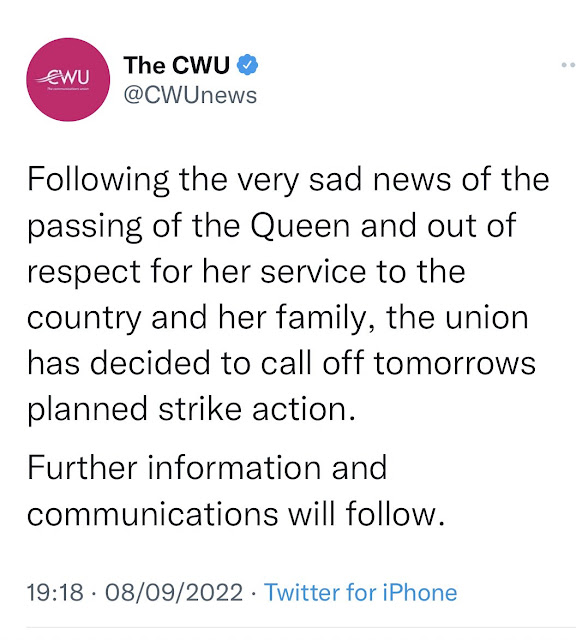

It is bizarre in the extreme to see people whose jobs and identities are supposed to be about representation and support of the workers and vulnerable in society prostrate themselves before institutional wealth and social hierarchy but simply put, they don't really care that much how the state is arranged and so don't want to risk undermining themselves by getting into a wider spat over how power is exercised even on this limited plane.

Its less that the TUC, Labour et al should be diehard Jacobins* and more that this country has a very large and quite well connected labour movement the vast majority of which is perfectly fine with things carrying on as they are overall. And the lack of serious challenge to the Crown even on the rare occasion it becomes an active impediment to what this movement does like to do is a pretty good example of this crippling limitation.
Bastani's response to the massive backlash is that this comment was value neutral and not a contradiction with his stated republican views. I struggle to read it in that light, and if that was the intention rewriting would be the better option. It also makes an equation ala Louis XIV "I am the state" which I wouldn't go as far.


On paper the Crown should be the most vulnerable part of the whole political establishment. Even by the logic of capitalism rewarding a few families large sums of money, land, and access to government because four hundred years ago their ancestor married someone else, just doesn't make sense. Especially when you consider that most royals in the world today are capitalists in their own right.  And yet frequently the reality is that it proves to be quite resilient. 

So, what is to be done? Well, focusing on the Crown to exclusion of all else, the way of Republic doesn't seem to have born much fruit, but on the other hand ignoring it as a relic or minor institution as is common amongst the more radical parts also doesn't seem to have worked out very well. I suppose I'd argue directly challenging it where it has an impact and keeping it in the wider criticism of the whole political and economic system**. Not because I believe a thriving republican movement can springboard a revolution of the proletariat, but because they simply are part of the wider political and economic system along with transnational corporations, land owners, state run industries, etc. 

Essentially try to make it the vulnerable point it should be but as a wedge to expose the rest of the system instead of settling for a re-enactment of the French Convention.

I think the Class War Federation had an approach that was close to what I'm thinking of. They didn't focus on the royal family but would produce material and actions when it seemed relevant.


_________________________________________________________

*my years in republican circles have largely been disappointing, but they did mean I met several key figures in Britain's left, so I can say with certainty that quite a few of them as private individual think this whole blue blood thing its nonsense, 

**I haven't really touched on this much but the modern aristocracy in the UK are capitalists in their own right, owning land and companies and I know from experience with my local Earl they use their privileges and status as much as possible in pursuing their business interests

Thursday, 8 September 2022

Well that's it then she's dead


I like this photo, it looks like a servant is tugging on the string to make her talk

Today Elizabeth II died aged 96, I found out when a 70s music marathon on a local tv station was interrupted, the song was all by myself if you're curious. I'd expected more emotion really, I have been spending much of the afternoon waiting for announcement by trying to wind up royalists on twitter, but even the level of sycophancy has been muted. At least that's how it appears to me, time will tell whether this is an important sign of the times or whether the patriotic machine needed some time to kick into gear.

I know when Philip died I avoided tv and talk radio like the plague for a week, record complaints over the officially mandated mourning period shows this wasn't an isolated experience. Checking back in an hour later all five national channels have round the clock tributes posing as news broadcasts but the extra channels on the freeview remain unsullied. 

Well I hope this'll be the final mortal wound that ends the institution. The monarchy has been rotting away for some time, I've lost count over the years how many people who differentiated their positive feelings for the queen from their growing indifference or in the case of the sleazier ones open contempt for the rest. The overseas commonwealth nations that have the monarch as the head of state are shrinking in number and Charles has done nothing to endear himself despite nearly a years head start. I kinda hope they do go through with their planned compulsory mourning with no sport and comedy and constant solemn sessions, it'll be hell for a week or two but it'll kill a lot of the lingering good feelings.

If this is the beginning of the end I'll take it, but I'm a little annoyed it went the whimper route and we didn't get a bang like this.


Tuesday, 27 April 2021

Monarchy in Malaysia


From Reddit 

 I have no idea where else to go to share this, without being in risk of being thrown in prison.

Just to give a brief description in malaysia there are 9 royal families that take turn ruling as king every 5 years or so. (has been since we got independence)

We cant critique or even point out the flaws that were done by them without risk of imprisonment. There is no law that actually forbade this, however they have abused the Sedation Act to keep the people silent.

Some of them has described themselves as "Eagles" (term is also used by normal folk to describe oligarchs) and the rest of us as mere sparrows. They have sold of much of our land to foreign investors while our people dont have any affordable housing. Given the pandemic most of the common folk are suffering and some of these royals have flaunted their wealth on Instagram (literally made a video like a rapper with super-cars and private jets) amidst the pandemic.

These people who are considered "Eagles" are allowed to hold large gathering without any fines or such. where as a normal folk like us would be fines RM10,000 (1,700 pounds) just for not wearing face mask in public. From single parents, college students to beggars without any mercy.

Recently there was shortage of vaccine in the country even most frontliners couldn't get them. Then news broke some of the royals flew to Saudi and bought vaccines for about 2000 for their family members. In which some common folk decided to question this at which the current queen replied "Are you jealous" on Instagram.

In response to this many people took to social media to express their dissatisfaction. Then a cartoonist / activist decided to make a spotify playlist titled "are you jealous" and decided to share it. (just a week back)

Today 20 cops broke into his house and arrested him before he could even contact his lawyers.

https://www.malaymail.com/news/malaysia/2021/04/23/activist-fahmi-reza-arrested-for-alleged-sedition/1968982


I just dont know what to do, i feel like my country is sinking in all aspects due to the monarchs & the politicians that are in league with them.

p.s i had to make a new account + VPN just to post this.


Friday, 29 January 2021

The Documentary the Queen tried to bury resurfaces - The Royal Family


Back in 1969 the BBC and the Royal Family got together and decided on collaborating on a behind the scenes style documentary on the lives of the Royals and there work in the Palace and duties as representatives of the British state. It was a major success attracting 30 million views, however it also caused the Queen to panic and use her powers and connections at the BBC to have the film suppressed and stored in the royal archives, it was taken off the air in 1972 and the only way to see the film was to get permission from the royal family (well their staff in reality) effectively consigning the film to obscurity. Until this month when it was leaked onto the web.

Its worth quoting from the wiki page

https://en.wikipedia.org/wiki/Royal_Family_(film)

"Royal Family (also known as The Royal Family[1]) is a British television documentary about the family of Queen Elizabeth II. It originally aired on BBC One and ITV in June 1969.[2][3] The film attracted over 30 million viewers in the United Kingdom. The Queen later had the documentary banned, and it has not been shown again on TV since 1972, and access to the remaining copy was severely restricted. Despite this, in early 2021 it was leaked, and published online.[4]"

Royal Family has been accused of revealing too much about the royals. David Attenborough – at the time, controller of BBC Two – warned Cawston that his film was in danger of "killing the monarchy".[8] The film critic Milton Shulman wrote "every institution that has so far attempted to use TV to popularise or aggrandise itself has been trivialised by it".[15]

A review in The Times concluded that Cawston's film had given the nation "an intimate understanding of what members of the Royal Family are like as individual people without jeopardising their dignity or losing the sense of distance".[19] The journalist and broadcaster Peregrine Worsthorne remarked "Initially the public will love seeing the Royal Family as not essentially different from anyone else … but in the not-so-long run familiarity will breed, if not contempt, familiarity".[12]

In later years, some blamed the film for a growing lack of deference towards the monarchy. However, William Heseltine had no regrets, calling it "a fantastic success".

Seems really exciting and damming, "killing the monarchy" and its not even my birthday. Unfortunately the BBC is still actively trying to shutdown the spread of the film, uploading it to youtube quickly results in a takedown and the more well known alternative streaming platforms are also not particularly safe. Fortunately they haven't got to them all, its up on the Eye

https://archive.org/details/royal-family-1969_202101

And can be downloaded, I strongly recommend you do so if you're interested in seeing it, in case of further action. This film has been the victim of over 40 years of grudges from some of the most powerful people in the British establishment after all. 

Anyway with all that said it may be a surprise to read that having watched the film in its entirety there isn't really anything that on first glance would explain the hostile attitude by the authorities to the film. There is no smoking gun scene where the Royals and the Queen in particular being openly evil or transparently corrupt. There are scenes of luxury and opulence that to me make them look bad, but nothing special, and most of it like the jewels from India are openly flaunted to create a sense of splendour and majesty. There's also footage of a Royal visit to Brazil which means the royal family were hobnobbing with a military dictatorship. That could potentially have been damaging and controversial but the royals hosting or visiting brutal despots isn't exactly rare and the doc fails to even mention the political situation in Brazil, its just another opportunity for photos and crowd cheering. Large sections of it seem indistinguishable from the mountains of pro royal guff that gets recorded and broadcast on a nearly daily basis here.

But I do get why they tried to bury the film. While it doesn't demonise them it does possible the next worst thing and normalises them. Instead of being depicted as sober and wise benevolent stewards of the nation and their subjects, which is what the royal family want everyone to see them as, they come across as bureaucrats dedicated to their jobs, and do to the circumstances of their surroundings a bit pompous and at times whiny and very, very out of their depth, to the point they struggle to understand how the world works in the 1960s. God knows how much hand holding they need nowadays. 

There's a section very early on that introduces Prince Phillip to the film and he struggles to understand how to proceed with a royal visit to a school (in Cambridge naturally) even though he's reading the typed out instructions that are walking him through it stage by stage. He has to contact a servant on a special intercom system and have him talk him through it and he still doesn't sound sure of what they want him to do.

And the Queen isn't much better, she sounds lost and confused in most interactions even with her long time staff and some visitors of high rank. Nearly every conversation even between themselves comes across as awkward and stiff. There is also a strong focus on many of the ceremonies that surround the palace and the other royal estates, again there isn't much out of the ordinary from the countless other fawning films that the royal's approve of in terms of content, its trooping of colours, garden parties, royal visits and royal audiences etc. Would is different and actually caught me by surprise when I first watched it was how matter of fact and dry it was about the whole thing. There's no attempt to romanticise any of it, its happening the narrator explains in detail how it happens and an explanation from why it happens and why its done the way it is, which most of the time is just "Queen Victoria did it this way so we're still doing it like this".

What stood out to me was an early example of a royal audience with the poet Robert Graves, the whole thing is given a sort conveyor belt feel, then after that its on to a garden party that's planned and operated just like hundreds of other garden parties like it every year. Another highlight is a montage of royal visits that cuts quite aggressively between Prince Phillip, the Queen and Prince Charles, all of them essentially just looking at things (cows in Ulster, military Jets, oil rigs, etc) and occasionally making inane conversation. Its clear they either have no understanding of most of these things or just don't care, which to me struck me with strong sense of pointless going through the motions. 

And then there's the servants. If this film had a thesis statement it would be the Royal Family an archaic institution adapting to life in the 20th century. There is plenty of evidence that most of the Royals are struggling with that but the biggest sign that the adaptation is working well is the servants. We see a lot of how the serving staff perform their duties and its extremely incongruous. Most of them work in ways hard to distinguish from modern office staff, manning phones, preparing reports, arranging appointments etc, but on top of that they're still burdened with protocols and customs that date back many decades because they were decided by Monarchs long dead. Like the Page of the Backstairs (yes really, that is a job and its official title) his job is to deliver to the Queen state papers, while on a Royal Yacht he and other crew on deck must wear soft shoes and use hand signals to preserve their masters quiet. How are these state papers delivered to a yacht at sea? By helicopter, a big noisy Navy helicopter.

Its largely this pattern from start to finish, there's no real major moment of damage its just little moments cutting into the royal propaganda, like the segment where a secretary as part of his duties presents the Queen with a certificate for a state honour (gallantry I think) and while she signs it the secretary gives her a quick summary of the achievements of the recipient and she makes vague noises of admiration. Its clear she has no idea who these people are, but these are the people we are officially supposed to celebrate and admire for their great deeds. I imagine that stung a few people who were proud of holding various medals and honours.

So alas its no bomb at the foundations of the crown, but it could chip away at it quite a bit. And if both the BBC and the royals are still dedicated to suppressing it, watching and sharing it can't hurt. 


Wednesday, 2 May 2018

1848 The Year of Revolutions


In 1848 political turmoil in the Italian states and the collapse of the July Monarchy in France and the establishment of the Second French Republic encouraged liberals, nationalists, republicans of all types and the young Socialist movement in much of Europe to rally. Revolutionary outbreaks occurred throughout the rest of Italy, much of the German states including Prussia and the city of Baden, the Hapsburg Empire was tearing itself apart at the seems with Hungarians pushing for autonomy and then independence, the workers and students of Vienna rising up and chasing the Emperor out of his capital, the Italian possesions in revolt, with Venice withstand Austrian bombardment and siege for months, and the building of barricades in Prague.

Elsewhere the revolutions made themselves felt, Denmark, fearing the revolution would spread from Prussia passed extensive political reforms, and in Ireland an armed uprising of the Young Irish threatened British rule.

This video is a discussion by various academics on the extent of the revolts and the impact and legacy of those movements.


Melvyn Bragg and his guests discuss 1848, the year that saw Europe engulfed in revolution. Across the continent, from Paris to Palermo, liberals rose against conservative governments. The first stirrings of rebellion came in January, in Sicily; in February the French monarchy fell; and within a few months Germany, Austria, Hungary and Italy had all been overtaken by revolutionary fervour. Only a few countries, notably Britain and Russia, were spared.The rebels were fighting for nationalism, social justice and civil rights, and were prepared to fight in the streets down to the last man. Tens of thousands of people lost their lives; but little of lasting value was achieved, and by the end of the year the liberal revolutions had been soundly beaten.With: Tim BlanningEmeritus Professor of History at the University of CambridgeLucy RiallProfessor of History at Birkbeck, University of LondonMike RapportSenior Lecturer in History at the University of Stirling.Producer: Thomas Morris.

 I've been slowly building up an archive of the revolts on Libcom.org, so far focusing on the events in Germany and France.

Sunday, 24 April 2016

The True Cost of the Royal Family is More Than Pounds and Pence


Youtube educational channel CGP Grey made a video about the Royal Family five years ago, and its below average compared to their usually educational trivia. The poor quality is clearly a result of the presenters bias in favour of the Royal Family, a bias that jumps out of their tone and subject choices.

The first part of the video dealing with the economics of the Royal Family and relations to the rest of the UK (Parliament) is correct though it skips other some interesting and important incidents in that relationship, like the time in 1795 when the Prince of Wales married the Princess of Brunswick and Parliament raised an £65,000 per year to pay off her debts. This was at a time when food riots were common, and starvation threatened thousands of commoners.

But the real issues begin after the video moves beyond this into other areas. Tourism for one, he talks about American tourism and states that it is simply because of the Royal family, and so the Royal Family are responsible for the GDP share that tourism brings in.

This is a common argument trotted out by Monarchists in the rare occasions that the Royal Family is publicly challenged, and as per usual nothing is given to substantiate it.

Because there simply isn't, first US tourists aren't the most common tourists to the UK in 2014 they were in third place behind France (1,980,000) and Germany (1,460,000) with a total of 1,280,000. That's quite a high number but it isn't what is being argued here. And as for why those Americans visit we're given the answer "the Queen". So language and family connections don't factor into this at all hey?

Interestingly in that same year 24 million Americans went to Mexico, and 12 million to Canada, so if governmental systems are the main attractions for tourism and tourist revenue a good reason to keep or change that system, I guess the UK should turn itself into a Federal Republic. Oh and the only thing given as evidence for the importance of the Queen to the Yankee tourist dollar was France. Now according to the statistics I could find, boring Republican Paris is a close second to London, oh and France is global number one travel destination for tourism, having 84 million visitors in 2014. And the UK was beaten by the republican USA, China, Italy, Turkey, and Germany. But Monarchist Spain was third with 65 million tourists so its not all doom and gloom for the Crown.

But enough about tourism, the video gets much worse. At 3:30 the video talks about Royal prerogatives in a dismissive way. Showing a rather simplistic view, yes the Royal Prerogatives are really used by the actual Royal, but they've been used by most governments ever since. A Prerogative is

The Royal Prerogatives are a series of historic powers formally exercised by the monarch acting alone, but which in reality are exercised by government ministers. They enable government ministers to rule virtually by decree, without the backing of or consultation with Parliament, in many areas not covered by statute. A.V Dicey has described the Royal Prerogative as: “the residue of discretionary or arbitrary authority which at any given time is legally left in the hands of the crown”.

In relation to foreign affairs, the powers cover:
  • the recognition of foreign states;
  • the declaration of war;
  • the making of treaties;
  • the accreditation of diplomats; and
  • the deployment of armed forces in the UK and abroad.
In relation to domestic matters, the powers include:
  • the appointment and dismissal of ministers;
  • the issuing and withdrawal of passports;
  • the appointment of Queen’s Counsel;
  • the dissolution of Parliament;
  • the granting of honours;
  • appointments to, and employment conditions of, the civil service;
  • the commissioning and regulation of the armed forces; and
  • the calling of elections.*
There is also the prerogative of ‘mercy’, which affects the judicial system. It means that ‘pardons’ can be granted in relation to a criminal conviction (i.e. it used to allow the withdrawal of the death penalty), or legal proceedings can be halted against an individual.

Now these powers are used by the Prime Minister, but that doesn't mean the Monarchy is sqeuky clean, the government is still using autocratic powers to subvert the principle of democracy, and given they do require the public consent of the Monarch of the day, that means the Queen/King is still complicit in these acts.

Thanks to the Royal prerogative the UK government can declare war on a whim, and control the civil service. These are very serious parts of the UK governmental system and they stem directly from the Crown. The video alleges that abolishing the Monarchy wouldn't change much and they may be right Republican movement have sometimes deposed one family simply to build another form of tyranny. But sometimes they have succeeded in granting at least limited freedoms. The fact that Royal Prerogatives come from the Royal family would suggest that an attack on the Royals legitimacy would also attack the legitimacy of its powers.

Then at 4:00 the video takes its final most absurd step by coming up with a hypothetical Queen Elizabeth II as global despot. This suggests that the maker of the video genuinely doesn't understand the institution of Monarchy at all really. The Monarchical system is more than the actual Monarch, human beings do not live for ever and so do not rule forever (Unless your name is Kim). Even if the current Monarch is amazing, that's no guarantee that the rest of them in the future will be.

After all King Edward VIII whom actually appears in the video at 02:04 was a Nazi sympathiser and an agent for the Axis powers.

"The active supporters of the Duke of Windsor within England are those elements known to have inclinations towards Fascist dictatorships, and the recent tour of Germany by the Duke of Windsor and his ostentatious reception by Hitler and his regime can only be construed as a willingness on the part of the Duke of Windsor to lend himself to these tendencies."
 "The American understood he was being asked to carry a message to the President, but he was unsure of the exact terms. As he was leaving the governor general's residence, the duke's aide-de-camp spelt it out. He instructed Oursler to tell the President that if he would make an offer for intervention for peace, before anyone in England could oppose it, the duke would instantly issue a statement supporting the move. It would start a revolution in England and, the duke hoped, lead to peace."

Although funnily enough this absurd hypothetical isn't nearly as absurd or hypothetical as the video maker thinks. The House of Windsor is actually very comfortable with the idea of coups and brutal Monarchies. To take one example the Queen is married to Prince Philip, who as most tabloid readers will know is Greek. Greek royalty to be precise, the Greek Royal  Family remains close to the British family despite the embarrassment of being kicked off the throne in 1973. Constantine II was on the guest list for the Queen's diamond Jubilee before protests by the Greek government got him dropped.

 “Constantine is not allowed to go,” a courtier tells me. “If the Queen could invite whom she liked, of course he would be there.” Constantine attended the Duke of Cambridge’s wedding and is a regular guest at the most important royal events. His sister, Queen Sofia of Spain, has been invited to the luncheon.

Why so much hostility, well Constantine II wasn't happy being a constitutional monarch and decided on a little restoration, in 1967 there was a coup by right wing officers, mostly of the rank of Colonel hence the nickname "Colonel's Coup". The King decided to support them, (many generals and the Navy and Air force were loyal to the royal family). Unfortunately by December the relationship between the King and the Junta broke down, so the King decided to run his own coup using the officers and units loyal to him. The counter coup failed miserable merely strengthening the Junta's position so the King and his family fled to Rome. In 1974 the people of Greece would show their appreciation for the King's politicking and the regime it helped create by voting for a republic.


http://i.imgur.com/cxlDLUj.jpg

But that was Greece and decades ago, well at the time The Queen with the rest of the government backed the Junta even after the hapless Constantine had fled. Also on the Jubilee guest list were the King's of Romania and Bulgaria. Two houses that supported brutal genocide and oppression in the 20th century.

 Between 1941 and 1944, Romania was responsible for exterminating approximately 300,000 Jews, giving it the sinister distinction of ranking second only to Germany in terms of the number of Jews murdered during the Second World War.
The new legal policy, dictated by the governments of King Carol II and Marshall Ion Antonescu, discriminated against the Jews of Transylvania and Banat, among other groups, on the basis of citizenship. Moreover, it confirmed the intention to apply a "detailed plan" of deportation of the Jews from the above-mentioned areas (The Archive of the Jewish Communities of Timisoara, Doc. 76-78, 1943). Negotiations for these deportations began in November 1941 and were resumed in the spring and summer of 1942. All attempts to persuade the authorities to change this policy failed. An existing prejudice towards Jews as an ethnic group - according to which the Jews of Southern Transylvania could become spies or betray the Romanian interests as speakers of Hungarian and German - played an important role in the hostility against them. - See more at: https://www.wilsoncenter.org/publication/236-between-hungary-and-romania-the-case-the-southern-transylvanias-jews-during-the#sthash.ulNcVCMV.dpuf

Oh and there was a time when a commonwealth government was overthrown by the military in 1975 that had no protests or condemnation. That nation was the little known Australia, and the reasons for the coup involved the royal relationship.

 Australia briefly became an independent state during the Whitlam years, 1972-75. An American commentator wrote that no country had “reversed its posture in international affairs so totally without going through a domestic revolution”. Whitlam ended his nation’s colonial servility. He abolished royal patronage, moved Australia towards the Non-Aligned Movement, supported “zones of peace” and opposed nuclear weapons testing.
 Sir John Kerr, the Governor General (the crown's representative to Australia) with the support of MI6 and the CIA deposed the elected Prime Minister Gough Whitlam using the powers of the Crown.


 The democratic process destroyed using the powers of the Monarch. Every Monarchist should ask themselves, if the Queen is happy to hobknob with brutal autocrats, and have her powers used to topple elected governments, would she really be opposed to the same happening here?

Of course the greatest fault of the video is that the whole thing is a massive strawman. The objections to the continuation of the Monarchical system are not those presented in the video. Here's what Republic the largest and most prominent Republican group in Britain has to say on the matter.


It's simple: Hereditary public office goes against every democratic principle.
And because we can’t hold the Queen and her family to account at the ballot box, there’s nothing to stop them abusing their privilege, misusing their influence or simply wasting our money.
Meanwhile, the monarchy gives vast arbitrary power to the government, shutting voters out from major decisions affecting the national interest.  The Queen can only ever act in the interests of the government of the day and does not represent ordinary voters.
The monarchy is a broken institution. A head of state that’s chosen by us could really represent our hopes and aspirations – and help us keep politicians in check.

It's simple: Hereditary public office goes against every democratic principle.
And because we can’t hold the Queen and her family to account at the ballot box, there’s nothing to stop them abusing their privilege, misusing their influence or simply wasting our money.
Meanwhile, the monarchy gives vast arbitrary power to the government, shutting voters out from major decisions affecting the national interest.  The Queen can only ever act in the interests of the government of the day and does not represent ordinary voters.
The monarchy is a broken institution. A head of state that’s chosen by us could really represent our hopes and aspirations – and help us keep politicians in check.
- See more at: https://republic.org.uk/what-we-want#sthash.sJ6Vh5Jy.dpuf
And in not one second of this video are these costs of the monarchy responded too.

*We now have fixed terms of five years, however there are two exceptions for an earlier election and they both require the consent of the ruling Monarch. 

Popular Posts