Search This Blog

Showing posts with label Yugoslavia. Show all posts

Wednesday, 12 October 2022

Regarding that Time magazine cover from the 1990s - Or condemning NATO for clipping the wings of greater Serbia

 The war in Ukraine is being fought online as well as in Ukraine. The Russian Federation is keen to deflect attention from its targeting of civilians, and the discovery of mass graves and torture sites in areas formerly occupied by its military. Fortunately for the successors of TASS, it has several decades of material to pull from and an eager audience.

One of the richest veins strangely has been to re-ignite the Yugoslav conflicts of the 1990s. And for even more audaciousness doing so by backing the expansionist nationalism of the Serbian far right. If you're even passingly familiar with that period and those clashes this would seem like a terrible strategy, but it's found fertile ground. Sympathy for the Serbian nationalist movement isn't a new phenomena its been around since the 1990, but it was relegated to the fringes. It was hard to maintain credibility when the Serb paramilitaries massacring Bosniaks in Bijeljina had taken a photography with them and let him take photographs of their executions and then proudly displayed them.

But we now live in the future, and those wars are in the past, so without the constant drip feed of fresh atrocities and military manoeuvres its easy for propagandists to play fast and loose. For example, you may have seen an infamous Time magazine cover.


I get why this is so often chosen by Cyber Chetniks. Its naked jingoism is offensive, and in a vacuum I can see plenty of people who have no interest in Serbia but are to a degree pro peace being vulnerable to this and similar messaging. For example, several Russian embassies have been using this to accuse nations condemning their barrage of cities hypocritical. 
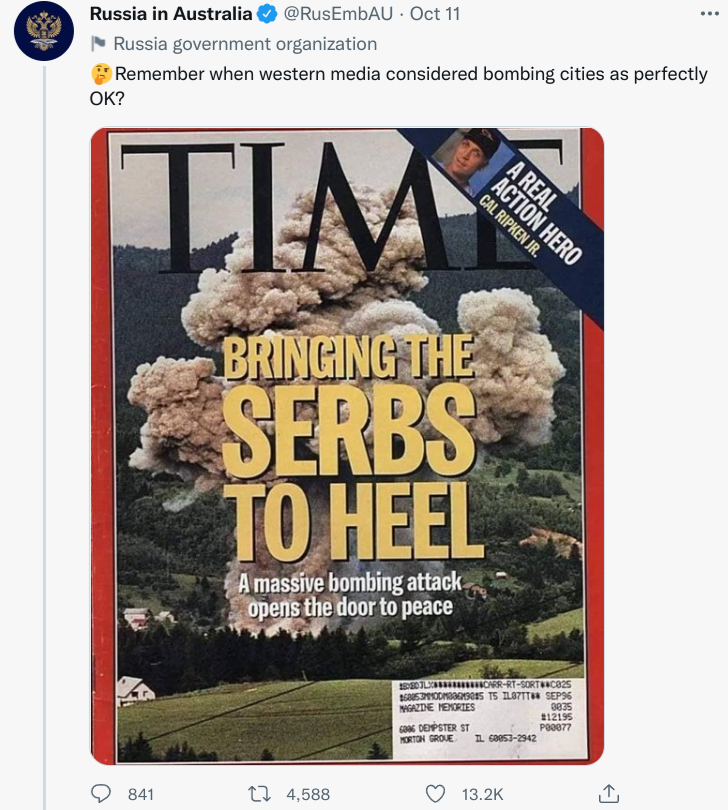
Well, the thing about this cover is that while it is obnoxiously celebrating military action, its supporting the destruction of a military outpost that had that same struck a market in Sarajevo killing 43 and wounded over 80 more. 

A man with no arm came into my shop, the blood gushing from his stump. Then he ran away. I saw the torso of a woman. She was still moving, but her legs were gone. The other day I saw something similar in a film. A beast cut a man in two, torso and legs. One was a movie, the other is our reality here in Bosnia. We are like a flock of little chickens squeezed into this cage of a town, chirping for help.

This was just one event during the siege of Sarajevo, a siege that lasted 1,425 days. But you don't have to take my word for it. Time has helpfully arranged an online archive for its catalogue and this issue can be found quite easily. Here's the link for the issue and page for the article attached to the cover image https://time.com/vault/issue/1995-09-11/page/52/

Another example of this strategy gained traction earlier in the war, fans of Serbian football club Red Star Belgrade unfurled a banner


Which looks great and pacific, but the give away is its inclusion of Republic of Srpska 1995 and Yugoslavia 1999. The former refers to the territory carved out of Bosnia & Herzegovina through ethnic cleansing. And Yugoslavia 1999 of course refers to the conflict in Kosovo where Serbian military tried to maintain control of that territory by reducing the population of Albanian Kosovans. 

Red Star Belgrade, was founded during Tito's rule and was originally tied to imagery of Communist Partisans. But since then it has moved over to Serbian nationalist politics. The Serbian Unity Party was founded by a former president of its fan club Željko Ražnatović more commonly known as Arkan. Arkan had a shady past with organised crime and in the 1990s led his own paramilitary unit the Serbian Volunteer Guard (SVG) also more popularly known as Arkan's Tigers. 

Arkan with members of the SVG and a stolen Tiger

The SVG fought in Croatia and in Bosnia, and the group carried out numerous atrocities, including participating in the Bjeljina massacre. SVG recruited heavily from Red Star's terraces. Red Star weren't the only Serbian football club to recruit volunteers for the paramilitaries but they were the biggest and do have a well earned reputation for being the most violent football fans in Europe. 

In 1997 Arkan was indicted for war crimes, in 1999 he was again indicted 24 crimes against humanity by the International Criminal Tribunal for the Former Yugoslavia. He was assassinated in 2000. In addition Red Star Belgrade's main sponsor is Gazprom Neft, Russia's third largest oil company. So, while the message may be good, I have a hard time buying that it is genuine. 

You can oppose war and interventionism in general or this particular case, you can even be openly pro Russian Federation if you wish, without mourning the Serbian far right and lying about its brutal campaigns of genocide. 

Indeed, it is such an easy thing to do that I am forced to conclude that those who have to resort to this method are motivated either;

  1. Ignorance, and ignorance in the extreme. Anyone sharing images from Serb nationalist sources or that Time magazine cover must know nothing about the conflicts that ripped apart the Balkans, and given how easy it is to lookup must not care much about it really.
  2. Genuine sympathy for genocidal nationalism.
Either way I'd advise treating this as a canary in a coal mine situation. Anyone peddling these narratives should be treated like a toxic hazard.

Addendum

The break up of Yugoslavia was a bitter and complex conflict, it was also heavily documented and so there are many resources available to make sense of it. In an effort to help explain the complexities of the break up of Yugoslavia to an audience unaware, here are several documentaries dealing with it and its aftermath.

The Death of Yugoslavia

This documentary series recounted the conflict from the late 1980s to 1997. It interviewed dozens of political and military leaders from all sides including Milosevic and Radovan Karadžić. It uncovers and accuses multiple heads of government of complicity in crimes against humanity including the treatment of Bosniak prisoners by Croatian forces, and packs up every point with footage from multiple sources.


Belgrade Radio Warriors - Turn on, Tune in, Slob out


Documentary on independent Belgrade radio station B-92 and Serbian's who lived through this period and opposed Milosevic's government. Life in Belgrade during the 1990s. 


Frontline Football

Covers the 2006 clash between Serbia and Bosnia for the World cup qualifier. It covers the aftermath of the conflict and the connections between football and nationalism including Red Star Belgrade.


Monday, 17 June 2019

Josef Schultz - The Man Who Wouldn't Shoot


Map showing partisan areas of operation in 1943
Despite the staggering amount of media made about World War II we barely scratch the surface. Entire fronts of the war and its darker sides particularly those carried out by Allied powers are often overlooked with one or two exceptions. For example the Yugoslav front, while the war in Greece has received some attention, probably due to the presence of British divisions there before the country was occupied by the German army, almost nothing about what went on across the border in neighbouring Albania and Yugoslavia gets popular attention.

In the case of Albania its early annexation by Italy is brought up as an example of a missed warning sign, and the SS recruiting Albanians is brought up as footnote, often by Reich apologists to try and dispute the popular and correct impression that Nazi Germany was a nation obsessed with racial purity.

Yugoslavia tends to get much less, aside from Force 10 from Navarrone the cheaper more action pulp sequel to the famous Guns of Navarrone, it doesn't get much attention outside of Yugoslav and former Yugoslav made documentaries and books. In a way this is understandable if disappointing, the Balkans were extremely complex. Initially Kingdom of Yugoslavia joined the Axis before popular protests and a coup by officers in the armed forces installed a pro Allied one instead. A combined German and Italian force (mostly German, since Italy's failed invasion of Greece had cost it entire armies) quickly overran the country.

But instead of a quick and fairly easy occupation the region erupted into even more mass violence once the Wehrmacht had established itself. Croatian Fascists in the Ustashe movement set up an independent pro Nazi region, ran their own paramilitary and extermination camp system targeting Serbs and the Balkan Jewish community. A puppet government, Italian, Hungarian and Bulgarian occupation zones and bands of Chetniks, majority Serb armed bands that sometimes supported the Axis but over times worked independently. And then finally there were the partisans, of which Tito's Communist forces are the most well known and active.

This made for a vicious mix, with the armies of occupation and their allies often resorting to the destruction of entire villages, collective punishments and ethnic cleansing campaigns. Out of all of this confusion and terror and mythic hero was created. Private Josef Schultz, soldier of the 714th Infantry division.

Shultz is something of a folk hero in the region as a soldier who refused to take part in executions of prisoners, and according to legend was made to stand in line with those prisoners and die along side them. The existence of Josef Schultz and his deployment to Yugoslavia are confirmed, but West German investigations believe the stories around his death are fictious. Nevertheless he remains a popular folk hero.

In 1973 Zastava films made a short film about Josef Schultz, and at only 13 minutes long its one of the most moving anti-war films I've ever seen.


https://youtu.be/REkZ1gcqzL8

Short film about the life and death of Joseph Schultz, made in 1973 in Yugoslavia.
Download https://archive.org/details/josephschultz_201702
This photo often attributes the soldier without a helmet as being the last photo of Josef Schultz, sadly while this is disputed the photo is otherwise genuine. This is a real photo of a mass execution carried out by the German army.

Thursday, 2 August 2018

The Belgrade 1968 Student Revolution


An account of the student protests in Belgrade in 1968 by one of the participants.


Transcript of the above video.


Program Announcer:

We begin with another set of student protests from 50 years ago. 1968 was a turbulent year in much of Europe and the U.S, a new found sense of free expression had led to demonstrations against the old elites, against the inequalities of capitalism, and against the Vietnam war. That’s certainly what was happening in the West, but there was also unrest in the Eastern bloc and that’s where we’re going now as we take you back to June 1968 and a student revolt in Communist Yugoslavia which exposed deep discontent at the country’s unique system of market socialism. Dina Newman has been speaking to one of the leaders of that protest Sonia Licht.


[Music- Yugoslavian National Anthem Hej Sloveni]


Dina Newman:
Yugoslavia was formed after World War II as a one-party communist state, by its wartime anti-fascist leader Josip Broz Tito. But Tito soon parted company with Moscow’s brand of communism. And adopted a more flexible approach, the so-called Market Socialism. Yugoslav citizens were allowed to travel and work abroad, but Tito’s Communist Party dominated domestic politics. In 1968 many Yugoslav students still supported socialism but they wanted reform.

Sonia Licht:

Definitely, we were the last generation who believed that socialism can be reformed, can be made better according to the needs of its citizens. And what happened during 68 proved to us that that system that we are living in cannot be made better.

Dina:

Sonia Licht was a twenty-one-year-old philosophy student in the university of Belgrade. Growing up in the 1950’s she had been told that Tito’s Communist party ran the country on behalf of the working classes.

Propaganda films of the time showed enthusiastic workers and happy peasants rebuilding the country from the ruins of World War II.

[Film Narrator] Progress is being made in industry and agriculture, in health and in education, in mining and transportation.

Dina:

But by the end of the 1960’s Yugoslavia had one of the highest unemployment rates in Europe and pockets of dire poverty. Yet top Communist bureaucrats enjoyed high salaries and better housing, health care and education for their children. These officials were known as the `Red Bourgeoisie`.

Sonia:
The Red Bourgeoisie, was the leadership of the Communist party, but also directors of huge corporations such as export-import companies, they had all kinds of privileges that the working people did not have.

Dina:

At the same time, yourself and many other students were actually members of the Communist party, so you still believed in the Communist ideology, right?

Sonia:
Well we should make a difference Dina between socialism and communism. We believed in the socialist project, we believed in social justice, we believed in the necessity to have an alternative to hardline Stalinist communism, but also to American Imperialism.


Dina:

Inspired by their vision of socialism as well as the student protests in Western Europe on the 2nd of June around 4,000 Belgrade University students attempted a protest march. They were [pushed back by armed police and retreated to their Halls of Residence in the so-called student city on the outskirts of Belgrade.

Sonia:
I joined on the next day, the mood was, well something between the kind of euphoria and wondering what is going to be the next steps.

Dina:

Then news came through that the Faculty of Philosophy in the centre of Belgrade had been occupied. Sonia and some of her friends hurried there. They found students as well as hundreds of residents gathered around the faculty building.

Sonia:
The news started spreading, the media also started giving some reports, of course they were terribly negative against the students `class enemies` etc, etc, the usual stuff. But still the citizens of Belgrade started assembling.

Dina:

Encouraged by public support, the protestors renamed their University the Red University of Karl Marx. Day and night, they debated Marxist philosophy and political developments elsewhere in Europe. They drew up a list of demands, including freedom of speech and assembly and the end of the hated Red Bourgeoisie. Many leading intellectuals and artists joined the protest.

Sonia:

For example, I remember the most famous Yugoslav actor whom I met one morning at 4 o’clock in the morning, completely on her own, [hard to make out, best guess is Dušica Žegarac an actress who took part in the student protests, - Transcriber note] was at that time quite young, very famous. She took some gloves and water and she was cleaning the bathrooms. On her own, no one asked her to do it. For me she remained one of the symbols of the 68 movement. Cleaning the loos, which was not the most pleasant thing to do.

Dina:
Because of course you had several thousand people and those bathrooms must have been over flowing.

Sonia:
Of course they were.

Dina:

But on the fourth day of the protest a woman from a local factory approached Sonia. She said that bosses at her factory were organising `hit squads` groups of workers who were going to storm the university building that night. The protest organisers most of the students to leave the faculty building for their own safety, and only a hundred or so of the most determined protestors stayed on. Sonia was among them.

Sonia:

If I would tell you that I was not afraid that wouldn’t be true, in the same time we were relying on each other, we were trusting each other and we were really feeling, thinking there is something so much bigger than us going on that whatever happens, happens.

Dina:
And you were preparing yourself for some kind of violent confrontation?

Sonia:
Yes.

Dina:
And what happened?


Sonia:
Nothing, no one came.

Dina:
Wow, how did you feel after that?

Sonia:
People would expect that you feel happy, that is not that simple, because, you know because we were the last generation to believe in socialism. And then your illusions are being smashed. Every such situation leaves an emptiness in you. So, I remember that feeling of emptiness as well.

Dina:

Thousands of students returned to the protest the next day and the occupation in Belgrade lasted for seven days and nights in all. There were student protests in other parts of the country too, but on the 9th of June President Tito gave a speech which came as a surprise not only to the students but also to his own advisors.

[Brief excerpt of Tito’s speech in Serbo-Croatian]

Sonia:
He said that the students are right, there are many things that went wrong in the country, he sides with the students; except a small group that are the enemies and that are working someone else’s interest. We immediately knew that the small group are we at the Faculty of Philosophy and that we will be singled out as the enemy. So he did one of his famous, famous manipulations, he was a great manipulator.

Dina:
Most students fell for Tito’s manipulative rhetoric and returned to their Halls of Residence.

[Serbian folk music plays]

Dina:
The student city on the outskirts of Belgrade shook with the sounds of `Kolo` a traditional Serbian circle dance, as the students celebrated their apparent victory.

While most students celebrated, Sonia and her colleagues at the Faculty of Philosophy braced themselves for the reprisals. Sonia and a few other activists were kicked out of the Communist Party, their passports were confiscated and they were barred from jobs in education. Eventually some student leaders were arrested and served jail terms, so on the face of it Tito won. But Sonia believes that their protest was not in vain.

Sonia:
We changed the understanding about the real nature of the regime. We understood that the right to rebel should be a basic Human Right, but it isn’t. And that this so-called socialism cannot be reformed, it has to be destroyed.

Program Announcer:
Sonia Licht, who is now the president of a think tank called the Belgrade Fund for Political Excellence was speaking to Dina Newman. And there’s a photo of Sonia on our website, as ever search for BBC Witness.

Popular Posts