Search This Blog

Showing posts with label Fascism. Show all posts

Friday, 20 February 2026

The Crooked Cross; fascism and appropriation of Celtic Culture


Croeso! 

A bit ago, a US politician got in some trouble when he unwittingly disclosed that he had a tattoo of the SS emblem, the Totenkopf (Death's Head). That politician is called Graham Platner, and he's a Maine Democrat. In a related story, another Democrat politician Dylan Blaha disclosed he has six tattoos, five of which seem to be typical military ink (both Dylan and Graham are ex-servicemen) but the sixth raised an eyebrow for me. On his right calf, Dylan has a Celtic cross, which he got in Germany after a trip to Ireland.

Now, I don't know either of these guys, Graham Platner claims he didn't know it was the SS murder skull and says he got it altered when he found out. As for the Celtic cross, it isn't a hate symbol yet, but there is a determined push to make it into one. And I know from experience this is largely overlooked in Anglophone circles.  So, I have no idea if either Democratic politician is a secret Nazi. I think it would be a very stupid thing for secret Nazis to declare themselves that way, but I'll sit back and let better placed individuals look into those stories. What I am going to do is take advantage of the rare window of public attention these revelations have caused to sound the alarm bells about a pernicious tactic on the far right. 

 I don't like talking about myself, but this text will go on to rely on my personal experiences, so I may as well get this out of the way. I am a Celt (it's pronounced Kelt) I grew up in a Celtic family surrounded by other Celts, in Ireland, Wales and Scotland, and the part of England I live in is one with a large Scottish and Irish population. I would not pass an Irish or Welsh language test nor could I write a book on Celtic folklore (not yet anyway) but I did grow up hearing words from both languages. In fact, in a funny twist for today's topic, my blood is so purely Celtic that I have a rare genetic blood disease that targets north European Celtic populations. That's not relevant to this particular discussion, but I think you should keep it in mind for when you encounter gobshites bemoaning the watering down of Europe with all that race mixing.  

Cultural appropriation, now to be clear I'm not using this term the way some do to mean any and all cross-cultural interaction and exchange. I mean it in the sense of taking something from one cultural and deliberately and radically trying to reclaim it as something else for a deliberate political end. I have no objection to other peoples learning about Celtic history and culture and myths, if anything I think its beneficial that cultural awareness is increased as a way to combat the attempts to hijack it for divisive ends. 

Fascists and their fellow travellers have been busy for years trying to replace the old toxic branding, swastikas, fasces etc, with new ones that can serve to rally the racists without tipping off normal society. They've mostly targeted Scandinavian cultural artifacts with knock off runes due to associations with Viking warriors and the convenient overlap with German mythology and some connections to original Nazi occultists.

I'm not knowledgeable enough to comment in detail on the pillaging of the Norse lore, so I'll also leave that to others. They have also appropriated Celtic symbology, including adopting a variation on the Celtic cross that marks very old churches in Ireland and Britain and have a smaller presence in Northern Europe. Celtic cross have many designs, what they usually have in common is a circle behind the head and the arms of the Cross. Fascist groups have latched onto to a simplified version of that characteristic and use variations of it that often look like a target cross-hair or a plus symbol in a circle. I've known for sometime that knowledge of these fash rebrand attempts isn't very high for some time. Even experienced anti-fascist activists who clock that these are fash emblems often don't know what they are. I remember one calling out the use of "fascist plus signs" on a banner when checking out who was marching down the street.


The sheer gall, or should I say Gaul, of French far right using Celtic imagery
 

I grew up with tattoos of Celtic crosses, every man from my father's generation who's a Celt has one somewhere, its become a very popular symbol of heritage and pride. Like the Harp for the Irish, Red Dragons for Welsh or Thistles for Scottish only this one can be used by most Celtic peoples. Generally the more the tattoo looks like its based on a real 9th century cross in a graveyard somewhere in Donegal or rural parts of Western Scotland, and the owner is a Celt or someone who has parents/grandparents, or just lives in Wales or Brittany or something, it's probably benign. When someone is using the streamlined version and has no connection to the Celts or a part of Europe where the Irish Catholic Church (which promoted the adoption of that cross style) had no presence, I would ask questions, like "what is that?" and then "why did you choose that?" and their answer is some nonsense about "our heritage" or pride I would be wary of them.

To link back to original premise, if Dylan Blaha had got the tattoo in Ireland, I'd think it's either a touristy thing or an attempt to get in touch with his "roots". Getting it in Germany gave me a moment of pause, the Ancient Celts were around the Rhine and Alpine regions but didn't get into the German interior much. However, designs for "authentic" crosses are popular, and their details are a good way for a skilled tattoo artist to show off their skills. If it turned out he just went to a tattoo parlour in Germany where knowledge of far right symbols is more common especially for tattoo artists who can get into trouble for making them, and got a short and quick plus and circle job I'd be far more suspicious. 

From a friend on Bluesky, a stall for the National Rebirth Party in Leicester, using a Triskelion as their emblem.

It's not just the cross that's been high jacked, other lesser known Celtic symbols are also being used. A variation on the Triskelion also pops up from time to time. Now Triskelion's aren't strictly a purely Celtic symbol, like the swastika its appeared in many cultures, some of which predate the Celts, it was also heavily tied to early civilisations in Sicily as another example. The Celts of ancient times used versions of it in many forms, and I have seen variations used by fash types that are based on the more common Celt designs. So, by talking mostly about the Celt versions I don't wish to imply the other cultures are fair game, just sticking to what I know.

If you don't know what a Triskelion is, the flag of the Isle of Man uses a version, the three legs on it are an example. Yes, the tri in triskelion means three, so it's a triskelion if it uses a pattern of three.  This appropriation is not as well known but goes back further. The ultra racist Afrikaner Weerstandsbeweging (AWB) took the Nazi flag, cut the swastika out of it and stitched a black triskelion into its place.

I guess subtlety doesn't translate into Afrikaans.

 There was also a SS division that used one as their personal logo.

Again I don't like seeing symbols I grew up with re-purposed for hate politics, growing up the Triskelion was a symbol of protection, a silly good luck charm. Speaking of luck charms, specifically Irish symbols are commonly used by far right groups in the United States of America. I'm thinking of the Ayran Brotherhood who use clovers as their emblem. This one I feel is more well known, I've seen documentaries about it for one, and I'm not familiar with conditions in the United States, so I won't talk further on this other than to note that in the documentaries I've seen on this group they allege that the Brotherhood considers clovers to be their symbol and not an Irish symbol and will attack Irish American inmates who have clover tattoos who aren't a "brother". I can't think of better example of the dangers of cultural appropriation.

Part II, Why?

  Now I've detailed some of the more common examples I feel It's important to look at why these disparate groups are doing this. Well while it may not seem like it in 2026 with the far right gaining popular support in many nations the authentic WWII era Nazi branding is still toxic and weird to even the majority of their voters. Fascism has always relied on euphemism and that reliance has grown since the WWII defeat and the Holocaust and the other brutal occupations from that time. One curious fact about the Graham Platner incident is that he says he got the SS tattoo in Croatia. Croatia like all the former Kingdom of Yugoslavia suffered greatly from German occupation, events marking the partisan movement are still publicly commemorated to this day. That said, Croatia also had an infamous history of collaboration with the Axis powers. I'm going to be careful here and make clear I do not mean all Croatians collaborated, there was however a fascist Croat movement called the Ustasha who were given de facto control of a collaborationist state and this state and its movement enthusiastically carried out genocides against Serbs, Jews and Freemasons and Communists and Gypsies and other undesirables*. I have no idea if Graham Platner is being honest when he claims ignorance, however it is inconceivable that the tattooist who gave him that skull didn't know about it.

In addition to misdirection the choosing of Celtic bits and pieces also slots in nicely with pre-existing fascist pseudo-history. The Celts in the accounts of Ancient Greek and Roman sources are violent and war like, which fits in with the machismo men of action cult. The Celts are also quite pale and European, so those are two ticks on the check sheet right there. Of course, most of this breaks down once you take even a cursory look at history, but I'm getting ahead of myself. Theirs also a religious component, the Celtic cross is also a cross, and its origins lie with the Irish Catholic Church. While fascism is quite diverse on questions of spirituality, hostility to Jews and Muslims means some form of militant Christianity will appeal to some of them. I don't think every fash with the fascist plus symbol is a militant christian, but I have seen its use in places like Italy and France where the Celtic connection just doesn't make sense, but the "a normal Italian/Frenchman is a Christian/Catholic" does make some kind of ideological sense.

And of course we can't overlook the follow the leader phenomena. I have a suspicion that if you were to conduct a poll of the international far right population where the Celtic cross is used many respondents wouldn't know what it really is and just copied what another fascist group did. This isn't the first time this has happened. When Mussolini came to power in Italy their was a global trend in copycat ___ Shirt movements. The Brown Shirts in Germany, Blue Shirts of Ireland, Silver Shirts in the USA, in Britain Mosely couldn't be bothered to pick a different colour they just ripped off Benito entirely.  And when Hitler rose to power in Berlin their was another wave of copy cats aping him. The fascists in Hungary where called the Arrow Cross party because their knock off Swastika was a cross made of Arrows. 

They're also fairly easy to draw and have the added bonus where should a fascist group find itself out of step and under hostile scrutiny they can play the "Nu-uh" card. They can use to attract sympathisers in the know while playing coy to everyone else. Of course this is subject to the rule of diminishing returns, the more they use it the less cover it provides. The more times an "immigration sceptic" is caught at a stop the boats protest with a triskelion t-shirt is found to have been at a national front rally in the 80s with a Nazi armband the less credulous the general public will become.

 Part III, Why the Celts make terrible stormtroopers

I was debating whether or not to include this part, I don't think this is the place for a full history of Celts whether ancient or modern. However as I said when I spoke about cultural appropriation, I think knowledge of real Celtic culture and its symbols will help to expose the operation, its also really interesting, with dragons, vengeful gods, curses and so on. Though I believe most Euro fash are unaware and do not care about the Celts even as a tool to use. As an example I've seen the symbols stolen by groups operating in countries where the Celts left no impact if they ever got their and Italian and French fascists are using it. If you wonder why I keep bringing them up, Italian fascsits love the Romans, who committed multiple genocides against many Celtic tribes and are in fact the nemesis of the ancient Celts. Meanwhile the French republic in 2026 is currently actively carrying out policies to destroy the culture and language of the Bretons, its Celtic minority. That's the nasty side of appropriation and fetishisation, it doesn't actually care about its targets, it just exploits them for its own gain.

 So here's a few inconvenient facts that get in away of a more serious fash interpretation of the Celtic legacy. 

  1. Ancient Celts were quite diverse. The old Celts of the times of Asterix and Obelisk got around, they spread out so far and for so long that there is still debate over where the Celts originated, one theory says Central Europe, another says they came from Iberia and Western Europe. With an open question about where did their ancestors come from.
  2. Celtic culture originates in language, the Ic in Celtic means speaker of a Celt language. Attachment to the Celtic peoples of antiquity were on the basis of tongue not race. Some nationalists may push back on this with an appeal to shared Europeanness. But that doesn't hold either, while the Celts were concentrated in North and Western Europe we know that Celts were present in areas further afield, the Galatians from the bible were a Celtic people and they lived in the middle of what is now Turkey. Celtic tribes also had access to the Mediterranean and traded extensively, where there was differences on parentage or relationship was along tribal lines within the Celts. They were never a unified "Volk" there were variations in culture, custom and language throughout. 
  3. If the Celts had a "nemesis" they wouldn't be Jews or Africans or any other foreign bogeyman picked on by the far right. There enemies were other Europeans, Vikings, Germanic tribes, Romans, Greeks etc. If there were stop the boats protests in Britain in the 6th Century the targets would be the Saxons, Jutes and Angles who created the proto-English culture**. That Celts even still exist is a testament to resistance to these attempts to destroy and subjugate them. The French Republic is still trying to force the Bretons to become French by doing all it can to make Brezhoneg a dead language. The people who have been oppressing us, destroying our cultures and forcing us to behave as they see fit are fellow Europeans, often motivated by nationalism.
  4. The Celts expose the arbitrariness of nations, races and culture itself. The terms Celt and Celtic dissappear until the 1700s when very early studies in what would become anthropolgy and linguistics realised the langauges and cultures of the people living in Wales, Ireland, Brittany etc shared many common characteristics and that some them seem to connect these modern peoples to those of the civilisations from ancient times. They could've easily not adopted the common "family name" and kept us all separate afterall while the Celtic languages are related they're not mutual intelligible, at least not at without a good deal of exposure. And since language was the main decider rather than religion or physical characteristics (I would say stereotypes) we can easily redefine the Celtic population drastically downward excluding many including myself but include a small number of other people including a student from Hong Kong who speaks far better Cymraeg then I can. If langauge is the deciding factor that it de facto means that ethnicity and sense of belonging are largely arbitrary and open to change. Which it already has, many English and French share the same ancestors as Bretons and Welsh, and yet we think of them as different peoples because when the labels were reintroduced the majority of them didn't speak a Celtic language as their first and main language.  

That's the annoying thing about history for propagandists its too messy and doesn't fit neat sides of a box. If militant Celtic nationalism where to take off as a movement it'd be more likely to divide the Euro fash camp even more. Let's look at one Welsh national hero, Owain Glyndŵr (Owen Glendower in English). There's a man who in the popular retelling rallied the Cymry in a heroic struggle for freedom from the violent alien oppressor the English... Mainstream Celtic nationalism is already speratist.

 Appendix: Real Celtic Fascism

I wasn't sure whether to add this or not, but on re-reading I felt there was a theme of alien corruption of noble culture. While I beleive much of this appropriation is from non-Celtic sources there are examples of homegrown Celtic fascist and other reactionary tendencies. And while I'm busy pre-empting criticism I'll reiterate my personal view that these fash types being "foreign" is not the issue, I genuinely like it when others show interest in culture and language, nor do I have an issue with benign use or borrowing for new things.  Its very much the exploiting a frankly damaged and misunderstood culture for xenophobic purposes that I can't stand, regardless of whose doing it.

 So, with that in mind I will briefly document a few examples of Celtic fascism from history. 

 The Blue Shirts,


Fascist politician Eoin O'Duffy inspects his troops,
The Blue Shirts were one of the copy cats of Mussolini, their leade O'Duffy also set up a Corpratist Political party further copying his mentor. At their peak in 1934 the Blue Shirts numbered 48,000 though they quickly lost most of those members. The Blue Shirts were formed as a paramilitary and security unit for one of the groups that merged into Fine Gael (Family of the Irish) the same Fine Gael that currently is the ruling coalition of the Republic of Ireland. The Blues infamously raised a brigade of Irish volunteers for Franco's army rebels in the Spanish Civil War. Some Irish historians try to avoid the Fascist label for the Blue Shirts but curiously not its leader O'Duffy, by arguing they were motivated by extreme authoritiarian catholicism. I won't deny there Catholic zealotry but that's not a disqualifier for fascist politics. They also officially supported democracy in Ireland, however they materially supported a fascist dictatorship in Spain and their idea of a model democracy was the Irish Free State, a state that was not free and had came into existence through an extreme and ruthless victory in a civil war. The Blue Shirts were founded largely due to the release of prisoners from the losing side in that war. The Free State of the 30s was not the tourist friendly Temple Bar of modern Dublin, it was suspicious and actively controlling of the population.

The Breton National Party

The Breton National Party, founded in 1931 was a nationalist party that sought independence from France. It rivaled a Breton federalist movement***. During the second world war it collaborated with the Nazi Occupation forces. Brittany had its own little Vichy. 

Members of the BNP in 1942, its hard to make out, but those armbands they're wearing sport a Triskelion

 The BNP was disbanded forcibly in 1944 during the liberation of France. Meanwhile the rival federalist movement which sported a Hevoud symbol which is also sometimes called a Celtic swastika was driven out of eixstence sometime after 1938. Though sucessor organisations of sorts for both them came into existence in the 2000s, the Adsav being the far right bastard child of the BNP, still keeping the triskelion emblem, while the Federalists revived the Federalist League name. 

Defence Leagues

The English Defence League or EDL was the most popular and in your face strain of far right politics in the UK in the 2010s. Of course there was both a knock off Scottish Defence League and a Welsh Defence League but the EDL had the numbers and caused the biggest impact and damage to communities all over Britain. 

I don't know much about the Scottish Defence League but I'm more familiar with the WDL, though not by much as it collapsed into infighting and feuding after investigations into their members and their links to Neo-Nazis were exposed**** soon after launching. The same fate eventually befell the EDL with many splinter groups and rivals often trying to beat the rump EDL of the streets in some regions.  

The Welsh off shoot collapse so quickly that the EDL tried to pick up the slack by marching in Wales demanding "their country back", which didn't go down well. 


 *I should also mention that there were Croats who resisted occupation and that the other groups and peoples in Yugoslavia had collaborators too, it's not a clear-cut distinction. 

 ** A fun fact, in all the Celt languages still spoken, the word for an Englishman literally translates as Saxon. Whereas Welsh and Wales come from Saxon words meaning foreigner and outsider. 

***  "..the pressing duty to gather those of our compatriots who do not want to confuse Brittany with the Church; Brittany with reaction; Brittany with puerile anti-French bias; Brittany with capitalism; and even less, Brittany with racism." From the manifesto of the Breton Federalist League 

**** Unmasked: Welsh Defence League, by the BBC 

Friday, 6 February 2026

The Ghosts of the Past


Spanish Republican prisoners

 I was listening to the Real Dictators podcast, specifically working through the episodes on Francisco Franco the Fascist dictator of Spain. I've gone through many books, articles and documentaries and feature films about the Spanish Civil War, but this one did cover some information that was new to me including an in-depth look at the collaboration between the British establishment and Franco and the other rebel Generals. 

Episode Four, revealed some information that genuinely caused me to hit the pause button and then rewind to listen with my complete attention. The segment documented the network of Concentration Camps Franco had built throughout Spain to break the will of the population. Victory on the battlefield does little to win hearts and minds, after all. It's a grim sequence of figures for deaths, slavery and executions. The part that shook me was the revelation that I had been to one of these Concentration Camps several times as youth. That it is because that camp is now the location of the Aqualand water park in Torremolinos. My family lived in Gibraltar so we got to know Andalusia quite well, Torremolinos was a regular holiday destination and the park was a welcome relief from the heat. My family have many anecdotes of misadventures there, the kind that's nostalgic and hilarious to us but boring to everyone else. 


One of the unearthed documents that prove the Camp existed.

But as you may suspect, there was no inkling that the site used to be a place of death and brutality. Which is not surprising if you're familiar with Spain, part of the aftermath of the transition from Francoismo to liberal democracy was that the state would leave sleeping dogs to lie. Spanish governemnts have not as a rule championed or officially endorsed Francoismo, and it has moved legislatively away from personalised dictatorship and toward liberal democracy and regional autonomy. Still, It very rarely gets involved in dealing directly with its past unless it has to. Official Francoist commemoration events take place annually in areas where the Franco cult remains strong, and it was not until 2019 that Franco's remains were removed from the Valley of the Fallen, a tomb dedicated to the war dead of the Civil War and while it contains bodies of Republican soldiers, it is dedicated using the Motto and other iconography of the dictatorship.


Before the removal of his body the site had become a place of pilgrimage for many Spanish and foreign far right groups.


So, the majority of the work of establishing the facts and the scale of the repression which may have included over 200,000 victims has been handled by the survivors and independent minded historians and journalists, who have done the lion's share of work uncovering the 700 and counting mass graves, and tracing the archipelago of state violence, its connections to the Spanish military and business world and of course the Catholic Church. The revelations that the Camp in Torremolinos did in fact exist was largely thanks to the work of the historian Carlos Blancos. 

 Until now. Local historian Carlos Blanco has found official documents that show the existence of the facility; these include a quartermaster's report, an administrative journal and an invoice. A budget from the Ministry of National Defence reveals that the Seville Treasury covered the expenses of this terrible service, with a daily cost of 1.65 pesetas per prisoner.

The documentation discovered by Blanco leaves no room for euphemisms despite years of attempts by the council to play down the facility. Former mayor Pedro Fernández Montes (PP) denied that there had ever been a concentration camp in Torremolinos - only a detention centre, which is not the same - and called the claim cliché during a council meeting in 2015. 

More details in this article 

This is rather typical of parts of Spain where the remembrance of the dead are especially inconvenient, the result is greatly uneven remembrance. There are parts of the country, especially in regions with their own language and identity, where the work of documentation, mourning and remembrance are quite extensive. In other parts where the Francoists were more popular, the work is far less prominent. Currently, Spain is in a weird state of flux were the atrocities of Franco are not denied outright, the former Mayor* for example did concede something happened in Torremolinos, but defenders of the dead regime will downplay and minimise and do their best to ignore the bad things, while loudly shouting about the supposed benefits of decades of brutal dictatorship**. 

I think overall the tide is shifting in the right direction, more evidence throughout the country is being unearthed, and it's harder and harder for the Spanish right to play dumb. While it took far too long, removing Franco's bones from a national monument where he took centre stage was also a positive symbolic step. Unfortunately this path is not guaranteed the Spanish right is still large and in the form of the right wing of the PP and the Vox party is much more open to embracing the Francoist past which was considered taboo in polite circles. If that movement succeeds in gaining momentum and coming to power, who knows what the future brings. 

 There is also another danger these malignant splinters of Francosimo pose to the international community. I have encountered both online and in the wild people who know nothing of Spain but have met a Spaniard who is a Francoist and bought wholesale the nonsense they spout. It's frustrating dealing with these gullible fools. So far it's relatively easy to put them on the back foot with simple references to the frequent execution by garroting, the time Basque nationalist sent Franco's Prime Minister into space, But a lie repeated often enough while not becoming the truth is believed to be by a greater number of people each time. The Spanish historians, journalists, survivors and family of survivors are doing fantastic work in dragging the secrets of the Spanish far right into the sunlight, I wish to support their efforts. 


Poster for the 1979 drama Operacion Ogro which covered the 1973 assassination.

*If you're curious, PP stands for the Partido Popular (People's Party) a Conservative party and the largest political party in Spain in 2026. 

** An example of this odd tension was the 2016 Cassandra case. 18-year-old Cassandra Vera Paz posted a series of tweets poking fun at the 1973 assassination of Prime Minister Blanco via car bomb, this is the event that's been commemorated as "Spain's first astronaut" in memes. Paz was found guilty of the crime of insulting the victims of terrorism, and sentenced to a year in prison. Eventually, Spain's Supreme Court overruled the sentence for a number of reason's including the fact that many people around the world have been making jokes about that assassination for decades.

Saturday, 31 January 2026

Re-defining Donald Trump; a response to the Financial Times

I was unable to find the original English version, so this Spanish translation will have to suffice for now.


 This month, I read an article in the Financial Times, Defining Donald Trump, The US leader is often called a fascist but he represents a different kind of political authoritarianism  by Simon Kuper. I think it's one of the more intelligent attempts to grapple with Donald Trump I've seen from the mainstream news outlets. There are points in which I agree with Kuper, but fundamentally I disagree with how Kuper defines fascism.

Kuper's article contends that Donald Trump's administration is modelled on a mafia instead of a fascist police state. I agree that a mafia family is the closer model so far (we'll see how that develops in the future) but I disagree that this means we can discount the fascist content of the administration.

Kuper's article cites two sources of expertise on what is fascism. One is Umberto Eco's 1995 essay Ur-Fascism, and a collection of essays by German researchers called When Yesterday Knocks. Readers of Umberto have noticed the strong correlations between how Donald Trump behaves and the movement he is attached to, and the 14 features outlined in Ur-Fascism. The image at the top was created early into his first term, which started in 2016. And Kuper agrees with the connections, however the latter text has convinced him that the model doesn't quite fit.

I haven't been successful in tracking down a copy of the latter text, so I'll have to rely on Kuper's commentary, the key points are in summary.

  1.  Hitler believed in a Volk and its highest aim was war, while Trump is not interested in war and only attacks nations too weak to strike back.
  2. Trump has no interest in the state and openly believes in capitalism to extreme levels, he even brought in Elon Musk to break up parts of the state.
  3. Hitler downplayed his family while Trump relies on them for key parts of his business and policy.

And I think there's series problems with all three if we're trying to use them to argue that Donald Trump isn't a Fascist.

1) Firstly, I think the WWII is muddying the waters somewhat. Yes, we know that Hitler was a fanatical racist, who had extreme fixations on war and conflict. However, Trump is also clearly extremely racist and his ideas on what constitutes a "real American" and a "Great America" is one with fewer ethnic minorities. His actions vis a vis Muslims are similar to early actions taken by Nazi Germany against its Jewish population. In addition, both Hitler and Mussolini showed extreme caution in the early days, Mussolini invaded Ethiopia, Albania and Greece, nations he was convinced he could beat easily, and Ethiopia and Greece proved he was wrong. Italy didn't formerly join WWII until after the invasion of France. Hitler in 1934 pulled support for the Austrian Nazi party that was trying to seize control of Austria in the July Putsch when Mussolini declared he would back Austria. Yes, you read that correctly, there was once a time when Hitler was intimidated by Mussolini. His re-militarisation of the Rhineland was so controversial that the army had standing orders to withdraw should France respond. And in the Spanish Civil War it was impossible to hide German involvement, but steps were taken to limit knowledge of how much German assistance was provided and what that assistance was doing. The bombing of Guernica by German bombers, for example wasn't officially admitted until 1939, Franco's troops did their best to collect the bomb fragments and blame the devastation on the "Red Republicans". And the invasion of Poland did not happen until Germany had signed an agreement with the Soviet Union to divide it and the rest of Eastern Europe between them.

Hitler did become the global menace he was until after years of getting away with easy victories and the opportunity to build up his forces. This should concern us greatly, considering right now the same thing is happening with Trump.  

 2) I concede that there is plenty of difference between Trump and Hitler on the role of the state and capitalism, Hitler hated financial capitalism while loving heavy industry. While Trump loves financial capitalism, although he has also spent plenty of air time bemoaning the collapse of American industry and claims his economic policies will revive it. However, Hitler and the Nazis while fanatics did not live like monks. Hitler used his political power to become the richest man in Germany, he even associated himself with merchandising opportunities. The German post office had to use his face on their stamps and pay him for the use of his likeness as just one example. In general the Nazis inherited a German economy with a large state sector and then privatised most of it, awarding assets and contracts to loyal party members and industrialists who would toe the line.

 On the other hand, the activities of private business organizations and the fact that big
businesses had some power seem to be grounds for inferring that the Nazis
promoted private property. Privatization, according to this analysis, was intended
to promote the interests of the business sectors supportive of the Nazi regime, as
well as the interests of the top echelons in the Nazi Party

Against the Mainstream 

 Even the holocaust involved private capital, slave labour was leased to factories and IG Farben was a private company.

You'd be hard-pressed to find a dictator, Fascist or otherwise, who didn't exploit their position for personal gain. Spain's Francisco Franco became a millionaire during the Civil War and used those funds to build an extensive business portfolio for him and his family.

 Mariano Sánchez Soler, the journalist who is most familiar with the Franco family businesses (he wrote a book, Los Franco S. A., or Franco Inc., a must-read for anyone with an interest in the matter), holds that the Francos had assets worth well over a billion pesetas in 1975, the year of the dictator's death. In the following decades, they ate up "a few bits of the cow," including the palace of Canto del Pico or the villa that Carmen Martínez-Bordiú sold to the ambassadors of Venezuela for 150 million pesetas (over 900,000 euros).

El Pais. 

Franco also leased the inmates of his Concentration Camps to private companies as a source of cheap labour. Slave labour was used in the construction of Malaga airport to pick just one example close to me personally.  

It's true that the manner in which the theft of public funds is different, however we should remember that Trump was a businessman first, and then a politician whereas most dictators move into politics first, and then they branch out into big business. 

3) Sure, Hitler was extremely weird about his family, but other dictators weren't so shy. Two of Mussolini's sons served in the Italian air force and participated in carpet bombing operations in Ethiopia. I'll be honest, I don't wish to come across as one of those debate bros with their "Not an argument!" but I do not think this argument should be included, it's taking a personal behavioural pattern of one man who had few friends and relationships and elevating them to an ideological standard. Hitler didn't use family as members of his important networks, but then he didn't have any close family left by the time he came to power in 1933. His inner circle of party chieftains divided up Germany and took on important international posts for him instead. Does it really matter that Goebbels wasn't a relation when he was given control over Germany's media? Or that Heydrich never married into the Hitler household when working out whether it was feasible to send the European Jewish population to Madagascar?


 In conclusion, I do not disagree that Trump acts like a Mob boss. However, I do not think that that means we can dismiss the fascist threat that he and his regime poses. I think the differences here are more the result of circumstance and the USA of the 21st century as opposed to Europe in the 1930s.

Friday, 7 March 2025

Using Mother Night to Understand Elon Musk


Thanks to Cold War Steve

 Some years ago, I reviewed Kurt Vonnegut's story Mother Night. I won't rehash what I said then, I'd just like to bring up that one of the points I was keen to emphasise is that the book is one of the few that deserves the cliché "More timely now than when it was written". I'm not sure if Mother Night is my favourite of Vonnegut's works, but it is the one I come back to most.

I don't think I need to introduce Elon Musk, even if this is the first blog post you've read. There have been much commentary on his Nazi salutes and boosting of Nazi sympathisers on his platform Twitter. The thesis of Mother Night is summed up in the phrase "You should be careful about what you pretend to be, because in the end you are what you pretend to be"

I don't think Elon Musk is a Nazi in his heart and mind, his temperament isn't a good fit for the mindset. But, this is irrelevant compared to the material impact of his actions and his conscious attempts to emulate the Nazis as much as the circumstances and his own talents will allow. It doesn't matter that he's not a Nazi, because in the end of the day he is pretending to be one. 

He shares some things in common with Howard Campbell Jnr, the protagonist of Mother Night. Howard, like Musk was a bit of an outsider, Howard was an American but raised in Germany and spoke German as a first language, and like Musk Howard was a Nazi, that's why he's in a cell in Israel when the story starts. He was a prominent official working under Goebbels. He was also a spy for the Allied cause and is credited by his handler with bringing the Allied victory sooner than expected. 

  So, what's Howard's problem? Well, in a nutshell, Howard can't reconcile his idealised version of himself with the material reality of his existence. In order to become a good spy he had to win over the Nazi government, in order to do that he had to be useful to them. During the War Howard spent his time crafting propaganda for the Axis powers, radio broadcasts to the US Army denouncing Roosevelt, plays and other antisemitic propaganda. All of which he personally ridiculed as insane drivel. At no point in the narrative are we given any suggestion that Howard was remotely close to the Nazi ideology, he was just very good at both of his jobs.

This fact haunts him, time, and again he is confronted with the toxic impact and festering legacy of his work. His father-in-law a brutal Nazi police officer who enslaved dozens of Slav women to work on his estate thanks Howard personally for convincing him of the righteousness of the cause. In a horrifically beautiful passage, the father-in-law unknowingly twists a knife in Howard's insides by confiding that there was a time when he had doubts about this whole Greater Germania and master race thing, but it was Howard's propaganda that corrected him. 

In yet another example, after the War, Howard runs into the American Neo-Nazi fringe. This is a tiny movement led by decrepit cranks and a dozen or so angry, alienated young men. The whole "movement" is a sad bunch of losers, but their guns still work, and they've been using bootleg recordings of Howard's old racist ranting speeches for succour and to maintain morale. Even after the War has ended, the seeds he planted are still sprouting.

Still, Musk and Howard are not completely alike, Howard is torn apart about the evils he aided, whereas Musk seems positively giddy about them and frustrated that he can't go further. In the end if Musk teaches us anything, it's that Vonnegut was right. We are who we pretend to be.


Friday, 7 February 2025

Schindler's List


Someone showed me a review of Schindler's List which left me struggling to comprehend what I was reading. I have a high opinion of the film, the reviewer did not, but that's okay, everyone interacts with media differently, the issue is in why they did not like it. Neoliberalism and a Zionist ending, apparently.

If you're not familiar with the movie, it's based on real events and documents how a factory owner saved the lives of some of his Jewish labourers and conspired in some industrial sabotage of the Nazi German war effort. The ending is the surviving Jewish labourers and their children placing stones on the real Schindler's grave, which is a Jewish sign of respect for the dead. The only way that's zionist is if you equate Jewishness with zionism, which is deeply antisemitic and plays into the hands of the actual zionist movement. There's a lot more to the film than this brief synopsis I think the film is worth seeing, and there are many other places to get a deeper look at it as a movie. It's not a cheerful movie, obviously, I think you need to be prepared to experience it. 

As for neoliberal? I guess we have got to the point where that term has no meaning any more so whatever.

Personally speaking, I think that the movie does a very good job of exposing a mainstream audience to the capitalist nature of the Nazi regime. The racist bigotry and the militaristic brutality of the Hitlerites is popularly understood which is why even with a global resurgence in far right movements and personalities the really popular ones still try to obscure their connections. Less understood is the capitalist nature of the Imperial expansion, I think the most popular recent document to hammer that home was Germa Bel's documentation of privatisation in Nazi Germany, Against the Mainstream, and that's still stuck in the capital P politics corners of the web. 

In History circles the role of big business in Nazi Germany is well understood, but I can't think of a more popular example of this process than the book and film about Oskar Schindler. Who is Oskar Schindler? Well in the film he is a user of slave labour and an opportunist. He is a member of the Nazi Party and businessman, he arrives in occupied Poland with the idea to open factories because labour is much cheaper has no legal standing, and he will have the backing of the occupying state to do what he wishes. His decision to take on Jewish workers instead of Polish ones is nakedly financial, Jewish workers cost less and are even more vulnerable to exploitation than Polish workers.

 STERN
The standard SS rate for Jewish
skilled labor is seven Marks a day,
five for unskilled and women. This
is what you pay the Reich Economic
Office, the laborers themselves
receive nothing. Poles you pay
wages. Generally, they get a little
more. Are you listening?

Schindler turns from the wall of glass to face his new
accountant/plant manager.

SCHINDLER
What was that about the SS, the
rate, the - ?

STERN
The Jewish worker's salary - you
pay it directly to the SS, not to

STERN(CONT'D)
the worker. He gets nothing.

SCHINDLER
But it's less. It's less than what
I would pay a Pole. That's the
point I'm trying to make. Poles
cost more.

Stern hesitates, then nods. The look on Schindler's face
says, Well, what's to debate, the answer's clear to any fool.

SCHINDLER
Why should I hire Poles?

Schindler is an outsourcer, the only difference between him and the CEO of Nike who shifted production to Indonesia in the 1990s is the contexts in which they both operate. The amoral, nakedly self-interested logic is the same, "doing this ____ will benefit me, and I am allowed by the powers in charge to do ____, so why should I do anything else?"

And of course Schindler exploits the vulnerabilities of the Jewish community in order to acquire the capital as well as the labour to open his new company, which was seized as from its Jewish owners. And he relies exclusively on his assistant Stern to do the actual work of running a business, which gives Stern the latitude to start intervening on the behalf of his fellow Jewish inmates. He's nice and charming about it, makes it all sound like a good deal for everyone involved, but he's exploiting the market to compete to his advantage.

 SCHINDLER
Jews, yeah. Investors.
(pause)
You must have contacts in the
Jewish business community, working
here.

STERN
What "community?" Jews can no
longer own businesses, sir, that's
why this one's in receivership.

SCHINDLER
Well, they wouldn't own it, I'd own
it. I'd pay them back in product.

STERN
(pause)
Pots and pans.

SCHINDLER
Something they can hold in their
hands. They can trade it on the
black market, do whatever they
want, everybody's happy.

He shrugs; it sounds more than fair to him. In fact, so taken
with the spirit of his own largesse, he offers even more:

And at first once he's shuckdown his Jewish investors and opened the factory with his compliant workforce he lives it up and leaves Stern to do all that boring work. That last part at least gives Stern some time to get a support system off the ground. If the story (both real and fictional) ended here Schindler would be remembered as a villain. But history marched on.

Schindler's turn or redemption stems from two intertwined factors. He finds it impossible to avoid being directly confronted with the bloody context in which he operates, and he as he spends time with these Jewish labourers he's been exploiting for maximum profits he starts relating to them as people outside the employer v employee/master v slave relationship. He knew about the war, and the slave labour system, the racism and the ethnic expulsions and the dictatorship, and made his peace with all of them since he found a way to profit and thrive from it and the bad things were happening to people he didn't know. Those experiences changed him. But they didn't change him that much, throughout the film he's still businessman, he's just shifted from laissez-faire to paternalist boss. His early episodes of friction with the Nazi regime have him arguing with officials over their interference in his factory, and abusing his workers.

And he also works to sabotage the German war effort by producing faulty shells. Sabotaging the war effort is a good thing, but the issue is that Schindler himself as decided that his factory will not produce shells and bullets for the war effort and thus his workers must comply, which puts them in an extremely dangerous position, if its discovered even if no active sabotage is suspected they will be sent to their deaths, the only reason they survive is thanks to their designations as essential workers. 

If I sound critically I'm not particularly, this is largely what happens in the film and in real life, I just thought it was worth noting.  

Beyond Schindler there is another well remembered part of the film that demonstrates the murderous capitalist logic of the Nazis, it is the infamous "hinge" scene.

During this scene, the commandant tests a slave-worker's productivity by timing how long he takes to make one hinge. He performs the job very quickly only to release the trap, he made a hinge in excellent time and yet his overall output is low. Goeth the commandant then drags him away for what is supposed to be an execution but faults in both of his pistols grants a temporary reprieve. This is cruelty at its unadulterated, and it's clearly motivated by extreme racism, but there is also a cold economic logic, the camp is receiving more inmates and more slaves for its workshops, so the test. Of course that was just an excuse to demonstrate power over an "inferior" hence the game and the method of execution. However, the commandant would have to murder someone in these circumstances, either some of his slaves or the new arrivals, he can't afford to keep them all, and they have to meet their targets. 

I'm not arguing that Schindler's List is an anti-capitalist movie designed to radicalise the masses, that's taking the argument too far. It condemns the Nazis in all their facets, including the economic drives of mass subjugation and mass murder.


Saturday, 11 January 2025

Looking at an Old Lie


The Company Sign, by Jacobus Belsen
 

One annoying thing about historical research on Hitler and the Nazi party is, the never ending game of hot potato. This week, one Elon Musk hosted a discussion with the leader of the political party Alternative for Germany (AfD). It provided a platform for the AfD's controversial views and rhetoric, which puts the party firmly in the far right of the Bundestag. In addition to lamentations over immigrants, Musk and the leader of the AfD declared that that Hitler bloke was a Commie.

On Thursday, Elon Musk agreed with the leader of a far-right German political party that Adolf Hitler was a communist and that left-wing groups who support Palestinian causes have more in common with Nazis than with her own party.

The deeply weird and disinformation-filled conversation between Musk and Alice Weidel, the leader of Alternative for Germany (AfD), took place on X. It came after weeks of Musk’s efforts to boost the far-right party, which has deep links to neo-Nazism and has been surveilled for suspected extremism by Germany’s own intelligence services.

“The biggest success after that terrible era in our history was to label Adolf Hitler as right[-wing] and conservative, he was exactly the opposite,” Weidel said. “He wasn't a conservative, he wasn't a libertarian, he was a communist, socialist guy, and we are the opposite.”

“Right,” Musk responded.

These quotes come from Wired, who have done an excellent job of debunking this absurdity. 

This is not an isolated incident there is a vocal minority out there who hate Hitler and the Nazis, not out of disgust for his views and policies but because Hitler and the World War II Fascists have given them the mother of all PR disasters. They know they're lying and to an absurd degree, they also know many people will be appalled at such flagrant disregard for historical fact, including Hitler's own words, but this is aimed at their own base of support and the members of the public who aren't engaged and forgotten what they were taught in schools.

If you're an AfD member or voter, you know have an authority figure to appeal to when you repeat such nonsense. If enough people repeat this nonsense, eventually it will have an impact on some other people and serve to shift blame from groups like the AfD to the opposition. Is this a key plank of their propaganda? No, but it's part of it and if it's left unchecked it will take root in some soil like a weed.

Casting Hitler as a socialist is already popular amongst the US far right and Republican fringe, so it can gain traction elsewhere. 

The Wired article dissects this specific example better than I could, so check that out if you're curious. https://www.wired.com/story/elon-musk-far-right-german-leader-weidel-hitler-communist/

What I will do instead is comment on the general thrust of this tactic historically. It's a terrible argument to bury, since there really isn't anything to it beside the name. The name of course is National Socialist German Workers Party NSDAP or Nazi for short. Now aside from the name containing the word Socialist, there's nothing more to pin the label on. 

 Argument 1, It's on the Tin!

The usual rebuttal to this is to sarcastically ask if North Korea is a Democracy, since its official title in English is The Democratic People's Republic of Korea (DPRK). But we don't need to go outside Germany to find a similar corner example. At the same time the Nazis were knocking about you had the KPD which stood for Communist Party of Germany, and you also had the KAPD the Communist Worker's Party of Germany. Does that mean that the KAPD was the party for workers who were Communists and the membership of the KPD solely made up of non-working Communists? Sticking with this for a bit longer, the A in KAPD and NSDAP was the same, it stood for Arbeiter which is German for worker. If the S means they were Socialists, then the A must mean the Nazis were workers, so how do we explain the factory owners who members like the famous Oskar Schindler? 

And to take yet just one more example of the name game being deficient, we have the SPD. The SPD was the largest of the German Socialist parties, and yet the name didn't include Socialism it used Social, Socialist for the Nazis comes from Sozialistiche, but the SPD used and still uses Sozial for Sozialdemokratische Partei Deustchlands. So I guess the SPD the party which included Kautsky, Liebknecht, Luxemburg, Bebel, Engels and Marx amongst its membership wasn't socialist at all, they were the Socials. 

Let's move on in time to modern Germany, we currently have two curiously named parties in the Bundestag, the CDU and the Greens. The CDU are the Christian Democratic Union, a conservative party, based on their name we could expect them to discriminate and only allow Christians to join them but this is not the case. The name comes from when they were founded by socially Conservative groups attached to Germany's Protestant Christianity. The Greens are widely understood to be a party representing people concerned about the environment, but they aren't called the Ecology/Environment party they're called the Greens. Which should mean that they should militant colourists campaigning to pass legislation at the state and federal level to promote Green and ban other colours.

The past three paragraphs are confused nonsense because they're addressing a confused argument on its own merits and applying to other examples. The point is to demonstrate that the name or title aren't enough to prove anything.

Argument 2, they said they were for workers X speech and Y pamphlet

"German socialism is not an economic doctrine but a profound Weltanschauung [worldview] that is adhered to almost religiously, a spiritual movement which also catches hold of our thoughts and feelings and renews us, and will make better men."  Carl Riedahl 1921, published in the Völkischer Beobachter

Yeah, that's the point of political propaganda, to appeal to an audience. One important caveat though, they never actually appealed to workers for support, they always appealed exclusively to German workers, and by German workers I do not mean workers living and working in the borders of Germany, I mean the specific narrow and racially defined group of workers. Jewish, Polish, Czech minorities within Germany were not appealed to, they were often targetted within the same appeals to the "Pure" German workers. They never once abandoned their nationalist views, even rhetorically. This predates Hitler joining the party, the founder of NSDAP, back when it was just called DAP its founder Anton Drexler declared that his party was the true champion of the workers in Germany because he believed the SPD was controlled by Jewish and other foreign interests. So, from the start, the appeals to workers were rooted in a nationalist world view. Here's what Hitler thought of Drexler's work

"In his (Feder's) little book he described how his mind had thrown off the shackles of the Marxist and trades-union phraseology, and that he had come back to the nationalist ideals."

 As Jacobus Belsen pointed out at the time, Nazi propaganda was crafted for specific audiences, so it isn't strange to see Nazi party spokesman and news-sheets aimed at working class districts to play up ideas and policies that appeal more to that demographic. If you're curious, the cartoon says "for the proletarians" in the top and "for the affluent circles" with the name of the party emphasised differently for each audience. That's what you do when you want to win support. The UK's Labour Party has been doing something very similar, it talks to the Trade Unions about plans to end zero hours contracts, improve workers rights and make it easier for Trade Unions to operate, it then goes to the heads of British Trade and Industry groups and talks about its plans to stimulate growth of the economy and how it won't be increasing taxes on the rich. It's a common tactic, political parties can't build a path to power in a nation solely by appealing to one or two parts of society, they have to draw from many, often competing groups. 

So, if we can't trust what they say, how then can we know what they actually stand for? Well, by looking at what they did and do. Hitler allowed industrialists to be party members, and build alliances with them and conservative institutions and parties, e.g. the Catholic Church and the DNVP (German National People's Party). Did he do the same with the workers associations and political parties? No, in May 1933 Trade Unions were outlawed by his government, the KPD and SPD weren't banned yet but their leading members were being arrested, the bans came in July. The bans applied to all parties that weren't the Nazi party including his friends in the DNVP, but their leaders were allowed to join the Nazis and its paramilitary wing, members of the left wing parties were not allowed to join and were often arrested. 

So, we have a political party that talks to both sides while touting for votes and members, but then once in power firmly leans to the big business and conservative right once in power, and even sweeping policies that affect all of Germany make exemptions for these groups so long as they're willing to collaborate.

Experience of sharing this image has taught me I need to translate this banner, it reads "Death to Marxism" and its carriers are members of the Nazi Party SA paramilitary

Argument 3, okay he wasn't a Marxist, but he was still a lefty!

 Well I agree he wasn't a Marxist, aside from a tiny circle of fundamentalist Christians in the United States I don't think anyone would claim Hitler was a Marxist. It's easy to find passages in Mein Kampf disparaging Marx and Marxism, and also Communism and even Socialism. So, where do we go from here? If we accept the argument that the Nazis were socialists (and to be clear I do not accept that) then that would mean that the Germany of the 1920s-30s was the most socialist nation on the earth. In addition to the Nazis we also have the KPD, KAPD, SPD and other smaller groups not previously discussed, but just sticking with the KPD, SPD and NSDAP that gives us a combined population in the tens of millions all clambering for the same thing.

Well, this argument acknowledges that there are degrees of socialism, but that just raises the spectre of what actually is socialism? What is the germ or seed of socialism? Depending on the dictionary you bought, you may get a definition along the lines of state involvement in the economy, but that definition makes every political leader of a nation a socialist to a degree as they all direct some form of state/gvoernment entity, and would in the case of the Nazis make them less socialist than the Weimar Republican governments as they privatised large parts of the economy

A better definition involves the phrase workplaces/industry/economy operated by the workers themselves with an added descriptor of self-organisation. Some argue that this alone is not enough to make a socialist society and I agree but without something close to this as a foundation there's nothing to build from. A loose version of this definition includes the German Council movement, the early Soviets in the Russian Empire, the Wobblies strategy of "Building the new society from within the shell of the old" the collectives in Spain during the revolution and civil war etc. 

There isn't an equivalent to point to for Nazi Germany. In addition to selling stocks and stakes in previously government owned companies to wealthy individuals they also banned independent workers associations. The only legal representation a worker in Germany had (reminder, these are the "pure" German workers) was the Germand Workers Front DAF. The DAF was a Nazi party organisation whose loyalty was the the Nazi party and not the workers. A lot is made of the DAFs luxuries and gifts to German workers, package holidays, medals for productivity, credit schemes, radios etc. All these good things were run by the Nazi party and came with other changes, the restoration of piece rate work where pay was based on how much work you did per day, observation and monitoring, and the radios were set to recieve only authorised channels with unauthorised usage punished severly. 

I'm not seeing any socialism here, I certainly see nationalism, and I see paternalism, a system where the workers of Germany are brought under the benevolent tutelage of their rulers. Its certainly different to the laissez-faire style of capitalism popular in our current climate where the worker is free on their time off but also completly unsupported, but is socialism really holidays, radios and medals for achieving targets?

Of course not, we're only supposed to think of the "good" things the Nazis did once the political atmosphere has changed enough that comparisions to the goose-steppers is no longer taboo. For now we must think the Nazis are scarier because they are allegedly an example of the  Red Terrorists. So, labour camps and secret police.

Well, forced labour and powerful police forces were certainly a feature of the Nazi society. Just like they are for many societies some of which are led by declared socialists and most are not. No, this isn't whattaboutery I acknowledge and oppose the repressions of working people in all countries regardless of the colour of the flag or party name and logo. My point is that if like the "government doing stuff" repression is the defining standard of socialism than we must conclude that all nations on the planet are socialist to one degree or another, they all have institutions for coercion and control, they all used coerced labour. No, I'm not equating my employment to prevent homelessness to building the White Sea Canal or an Autobahn towards the Polish border, but that's the underlying social relationships, the workers do not have control of their own economic or social lives.

Its why the only definition of socialism that makes sense is the one I stick to above.

TL:DR

Hitler and the Nazis are socialists when the word has lost all meaning.

Sunday, 3 November 2024

The Resistance Muesuem Tour


This Summer I was in Lisbon with some friends, had a lovely time, a strike by bus drivers ensured we got to see some parts of the city not on the tourguide maps while walking in the sunshine[1]. One day, we were walking into the Marina area after riding on the Metro's Green Line, we found a museum commemorating the downfall of Portugal's brutal dictatorial regime. Its called the Museum of Aljube Resistance and Freedom, and its directly behind Lisbon Cathedral, the Cathedral was closed for repairs but you see into the Cathedral from the windows of the Museum.  

This is a collage, the face of one of Amável Vitorino, one of Estado Novo's victims is created from the prisoner ID photographs of many other victims.

Its a small building with four floors, it makes excellent use of its space. The photos were taken by me, so apologies for the blurriness. From 1926 to 1974 Portugal and its colonial possessions (Goa, Angola, Mozambique, Guinea-Bissau, Cape Verde etc.) were ruled by a dictatorial regime established by Antonio Salazar. The period before 1926 was also marked with military seizures of power and instability. In 1933 Salazar cemented his grip on power by establishing the Estado Novo (New State) which just barely outlived him before crashing down when the military revolted in what is known as the Carnation Revolution.

The Museum outlines the chronology of this brutal state and its many acts of violence and repression against its own populations. One floor is dedicated to the Portuguese Colonial wars as Salazar attempted to keep his colonies under direct control.

The first rooms have information in Portugeuse only, but everything else has English translations available and audio guides are also available for other languages. They also explain just how Portugal could remain under such a brutal regime for so long, they give evidence of Salazar's collaboration with the Allied Powers during WWII despite his Fascistic leanings, and how during the Cold War his regime's fanatical opposition to Communism gained him important allies in the United States. 

One thing I did notice though, is a sort of reticience to acknowledge the political characters of the resistance to Estado Novo, often the groups are named but there was no attempt to explain them beyond their names. I got a sense that the Musuem was trying to depoliticise the revolt against dictatorship. For example the hi-jacking of the passenger ship Santa Maria has a segment of the wall dedicated to it as it was a very important action of the resistance that brought international attention to the often overlooked situation in Portugal. And DRIL (Iberian Revolutionary Liberation Directory) is named but there's no information given beyond the name. Which is a little odd since the website of the Museum does give abit more information.

The Santa Maria action carried out by DRIL

The one exception I can recall was a wall featuring newspapers published within the Portuguese prison system, the groups publishing the papers emboldened their masts with symbols representing the groups and some had taglines about specific political oreintations.

Possibly, I'm being too cynical, the politics of the resistance was confusing and secterian, I remember reading in Impossible Revolution how the Moscow backed Communist Party was attacked more often in 74 by Maoists then the embittered supporters of Estado Novo. Giving this subject the space to make sense of it would be a tricky proposition for a small building. The gift shop was also full of books written by former prisoners and participants of the Carnation Revolution so perhaps it is there that the subject is given more attention.

I'll finish with a handful of photos that didn't turn out too bad.


This is a diagram of methods of torture employed by the political police PIDE


Police attack a demonstration of women and children who were supporting their striking husbands/fathers


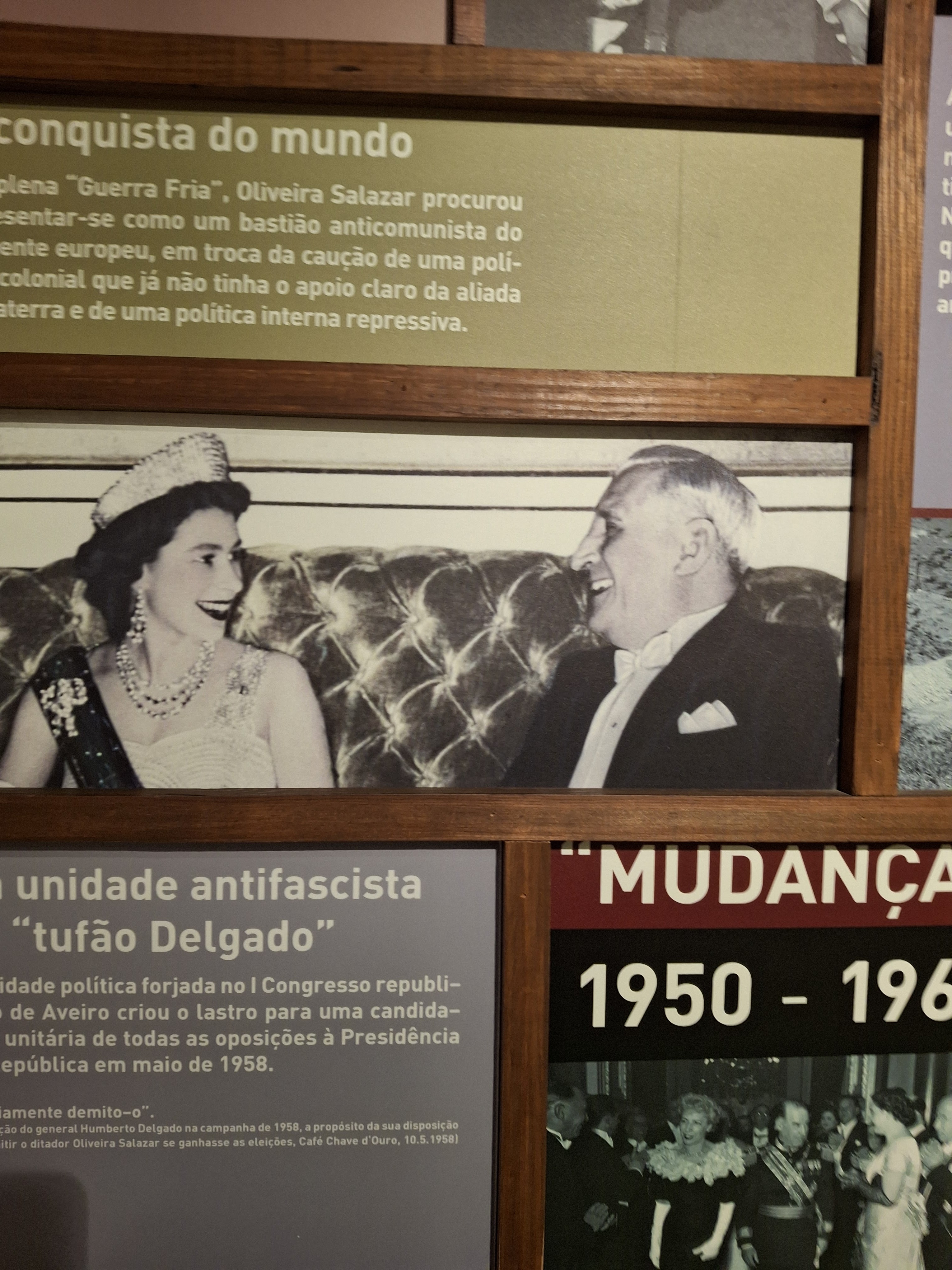
A photograph of Queen Elizabeth II meeting Antonio Salazar in 1957.
_______________________________________________________

1: If like me you have some mobility issues I'd strongly recommend taking a stick with you, Lisbon is built on several hills and most of the streets are cobbled.

Popular Posts