Search This Blog

Showing posts with label Esperanto. Show all posts

Sunday, 14 December 2025

Anarĥiismo (A. Borovoj) - Anarchism


"No social ideal, from the point of view of anarchism, could be referred to as absolute in a sense that supposes it’s the crown of human wisdom, the end of social and ethical quest of man." Alexei Borovoj Anarchism, 1918.

Alexei Borovoi was a Russian Anarchist, teacher and writer. Born in 1875 he spent much of his life articulating an individualist anarchism and giving lectures on anarchist thought. During the Russian Revolution he remained active and was a founding member of the Unions of of Workers of Intellectual Labour, a union for doctors and teachers and the Union of Ideological Propaganda of Anarchism a group whose purpose was the spreading of Anarchist ideas. He edited both organisations newspapers.

The Bolsheviks shut both organisations down, Borovoi continued to teach until 1922 when he was stripped of his professorship and banned from teaching. In 1929 he was arrested and exiled to Vyaltka, he spent the last years of his life in minor clerical posts. He died in 1935. 

In his time Borovoi was a very popular figure in Russia, university students lodged a mass petition for an intellectual debate on Anarchism vs Marxism with Borovoi representing the Anarchists, while Bhukarin and Lunarchasky were to be his opposition. The debates never happened though as the Bolshevik central government cancelled them. Unfortunately in our present time and Anglocentric world Borovoi is an obscure figure, there are only scraps of information about him, the Esperanto wikipedia has more information than then the English language entry, and I can find just one short piece by him on the Anarchist library, Anarchism and Law, so I hope translation of this short piece (not to be confused with the book of the same name) will help correct that in a small way.

Anarĥiismo (A. Borovoj)

Anarchism by A. Borovoj.


Is there in the sphere of modern socio-politics and ideas an idea as indefinite, contradictory and at the same time exciting to all, as anarchism? 

Here, full of irresistible attraction, here full of terror and disgust, the synonym of perfect harmony and fraternal unity, the symbol of the destruction of faith and fratricidal infighting, the triumph of freedom and justice, the feast of unbridled passions and arbitrariness, anarchism stands as a great enigma, stirring by its name immense feats of human love and explosions of obscure [2] vile passions, all are called the same.

And anarchism, affirming freedom, fighting against any form of despotism, regardless of the mask it hides behind, cannot but rise up against the excessive distortions of it, against the identification of revolutionary creation with the destruction of faith, of anarchic rebellion with the abominable dance of savages. Where do these arbitrary contradictory understandings of anarchism come from?

1-e. No socio-political thought can fit neatly into ready-made, finished formulas. Life is so full, elastic, and versatile that no dogma can forge chains can forge chains to restrain freedom of expression for long. It elementally outgrows the most fearless inventions of the wise, it puts aside the experienced, the old, buries the laws and theories, disregarding their logical harmony and the perfection of their constructions.

2-e. Despite the general conviction, the socio-political vivid idea is not so much the fruit of abstract speculations, the truth obtained through "reason", as the object of belief, conditioned by the profound originality of an individual.

In every human being, and the richer the individuality, the more strongly it manifests itself as an ever-living tendency towards the acceptance and understanding of definite truths. It may be modified according to time and place, environment, fashion, but the psychophysical originality of the individuality is its main source. Not expressed in terms of logic, it stands behind external argumentation and it decides the matter.

 The citizen of modern cultural society can freely, handily, draw from the rich treasury of human thought. Various worldviews, hostile and close to each other, are equally presented with great brilliance and talent, and despite all this, in addition to the external, obvious for all reasons, there are the internal, inconsiderable, powerfully drawing us to the acceptance and confession of one truth and to the equally passionate denial of the other. Never before has one religious teaching, one philosophical system, one socio-political institution united all people. This is impossible and unnecessary. Namely, this absence in humanity of one faith is the best evidence of the multifaceted nature of human nature and at the same time - the hopelessness of the claims of an individual, party, class, state, nation, to say - the whole truth.

 3-e. Anarchism has not yet had historical experience. One can speak of the history of anarchist thought, of the history of anarchist groups, communities, and individual attempts, but it is premature to speak of the social experience of anarchism. Conservatism and liberalism, as forms of socio-political thought, have deep living roots.

 They were not born of the cabinet meditations of scientists, nor of the disputes of progressive circles, but of real life interests. From the stage of separate attempts they had long since passed into the form of practical experience, had defined the politics of classes, had more than once taken the destinies of nations into their own hands; in a word, they had a long and complicated history.

 In the last half of the 19th century we can already speak not only of socialist vision, but also of socialist practice. The theoretical demands of Socialism began to be embodied in the real politics of the proletariat. And now we already have extensive socialist experience, because under the banner of socialism the ranks of modern workers' parties are being founded.

 Anarchism was not yet a real policy.
Separate pages of the International, small circles, colonies of intellectuals and some facts from the history of the workers' and especially peasant movement, that is all that can be called a particularly anarchist experience. The traditional aversion to "organization" and "collective discipline" has slowed down anarchism from playing a significant role in the development of the workers' movement. Anarcho-syndicalism is the phenomenon of recent years and in the history of anarchism it has opened a completely new page.

 4-e. Finally, one must pay attention to the abnormality, both of anarchist thinking itself, and of anarchist behavior. The socio-political philosophy of liberalism and socialism is based on the experience of a defined legality. The birth and development of class consciousness for them are the results of defined historical premises.

 On the contrary, anarchism, despite the proclamations of its leaders - Bakunin, Kropotkin and others - has always been outside historicism, being in its sociological concepts a methodology inherited from the rationalist teachings about "natural man", "state of nature", "natural law". In its assertions, society did not have an independent existence; it is a mechanical aggregate of free, self-defining "individuals".

 Anarchism was not and until recently did not claim to be the philosophy of any class. It was a philosophy of the creatively self-defining individual. It knew no formulas that bound the individual, acknowledging for everyone the unrestricted right of criticism.

 Hence the boundless diversity of statements of particular shades, currents in anarchism or even of particular anarchists, which with difficulty allows us to establish at least general lines of the worldview common to all of them.
But as for the "rules" of conduct, in fact, up to now there have been and are absent.
These are the general causes that have slowed down and that still continue to slow down the recognition of the nature of anarchism and the establishment of its constitutional recognitions.

Alexei Borovi 1924. 


Anarĥiismo
De A. Borovoj [1]

Ĉu estas en la sfero de l’modernaj socie-politikaj kaj ideoj ideo tiom nedifinita, kontraŭdireca kaj samtempe ĉiujn emociiganta, kiel anarĥiismo ?
Jen plena de nekontraŭstarebla allogo, jen plena de teruro kaj abomeno, la sinonimo de l’perfekta harmonio kaj frata unuiĝo, la simbolo de fi-detruado kaj fratmortiga batalado, triumfo de libereco kaj justeco, festenado de senbridigitaj pasioj kaj arbitreco, la anarĥiismo staras kiel granda enigmo agitanta kaj per ĝia nomo oni samnomas grandegajn heroaĵojn de homamo kaj eksplodojn de obskuraj [2] malnoblaj pasioj.
Kaj anarĥiismo konfirmanta la liberecon, batalanta kontraŭ iu ajn formo de despotismo, sin ŝirmanta per iu ajn masko, ne povas ne ekstari kontraŭ troegaj kripligoj de ĝi, kontraŭ samsencigo de l’revolucia kreado kun fi-detruado, de l’anarĥia ribeleco kun abomenega dancado de sovaĝuloj.
De kio devenas tiuj arbitraj kontraŭdiraj komprenadoj de anarĥiismo ?
1-e. Ĉiu socie-politika penso ne enmetiĝas tutece en la pretajn, finitajn formulojn. La vivo estas tiel plena, elasta, diversflanka, ke neniuj dogmaj katenoj povas kunforĝi por-longe la liberecon de ĝiaj celadoj. Elementece ĝi superkreskas la plej maltimajn elpensaĵojn de l’saĝeguloj, ĝi demetas la travivitaĵon, la malnovan, entombigas la leĝojn kaj teoriojn, malatentante ilian logikan harmonieco kaj perfektecon de iliaj konstruoj.
2-e. Spite la ĝenerala konvinko, la socie-politika vividearo estas ne tiom la frukto de l’abstraktaj spekulativoj, la vero, akirita per « racio », kion la objekto de l’ kredo, kondiĉata de l’profunda originaleco de individuo.

En ĉiu hom-estaĵo, kaj ju pli riĉa estas individueco, per des pli granda forto tio montriĝas ĉiam vivas emiĝo al la akcepto kaj kompreno de l’difinitaj veroj. Ĝi povas esti modifata laŭ la tempo kaj loko, medio, modo, sed psikofizika originalec’ de l’ individueco, estas ĝia ĉefa fonto. Ne esprimata en la terminoj de l’ logiko ĝi staras post la ekstera argumentado kaj ĝi decidas la aferon.
La civitano de l’ kultura socio moderna povas libere, plenmane ĉerpi el la riĉegaj trezorujoj de l’homa penso. Diversaj mondkomprenoj, malamikaj kaj proksimaj unu de alia estas egale prezentitaj kun granda brilo kaj talento kaj malgraŭ ĉio-ĉi, krom la eksteraj, evidentaj por ĉiuj kaŭzoj, estas la internaj, neprikonsidereblaj, potence nin tirantaj al la akcepto kaj konfeso de unu vero kaj al la same pasia malkonfeso de l’alia. Ankoraŭ neniam, unu religia instruo, unu filozofia sistemo, unu socie-politika institucio kunigis ĉiujn homojn. Tio estas neebla kaj malbezona. Nome tiu-ĉi malesto en la homaro de unu kredo estas la plej bona atestilo de multfaceteco de l’homnaturo kaj kune -senespereco de l’pretendoj de individuo, partio, klaso, ŝtato, nacio, diri- la tutan veron.
3-e. Anarĥiismo ankoraŭ ne havis historian sperton. Oni povas paroli pri historio de l’anarĥia penso, pri historio de l’anarĥiaj grupoj, kolonioj, apartaj ekprovoj, sed pri socia sperto de anarĥiismo paroli estas antaŭtempe. La konservatismo kaj liberalismo, kiel formoj de l’socie-politika pensado, havas profundajn vivajn radikojn.
Ne kabineta meditado de scienculoj, ne disputoj de l’progresemaj rondoj ilin naskis, sed realaj vivinteresoj. El stado de l’apartaj ekprovoj ili jam delonge transiris en la formon de praktika spertado, difinis la politikon de klasoj, ne unufoje prenis en siajn manojn la sortojn de l’nacioj ; unuvorte havis longan implikitan historion.
En lasta duono de 19a jarcento ni jam povas paroli ne nur pri socialisma vididearo, sed ankaŭ pri socialisma praktiko. La teoriaj postulaĵoj de Socialismo komencis enkorpiĝi en la reala politiko de l’ proletariaro. Kaj nun ni jam havas grandan socialisman spertadon, ĉar sub flago de socialismo fondiĝas la vico de l’modernaj laboristaj partioj.
Anarĥiismo ankoraŭ ne estis reala politiko.
Apartaj paĝoj de Internacio, rondetoj, inteligentulaj kolonioj kaj iuj faktoj el la historio de laborista kaj precipe kamparana movado, jen ĉio, kion oni povas nomi precipe anarĥiisma spertado. La tradicia abomenado al la « organiziteco » kaj « kolektiva disciplino » malakcelis al la anarĥiismo ludi iom atentindan rolon en la disvolviĝo de laborista movado. La Anarĥii-sindikalismo estas la fenomeno de lastaj jaroj kaj en la historio de l’anarĥiismo ĝi malfermis tute novan paĝon.
4-e. Fine, oni devas atenti la malnormalecon, kiel de l’anarĥiista pensado mem, tiel de l’anarĥiista konduto. La socie-politika filozofio de l’liberalismo kaj socialismo baziĝas sur la konfeso de l’difinita laŭleĝeco. La naskiĝo kaj disvolviĝo de l’klaskonscio por ili estas rezultaĵoj de l’difinitaj historiaj premisoj.


Male, la anarĥiismo eĉ malgraŭ la proklamoj de ĝiaj gvidantoj -BakuninKropotkin kaj aliaj- ĉiam estis ekster historiismo, estante en siaj sociologiaj konceptoj metodologia heredanto de l’racionalismaj instruoj pri « natura homo », « natura stato », « natura juro ». En ĝiaj asertoj la socio ne havis memstaran ekzistadon ; ĝi estas mekanika agregato de liberaj, sindifinantaj « individuoj ».
La anarĥiismo ne estis kaj ĝis lasta tempo ne pretendis esti la filozofio de iu klaso. Ĝi estis filozofio de l’kreece sindifinanta individuo. Ĝi ne sciis devigantajn la individuon formulojn, konfesante por ĉiu neniel limigitan rajton de kritiko.
Pro tio estas tiu senlima diverseco de l’deklaroj de apartaj nuancoj, fluoj en la anarfiiismo aŭ eĉ de apartaj anarfiiistoj, kiu kun la penego lasas starigi kvankam ĝeneralajn liniojn de l’komuna por ĉiuj ili mondpririgardo.
Sed koncerne la « regulojn » de l’konduto, fakte ĝis nun tiuj ne estis kaj malestas.
Jen la ĝeneralaj kaŭzoj malakcelintaj kaj kiuj ankoraŭ daŭras malakceli la ekkonon de l’naturo de anarĥiismo kaj starigon de ĝiaj konstituciaj rekonigiloj.

Tradukis el rusa lingo A. Pikilhavski (2333).
Sennacieca Revuo n° 4 (45) Januaro 1924, p. 9.


Saturday, 1 February 2025

En Afriko la ĝendarmo foriras - The Policeman of Africa Retires


French Military Instructors in Chad, photo sourced from the French Ministry of the Army, 25/01/2024
 

Translated from Le Monde Diplomatique

 While Emmanuel Macron's special envoy, former Minister Jean-Marie Bockel gave his report on the reorganisation of the French military disposition at the end of November, Paris was shocked to learn of Senegal and Chad's decision to end their security agreements with the former Colonial power. This new failure marks a turning point for France.

And so there were two less, leaving just three in total. By the 28th of November, in just a few hours France had lost two more positions on the African continent: Senegal, where France has been present for over 200 years, with a current garrison strength of 350 soldiers, and Chad a nation where France established a military presence more than 40 years ago and which stations a thousand soldiers and was until recently the base from which France launched the majority of its international interventions within Africa (six since 1968). Once those, 1350 soldiers withdraw from the region France will have just three bases in Africa - Djibouti, Ivory Coast and Gabon, with a combined force of fewer than 2000 personnel compared to 8500 in 2022.

This is a severe blow for France, whose military and political establishment has already been suffering over the past 3 years. This time the French were not expelled by mass protests, boos and the burning of the blue-white-red flags as happened in Mali, Burkina Faso and Niger in 2022 and 2023. The retreat was imposed from above. Paris learnt of the new reality in Senegal through newspaper interviews, President Bassirou Diomaye Faye gave to the French media. Although the matter of the withdrawal of the French army was one of the most important demands of his party, the party o African Patriots of Senegal for Work, Ethics and Fraternity (PASTEF), the French optimists hoped he would stall on the question. 

In Chad, the decision announced via an ordinary press statement caused a bombshell, because the French Minister for Foreign Affairs had just left N'Dajemena. At first no one could believe it, because this country was considered as the most important strategic location on the African Continent, a "perfect Aircraft carrier" as one high ranked officer described it, and it was also considered a trusted alliance partner, whose ruling Déby dynasty had many reasons to be grateful to France over the decades due to the support of the French secret services and air force in saving them from being overthrown by military mutinies on multiple occasions. 

For the French Army which has for decades viewed itself as the "Gendarme of Africa" and used the nation since independence in 1960 as a base of operations to launch nearly 40 foreign operations (OPEX) this loss is an historical turning point. It has lost the means and infrastructure to mobilise operations in the region within a few hours notice, as was the case during operation "Serval" in Mali in 2013, launched urgently to prevent an offensive by Jihadist groups.

France Intends to remain "In another form"

In February 2023 President Macron declared his intention not to end the national military presence in Africa but to fundamentally reorganise it. "The logic is that our model is that there should no longer be military bases there as they currently exist" he declared in a speech concerning "Franco-African relations". He announced a major reduction in the number of troops and increased participation with local partners. France had just been driven out of Mali and Burkina Faso by military coups which it had not foreseen. Demonstrations against French influence spread everywhere throughout West Africa. The military and political establishment were (finally!) understanding that a change in relationship was necessary concerning the populations and militaries of the nations concerned, who could no longer tolerate French intrusions. 

After Macron's speech, the military high command and the parliamentary deputies in Macron's camp promised greater "discretion" "a lighter tread" and even a "paradigm shift".... "Now, we have flipped the relationship on its head, now the one who calls the shots is the [African] partner". Said Thierry Buckhard, Army Chief of Staff, speaking to the French parliament in January 2024. Over the following months, the chief of staff worked on new provisions with two necessities; respond to the wishes of the local regimes presented as "partners" and conserve and maintain influence, a difficult balancing act. Under these plans every base except for Djibouti - which has a special status in French strategy and with its 1500 strong garrison is considered indispensable- will drastically reduce its personnel, between 150 and 300 soldiers depending on the base and instead of being given to the host nation will be co-administered by them. "These bases are key to guarding our capability to intervene militarily" explained Deputy Jean-Michael Jacques, Macron supporter and president of the commission for national defence. The remarks come from a report in May 2023. "The strategy presented by the head of state prevents the growing rift that would nullify our military presence in Africa and consequently our influence on the continent"1. 

In a report on French Defence policy by another Deputy, Thomas Gassilloud, repeats the thinking that reigns in Paris "Remain, in another form". According to Gassilloud who is close to the Presidential Palace and served in the army before entering politics, the destiny of France is linked to Africa. That is why it is vital to rebuild "strategic intimacy". "Without a strong reaction, we will face the risk of the degradation of our influence in French-speaking Africa". He underlines 2. When ill winds blow, continued Buckhard, it is necessary to know when to bend, but always with the aim of standing tall again. "We must be capable of quickly shrinking our presence and disappear from the landscape to then restore our presence as needed... [This last] must include the ability to liaise with local militaries and secure strategic access by sea and air".

France can continue to influence the destiny of Africa. It must not "let its hands drop" in the words of General Jerome Pellistrandi in a May 2023 edition of National Defence dedicated to "new relations" between France and Africa. "Quite the opposite" says this senior figure and seasoned debater who regularly appears on television, "more than ever it is necessary to act, but differently... An influence strategy is more necessary now than ever"3. In that same publication another eminent General, Bruno Clement-Bollee, asserted that "it is imperative to react and decide on an ambitious, robust and realistic strategy that will restore to France the status of great nation"4. This is where its international standing lies, above all in its permanent presence on the United Nations Security Council, partly justified by its influence in French-speaking Africa.

The subject of Africa is not solely a question of influence. The French military views the continent as ideal terrain to test its soldiers and equipment, especially in deserts and near desert like environments, offering fringe benefits, career advancement opportunities, shared experiences and adventure. "Our martial culture contains a strong African flavour, affecting our tastes and nostalgia. How will [the new provisions] change the appeal of a military career?" asked right wing Deputy Jean-Louis Thieriot (Republicans) during a discussion by Buckhard inside the National Assembly. It is therefore necessary to reshape the offer of military co-operation, so that what is lost on the one hand is regained through intensive collaboration. That is the indispensable "corollary" according to another of Macron's deputies (and former soldier) Ms. Laetitia Saint-Paul. 

Collaboration was the core of French strategy in the period immediately following independence of the African colonies. It was only from 1970 onwards that direct foreign intervention became the preffered tool of French rulers in resolving political crisis through military means. This period became known as "Jaguar diplomacy" named after the fighter jet that ended service in 1972. This latter period probably ended in 2022 after the disastrous Operation "Barkhane".


Reinvent collaboration or disappear

Now, we arrive at the subject of how to rebuild collaboration and conserving links between the French and local armies; instead of returning sovereignty over the military bases, the idea is to transform them into academies, national schools with a regional objective (ENVR) with the goal of being co-managed by France and the host nation. This project is not new, it dates back to the 1990s. At present nineteen such institutions exist throughout the continent in Senegal, the Ivory Coast, Benin, Gabon and in Cameroon. Combined they are capable of instructing 3000 Non-Commissioned Officers and Cadets annually, and thus foster "intimacy".

Now France plans to rapidly multiply them. That is the task of the Directorate of Security and Defence Co-operation (DCSD), a section under the Ministry of Foreign Affairs, headed by an officer and dealing almost exclusively with Africa. Of the 313 collaborators sent abroad most went to Africa, and mainly to the former colonies. On the previous 9th of July the director of the DCSD General Colcombet visited Gabon to inaugarate the opening of School for the administration of Defence Forces in Libreville (EAFDL). This French base also hosts an Academy for environmental protection and natural resources. In his speech Colcombet aluded to "historical evolution" and an "important turning point" in the history of Franco-Gabonese relations. But the goal of these schools is not just to train African militaries; they also must "preserve logistical, human and equipment links to those nations." Jean-Marie Bockel stressed at a meeting with members of the Senate in May 2024. In short, to maintain a foothold abroad in case of need...

A former Minister under Nicholas Sarkozy, who famously declared his willingness "to sign the death warrant of French Africa"5 in 2007, which prompted his dismissal, Mr. Bockel has been interested in these matters for some time. His son, a soldier, was killed in Mali in 2019. In 2024 Macron appointed him "special envoy" tasked with study the reorganisation of the disposition of the French Army in Africa. His task was to liaise with the concerned heads of state and draft a list of proposals which he submitted just three days before the announcements of Senegal and Chad. The choice of appointment of Mr. Bockel followed a certain kind of logic; in 2013 while a Senator he and his colleague Jeanny Lorgeaux wrote a report "on France's presence in coveted Africa" which summarised the current priorities well. "It is our duty to be there" the report says, "because we are betting a part of our future growth in Africa" While they advised "giving an African meaning to the French presence in Africa" both Senators concluded that the remaining 8 military bases "should be maintained"6.

It was a different era then. France had just launched Operation "Serval" in Mali, with military success and the support of the majority of the African states, and was preparing to launch Operation "Sangaris" in Central Africa. France had a certain grand reputation then. Eleven years later and it looks like a relic of the past. By trying to "re-invent military partnerships instead of demilitarising Franco-Africa realtions" researcher Thierry Vircoloun explains, "the government attempted to carry out half measures which pleased no one"7. Its military presence may become an important issue during the Presidential elections in Gabon, where the Bongo family were ousted in a Coup in 2023, and in the Ivory Coast, both elections are schedule for 2025, it is possible that the French Army will be expelled from both countries as well.

Remi Carayol


___________________________________________________________

1: Jean-Michel Jacques, Report made on behalf of the committee on national defense and the armed forces on the draft law relating to the military budget for the years 2024 to 2030, and containing various decisions on national defense, n°1234, National Assembly, May 12, 2023.

 2: Thomas Gassilloud, Information report on the hearings of the committee on French defense policy in Africa, n°2461, National Assembly, April 10, 2024.

3: Jérôme Pellistrandi, «A falling tree makes more noise than a growing forest,” Revue Défense nationale, n° 860, Paris, May 2023.

 4: Bruno Clément-Bollée, “France, becoming a true balancing power again”, Revue Défense nationale, n° 860, Parizo, majo 2023.

 5: A term that defines France's neocolonial relations with Africa. (TT)

6: Jeanny Lorgeoux and Jean-marie Bockel, report made on behalf of the committee on foreign affairs, defense and the armed forces on France's presence in coveted Africa, n°104, French Senate, Paris, October 29, 2013.

 7: Thierry Vircoulon, "The dilemma of the Franco-African military relationship: reinvent or turn the page?", French Institute of International Relations (IFRI), November 18, 2024.


Monday, 28 October 2024

How Hitler Came to Power - Kaj la nazioj prenis la potencon


Key figures in Hitler's rise to power, Left to right, Dietrich Klagges, Alfred Hugenberg, Paul von Hindenburg and Franz von Papen

A translation of Johann Chapoutot's article for Le Monde Diplomatique


Contrary to the popular belief, Adolph Hitler was not empowered by a popular vote. Instead, his rise was thanks to frequent parliamentary crisis and moral panics exploited by a press controlled by a far right magnate and the willing support of key industrialists and bankers. They all shared a desire to break the electoral momentum of the left and kill the social state.

 The installation of the Nazis on the 30th of January 1933 was the gravest trauma to the conscience of every democrat. In the West Germany was a nation of high culture, science, research and technology, full of music, literature and philosophical glory and Nobel Prizes. It was also proudly the country with the oldest and most well-organised left wing movement in the world. With large Social Democratic and Communist Trade Unions and parties to match, who through their activism in the case of the Social Democratic Party (SPD) or the mere fact of its existence in regard to the Communist Party (KPD) managed to establish an advanced social democratic system by 1918-1919. But by 1920 the "Weimar Coalition" established by the SPD, German Democratic Party (DPP) and the Catholic Centre Party (DZP) had weakened electorally and was quickly replaced by moderate or right wing majorities, who strived to undo the progressive measure and social gains. In addition, the Social Democratic President Friedrich Ebert died in the middle of his mandate and was replaced in 1925 by the living fossil, the General Field Marshal Paul von Hindenburg, although in accordance with the law he swore loyalty to the Constitution and kept that oath.

The Treaty of Versailles and the contempt it inspired in many nations and costly economic reparations did not create an auspicious international situation. Despite that background, the German Democratic, Liberal and Parliamentary Republic worked to develop a democratic culture through regular balloting at the national level, within the federal states and through interparty dialogue. In fact, it was a coalition of the right and left headed by Gustav Stresemann (DVP, right wing) which in the Autumn of 1923 confronted the Occupation of the Ruhr, hyperinflation and the collapse of the German currency. This same coalition also faced several insurrections (Rhineland separatists tried to copy the Bolshevik revolution, and a failed putsch by Nazis in Bavaria). Once again since the 28th of June 1928 another grand coalition of parties helmed by Herman Muller (SPD) ran the German government. The great economic crisis (Wall Street crash) struck Germany in the Autumn of 1929. Its intensity destroyed the government when the right wing parties pushed for budget austerity while the left pushed for increasing unemployment benefits.

When no party could succeed in building a parliamentary majority, a small circle of advisers to the President, military officers, large landowners, industrialists and bankers, moved to alter normal constitutional practice and carried out a sort of permanent coup supported by the personal prestige and importance of Hindenburg.  The right ruled through Presidential cabinets, often ignoring the Reichstag. Indeed, Article 48.2[1] of the 1919 Constitution permitted the head of state to enact laws by decree, even though this practice undermined democratic customs. It was supposed to be used only in periods of extreme danger, Ebert had used it often between 1919-23 to confront Communist and right wing insurrections. Now it was being used to push through budgetary measures that were extremely anti-social, cutting assistance for the unemployed and other welfare programs, and sector wide cuts to minimum wages.


Rebuilding the Army

In the opinion of the circle around the President, Brüning had made serious by continuing with austerity, his policy of transferring vast tracts of uncultivated lands in Germany's east as much of that land belonged to Germany's major landowners. Hindenburg was one of them: the majority of his social circle consisted of Junkers the landed nobility of Prussia and members of the army. In addition, there were tactical disagreements on how to handle the National Socialist Workers Party (NSDAP), after a failed attempt to negotiate with the Nazis Brüning decided to outlaw them by a decree passed in April 1932, this decree targetted the Nazis paramilitary groups the Storm troopers (SA) and the SS. General Kurt von Schleicher a high ranking military officer with influence in the Hindenburg clique disagreed with this policy, he considered the Nazi armed forces essential to defeat the Communists in the streets and rebuild the German army. In the brownshirt wearing street fighters, he saw high quality "human material" for the new German army the military high command dreamed of.  That dream looked more realistic in 1932 after the reparation payments mandated by Versailles had ended and there was renewed hope that a relaxation of the cap on troop numbers of the Reichswehr (the new name of the German armed forces) that limited it to 100,000 men would soon follow. Secret intrigues, behind the scenes meetings, secret contacts and plots made behind the back of Brüning to weaken him and General Wilhelm Groener the Minister for Defence and the Internal Security, both were targetted due to their support for a ban on the Nazi paramilitary groups. In June 1932 these intrigues succeeded in toppling Brüning's Administration and nominating a new Chancellor Von Papan, as well as a new Cabinet in record time!

 Papen was almost a political unknown: A member of Zentrum, (the Centre party) he was a Landtag deputy for the Prussian state parliament, Prussia was the most important state within the German Federal system, but Papen was discreet in method. An Aristocrat, ex-officer and businessman, he also had contacts and influence, he was also a member of the Herrenklub, a private members club whose membership were powerful and well-connected right wing businessman, state functionaries and military officers. To Schleicher he seemed the perfect figurehead ("I do not want a head, but a hat" he once said regarding this question of governance) to carry out his work of collaboration with the Nazis. Papen fulfilled this task by making the SA and SS legal once again, though when the Nazis carried out a massacre in the Summer of 1932, murdering over a hundred left-wing activists and sympathisers and some passers-by using bullets and clubs Papen was forced to pass a special decree outlawing political violence which specifically carried an unappealable death sentence. Regarding economic and social policy he had his own ideas: he continued the dismantling of welfare policies and supported economic subsidies and tax cuts for major companies, he carried out these policies under another law by decree on the 5th of September 1932. Papen, together with his circle of conspirators which including one of the "Great theorists" of Conservative Revolution Edgard Jung and Carl Schmitt[2], considered ending the system of parilamentary democracy in Germany entirely. After the dissolution of the Reichstag and the election of the 31st of July 1933 this right wing clique expreienced severe opposition, the Nazis held 230 deputies around a hundred more seats than previously. Papen's government lost a confidence vote and his government fell by an overwhelming majority, elections were once again held in Germany.

The attempt to keep the Nazis under control

The next election which was held on the 6th of November showed the continuance of the decline of the liberal right, but just as important the Nazis lost 36 deputies to the DNVP (German National People's Party, an extreme conservative party). The DNVP was also a far right party whose leader Alfred Hugenberg was even more anti-worker than Hitler, just not as charismatic. He was also much older than Hitler and in every respect lived like the shameless bourgeois and held extreme reactionary views throughout his life. He was a racist, an antisemite and a German ultranationalist. A former President of the Krupp firm, he had been a vocal advocate of German territorial expansion and the colonisation of Polish lands before the First World War. After the War he became a mass media magnate, purchasing twelve newspapers including weeklies and monthlies, and a film studio (Deulig, renamed UFA) which produced a newsreel service to show in the cinemas before the films. By standardising the contents of his media mouthpieces (to reduce costs and sure up ideological coherence) Hugenberg succeeded in distressing the German population and stimulating a moral panic over "Cultural Bolshevism" the Herald of homosexuality, modern art, feminism, and the corruption of youth, and the spectre of "Judeo-Bolshevism" a greedy force set on the ceasing of private property and the destruction of Christianity. Hugenberg radicalised the right wing of Germany and legitimised the Nazi party. A defender of the unification of the Right, in 1929 he associated with NSDAP members as part of a campaign against the Young Plan (a plan to restructure the remaining reparations) by uniting the right wing parties in a campaign through a popular referendum. Later, he created the Harzburg Front, a short-lived political alliance which proved in October 1931 that the Nazis were now respectable enough to appear alongside the worthy representatives of the banks, industry, military and the traditional right.

In November 1932 the right was hesitating over choosing the best way forward to maintaining the existing social order and make Germany a military power again, while also confronting what was in their eyes the most serious danger: the growth of the Communist party's voting base. Which continued to grow in the Autumn of 1932 while Nazi support declined. 

By August 1932 in the aftermath of an election that was aa disaster for Papen's government the Hindenburg right were left with two choices. The first option was to bring the Nazis fully into the coalition of state administration, something which Brüning had already proposed at the start of 1932 and which Papen now offered again to Hitler. The Problem: Since the Nazi party was the largest in the Reichstag, a fact reinforced by the elections in November, Hitler demanded the position of Chancellor in the proposed new government, this was something that Hindenburg opposed on principle, Hitler was pushing for a cabinet filled exclusively with Nazi party appointments while Hindenburg desired a broad coalition of the German right. Hindenburg also personally disliked Hitler, too Austrian for his Prussian character, an upstart Corporal who lacked deference for his Field Marshal rank, too bombastic and Catholic for Hindenburg's restrained and Protestant nature etc. The second option was to once again dissolve parliament (the third time in less than six months!) and hold another undated call for elections in violation of article 25 of the Constitution which outlined a maximum period of 60 days to hold new elections[3]. Meanwhile the Government continued to carry out its policy by resorting exclusively to law by decree. In the event of strong extra-parliamentary opposition (strikes, street demonstrations, insurrections) a state of emergency would be declared with the army tasked with restoring order. But in December 1932 the Army declared that it was incapable of handling the threat posed by the Communists and Nazis if a foreign power chose to invade as well.

But, there was a third option. General Kurt von Schleicher, Chancellor since the 3rd of December 1932 proposed adopting a political programe that was social and nationalistic to convince Gregor Strasser the Nazi party number 2 to join the governing colation. Strasser had been disatisfied with his position within the party and the decline in support for the Nazis with voters and the Unions. He also returned to Brüning's old plan of using agrarian reform to combat unemployment, which angered Hindenburg and his closest advisers. Papen supported intrigues against Schleicher with the help of landowners, bankers and industrialists, who had been publicly advocating Hitler be given the Chancellorship since the 19th of November 1932. On the 4th of January 1933, a secret meeting was held by the banker Kurt von Schröder, the meeting decided upon organising a new goverment of the Right, Hitler as Chancellor, Papen as Vice Chancellor. The government would promote a "National politics" and oppose "Anti-national elements" and support private business interests. For over a year and a half Hitler had repeated meetings with important businessmen to reassure them that the Nazi party was not a social party and certainly not a socialist one, he was in fact the leader of political party that believed in re-armament, economic growth and the conquest of new markets in the East.

This was the chosen solution to the crisis. On noon on the 30th of January 1933 the new government took its oaths in front of Hindenburg who had been won over by the promise of Papen to keep Hitler under control and by the fact that since 1930 there were already three State goverments within Germany established through coalitions of the Nazis and the wider right[4]. On the 31st of January Hindenburg signed another decree for dissolution and call for what he hoped would be the last election. The democratic government of Article 48.2 would die and be replaced by a new openly Authoritarian government, one in which the traditional German Right, (Liberals and National Conservatives) and the Nazis unanimously desired. 

Johan Chapotout


 1: Art. 48. If a state fails to perform the duties imposed upon it by the federal constitution or by federal law, the President . . may enforce performance with the aid of the armed forces.
If public order and security are seriously disturbed or endangered within the Federation, the President . . may take all necessary steps for their restoration, intervening, if need be, with the aid of the armed forces. For the said purpose he may suspend for the time being, either wholly or in part, the fundamental rights described in Articles 114, 115, 117, 118, 123, 124, and 153.

2: A lifelong advocate of authoritarianism and dictatorship, Schmitt became a leading and active supporter of the Nazi party and its legal system. After WWII, Schmitt refused to work with denazification policies and retained link's with Fascist Spain.

3: Art. 25. The President of the Federation may dissolve the Reichstag, but only once for any one cause.
The general election is held not later than on the sixtieth day after dissolution.

4: Five Federal states had Nazi governments before Hitler's rise to power nationally, I'm not sure which three are referenced here though I believe they would be the Free State of Mecklenburg-Schwerin, the Free State of Brunswick, and the Free State of Thuringia, it was also the governor of Brunswick Dietrich Klagges who suceeded in granting Hitler German citizenship clearing several constitutional barriers to his participation in German politics.


Sunday, 7 July 2024

An Esperantist died at the frontlines in Ukraine - Esperantisto pereis ĉe la fronto en Ukrainio


Vadimas his friends would like to remember him

 El Libera Folio

English Version

Vadim Bikov was killed in the last days of May while serving at the front in Ukraine, he was 54 years old. He voluntarily joined the Ukrainian army immediately after the start of the war, and for over two years served in several dangerous hotspots along the frontline. He is mourned by his Esperantist wife, Julia Dmitrieva.

Vadim Bikov was born on the 30th of November 1969 in Soviet Qazaqstan, and spent his childhood in Uzbekistan. He grew up with Russian language media and completed his education in Donbas in the east of Ukraine, and settled there. 

When conflict erupted in Donbas in 2014 Vadim fled to unoccupied territory and joined the Ukrainian army to defend the country whose citizenship he had obtained after the collapse of the Soviet Union. 

In February 2022 after Russia launched its full scale invasion of Ukraine, Vadim joined the Territorial Defence and spent some weeks guarding a hospital. However, he wished to rejoin the professional army, but in the beginning of the war there were many volunteers and the lines outside recruitment centres were very long.

For several days, Vadim queued outside the recruitment office as a volunteer, but the authorities announced that everyone in the line must go home because it was not possible to take on any more recruits. The majority of the volunteers obeyed the order but Vadim and a friend remained outside the office. It was close to midnight and the martial law mandated curfew when they were finally able to sign up, and only thanks to both having prior military experience. 

In civilian life, Vadim had been a chef and businessman, he ran a stall in the centre of Kyiv selling baked goods similar to pizza. They were delicious according to the Esperantists who tasted them. During the Summers he sometimes worked as a chef for a chess players camp on an island in the Dnieper River in the middle of Kyiv. These experiences are why he was giving the task of cook in the army.

However, that posting did not mean that his time on duty was without danger. Among the tasks he was assigned included the responsibility of delivering food to soldiers who were close to the enemy, and transportation of supplies was often a dangerous task. In addition, like everyone else, he was often deployed to the farthest perimeter of the frontline and had to guard positions close to the enemy and fire on enemy troops crawling toward the trenches. He described those nights in discussions with his Esperantist friends as the most difficult experiences of his life.

On several occasions, Vadim's Detachment had the difficult task of defending retreating Ukrainian troops after they were forced to evacuate positions that could no longer be defended. Among other things he fought in Severeodonetsk during the intense battles there in May-June 2022, the fighting cost both sides high casualties before Ukrainian forces withdrew at the end of June.

Vadim was a native Russian speaker, but he intensively studied the Ukrainian language and later the English language and Esperanto, aided by his wife Julia Dimitrieva. They met at an English language course that she taught. For Vadim learning languages was a great struggle, and he never learnt to speak Esperanto fluently. Though he still enthusiastically took part in informal events, especially those organised by the younger generation of Ukrainian Esperantists.

On several occasions, Vadim obtained leave from the front and was able to reconnect with friends who always feared that they would see him for the last time. Vadim took part in an Esperanto gathering for the last time just two weeks before his death, he used an internet link in an underground location close to the frontline. He spoke about how he, like the others, did not realise and appreciate how free and rich the pre-war life outside the trenches had been.

On the 26th of May, he stopped responding to his wife's messages. Information soon came that explained that on that day he had been killed by a rocket explosion. His burial was on the 6th of June in Kyiv. His wife and two other Kyiv Esperantists attended the service. Members of the chess club that he cooked for in the Summers also attended, along with thirty of his soldier comrades, some baring prostheses instead of legs.   


 Fine de majo en la aĝo de 54 jaroj pereis ĉe la fronto la ukraina esperantisto Vadim Bikov. Li libervole aliĝis al la ukraina armeo tuj komence de la nuna milito kaj dum pli ol du jaroj servis en pluraj danĝeraj partoj de la fronto. Lin funebras lia esperantista edzino Julia Dmitrieva.


Vadim Bikov naskiĝis la 30-an de novembro 1969 en sovetia Kazaĥio kaj infanaĝe loĝis en Uzbekio. Li kreskis en ĉefe ruslingva medio kaj finis la lernejon en Donbaso en la orienta parto de Ukrainio, kie li poste loĝis.

Kiam komenciĝis la milito en Donbaso en 2014, li fuĝis al neokupita teritorio kaj libervole aliĝis al la ukrainia armeo por defendi la landon, kies civitano li iĝis lige kun la disfalo de Sovetio.

Kiam en februaro 2022 komenciĝis la grandskala atako de Rusio kontraŭ Ukrainio, Vadim unue aliĝis al la teritoria defendo kaj dum kelkaj semajnoj gardis hospitalon. Li tamen deziris aliĝi al la efektiva armeo, sed en la komenco de la milito estis multaj volontuloj kaj la vicoj ekster la rekrutejoj estis longaj.

Vadim dum kelkaj tagoj atendis sian vicon por aliĝi al la armeo kiel libervolulo, sed la respondeculoj de la rekrutejo fine anoncis, ke ĉiuj en la vico iru hejmen, ĉar momente ne eblos ekipi pliajn volontulojn. La plej multaj obeis kaj iris hejmen, sed Vadim kune kun amiko plu restis ekster la rekrutejo. Jam ekproksimiĝis la noktomezo kaj la horo de la dummilita nokta elirmalpermeso. Tiam oni fine alvokis ilin kaj registris ilin kiel rekrutojn, ĉar ili jam havis militan sperton.

En la civila vivo Vadim Bikov estis kuiristo kaj entreprenisto – li posedis en centra Kijivo budon, kie oni vendis bakaĵojn similajn al pico. Tre bongustajn, laŭ esperantistoj kiuj ilin gustumis. Dum someroj li kelkfoje laboris kiel kuiristo en tendaro de ŝakistoj sur ĝardena insulo en Dnepro en la centro de Kijivo. Tial ankaŭ en la armeo li ekhavis la taskon de kuiristo.

Tio tamen ne signifas, ke lia deĵorado estus sendanĝera. Al liaj taskoj apartenis porti manĝaĵojn al la batalantoj tre proksime al la malamiko, kaj la transportado de la manĝaĵoj ofte estis tre riska entrepreno. Krome li samkiel ĉiuj devis gardodeĵori ĉe la absoluta frontlinio kaj regule pafi kontraŭ la malamikoj kiuj rampe proksimiĝis al la tranĉeo. Tiujn noktojn li en diskutoj kun esperantistaj amikoj priskribis kiel la plej malfacilan sperton de sia vivo.

La taĉmento de Vadim plurfoje havis la tre danĝeran taskon protekti la retiriĝon de ukrainiaj trupoj, kiuj estis devigitaj forlasi siajn ne plu defendeblajn poziciojn. Li estis interalie en Severodonecko, kie en majo kaj junio 2022 daŭris intensaj bataloj kun grandaj perdoj ambaŭflanke, ĝis fine de junio la ukrainaj defendantoj pleje fortiriĝis.

Vadim estis denaske ruslingvano, sed intense studis la ukrainan lingvon, poste la anglan, kaj poste ankaŭ Esperanton, helpe de sia edzino Julia Dmitrieva. Ŝin li renkontis pro kurso de la angla lingvo, kie ŝi estis instruisto. Lerni lingvojn por li estis granda peno, kaj li neniam lernis tute flue paroli Esperanton. Li tamen kun granda ĝuo regule partoprenis precipe en neformalaj aranĝoj de la juna generacio de ukrainaj esperantistoj.

Kelkfoje dum la milito li havis forpermeson de la fronto kaj povis renkonti amikojn, kiuj ĉiam timis, ke ili lin vidas la lastan fojon. Lastfoje Vadim partoprenis en kunveno de esperantistoj nur du semajnojn antaŭ sia pereo, per retligo el ia subtera ejo proksime al la fronto. Li parolis pri tio, ke li samkiel aliaj ne komprenis kaj aprezis, kiel riĉa kaj libera estis la antaŭmilita vivo ekster la tranĉeoj.

La 26-an de majo li ne plu respondis al mesaĝoj de la edzino. Baldaŭ venis informo, ke en tiu tago li pereis pro raketa eksplodo. La enterigo okazis en Kijivo la 6-an de junio. Ĉeestis krom la edzino du aliaj esperantistoj el Kijivo. La ceremonion partoprenis ankaŭ anoj de la ŝakoklubo, ĉe kiu li en iuj someroj laboris kiel kuiristo, kaj trideko da liaj soldataj kamaradoj, kelkaj el ili kun protezo anstataŭ gambo.


Sunday, 12 November 2023

HALTIGU LA BARBARECON ! - Stop this Barbarism the conflict in Gaza


Stop the Barbarism!

Once again the flames of war have sparked into life in the Palestine/Israel region. This time Hamas took the inciative to start the atrocities. They did not act alone in this attack, militants from the PFLP also took part in the armed assaults. The pictures are unbearable: civilians murdered in the streets, and in their homes, the taken of hostages etc.

Although the Israeli government conducts a system of political Apartheid, which has even been acknowledged by Tamir Prado, the ex-director of Israel's Intelligence service. But that does not justify the conscious murder civilians. That is as condemnable as the murder of Palestinian civilans by the Israeli army! Without a doubt the response of the Israeli government will be just as terrible as it is blind. Already buildings in Gaza are being bombed and electricity has been cut throughout the whole territory. 

We can only express our deepest fears and concern for the civilian inhabitants, Palestinian and Israeli both hostages to their respective governments in this conflict, and we must remember that during these past months the civilian populations had been demonstrating against their own governments and this lethal politics; over the past weeks, especially since the 30th of July thousands of people in Gaza have been protesting against the rule of Hamas under the slogan "We Want to Live!"

At the same time in Israel, tens of thousands had repeatedly took to the streets to oppose the right wing policy of the government which was no longer capable of controlling the protests and was heading toward collapse. 

The attacks by Hamas therefore have occurred while on both sides of the wall of shame thousands of people had begun to organise themeselves against their rulers. 

The violence unleashed by these attacks will unite the people with their corrupt rulers and strengthen the nationalist fervour, fueled by desires for mutual revenge.

In Gaza, Hamas is calling for the whole population to rally behind its flag in an united front. Already Netanyahu has formed a government of national unity. The thousands of reservist soldiers who have been striking for weeks after announced the break up of their movement!

This attack also has an international dimension. It happened after the leader of Hamas met with Ayatollah Ali Khamenei the leader of Iran and while Saudi Arabia - an enemy of Iran- has begun building official relations with Israel. Hezbollah the terrorist puppet of Iran in Lebanon has already declared that "the attack by Hamas against Israel sends a message to anyone who tries to normalise relations with Isreal or hopes that the Palestinian struggle is dead".     

In the aftermath it is the inhabitants of Israel and Gaza who will pay the price for this bloody game played between states in order to cement their own power.

Once again, those who decide to have a war are not those who die in it. 

Once again, the civilian will suffer, from Sderot to Gaza. All ideologies of power, especially nationalism and religious fervour are the pillars of logic that encoruages people to kill each other for the benefit of the rulers of the world.

CNT-AIT

During the pandemic two nurses in Ramdam hospital display an essential message.
"We refuse to be enemies. For a just and lasting peace!"


HALTIGU LA BARBARECON !
Denove la milito ekflamas en la Palestina/Israela regiono.
Ĉi-foje la Hamaso prenis la iniciativon komenci la
barbarecon. Ĝi ne estas sola en tiu atako, ankaŭ sturmantoj
de la FPLP partoprenas la armitajn agojn. La bildoj estas
neelteneblaj: civiluloj murditaj sur la stratoj aŭ hejme,
ostaĝigoj.
Kvankam la israela registaro kondukas politikon
kvalifikitan apartismo, eĉ de la eks-direktoro de la israelaj
spionservoj Tamir Prado, tio tute ne pravigas plenkonsciajn
murdojn de civiluloj. Tio estas tiel kondamnindaj kiel
mortigo de palestinaj civiluloj fare de la israela armeo !
Sendube, la milita respondo de la israela registaro estos
same terura kaj blinda. Jam konstruaĵoj de Gazao estis
bombaditaj kaj elektro estas interrompita en la tuta teritorio.
Ni nur povas esprimi la plej grandajn timojn por la civilaj
loĝantoj, palestinaj kaj israelaj, ostaĝigitaj de la iliaj
respektivaj registaroj en tiu konflikto kaj tio, dum tiuj
loĝantoj manifestaciis de monatoj kontraŭ siaj propraj
registaroj kaj ties mortigaj politikoj: dum la lastaj semajnoj,
kaj precipe la pasintan 30an de julio, miloj da Palestinanoj
manifestaciis en Gazao kontraŭ la politiko de la Hamaso per
la slogano « ni volas vivi ».
Samtempe en Israelo, dekoj da miloj da israelanoj multfoje
surstratiĝis kontraŭ la politiko de la dekstra registaro, kiu ne
plu kapablis kontroli la manifestaciojn kaj direktiĝis al
kolapso.
La atako de la Hamaso do okazas, kiam – ambaŭflanke de
la muro de la honto – la loĝantoj komencis memorganiziĝi
kontraŭ siaj estroj.
La perforto senbridigita de tiu atako tute male unuigos la
loĝantaron ĉirkaŭ tiuj koruptitaj estroj, plifortigante la
naciismajn sentojn nutratajn per deziroj de reciproka venĝo.
En Gazao, la Hamaso alvokas la sakralan unuiĝon malantaŭ
sia flago. Jam Netanjahu anoncas registaron de nacia unuiĝo
; la miloj da rezervistaj soldatoj, kiuj strikis de semajnoj
anoncis interrompon de sia movado !
Tiu atako aliparte intervenas, dum la ĉefo de la Hamaso
renkontis la ajatolon Ali Khamenej en Teherano pasintan
junion, kaj ke Sauda Arabio – reĝimo malamegata de Irano
– interdiskutas kun Israelo por starigi oficialajn rilatojn. Jam
la Hizbulaho, terorisma marioneto de Irano, anoncis, ke « la
ofensivo de la Hamaso kontraŭ Israleo konsistigas mesaĝon
al tiuj, kiuj provas normaligi siajn rilatojn kun Israelo por
esprimi, ke la palestina lukto ne mortas ». 

Post la israela loĝantaro, ja la loĝantaro de Gazao pagos la
prezon de tiuj sangoplenaj ludoj inter Ŝtatoj por certigi sian
potencon.
Unu plian fojon tiuj, kiuj decidas militojn ne estas tiuj, kiuj
mortas en ĝi…
Unu plian fojon, la civiluloj suferos, de Sderoto ĝis Gazao.
Ĉiuj ĉi ideologioj uzitaj de la potenco, nome naciismojn kaj
religiojn, estas la pilieroj de tiu mortiga logiko, kiu instigas
la homojn intermortigi sin por la plej granda profito de la
estroj de tiu mondo.
CNT-AIT
http://cnt-ait.info/2023/10/09/halte-a-la-barbarie/
dankon al nia amiko http://neniammilitointerni.over-
blog.com
pro la traduko


Tuesday, 19 September 2023

1915: Two Obituaries of Sifo (Shifu)


Shifu's gravestone. Photos courtesy of the Chinese Anarchist Front.
 

This notice first appeared in the Esperanto language journal La Ondo de Esperanto (The Esperanto Wave) in July 1915 and can be viewed online here

Shifu was an influential Chinese pioneer of Anarchism. He changed his name on several occasions and was known as Shifu at the end of his life, though in English he's remembered under the name Liu Shifu. He was also an active Esperantist and used the pen name Sifo for Esperanto writings. I translated a short biography of his life earlier, which may help explain some points.

 Sifo

Shifu (Liu Shifu) the editor of the Esperanto and Chinese language weekly newspaper The Voice of the People, died in Shanghai from tuberculosis. We take some biographical details about Shifu from his publication's 23rd issue. Sifo was born in 1884 in Hongsang* in the province of Canton. He was an extraordinarily talented boy in his youth. At the age of fifteen, he became a "Sin-Can"** the highest student in the local examinations. He participated energetically within the Chinese political movement and provided a lot of assistance to the well known Doctor Sun Yat-Sen. Sifo edited a progressive newspaper in Hong Kong and opened a school for women.

He was gravely wounded by an explosion and had to have his left hand amputated. Furthermore, he was arrested and while in prison he wrote the text On the reform of prison. After reading this text, the city officials were so stunned by the talent demonstrated by the author that they ordered his release. In total Sifo spent three years in prison, while incarcerated he also wrote texts on linguistics, including a book on the Canton Dialect. In 1912 Shifu founded an Esperanto group and became a Vice delegate for the U.E.A (Universal Esperanto Association). In 1913 Shifu published The Voice of the People, an Esperanto and Chinese language newspaper. It wasn't long before the new newspaper was suppressed and Shifu had to flee to Macau (the Portuguese Colony***) but the Portuguese authorities also disrupted the publication of Voice. 

Shifu published Voice, until the money ran out. He was an editor, administrator and printer at the same time. That is why he grew weaker with the publication of each issue, the work finally consumed him totally. When he fell ill, his poverty prevented him from seeing a doctor for treatment. Friends begged him to sell his printing press (Shifu's press was operated by hand, or in his case one-handed) but Shifu refused.

Shifu adored Lev Tolstoy and founded Conscience, a group whose principles were as follows:

  1. Against Meat eating,
  2. Against alcohol
  3. Against smoking
  4. Against slavery
  5. Against using human vehicles (I.e. Rickshaws and pedicabs)
  6. Against marriage
  7. Against families
  8. Against deputation 
  9. Against political parties
  10. Against state officials
  11. Against war
  12. Against religion

During his sickness, his friends begged him to eat meat, but he kept his principles until his death. 

We acknowledge the highly civilized principles of Shifu, but express extreme regret over his death. China has lost one of the most fervent and sincere pioneers of the international language. 

*I have not been able to figure out what the modern name of the city is, the English language biographies just refer to him being born in the Canton area.

** I don't know what that means, I believe this is an academic achievement, the second obituary by the British Esperantist goes into a bit more detail about this period of Shifu's life and I found a little more information in some brief biographies written in English.

** Returned to the control of the People's Republic in 1999.


Obituary from the British Esperantist, published in 1915, the original article can be found online here. And continues onto the following page.

Mr Shifu

Here is a biography of a remarkable man, excerpted from The Voice of the People, a weekly Chinese and Esperanto language newspaper. We present it here without changes.

Biography of Mr Shifu

Mr Shifu was born in 1884 in the city of Hongsang in Canton province. He was an extraordinarily talented boy in his youth. At the age of fifteen, he became a "Sin-Can" the highest student in the local examinations. However, he did not want to submit to the institution which demanded he behave like a slave. Instead, he taught himself about many practical sciences and read every kind of book he could find. Although he learnt without a guide, he came to understand many subjects at a profound level. In 1901 an 18-year-old Shifu appalled by the suffering of the people and disgusted with the rot and corruption of the government organised a public speech in his home city to inspire a political revolution, it made a good impression. He later travelled to Japan. While in Japan, he met Sun Yat-sen who was staying in Japan to recruit supporters for his organisation "Tongmenghui" after the failure of his revolt in Huizhou (1900). Shifu assisted Sun Yat-sen for a time. Shortly after, Shifu returned to China and started publishing a progressive newspaper in Hong Kong and founded a school for women. In 1907 the revolutionaries attempted to resume their activities. At that time, the official Lee Tseng ruled over Canton and opposed the revolutionary movement. Shifu believed that the first step had to be the removal of this devil.  Shifu lay in wait one morning with a suitcase for Lee Tseng to pass-by on the road, unfortunately the suitcase exploded before Lee Tseng had appeared. Shifu was wounded in the arms, head and chest. The police sent him unconscious to a hospital, after a month in hospital and a surgical amputation of his left arm he recovered from his wounds. Of course, he was tried in a courthouse. 

Shifu defended himself on several pretexts, but due to suspicion was sentenced to prison. While in prison, a living hell, he wrote the text On the reform of prison. After reading this text, the city officials were so stunned by the talent demonstrated by the author that they ordered his release. In three years of prison, instead of giving in to depression, he worked on the book "Cantonese Dialect", a work so brilliant that even famous linguists admired it. After leaving prison, he met with some sympathisers and founded a group for assassinations. In 1911 a member of this group Lin Kaun-Si threw a bomb at Lee Tseng while Shifu wished to go to Beijing to kill the Qing Prince Regent Zaifeng. Shifu was in Shanghai when the Qing Emperor abdicated, seeing a good opportunity to promote his ideas, he returned to Canton and founded the Fui Min (The Cock crows in Darkness) school.  

As you know, Chinese students of Anarchism in Paris had already begun publishing a Chinese language newspaper, The New Times. In its pages, many translations of different Anarchist ideas appeared, including Bakunin and Kropotkin. However, importing these ideas into China proved very difficult. Fui Min collecting The New Times and published them as small pamphlets that were easy to circulate, effectively becoming the soil seed of Anarchism planted within China. 

In 1912 Shifu founded an Esperanto group and soon became a Vice delegate for the U.E.A. In the summer of 1913 when civil war broke out within China he witnessed with his own eyes the crimes of the warlords and fervently attacked militarism in articles that were published in both Esperanto and Chinese in the newspaper The Voice of the People Issues 1 and 2. As a consequence The Voice was suppressed and Shifu had to escape persecution to Macau which is ruled by the Portuguese. But the Portuguese authorities agreed with their Chinese counterparts to prevent the publication of Shifu's work. That is why The Voice has only reappeared now after two years of great hardship. In July of last year, Shifu founded the "Anarchist-Communist Group" in Shanghai, which is influencing the founding of regional groups to spread Anarchist ideas throughout China.

 Shifu was brave, tolerant, decisive and hard-working. He published The Voice, with no funds and very few assistants. He was also its editor and administrator, but none of this frightened him. It is true that he was also quite sickly, as such he would fall ill after every issue of The Voice appeared and would rest for a short time before working just as hard as before once he started to recover. Understandably, this consumed his young life. When he fell ill, his poverty prevented him from hiring a doctor. We begged him to sell his press (his printing press was operated by hand) but he refused, explaining that the press was the sole source of life for our ideas in the East. It would be futile to save one person by selling it. 

Later with the help of some friends we were able to send Shifu to hospital, but alas! It was too late. The disease is incurable and so, at 10 o'clock in the morning of the 27th of March 1915 Shifu passed away aged 31. 

Shifu adored Lev Tolstoy not just for his wisdom, but also for his morality. Together with some friends, he founded Conscience, a group whose principles were as follows:

  1. Against Meat eating,
  2. Against alcohol
  3. Against smoking
  4. Against slavery
  5. Against using human vehicles (I.e. Rickshaws and pedicabs)
  6. Against marriage
  7. Against families
  8. Against deputation 
  9. Against political parties
  10. Against state officials
  11. Against war
  12. Against religion

During his sickness, his Doctor advised him to eat meat to keep his body strong, but he kept his principles until his death.

K. Ch. San


Friday, 25 August 2023

From Russia; We Demand freedom for Azat Miftakhov - Ni postulu liberecon por Azat Miftakhov


Translated into English from an Esperanto language article hosted at Neniammilitointerni.

 Since 2019 Azat Miftakhov has been imprisoned by the authorities of the Russian Federation. Azat is a young Mathematician and doctoral student at the Lomonosov Moscow State University, and an Anarchist activist. He was sent to pre-trial detention for two years before being sentenced to a six-year prison term on trumped-up charges based on false testimony acquired through torture. 

In fact, one of the two accusers whose testimony alleged that Azat threw a smoke grenade through the window of the office of United Russia, the political party of Putin, was conveniently found to have died before a cross-examination could take place. 

A third "witness" is now a refuge in France and in March 2023 wrote to the online journal Mediapart, describing the torture he received by the FSB to secure a denunciation of Azat. Currently, that testimony has not been used against Azat, but it could form the basis of a future persecution.

Statements of support demanding Azat's release come from all over the world and have multiplied and include Non Governmental Organisations like Memorial and Human Rights Watch, intellectuals, Russian academics, over 2,500 Mathematicians from in 2022 and Mathematical societies in France, Italy, Brazil, the USA, and union activists in several unions including the Russian University Solidarity union. 

While his release is supposed to happen any day between now and September 2023, we fear based on the information we have received that the Russian security services are plotting fresh charges against him to keep this university student in prison for years to come. 

For freedom of expression in Russia
For Human Rights
Azat must be freed

The Russian Federation has invaded Ukraine and is increasing the risk of a widespread escalation. We, the defenders of peace, consider the freedom of expression of the Russian people and the freedom of expression of all people's involved in is the decisive question to find a way out for the peoples of Ukraine and Russia.

 We, university students, intellectual, political activists, union members, elected representatives, association officials, journalists, citizens etc, in diversity of our opinions and activities - forewarned by the Russian student group FreeAzat, add our voices to those already expressed across the world. We solemnly demand that the government of the Russian Federation release Azat.

 Links to show support (in French)

Please add your voice:

ttps://docs.google.com/forms/d/e/1FAIpQLSfJfoCxgSOwFbmcQXwtzE1SIabfJLC4ud6B-WL1knrU_L73Ow/viewform?pli=1

First list of signatories:

https://blogs.mediapart.fr/solidarite-freeazat/blog/020623/liberte-pour-azat-miftakhov

Second list of signatories:

https://blogs.mediapart.fr/solidarite-freeazat/blog/230723/liberte-pour-azat-miftakhov-deuxieme-liste-de-signataires

A video made by supporters of Azat explaining the case in greater detail.


Some additional context

Here is some additional information. Originally in 2019 Azat Miftakhov was arrested on a charge of manufacturing explosives. He was detained in a police station for three days and was tortured. Since he still refused to co-operate and maintained his innocence, he was released due to lack of evidence. But before his release was processed, new charges against him relating to allegedly damaging a United Russia party office were filed based on the testimony of several people who were also tortured.
 

Reddebrek

Update

On Monday, the 4th of September, Azat Miftakhov completed his sentence at IK-17, a Penal Colony in the Kirov region. Minutes later he was charged with a fresh allegation of justifying terrorism and after refusing to plead guilty was sent to another pre-trail detention centre to await sentencing. He had five minutes to talk to his wife and friends before being taken away by the FSB.


Tuesday, 4 July 2023

The ISK [Militant Socialist International] and its relationship to Vegetarianism and Esperanto


The ISK [Militant Socialist 

International] and its relationship to

 Vegetarianism and Esperanto


Text of a lecture for the Vegan Meeting in Castle Gresilion Paris on the 2018-05-11.

  1. ISK

  2. Vegetarianism in the ISK: History according to End the Slaughter!

  3. ISK, Esperanto and SAT

  4. Sources

[Note; While translating the first section of Gary Mickle's text I discovered that most of the first section had already been translated into English and was being used as the English wikipedia page entry for the ISK. So I used that and translated the parts that were not in it. Section 1's Political ideas through to the end is my translation. Reddebrek]

1. ISK

The Internationale Sozialistische Kampfbund (ISK) was a socialist split from the Social Democratic Party (SPD) during the Weimar Republic period, and it was active in the resistance against National Socialism (Nazism). Internationally it used the names Militant Socialist International (in English), Internationale Militante Socialiste (in French) and in Esperanto the name Internacio de Socialista Kunbatalo.

History

Founded in 1925 the ISK was the political organisation and platform for a circle that had gathered around the philosophy of Göttingen Leonard Nelson and his collaborator Minna Specht. It was preceded by an organization the International Socialist Youth League (ISJ) that arose in the context of the youth movement of the turn of the century, founded by Nelson and Specht in 1917 with the support of Albert Einstein. Leonard Nelson, philosophically speaking heavily tied to Neo-Kantianism- wanted to become a University Professor whose political impact surpassed the limits of the University. He was a defender of an ethically motivated, anti-clerical, anti-Marxist, but also anti-democratic oriented socialism, which included strict compulsory adherence to animal protection and vegetarianism. Nelson decided to found the ISK, after the ISJ were expelled from both the Communist Party (KPD) in 1922 and the SPD in 1925.


The ISK took over the ISYL's publishing label, Öffentliches Leben, which published the ISK newsletter beginning January 1, 1926. Beginning January 1929, an edition in Esperanto was added, and in April, a small circulation quarterly in English was added as well. It was usually eight pages and editions ran an average of 5,000 to 6,000 copies. Nelson moved his main published works there as well, his philosophical and political series Öffentliches Leben and his 1904 treatises, "Abhandlungen der Fries’schen Schule, Neue Folge", re-reasoned with mathematician Gerhard Hessenberg and physiologist Karl Kaiser, and which, after Nelson's death, was continued by Nobel Prize winner Otto Meyerhof, sociologist Franz Oppenheimer and Minna Specht until 1937.

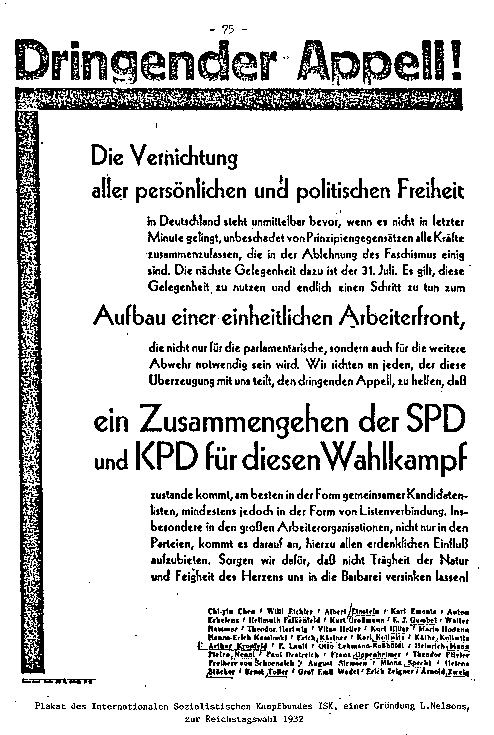
With the growing electoral success of the Nazis at the end of the Weimar Republic, the ISK founded the newspaper, Der Funke to confront the situation. Of particular note was the "Urgent Call for Unity" (Dringender Appell für die Einheit) regarding the July 1932 federal election. It appeared in the newspaper and on placards all over Berlin. Calling for unity and support of the SPD and the KPD in order to thwart further gains by the Nazis, it was signed by 33 leading German intellectuals, including scientists Albert Einstein, Franz Oppenheimer, Emil Gumbel, Arthur Kronfeld, the artist Käthe Kollwitz, writers Kurt Hiller, Erich Kästner, Heinrich Mann, Ernst Toller and Arnold Zweig and many others.[3]

The ISK continued to work in the resistance after the 1933 Nazi ban. The ISK had destroyed all written party records and until 1938, remained undetected, while the larger parties, the KPD and SPD, were being battered by massive arrests. The ISK was therefore able to continue its resistance work, helping political refugees leave the country, conducting sabotage and distributing leaflets. In 1938, however, a wave of arrests hit the ISK.[4] A main focus of the work was the attempt to build a clandestine trade union, the Unabhängige Sozialistische Gewerkschaft ("Independent Socialist Union"), which also supported the Internationale Transport Workers' Federation.[5] The ISK's best known act of resistance was the sabotage of the opening of the Reichsautobahn on May 19, 1935. The night before Hitler's trip to inaugurate the new highway, ISK activists wrote anti-Hitler slogans, such as "Hitler = War" and "Down with Hitler", on all the bridges along the route between Frankfurt am Main and Darmstadt, where he was to travel.[6] The Nazi propaganda film produced of the event had to be edited numerous times.

In exile, the ISK also published the Reinhart Briefe ("Reinhart Letters") and Sozialistische Warte, which were then smuggled into Germany. Because of their factual and unpolemical reporting, these were valued by various members of the German Resistance. The ISK was linked with the Socialist Vanguard Group in England and the Internationale Militante Socialiste in France.

ISK members after 1945

After World War II, the ISK was merged into the SPD on December 10, 1945 after talks between Willi Eichler, chairman of the ISK and Kurt Schumacher, then chairman of the SPD. Most of the former ISK members then joined the SPD.[5]

One prominent member of the ISK, Ludwig Gehm, was later the national vice chairman of the Committee of Formerly Persecuted Social Democrats (Arbeitsgemeinschaft ehemals verfolgter Sozialdemokraten) and a Frankfurt am Main city council member from the SPD. Eichler, who was chairman of the ISK for many years, represented the SPD in the Bundestag from 1949 to 1953 and is considered one of the main authors of the Godesberg Program. Alfred Kubel was a member of the Lower Saxony state government for many years and was Ministerpräsident from 1970 to 1976. Hamburger ISK member Hellmut Kalbitzer was elected to the Bundestag several times, served in the Hamburg Bürgerschaft and from 1958 to 1962, was vice president of the European Parliament. Fritz Eberhard, who was in the ISK until 1939, was a member of the Parlamentarischer Rat ("Parliamentary Council") and was involved in writing the postwar constitution, including the right to conscientious objector status in the new laws of the Federal Republic of Germany.

Eichler also published a monthly magazine from 1946 until his death in 1971, Geist und Tat, which was devoted to "rights, freedom and culture" and he had a publishing house, Europäische Verlagsanstalt until the 1960s.

Structure

The ISK never set out to amass a large membership, but rather to become an active and hard-hitting organization. Membership requirements for prospective candidates included adherence to a certain ethical socialism that were more stringent than for the major parties.

  • Members were to abstain from nicotine, alcohol and meat, were to be absolutely punctual and orderly, and because of the anti-clerical position of the organization, withdrawal from church affiliation was mandatory

  • Participation in a trade union, the ISK and the labor movement was general requirement for members (eliminating passive membership)

  • Instead of a membership fee, there was a "Party tax," which all members with an income over 150 Reichsmarks had to pay

The ISK never had more than 300 members, largely because of the strict requirements for membership. These members were organized into 32 local groups. However, its political work involved sympathizers, between 600 and 1,000 in 1933. A survey in 1929 revealed that 85% of ISK members were under 35 years of age.

Chairmen of the ISK (formerly, the ISYL)

  • 1922–1927, Leonard Nelson and Minna Specht

  • 1927–1945, Willi Eichler and Minna Specht

From 1924 to 1933, the ISK (and its forerunner, the ISYL) maintained its rural school, the Walkemühle in the Adelshausen quarter of Melsungen, Hesse and from 1931 to 1933, its own newspaper, Der Funke, both of which were banned by the Nazis.

Political Ideas

The relationship between the rank and file ISK membership and its founder and chief ideologue Leonard Nelson has been described as a “personal cult”. Nelson rejected the democratic principle, in which the majority decision is to be treated as rational. In its place he used what he called a rational-leader-principle, which has some obvious problematic elements. Nelson promoted the concept of a rational dictatorship, believing that it was possible to ascertain in an objective manner what needed to be done. The ethics of science would become the foundation of a politics of science. Nelson believed that science could show what is just, i.e. in accordance with moral law, so the rational individual who has a keen enough grasp of science will know the moral and intellectually best ways to run society they must be free from limits. An all-powerful state should carry out any and all reforms deemed necessary.

Nelson opposed the Marxist teachings of the historical necessity of capitalism to the development of socialism and communism. Instead he promoted human responsibility and the necessity of a “moral compass”. He based these beliefs in his readings of Immanuel Kant.

Since its creation ISK was strictly anti-nationalist and anti-militarist. During the war Eichler publicly expressed opposition to the dogma of national sovereignty. The ISK also practiced sexual equality amongst its membership by promoting equality of rights for women.

The group promoted a mix of non-authoritarian and authoritarian structures within its orbit. On the one hand its educational service Walkemühle instructed both adults and youths on the importance of critical thinking and some of the latest concepts of the time. While on the other hand ISK described the training of civil servants as an example of authoritarianism.


Poster of the “Internationaler Sozialistischer Kampfbund” (ISK), a foundation of
Leonard Nelsons for the parliament elections in 1932. Signed by Kronfeld, Albert Einstein
and Franz Oppenheimer and well known artists like Kurt Hiller, Erich Kästner, Karl and
Käthe Kollwitz, Heinrich Mann, Ernst Toller and Arnold Zweig.


2. Vegetarianism in the ISK and the anti-Fascist Resistance


As described, a vegetarian way of life was a mandatory membership condition in ISK. Through its publications it propagated vegetarianism in Germany and abroad. It organized group visits in slaughterhouses to convince the workers to renounce their work and the other violent ways humans relate to animals. Willi Eichler ISK co-president since 1927 documents one of these visits in his 1926 essay “Even Vegetarians?” Recently that essay has been circulated again by social democrats acting in the group Sozis für Tiere (Social Democrats for animals). Willi Eichler would join the SPD in the aftermath of the Second World War and moderate his politics. He led the commission that developed the social democratic Program of Godesberg (accepted in 1959), in which the idea of socialism appeared only in a very diluted form, and which many later regarded as a road map for the right-wing in that party. I could not find out if he remained a lifelong vegetarian.

Nelson agreed with Eichler: "A worker who wishes more than a guarantee he will not become a capitalist and for whom the fight against all exploitation is a serious matter, he does not bow before the pressure of public opinion toward the habit of exploiting harmless animals, he does not participate in the daily millionfold murder."

The resistance activity of the ISK against the Nazi rule was effective, if we consider the enormous difficulties and the small membership. Cunning means were applied, and one of them made use of vegetarianism - more on that later.

At the beginning of Nazi rule, the ISK formulated 4 objectives for resistance activity: information, propaganda, anti-Nazi actions, and security for the group. One means was illegal leafleting. The Nazis held elections of worker representatives in companies, admitting only "suitable" candidates. The ISK campaigned for a vote of no confidence against all candidates - until the Nazis gave up on the elections in 1936 due to the lack of popular support for their picked candidates. (Only 50-60% voted for the official list.) Also in 1936, ISK members also collected money in workplaces for the resistance in Spain.


At the inauguration of a highway, it was discovered that the bridges were painted overnight with chemicals that can be seen only when daylight hits them, and the speaker systems had been sabotaged. Two SS members were later executed for insufficient vigilance. Invisible paint, which is visible in daylight, was also used for to daub slogans on the pavement, using suitcases with a special mechanism. A grassy hill next to the Berlin railway was chosen for an action using fertilizer poured from canisters. After a few weeks the hill was marked with the slogan "Nieder mit Hitler" [Death to Hitler].

The ISK also discussed a plan to kill Hitler via a suicide attack, but the plan was opposed by some members and did not go beyond discussions.

The anti-Nazi activity included a set of vegetarian restaurants, which ISK members operated in several cities and used for clandestine purposes. Some had opened before 1933, the remainder opened after the rise to power from the Nazis. Large restaurants were founded in Berlin, Hamburg, Frankfurt am Main and Bochum. According to one report, the Hamburg restaurant prepared 120 lunches a day.

They were often led by women, but both men and women worked in them. The working day was long and the pay low. The restaurants served several purposes: to provide work to the unemployed, to generate a profit that was used for resistance activity, enable contact between resistance agents in a relatively unsuspicious place, serve as bases for production and distribution of illegal printing material etc. However, they also served for promote vegetarianism.

A wave of arrests in 1937 forced many restaurant workers to flee abroad or to live in hiding. Two fugitives founded vegetarian restaurants in Paris and London. The restaurant in Paris became a contact point for exiled Germans and was also a source of funds. The same for the restaurant in London. There they were supported by a group linked to Nelson inside the Labour Party, the Socialist Vanguard Group, the British affiliate to the Militant Socialist International (ISK).

Here is a somewhat extensive quote from a document from the City Archives of Göttingen, which captures the atmosphere of the era and also paints a picture of the spread of vegetarianism in Germany at the time and the political implications of it, e.g. the spread of the legend about Hitler being “Vegetarian”:

Next to the premises of the ISK in the city, the vegetarian restaurant can be seen, operated by the mother of Fritz and Helmut Schmalz on Weenderstraße 71/72. August Schmalz was member in the ISK since 1927; she had already led vegetarian cooking courses in the Walkemühle. Vegetarian restaurants were a financial pillar of the organization, although more profitable and useful for that purpose were the restaurants in the bigger cities like Berlin, Hamburg (Anna Kothe worked there since 1934, who for a long time worked in the headquarters in Göttingen as a housekeeper), Cologne or Frankfurt. Auguste Schmalz's vegetarian luncheonette has been around since at least 1931 and was a regular meeting place. Hannah Vogt recalled: “I remember a place in Weender Straße – which was led by the mother of trade unionist Fritz Schmalz – where everyone had a vegetarian lunch. Many of them regularly met there.” Since spring of 1933 the premises were observed, however the police failed to prove that the guests of the Schmalz lunchroom participated in anti government discussions.
The income opportunities that opened up with such a restaurant also attracted the greedy gaze of the "Volksgenossen" [Nazi term, roughly means People’s comrades, used as a term for correct i.e. Nazi behaviour]. In a letter to the rector of the university at the end of October 1933, someone proposed a remedy against an urgent lack of food for the students. He said that among the 4,000 students there are at least 150 vegetarians, "who now wish to live according to the way of life of our people's chancellor", but can't, because "the only vegetarian lunch place here (...) is run by the ex-communist Schmalz". According to the writer, he even makes an advertisement by posting it on the blackboard of the auditorium, despite the fact that it is possible to prove, "that the students are being influenced by propaganda there, acting at that in a very refined manner”. The author of the letter thought his “most noble task to provide the students of the University of Göttingen with the cheapest high-quality food, in accordance with the new theory of nutrition". Of course he hoped for the support from the rector for his "valuable idea, also represented by Hitler, Rudolf Hess, Göbbels (!) and even many professors in Göttingen". Schmalz's lunchroom survived despite these attacks and denouncements at least until the beginning of the war.


3. ISK, Esperanto and SAT

The ISK attempted to spread beyond the borders of Germany in their early days and adopted Esperanto as one of the means to achieve this.

Registered in bibliographies is the edition of the quarterly Esperanto-language Organo de Internacio de Socialista Kunbatalo since 1929 (before the appearance of a similar publication in English). After the Autumn of 1933 it appeared in Paris under the name The Critical Observer: magazine of politics and culture. It continued to be published until the end of 1939 if not longer. Hermann Platiel was credited as its editor after the move to Paris, but its possible that he occupied that position earlier.

The ISK published a daily newspaper Der Funke [The Spark] for 14 months, between 1932-01-01 and 1933-02-17. Then it was banned. The release necessitated great sacrifices, inevitable for such a small organization. Notable in it is the striving for a working class united front against the looming fascism and the very critical reporting on nationalism in general. The complete journal collection is now archived online. There you can find three kindly written articles about SAT and its congress from 1932 in Stuttgart. Although one would expect that their author would be Hermann Platiel, the authors used initials ("M. H.", "Rpt.", "O. W.") do not match that assumption.

Some excerpts from the articles:


Party political neutrality among the Worker Esperantists (from Der Funke 1932-06-05) In the Esperanto Labour movement, whose most important, global organization is SAT (World Anti-national Association), the party political disputes, especially between the CP and the SP, was not missing. In Germany there are already in many cities separate communist and social democratic Esperanto groups. All the more gratifying that the president of SAT, Lanti, who also publishes the Esperanto newspaper Sennaciulo, stands entirely on the ground of the party political neutrality of SAT. In an open letter to many SAT members he assumes a position against the communist attempts to link SAT to a definite political program, by which the CP wants to secure for itself a better foundation for its domination. The CP wants first, that SAT compels all members to recognize Marxism as “the correct basis on which the firm unity of the proletarian Esperantists can be founded".
[…]
In addition, Lanti quite rightly throws back the opinion that non-Marxist viewpoints such as those of Nelson, Kropotkin or Gesell should remain undiscussed in the newspaper, because "the vast majority of organized workers recognize Marxism as the theoretical basis for their class struggle”. That is totally incorrect - let's think about England, Spain or India!
[…]
It is desirable that Lanti's positions continue to be guiding SAT and its newspaper, so that the very desirable propaganda for Esperanto as an international means of understanding, especially as a tool for a fighting working class should not be hindered by a dogmatic and party-politically narrow framework.
We greet the Esperantists in Stuttgart [title originally in Esperanto] (from Der Funke 1932-08-06) In the second week of August, the 12th congress of ... SAT meets in Stuttgart. […]
SAT for two reasons is particularly called to work on the creation of the socialist united front: Its members are linked by the bond of a common language. […] SAT also fulfills an important prerequisite for the collaboration in the creation of united front of the various workers parties. The management of SAT has been resisting firmly and successfully for years against the disrespect of party political neutrality within the Association. [...]
The working Esperantists in Stuttgart (from Der Funke 1932-09-01) The 12th congress of the world association of working Esperantists (SAT) 250 comrades from 12 countries participated despite the bad economic situation.
[…]
The most important result of the congress was the re-securing of the party political neutrality of SAT.
[…]
Also the efforts to change the current structure of SAT – a union of all the proletarian Esperantists without regard to their nationality or race - by associating national associations, were unanimously rejected.
With the exception of the proposers, all the comrades emphasized the necessity right now, of a front between the workers and the growing wave of nationalism, not only emphasizing the international connectedness of the proletariat, but also to practically realize it, for which purpose the present stateless organizational form offers the best basis.
[...]

Its known that Hermann Platiel was both an ISK and SAT member. Born in 1896 (or possibly 1886) and died in 1980, Platiel was hired as an administrator for the SAT office in Leipzig from the 8th of May 1929 until 1932. In Leipzig he also led the local ISK branch. After Lanti stood down from the post it was Platiel who became the President and Director of SAT from 1933-35. SAT published his text History of the schism in the Workers Esperanto-Movement: Documentation which shows the causes and responsibilities and prepares the foundation for united action. He then became the secretary of the French Esperanto section of ISK 1938-39. I do not know if he has been active in SAT since the 40s or maintained any relationship with Esperanto at all. Petro Levi who joined SAT shortly after the war does not remember seeing him when I asked, and I was not able to find anything online, though of course there are still other sources to check,

In 1943 he illegally fled to Switzerland, and worked for the "Schweizer Hilfswerk" (Swiss Relief Fund) and wrote reports for the London foreign leadership of ISK. Before the escape to Switzerland he was located in the southern French city of Montauban, to which he fled from the internment camp in Gurs. There he married with well-known ISK member Nora Platiel (née Block). In 1949 they settled in the German city of Kassel, where Nora began a career as a court jurist and then a representative of the Hesse parliament (for the SPD). Hermann worked as a director of a theatre in Kassel, according to reports with great commitment.

This summary of facts about ISK's relations with Esperanto and especially with SAT is very incomplete. Further research would be worthwhile. Research in the archive of SAT in Paris should provide insights about that, also about Hermann Platiel personally, and would answer the question whether he and possibly others ISK members played a role in the then Vegetarian Section of SAT, which we can guess, but do not know now.


4. Sources

• Das Schlachten beenden!, Verlag Graswurzelrevolution, Nettersheim 2010 [GWR estas

monata ĵurnalo kaj eldonejo dediĉitaj al senperforta anarkiismo, kun ekologia emfazo kaj

simpatianta kun veganismo; pli ĉe www.graswurzel.net]

• Heiner Lindner: Um etwas zu erreichen, muss man sich etwas vornehmen, von dem man

glaubt, dass es unmöglich sei – Der Internationale Sozialistische Kampf-Bund (ISK) und

seine Publikationen, Friedrich-Ebert-Stiftung 2006, http://library.fes.de/pdf-

files/historiker/03535.pdf

• Vikipedio germanlingva: ISK, Nora Platiel kaj esperantlingva pri Hermann Platiel

• urba arkivejo de Göttingen: http://www.stadtarchiv.goettingen.de/widerstand/texte/isk-

goettingen_1933-1935.html

Gary Mickle

Translated into English by Reddebrek

Popular Posts