La Centra Oficejo de EANA konstante ricevas leterojn de Hungaraj samideanoj, kiuj travivinte revolucion troviĝas nun en mizera stato, kaj petas nin pri helpo. En Budapest fondiĝis eĉ speciala “Esperanta Help- Komitato”, kies tasko estas organizi kaj juste distribui la helpon de eksterlando. Oni sendis al ni liston de samideanoj, kiuj bezonas kaj meritas helpon, kaj petis nin alvoki Usonajn samideanojn helpi al la suferantaj gesamideanoj en Hungarujo.
Ni scias, ke inter ni ne estas multaj kiuj estas en stato sendi grand- ajn kaj multekostajn pakajojn, sed ni ankaŭ forte kredas, ke troviĝos multaj, kiuj sendos malgrandajn "am-pakajetojn” por esprimi sian sim- pation kaj solidarecon kun suferantaj samcelanoj. La malgrandaj pakajetoj (Small Packet) povas esti ĝis 2 funtoj pezaj kaj poŝtafranko estas nur ĉirkaŭ 30c. Detalan informon pri ’Small Packet” ĉiu povas ricevi Ĉe sia poŝtoficejo. Se iu volos sendi pakaĵeton al Hungarujo, bonvolu skribi al ni pri adresoj.
Ankaŭ la Centra Oficejo akceptas mondonacojn por tiu celo. El malgrandaj sumetoj, kiujn oni sendos al ni, kolektiĝos eble sufiĉa sumo, por ke ni povu sendi al suferantoj medikamentojn aŭ aliajn urĝajn ajojn. Ni petas niajn samideanojn, helpu malavare al Hungaraj Esperantistoj, sendante la pakajojn rekte al adresoj, kiujn ni disponigos al vi, aŭ per sendo de monkontribuajoj por tiu celo al adreso de EANA.
La Angla Traduko
The Central office of the Esperanto Association of North America (EANA) constantly receives letters from Hungarian Esperantists, who having lived through the revolution*now find themselves in a miserable state, and request our help. There has been established a special "Esperanto Help Committee" in Budapest, whose task is to organise and justly distribute the aid from foreigners. We have been sent a list of Esperantists who require and deserve help, and have asked us to call on American Esperantists to help suffering Esperantists in Hungary.
We know that between us there are not many who are capable of sending large and expensive packages, but we also strongly believe that we will find many who will send small "care packages" to express their sympathy and solidarity with suffering fellow travellers. These small parcels can be up to 2 pounds in weight and postage is only around 30 cents. Detailed information about small packages can be received at your post office. If someone wants to send a small parcel to Hungary, please write to our address.
Also the Central Office accepts money donations for this cause. Even small sums, which you send us will be collected into a larger sum to send medicine or other urgent materials to the suffering. We call on our supporters to give generously to Hungarian Esperantists, send parcels directly to the addresses which we will disclose to you, or send money contribution for this goal to the address of the EANA.
*Hungarian revolution and Soviet military invasion in 1956.
I have just come out of Budapest, where for six days I have watched
Hungary’s new-born freedom tragically destroyed by Soviet troops.
....
Vast areas of the city – the working-class areas above all – are
virtually in ruins. For four days and nights Budapest was under
continuous bombardment. I saw a once lovely city battered, bludgeoned,
smashed and bled into submission. To an one who loves equally the
Socialist Soviet Union and the Hungarian people it was heart-breaking.
Peter Fryer Hungarian Tragedy
There's quite a surprising disconnect between online socialists and offline socialists, I'm sure I'm not the only one to notice that people advocating for certain politics behave completely differently on the web than those advocates on the streets, and sometimes different websites will have their own subcultures despite on the surface being identical.
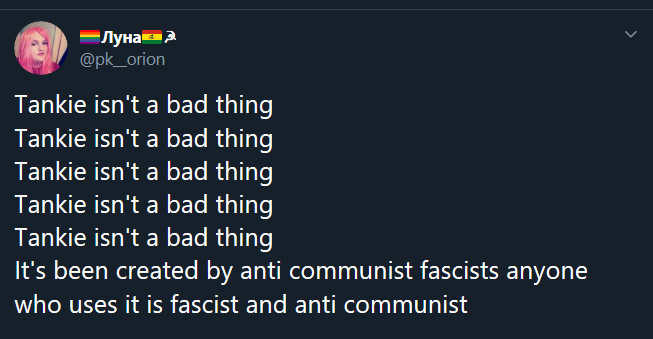
For me one of the most jarring has been social media Marxist-Leninists and their allergic reaction to the term Tankie. That doesn't correlate at all with my experiences with the UK Stalinist remnant.
What's even more annoying is the bizarre allegation many cyberstalinists make that the term is some kind of slur of fascist propaganda. The term of course unusually for slang has a pretty well documented history, and that history is tied up with that of the Communist Party of Great Britain (CPGB).
The term was coined shortly after the bloody events of Hungary 1956 when the Soviet army entered the country and began violently crushing any traces of dissent, and in the process destroyed a working class revolution built around workers councils and the dismantling of the repressive state functions.
The invasion received the full and enthusiastic support of all Moscow aligned Communist parties in the west including the CPGB, however cheerleading a brutal invasion in the heart of Europe and the culling of many former comrades from the Hungarian party was too much to stomach for many members.
So many members tore up their cards and left, its here that the term Tankie made its appearance. We don't know who came up with it first, but given its slang nature was probably coined by an ex or reluctantly remaining member. But what's strange about this term is that it very, very quickly was adopted as a sort of point of pride.
One of the earliest appearances of the word in print is from journalist Peter Patterson recalling A 1956 interview he had with Trade Union leader Reg Birch shortly after he joined the CPGB's Executive Committee.
When I asked him how he could possibly have sided with the 'tankies',
so called because of the use of Russian tanks to quell the revolt, he
said 'they wanted a trade unionist who could stomach Hungary, and I
fitted the bill'."
From Peter Paterson How Much More of This, Old Boy-- ?: Scenes from a Reporter's Life
This is an important dialogue, here we have the term linked to the events of Hungary and Reg instead of disputing that or being insulted confirms that connection and that it applies to him and the other leaders of the party.
Reg Birch would eventually leave the CPGB n the 60s to found the Communist Party of Britain Marxist-Leninist CPB-ML which moved to supporting Mao until the late 70s when the party sided with Enver Hoxha in his break with the People's Republic. I'd barely encountered a handful of references to the CPB-ML over the years and they were all in the past tense, so I assumed they had folded at some point, but they're still around and so far have been part of a small coalition of parties pushing for "Lexit".
Anyway, after this the term was used by critics of the party and its politics as a term of abuse, but within the party it found traction as insult and badge of pride. As the CPGB continued it started to fracture with multiple factions and competing tendencies, the two main tendencies broadly speaking were the Eurocommunists and the hardliners, but that's simplifying a lot, both positions in the 70s and 80s would splinter and there were factions and members who didn't really fit into either.
For example the group around the news sheet The Leninist, would go on to be influenced by Trotskyism as well as others, and the group Straight Left was often described as a hardliner or tankie faction by other members but its ideas revolved around working more closely with and using the Labour party.
Essentially its a big mess, who is a hardliner or a soft moderate depends on which former members accounts you read and who they apply it to. Honestly I think at this point in time the term Tankie started to lose much of its original meaning within the CPGB despite its increase in popularity.
Eventually the splintering would eat the party up and when the Soviet Union collapsed the hardliners were adrift and the old CPGB dissolved in 1991 with its members diffusing to at least a dozen other parties.
Over the years at union marches, demonstrations and conferences I've encountered over a dozen old ex CPGBers most of whom were either in the Communist Party of Britain or the Labour Party, but some had attached themselves to pressure groups instead like the campaign for Clause Four or peace groups.
Interestingly they all described themselves nostalgically as old Tankies, I don't think I've ever met a member of the Eurocommunists which is a bit strange. I remember one fellow selling Morning Stars at a stall who told me about how he and his branch used to have secret meetings with Left wing Labour members like Harriet Harman about how to topple the British state.
So this is why I find it so jarring to see so many North American supposed inheritors of the legacy of the old CPGB react this way.
I especially find it very odd, because most of the people complaining about the term are open and even proud of their belief that the events of Hungary and other similar examples of the "workers state" clubbing dissident workers is not only necessary but perfectly compatible with workers liberation.
Hell, many of these people are openly contemptuous of anyone who disagrees with the proletarian party's right to break up strikes and detain thousands.
To be blunt I think calling the older members of Britain's Communist party soup Tankies is a bit insulting since most of them seem to have mellowed out since 1991. I have a hard time thinking the old man in a beret and apron covered in decades old badges would be okay with military police with red stars on their helmets cracking heads on picket lines outside the People's Ironworks No.7.
But the twitter user with a dozen flags in their bio who has just written a thread on how the camps in Xinjiang are great and the dissident Chinese communists are CIA plants etc? Yeah I can absolutely see them happy about that. Many of the online Marxist-Leninists and Maoists seem to have built their identity and political outlook entirely around justifying the repression of regimes who use the right phrases.
Indeed over the past two years I've seen talk of Hungary go from sheepish silence to increased combativeness about how the Hungarians were fascists and deserved to be defeated all along. So if they're okay with Hungary why so hostile to a slang term that accurately describes their own views?
Program Moderator:
Next to the fallout from the division of Europe which followed the Second World
War. As Winston Churchill put it in a speech from 1946, `an Iron Curtain
descended across the continent, from Stettin in the Baltic, to Trieste in the
Adriatic`. The consequence was that those on the west of that Iron Curtain
after 1949 were generally under implied American protection as part of NATO, but
those on the east came under the strict influence of Moscow, and not always
willingly. For example 60 years ago, students and workers took to the streets
of Budapest to protest at Soviet rule in Hungary. The demonstrations turned
violent and for awhile the Revolutionaries were in control.
In 2010 Ed Butler spoke to one of the rebels Peter Pallai,
who was a first year student at university when he joined in the street
protests in Budapest in October 1956.
Peter Pallai:
All we wanted was that we should have a more humane treatment, we should have a
more liveable society, that socialism should actually live up to its name. So
we were going to march and a lot of people spontaneously started joining from
the sidewalks, people looked out of office windows, some of them hung out
Hungarian flags. And workers started pouring into the centre and joining us. So
what started out with a few hundred students soon turned into a fantastic mass
demonstration.
It’s very hard to estimate how many people poured out onto
the streets, probably half a million.
[Applause]
People started shouting various slogans, and one that sticks
in my mind which the first time it sounded a bit risky but we all took it up,
it went, probably the best English translation that `soldiers of all lands go
back to your homelands.` And as the evening wore out somebody started shouting
Russkies go home, Russians go home. And I had absolutely no premonition of the
fighting to come.
[Music]
At that moment, a couple of people came on motorcycles in a
terribly agitated manner. They were shouting, screaming that the Security
police is shooting at unarmed people at the radio station. And we ran into the
street were the radio building was, and we actually came under fire, and it was
a terrible shock. Next to me a fourteen year old girl was just cut down by
bullets, and I was very lucky not to be shot. I saw absolutely no weapons on
our side from anyone. Suddenly people had the idea that there was a large
barracks building on that same boulevard. To go there and get the army people
to give their weapons.
The crowd broke down the door and as the doors broke down we
saw a line of soldiers with bayonets fixed and a Lieutenant in command. And the
Lieutenant started shouting at us that he would order the soldiers to fire if
we proceed any further. Even if we wanted to back down we couldn’t because of
the pressure of the people behind us. We started shouting at the soldiers that
`you’re not going to shoot your own kind are you?` and the soldiers didn’t,
they just pushed this officer aside and we suddenly streamed into this
building. So we were given ammunition and armed with rifles and ammunition, at
the radio building the battle was fantastic. But by that time our side was
armed it had turned out that workers came from another suburb, from an
industrial suburb and they broke into factories were not just ammunition but
weapons were made and they armed the rebels and they were armed themselves, and
they were storming the radio.
[Gunfire]
Ed Butler:
After just five days of popular revolt the Soviet troops stationed in the
capital pulled out. A reformist Communist Imre Nagy was installed as the
country’s new President, pledging the end to Moscow’s control. For a few days
it seemed as though the revolution had won, and for Peter Pallai a dream had
been realised.
Peter Pallai:
I mean we went from a demonstration where no one thought that it would be any
fighting, then it turned into a terrible struggle which ended or seemed to have
ended with a miracle. And we thought that finally this little country which was
squeezed between Germany and Russia and the Turks and all the great powers,
finally finally we can determine our own fate.
Ed Butler:
What happened then?
Peter Pallai:
On the 3rd of November, which was a Saturday, we heard news that a
Hungarian delegation made up of party people, all parties and of Hungarian
rebel forces went to talk to the Russians, how they shall be withdrawing, and
how the Hungarian rebel forces will not fire on Russian troops. And I remember
that very relieved I went home to sleep, to my parents.
I took my weapons with me and next morning I woke up and
heard gunfire, and we switched on the radio and we heard the Premier Imre Nagy
saying that the Soviet troops had attacked unexpectedly and he was asking for
help from the West.
[Extract from Imre Nagy’s radio speech]
This is the Hungarian Prime Minister Imre Nagy speaking. At
dawn Soviet troops attacked our country, in order to overthrow the legitimate
Hungarian Democratic government.
[Explosions]
Ed Butler:
On the streets of Budapest civilian fighters armed with nothing more than
rifles tried to stand up to the might of the Soviet tanks and artillery, it was
an uneven contest, and Hungary’s cries for help became increasingly desperate.
[Hungarian radio broadcast in English]
This is Hungary calling, this is Hungary calling, the last
remaining station, we are requesting you to send us immediate aid in the form
of parachute troops over the trans-Danubian provinces. For the sake of God and
Freedom help Hungary.
Peter Pallai:
They had overwhelming strength, I did realise that it is all lost and I didn’t
want to go back to fighting because I knew that it would be just senseless to
lay down my life. It was terrible, we couldn’t quite believe that the world would
just sit back and do nothing about this.
Ed Butler:
So what happened to you, once the Soviets regained control of the city?
Peter Pallai:
Well, my friends and myself, we were manufacturing various leaflets which we
stuck up on various parts of the town. And when I was walking home my dad was
waiting for me on the corner, and dad said to me, don’t come home because
they’ve been looking for you. Dad handed me a briefcase, in that briefcase was
a bottle of plum brandy, my pyjamas a toothbrush, five thousand forints. And he
said mother sends her love, go, don’t come back.
He said that we go Northwest, and there’s a huge barracks
building, used to be manned by the Hungarian border guard, now filled by
Russians which is practically straddling the border. He said there’s a regular
search light going round, its predictable how its circling, and we should try
to go as near as we dare to the Russian sentry, because there’s a North wind
that evening and if we approach them from the South their voices will be carried
to us, but we have to crawl.
I don’t know how long it took, I was scared out of my wits,
there were three of us and we crawled for god knows how long. And when we left
the Russian voices behind we stood up and started walking, and I did something
very melodramatic, something which I must have read in books but it came to
from the heart. On the last piece of Hungarian ground, I just kneeled down and
kissed the land, kissed the ground because I thought that I’ll never see my
parents again, I’ll never see my friends again, I never see my country
again.
And that was to be the fact for 28 years actually. It was a
feeling of broken hopes, it was a feeling of betrayal, it was a feeling of
there’s no justice in the world, the pointlessness of politics, the pointlessness
of doing anything. And the Russians can do anything they want to us.
Ed Butler:
Peter Pallai was among some 200,000 Hungarians who fled the country, he moved
to London becoming a journalist and worked at the BBC World Service. Thousands
of others died in the fighting or they were executed in the crackdown that
followed, among them Imre Nagy the President. It was to be another 33 years
before Soviet backed Communist rule was finally ended in Hungary.
Gay rights and Queer issues have become something of a point scoring trick in political forums today. Depending on the region or website "Leftists" either smugly tut tut at backward Conservative types with their family values crusades or fume that the workers movement has been high jacked by a rainbow coalition of western puppets/bourgeois decadence.
The treatment of homosexuals in "Socialist states" is rather poor, the regimes substituted religious dogmatism for a more "rational" dogmatism about bourgeois relationships and proletarian relationships. A number of states like the Soviet Union and Romania where incredibly harsh in punishing those who didn't fit their very narrowly definition of behaviour. Others like East Germany, Czechoslovakia and Hungary had abolished their legal objections to same sex relationships in the 60's. Famously the DDR beat West Germany to it by a year (1968 in the East, 1969 in the West). And curiously Yugoslavia in the 70's had some of its states repeal their laws on homosexuality while others kept them on the books until after Yugoslavia collapsed.
An important thing to keep in mind is that legal tolerance doesn't automatically mean acceptance or even social tolerance.
To date their have been some official state sanctioned works about being Gay under "actually existing socialism" a total of two as far as I can tell. One comes from East Germany (Coming Out)and premièred the day the Berlin Wall fell, and one from 1982 in Hungary (Another Way). Both have been commercially released but information about them both is hard to come by. Fortunately youtube user Infamous Sphere has uploaded detailed reviews of both so we can see some of them.
Interesting to note that the DDR also follows the tradition of making Queer films look
An additional note, most if not all of the cast of Another Way where played by Polish Actors and then dubbed into Hungarian. The reason for this is that no Hungarian actor would work on the project, whether because of the fear of being associated with homosexuality or because the film was very critical of the regime in the 50's or both is debatable. But fortunately for the film a crackdown on civil liberties (such as they were) in the People's Republic of Poland (The country had been under martial law since 1981) lead to a massive protest and boycott by the Polish entertainment industry. Meaning that there were many out of work actors in Poland willing to take a chance on any project that would hire them, this is what Polish Wikipedia has to say on the subject, (Translated by user Madaffi)
No Hungarian actress dared to play in this film. At the time (1982),
Poland was under martial law (since December 13, 1981) and Polish actors
and actresses were boycotting state television (and there was no
non-state television so they played in foreign films). Jadwiga
Jankowska-Cieślak, who played Eva, was a part of a theatre group that
was dissolved because her international success which came from this
film didn't sit well with Communists that ruled Poland at the time.
Furthermore, after she got a Palme d'Or at the Cannes Film Festival, the
only polish state run film production organisation that was allowed to
deliver messages between foreign and domestic producers was flooded with
calls and letters, but they were ordered by Communist Party of Poland
to not pass it along to the actress - she received none and thought
no-one was interested in hiring her for roles.

 Posts
Posts