Search This Blog

Showing posts with label DVD. Show all posts

Tuesday, 30 December 2025

So they're threatening us with an new Animal Farm movie


I was innocently scrolling through social media when a trailer for an CG film starring animals started playing. My settings mute automatically so I just saw a few seconds of CG pigs smiling. Those pigs look creepy when they smile was my reaction, and then I moved on with my life.

A few days later I saw those creepy porcine smiles again, this time as part of a thread of comments denouncing the film, which is how I learnt that it was an Animal Farm movie, and that Seth Rogan voices the Napoleon character. Oh, joy.

Look, the film has not been released, it's scheduled for release on the 1st of May 2026, that's International Worker's Day, and from the bits shown in the trailer it looks to be a modern retelling of the dangers of capitalism. I don't particularly wish to watch it and I have no expectations for it, but I won't write it off before it comes out. Though I do have things to say about an Animal Farm but capitalist reading, which I will come back to later on.

 Before we move on, I have a question for you. Have you read Animal Farm? I'm not being cute, I think it's one of those things where the discourse/gossip that surrounds it is more well known and more famous than the story itself. And I think that's partly to blame for the majority of the confusion and abuse of that name. So, if you haven't read it, I would recommend you do so. It's quite a short read it's a novella and most versions don't include Orwell's preface making it even shorter. It's public domain in the UK and can be found online fairly easily, here's the first version I read many years ago

 No question, now, what had happened to the faces of the pigs. The creatures outside looked from pig to man, and from man to pig, and from pig to man again; but already it was impossible to say which was which.

A brief summary,

 Our story is set on Manor Farm, a typical farm in the 1930s England, the Farmer Jones is lazy and drunk. The Animals are growing dissatisfied with his stewardship of the farm, eventually tensions explode and a revolt led by the pigs succeeds in overthrowing the hated Jones and the animal's find themselves in charge of the farm. Not knowing what to do now, the animals consent to letting the pigs take the vanguard position, and they administer the farm. The pigs promise equality and a new life free of exploitation, but work needs doing, so the other animals provide the muscle and work to the pigs plans. Overtime, the pigs gain and enjoy more privileges and their rule becomes far less popular, by manipulating language, fears and the use of force the pigs under their leader Napoleon from a dictatorship and in the end they use the wealth of the farm to parley a seat at the table with the human farmers. The quotation above comes from the final scene, where the pigs entertain a group of human farmers. It's not as iconic as "All animals are equal, but some are more equal than others" but it represents the same message and is key to the author's intent with the story. 

You may have been aware that Animal Farm is an allegory for the Russian Revolution, and it is, although just knowing that fact without familiarity with the work will obscure the main point of the story.  Many readings of the book and its other film adaptations will focus on Napoleon being like Stalin and other events that have parallels with early soviet history and then deduce something along the lines of "Animal farm is an allegory about the dangers of revolution and how they eat their own" this might be what they got from it, but I don't see that in the story and from what I know of George Orwell. For starters, Jones is seen as a tyrant who needed to be overthrown, the problem is in the aftermath and how the pigs behave.

The other animals don't act like the pigs, many are shown to be devoted to the cause they work and often die for. Their problem is that they allowed the pigs to occupy positions of power over them and the pigs grew accustomed to the trappings of power and their own self-importance and corrupted themselves and their revolution. The pigs are the Bolsheviks here, you see. 

There is a sort of restoration theme in Animal Farm, but the return of the status quo is the crux of the depressing ending. You're not supposed to think it's good that the pigs act so much like their former masters that the animals can't distinguish between them any more.  


The pointlessness of an anti-capitalist animal farm

From the trailer the 2025 Animal Farm film casts its Napoleon as a tech bro capitalist, it's not the first time someone came along and wrote an anti-capitalist version of Animal Farm, there was an unofficial sequel where Snowball (a pig heavily coded as Leon Trotsky) returns from exile to the farm and leads it in a new business friendly way. Neither of these re-imaginings can escape a core problem, and that is that we already have a definitive attack on capitalism to George Orwell's Animal Farm. It's called Animal Farm, it was published in 1945 and was written by George Orwell.      

Going back to the quote, the reason that the animals can no longer distinguish between the human's and pigs is so damning of an ending is what both represent. The pigs represent the communist party, I don't know anyone who would dispute that, but what many seem to miss is that the humans in the story are the capitalists. They're allegories for the capitalists who rule the world, they take the eggs, and milk and meat etc. from the animals and sell them for a profit. That's an allegory for the capitalist system, the produce is the commodities produced by workers labour time and power. 

So, when the animals can't tell the difference between the two, Orwell is accusing Stalin and his party cronies of using the language and symbols of socialism to trick the population while he builds a capitalist economy. This is not a surprise, throughout the story the pigs use and exploit the other animals to make a profit, and it's their ability to control a restive farm and conduct good business that turns the humans who initially rejected the pigs as usurpers other to letting them take part in the wider community. 

That is a very simplified criticism of the Soviet Union, but one that is based on a wider criticism of capitalism. It's good that Jones is gone, and it's a tragedy that the new rulers continue to behave like him and represent the same cruel dynamic. The pigs are usurpers, but not because they dared to take Jones's rightful property, they usurped a genuine movement to end tyranny and exploitation. 

This gets overlooked all the time by liberal critics and deliberately ignored by the "communists" who comment on the work. I can understand the former, the phrase missing the forest for the trees springs to mind. The clear parallels to Stalin and the Soviet Union are so obvious that its wider message gets lost. It doesn't help that much of the intended audience has its own blinkers on, since Animal Farm is obviously the Soviet Union* which was different from the USA which we all know is capitalist, so the capitalist dimension is overshadowed. I think this is the result of buying into capitalist propaganda, the idea that capitalist economy is built on an abstract freedom and not the material class relationships of boss and workers. Workers in both the USA and USSR were alienated and controlled, they're worked on what those above them chose for them and in the manner decided for them, and the results of their work, the products and materials were sold off, and the profits went to the powerful. There are differences between a board of directors and a state planning agency, sure, but the foundations of the economy are the same. 

A film where Napoleon parties and drives a Tesla might be entertaining, I doubt it, but it is possible. However, it will always be redundant. We already had that story in 1945.


Appendix One: The 1954 film, aka the CIA movie

"You'll laugh and cry a little!" good to see lying has been a cornerstone of marketing for so long.


 Thought it's best to deal with this one while we're here. In 1954, just four years after the death of George Orwell, the British studio Halas and Bachelor released a full length animated adaption. The animation is excellent for 1954 and is arguably the first feature length animated film released in the United Kingdom. And aside from a few changes (we're getting to), is a faithful adaption of the story. But that's not why anyone talks about this film.

No, all that anyone talks about when the film comes up is the presence of the CIA. It's true, two executives who worked for the CIA bought the rights to the film from Orwell's widow then used Rochemont as a front who selected Halas and Bachelor to produce the film. This was unknown to everyone until historian Tony Shaw uncovered the financial connections. So, I think we have an excellent example of the damage propaganda can have on art. Even when it produces a technically impressive and moving work, the real purpose of it hangs over it.

Regarding those changes, the film's wiki entry helpfully lists them and some potential changes that were not made. A few that stand out, adding scenes where some animals who are content have no interest when learning of the revolution in Animal Farm, I get their intent, but the result is a short and succinct demonstration of what marxists call false consciousness. There were also animals in the novella who didn't see why they needed to fight Jones either, 

 Some of the animals talked of the duty of loyalty to Mr. Jones, whom they referred to as "Master," or made elementary remarks such as "Mr. Jones feeds us. If he were gone, we should starve to death." Others asked such questions as "Why should we care what happens after we are dead?" or "If this Rebellion is to happen anyway, what difference does it make whether we work for it or not?", and the pigs had great difficulty in making them see that this was contrary to the spirit of Animalism. The stupidest questions of all were asked by Mollie, the white mare. The very first question she asked Snowball was: "Will there still be sugar after the Rebellion?"

Another concerns Snowball being too good and the need to make him just as bad as Napoleon. Well, that mission failed Snowball is still seen as the good of the two pigs and his murder by the dogs reads as tragic. Another change due to pressure was the reduction of humans and the focusing on Jones as the evil one. 

But the big change concerns the ending. Orwell's novella ends with the animals broken, the film ends with the pigs being overthrown. I personally don't see an issue with the bad guys being overthrown, it's a change, but the novella's ending was the way it was because it was released in 1945 when Stalin stood triumphant. In 1954 there had been revolts, including East Germany the year before. To me the bit of the changed ending that is a problem is the replacement of the human visitors with other pigs. These pigs are clearly stand ins for the soviet sattelite states of East Germany, Bulgaria etc. This means that Napoleon hasn't been accepted by the wider capitalist world. But, to my great surprise the ending keeps the trigger point. It still keeps this bit.

 No question, now, what had happened to the faces of the pigs. The creatures outside looked from pig to man, and from man to pig, and from pig to man again; but already it was impossible to say which was which.

They see the pigs acting like Jones the human and its that which drives them into a frenzy to overthrow their masters. So, the CIA funded a film based on a work where the villains are evil for adopting capitalist methods and despite wielding great influence kept that criticism in the film. Its not just in the ending either, throughout the film the pigs constantly trick, pressure and cajole the other animals into working so they can profit from their labours. Animal Farm is ruled by a brutal clique who spend other people's money on booze, clothes and automobiles, and this is somehow different to the USA how?

Again, I really think you should read the novella, the criticisms of capitalism are entwined within the crticism of Stalin.  

Oh and one final note on the changes, while reading the book Orwell Subverted:The CIA and the filming of Animal Farm, I came across the CIA's negative reactions to the first proposed uprising ending where the human guests are preserved.

 This dramatic reversal of the book’s downbeat conclusion notwith-
standing, the memo argued that, as scripted, the final sequence, which
included men and pigs, was ‘‘ambiguous at best’’ and ‘‘at worst’’ was an
‘‘endorsement of . . . anarchism
.’’

So, there you have it, keeping the anti pig and human theming of the Novella is an endorsement of Anarchism.  

 Appendix Two: The other Animal Farm movie


Somehow this poster even more misleading than the 54 version

Did you know that there was another Animal Farm film? It released in 1999, and it uses the voices of Patrick Stewart for Napoleon and Kelsey Grammar for Snowball. It also uses some CG animation but mostly relies on animatronics, puppets and real animal stuntwork. It was also faithful to the Novella and as far as I can tell was not funded by any intelligence services. Oh and the pigs don't look creepy when they smile.

 It doesn't get brought up ever when Animal Farm is being discussed. I guess its marketing failed, its trailer and posters make it look like a Babe Big in the City knockoff. Its a shame really, its a strong adaption. Again the biggest change is the ending, some animal's after seeing the pigs and humans pal around to the point it is impossible to say which is which they run off and escape. Then years later the regime has crumbled and collapsed. I suspect that change was due to the film releasing in 1999 years after the soviet union crumbled in on itself and collapsed.

If you want a faithful adaption of Animal Farm this will probably remain the best version available.  

Taken together the Novella and the two films represent an interesting timeline, we have Stalinism triumphant (1945), in trouble (1954) and death through decay (1999).  


  *Which makes me wonder how younger readers react to it since they have no memory of the Soviet Union to base their thoughts on.

Tuesday, 23 April 2024

Bartleby; a Tale of Work, a Tale of Life and Individuality


Humour is subjective, but not sure, I'd get along with anyone who found Bartleby hilarious
 

"I would prefer not to"

I finally managed to catch my White Whale. Bartleby, the 2001 film adaptation of Herman Melville's short story about a Wall Street clerk, has been on my watchlist for some time. Bartleby belongs to that category of film that seems like it'd be pretty interesting but never appears on anything, so better hope the bare-bones DVD is still in print. I've been interested in Bartleby ever since I mistook it for a Cohen brothers film, looks like me and Bill Murray have something in common after all.  But unlike Bill I'm glad I was mistaken, Bartleby which was directed and written by Jonathan Parker, and it is a strange miserable vaguely hostile movie about the crushing of the individual by corporate productivity.

I know that doesn't sound like a good time, but the odd thing about Bartleby is that it gets its hooks into you. There were times when I found myself mirroring the confused musings of David Paymer's The Boss, and wanting to figure out this puzzle. I had not read Melville's short story before watching the movie, the reason for that is that I attempted to read Moby Dick and according to my bookmark I have been stuck two hundred or so pages into it for three years now, which dulled my enthusiasm for checking out the rest of his work for a time. I suppose I should finish it, but if you'll forgive the joke, "I would prefer not to".

 So I went in largely blind, the film opens with a brief biography of Herman Melville, it sets the tone for the rest of the film, Herman Melville's more psychological works found few readers, and he was forced to get a job as a scrivener in a customs house, as hard as it is to believe today, he died at the age of 72 in obscurity. Hilarious right? Sorry, I understand from experience that marketing unorthodox products is an impossible task. Just like with Slasher, I understand why movies like this would be stuck in the comedy box. Grumbling about the quote aside, that poster is a good representation of the confusion and isolation at the heart of Bartleby. 

Bartleby is one of those odd ducks that doesn't fit in. I think it's very good with a lot to offer an audience, but I do understand why it failed to leave a massive impression. As a product, it is as awkward and difficult to work with as Bartleby the character. Every part of this movie is dedicated to showing normal life and normal work as slightly hostile but largely indifferent to human beings as human beings and not economic functionaries. The camera angles and lighting make office spaces look sinister, the exterior of the office building is a model of a concrete lump on top of a rock that overshadows the urban sprawl and is so isolated you can't get to it without driving a car, character interactions are defined by friction and cross purposes, it's rare that two characters have a conversation where both participants are on the same page, even something as simple as "how's your day going?" causes tension. Crispin Glover's Bartleby is weird and awkward, but his differences are by degree and not kind. Everyone in this film is odd, it's just that Bartleby is more noticeable, but this isn't much of an issue while Bartleby continues to work it's the value to the company that ultimately matters and The Boss while a little uncomfortable with Bartleby is willing to live with it.

The breaking point comes when Bartleby starts to gradually withdraw his labour, justifying his actions with the phrase "I would prefer not to". Immediately this ratchets up the tension and Bartleby becomes a source of bullying, The Boss doesn't feel right firing such an awkward person so tries to find a justification for doing so, while that goes on Bartleby continues to withdraw, refusing more and more work and to answer questions from his increasingly perplexed and frustrated boss and co-workers. We're never given an answer as to why Bartleby withdraws into himself, the Boss and his co-workers guess that he has some kind of mental illness or learning difficulty Attention Deficit Syndrome* is one of them. But it's clear that whatever is at the root, living and working as a "normal" person is making it much worse. 

The Boss who tries to resolve the problem fails ultimately because all he can offer is work support or a recommendation letter to help him find other work. Since it is work itself and the lifestyle that comes with it that is at issue, these offers are useless. Bartleby ends up being treated like every other person who cannot work, homeless and arrested for vagrancy before being forcibly cast into the gutter. At that point his withdrawal into himself is so complete he can't even interact with the community and customs of the homeless, he starves to death outside a soup kitchen because he can't go inside and the workers their won't go outside and bring him food.

The Boss has been torn throughout the movie between his two selves, The Boss who employs Bartleby and the human who knows Bartleby. As The Boss, he tries to persuade, cajole and compel Bartleby to be a normal worker and when that fails attempts to cut Bartleby off from his life. The human part of him though has a mix of curiosity and pity for Bartleby and tries to get him to conform and be normal for his own sake. He does not take the failure very well, after Bartleby's death he tries to keep him alive by turning his notes on Bartleby into a book, the book is rejected for being too sad and strange. This rejection and his inability to get the publisher to understand the importance of Bartleby pushes him into emulating Bartleby, shouting "I would prefer not to" as the publisher tries to get him out of her office.

Overall, I'm not surprised Bartleby has struggled to find mainstream appeal, but I do wonder if audiences nowadays would be more receptive to Bartleby. Office Space was another movie about how work sucks, it sucks so much that it sucks your essence out of you, it's regarded as a classic now with many memes, but it was a bit of a flop on release in 1999. I remember watching very late at night in the dead air slot in the early 2000s and had to work hard to convince my friends to watch, I only managed to do so by telling them Rachael from Friends was in it. 

If you think about it, "I would prefer not to" is a response HR would have to work really hard to justify disciplinaries over, it's polite and you aren't unambiguously saying no. 
 

We now live in less optimistic times, everyone agrees that work is awful, even senior management at most companies have to waste their time reminding everyone to take care of themselves. Perhaps, the jaded masses of the current year could empathise with Bartleby and his struggles and respect his flawed attempt to take control of his life.


* As someone with ADHD Bartleby doesn't seem the type, apart from occasionally hyperfocusing and I think he might be trying to avoid something given Glover's pained expressions in those scenes he seems more likely to be processing trauma which is made harder by his surroundings and life.

Sunday, 4 February 2024

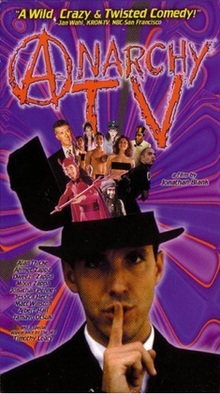
Anarchy TV


Turns out the Revolution will in fact be televised

90s era Anarchists seize control of a public access TV station from its corrupt Televangelist owner and strip naked live on air to protest social conformity and get some ratings for their revolution. Jonathan Blank's independently funded 1998 film was a challenge to find, I discovered its existence looking up the filmography of George Wendt who briefly appears alongside Alan Thicke, Jessica Hecht and the Zappa clan. After finding out about the film and its premise, "Anarchists take control of a public access TV channel to protest a Televangelist and get naked to get viewers" I tried looking it up and could only find a VHS rip.  

From the premise, I was worried I'd be wasting my time with another edgy comedy that littered the 90s indie scene. The kind of film that used shocking behaviour, nudity, sex and swearing as crutches for clever humour and plots that mean things and make consistent sense. I was expecting to waste 90 minutes watching some grainy not quite porn mixed with cheap sets and running joke skits. Luckily, Anarchy TV for all its limitations in budget does not disappoint. It does include nudity, sexuality, swearing and edgy satire, but they all have a point to make and serve the film and are not ploys to get audiences. The VHS rip is quite good considering the age, and I found the film noise and artifacting added to the movie's grungy aesthetics and public access television setting. 

The cast is a bit rough but likeable, I was sympathetic to their plight, and they were refreshingly odd in ways that felt authentic. They're caricatures of 90s American activists, the conspiracy obsessive, the militant sex negative feminist, the free speech crusader who uses jokes and satire as weapons, the survivor of the New Left and civil rights movement who hasn't found their place in the new ideology free 90s. But unlike most caricatures of these types in media, they aren't the objects of scorn and were written and acted by people who were familiar with the real life examples. "Anarchists" and "Anarchy" appear a lot in media, it's just that usually those terms are synonyms for random violence and scary bad things. I was expecting Anarchy TV to be equally sloppy, but again I was proven wrong, these Anarchists might fail the Anarchist tests, they don't quote Bakunin or Emma Goldman, but they're close to the Anarchists that were around in the anti-globalisation fights of the period. They are openly hostile to capitalist society, its values and its power structures, and while they use the common Anarchist dressings and slogans they also make use of more obscure ones, and in ways that are appropriate to the satirical vibes.

Televangelism and business orientated religion is cruel, callous, hypocritical, corrupting, bigoted and reactionary. Anarchy TV makes this point through jokes, but the message is loud and clear. The police are also scum and active participants in repressing non-conformist voices. The TV studio group are arrested after a non-violent protest picket*, the police are openly racist and work with the Televangelist, both because he's in the legal right, and they're being paid by him for some extra muscle. The people that American society treats like trash, the odd balls who find self-expression and meaning through obscure art and performances on TV channels few people watch, sex workers and other criminalised poor people, ethnic minorities etc, can come together, share their depth and talent and value and cause enough disruption to force the proud and powerful to suffer a defeat.

Now for what you've all come for, full-frontal nudity. Yes, there is indeed open and non-simulated nudity in this film. And to this film's credit, it does not fall into that double standard where female nudity is okay and male nudity is taboo, both men and women get naked, and we see everything. Also, the nudity is not actively fetishised, it's quite upfront and honest in how it handles nudity. And as an extra layer, while the nudity is a tactic to get people to tune in and pay attention to their hijacking of the station it is treated as a political act and is shown to have important effects on self-esteem and coming to terms with your own body. Nowadays, nudity is split off into a shocking action of perverts and maladjusted people or gated off in a small cluster of approved and regulated zones like nudist beaches. There was a time when behavioural non-conformity including nudity was considered quite a revolutionary break with societal norms that stifle self-expression and identity. Emile Armand, the French Individualist Anarchist, was an advocate of this tendency "Liberation from one of the main notions on which the ideas of “permitted” and forbidden, of “good” and “evil” are based. Liberation from coquetry, from the conformism to an artificial standard of appearance that maintains the differentiation of classes**." Anarchy TV has the discussion about this tendency and whether it can be a valid form of protest.

The film is not perfect, its jokes hit for me more often than they missed, but I didn't find many of them hilarious, more funny as in clever less funny as in "ha,ha". And there are some 90s context that hasn't aged well. Tamayo Otsuki plays my favourite character Tiffany. She's a sex worker who bounds with the TV crowd and overcomes some of their snobbery over her life, it's her act of solidarity, posting bail that gives the crew their chance to strike back at the man, and it's her openness towards nudity that kicks off the nudity stunt that succeeds in bringing and audience and rallying the community to foil the bad guys. She is depicted as a bit rough compared to Anarchy TV crew and their activist sensibilities, but she isn't stupid nor is she a dupe, she watched their show and is a willing and conscious participant. Unfortunately, as an Asian woman in a 90s comedy, she has one of those joke exaggerated Asian immigrant accents. 

But overall I enjoy the film and believe it deserved a bigger audience. I think the nudity is what cost the film a wider release. As far as I can tell, it never received a DVD release and isn't on any streaming service I can find. The film's distributors were Asylum, yes, that Asylum, the company whose business model is tricking people into buying low effort rip-offs of popular franchises. Qualms about the quality of the final product can't have been the reason for the film's lack of support and distribution, it's far superior to the typical Asylum production. I think this is a rare case of an edgy satire that genuinely went too far for mainstream societies standards and got buried. Nudity, especially male nudity, is still very taboo with few examples outside open pornography.

 *Well, there is actually plenty of violence at the picket line, just that it's the studio staff fighting each other.

** https://theanarchistlibrary.org/library/emile-armand-revolutionary-nudism

Friday, 5 January 2024

Watching Tank Police in a post-2016 World


That's right, horrified at the way things are going I've embraced a period of escapism and watched a horrifying speculative future 2010s where the police have the firepower of militaries, the world is heavily polluted, the politicians only care about re-election and corporations believe employment contracts give them the right to control their employees own bodies. In hindsight, that wasn't the best plan I've authored.

It's the holiday period, and I've caught several winter bugs over the past two months. So in addition to having time off, an erratic sleep pattern and semiregular periods of imposed isolation has led to quite a bit more time on my hands than I had planned for. And I filled part of the hiatus catching up on a backlog of films and television. I finally scratched a few things off my list, including It's a Wonderful Life, and also today's topic for discussion Dominion Tank Police, and its sequel (kinda) New Dominion Tank Police. The Tank Police OVAs have been on my list for some time, why the long wait? Well, a combination of them being in limited availability in my markets and a reputation for not being great pieces of entertainment. What fanbase they do have is largely thanks to being early action Sci-Fi anime that were licensed internationally, and being based on Manga by Shirow Masmune, the creator of Ghost in the Shell didn't hurt either. They also benefited by the existence of Anna and Uni Puma who are androids, sisters and Cat girls. 

Apart from that, both shows have their issues, the first series from the late 1980s is quite cheap, the animation can be choppy and reuse of assets is obvious, the dubbing itself is also a bit spotty, some of the voice acting feels weak, and the dialogue sounds weird. It also struggles with tone, it's a rather cynical take on cyber punk futures and cop dramas with very crude humour and extremely hard to like protagonists. Only to drop most of the jokes and refocus attention on a comedic fool villain (Buaku) and his tragic past at the end. Oh, and it ends on a cliffhanger that is not followed up on in New Tank Police.

New Tank Police on paper has a lot more going for it. Released in the mid 90s, it looks more professionally made, the characters have more detail, the animation is smoother, and I didn't notice much reusing and recycling of previous footage. The dialogue sounds a lot more like things people would actually say, and the cast who are the same voice actors who worked on Tank Police either gained more experience and confidence in the years between releases, or they received a lot more support direction wise. And the action set pieces have more going on too, most of the action in the first series were basic chases with some gag stunts thrown in. In New Tank Police, there are clever escalations and use of vertical space. 

And yet, and yet, I found myself having stronger feelings for the choppier and cheaper series. Which is a little odd since that show's four episode run goes from stealing jars of piss and anti-tank mines that are dick jokes - yes I am serious- to a sad look at the life of a hairy android crook for hire whose stealing a piece of fine art and risking his life, not for the massive pay-off, but because he was the subject of that painting, and it depicts his early life in a lab where he was physically and mentally tortured since creation by uncaring scientists who used him as raw material for experiments. So, as far as he (Buaku) is concerned it's his by right, oh, and it also contains hidden data that can prove the existence of that experiment and the existence of his fellow lab mates who did not survive and escape the lab. It's extremely sad, and it makes it perfectly crystal clear just how crooked, horrible and miserable this world is. 

New Tank Police, well Lenoa Ozaki the female cop on the top image and the protagonist of the franchise has to investigate the murder of an old friend on the motorcycle police, and there's some corporate scheming going on with cyborg henchmen. It's perfectly fine sci-fi with a cynical edge where the protagonists are cops. It's perfectly fine, didn't get very engaged with it, wasn't put off by it. I did find it slightly amusing to learn that New Tank Police took place in 2016, well, I found it funny at first, now I'm a little sad.

Speaking of sad, I was surprised to see how different the Cat Women were to what I had been primed to expect from the marketing. The Puma sisters were the breakout characters of this franchise, most marketing material I've found about these two series heavily pushes them, sometimes to the exclusion of tanks and police. I suspect quite a few people who watched these two miniseries were quite disappointed. Yes the Puma sisters appear frequently, yes they wear costumes that are usually revealing, and they do a striptease. Just the one though, and it's depicted as very goofy if many cutaways to reaction shots of SWAT police behaving like the Wolf from those Tex Avery cartoons. 

No, they don't wear anything like that in the show. And not to get into a slap fight with TV Guide, but the word sometimes is doing the heavy lifting in that quote.


There are raunchy anime OVAs, but the Tank Police ones are not in that number. The sister's main contributions were comedy and then some tear-jerking because as androids they are treated very poorly by society. They're in Buaku's gang because that's the only prospect of regular money that they can get that isn't stripping. And in New Tank Police where Buaku is completely absent, they sleep in an underground car park and have nothing going for them except more crime. Even when they move over into sort of doing the right thing territory, they get hassled and harassed by the Tank Police anyway.

Having watched both, I now understand why it's largely been relegated as an artefact of the 90s-early 2000s. Though watching in 2023 I think it may have aged pretty well. It's a cynical franchise where the label hero doesn't fit anyone comfortably, and the protagonists would be denounced and avoided if they were real people, but here the violence and cruelty is softened with crude humour and a strong distrust of everyone and everything. Like how the Home Alone movies use slapstick sensibilities and heart string tugging to take the sting out of scenes of Kevin McCallister throwing bricks at Daniel Stern's head. 

Grenade torture, Dominion Tank Police's first running joke

Despite this, unfortunately, the march of time has shown that its depictions of cops as a bunch of self obsessed jerks and violent thugs barely qualifies as satire. The first four minutes of the first episode of Tank Police is a back and forth shouting match between two characters, the mayor and the Chief of Police, the Mayor is furious that the Tank Police are causing so much damage to the city while the Chief couldn't care less about that and is demanding even more dangerous and powerful weapons. Since the 1980s, police forces across the world have been showered with military grade weapon systems, including armoured vehicles, so Main Battle Tanks aren't so farfetched. 

https://www.theguardian.com/world/2020/jun/05/why-are-some-us-police-forces-equipped-like-military-units
How about the attitude? Well, the Tank Police are depicted as selfish arseholes who only bother to fight crime because they view the activities of criminals as a direct challenge to them personally. In the first Tank Police episode, the captain of the force is lecturing Lenoa and another rookie on how the most important thing is to preserve their Tanks. There's a violent incident every 36 seconds on average in that city, and if they were too active in responding, they'd soon be worn down. He even overrules the rookies who which to answer a call for back up from the SWAT police, since he views his fellow police officers with contempt. He only bothers to try and stop Buaku's gang when they rear end his Tank and thus insult him personally.

Lenoa is no better, unlike the Captain she doesn't subscribe to How to Kill magazine, but once her Tank gets scratched in yet another grenade "Interrogation" scene which she set up she tries to gun down an unarmed prisoner who is suspended from a game show spin wheel. She sort of sees Buaku as a person by the end of Tank Police thanks to how that plot line goes, but she's more than willing to kill and torture anyone who runs afoul of her. Many cop centred media products deal with abuse of power and usually covers for it with some appeal to pragmatism or threatening potential outcome, if the detective doesn't murder the child murderer the bill of rights and lawyers will set them free, or there's a ticking time bomb and people's lives are at stake so they had to beat the suspect until they can't walk any more, or show that the bad things made the police feel bad about doing them.

Tank Police throws all of that out of the window. The criminals who get the grenade treatment are bad people who admit to horrible actions, but it's crystal clear that the "interrogations" were excuses for the Tank Police to torture people for fun. One of them confesses to multiple murders, which they didn't ask him about because they didn't know anything about them. When they deploy they frequently level the City, they in fact do much more damage to than the criminals do, and they are fully aware of this and do not care about it. They don't even like supporting fellow police officers, Lenoa's dramatic climax is using her damaged Tank to shut a civilian jet out of the air, killing everyone on board. The passengers are shady corporate criminals, but she's avenging a friend and has no real interest in whatever their scheme was. Make the Tank Police into a rival gang with better connections to international arms markets and nothing much changes in how they operate. You could even keep the paperwork jokes and change them to being compensation payments that are deducted from their protection racket income. Which is functionally what taxes to pay for the police are.

So, surely this level of callous self interest must be a product of cynical imagination, right? Well, in the United States of America the doctrine of Qualified Immunity protects police officers in what are blatent examples of brutality. 

To push Brooks to step out of her car, one of the officers pulled out a Taser and asked her if she knew what it was. She didn’t, but told the officer she was seven months pregnant. The officers chatted in front of her, casually discussing which part of her body they would tase: “Well, don’t do it in her stomach,” one of them said, “do it in her thigh.” The officers twisted Brooks’s arm behind her back and tased her three separate times—first on her thigh, then in the arm, and then in the neck—before dragging her into the street, laying her face down, and cuffing her.Brooks sued the officers to hold them accountable for their conduct. Six federal judges agreed that the officers’ use of severe force absent any threat to their safety violated the U.S. Constitution. But those same judges dismissed her case, relying on a legal doctrine called “qualified immunity.” Qualified Immunity Explained

 And said actions of brutality are not uncommon. Furthermore, funding these police forces is draining multiple city budgets.

https://www.statista.com/chart/10593/how-much-do-us-cities-spend-on-policing/
And as for giving a damn about other people, well they haven't done that for a long time if they ever did. Currently as I'm writing this in the United Kingdom every month there's another reveleation that police forces especially the Metropolitan have been harbouring and covering for murderers and rapists within there ranks. And Uvalde Texas showed the world that over 400 police officers from multiple forces including special tactical response units with military grade equipment will just stay in cover listening to gunfire and calls for help from schoolchildren for over an hour before deciding they had enough strength assembled to intervene. The shooter entered the school at 11:30 am and wasn't confronted and eliminated untill 12:50. At the start of the attack there were 19 officers inside the school building the majority of the back up stayed outside for the duration.

Practically the only thing that still science fiction about the Tank Police franchise is that we don't have fully sapient Cat Women gynoids and anti-tank mines that humoursly flip the tank over like a Chef's spatula only more phallic. We're stuck with weird walking dog leg robots and anti-tank mines that explode and maim or kill everyone in the vicinity. Once again reality has ruined a joke.

Friday, 8 September 2023

The Death of Stalinism in Bohemia


This short sequence says more about early 90s Eastern Europe than entire forests of books.
I'm reading a book on the history of censorship in animation. The book covers many well known examples and also documents some lesser known ones. It also covers the filmography of Jan Å vankmajer, a Czech director and animator who serves as an example of what it was like to work in the film industry in the Warsaw Pact. To get a film or program funded, scripts had to be approved by the responsible bureaucrats, Jan Å vankmajer had some success for a time getting projects off the ground, but it eventually he got a reputation for making films that were pessimistic and individualistic, in short, bad art in the opinion of the Communist Party.

Jan Å vankmajer is a committed Surrealist. In the popular parlance, surrealism is just an adjective to describe work that's odd. A painting that doesn't look much like something or a play that plays with the fourth wall or a film that has a sequence that breaks the rules of conventional cinema will be described as surrealist. However, the original Surrealists were a group of political radicals closely associated with Anarchism and libertarian socialism. It's this political Surrealism that Å vankmajer was inspired by.

The opposition force Å vankmajer to find new work as a puppet maker and painter. Fortunately for Jan Å vankmajer he was noticed by the West German film industry who introduced his work to the rest of Western Europe. Several financiers including the UK's Channel Four and the BBC made overtures to fund some of his projects, which meant the Czechoslovak film authorities reluctantly allow him to return, though opposition continued. Jan Å vankmajer's film Alice, an adaption of Alice in Wonderland, was made while he was supposed to be working on a different film and was only allowed to be completed after a bitter dispute in which the foreign funders threatened to withdraw if Alice wasn't completed. 

So, with all those headaches, it's not surprising that once the regime collapsed in 1989 that Å vankmajer would take the opportunity to comment on its demise. In 1990, with assistance from the BBC, he released a ten-minute animated short titled The Death of Stalinism in Bohemia. I've wanted to see this film for some time after seeing clips of his Alice. And now thanks to a YouTube channel I got my chance. It's simply excellent, the imagery is striking, the claymation animation is not only interesting to watch on its own, but it makes many of the film's points in itself. There's a sequence where clay workers in flat caps and overalls, the men who populated every Soviet poster from 1918-91 created via moulds, going through an assembly line and then hanged, after which their bodies fall into a bucket and turn back into clay which is then moulded back into workers which go back on the line and so on and so on, meanwhile the film juxtaposes imagery from Czechoslovakia's Five-Year plans with the production targets getting higher and higher. 

Practically every sequence is like this, the imagery and transitions and movements work together to make the point crystal clear even if you can't read Czech. I could describe the entire ten-minute run time, the crumpling up of posters of old Czechoslovak/Soviet leaders followed by uncrumpling those posters to reveal their replacements, meet the new boss, mostly the same as the old, as a quick example. But I'll restrain myself and just discuss what for me is the most important sequence, the film has a bookend sequence, it starts with a creaky old Stalin bust having surgery, his skull is cut open to reveal his brain, the surgeon plunges both hands into the gory matter and pulls out a smaller bust of Klement Gottwald, ardent Czech Stalinist and leader of the 1948 coup that established the Communist party dictatorship. After cleaning up the blood and tying off the umbilical cord, the Gottwald bust comes to life, the birth of Stalinism in Bohemia. At the end of the film the chronology has entered the late 80s and the soundtrack is full of jubilant crowds and photographs of mass demonstrations in the streets. While this is going on, the hands that have been controlling everything throughout the film start painting everything with the Czech national flag. A new coat of paint on rusty equipment, including an old and dirty Stalin bust. This Czech national flag Stalin bust undergoes the same surgery and those hands plunge back into the brain matter, but the film ends before we can see what emerges from it. 

The film is open about its existence as a form of Agitprop, agitational propaganda and Å vankmajer has stated that he thought the film would age very quickly because it's a direct commentary upon current events  "Despite the fact that this film emerged along the same path of imagination as all my other films, I never pretended that it was anything more than propaganda. Therefore, I think it is a film which will age more quickly than any of the others." To call a film Agitprop or propaganda is to insult in conventional circles. Art is supposed to rise above petty political statements, this film is the best rebuttal to that assumption I've come across so far. Removing the politics from this film is to leave it an empty husk, its politics is its art.

Most political film animated or otherwise are frankly quite blunt and simplistic, there's a bad guy who demonstrates all the qualities the makers criticize, the good people eventually triumph etc. Here the villain is a system, it isn't the death of Stalin in Bohemia, it's the Death of Stalinism in Bohemia with a question mark. Stalin died in 1953 just days before Klement Gottwald died oddly enough. And even Stalin is manipulated by the hands of the unseen operator of the system, who is still around in 1990 and working hard to mutate into a more politically acceptable Czechoslovak national form to continue its work.

The scepticism wasn't some paranoia from an artist who thinks too much, either. The book I'm reading that reminded me to look up Å vankmajer's work was published in the middle of the 1990s several years after The Death of Stalinism, was released. It includes comments by Czech filmmakers that things haven't changed completely, many of the old Communist party bureaucrats were still in positions of power in the industry and not all of them had adapted to the changing times. Which is what the Stalin bust with the flag paint was about, the collapse of the old regimes removed some of the most high profile and infamous personalities, but left thousands of lower level authorities in place, and it was an open question just how far these authorities would be willing to change. 

And of course, the reason much of the imagery is obvious despite cultural distance is that much of what is odious about the Stalinist regimes of Eastern Europe can be found in Western European capitalism. I've worked in factories with grimy walls covered in propaganda posters while sweating and aching to fill ridiculous quotas. The secret police are gone, but the regular police are quite capable of repression, the governing institutions are just as invested in keeping the population passive through a combination of restrictions and distractions.

 I've been to Czechia and Slovakia, so I'm under no illusion that these two things are the same, there are differences, just not as much as the propagandists of both systems would like us to believe.

Monday, 4 September 2023

The Lone Gunmen's Lone Season


 I've been watching the X-Files from start to finish, I had watched a handful of episodes on the BBC and Sky One back in the day, so a mix of its earliest episodes and bits of season 09, and I stayed up watching the first film on a school night. So, I've been enjoying going through it in order, discovering parts of the show for the first time and revisiting old memories. I'm pleased I did not imagine the episode with Brady Bunch obsessed psychic. I have completed season 09 and am up to the second film I Want to Believe, which has a reputation so poor that I decided to put it on hold and watch the spin off The Lone Gunmen.

The Lone Gunmen was a one season 13 episode spin off starring The Lone Gunmen, the trio of paranoid anti-government conspiracy theorists and investigative newsletter journalists. Technically I'm watching the show out of order since I had already watched season 09's Jumped the Shark which was the finale to The Lone Gunmen story line. 

Disney now owns the X-Files franchise and that includes The Lone Gunmen, though curiously the show is absent on its streaming service despite everything else X-Files related being on there. I have an idea as to why that is, but I'll get to that later. Currently, no streaming service is running the show and I don't think it's re-run on television much. It's considered something of a blip, it didn't make much impact in the UK, though I do remember seeing adverts for it, I believe the Sci-Fi channel carried it over here, which would explain its lack of footprint here despite the X-Files fandom being a big hit over here. Sometimes, I think I'm the only one who watched that channel.

 Anyway, the only ways to watch it are to buy the DVD, or find it online, the whole series has been uploaded multiple times to many video hosting sites including YouTube. And with no attempt to hide what it is. That's usually a clear-cut sign that the owners of the property have zero interest in further commercial activity with it. And is often a damning comment on the properties quality. Though there are exceptions, and The Lone Gunmen is an exception.

It's not a classic killed in the cradle, there are problems with individual episodes and throughout the show, but there are some high points and parts that work well. The X-Files is a Sci-Fi drama that revolved around mysteries but would occasionally stretch to comedy, romance and open horror. The Lone Gunmen (TLG) commits fully to comedy with occasional action, dramatic tensions and very brief romance. Humour is subjective, we all find different things funny, I did not find TLG particularly funny, most jokes didn't land for me, and a few have aged poorly, the blind American Football team, the farce about a birthmark on an old ladies buttocks and the Matrix martial arts fight parody stick out.

However, despite this I found myself watching the show in two days and found a lot to like in its plot and character moments, and a few of the smaller jokes had me raising the corners of my mouth. In comparison to the X-Files, which often had some absurd leaps into magical nonsense to justify its plots, TLG stuck a lot closer to the ground. The bad guys here are arms dealers, poachers of endangered animals, corrupt businessmen, there are two episodes that deviate a bit from the formula, one involving a virtual reality behavioural reprogramming technology and the other a secret government program to create super smart Chimpanzees. The focus on more mundane conspiracies and bad guys was surprising to me, since in the show the three Gunmen Byers, Langley and Frohike often believed in things that even the X-Files world treated as nonsense. 

The Gunmen reprise their roles from the X-Files with two additions, Jimmy played by Stephen Snedden is their intern and source of finances. Jimmy is introduced as a passionate moron who fails at even simple tasks like cleaning keyboards or shredding paper, frustrating the three seasoned hackers. Which runs thin pretty quick, fortunately they give the character a sort of intuitive intelligence, so he contributes more than just another body and receiver of exposition for the audience. The other addition is Yves Adele Harlow, played by Zuleikha Robinson. Yves is initially a rival but soon comes over to assist, though is still standoffish and her relations with the Gunmen remain fraught. TLG was released in 2001, so it isn't surprising how Yves is treated by the show. Zuleika Robinson is an attractive woman, and they remind you of that every second she's on-screen. Her hair and make up are always immaculate, the camera focuses on her figure, she speaks in a fake British accent that drips with cool aloofness, and she poses most of the time she isn't moving. Yves is an attempt at having an `empowered` woman via shortcutting. She's shown being cool and action orientated, and is smarter than the Gunmen. The problem is how this is done. When Yves is an ally to the Gunmen, she gives the key piece of the puzzle by conveniently knowing the information they want when she turns up. I'm not exaggerating, several episodes have the Gunmen mulling over a case and repeatedly hitting brick walls, only for Yves to walk in and know all about whatever it is they're dealing with. Though again, as the season progressed they seemed to get more of a handle on what they wanted from the character and were going in a new direction with her. I think both characters would've improved a lot in a second season, unfortunately that never happened.

I found myself liking most of the episode plots, and the core three Gunmen got some interesting character development. Likewise, I like what they did with Langley the most, apart from a long-running gag about his long blond hair getting him confused for a girl. Some of the jokes landed better than most for me, and it made sense that authoritarian jerks and establishment stooges would go for a cheap shot, it's just the constant returning to that well that diminished those returns.  I'm not a big fan of the Gunmen on the X-Files, I enjoyed most of their appearances on the show, I just didn't place those episodes in my favourites list. I guess I prefer their depictions on TLG, on X-Files they seemed like kneejerk the government is behind everything for ridiculous reasons conspiracy theorists. On TLG they're motivated by civil liberties issues, wanting to save lives and even environmental concerns, with reasons for why they hold those commitments. So if you were a big Gunmen fan and this show passed you by, you'll probably find a lot to enjoy here. 

Overall, like most new TV shows, the start was a bit rough with room for improvement and some signs that steps were already being taken to get there. But alas we didn't get a chance to see the improvements, 13 episodes are all we got. So, speaking of those 13 here are some notes I had about several that I found very interesting. I'm going to spoil many of these, FYI.

  • The pilot. If this show has had any memorable moments, it is the plot of the pilot. It starts with Byers believing his father who worked for the government was murdered. And while investigating it, the Gunmen uncover a plot by a rogue faction of the US government to kick off a new climate of fear to replace the Cold War and its lucrative military budgets by crashing a commercial airliner into the World Trade Centre and have anti-American terrorists and dictators take the blame. And yes, we do get shots of the plane getting closer and closer to the twin towers before they save the day. When this episode went to credits, I paused it and immediately looked up when it had aired. I knew the show aired in 2001, but I wanted to know when in 2001. And, it released on the 4th of March. I quickly scrolled through the release dates for the rest of the show, and the last episode aired on the 1st of June, pretty close to 9/11.


  • Bond, Jimmy Bond. This episode introduces Jimmy, It's pretty forgettable apart from that. The reason I mention it is because of a sequence that demonstrates how TV shows were starting to mature in the 2000s. Jimmy is coaching a team of blind American football players, they use technology including footballs that emit sounds. The sequence is just a series of painful jokes about how daft and funny such a thing would be, blind people trying to play football. At the end of the sequence, Jimmy makes a passionate speech about how this isn't funny at all, and blind people deserve the opportunity to play sports if they wish and people who scoff at them aren't very nice. This attitude of having and eating cake was common for TV writing back then. The show's creative teams were aware that cheap digs about appearances and physical differences were nasty and harmful, but they were still expected, so shows would try and bridge the gap by having some jokes and then having a bit that says `actually, these people aren't freaks but people and should be respected` moments. I also bring it up because there's a later episode which I could've sworn they would do something like this, but did not.
  • Like Water for Octane. This episode is a race to find a car that runs on water before a corrupt oil company can get their hands on it. It's a bread crumb trail mystery, the physical comedy was tighter for me in this one, but the standout for me was the conclusion of the episode. The Gunmen foil the oil tycoon and secure the car, but decide not to release it to the public. The reason for this is because they are worried that the potential a car that runs on water would lead to an even more expansive productivity boom which would deplete the world's resources much faster and would not in fact lead to an end to oil dependency because oil is a key component in the manufacturing of roads, and plastic components. The evil oil tycoon did not want to destroy the car as was assumed, instead his plan was to capture the car and hold on to it until he could figure out how to control the release of it and profit heavily from it. He wants to pivot to water cars because oil is getting scarcer. 
  • Three Men and a Smoking Diaper. This episode involves the Gunmen trying to expose a Senator for murder of a campaign worker before he's re-elected. This one ends with the discovery there was no murder, but the Senator's womanising did cause real harm and provoke the car crash. So, once he's confronted with the truth of the damage his behaviour has done he makes a public confession and acknowledges the son born from the affair. The episode ends implying he'll win re-election and the whole group cheer. This episode didn't leave me much to chew on until the final scene, I think the revelation was interesting and it shows that actions can have tragic consequences even without intentional malice. But the ending made me pause for a few moments. If Byers, Langley and Frohike were real people and not characters I doubt they would be enthusiastic that he got in he's not a friend or person they admired. But its a TV show and the politician did the right thing in the end and in America the system isn't perfect but it works gosh darn it!
  • The Lying Game. Yes, that's right, TLG a show that came out in 2001 had an episode that prominently featured a trans person. I was surprised it happened and how they handled it. Carol, a woman whom Byers knew in College asks the group to help investigate her brothers murder. As the episode plays out its revealed that the brother is alive, and isn't on very good terms with his sister. The reason for that becomes clear once he outs her to the Gunmen as Trans. Byers, who is the most ethical of the three and has refered to Carol by her name and used female pronouns apart from one slip up while arguing with her brother, something he immediately regrets eventually explodes at the brother who had outed he previously for his shitty behaviour and declares that everyone deserves privacy. The rest of the Gunmen come around and at the end of the episode Jimmy and Yves declare they don't have a problem with Carol being Trans. I was quite surprised at the episode, compared to the present it isn't perfect, they don't say Trans or transition they say used to be a man, but the intent is clear. I think the episode would stand favourably if it were released today.


  • The Cap'n Toby Show. The last episode to be released even though it was supposed to air before the episode All About Yves which ends on a to be continued. Scheduling meddling aside this episode is about a Chinese spy ring operating within children's TV show. The epsiode features some misdirection, when the spy ring is discovered the TV shows main presenter and host Cap'n Toby is fingered as a fall guy and his guilt is widely beleived by the public because his wife is Chinese. In addition to proving the real spy was a CIA turncoat the show explicitly condemns racist profile and jumping to conclusion because of ethnic and national identity. 

And now that that is finished I'll wrap up with some thoughts that verge on speculation. The reason given for the shows early cancellation was low ratings, and compared to the X-Files there's a noticeable gap, and there was a drop from the pilot to the final episode. However the ratings didn't trend down constantly, some picked up and on a special feature about the show recorded in 2005 to tie in with the X-Files DVD releases the ratings were on par with early X-Files. This is 2000s Fox, so it is entirely possible they greenlit the production on TLG expecting a X-Files at its peak audience and then immediately canned it once it was clear it wouldn't reach those heights. 

And I'm sure once 9/11 happened even the slimmest possibility of a revival was done. Having a pilot that tied very closely to the attack and effectively preempted several conspiracy theories about it couldn't have gone over well. Although I did find a 2002 TV Guide article marvelling at how little controversy this caused in the aftermath. 

Shockingly, this horrifying bit of foreshadowing was never widely reported until Thursday, when industry newsletter The Myers Report broke the story. How is it that virtually no one remembered this post 9/11? "I know! That's what I've been wondering," marvels Frank Spotnitz, who along with Vince Gilligan and John Shiban wrote the episode. "I thought, 'Nobody noticed!' I guess so few people saw the show. But it's strange too because that was the pilot and the ratings were actually quite good for [that episode], and yet, we didn't hear anything."

 The Sept. 11 Parallel "Nobody Noticed"

But it goes beyond that, the show itself has an atmosphere of distrusting authority, including governent and the military, many episodes involve the Gunmen casually cracking Department of Defence software to look for evidence of crimes and shady projects. The cliff hanger episode All About Yves involves the discovery of another secret government faction that is responsible for multiple acts of terrorism including the Kennedy assassination and the Lockerbie bombing. The Gunmen talk a lot about patriotism and the dream of America, but their sole reason for existing is because the entire system that is supposed to protect and nurture that dream has become corrupt and violent. Even Cap'n Toby a silly episode about how executives who don't get the shows they control and ruin them through chasing trends denounces profiling and assuming someone is a threat becuase they share a nation or ethnicity with bad actors. The post 9/11 years were extremely ugly and not kind to criticism or people who were Middle Eastern or Muslim or beleived to be so.

I cannot imagine a show like TLG would have been recieved positively in 2002. I suppose the proverbial smoking gun would be if I could find a definitive date of cancellation being made before or after 9/11. I couldn't find that, though I did find in the DVD special some of the creators of TLG saying that when they wanted to bring back the Gunmen on the X-Files to atleast tie up some plot threads and give the characters a conclusion they faced resistance from higher up. I can't imagine what the issue would be, they had appeared multiple times on the show so there wasn't a rights issue. Well, regardless, aside from a comic book and a cameo in the finale of X-Files season 09 and something in the later season's which I have not seen that was it for the Lone Gunmen. 

Thursday, 10 August 2023

Damning with Faint Praise - Watching G-Saviour


 I had two hours of free time and nothing to fill it, while contemplating nothing my mind dug up the film G-Saviour, so I tracked it down and watched it. Writing about G-Saviour (I'm calling Saviour) is going to do my analytics any favours, despite a big push at the time of its release it's falling into obscurity and the few who know of it have few nice words to say about it. The G stands for Gundam, though the word Gundam is never said in the film at all. Saviour is a 1999 Canadian TV movie set in the Gundam IP, the Universal Century(UC)* timeline to be precise. That's a very strange sentence, it failed to find an audience in North America on its release and I haven't been able to find evidence that it was released in Europe before its 2002 DVD release, and I'm not sure whether that was just fans importing American region DVDs. 

I first heard of it in 2019ish, when a several anime news blogs cause a mini-panic in the Gundam fanbase by reporting that there were feelers being put out to make a Gundam movie in Hollywood. 

*The UC is the continuity that the first Gundam shows and novels were set in, and is considered the default Gundam continuity among fans and Sunrise, the company that makes most of the animated shows. American movies based on Japanese source material have some hits, like Road to Perdition, but there are many more duds. The news did give some exposure to the existence of Saviour, with most mentions using it as a warning of what to expect if the deal went through. And it's been kicking around in the back of my mind ever since. What little I had heard about the project left me morbidly curious and expecting a terrible 90 minutes. Instead, I got a perfectly fine experience. Not great, not terrible.

It's a fairly competent and typical 90s film pilot to pitch a sci-fi series. None of the actors convince you they're space marines, scientists, political leaders etc. But none of the performers come across as miscast, I would liken the experience to watching a stage play dramatizing real events, you know you're watching actors on sets, they just do their jobs of telling a story. Among the cast no one stands out as bad or good, Blu Mankuma comes closest to living his role as the benevolent leader of his space colony, but he doesn't have enough screen time and material to work with. Everyone else is fine, the weakest in the main cast is Saviour's Char Aznable, Lieutenant Colonel Jack Halle played by David Longren. He's serviceable as a military bad guy, but he falls flat when he's supposed to be swaggering.

Had this been taken on as a full series, I can see the cast ironing out the wrinkles and improving with more screen time and plot development. With what we got, it's perfectly satisfactory. The effects do not wow, the film is live action except for vehicles and mobile suits (the mechas). The CG animation is on par with what a production like Saviour could expect in 1999. Babylon 5's CG effects were usually better, though I've seen many productions, some made a decade later, that look worse. The main flaw with the CG effects isn't the graphics or the animation, it's the editing. There is one battle segment in the film, it is impossible to follow.  The battle is outside a space colony, and all the shots are tight close-ups on one or two mobile suits and then a hard cut to an actor in a chair with an ill-fitting helmet shaking around trying to react appropriately to whatever was storyboarded for the CG bits. The whole sequence is confusing, you cannot follow the battle, and the few bits of action that are shown are slow and lack weight. 

There is one exception I would like to highlight. The film starts underwater, there the mobile suit sequence looked at its best. I think the water filter masked the 90s computer glow that plagued contemporary CG animation, and being set underwater did a lot to justify the ponderous movement of the mechs.

The plot is also serviceable, the setting is in the future, UC 0223 according to the opening credit voice over, which is in the future for most of Gundam as well. Mankind is still divided, the lines are roughly drawn between the Congressionals who control Earth and settlements in space, colonies including one called Gaea. The political situation is deteriorating due to a food crisis, the crisis is so severe that a radical plan to turn the seabed into agricultural zones. And agriculture and a scientific breakthrough are key to the conflict for the film. Scientists from the Congress and Gaea have cracked how to grow crops in the sea, and there's a conspiracy to control this key technology and resource.

Our Amuro Rey is Jack Curran (Brennan Elliot) can he rise above self-interest and fear and is what right? Will he successfully pilot the Gundam G-Saviour to save his friends and defeat the deadly Jack Halle? I won't spoil it, hell, chances are good you've already correctly guessed those answers. When the credits were rolling, I thought the Gundam connections were weak and could've easily been excised with original IP replacements. They don't even call the Gundam a Gundam, and it has no connection to any pre-existing Gundam storyline. I thought this was TV movie already in pre-production for a unique Sci-fi property, the genre was big business in the 90s, and Sunrise stepped in with some financial and technical assistance in exchange for using the film to promote its long-running franchise that still had trouble breaking into the North American market.

Everything seemed to fit that premise. The Canadian television production, the tacked on feel of the Gundam elements, the lack of connection or references to anything that came before, a setting so far away from the rest of the franchise there was no danger of it muddying the waters for other projects. The lack of follow up or push to include it or build upon it in following years. It ticked every box.

So, I was surprised when I went to the film's wikipages, both main and Gundam entries to double-check that my memory was accurate for Saviour, and discovered that I was completely wrong. The film had been in production for at least two years and was not only part of a multimedia project including a video game, novelisation and manga, but that it was part of Sunrise's 20th anniversary celebrations for the franchise, together with the anime series Turn-A Gundam. There went my theory, crashing into earth.

That was the last thing I expected. The film was released in cinemas in Japan, which didn't surprise me, Gundam is a massive property in that country. But all the rest of it, the tie-in video game, novels and manga were surprising, that meant Sunrise was heavily involved in this thing. Why make a multimedia project where the main property is made by another company, Canada's Polestar, and has little connection to greater franchise and all the rest of the project is Japan only? I do not understand the logic behind this at all, who was then was the target audience for Saviour? An international audience can't have been the main target, most of the products weren't available in their markets. And I can't imagine Japanese audiences already on board with Gundam got much out of the film. Making a Gundam film with little connective tissue to the wider franchise does make sense if the intent is to entice a new audience, and Sunrise had success with this before Saviour, creating new Gundam properties that could stand on their own, some that weren't even in the UC continuity. But apparently their main target was the audience they already had. 

Saviour is extremely obscure, it doesn't have many fans. My faint praise puts me in that small camp. And even though I grew up on sci-fi shows with the feel and sensibility of Saviour, I wouldn't have bothered tracking it down without the Gundam connection. I don't understand much about the G-Saviour project, but I do understand why the film failed to catch an audience, its ram shackle construction leaves little for anyone. If there was a target audience for G-Saviour, it was probably me, just me. And I didn't live in North America nor Japan. I was busy watching Babylon 5, Star Trek, Sea Quest DSV, Sliders, X-Files, repeats of Doctor Who and Anime movies on a German language channel broadcast from Frankfurt. I'm reminded of an old saying, "try to please everyone, and you'll disappoint everyone".

Thursday, 16 September 2021

Subs vs Dubs


The other day I rewatched the South Korean film Train to Busan, it's a solid action horror, I recommend it if you haven't seen it and are interested in horror and aren't put off by biting. A couple of weeks ago I saw that an American remake had been announced, don't know any of the details because I have zero interest in it. The reception was quite hostile, and I'm largely in agreement, it doesn't need any remakes from anyone, the film is still perfectly fresh and available.

But a lot of the criticism of this decision and and of past announcements of American remakes of foreign films tends to miss the mark. A lot of it is based on exasperation over a perceived reluctance by US film watchers to buy tickets for subtitled movies. I'm not an American nor have I been to the great Satan, so I don't know if this is true or a stereotype, all the Americans I interact with love foreign movies and most of the obnoxious subtitle enjoyers have been American, but if this is true, [i]and[/i] it was the reason for this trend, then why bother remaking from scratch when dubbing exists? I know that in English-speaking nations dubbing has a bad reputation, but that's largely the result of the history of dubbing, not the technique itself. In the US and UK dubbing was usually done by small outfits with little previous experience, little equipment and shoestring budgets, or when done by a bigger distributor who did have more funding and expertise to spare still chose not to. So the results were the infamous Kung Fu movies, anime voiced by people who happened to be passing by during recording, or my favourite, a competent dub with experienced actors, but only five of them who have to voice 30 or more characters.

Simply put, even a middle size studio or distributor based in Hollywood has access to very good audio engineering equipment and a decent talent pool for voices. If hesitancy over reading was considered a serious barrier to the popularity of a property they acquired, then at least some of these companies would put more effort into dubbing. The German-speaking regions have excellent dubbing standards, to the point that several German friends were shocked and horrified to find out what Arnold Schwarzenegger's real accent was.

I'm also not convinced of charges of racism. I'm not saying the executives are on a personal level free of prejudice, I don't know them that well to make that judgement, but I just don't find the argument that American studios "Yankify" movies out of hostility to other cultures. It seems compelling just looking from the mid 2000s to the present, where the main victims of this mangling are Asian films, but American media does the same to European films and tv, including shows made by other English-speaking nations. Hollywood currently has a rotten reputation for its treatment of Asian cinema, in the UK it also has a similar reputation for how it handles British television, especially comedies.

So then, why are they doing this? Well, I think it's simply a case of intellectual property. The American studios and distribution companies own more of the Americanised version and can exploit it's profitably much more fully. If there is genuine reluctance to watch subtitled films and domestic box office trends  higher for the American remake* then this can play a part, but it's an added feature or bonus. I've never seen the American Ring and Grudge movies (remakes of two Japanese horror series) but I know they exist because I've seen trailers and adverts on the side of buses for them. So by remaking a popular foreign film, they (usually, though it depends on contract specifics) get a bigger slice of a commodity that's already proved its market viability and potential for profit.

So even if Americans finally "Learn how to fucking read" as several commenters wish, this annoying phenomena probably won't go away. It's not even unique to the USA, taking a popular foreign film, doing it again and casting locally is a staple of practically all film industries, including in nations where dubbing and subtitling are perfectly common practice. There's an Indian remake of Stephen King's Misery to pick just one example.

Sadly, if we want this annoying practice to end we'll have to abolish capitalism, that way films will only be remade if a film collective wants to do its own different take on the formula.

*I tried looking into it, and I could find cases for and against, couldn't find a trend either way.

Friday, 21 May 2021

Wolf in Sheep's Clothing - the Last Post


I've been working my way through lists of war and anti-war films, I stumbled upon this Argentine short film about the Falklands conflict and was intrigued, can't think of many films that tackle it outside of films about the UK in the 80s which use it as a sort of footnote.

Its 16 minutes including credits and can be viewed on the directors youtube channel Santanna Brothers Films,

The Falklands War, 1982. In the heat of battle, a young British soldier, Mark, deserts his post, only to be captured by an injured Argentinean, Jose Francisco. Gradually the two men form an understanding of friendship and trust, until the arrival of a unit of British Paras, who force Mark to choose between his patriotic duty and his conscience. BAFTA Nominated film starring Gael Garcia Bernal and Kevin Knapman

The few reviews and snippets I've seen are of a similar vein and talk about its bleak message for example this off IMDB

This film tells us that there is no sides that are all good and all bad in a war.

 To put it bluntly its all nonsense. It doesn't tell us this at all, I don't even believe the Last Post qualifies as an anti-war or even war sceptical film. Its pretty blatant in showing who it thinks are the bad in that war. 

In outline its quite similar to many other stories about conflict, including some that are openly opposing conflict as an endeavour, two soldiers from opposite sides find themselves in close contact with each other and both isolated from their sides. There's tension as they try and navigate this frightening environment and eventually try to reach some common ground with language barriers being just one of the obstacles. Its similar to the film about the break up of Yugoslavia No Man's Land (also from 2001) about two Bosniaks and a Serb in a trench in between the lines.

But the issue is in the framing, the ugliness of war is all put on one side, the British who are clearly shown as the aggressors, Knapman and his unit are introduced night marching towards Argentine positions, the post where the surviving Gael Garcia Bernal is sheltering has already been neutralised with the rest of the Argentines already dead. The brief shots of Argentina depict it as a perfectly nice and ordinary nation, not the turbulent, brutal and crumbling dictatorship it was. And there isn't really much tension at all, Bernal surrenders quickly the two don't really bond beyond sharing a cigarette so there's not much in the tragedy of Knapman's decision at the climax when Bernal is murdered and his body used as a cruel and pointless insult to his loved ones, and that's it. Brits attack, Brits torment, Brits murder, Brits desecrate a corpse. 

My disquiet isn't that I don't find this believable, the really nasty Brit soldiers are Paras to make it even more believable that they would do such a thing. Its that this film seems to have been made to feed into Argentine myths of victimhood. Ever since losing the conflict many Argentine governments and cultural luminaries have put a lot of time and effort into constructing a myth of victimisation from British Imperialism, totally erasing the century or more of collaboration with the British government, the brutal military dictatorship that was in the middle of a bloody civil war against its own population and the invasion and occupation of the islands and the oppression of its civilian population. The only thing the Argentine government and military is shown to be at fault for is being out of its depth.

The Last Post, an Argentine film supposedly about the ill effects of war and uses this conflict as its platform fails to address or even acknowledge any of this and that's frankly cowardly if the intent wasn't deliberately made to appeal to this revanchist spirit. 


Sunday, 6 September 2020

A Mild Defence of White Man's Burden (the 1995 film, not the cultural concept)


White Man's Burden was made in 1995, the plot is in a nutshell; John Travolta (Louis Pinnock) is a working class man raising a family in a bad neighbourhood, gets falsely accused as a peeping tom by his employer Harry Belafonte (Thaddeus Thomas) and is soon dismissed, losing his job and the callous way he loses it kicks off a chain reaction of bad news for Louis, who faces unemployment and eviction, after trying and failing to find a new job a desperate Louis kidnaps Thaddeus and tries to ransom him. The rest of the film is a sort of odd couple morality tale where a hostage Thaddeus is dragged through the slums and learns how the other half live while an increasingly desperate Louis tries to improvise ways to make his ransom plan work.

The unique selling point of this movie is that it takes place in an alternate reality USA where the racial dynamics are flipped upside down. Here the wealthy and politically dominant are Black Americans, and the White Americans are a marginalised underclass. Its not a great movie, but I feel its heart was in the right place, the reason it exists its to try and expose the features of societal racism to the group that gets the most out of the way society works. To paraphrase `Think racism is no big deal huh, well what if you were on the receiving end of it?` sort of moral lesson. I'm not American so I can't say how well its aged but its an interesting attempt at least. And Harry Belafonte does excellent work with what he's given, he's really convincing as an aloof casually bigoted wealthy patriarch who thoughtlessly uses the vast powers his position gives him to practically make or ruin many total strangers lives and doesn't even notice. And when he's being dragged through the films ghetto neighbourhoods he's believable as the scared and clueless fish out of water. As impractical and ill thought out as Louis's kidnapping plan is, Thaddeus has never had to be confronted in this way before and is equally hapless as he tries to placate the unstable Louis and use opportunities for escape and rescue. And his final transformation as man riddled with guilt over his own role in a horrible system, combined with his continued uselessness and unfamiliarity with his surroundings gives the film its emotional weight.


Its not a science fiction dystopia, its a pretty realistic depiction of a 1990s USA, just with the roles mirrored. The businessmen are all highly educated Black men, there are Black workers in the factories and services alongside white Americans, but the senior positions, the managers, foreman etc are mostly held by black workers. The unemployment office is bureaucratic and unhelpful, and they filmed the scenes depicting overwhelmingly white slums in the actually existing impoverished neighbourhoods that have overwhelming black and latinx populations, and the largely black police force behaves just like the largely white police force does. However there is a downside to this striving for a sense of realism, John Travolta does an accent, loaded with a slang dialect, he's doing this so the film can comment on how society penalises and judges minorities for behaving in ways that are perfectly normal for them, but different from that of the more powerful group that establishes normality. Problem is its very distracting, and it weakens his performance because so much of his energy is spent on keeping the accent going. 

Its not a perfect film, but it is watchable and while the message may seem a bit obvious to some, but when I saw it one night in the early 2000s, -I couldn't have been older than 13- certain parts of it did teach me things I honestly had never encountered or considered before. I grew up in a small town with very little ethnic diversity, so while I was aware that racism exists and is bad, it was always a bit abstract. This film helped me understand that it wasn't just individual ideology and beliefs that created racism and kept it going, but that a society founded for and on the benefit of some would perpetuate those views and relationships everywhere. I still remember the scene where they're channel surfing, and the cast of every single program be it adverts, soap operas, action movies, documentaries etc was starring black actors, and were usually depicting "typical American lifestyles and values" that were far removed from the lives lived by the white urban poor of the film. Which got me thinking, that's probably not because the heads of the tv channels are all individually actively racist, its because they're run by people who grew up in those life styles, and are marketing shows and products to that audience. But the effect of this is that the people who don't have any connections to those lifestyles, and cannot take part in the markets being targeted are essentially stuck watching another world that's foreign and alienating.

Another strength of the film is that it doesn't take easy ways out. Thaddeus is not like Scrooge, who totally changed his ways after being visited by three ghosts in the night. Thaddeus has been changed by what he's witnessed, but his one attempt at change is not accepted, is motivated largely by personal guilt and its made clear that even if his gestured had been accepted it wouldn't have changed anything truly important. At the start of the film he's part of a societal power structure that perpetuates cruelty, and he's powerful enough to inflict some of that on his own, but when it comes to making meaningful change he's powerless and buckles under the pressure. 

White Man's Burden isn't very popular, its critical reception is mixed and it doesn't come up in conversations often, but its not totally obscure either, dvds are still being sold at standard prices and clips aren't hard to find. But given the content and how our existing societies have developed since the 1990s, I would be very curious to see if this film could still get broadcast today and what its modern reception to a new audience was. 

Popular Posts