Search This Blog

Showing posts with label Korea. Show all posts

Monday, 13 July 2020

Capitalist Realism on the Korean Peninsula

One of the strangest features of the online left is the foreign admirers of the North Korean system. In a way it isn't that surprising if viewed as another depressing reminder that for many people what matters is the worship of power first, and for all its many faults and short comings the DPRK has managed to project an image of strength. That image loses its shine if you look to closely at just how old most of the armed forces equipment is, and how many of its missile tests fail, but still its ability to at least alarm and annoy larger regional powers and the USA is undeniable.

What really does baffle though is that how many of this admirers are wedded to this fiction that the DPRKorea and they themselves are some kind of socialist. Again sadly this isn't a new phenomena the history of socialism has always had admirers of force and despotism. But what's especially strange with the current generations of Kim and Xi admirers is that the nations they admire are pretty open about being open for business. And their rhetoric has been backed up by legal reforms dating back decades and the increasing presence of international business personalities getting invited to important party functions.

Its not hard to find evidence of the new growing market economy in North Korea, and the list of businesses investing in the country and the number of special economic zones continues to grow. I must have brought up the Korean Friendship Associations section touting its business interests section on a dozen occasions for just one example. But the information is largely scattered or in Chinese since that's were a lot of the companies come from.

So I wasn't surprised to see a book by one of the growing number of profit seekers, though I was surprised it hadn't come to my attention before. Especially when it also talked about the Korean Friendship Association and its role in drumming up investment opportunities for the country.

The book was published in 2014 and largely concerns the period of 2002-9 though the economics and history of North Korea before that is also covered quite a bit and later portions are dedicated to summing up the early years of Kim Jong-Un's leadership. I was worried at first that this would be a greed is good manifesto or vanity project like most of the stuff I've read that was written by investors and CEOs, but thankfully aside from a few brief paragraphs the book largely glosses over his personal philosophy. If your curious Felix Abt is a believer in trade being the best engine for understanding, peace and better governance.

Which coupled with his insistence on describing the North Korea of Kim Il Sung has an advanced socialist/communist/marxist state I did find somewhat irksome. But the meat of the book is the economic history and present, and it doesn't disappoint. Nearly every page I found myself making a note of some interesting data or anecdote, I already knew North Korea had pretty extensive links to big business interests and had been legalising market economics after the collapse of its rationing system in the 80s, but I was still surprised at the extent.

Felix Abt's main business venture was building a joint North Korean and foreign owned pharmaceutical manufacturer called PyongSu which I believe is still trading, despite being hit by sanctions. While Felix was running the operation it grew to the point it was running its own pharmacies, so there is some competition and for profit healthcare and treatments available.

He also found time to lobby North Korean officials for many other business opportunities, some of which were rejected, some approved but never got further, and some got off the ground. One of the projects that had some legs, was the founding of the Pyongyang Business School 2004-2010. It was as the name implies a school to train students (mostly top Pyongyangites) in how to run business in the way its run all over the world. In his account the authorities were hesitant at first, not because they saw this as encroaching capitalism strangling their socialist system, but because it would need many foreign academics who might bring ideologically incompatible views and ideas. Once he convinced them they could run a business school without indoctrinating the students in anti regime ideas they approved it.

The project was in jeopardy, so I took extra pains to carefully select the lecturers. I mostly took on those with an academic teaching background plus long-running business experience in Asia and elsewhere. I briefed them thoroughly on the sensitive political nature of their lectures, urging them, for instance, not to talk about the South Korean chaebol like Samsung and Hyundai. I revised and sometimes censored their lectures and teaching materials.

The school would close not because of a backlash by the government hardliners, but because its foreign funders were squeezed out thanks to tightening sanctions and the Swiss government lost interest.

My involvement with the Pyongyang Business School ended at the end of 2010, when the business school was about to be closed. By the following year, the market-driven idealism of those earlier years had withered. Seminars ceased to be held on a regular schedule after the only remaining sponsor, the Swiss government, halted all its development cooperation at the end of that year following a decision by the Swiss parliament.
So yes for several years there was a privately run business school in the heart of North Korea. Although it closed Felix Abt frequently noted with pride that many of his students went on to high positions in the state administration or to run successful businesses of their own.

If anything a running theme of the book is that Felix Abt lays the blame for the slow pace of economic opening up in North Korea, not on the conservative ideologues or the military, but on the western powers for continuing to put tighter and tighter sanctions on the country. Time and again he complained about how his businesses kept facing bankruptcy from the being caught in political entanglements, and having looked him up he does have something of a reputation akin to an embargo buster for the Apartheid regime, since he came up with ways to get around sanctions using tricks and agreements with less reputable Chinese companies.

The last sections are also the most gushing over Kim Jong Un I've seen that wasn't under a masthead of some People's Vanguard.

It was the state farms that were tied down by these measures, which made them unable to compete in markets and to produce more. Having recognized this, Kim Jong Un worked out a new agricultural policy in 2012 addressing some of these problems. Indeed, farmers were told in July 2012 that the state would henceforth take only 70 percent instead of 100 percent from their entire harvest.
 Kim Jong Un acknowledged in a landmark speech that he would make sure that North Koreans “will never have to tighten their belts again.” Indeed, ever since his succession, a number of economically oriented policy advisors have risen to power. This will lead to more streamlining of the bureaucracy and the creation of a more investor-friendly environment. I have met some of these new bureaucrats, whom I consider to be clearly pro-business and pro-growth. A few small changes have already been made in market policy: more flexible opening hours are allowed for markets, and more companies are permitted to interact with businesses abroad. These have led to changes in light industry and economic development in the broader sense.
 The government’s order applied to its own companies, but not to companies and banks under the party and the army. This was because there were three self-contained economies: the civilian economy under the civilian government, the army’s economy under the National Defense Commission, and the party economy under the Central Committee. This has led to unproductive frictions, and Kim Jong Un has started shifting economic decision making away from the party and army and to the cabinet headed by the prime minister. And that’s not all: even a number of military companies were recently moved away from the army and are now under civilian government control

He even notes approvingly that state owned companies are moving away from the old system of service provision to active trading for profit.
While I met a number of risk-averse leaders of socialist bureaucracies, I also met young company heads with sharp business acumen. One bright fellow was Dr. Jon Sung Hun, the president of Pugang, one of the country’s largest state-run corporations. His group, founded in 1979, had capital of $20 million and eight business divisions spread across many industries, such as mining, electronics, pharmaceuticals, coins, glassware, machinery, and drinking water factories. Collectively, Pugang realized annual revenue from sales of more than $150 million. The group had sales offices or agents all over the world, in Germany, Bulgaria, Egypt, Ethiopia, and Malaysia, to name some of its prime markets.
The whole book is like this, but in between the stories of wheeling and dealing there are more human stories about interacting with North Koreans for over seven years, which are also pretty interesting. Sometimes they relate to business stories, such as Felix saying how he found it cheaper and more effective to give people usb sticks instead of the more expensive traditional gifts, usb sticks are really popular because you watch movies, listen to music and read books that are at least frowned upon if not outright illegal.

He also describes the life of a urban worker including typical pay and conditions. Its pretty grim.

PyongSu had, like most if not all Korean companies, a canteen where the staff could eat. Some staff brought food to the workplace that they had prepared at home. It was usual for workplaces to feed the staff and their families, provided they were able to generate the necessary revenues.
"provided they were able to generate the necessary revenues".
Salaries at PyongSu were 35 Euros a month and this was typical of workers at foreign or joint owned businesses, but this was still higher than the average wage at a state owned factory. Though the workers at Kaesong Industrial park where an exception and typically got paid much more.

Furthermore due to the constant electricity shortages it wasn't unknown for a factory to only be able to work for two or three hours a day but the staff were still expected to be there for the full day and either had to make up the rest of the time on maintenance and cleaning or on extra ideological lessons.

Interestingly unions were mentioned just once,

The trade union cells and the party cells in the company were responsible for holding regular sessions for our staff, including exams.
It worth keeping in mind too, that while at times everything that could go wrong did go wrong, and at times staff morale was poor do to them not being able to turn a profit and maybe even facing closure, their are no mentions of workplace complaints from the North Korea staff, or mention of strikes or any resistance at his company or any of the others he was involved with or knew about. It just doesn't feature, the workers don't have any agency, especially not compared to this small but growing class of market traders and public/private business partners.

This is particularly curious since while many books on North Korea have a habit of painting the population as obedient drones, this book usually goes out of its way to destroy that notion. There are brief passages about flats putting bars on their windows because thefts are on the rise, being held up in traffic because someone in front has gotten out to argue in broad daylight with the police, women ignoring laws on appropriate fashion and the ban on them riding bicycles, officials admitting over drinks that they've had plastic surgery or that so and so has had an affair or that prostitution does happen. There's even a really interesting chapter about how the role of women in North Korean society has changed since the disruption of the famine. Women are now regularly ignoring the laws on dress and prohibitions on bike riding, which led to many of those laws being abolished in 2012. So it does strike me as very strange and ominous that at no point in his seven year stay plus seven more years of being heavily connected with country that not one example of workplace resistance became known to him.

Overall its a interesting read and quite informative on North Korea's growing market capitalist economy and life working in the country.

Sunday, 22 October 2017

From the Fatherland With Love - Ryu Murakami

From the Fatherland is a bit like the Japanese response to that weird pop cultural trend in America about North Korea suddenly becoming a dominant military power and somehow occupying them. That Red Dawn remake, the Homefront series of games etc. Its a lot more coherent, believable and smart than those though.

For a start North Korea has no interest in conquering Japan, they just plan to occupy Fukuoka city, and they want to do that to knock Japan and the world off balance and weaken a regional rival. Japan hasn't been doing too well at this point, its looking quite a bit like Weimar Germany. The economy is stagnant, unemployment is extreme, the government is weak and only still functioning thanks to a coalition government of moderates from the main parties. Both the political right and left are polarising society and looks like re-armament and militarisation might be a possibility. The JDF has been guying a lot of equipment, most of which doesn't really make sense unless they go on a war footing.

Meanwhile in North Korea things are (relatively) on the up. Tensions with the US have declined (wouldn't that be nice) and their economy is staggering back onto its feet. So now's the best time to strike. The plan is simple, smuggle some Special Operations Forces (SOF) into the country and start taking hostages. For their plans to work they're relying on the fact the Japanese state has no experience with situations of this sort and will probably be paralysed. Then wait for reinforcements to move into secure the territory as an exclave.

There's a ton of research that's been put into the novel and the work shows. There's an explanation for every question, how they get the first teams in, how they cover for this internationally (a fake rebellion) and how they're going to pay for the massive costs of occupation, how so few soldiers can have such tight control of so large a population etc. It wouldn't work in reality but for a novel it grounds everything really well.

But despite the premise this isn't a military pulp novel, there are some shoot outs and skirmishing but the focus is mainly on culture clash. It does this in two ways, the first is contemporary Japanese culture and North Korean military culture. Its quite funny, most of the Koreans have to drink unsweetened tea at first because they couldn't find any sugar jars, they didn't know about the little packets of sugar. Another time a sergeant discovers a porno mag and can't understand what the captions under the pictures mean. He can read Japanese fairly well its just the slang talk in the magazine about Double D's and ballistics confuses him.

The other case is with a group of delinquent youths who live in a sort of runaway commune of outcasts on the outskirts of the city. They don't fit into either world, and soon come into conflict with the commandos. By delinquents I don't mean anime nerds, these boys are so distant from other people several have assaulted or killed people already, and they weird and dangerous obsessions. One collects venomous insects, another has a sort of sawblade boomerang, another knows so much about buildings they've collected explosives and cutting torches etc.

Its a very interesting conflict, and one that's kinda depressing in its conclusions. Japanese society, its governance and values don't come out of it unscathed, and its hard to call the outcast boys heroic.  


Friday, 11 March 2016

Far East Ostalgia: Thoughts on the bizarre love affair of hardliner “communists” with the Kim Dynasty


http://www.cbc.ca/strombo/content/images/korea-cao-thumb.jpg

For a good few years now I’ve been annoyed by this bizarre phenomena that is the North Korean fan club. I couldn’t understand why a group that prides itself on being “Pure” and deeply committed to the revolution and the ideal of workers state would waste so much time defending the honour of the Kim dictatorship. Making dictators that oppose one or more Western power look like the best thing since sliced bread isn’t anything new for this sorry shower, but even for them the DPRK should be a bridge too far.

This is a “Democratic People’s Republic” that isn’t Democratic even in the liberal Bourgeois sense –though that hasn’t stop them before- hell it isn’t even a republic. It’s a monarchy founded with 20th century baggage. While the Kings of old had court advisers they have a Politburo, instead of lesser nobles there’s Korean Workers Party chiefs, the knightly orders are replaced with the Special Operations Forces, and the role of the witch hunter is filled by the State Security Department that hunts down heretics from the Cult of Personality surrounding the Kim trinity, Kim Il Sung the Father, Kim Jong il the Son and now Kim Jong Un the holy ghost (he is everywhere after all). Now I’m being a little flippant, but only a little of all the parallels the comparison to the trinity is the biggest stretch but only because it’s a direct illusion to Christianity and so not really culturally appropriate. A Confucian comparison would be better, but my knowledge of Confucius begins with wall calenders, vaguely racist "Confucius say" jokes and that film released in 2010.

North Korea is so backward it lacks even the progressive tint that’s used as the foundation for the lines taken by so many “anti-imperialist” post 50’s tankies. I’ve seen dozens of documentaries on North Korea, many of which have interviews with members of the government and military, and all of their comments are filled with rampant nationalism, and bombastic militarism. On rare occasions one of them briefly mentions socialism, but it’s never expanded on and always came sandwiched between nationalist platitudes. I’ve also read a number of books on North Korea and even frequent the Korean Central News Agency website (the official English language site that reports from North Korean government)  I’ve never seen or heard them use any of the usual tropes and holy words all the other regimes did that these wannabe despots trip over themselves to praise. Hell by their own admission they rejected Karl Marx and the socialist concept of class, rejecting the two classes in conflict, in favour of national harmony between 55 class categories. Yes that’s right, North Korean society is based on total loyalty to the nation state, and has stratified its citizenry into 55 categories, based on occupation, family positions, and even ancestry is taken into account. 

Indeed, it started taking the works of Communist thinkers whose work contradicted and challenged the North Korean state out of wide circulation in the 60’s. “Books on Marx disappeared from library shelves about this time(1)as well. People could read Marx only in a few select libraries, and scholars had tio produce a reason for reading him.” 
Amusingly, the cult of Kim Il Sung also supplanted this crowds number one idle Stalin. “Three years after Stalin’s death, his cult of personality was officially denounced at the 20th Congress of the CPSU. This de-Stalinization influenced the DPRK as well: Stalin’s portraits were removed and the Soviet songs were to be performed in the new, edited variant. For example, if under Stalin North Koreans sang “Our toast is for the Motherland, our toast is for Stalin, our toast is for the banner of victories,” after 1956 the toast was supposed to be proclaimed not for Stalin, but for the party.
In the mid-1950s Kim Il Sung, who after Stalin death’s felt much more confident, started a campaign against Soviet influence, emphasizing the need for everything that is Korean and national. Since Stalin was neither Korean, nor national, his image began to wither away. It was not done very fast, and what is now Victory Street in Pyongyang kept its old name – Stalin Street – up to the 1970s. And in the late 1960s the works of Marx, Engels, Lenin and Stalin were removed from libraries and access to them was restricted: Kim Il Sung had no need for predecessors. After the DPRK became politically independent from the Soviet Union, Stalin still remained in the North Korean political discourse, but he occupied the place similar to that of Kim Il Sung in Stalin’s USSR: the leader of a friendly, but clearly a “junior” state, a positive figure which, as such, bowed to the world leader.”(2) 
And the regime has continued dropping bit by bit the old associations with any none Korean leftist.

Now would be the time were I bring up North Korea’s murderous regime and oppression of its population including its proletariat. But there isn’t any point because that’s true of every regime this crowd has championed. Of all the features of the North Korean system, its brutality towards its own citizen is by far its most typical feature.

It’s not really a surprise that these so called radical communists and militant socialists are nothing of the sort. Prick them on this and they’ll quickly pull up a North Korean state document maintaining that the DPRK is a socialist state, or Kim Jong Il’s speeches or books where he talks about the importance of “Socialist Construction” etc. But all that does is expose their own blatant ignorance of socialism. Poke them about authoritarianism and they’ll bring up the elections, rather hypocritically as many of these people will quickly denounce elections in western nations as shams, and in North Korea every eligible political party takes part in the same front with the Workers Party of Korea, meaning that elections in North Korea are even more pointless than usual. 

However the extensive lip service paid by the regimes of old to “socialism” international revolution and the working classes gave them enough jargon to camouflage themselves. North Korea doesn’t give them much room to do this, its isolationist instead of internationalist, and its preoccupation is reunification of Korea and building up its military industry at the expense of living standards for the average North Korean, both nationalist pursuits in place of workers liberation. These cheerleaders of the Dear Leader still try to paint North Korea as a model Socialist society, but the gulf between reality and their arguments is so vast and so noticeable that they don’t wash with anyone not already inducted, and makes them look callous and delusional.

But why this brutal cold war relic in particular? Why doesn’t China, Laos, Vietnam or Cuba command the affections of this crowd? Especially since they all make a much better show of continuity with the good old days? Well the answer may lie in the combination of militaristic posturing and state control of the economy.  Of all the other “Communist countries” left the one that could compete with North Korea for the affections of this crowd (though why they’d want to I don’t know) was Cuba. And what is Cuba famous for? A leadership clad in Olive green army fatigues shouting angrily at the US, state control of all production including sugar cane cultivators, and sponsoring revolts in Africa and Latin America. However since the 90’s Cuba has progressively followed a more market orientated economy, and conciliation with the USA. And it’s been years since Cuban soldiers have been seen carrying out nefarious schemes in the third world. Che Guevara still has some pull but overall the enthusiasm for the sunshine Stalinist state has dimmed amongst the ranks of the hard liners. 

Compare this to North Korea, a regime that repeated threatens its neighbours and the US with missile, nuclear missiles and maintains a stranglehold on the economy. When I first started visiting youtube the only “socialist” videos I found for years, were footage of Soviet mayday parades with thousands of soldiers, tanks and missiles. I have also seen many of these pro NK types take time out to specifically congratulate the North Koreans on nuclear weapons tests and rocket launches. This from the types who shrilly denounce NATO and the US armed forces. I have also seen these Kimchi jingo’s celebrate the execution of Jang sun-Taek because he was apparently a capitalist sell out.   So that covers the military fetishism, what about standing up to the markets?

Well like most things concerning North Korea reality shows the official line to be wishful thinking at best and outright lie at worst. The North Korean economy much like its claims to democracy and socialism only helps proves how out of touch the cheerleaders of the Great General are. I could launch into a lecture about the collapse of the ration system in the 90’s during the famine, privileges for heads of industrial and agricultural concerns, the existence of wage labour, the state taking surplus profit from economy to invest elsewhere, the state operating like a corporation, the establishment of state owned companies, and the thriving black market which tarnishing the ideal of a fully planned economy, but I don’t really need to. North Korea doesn’t really oppose market capitalism or private finance. It welcomes them provided the terms of the deals made benefit its overall aims. North Korea’s mobile phone network was built by an Egyptian company Orascom, which joint owns a public/private partnership company called Koryolink. A public private partnership was the key pillar to Tony Blair’s economic vision, and is usually seen by tankies as the first crack in the walls of a “socialist economy” when it occurs elsewhere. Nor is it the only example 


 In the past, China persuaded North Korea with various joint venture projects arguing that, “You have nothing to lose from these projects. Although it’s based on market principles, ultimately it’s beneficial for both parties.” North Korea on the other hand maintained the stance, “You (China) invest and we will manage,” holding on to management rights of these companies. However, for this very reason Chinese companies were reluctant to directly invest in North Korea. Even after contracts were signed, large -scale investment did not transpire due to poor management.
However, North Korea finally yielded to China’s request, handing over major management rights to Chinese investors. This recent move is analyzed as an attempt to attract more foreign investment to actualize North Korea’s goal of building a “Strong and Prosperous Nation” by 2012. With large-scale management rights transferred to the Chinese companies for joint ventures, the DPRK-China economic cooperation volume is expected to grow.
There's also official commitments by the DPRK to protect foreign investment.


Indeed the DPRK is so eager to encourage investment in North Korea, that it set up the IKBC (The International Korean Business Centre) and advertises its services through the Korean Friendship Association the official mouthpiece of the North Korean fan club. 

The IKBC sales pitch includes the following:


Lowest labour cost in Asia.
Highly qualified, loyal and motivated personnel. Education, housing and health service is provided free to all citizens. As opposed to other Asian countries, worker's will not abandon their positions for higher salaries once they are trained.
Lowest taxes scheme in Asia. Especially for high-tech factories. Typical tax exemption for the first two years.
No middle agents. All business made directly with the government, state-owned companies.
Stable. A government with solid security and very stable political system, without corruption.
Full diplomatic relations with most EU members and rest of countries.
New market. Many areas of business and exclusive distribution of products (sole-distribution).
Transparant legal work. Legal procedures, intellectual rights, patents and warranties for investors settled.

So an official arm of the North Korean government is other monopoly capital schemes, corporate tax cuts, and guarantees the loyalty of its workforce? How's that for socialism?

So why the lack of alarm in this case? Well the North Korean state is still the main force in the North Korea’s economy and it’s not squeamish about taking severe action against those who failure to deliver, so this goes away to reassuring them. Several companies that do actually invest in North Korea have been alleging being ripped off. But realistically speaking, I  think they just don't want to see it. I know some of these fellows turned a blind eye to Fidel Castro’s early reforms or justified them as pragmatic, and ended up condemning his brother Raul for continuing the reform process. North Korea still lags behind the alternatives, especially China and Vietnam so it’s the last stop on the line. If North Korea goes “revisionist” or “capitalist roader” then that’s it. This is a loose coalition of people made up of those who for decades have deflected criticism by simply pointing to examples of “actually existing socialism” so without an actual example of “actually existing socialism” they have no more platform. The other big trend in this group are the extreme anti western “progressives/socialists/anti-imperialists” who also have few options else left now since all the other anti western “modernisers” have either capitulated to the western order or been overthrown. Well Assad’s still clinging on in Syria, and it’s possible a Conservative shift in Iran could reopen wounds.  There’s also Putin, but his brand of conservatism and capitalist economics will keep all but the most desperate from rallying around him now.  He's even increased his criticism of the Soviet Union so no one but those strange Russian nationalists whom dress like 1940's red army officers will stick around.

There is another question here, does any of this matter? I would say yes but admit this North Korean caucus is a minor problem. Compared to all the other obstacles and outright threats we face. Though Korean Friendship Association et al  have raised funds for North Korea and been used as an intermediary for business deals and who knows where that money goes? Their existence and visibility is also an embarrassment  for individuals and groups identified with socialism or communism from interacting with the public. Explicitly Anarchist groups don't have that problem, but that's mostly because in the mainstream anarchism is still associated with Individualistic Terror.   But the equation of socialism and workers power with Juche and the Workers Party of Korea is an issue, just like how it was when the Soviet Union was around. Now North Korea isn’t as imposing and omnipresent as the Soviet Union or China during Mao’s day, but it has and will pop up in places. There are parts of the world where North Korea is quite well known and where this problem will be more pronounced, South Korea and Japan spring to mind, but also parts of Africa where North Korea has some involvement via trade and aid. There are Kim Il Sung study groups and societies in countries like Nigeria and Tanzania(3). 


 Yes of course. There are so many North Koreans here. They are in Nigeria helping us, in our health care system, with our agriculture.  They also provide technical experience and there are also some joint ventures between Nigerians and North Koreans. These joint ventures are in chemicals, fertilizers, agricultures, furniture, marble, mostly from granite (the North Koreans are very good in this), hospitals in Yobe, Adamawa, Zamfara, Enugu, Nasarawa, Delta, Rivers and Borno as well as Lagos states.The three DPRK doctors that were killed were working in Yobe state, which is in the northeastern part of Nigeria. As you may aware, the northeastern part of Nigeria is the hot bed of the insurgency in Nigeria.

 
And here in the jolly old UK we have the Communist Party of Great Britain Marxist Leninist (CPGB-ML) a group that champions North Korea among other things. Again I must confess my ignorance, despite encountering them several times online, I've never had the pleasure of meeting these folks in the flesh, indeed I've can't recall seeing a banner or group participating in the TUC marches I used to go too. But that doesn't necessarily mean they're not a force in another region. Although to be fair to North Korea, the CPGB-ML has many other daft ideas, and still champions a few of the other progressive strongmen like Assad and Castro.


So I think that these embarrassing “comrades” can be considered an active problem, and added to the list. Unfortunately I don’t have much in the way of a practical solution; the one positive I can say about these people is their dedication to the cause. More the pity they’ve chosen such a rotten banner to fly. They’ll keep on banging the (war)drum until the regime itself goes away or is no longer to their liking. Public criticism of North Korea and other “progressive” dictatorships might help a little but making it a priority given the low level of trouble this lot have caused (unless of course you’re in an area where there’s a pro NK group of some size) would be a mistake. You may think that’s hypocritical of me having written all this, but it’s not a priority for me either, I wrote this at work during a break from my other projects, and felt compelled to because as a NK watcher I encounter these people regularly and get tired of their callous and ignorant bile.

 1: From Exit Emperor Kim Jong Il, “this time” refers to the March 25th purge in 1967 of a “liberal” Kapsan faction of the party and the expansion of censorship and the positioning of Kim il Sung as the Supreme Leader.
2: From an article by Fyodor Tertitskiy on NKnews https://www.nknews.org/2016/01/the-image-of-stalin-in-north-korea/
3:In addition to material and military aid, North Korea has built a number of governmental buildings and national stadiums for various African countries.  

Friday, 4 September 2015

Hate America Month came early this year

https://osgapusgov.files.wordpress.com/2013/10/north-korea21.jpg

Years it appears that once again I'm late to the party, the month long struggle against American imperialism party, I assume my invitation was lost in the post. The gala was once again graciuolsy hosted for the thirtieth time in Pyongyang by the Kim family. Still fortunately we have the Real News to give us some highlights, with a new guest commentator Brian Becker.

I'm a supporter of the Real News, but I have some criticisms, they seem internet illiterate, they don't really know how to use youtube, they frequently have a series of interviews and reports but no easy way to find individual parts. And they're over reliant on academics, and frequently don't have much to say to follow up or counter what these academics say even if its factually disputed or even contradictory. This interview with Becker is an excellent example of the latter problem.

Note: For some daft reason, the Real News has decided to disable video embedding on its youtube channel, effectively limiting its ability to reach a wider audience. Hence my uploading via blogger, to see the original video click here.

Minor note: The host and most people talking about inter Korean relations mentions that the Korean war `ended` with a temporary ceasefire.  The ceasefire has lasted over fifty years now can it really still be said to be temporary?

Well  that was certainly something. I'll give Becker credit for downplaying the significance of that naval dispute and for pointing out that sporadic outbreaks of tension and brief fire fights between Northern and Southern forces happen fairly often. Every other media outlet not focussed on the Korean Peninsula either ignores them or acts like World War III has just been declared. As happened recently in the last days of August. But it all goes downhill from there.

Becker shows his bias immediately by singling out the US for criticism even when he's acknowledged that other nations were culpable in the things he condemns. For starters its a myth that the US split Korea alone. The partition of Korea was decided at Potsdam between the US, UK and USSR, Becker admits this but apparently struggles to follow through. This means that Korea was split by three nation states not just mean old Uncle Sam. Just days after partition was agreed the Soviet Union  had troops in the Korean peninsula having smashed the Japanese army in Manchuria. So really they ample opportunity to continue south but didn't because Uncle Joe favoured good relations with the Western powers. And of course Britain wouldn't lose sleep over arbitrary drawing of lines all over oriental lands.  They were more occupied trying to keep control of the bits of the world map they coloured in.

https://blogger.googleusercontent.com/img/b/R29vZ2xl/AVvXsEhYcFBRfd2zJIEMskl425Aek3udBeXeCcuSlTs7gUVQcV3E2oZSTHuiS1CSu6Lckgz11poPR5vS8iiCraK4ObYU-pFczdGzC-N58RXWJxtYKOm0oRQ062RWKqL9BtPVVx5hivW1ZOS36rEg/s1600/Eussian-soldiers-American-soldiers-Seoul-1945.jpg
Soviet and American military personnel meet in Seoul in 1945

So really the blame should be shared between the three. But that's just a starter, the main course starts at 05:03 when the host brings up the North Korea is a Dictatorship, allowing Becker to respond in a way that's all too familiar.

Well to be fair again he starts off well, bringing up the surprisingly obscure fact that South Korea was Dictatorship (and quite a brutal one at that) until the 1980's when the regime collapsed. But here's the problem though the regime did collapse despite heavy US backing, and the US had to accept it. That's not really a strong case for continued occupation, at least not after the collapse of the dictatorship in the 80's. Yes there are a large number of US military and intelligence officials in South Korea (approximately 30,000 plus troops in neighbouring nations like Japan) but that's true of many nations around the world including the UK. And yet we don't often see claims that Western Europe is occupied by America, except perhaps from the extreme fringe of the Anti-Nato crowd. The presence of foreign troops on national soil in peace time is not an indication of an occupation regardless of size. To occupy something means to maintain control of it via force, and is the United States currently doing this in South Korea? The answer is no, could the US start doing this? Yes it could, but that's speculation not fact.

Speaking of facts, yes the South Korean dictatorship was very reliant on the United States when it was founded, but the same was true of the North Korean dictatorship and its patron the Soviet Union. And yes the United States (with the backing of the UN including combat troops from many nations in large numbers) bombed and invaded North Korea... after North Korea bombed and invaded South Korea.  Why is one ok and not the other?

Then he blathers on about North Korea being a "socialist government" which is odd since that's impossible. Socialism is the working class controlling the means of production, how does that apply to governance? He doesn't explain but then he goes on about one party rule which is just hilarious, since A) That has no bearing on Socialism or the lack of socialism, B) Isn't officially true the Korean Workers Party works with two other parties the Social Democratic Party, and the Chondoist chongdu party a religious group. They also have representatives from the Korean residences in Japan. So he's going off message here.

But apparently that doesn't matter because North Korea has free education, free housing, free health care,  guaranteed employment and no income taxes! wait what? Actually to be fair the Becker this is technically true North Korea officially abolished income taxes in 1974. Unfortunately its not actually true in the sense that taxes were genuinely abolished. All that changed was the method of collection. Here's an account of how taxation works in North Korea (made be pay walled) by a former North Korean. Basically they replaced income deductions with an obligation for free labour and payment in kind. Now to really stick the needle in Becker, this is the point where even a sympathetic listener should wake up and ignore him. Not only is what he said not true, it doesn't even tally with what he just said microseconds before. If North Korea genuinely has no taxation system in any shape or form then how on earth does it pay for that free housing? how do the schools and hospitals run? Even if the staff work for free they'll still use resources which need replenishing. And how can the State guarantee employment when it apparently has no financial reserves?

How does it pay for the Japanese website that hosts the Korean Central News Agency? Does the association of Korean residents of Japan foot the bill? And what about those embassies in other countries?
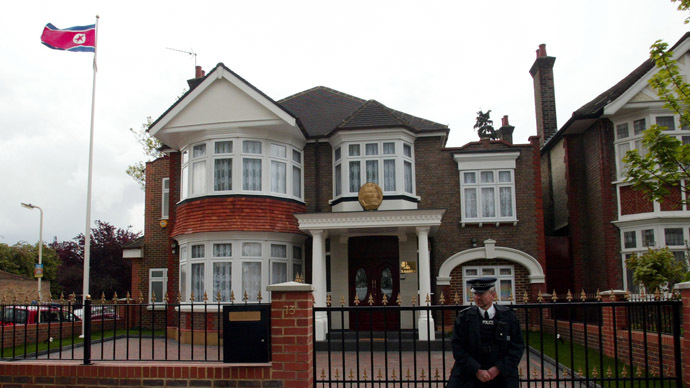
https://img.rt.com/files/news/2a/49/80/00/north-korea-embassy-fines.jpg
Property in London isn't cheap you know

There are really only two options here, either the North Korean government was using semantics to make itself more popular and impressive looking, what we call spin and PR in the west, and does have a taxation system of some sort, and as an alleged expert on North Korea Becker should be aware of this.

Or North Korea has made the transition from a capitalist economy  into one based on needs, and everyone works to fulfil collective needs in the knowledge that the rest of the community will reciprocate with their own strengths and skills. But that can't be the case since North Korea has a currency system and a powerful state that employs everyone and is in charge of allocating resources for the benefit of the nation state, with little or no autonomy or decision making power available to the local populations. Oh and it allows private business to work and operate within its borders.


http://www.bestourism.com/img/items/big/6957/North-Korea_Currency_8537.jpg


He then goes onto to bring up Saudi Arabia and Israel and other nations that the US quite likes that are quite horrible, to drum up the old charge of hypocrisy. But here's the problem is it not equally valid to call Becker a hypocrite too, since he also condemns some nations with terrible records but supports others? One thing I noticed was that he never really refuted the question about North Korea's darkside, he just shifted the conversation onto other topics, the US, South Korea, the US again, and only returned to the North so he could sing the praises of the regime.

This chat encapsulates an endemic problem with alternative media, the dependence on talking heads who can be very shady. Just because someone offers an opposing view to the mainstream narrative does not automatically give them credibility. What annoys me is that Becker had some valid points (about 40 seconds) but this was either buried in his ode to the leader, or undermined by his rhetorical tricks.


Saturday, 14 March 2015

Secrets and Lies in Pyongyang

http://fc08.deviantart.net/fs71/i/2013/209/b/4/jason_unruhe_aka__maoist_rebel_by_f1st_of_r3volution-d6firt4.jpg
The Honourable Chairman of the Youtube section of the Ministry of Agitprop


Yep its time for another Korea post, this time we have a newsflash from youtube's -self proclaimed- number one Marxist. Concerning an organisation known to many NK watchers the Korean Friendship Association (KFA). If you're not that familiar with the organisation they're global organisation of supporters of North Korea their three aims are 1: `Show the reality of the DPR Korea to the world` 2: `Defend the independence and socialist construction in the DPR of Korea` 3: `Learn from the culture and history of the Korean People - Work for the peaceful unification of the Korean peninsula` how a small and dispersed (they claim members in over 120 nations with offices in several like Norway and Thailand) band of well wishers could offer Pyongyang any practical assistance in any of these aims isn't really clear. Anyway they do have official offices and relations with the North Korean government and are usually the people you have to talk to if you want access to North Korean officials and permits.

Most documentaries about North Korea will have had to go through someone in the KFA, and most investors in North Korea use the organisation as their first point of contact.

It was founded in the year 2000 by a Spanish IT consultant called Alejandro Cao de Benós de Les y Pérez AKA Alejandro. Apparently not all is well in the KFA and a brave young(ish) whistleblower has stepped forward to disclose the truth.
http://www.trbimg.com/img-51d60488/turbine/la-la--fg-adv-spain-norkor01-jpg-20130704/600/463x600
They gave him some medals a book and some snazzy new threads


Well sort of, actually you'll notice that the Maoist Rebel (MR) at no point offers any evidence to substantiate any of his allegations. Which is strange given that at least some of the allegations should be easy to support. Like the comments that many North Korean officials are critical of Alejandro, if that's true their comments must have been made public and in English, since the MR does not have a privileged relationship with the North Korean government and can't speak Korean so these comments should exist and be easy to point to, but nothing.

And I'd be interested to know where MR is getting his figures for the alleged scams, how does he know Alejandro pockets €35,000's? That seems an oddly specific figure and yet no evidence is shown, no images or links to any further information.

I tried looking myself for information assuming MR was just being lazy but all I found were abusive articles about Alejandro being what's known as a useful idiot.

But there is something else, apparently MR's viewers also shared my problems with his `denunciation` prompting a second video on the subject. So now do we get some proof?


Well sorta I guess? MR reads from a clipboard citing two other people he's spoken too about Alejandro, that's better but it isn't really convincing. He doesn't show transcripts of these conversations nor link to where the people cited have been critical of Alejandro. It also doesn't help that one of them Mike Bassett doesn't say anything specific the allegations are all vague. The second case of the Norwegian businessmen isn't any good either because it doesn't tie with the earlier allegations. MR accused Alejandro of ripping off the North Koreans but the example given (or the way MR frames it) is a case of Alejandro not being able to deliver what he promised. That happens all the time in the business world "You pays your money, you takes your chances." Morally speaking not giving back the money is pretty poor form but unless he was contractually obligated to refund he doesn't have to.

Now I do think the end of this video was much better, many of the reasons MR gives for why evidence is quite possible. People do stay silent about the mistakes and poor behaviour and scamming of powerful colleagues for fear of reprisal in some form. But if you haven't found convincing evidence you can't denounce someone publicly, all you're doing is playing a he said, they said while she said game. Denunciations can be very damaging to political work and personal lives so you have a responsibility to make sure you are convinced of the allegations and have the proof to back it up, otherwise potentially you're causing great harm for an innocent.

If this Alejandro is doing or has done the things that some are saying he has, then he does need to be exposed, hell I'll even repost it here on the off chance it helps get the message across. But that doesn't mean you can just go off on a tangent about how awful you think someone is.

Thursday, 29 January 2015

The Interview

http://www.gannett-cdn.com/-mm-/7bc135a2083eb61b1f0b781b9b336cd37c473e11/c=0-2-297-398&r=537&c=0-0-534-712/local/-/media/USATODAY/USATODAY/2014/12/04/635532898706495971-The-INterview-poster.jpg


A little after new years day I saw The Interview was uploaded to youtube, originally when the trailer came out I was going to give it a miss since most comedy trailers nowadays put their best jokes in them and I didn't laugh once. But thanks to craziness about Kim Jong Un supposedly not being a fan (I wonder if he got a preview screening) and hacking and alarmist comments that this could somehow provoke a war

A North Korean foreign ministry spokesman said in state media that the movie's release would be an "act of war".
He did not mention the title, but a Hollywood movie called The Interview with a similar plot is due in October.
 I decided why not? After all it wasn't costing me anything, and I could always click onto something else if it was awful. I watched the whole thing which honestly surprised me, I didn't like any of the films big jokes but a few quick gags were amusing, and I was genuinely interested to see where the plot was going. Its got quite a few problems besides jokes that go on to long, James Franco seems to be doing an impression of Jack Nicholson's Joker, "First you eat your vegetables, then you get to eat your STEEEEEEAAAAKK!" which I found very distracting. And I don't really care for Seth Rogen, he's one of those actors who seems to be playing himself in every role, just with a different job and circle of friends. I don't dislike him or anything, I think he has the best lines of the two, but I don't think he adds much.
http://data1.ibtimes.co.in/en/full/525438/north-korea-has-threatened-us-war-over-move-interview-that-involves-assassination-plot-kim.jpg?w=660&h=369&l=50&t=40
Randall Park (pictured) the guy they got to play Kim Jong Un is very good though, in some scenes he does look very similar to the Great Leader, and his acting is very convincing. He's jokey and charming when the plot needs him to be, and he can snap into sinister viciousness when that's required too. Other than that, its well made, all the sets look convincing except for one though the fake set and dodgy props are deliberate ass they're part of the plot.

Now onto the juicy stuff, the political fallout. First a disclaimer I have absolutely no idea who was behind the Sony Hack and I don't really care, its completely irrelevant to anyone who isn't attached to Sony. Now the only reason I did bother to watch The Interview was because of the absurd political clashes over it. I was surprised by how surprised quite a few media personalities were about the denunciations by the North Korean government, plenty of government officials the world over have shown they have no sense of humour and the DPRK isn't usually considered an exception. I mean just saying you're going to kill the President of the US gets you investigated by the Secret Service so I don't think anyone has the moral high ground in this fight.

And its not like North Korea is unique in attacking media that revolves around killing a head of state, the 2004 game JFK: Reloaded a game about assassinating JFK was denounced by at least two Senators; Ted Kennedy and Joe Lieberman.

Like I was saying I was taken aback by the number of times I saw variations of "haven't they got something better to do?" -the they referring to the North Korean Foreign affairs and diplomats- in western media. I can only assume this stems from unfamiliarity with politicians who work in international affairs, which is kinda worrying since "knowing things"  is the main requirement of news media. Diplomats and Foreign Secretaries are living breathing propaganda machines, their one and only job is to represent their nation in the best possible light, that includes refuting and stifling criticism. Furthermore The Interview was made by Americans in the USA, a nation that North Korea has no official ties or business with, so they really don't have anything better to do there. If it was Russia or China or Iran, you know nations that North Korea does have a working relationship and economic ties, then yes they probably would have better things to do, like investments and rocket sales. Though personally speaking I think the North Korean government should be more worried about what the film has to say about assassinating Kim Jong Un, they outright state that killing him won't solve anything since they'll just replace him with another brother or just another General. You have to expose and publicly challenge the regime to have a chance at fundamental change.

If you were even a little curious I recommend giving the film a watch though feel free to skip the first bit its just "hilarious" buddy antics.

Saturday, 5 July 2014

North Korea becoming more like (a stereotypical) South Carolina

http://i.dailymail.co.uk/i/pix/2013/03/01/article-2285696-185CB6F4000005DC-744_634x548.jpg
Ah Rodman, are last best hope for peace. Sadly that isn't a joke.


With everything that's been going on in the world this is admittedly a minor point but it struck me as interesting. Among my many obscure hobbies I include Ostalgia and North Korea watching. Now North Korea watching is a bit like hunting for Bigfoot there's a lot of reports but most of them are exaggerated or an outright hoax. The only real difference is that here Bigfoot does his share of the exaggerating and lying.

This has been a hobby of mine on and off for years, I've watched every documentary on North Korea I know of, read several books and on rare occasion give the Korean Central News Agency (KCNA) a curious look through. If you're not familiar with that network the KCNA is the official English language news service -with a small Spanish version- of the North Korean government, which is strangely hosted in Japan. It has many problems and you'll quickly realise what they are when reading through them.

For the most part it doesn't actually give you any relevant information, most of the articles are acknowledgements that the North Korean government "greeted" or more accurately sent a letter to a head of state somewhere congratulating them and saying how nice it would be if the two nations worked together. The rest was really dull lists of things the leader did and attended. As a result I go months without even glancing at it, as a result I missed what is possibly the closest the KCNA has come to reporting and indeed making news in a long time.

I'm sure you're familiar with the UN's Human Rights Council's investigation on North Korea, the one that's sparked fresh allegations of torture, prison camps and mass systemic brutalisation of a large number of North Korea's population. The one were those sketches came from.

 Drawings by former prisioner 1Drawings by former prisioner 2

Well predictably the North Korean regime didn't take that well, and it reacted just like every other political group does when under criticism, deflect attention by claiming the source of the criticism is acting in ill faith. They did so by going in a strange direction however, the official line accuses the USA of being behind it shocking no one, but in addition to that they attacked one of the Councils Commissioners Michael Kirby. Since his from Australia a close ally of the USA that's not really surprising either, but instead of cracking jokes about Crocodile Dundee and ending with "G'day mate" the KCNA decided to attack his sex life.

Kirby is homosexual and currently Australia's been having one blazing row after another over the Gay marriage thing. The KCNA singled out Kirby's homosexuality and mocked this facet of Australian domestic politics. Here's the article in full emphasis is my own.
KCNA Commentary Slams Artifice by Political Swindlers

Pyongyang, April 22 (KCNA) -- Michael Kirby, chairman of the "Commission of Inquiry (CI)" on human rights situation in the DPRK, called a press conference at the UN headquarters on April 17.
He told reporters of different countries, skeptical about the truth of CI's "human rights report", that it was based on "testimonies" by "defectors". With such awkward excuse, he asserted it is high time that a UNSC was called to discuss the DPRK's "human rights issue" and bring it to the International Criminal Court.

His rash act is a last-ditch effort intended to lend credence to the "report" peppered with fabrications and create an atmosphere of international pressure on the DPRK in this regard.

Lurking behind it is a dishonest and political purpose of the U.S. and its followers seeking to undermine the ideology and social system of the DPRK.

Now, the forces hostile toward the DPRK regard the "human rights issue" as a main lever for stifling it since they had no way out over the "nuclear issue".

After all, such political swindlers as Kirby were mobilized so as to internationalize the nonexistent "human rights issue" of the DPRK.

As for Kirby who took the lead in cooking the "report", he is a disgusting old lecher with a 40-odd-year-long career of homosexuality. He is now over seventy, but he is still anxious to get married to his homosexual partner.

This practice can never be found in the DPRK boasting of the sound mentality and good morals, and homosexuality has become a target of public criticism even in Western countries, too. In fact, it is ridiculous for such gay to sponsor dealing with others' human rights issue.

As been already known, what was put up by Kirby and his group as data is all testimonies made by those "defectors", who are runaways or terrorists as they betrayed their country and nation after committing indelible crimes.

However, the Kirby group styling itself a judge accepted such unconfirmed data to cook up the "report". This makes one question if the group has an elementary legal sense. After all, they changed their position as judges with money paid by the U.S. and its followers.

At present, many countries and even Western media and personages are astonished at the Kirby group's "report" presented to a sacred UN body, terming it a replica of Nazi-style arbitrariness.

It is so pitiable for the U.S. and its followers to attempt to frighten the DPRK by letting such dirty swindlers, ready to do anything for money, invent an anti-DPRK false document.

The army and people of the DPRK reject the fabricated document as a foul crime unprecedented in the world history of human rights and will surely force them to pay dearly for it.
So in one brief article the KCNA and by extension the North Korean government has managed to cover an impressive number of homophobic slurs, we've got references to promiscuity, describing gay marriage as absurd and denying homosexuality exists in North Korea. The last one reminds me of when North Korea claimed disability not caused by an accident didn't exist in North Korea either.
http://towleroad.typepad.com/.a/6a00d8341c730253ef01a511a8f332970c-pi
The old lecher himself

Now I doubt this really surprises anyone North Korea is many things but San Francisco it isn't. And if as many have suspected for a long time that the North Korean regime is capable of treating its own people in just a handful of the atrocities alleged over the years then a like of social progressivism is trivial by comparison.Though given that the new line appears to be that North Korea treats homosexuality as a form of decadence and taking into account how their system treats people for lesser deviations that doesn't really bode well North Korean gays.

The KCNA article did however surprise me, since I can remember a time when North Korea was bragging about how irrational the West was in regard to homosexuality. Several years ago I went onto Korea-dpr.com "the official web page of the DPR of Korea" but in reality its run by the Korean Friendship Association (KFA) a small international gathering of mostly alienated Stalinists. However since the KFA is sponsored by the North Korean government and organises a lot of those group travel packages to North Korea, it is an unofficial arm of North Korean foreign policy. Anyway they had an FAQ section which I browsed, though interestingly I can no longer find it on there website and had to use a webarchive. The FAQ seemed pretty shifty though I was amused by the answer to a question about working in North Korea being answered with "No", whereas all the other questions got a paragraph at least.

Question twenty was

20. What is North Korea's stance on homosexuality?

Due to tradition in Korean culture, it is not customary for individuals of any sexual orientation to engage in public displays of affection(1). As a country that has embraced science and rationalism, the DPRK recognizes that many individuals are born with homosexuality as a genetic trait and treats them with due respect.
Homosexuals in the DPRK have never been subject to repression, as in many capitalist regimes around the world. However, North Koreans also place a lot of emphasis on social harmony and morals(2). Therefore, the DPRK rejects
many characteristics of the popular gay culture in the West(3), which many perceive to embrace consumerism, classism and promiscuity(4).
1: What has this got to do with homosexuality?
2: What exactly does this mean? to me it sounds like they "voluntarily" conform to societal pressures, but I don't know because they don't elaborate.
3: A false implication that there is such a thing as monolithic gay culture.
4: Ok, so what do they do instead?

Looking for official laws on the subject or statements didn't clear it up, as far as I can tell there have been no official statements by the North Korean government or the three legal political parties in North Korea about homosexuality. Though North Korea did vote against the UN declaration in support of LGBT rights, and also voted in favour of a resolution that supported sexual orientation as grounds for execution.

So over all not really great but there is definitely a regression and contradiction between this and the much more recent article by the KCNA. So could this be a sign of a drift into even more extreme social conservatism by the new Dear Leader? Maybe its worth keeping an eye on so long as its part of the overall framework of critique and observation of North Korea. Personally speaking if Kim Jong Un decided to embrace the Gays and use them to make his regime look more palatable and reformed internationally, whilst maintaining the oppressive system as a whole like his fathers administration sort of did in 2009 then I won't be cheering. This is just another example of the poor relationship between sex and sexuality and authoritarian politics.

Now before we wrap up you may be thinking this is evidence is a bit slim, and I agree assuming you are thinking that. The reason why I'm using just these two sources for my main argument is because those are the only two sources I am absolutely sure accurately reflect the views of the North Korean government regarding homosexuality at the time they were published. The said thing is that most stories about North Korea even those appearing on fairly reliable news sources can be false or exaggerated. I did however find other sources on the status and treatment of Gay North Koreans and will give a few interesting extracts. But I can't really vouch for there accuracy so keep that in mind if you wish to read on.

North Korean news has a pretty interesting article on the subject that talks to several defectors, KFA and KORYO tour operators and other North Korea watchers.

“You have flourishing same-sex relationships before marriage – it’s not conceived of as sex, it’s just physical affection,” Smith told NK News, and she said it is highly likely that same-sex relationships take place, just as in the West, in gender-segregated places such as the army.
Overall I find NK News to be fairly reliable, they have access to KFA and North Korean sources but are willing to criticise and examine North Korea too. They also have a KCNA watch section which despite just posting KCNA news verbatim manages to improve KCNA coverage. For starters they have a search bar meaning its possible to actually search for specific news items, to do that on the KCNA website you have to go to the calendar and check day by day. It also includes photo's KCNA does have photo's but to see them you have to go onto there Korean language photo service. It also a graphing tool so you can see how many KCNA news pieces are about or mention something in particular.

Echoing the NK News story I've found this piece by Koryo tours, the company that handles most of the group visits to North Korea, they supply the guides and pass and assign the travel plans. This is what it had to say.

While North Koreans will deny that homosexuality exists in the DPRK it is more a case of not existing culturally than anything else. It isn’t an inherently anti-gay country, just somewhere that this is never mentioned, and people grow up generally completely ignorant of the existence of alternative sexuality as well as gender issues, not to mention the mechanics of any kind of non-vanilla sex.

Now I personally don't like Koryo tours as a source of accurate information on North Korea in most areas because they are simply very dishonest. In that same article they deny that Koryo tours is part of the North Korean government, even though they admit to being set up by the KITC which is the national travel company and owned by the state. In this particular case they claim that "there are many differences between the State, state-ownership, and the Government" that simply is a lie. The government runs the state so it is also in charge of the states institutions like KITC. In Britain state owned businesses while run like any other company were ultimately under the control of the relevant Minister, Energy, Transport, Housing etc.

But in this case I don't really see what they'd gain by lying and what they say is backed up elsewhere so I guess its reliable.

Popular Posts