Search This Blog

Showing posts with label review. Show all posts

Tuesday, 28 April 2026

Goodbye Horses


Cover art for the game Horses, red background with Horses written in white letters. A worried young man is in the foreground, while a man and horse loom behind him.


I have finished the game HORSES, released in December 2025 by Santa Ragione

Note:  I will try and keep this safe for work, but the game's developers have placed one of the longest content warnings I've seen for a video game once you boot it up. It reads as follows

  CONTENT WARNING: This game contains scenes of physical violence, psychological abuse, gory imagery (mutilation, blood), depictions of slavery, physical and psychological torture, domestic abuse, sexual assault, suicide, and misogyny. The inclusion of these elements is intended to depict and characterize a fictional world and its fictional inhabitants. The presence of these elements is not an endorsement of them, nor do they reflect the beliefs or values of the creators. Some scenes also feature unsettling sounds, such as chewing and swallowing, which may be disturbing for players with sound sensitivities or related phobias. Character dialogue also includes references to psychological trauma that may be upsetting, especially for those who may have had similar experiences in their pasts. Player discretion is advised. If you feel uncomfortable or upset while playing, please consider stepping away and reaching out to someone you trust.

The above text is not a joke nor is it an attempt by an overly PC company PR team to head off negative press, Horses is a game about abuse and exploitation and depicts and examines nearly every form abuse and exploitation can take. For this review I will not be showing any of that content, but I will be discussing them to a degree, though I will try to be brief.

Horses is mechanically a simple game where you click to interact with objects and complete tasks at a sedate pace. Storywise you play a young man sent to a farm for a part-time job in the Summer. One of those "Make a man of yourself" by hard work deals. You quickly learn that this farm and its farmer are sick and twisted, and you still have two weeks to go.  The game is broken into days, and each day reveals more of the twisted reality of this farm and the eponymous "Horses". I don't like spoiling games, but I think the controversy gave this part away, the "Horses" are human beings made to wear horse masks and are being abused and tortured by the Farmer who is so accustomed to this sick fantasy that he openly shows his captives off to you (a stranger to him) when you arrive. 

That surprised me, I assumed the game would take it slower and reveal its secret gradually. The content of Horses led to its banning from the Steam and Epic storefronts and condemnation from some quarters. This was how I learnt of the game's existence and the impression I initially had was that this game was a gross and repugnant sadistic fantasy. Not something I would like to play, however there were some defenders, which got me curious. After spending a bit over 2 hours with the game I can say with confidence that the criticism was misleading. 

Though make no mistake, Horses is gross and disturbing and uncomfortable. You see and occasionally take part in horrific acts of abuse and violence against vulnerable people. The difference is that the game is not designed to titillate and endorse this behaviour. Great pains were taken to remove any appeal or attraction to these actions and beliefs, it's actively repellent. The "Horses" are dirty, their private parts censored, and throughout the game the protagonist is shown to be upset and afraid and at the mercy of the Farmer. You do horrible things to progress the game but Anselmo the young man out of his depth does horrible things out of compulsion and the implied threat of dire consequences. 

He is always watching


In moral terms Horses is heavily invested in attacking abusive relationships and their justifications, and the sympathies lie with the victims. It reminded me of watching the film Fiesta! Directed by Pierre Boutron. The film is set in Spanish Civil War and is told from the point of view of the Francoist army.

It also depicts a young man sent off to the cares of a strange and twisted patriarchal figure with the goals of turning him into a `real man`. It also shows just how brutalising that life and ideology are to even the `special ones` who have privileges and power over others.


To demonstrate without being too graphic, the Farmer has constructed a moral code inherited from his abusive father, that is twisted and self-serving. The only real purpose is to empower an authority figure. Consensual sex is denounced and punished, but the repeated violations he doles out to his captives is "just" and "necessary" to teach the "Horses" how to live virtuous lives. It reads like a criticism of the morality of religious institutions who are themselves mired in industrial scale abuse of vulnerable people, corrupt business dealings and active support for reactionary politics. Horses makes this explicit when on one day a priest arrives and endorses and collaborates in the farmers atrocities. The farmer's other accomplices are a wealthy family who believe in strict and lasting hierarchies and a veterinarian. 
 

 We are committed to producing challenging, adult storytelling. HORSES uses grotesque, subversive imagery to confront power, faith, and violence. We reject subjective obscenity standards and believe this kind of moralizing censorship evokes a darker past in which vague notions of “decency” were used to silence artists.

HORSES press release

One facet of the game that struck me while playing was Anselmo. Anselmo is a victim, he's isolated in a strange and hostile world in proximity to a very dangerous person who is accustomed to acts of violence and personal tyranny. He must keep this man appeased to keep the implied threat implied, but in the process he must assist in some of the crimes and violence of the farmer. He is similar to Fido a man turned into a guard dog by the Farmer. Both Fido and Anselmo occupy a position of relative privilege on the farm, but both are still vulnerable to the whims of the true power that is the farmer, and their privileges are contingent on collaborating with him. Anselmo must do chores on the farm, that can range from picking veggies in the garden to holding a victim done, so the Farmer can administer "correction". Even with the rudimentary models and animations its clear that Anselmo does not want to be there and taking part in these actions, but he continues to take part. Until he doesn't, at certain points in the game there are opportunities to rebel in small ways, which eventually snowball into more effective actions that eventually topple the reign of the Farmer and free the Horses. In my play through Anselmo even joined them, donning a Horse head and running away with them in an act of solidarity. 

The game is telling us in a very blunt way that disapproval of atrocities is not enough to stop them and that in a pyramid of tyranny the lower rungs are also victims to an extent, though this does not excuse the actions of those below in upholding the system. The only way to stop abuse is to take action and dismantle abusive institutions and relationships.

The use of Horses was an inspired choice. How can the Farmer and his associates treat people in such horrific ways? Simple, they don't see these people as human beings they see them as animals. Yes, the way the Farmer treats his "Horses" is extreme and cruel even if they were real Equines, but it is perfectly normal and socially acceptable to exploit animals. Especially in a farming setting, chaining people to a plough and forcing them to work in the baking sun is a criminal act, attaching a literal Horse or Donkey or Ox to one is not. Dehumanisation is a near constant when abuse and atrocities are present. The abusive father views his family as his property. The Israeli government views all Palestinians and Lebanese as fanatical terrorists so it's easier to bomb villages and apartment buildings. Hitler compared Jewish people to vermin and the Hutu paramilitaries denounced the Tutsi as cockroaches. Right now in the United States, multiple governmental agencies from the police to ICE are carrying out waves of violent assaults and captures of "Illegal Aliens". 

The hard part of getting people to do horrific things to other human beings is to convince them that their targets are not full functioning human beings, but something else, something lesser, than it becomes surprisingly easy. Its worth asking why. Why is it so easy for a man to capture a dozen people, keep them naked in a pen and beat them as he sees fit once he's gone through the rigmarole of putting a rubber horse mask on them? These are some of the uncomfortable questions HORSES confronted me with while playing.

The Controversy

It can't be overlooked the ban from Epic and especially Steam put the game and the studio in serious bind. Steam has a monopoly on PC gaming so any game not available on there has almost no chance of making it. Fortunately the storm over the game was big enough to get people curious and retailers like Itch.io and GOG (where I purchased my copy) did still stock it so it was able to stave off financial ruin, but it should alarm us all that one storefront has that much power in the first place.

 Steam’s refusal removed our primary path to reach players on PC, with no way to appeal and no clear path to compliance, as detailed in our FAQ. Steam has also stopped granting developer keys to indies that do not meet undisclosed sales thresholds, limiting third-party sales and retroactively affecting our catalogue. In a de facto monopoly, opaque decisions like these can quickly determine a small studio’s survival. We have set aside funds to support HORSES post-launch with bug fixes and quality-of-life updates for six months, but we will not be able to start new projects unless HORSES somehow recoups its development costs without access to more than 75% of the PC gaming market. 

I enjoy Steam products and services, but it is a corporation and a very large and heavily entrenched one at that, the power of one company to decide if a game and the developers behind succeed or fail is not a good thing for anyone, and differs little from a powerful state censor. We don't exactly which line HORSES crossed to get it blacklisted from Steam and Epic but whatever specific element was the issue HORSES is a game that tackled uncomfortable subjects for a purpose, it is unique and bold and deserves support, in recognition of the work put into it. 


Tuesday, 30 December 2025

So they're threatening us with an new Animal Farm movie


I was innocently scrolling through social media when a trailer for an CG film starring animals started playing. My settings mute automatically so I just saw a few seconds of CG pigs smiling. Those pigs look creepy when they smile was my reaction, and then I moved on with my life.

A few days later I saw those creepy porcine smiles again, this time as part of a thread of comments denouncing the film, which is how I learnt that it was an Animal Farm movie, and that Seth Rogan voices the Napoleon character. Oh, joy.

Look, the film has not been released, it's scheduled for release on the 1st of May 2026, that's International Worker's Day, and from the bits shown in the trailer it looks to be a modern retelling of the dangers of capitalism. I don't particularly wish to watch it and I have no expectations for it, but I won't write it off before it comes out. Though I do have things to say about an Animal Farm but capitalist reading, which I will come back to later on.

 Before we move on, I have a question for you. Have you read Animal Farm? I'm not being cute, I think it's one of those things where the discourse/gossip that surrounds it is more well known and more famous than the story itself. And I think that's partly to blame for the majority of the confusion and abuse of that name. So, if you haven't read it, I would recommend you do so. It's quite a short read it's a novella and most versions don't include Orwell's preface making it even shorter. It's public domain in the UK and can be found online fairly easily, here's the first version I read many years ago

 No question, now, what had happened to the faces of the pigs. The creatures outside looked from pig to man, and from man to pig, and from pig to man again; but already it was impossible to say which was which.

A brief summary,

 Our story is set on Manor Farm, a typical farm in the 1930s England, the Farmer Jones is lazy and drunk. The Animals are growing dissatisfied with his stewardship of the farm, eventually tensions explode and a revolt led by the pigs succeeds in overthrowing the hated Jones and the animal's find themselves in charge of the farm. Not knowing what to do now, the animals consent to letting the pigs take the vanguard position, and they administer the farm. The pigs promise equality and a new life free of exploitation, but work needs doing, so the other animals provide the muscle and work to the pigs plans. Overtime, the pigs gain and enjoy more privileges and their rule becomes far less popular, by manipulating language, fears and the use of force the pigs under their leader Napoleon from a dictatorship and in the end they use the wealth of the farm to parley a seat at the table with the human farmers. The quotation above comes from the final scene, where the pigs entertain a group of human farmers. It's not as iconic as "All animals are equal, but some are more equal than others" but it represents the same message and is key to the author's intent with the story. 

You may have been aware that Animal Farm is an allegory for the Russian Revolution, and it is, although just knowing that fact without familiarity with the work will obscure the main point of the story.  Many readings of the book and its other film adaptations will focus on Napoleon being like Stalin and other events that have parallels with early soviet history and then deduce something along the lines of "Animal farm is an allegory about the dangers of revolution and how they eat their own" this might be what they got from it, but I don't see that in the story and from what I know of George Orwell. For starters, Jones is seen as a tyrant who needed to be overthrown, the problem is in the aftermath and how the pigs behave.

The other animals don't act like the pigs, many are shown to be devoted to the cause they work and often die for. Their problem is that they allowed the pigs to occupy positions of power over them and the pigs grew accustomed to the trappings of power and their own self-importance and corrupted themselves and their revolution. The pigs are the Bolsheviks here, you see. 

There is a sort of restoration theme in Animal Farm, but the return of the status quo is the crux of the depressing ending. You're not supposed to think it's good that the pigs act so much like their former masters that the animals can't distinguish between them any more.  


The pointlessness of an anti-capitalist animal farm

From the trailer the 2025 Animal Farm film casts its Napoleon as a tech bro capitalist, it's not the first time someone came along and wrote an anti-capitalist version of Animal Farm, there was an unofficial sequel where Snowball (a pig heavily coded as Leon Trotsky) returns from exile to the farm and leads it in a new business friendly way. Neither of these re-imaginings can escape a core problem, and that is that we already have a definitive attack on capitalism to George Orwell's Animal Farm. It's called Animal Farm, it was published in 1945 and was written by George Orwell.      

Going back to the quote, the reason that the animals can no longer distinguish between the human's and pigs is so damning of an ending is what both represent. The pigs represent the communist party, I don't know anyone who would dispute that, but what many seem to miss is that the humans in the story are the capitalists. They're allegories for the capitalists who rule the world, they take the eggs, and milk and meat etc. from the animals and sell them for a profit. That's an allegory for the capitalist system, the produce is the commodities produced by workers labour time and power. 

So, when the animals can't tell the difference between the two, Orwell is accusing Stalin and his party cronies of using the language and symbols of socialism to trick the population while he builds a capitalist economy. This is not a surprise, throughout the story the pigs use and exploit the other animals to make a profit, and it's their ability to control a restive farm and conduct good business that turns the humans who initially rejected the pigs as usurpers other to letting them take part in the wider community. 

That is a very simplified criticism of the Soviet Union, but one that is based on a wider criticism of capitalism. It's good that Jones is gone, and it's a tragedy that the new rulers continue to behave like him and represent the same cruel dynamic. The pigs are usurpers, but not because they dared to take Jones's rightful property, they usurped a genuine movement to end tyranny and exploitation. 

This gets overlooked all the time by liberal critics and deliberately ignored by the "communists" who comment on the work. I can understand the former, the phrase missing the forest for the trees springs to mind. The clear parallels to Stalin and the Soviet Union are so obvious that its wider message gets lost. It doesn't help that much of the intended audience has its own blinkers on, since Animal Farm is obviously the Soviet Union* which was different from the USA which we all know is capitalist, so the capitalist dimension is overshadowed. I think this is the result of buying into capitalist propaganda, the idea that capitalist economy is built on an abstract freedom and not the material class relationships of boss and workers. Workers in both the USA and USSR were alienated and controlled, they're worked on what those above them chose for them and in the manner decided for them, and the results of their work, the products and materials were sold off, and the profits went to the powerful. There are differences between a board of directors and a state planning agency, sure, but the foundations of the economy are the same. 

A film where Napoleon parties and drives a Tesla might be entertaining, I doubt it, but it is possible. However, it will always be redundant. We already had that story in 1945.


Appendix One: The 1954 film, aka the CIA movie

"You'll laugh and cry a little!" good to see lying has been a cornerstone of marketing for so long.


 Thought it's best to deal with this one while we're here. In 1954, just four years after the death of George Orwell, the British studio Halas and Bachelor released a full length animated adaption. The animation is excellent for 1954 and is arguably the first feature length animated film released in the United Kingdom. And aside from a few changes (we're getting to), is a faithful adaption of the story. But that's not why anyone talks about this film.

No, all that anyone talks about when the film comes up is the presence of the CIA. It's true, two executives who worked for the CIA bought the rights to the film from Orwell's widow then used Rochemont as a front who selected Halas and Bachelor to produce the film. This was unknown to everyone until historian Tony Shaw uncovered the financial connections. So, I think we have an excellent example of the damage propaganda can have on art. Even when it produces a technically impressive and moving work, the real purpose of it hangs over it.

Regarding those changes, the film's wiki entry helpfully lists them and some potential changes that were not made. A few that stand out, adding scenes where some animals who are content have no interest when learning of the revolution in Animal Farm, I get their intent, but the result is a short and succinct demonstration of what marxists call false consciousness. There were also animals in the novella who didn't see why they needed to fight Jones either, 

 Some of the animals talked of the duty of loyalty to Mr. Jones, whom they referred to as "Master," or made elementary remarks such as "Mr. Jones feeds us. If he were gone, we should starve to death." Others asked such questions as "Why should we care what happens after we are dead?" or "If this Rebellion is to happen anyway, what difference does it make whether we work for it or not?", and the pigs had great difficulty in making them see that this was contrary to the spirit of Animalism. The stupidest questions of all were asked by Mollie, the white mare. The very first question she asked Snowball was: "Will there still be sugar after the Rebellion?"

Another concerns Snowball being too good and the need to make him just as bad as Napoleon. Well, that mission failed Snowball is still seen as the good of the two pigs and his murder by the dogs reads as tragic. Another change due to pressure was the reduction of humans and the focusing on Jones as the evil one. 

But the big change concerns the ending. Orwell's novella ends with the animals broken, the film ends with the pigs being overthrown. I personally don't see an issue with the bad guys being overthrown, it's a change, but the novella's ending was the way it was because it was released in 1945 when Stalin stood triumphant. In 1954 there had been revolts, including East Germany the year before. To me the bit of the changed ending that is a problem is the replacement of the human visitors with other pigs. These pigs are clearly stand ins for the soviet sattelite states of East Germany, Bulgaria etc. This means that Napoleon hasn't been accepted by the wider capitalist world. But, to my great surprise the ending keeps the trigger point. It still keeps this bit.

 No question, now, what had happened to the faces of the pigs. The creatures outside looked from pig to man, and from man to pig, and from pig to man again; but already it was impossible to say which was which.

They see the pigs acting like Jones the human and its that which drives them into a frenzy to overthrow their masters. So, the CIA funded a film based on a work where the villains are evil for adopting capitalist methods and despite wielding great influence kept that criticism in the film. Its not just in the ending either, throughout the film the pigs constantly trick, pressure and cajole the other animals into working so they can profit from their labours. Animal Farm is ruled by a brutal clique who spend other people's money on booze, clothes and automobiles, and this is somehow different to the USA how?

Again, I really think you should read the novella, the criticisms of capitalism are entwined within the crticism of Stalin.  

Oh and one final note on the changes, while reading the book Orwell Subverted:The CIA and the filming of Animal Farm, I came across the CIA's negative reactions to the first proposed uprising ending where the human guests are preserved.

 This dramatic reversal of the book’s downbeat conclusion notwith-
standing, the memo argued that, as scripted, the final sequence, which
included men and pigs, was ‘‘ambiguous at best’’ and ‘‘at worst’’ was an
‘‘endorsement of . . . anarchism
.’’

So, there you have it, keeping the anti pig and human theming of the Novella is an endorsement of Anarchism.  

 Appendix Two: The other Animal Farm movie


Somehow this poster even more misleading than the 54 version

Did you know that there was another Animal Farm film? It released in 1999, and it uses the voices of Patrick Stewart for Napoleon and Kelsey Grammar for Snowball. It also uses some CG animation but mostly relies on animatronics, puppets and real animal stuntwork. It was also faithful to the Novella and as far as I can tell was not funded by any intelligence services. Oh and the pigs don't look creepy when they smile.

 It doesn't get brought up ever when Animal Farm is being discussed. I guess its marketing failed, its trailer and posters make it look like a Babe Big in the City knockoff. Its a shame really, its a strong adaption. Again the biggest change is the ending, some animal's after seeing the pigs and humans pal around to the point it is impossible to say which is which they run off and escape. Then years later the regime has crumbled and collapsed. I suspect that change was due to the film releasing in 1999 years after the soviet union crumbled in on itself and collapsed.

If you want a faithful adaption of Animal Farm this will probably remain the best version available.  

Taken together the Novella and the two films represent an interesting timeline, we have Stalinism triumphant (1945), in trouble (1954) and death through decay (1999).  


  *Which makes me wonder how younger readers react to it since they have no memory of the Soviet Union to base their thoughts on.

Friday, 7 February 2025

Schindler's List


Someone showed me a review of Schindler's List which left me struggling to comprehend what I was reading. I have a high opinion of the film, the reviewer did not, but that's okay, everyone interacts with media differently, the issue is in why they did not like it. Neoliberalism and a Zionist ending, apparently.

If you're not familiar with the movie, it's based on real events and documents how a factory owner saved the lives of some of his Jewish labourers and conspired in some industrial sabotage of the Nazi German war effort. The ending is the surviving Jewish labourers and their children placing stones on the real Schindler's grave, which is a Jewish sign of respect for the dead. The only way that's zionist is if you equate Jewishness with zionism, which is deeply antisemitic and plays into the hands of the actual zionist movement. There's a lot more to the film than this brief synopsis I think the film is worth seeing, and there are many other places to get a deeper look at it as a movie. It's not a cheerful movie, obviously, I think you need to be prepared to experience it. 

As for neoliberal? I guess we have got to the point where that term has no meaning any more so whatever.

Personally speaking, I think that the movie does a very good job of exposing a mainstream audience to the capitalist nature of the Nazi regime. The racist bigotry and the militaristic brutality of the Hitlerites is popularly understood which is why even with a global resurgence in far right movements and personalities the really popular ones still try to obscure their connections. Less understood is the capitalist nature of the Imperial expansion, I think the most popular recent document to hammer that home was Germa Bel's documentation of privatisation in Nazi Germany, Against the Mainstream, and that's still stuck in the capital P politics corners of the web. 

In History circles the role of big business in Nazi Germany is well understood, but I can't think of a more popular example of this process than the book and film about Oskar Schindler. Who is Oskar Schindler? Well in the film he is a user of slave labour and an opportunist. He is a member of the Nazi Party and businessman, he arrives in occupied Poland with the idea to open factories because labour is much cheaper has no legal standing, and he will have the backing of the occupying state to do what he wishes. His decision to take on Jewish workers instead of Polish ones is nakedly financial, Jewish workers cost less and are even more vulnerable to exploitation than Polish workers.

 STERN
The standard SS rate for Jewish
skilled labor is seven Marks a day,
five for unskilled and women. This
is what you pay the Reich Economic
Office, the laborers themselves
receive nothing. Poles you pay
wages. Generally, they get a little
more. Are you listening?

Schindler turns from the wall of glass to face his new
accountant/plant manager.

SCHINDLER
What was that about the SS, the
rate, the - ?

STERN
The Jewish worker's salary - you
pay it directly to the SS, not to

STERN(CONT'D)
the worker. He gets nothing.

SCHINDLER
But it's less. It's less than what
I would pay a Pole. That's the
point I'm trying to make. Poles
cost more.

Stern hesitates, then nods. The look on Schindler's face
says, Well, what's to debate, the answer's clear to any fool.

SCHINDLER
Why should I hire Poles?

Schindler is an outsourcer, the only difference between him and the CEO of Nike who shifted production to Indonesia in the 1990s is the contexts in which they both operate. The amoral, nakedly self-interested logic is the same, "doing this ____ will benefit me, and I am allowed by the powers in charge to do ____, so why should I do anything else?"

And of course Schindler exploits the vulnerabilities of the Jewish community in order to acquire the capital as well as the labour to open his new company, which was seized as from its Jewish owners. And he relies exclusively on his assistant Stern to do the actual work of running a business, which gives Stern the latitude to start intervening on the behalf of his fellow Jewish inmates. He's nice and charming about it, makes it all sound like a good deal for everyone involved, but he's exploiting the market to compete to his advantage.

 SCHINDLER
Jews, yeah. Investors.
(pause)
You must have contacts in the
Jewish business community, working
here.

STERN
What "community?" Jews can no
longer own businesses, sir, that's
why this one's in receivership.

SCHINDLER
Well, they wouldn't own it, I'd own
it. I'd pay them back in product.

STERN
(pause)
Pots and pans.

SCHINDLER
Something they can hold in their
hands. They can trade it on the
black market, do whatever they
want, everybody's happy.

He shrugs; it sounds more than fair to him. In fact, so taken
with the spirit of his own largesse, he offers even more:

And at first once he's shuckdown his Jewish investors and opened the factory with his compliant workforce he lives it up and leaves Stern to do all that boring work. That last part at least gives Stern some time to get a support system off the ground. If the story (both real and fictional) ended here Schindler would be remembered as a villain. But history marched on.

Schindler's turn or redemption stems from two intertwined factors. He finds it impossible to avoid being directly confronted with the bloody context in which he operates, and he as he spends time with these Jewish labourers he's been exploiting for maximum profits he starts relating to them as people outside the employer v employee/master v slave relationship. He knew about the war, and the slave labour system, the racism and the ethnic expulsions and the dictatorship, and made his peace with all of them since he found a way to profit and thrive from it and the bad things were happening to people he didn't know. Those experiences changed him. But they didn't change him that much, throughout the film he's still businessman, he's just shifted from laissez-faire to paternalist boss. His early episodes of friction with the Nazi regime have him arguing with officials over their interference in his factory, and abusing his workers.

And he also works to sabotage the German war effort by producing faulty shells. Sabotaging the war effort is a good thing, but the issue is that Schindler himself as decided that his factory will not produce shells and bullets for the war effort and thus his workers must comply, which puts them in an extremely dangerous position, if its discovered even if no active sabotage is suspected they will be sent to their deaths, the only reason they survive is thanks to their designations as essential workers. 

If I sound critically I'm not particularly, this is largely what happens in the film and in real life, I just thought it was worth noting.  

Beyond Schindler there is another well remembered part of the film that demonstrates the murderous capitalist logic of the Nazis, it is the infamous "hinge" scene.

During this scene, the commandant tests a slave-worker's productivity by timing how long he takes to make one hinge. He performs the job very quickly only to release the trap, he made a hinge in excellent time and yet his overall output is low. Goeth the commandant then drags him away for what is supposed to be an execution but faults in both of his pistols grants a temporary reprieve. This is cruelty at its unadulterated, and it's clearly motivated by extreme racism, but there is also a cold economic logic, the camp is receiving more inmates and more slaves for its workshops, so the test. Of course that was just an excuse to demonstrate power over an "inferior" hence the game and the method of execution. However, the commandant would have to murder someone in these circumstances, either some of his slaves or the new arrivals, he can't afford to keep them all, and they have to meet their targets. 

I'm not arguing that Schindler's List is an anti-capitalist movie designed to radicalise the masses, that's taking the argument too far. It condemns the Nazis in all their facets, including the economic drives of mass subjugation and mass murder.


Sunday, 25 August 2024

Everything to Play For Review


Marijam Didžgalvytė (Marijam Did) has a book coming out in Autumn called Everything to Play For, How Videogames are Changing the World (EPF). I was one of the lucky few to be given an advance copy. My deadline for getting my notes into shape was extremely tight but I found the book an engaging read, EPF is a mix of autobiography, artistic review and criticism, sociological research, consumer activism, history of workplace organising and appeal for further activism and resistance to build a better gaming industry as part of a better society for everyone.

The book covers plenty of ground, and despite its grand scope EPF is newbie friendly - gaming terms are explained when they first appear in the text. Did’s target audience appears to be people who are committed left wingers of one stripe or other but are not into games or are sceptical of them and possibly even hostile to them. There are several passages lamenting the arbitrary treatment of games compared to film, art, literature etc. While every game terminology and technology is explained left wing terminology is only explained if it’s somewhat obscure. For example, the Situationist concept of Derive (Drift) is explained for the reader but Did’s usage of Historical Materialism is not.

I share Did’s frustrations on common left wing disdain for games and the blind spots that come with it. I’ve experienced the disapproval and belittling attitude first hand and I’ve been trying to chip away at that wall of disinterest for some time in my own small way. I was surprised when Organise expressed interest both in my writing and commentary about games in general as that is not a typical response for an older established platform. Film, music and literature are staples of left wing critical commentary, and entire schools of thought have risen to prominence pondering the impact of these media institutions on the minds of the working masses, but videogames are still shut out of those conversations. EPF’s publisher is Verso books, which is both another positive sign of change and a good platform to reach the audience of sceptics. Did makes an effective case that to ignore one of the largest industries on the planet is to seriously undermine any strategy for resistance to capitalism and hinders attempts to construct a world that is free from the exploitation and violence of infinite growth and productivity improvements.

The games industry is a major contributor to land clearance, modern slavery, resource depletion and pollution. If we wish to stop hyper-exploitation in the Democratic Republic of the Congo and other regions of the world we can’t limit ourselves to illegal logging and conflict diamonds, we have to challenge the role of tech and game companies in cobalt and other mineral mining. Tens of thousands of people around the world are employed in the games industry and just like their fellow workers on the docks, in the fields and factories they are exploited, overworked, underpaid, harassed sexually, bullied, fired on short or no notice, and through their labour create products that they will not own and will enrich someone else. Their struggles are just as worthy of moral and practical support.

Ignorance of these areas also presents the danger of sleep walking into a trap as the cultural, social and psychological effects of the lessons learnt in the gaming industry seep out into areas of our society and personal lives that at a glance are completely separate from the world of point winning and level climbing. Gamification is marketing buzzword, but annoyingly and dangerously it’s a buzzword that describes a real process that has proven time and again to be quite effective, at least effective at generating profit. The impact that the logic of video games being exported outside its traditional sphere is something we don’t fully understand yet as the process is still in early stages, but its quickly becoming inescapable even for those who have never touched a joystick and only use keyboards and mice for writing emails and browsing videos of cats being random. My audio book and podcasts apps recently added medals and experience points as an example of the future fast approaching.

All of these issues and more are summarised and examined in EPF, there’s lot of blood, sweat and tears that go into making plumbers jump up and down and hedgehogs collect shiny rings, and sadly that is often literal. I’ve never experienced crunch time developing a video game but I’ve experienced similar conditions in a factory, and its mind, body, and soul draining work, so I can empathise with conditions for game developers. There’s plenty to critique and lament in gaming spaces and the industry that shapes it right now, and EPF could easily have been another entry in the growing left wing genre of political pessimism, pointing out and cataloguing at length the many faults of the world as it is and then despairing about how insurmountable it all is. Thankfully EPF is not like that, although it does catalogue the many faults of the world as it is. It also credits the successes, games that engage politically with their players and raise awareness of issues, the growth of video game and tech worker unions, independent developers and games co-operatives that are experimenting with new ways of working that promote sustainability, collaboration and equability in compensation and decision making. EPF couples these positives with outlines of a potential better future for gaming that more support from the wider left could assist in making a reality sooner.

EPFs vision of a possible future is not a blueprint and there are parts of the puzzle that remain unanswered by the end of the conclusion. To me that isn’t a detriment; the history of the schools of socialism is littered with impressive schematics that breakdown and become obsolete within a year. The remaining ambiguities in EPF leave room for independent thought, and there were points in the text where Did asked a question and while reading I thought of a rough outline of an answer or potential avenue for discussion and examination. I really hope that in the near future I will find enough time to start writing some of them.

I’m not in the target demographic (well I am partially in that demographic - I am convinced that we need a revolutionary overhaul of society after all), but I’m not new to games and I doubt anyone who reads Red & Black Gamers would need the definition for a LAN party. If that’s the case should you still read EPF? I would hope that I’ve already answered that question, but just in case I’ll be blunt: yes, yes you should. I consider myself a well-informed gamer who has documented issues within the industry and supported early attempts at resistance, and yet I’ve learnt quite a bit, both new examples and some more information or another perspective on cases and incidents I was already aware of. To pick just one example I was aware of the game Dead Cells, but was not familiar with its studio Motion Twin nor that it is open about its support for Anarcho-Syndicalism.

“Follow games industry unions on social media and support their calls for action. Enjoy and encourage artistic experimentations in this field and support smaller creators. Do not dismiss political action within these spaces as isolated aberrations, but engage with them, give them merit, be curious.”

Is it a perfect book? No, but I don’t believe those exist and my negative notes were trivial, so I won’t bother including them as just mentioning them would give them greater weight than they merit. I think EPF is good contribution to the discourse about video games and I hope it proves to be a successful step in the process of getting video games as an industry, and as a subject for criticism, resistance and improvement out of the lefty sin bin and into the mainstream. Getting it on the bookshelf is a good start.■

Reddebrek
You can find more of Reddebreks writing and reviews on their website: reddebreksbowl.blogspot.com


Pre-orders of "Everything to Play For" are available from Verso Books with 20% off, £13.60 paper book / £8 Ebook which shipping commencing on 17 September.

Monday, 6 May 2024

Iron Front Simulator: Social Democracy vs Fascism


An example of the Social Democratic Party's propaganda between the wars
"Help Protect this house, Republic, Freedom, Give your vote to
the Social Democratic Party!"

"Such a general development cannot be attributed to the false tactics of any single party or to the mistakes of individual leaders. On the contrary, the conduct of individual leaders is determined largely by the sentiments of the people as a whole. It would be erroneous, however, to regard the sentiments of the moment as reflecting the natural make-up and character of the people. They are merely the consequence of the special circumstances which have brought about this profound degradation of the entire nation."

- Karl Kautsky, Hitlerism and Social Democracy, 1934

A friend shared a game they had found on Itch.io Social Democracy: An Alternative History. For brevity and clarity, I'll be referring to the game as SDA. The game's premise is quite intriguing, the year is 1928 and your task is to block the rise of German Fascism through the Social Democratic Party (SPD). The game runs in the browser, loads quickly and works very well on desktop computer and smartphone. I discovered it yesterday and have clocked over ten play throughs, most of which were on normal, but then It tried out easy to explore more paths and options. There is a hard mode which I haven't touched as beating the game on normal is extremely difficult, my one clear win was on easy after figuring out the most likely outcomes of several dead end paths.

 The game is played through text with period photographs, political posters and music recorded at the time, it keeps the User Interface concise and works really well at building atmosphere and immersing you in that world. The game can be played entirely through one tab, though checking its library is recommended both to explain the personalities and factions and to provide you with some feedback on the impact of your actions.

It turns out that even with foreknowledge of the period and the threat posed by Hitler and the Nazi party, stopping them is very difficult. Most of my games ended with Germany plunged into civil war, though I take some comfort that Hitler and Papen are not in total control of Germany, perhaps World War II can still be avoided. The Kautsky quotation at the top pops up at the start of every new game, after several attempts I think it's an excellent opener to the game. Since the player is essentially a time-traveller, the task should be easy, but the "obvious" solutions are off the table, this isn't a Hitler assassination simulation it's a Social Democracy simulation. 

You have to stop Hitler whilst remaining true to the ideology and goals of the SPD in the late 1920s. Yes, there was a time when the SPD took a firm and bloody hand to defend the German Republic from insurrectionary threats, but that was in the early days, the enemies were Communists, Anarchists and former party members and the people tasked with executions and street fighting the Reichswehr and Freikorps no longer reply to the SPD's letters and are fraternising with the SA and Stahlhelm (Paramilitary group for the German Nationalist pro-Kaiser DNVP, and also the first organisation in Germany to adopt the banner of Fascism). For years, the party has pushed for a "normal" bourgeois parliamentary way of doing things. Essentially, the SPD saved itself on Monday, but as a consequence doomed itself on Saturday.

You don't have much room to manoeuvre, yes the SPD has its own security paramilitary the Reichsbanner and then later the Iron Front, but these are dwarfed by the SA, Stahlhelm and Communist RFB (Red Front Fighters), the SPD has control of the Prussian state and has a good chance at joining the government and accessing state ministries, but institutions employ thousands in layers of responsibility and the state administrations are full of the traditional supporters of the German right, relying on them to target your enemies is not a sound strategy.

And that's just at turn one, the Wall Street crash is coming, as is the Presidential elections and a clash over the governorship of Prussia. There are many examples of the special circumstances getting in the way of the best laid plans. Using the typical methods of the SPD in the late 1920s is insufficient as a response to the far right, the only paths that can give a chance at victory are the paths that break heavily with recorded history. Building bridges with the Communist Party helps resist Nazi attacks, as does pursuing a radical restructuring of the party and an ambitious economic intervention program, though there are many barriers on those paths to derail you before the final showdown.

I think SDA is useful at showing the player a more accurate picture of party politics. Amongst the left-wing there is an obsession with the party structure, it's treated like the missing ingredient in an equation, get the party form and program right and the rest falls into place more or less. This is a major factor of the "splitting" phenomenon -though not the only one, as this also afflicts groups that aren't interested in the party form- and why elections in Europe are often contested by multiple parties with similar names, branding and ways of speaking, and why meaningful collaboration between these supposedly similar groups is so rare. They can't work together as equals because they all view each other as fundamentally wrong, and giving ground is compounding the error. And that's looking at the modern day, in the period of the Weimar Republic these parties not only split and rivalled each other over personality and position, they had all in living memory fought each other in pitched battles and street fighting and murder are still common occurrences. 

Building a broad front is extremely difficult, and the paid functionaries of the state have their own agendas and views on how things should be run. And there are factions within the party who must be appeased and convinced, the other parties have their own plans and the international situation is almost completely out of the hands of the party leadership even when they form a government. And that's just for the bourgeois democratic state, looking at the role of the party in building a new state or alternative system and the potential for control and co-ordinated action diminishes further.

Autumn Chen the games' developer has proven that it is on paper possible for a social democratic movement to stop a fascist threat, and at the same time shown that they almost certainly will fail to do so, as to effectively defeat the far right vision of government and society requires that movement to act in a manner that forces it to transform into a new more radical and disruptive form with little in the way of political logic driving that change. Playing SDA reminded me of my time playing Suzerain both in what it was teaching me and the tools it used to create a player experience. I don't do numerical or star scores, but SDA is one of my favourite games of this year.

Tuesday, 23 April 2024

Bartleby; a Tale of Work, a Tale of Life and Individuality


Humour is subjective, but not sure, I'd get along with anyone who found Bartleby hilarious
 

"I would prefer not to"

I finally managed to catch my White Whale. Bartleby, the 2001 film adaptation of Herman Melville's short story about a Wall Street clerk, has been on my watchlist for some time. Bartleby belongs to that category of film that seems like it'd be pretty interesting but never appears on anything, so better hope the bare-bones DVD is still in print. I've been interested in Bartleby ever since I mistook it for a Cohen brothers film, looks like me and Bill Murray have something in common after all.  But unlike Bill I'm glad I was mistaken, Bartleby which was directed and written by Jonathan Parker, and it is a strange miserable vaguely hostile movie about the crushing of the individual by corporate productivity.

I know that doesn't sound like a good time, but the odd thing about Bartleby is that it gets its hooks into you. There were times when I found myself mirroring the confused musings of David Paymer's The Boss, and wanting to figure out this puzzle. I had not read Melville's short story before watching the movie, the reason for that is that I attempted to read Moby Dick and according to my bookmark I have been stuck two hundred or so pages into it for three years now, which dulled my enthusiasm for checking out the rest of his work for a time. I suppose I should finish it, but if you'll forgive the joke, "I would prefer not to".

 So I went in largely blind, the film opens with a brief biography of Herman Melville, it sets the tone for the rest of the film, Herman Melville's more psychological works found few readers, and he was forced to get a job as a scrivener in a customs house, as hard as it is to believe today, he died at the age of 72 in obscurity. Hilarious right? Sorry, I understand from experience that marketing unorthodox products is an impossible task. Just like with Slasher, I understand why movies like this would be stuck in the comedy box. Grumbling about the quote aside, that poster is a good representation of the confusion and isolation at the heart of Bartleby. 

Bartleby is one of those odd ducks that doesn't fit in. I think it's very good with a lot to offer an audience, but I do understand why it failed to leave a massive impression. As a product, it is as awkward and difficult to work with as Bartleby the character. Every part of this movie is dedicated to showing normal life and normal work as slightly hostile but largely indifferent to human beings as human beings and not economic functionaries. The camera angles and lighting make office spaces look sinister, the exterior of the office building is a model of a concrete lump on top of a rock that overshadows the urban sprawl and is so isolated you can't get to it without driving a car, character interactions are defined by friction and cross purposes, it's rare that two characters have a conversation where both participants are on the same page, even something as simple as "how's your day going?" causes tension. Crispin Glover's Bartleby is weird and awkward, but his differences are by degree and not kind. Everyone in this film is odd, it's just that Bartleby is more noticeable, but this isn't much of an issue while Bartleby continues to work it's the value to the company that ultimately matters and The Boss while a little uncomfortable with Bartleby is willing to live with it.

The breaking point comes when Bartleby starts to gradually withdraw his labour, justifying his actions with the phrase "I would prefer not to". Immediately this ratchets up the tension and Bartleby becomes a source of bullying, The Boss doesn't feel right firing such an awkward person so tries to find a justification for doing so, while that goes on Bartleby continues to withdraw, refusing more and more work and to answer questions from his increasingly perplexed and frustrated boss and co-workers. We're never given an answer as to why Bartleby withdraws into himself, the Boss and his co-workers guess that he has some kind of mental illness or learning difficulty Attention Deficit Syndrome* is one of them. But it's clear that whatever is at the root, living and working as a "normal" person is making it much worse. 

The Boss who tries to resolve the problem fails ultimately because all he can offer is work support or a recommendation letter to help him find other work. Since it is work itself and the lifestyle that comes with it that is at issue, these offers are useless. Bartleby ends up being treated like every other person who cannot work, homeless and arrested for vagrancy before being forcibly cast into the gutter. At that point his withdrawal into himself is so complete he can't even interact with the community and customs of the homeless, he starves to death outside a soup kitchen because he can't go inside and the workers their won't go outside and bring him food.

The Boss has been torn throughout the movie between his two selves, The Boss who employs Bartleby and the human who knows Bartleby. As The Boss, he tries to persuade, cajole and compel Bartleby to be a normal worker and when that fails attempts to cut Bartleby off from his life. The human part of him though has a mix of curiosity and pity for Bartleby and tries to get him to conform and be normal for his own sake. He does not take the failure very well, after Bartleby's death he tries to keep him alive by turning his notes on Bartleby into a book, the book is rejected for being too sad and strange. This rejection and his inability to get the publisher to understand the importance of Bartleby pushes him into emulating Bartleby, shouting "I would prefer not to" as the publisher tries to get him out of her office.

Overall, I'm not surprised Bartleby has struggled to find mainstream appeal, but I do wonder if audiences nowadays would be more receptive to Bartleby. Office Space was another movie about how work sucks, it sucks so much that it sucks your essence out of you, it's regarded as a classic now with many memes, but it was a bit of a flop on release in 1999. I remember watching very late at night in the dead air slot in the early 2000s and had to work hard to convince my friends to watch, I only managed to do so by telling them Rachael from Friends was in it. 

If you think about it, "I would prefer not to" is a response HR would have to work really hard to justify disciplinaries over, it's polite and you aren't unambiguously saying no. 
 

We now live in less optimistic times, everyone agrees that work is awful, even senior management at most companies have to waste their time reminding everyone to take care of themselves. Perhaps, the jaded masses of the current year could empathise with Bartleby and his struggles and respect his flawed attempt to take control of his life.


* As someone with ADHD Bartleby doesn't seem the type, apart from occasionally hyperfocusing and I think he might be trying to avoid something given Glover's pained expressions in those scenes he seems more likely to be processing trauma which is made harder by his surroundings and life.

Saturday, 13 April 2024

Literal Wargaming notes on War of Heroes

A truck bombing mission


 So, there's a game on the app store that lets you actively support a side in a conflict, literal wargaming.

  Myanmar (still commonly called Burma) is a nation with a very long history of violent conflict, within its borders there are dozens of wars that date back to 1948 if not earlier. Despite that February 2021 is still considered a low point for Myanmar's political stability, this was when the military Junta (Tatmadaw) that has ruled the country for most of its history as an independent nation abandoned its strategy of limited reform and collaboration with civilian politicians and launched a coup to overthrow Aung Saan Su Kyi, since that time opposition spread across the country and due to the open use of military force many opponents started arming themselves, now in 2024 seemingly the entirety of the nation is in the grip of a civil war.

The ethnic minority and regional groups that were already in conflict with the Junta gained new recruits and multiple new factions sprung up, it's a very confusing conflict to keep track of. Just have a look at this map.


Every shade of colour represents territory under the control of a different group and that does not include every force participating, some are operating in areas too remote to be independently verified or are working as part of an umbrella alliance of other groups.

Tatmadaw has been a brutal force in Myanmar for decades, enforced conscription, racketeering, rape, murder, ethnic cleansing, bombing of civilians, slavery, human trafficking, alliances with organised crime, drug trafficking, deals with international conglomerates, and that was before it was faced with this massive wave of resistance. Its response has more bombings, more enforced conscriptions, more murder, more airstrikes on villages and townships. 

The opposition has been forced to get creative, in the early days I saw brief videos of small groups using 3D printed guns to drive-by small police check points, and plant homemade bombs on remote trails to ambush patrols. There's also been an explosion in cultural resistance, Anarchist punk music has exploded in popularity in the country, Rebel Riot is a personal favourite.

And there is also now an official mobile game created by a supporter of the People's Defence Forces (PDFs). It's called War of Heroes (WOH) its available now on IOS and Android. The PDF is an umbrella grouping of resistance to the Tatmadaw it varies in strength, capabilities and tactics throughout much of the nation. The mobile game has the player join the PDF and work their way up the ranks, carrying more and more effective attacks on the Tatmadaw's forces through a series of missions.

It was built out of unity store assets, is available in English and a Myanmar language (my limited knowledge of the country is showing here, I have no idea which language, I just know they have many) the game is free and supported by advertising, it's developed by one individual Ko Toot (not his real name) and playing this game in Myanmar will get you in serious trouble with the Tatmadaw.

Ko Toot was motivated to join the resistance and use his IT skills to develop this game after the army detained several people he knew arbitrarily.

"They had never done a single criminal thing in their lives," said Ko Toot of the couple, who were detained for supporting the pro-democracy movement.

He didn't know what had happened to them. The BBC only recently established the woman was released within a day, but the man was held for about a year and a half.

After their arrest, Ko Toot then heard the military had detained the wife and infant daughter of a pro-democracy activist it had been unable to locate.

"Imagine you are a young child and you grow up inside a dirty, stressful and sadistic prison, and you have no idea what's going on. It made my blood boil."

BBC  

In addition to being a propaganda boost for the resistance by letting players get revenge on their oppressors, the game raises funds for them as well. I have a low opinion of mobile games that use advertising to make money, but I was surprised how restrained WOH was, you watch adverts to get ammunition one ad=30 bullets, these are mostly needed for the battle missions which eat up quite a few rounds on later missions as the number of soldiers explodes.

You and eventually some AI support take on the army in the woods

Apart from battle missions there are also drive-bys, mine ambushes, assassination missions and later (around mission 45) there are some stealth and tank destruction missions. The game gets into a loop of battle mission then another mission then another battle mission for a while. It started to wear thin at mission 33, but then something strange happened, there was a cutscene, and then there were Zombies, zombie soldiers to be exact, so now there were two variations on the battle missions added to the mix. There's also an upgrade system, a login gives a coin (one per day) which can be spent on an attribute like health, reload speed etc.


I don't think this game will win awards for design, though development by one person in an active conflict who is targeted by the ruling government deserves some respect. I first downloaded the game several months ago, and it's been updated and improved regularly. When I first played the game, all light sources had opaque cones of purple, now they're using more natural light effects. There was also an auto aim system for the battle missions that didn't work, that has now been removed. 

And yes this a literal propaganda game raising funds for a side in a conflict, knowing that worries me, in this particular case I don't have any sympathy for the Tatmadaw they've had their reckoning coming for a long time, but it's not a good omen for the future. We've been slowly heading in this direction for some years, militaries around the world have been incorporating games into their outreach and training programs for years, America's Army is an obvious example, a game created to raise the profile of the United States Army and encourage enlistment, I'm not optimistic about the future. WOH seems to be a success, it's managed to stay on the App and Google Play Store in some version or other for a while and according to Ko Toot has raised thousands of dollars for the real PDFs. The Tatmadaw is also losing ground by the day, I discovered WOH by reading the BBC article written in August 2023, since then every week there's been another Tatmadaw defeat, often quite a serious one, in October three powerful armies ended their ceasefire, united in the Three Brothers Alliance, and launched an offensive that within weeks defeated the Myanmar and captured half of Shan state including the border crossings with China and most humiliatingly ceased a city controlled by organised crime families closely aligned with the Junta and freed thousands of slaves and repatriated many of them to their home countries.

Currently, observers claim that the Junta has lost control of 60% of the country, and they keep losing important border crossings and townships. WOH's part in this conflict is small, but it is playing a part. I'm sure others will be paying attention to its success.


Sunday, 4 February 2024

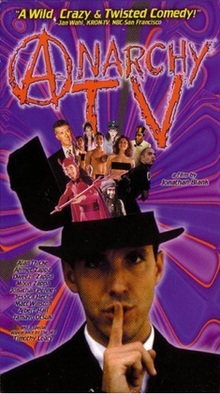
Anarchy TV


Turns out the Revolution will in fact be televised

90s era Anarchists seize control of a public access TV station from its corrupt Televangelist owner and strip naked live on air to protest social conformity and get some ratings for their revolution. Jonathan Blank's independently funded 1998 film was a challenge to find, I discovered its existence looking up the filmography of George Wendt who briefly appears alongside Alan Thicke, Jessica Hecht and the Zappa clan. After finding out about the film and its premise, "Anarchists take control of a public access TV channel to protest a Televangelist and get naked to get viewers" I tried looking it up and could only find a VHS rip.  

From the premise, I was worried I'd be wasting my time with another edgy comedy that littered the 90s indie scene. The kind of film that used shocking behaviour, nudity, sex and swearing as crutches for clever humour and plots that mean things and make consistent sense. I was expecting to waste 90 minutes watching some grainy not quite porn mixed with cheap sets and running joke skits. Luckily, Anarchy TV for all its limitations in budget does not disappoint. It does include nudity, sexuality, swearing and edgy satire, but they all have a point to make and serve the film and are not ploys to get audiences. The VHS rip is quite good considering the age, and I found the film noise and artifacting added to the movie's grungy aesthetics and public access television setting. 

The cast is a bit rough but likeable, I was sympathetic to their plight, and they were refreshingly odd in ways that felt authentic. They're caricatures of 90s American activists, the conspiracy obsessive, the militant sex negative feminist, the free speech crusader who uses jokes and satire as weapons, the survivor of the New Left and civil rights movement who hasn't found their place in the new ideology free 90s. But unlike most caricatures of these types in media, they aren't the objects of scorn and were written and acted by people who were familiar with the real life examples. "Anarchists" and "Anarchy" appear a lot in media, it's just that usually those terms are synonyms for random violence and scary bad things. I was expecting Anarchy TV to be equally sloppy, but again I was proven wrong, these Anarchists might fail the Anarchist tests, they don't quote Bakunin or Emma Goldman, but they're close to the Anarchists that were around in the anti-globalisation fights of the period. They are openly hostile to capitalist society, its values and its power structures, and while they use the common Anarchist dressings and slogans they also make use of more obscure ones, and in ways that are appropriate to the satirical vibes.

Televangelism and business orientated religion is cruel, callous, hypocritical, corrupting, bigoted and reactionary. Anarchy TV makes this point through jokes, but the message is loud and clear. The police are also scum and active participants in repressing non-conformist voices. The TV studio group are arrested after a non-violent protest picket*, the police are openly racist and work with the Televangelist, both because he's in the legal right, and they're being paid by him for some extra muscle. The people that American society treats like trash, the odd balls who find self-expression and meaning through obscure art and performances on TV channels few people watch, sex workers and other criminalised poor people, ethnic minorities etc, can come together, share their depth and talent and value and cause enough disruption to force the proud and powerful to suffer a defeat.

Now for what you've all come for, full-frontal nudity. Yes, there is indeed open and non-simulated nudity in this film. And to this film's credit, it does not fall into that double standard where female nudity is okay and male nudity is taboo, both men and women get naked, and we see everything. Also, the nudity is not actively fetishised, it's quite upfront and honest in how it handles nudity. And as an extra layer, while the nudity is a tactic to get people to tune in and pay attention to their hijacking of the station it is treated as a political act and is shown to have important effects on self-esteem and coming to terms with your own body. Nowadays, nudity is split off into a shocking action of perverts and maladjusted people or gated off in a small cluster of approved and regulated zones like nudist beaches. There was a time when behavioural non-conformity including nudity was considered quite a revolutionary break with societal norms that stifle self-expression and identity. Emile Armand, the French Individualist Anarchist, was an advocate of this tendency "Liberation from one of the main notions on which the ideas of “permitted” and forbidden, of “good” and “evil” are based. Liberation from coquetry, from the conformism to an artificial standard of appearance that maintains the differentiation of classes**." Anarchy TV has the discussion about this tendency and whether it can be a valid form of protest.

The film is not perfect, its jokes hit for me more often than they missed, but I didn't find many of them hilarious, more funny as in clever less funny as in "ha,ha". And there are some 90s context that hasn't aged well. Tamayo Otsuki plays my favourite character Tiffany. She's a sex worker who bounds with the TV crowd and overcomes some of their snobbery over her life, it's her act of solidarity, posting bail that gives the crew their chance to strike back at the man, and it's her openness towards nudity that kicks off the nudity stunt that succeeds in bringing and audience and rallying the community to foil the bad guys. She is depicted as a bit rough compared to Anarchy TV crew and their activist sensibilities, but she isn't stupid nor is she a dupe, she watched their show and is a willing and conscious participant. Unfortunately, as an Asian woman in a 90s comedy, she has one of those joke exaggerated Asian immigrant accents. 

But overall I enjoy the film and believe it deserved a bigger audience. I think the nudity is what cost the film a wider release. As far as I can tell, it never received a DVD release and isn't on any streaming service I can find. The film's distributors were Asylum, yes, that Asylum, the company whose business model is tricking people into buying low effort rip-offs of popular franchises. Qualms about the quality of the final product can't have been the reason for the film's lack of support and distribution, it's far superior to the typical Asylum production. I think this is a rare case of an edgy satire that genuinely went too far for mainstream societies standards and got buried. Nudity, especially male nudity, is still very taboo with few examples outside open pornography.

 *Well, there is actually plenty of violence at the picket line, just that it's the studio staff fighting each other.

** https://theanarchistlibrary.org/library/emile-armand-revolutionary-nudism

Wednesday, 31 January 2024

We live in Pottersville; thoughts on It's a Wonderful Life


Last Christmas, I scratched It's a Wonderful Life off my to watch list. It took me awhile, I suppose it was a combination of never being on TV when I was free at Christmastime and a case of absorbing much of the film via cultural osmosis due to the staggering number of other media spoofing, parodying and tributing the film. I learnt about the key plot twists as a child thanks to the Simpsons and an episode of Johnny Bravo. I was surprised to learn that the bits everyone knows about are only a fraction of the film, and that I still really enjoyed it despite popular culture spoiling nearly every key scene. Initially Jimmy Stewart's performance stunned me since I had been under the impression that his aww shucks and golly gee dialogue and put upon but dogged demeanour combined with that semi-warble line delivery was a product of exaggerated spoofs and not the performance of a Hollywood leading man.

It's a great film, has a good moral, the cast plays their roles excellently, I didn't feel its length and this is nothing new to anyone whose seen the film. All I'll say on that is that if you were like me and were in no rush to see it, give it a go, it'll be a pleasant evening. 

So, with that out of the way, the reason I'm talking about this movie is politics. The film was controversial on release wayback in 1946, the FBI in an early move in the second Red Scare investigated the film on suspicion of it being Communist propaganda. 

There is submitted herewith the running memorandum concerning Communist infiltration of the motion picture industry which has been brought up to date as of May 26, 1947....

With regard to the picture "It's a Wonderful Life", [redacted] stated in substance that the film represented rather obvious attempts to discredit bankers by casting Lionel Barrymore as a "scrooge-type" so that he would be the most hated man in the picture. This, according to these sources, is a common trick used by Communists.

  [redacted] stated that, in his opinion, this picture deliberately maligned the upper class, attempting to show the people who had money were mean and despicable characters. [redacted] related that if he made this picture portraying the banker, he would have shown this individual to have been following the rules as laid down by the State Bank Examiner in connection with making loans. Further, [redacted] stated that the scene wouldn't have "suffered at all" in portraying the banker as a man who was protecting funds put in his care by private individuals and adhering to the rules governing the loan of that money rather than portraying the part as it was shown. In summary, [redacted] stated that it was not necessary to make the banker such a mean character and "I would never have done it that way."

https://web.archive.org/web/20111229215857/http://www.wisebread.com/fbi-considered-its-a-wonderful-life-communist-propaganda#memo1 

 Which is of course total nonsense. Yes, Mr Potter as portrayed by Lionel Barrymore is an absolute scumbag who you're supposed to hate with vehemence, but Jimmy Stewart's character is also a banker. The film isn't Communist at all, Capra the director of the film is throwing his weight behind small scale community oriented capitalism. Bailey Brothers Building and Loans is a bank and its importance as an institution in the town and the hope it provides to the residence of Bedford Falls is salvation through capital investment, the homes they're building and enabling the community to buy come from those investments. 

Potter and Bailey are opposed ideologically, but it's an ideological divide within, the logic of capitalism. Potter represents old monopoly capitalism, he spends the film trying to destroy the Bailey Brothers because they are the one sole form of competition in the area, so he as the big established capitalist uses every advantage he has to break the rival bank, and when that fails he just steals from them to try and deal the killing blow. I think what really got the FBI and its informant [REDACTED] ornery was that Potter, the villain, is representative of the American system, he's the typical capitalist and so criticism of how he acts and behaves is criticism of officially sanctioned America. He also doesn't face any punishment for his many morally and ethically dubious but often legal actions. I don't know if Frank Capra was consciously aware of just how damning that is a judgement of American society. The film shows us that the established powers in America can use that power to crush the good in society out of personal spite or paranoia over a potential competition, and they can do that with impunity. 

The real tragedy is that in the real world, the Potters won.  Credit Unions, community and co-operative banks still exist in the present and some have grown to some size, but compared to the banks' ala Potter? Pebbles next to mountains. The successful stakeholder initiatives increasingly morph into or sell to the big banks, which are now so big and concentrate so much capital that they can plunge the whole global economy into recessions when they screw up. And closer to home, the Potters won the battle for the film. 

It's a Wonderful Life didn't just annoy the FBI, it did poorly with the critics and was a box office disappointment. It languished in obscurity and was such a low priority that when the copyright was up for renewal in 1974 it was botched, pushing the film into the public domain.  Thanks to that clerical error that led to the film's eventual rise to classic status and beloved fixture of American holidays. TV stations could air the film in exchange for royalties to the owner of the copyright of The Greatest Gift, the 24-page source material, which still made it much cheaper to show than most alternative films. This also probably played a role in why the film is so widely referenced, parody is protected under the doctrine of Fair Use, copyright can still provide grounds for offended rights holders to make it not worth the trouble.

Republic Pictures used its ownership of the copyright to the source material to clamp down further on the distribution of the film, effectively forcing it back into copyright. Republic Pictures had closed down in the 1960s and was revived in the 80s due to business restructuring, shortly after reclaiming It's a Wonderful Life they were folded up into Viacom. No one who worked on the story or the film is connected with the royalties and fees that are accrued by the film today. The cinematic community has been robbed of the film thanks to the power of large corporations to influence the legal system of the United States with their large law firms and lobbying agents. 

I suppose It's a Wonderful Life has some solace for us, in the film Potters triumph as bleak as it is not the end of the struggle, George Bailey doesn't give into despair despite the many trying obstacles, he earns his happy ending and we can too.


Friday, 5 January 2024

Watching Tank Police in a post-2016 World


That's right, horrified at the way things are going I've embraced a period of escapism and watched a horrifying speculative future 2010s where the police have the firepower of militaries, the world is heavily polluted, the politicians only care about re-election and corporations believe employment contracts give them the right to control their employees own bodies. In hindsight, that wasn't the best plan I've authored.

It's the holiday period, and I've caught several winter bugs over the past two months. So in addition to having time off, an erratic sleep pattern and semiregular periods of imposed isolation has led to quite a bit more time on my hands than I had planned for. And I filled part of the hiatus catching up on a backlog of films and television. I finally scratched a few things off my list, including It's a Wonderful Life, and also today's topic for discussion Dominion Tank Police, and its sequel (kinda) New Dominion Tank Police. The Tank Police OVAs have been on my list for some time, why the long wait? Well, a combination of them being in limited availability in my markets and a reputation for not being great pieces of entertainment. What fanbase they do have is largely thanks to being early action Sci-Fi anime that were licensed internationally, and being based on Manga by Shirow Masmune, the creator of Ghost in the Shell didn't hurt either. They also benefited by the existence of Anna and Uni Puma who are androids, sisters and Cat girls. 

Apart from that, both shows have their issues, the first series from the late 1980s is quite cheap, the animation can be choppy and reuse of assets is obvious, the dubbing itself is also a bit spotty, some of the voice acting feels weak, and the dialogue sounds weird. It also struggles with tone, it's a rather cynical take on cyber punk futures and cop dramas with very crude humour and extremely hard to like protagonists. Only to drop most of the jokes and refocus attention on a comedic fool villain (Buaku) and his tragic past at the end. Oh, and it ends on a cliffhanger that is not followed up on in New Tank Police.

New Tank Police on paper has a lot more going for it. Released in the mid 90s, it looks more professionally made, the characters have more detail, the animation is smoother, and I didn't notice much reusing and recycling of previous footage. The dialogue sounds a lot more like things people would actually say, and the cast who are the same voice actors who worked on Tank Police either gained more experience and confidence in the years between releases, or they received a lot more support direction wise. And the action set pieces have more going on too, most of the action in the first series were basic chases with some gag stunts thrown in. In New Tank Police, there are clever escalations and use of vertical space. 

And yet, and yet, I found myself having stronger feelings for the choppier and cheaper series. Which is a little odd since that show's four episode run goes from stealing jars of piss and anti-tank mines that are dick jokes - yes I am serious- to a sad look at the life of a hairy android crook for hire whose stealing a piece of fine art and risking his life, not for the massive pay-off, but because he was the subject of that painting, and it depicts his early life in a lab where he was physically and mentally tortured since creation by uncaring scientists who used him as raw material for experiments. So, as far as he (Buaku) is concerned it's his by right, oh, and it also contains hidden data that can prove the existence of that experiment and the existence of his fellow lab mates who did not survive and escape the lab. It's extremely sad, and it makes it perfectly crystal clear just how crooked, horrible and miserable this world is. 

New Tank Police, well Lenoa Ozaki the female cop on the top image and the protagonist of the franchise has to investigate the murder of an old friend on the motorcycle police, and there's some corporate scheming going on with cyborg henchmen. It's perfectly fine sci-fi with a cynical edge where the protagonists are cops. It's perfectly fine, didn't get very engaged with it, wasn't put off by it. I did find it slightly amusing to learn that New Tank Police took place in 2016, well, I found it funny at first, now I'm a little sad.

Speaking of sad, I was surprised to see how different the Cat Women were to what I had been primed to expect from the marketing. The Puma sisters were the breakout characters of this franchise, most marketing material I've found about these two series heavily pushes them, sometimes to the exclusion of tanks and police. I suspect quite a few people who watched these two miniseries were quite disappointed. Yes the Puma sisters appear frequently, yes they wear costumes that are usually revealing, and they do a striptease. Just the one though, and it's depicted as very goofy if many cutaways to reaction shots of SWAT police behaving like the Wolf from those Tex Avery cartoons. 

No, they don't wear anything like that in the show. And not to get into a slap fight with TV Guide, but the word sometimes is doing the heavy lifting in that quote.


There are raunchy anime OVAs, but the Tank Police ones are not in that number. The sister's main contributions were comedy and then some tear-jerking because as androids they are treated very poorly by society. They're in Buaku's gang because that's the only prospect of regular money that they can get that isn't stripping. And in New Tank Police where Buaku is completely absent, they sleep in an underground car park and have nothing going for them except more crime. Even when they move over into sort of doing the right thing territory, they get hassled and harassed by the Tank Police anyway.

Having watched both, I now understand why it's largely been relegated as an artefact of the 90s-early 2000s. Though watching in 2023 I think it may have aged pretty well. It's a cynical franchise where the label hero doesn't fit anyone comfortably, and the protagonists would be denounced and avoided if they were real people, but here the violence and cruelty is softened with crude humour and a strong distrust of everyone and everything. Like how the Home Alone movies use slapstick sensibilities and heart string tugging to take the sting out of scenes of Kevin McCallister throwing bricks at Daniel Stern's head. 

Grenade torture, Dominion Tank Police's first running joke

Despite this, unfortunately, the march of time has shown that its depictions of cops as a bunch of self obsessed jerks and violent thugs barely qualifies as satire. The first four minutes of the first episode of Tank Police is a back and forth shouting match between two characters, the mayor and the Chief of Police, the Mayor is furious that the Tank Police are causing so much damage to the city while the Chief couldn't care less about that and is demanding even more dangerous and powerful weapons. Since the 1980s, police forces across the world have been showered with military grade weapon systems, including armoured vehicles, so Main Battle Tanks aren't so farfetched. 

https://www.theguardian.com/world/2020/jun/05/why-are-some-us-police-forces-equipped-like-military-units
How about the attitude? Well, the Tank Police are depicted as selfish arseholes who only bother to fight crime because they view the activities of criminals as a direct challenge to them personally. In the first Tank Police episode, the captain of the force is lecturing Lenoa and another rookie on how the most important thing is to preserve their Tanks. There's a violent incident every 36 seconds on average in that city, and if they were too active in responding, they'd soon be worn down. He even overrules the rookies who which to answer a call for back up from the SWAT police, since he views his fellow police officers with contempt. He only bothers to try and stop Buaku's gang when they rear end his Tank and thus insult him personally.

Lenoa is no better, unlike the Captain she doesn't subscribe to How to Kill magazine, but once her Tank gets scratched in yet another grenade "Interrogation" scene which she set up she tries to gun down an unarmed prisoner who is suspended from a game show spin wheel. She sort of sees Buaku as a person by the end of Tank Police thanks to how that plot line goes, but she's more than willing to kill and torture anyone who runs afoul of her. Many cop centred media products deal with abuse of power and usually covers for it with some appeal to pragmatism or threatening potential outcome, if the detective doesn't murder the child murderer the bill of rights and lawyers will set them free, or there's a ticking time bomb and people's lives are at stake so they had to beat the suspect until they can't walk any more, or show that the bad things made the police feel bad about doing them.

Tank Police throws all of that out of the window. The criminals who get the grenade treatment are bad people who admit to horrible actions, but it's crystal clear that the "interrogations" were excuses for the Tank Police to torture people for fun. One of them confesses to multiple murders, which they didn't ask him about because they didn't know anything about them. When they deploy they frequently level the City, they in fact do much more damage to than the criminals do, and they are fully aware of this and do not care about it. They don't even like supporting fellow police officers, Lenoa's dramatic climax is using her damaged Tank to shut a civilian jet out of the air, killing everyone on board. The passengers are shady corporate criminals, but she's avenging a friend and has no real interest in whatever their scheme was. Make the Tank Police into a rival gang with better connections to international arms markets and nothing much changes in how they operate. You could even keep the paperwork jokes and change them to being compensation payments that are deducted from their protection racket income. Which is functionally what taxes to pay for the police are.

So, surely this level of callous self interest must be a product of cynical imagination, right? Well, in the United States of America the doctrine of Qualified Immunity protects police officers in what are blatent examples of brutality. 

To push Brooks to step out of her car, one of the officers pulled out a Taser and asked her if she knew what it was. She didn’t, but told the officer she was seven months pregnant. The officers chatted in front of her, casually discussing which part of her body they would tase: “Well, don’t do it in her stomach,” one of them said, “do it in her thigh.” The officers twisted Brooks’s arm behind her back and tased her three separate times—first on her thigh, then in the arm, and then in the neck—before dragging her into the street, laying her face down, and cuffing her.Brooks sued the officers to hold them accountable for their conduct. Six federal judges agreed that the officers’ use of severe force absent any threat to their safety violated the U.S. Constitution. But those same judges dismissed her case, relying on a legal doctrine called “qualified immunity.” Qualified Immunity Explained

 And said actions of brutality are not uncommon. Furthermore, funding these police forces is draining multiple city budgets.

https://www.statista.com/chart/10593/how-much-do-us-cities-spend-on-policing/
And as for giving a damn about other people, well they haven't done that for a long time if they ever did. Currently as I'm writing this in the United Kingdom every month there's another reveleation that police forces especially the Metropolitan have been harbouring and covering for murderers and rapists within there ranks. And Uvalde Texas showed the world that over 400 police officers from multiple forces including special tactical response units with military grade equipment will just stay in cover listening to gunfire and calls for help from schoolchildren for over an hour before deciding they had enough strength assembled to intervene. The shooter entered the school at 11:30 am and wasn't confronted and eliminated untill 12:50. At the start of the attack there were 19 officers inside the school building the majority of the back up stayed outside for the duration.

Practically the only thing that still science fiction about the Tank Police franchise is that we don't have fully sapient Cat Women gynoids and anti-tank mines that humoursly flip the tank over like a Chef's spatula only more phallic. We're stuck with weird walking dog leg robots and anti-tank mines that explode and maim or kill everyone in the vicinity. Once again reality has ruined a joke.

Popular Posts