Search This Blog

Showing posts with label sports. Show all posts

Wednesday, 1 December 2021

Notes on the life of Eduardo Vivancos 1920-2020; Almost a century in the Libertarian and Esperanto movements

A version of this article first appeared in Liberte Ouviere un Journal Anarcho-syndicaliste


Notes on the life of Eduardo Vivancos

1920-2020

Almost a century in the Libertarian and Esperanto movements

Reddebrek

2021


“Paroli Esperanton estis iam esenca parto de anarkiismo.”

(There was a time when speaking Esperanto was an essential part of being an anarchist.)

On the 30th of December 2020 Eduardo Vivancos passed away at the age of 100. He leaves behind a family and nearly a century of dedication to a number of causes, from athletics, Anarchosyndicalism, and minority languages, especially Catalan and Esperanto. I think his life is worth remembering, and while in the Spanish speaking world his death was marked with numerous tributes and retrospectives, including a feature in Corredor a popular magazine dedicated to running, and a lot of friends mourned him in Esperanto texts, he is largely unknown in English. A short blog post I wrote to mark his passing is the first hit when his name is searched in English, though there was also an article in Fifth Estate #400 written in 2018 by his fellow Esperantist Xavier Alcade that serves as a short introduction. Personally speaking, Vivancos’s writing was some of the first I read in Esperanto that I could mostly understand that wasn’t written as a teaching tool, though Vivancos did dabble in that as well. I suppose I should credit Vivancos with pushing me from viewing the language as a hobby into something to be taken seriously.

The son of Domingo Vivancos, Eduardo Vivancos was born into a working-class family in Barcelona on the 19th of September 1920. In 1934, shortly before his fourteenth birthday, Vivancos left elementary school and became an apprentice. In September of that year Vivancos had also enrolled in a worker’s school (Escuela del Trabajo) which held classes in the evenings. While at the school he mixed with a group of young workers who were members of the Iberian Federation of Libertarian Youth (FIJL) an organisation that he would join along with becoming a member of the Student Federation of Free Thinkers (Federacion Estudiantil de Concienecias Libres).

A year later Vivancos would join the Confederacion Nacional del Trabajo (CNT), he would remain a member of the CNT for the rest of his life. In 1936 Vivancos looked forward to the People’s Olympiad that was being prepared in Barcelona as an alternative to the official Olympics that were being hosted in Berlin. The first piece of writing I read by Vivancos were his recollections of those days when he would go to the training grounds and practice and mingle with hundreds of foreigners from dozens of nations. The enthusiasm of the time made a big impact on him, unfortunately there preparations for the games coincided with the beginning of the bloody civil war and the appearance of Franco as a political leader. The games were not only called off at the last minute by news of the revolt of the Spanish army, but the preparations for the games had also been targetted by a campaign of fascist sabotage and intimidation.

During the Spanish Revolution and Civil War Vivancos initially focused on his studies, enrolling in the Ateneo Enciclopedico Popular, where among other subjects he was taught Esperanto. He would remain an active Esperantist for the rest of his life, often combining it with his activism with the Libertarian movement. In 1937 the Spanish Republic created a number of Worker’s Institutes (Institutos Obreros) a high school system for workers, Vivancos passed the entrance exams in December 1937 and enrolled. However the war situation continue to get worse for the Republic and so in 1938 Vivancos and some fellow class mates from the institute volunteered to serve in a battalion of the 26th division of the Durruti Column and served at the Montsec front and saw combat at the battle of Lleida, and participated in other operations.

Whilst serving in the 26th division Vivancos was part of a small teaching and correspondence circle of Esperantists which included Gines Martinez the battalion commander. At the time most of the Spanish left and Libertarian movements had embraced Esperanto and were publishing Esperanto newspapers. From the Communist Party of Spain, to the Workers Party of Marxist Unification (POUM) the CNT and other Anarchist groups, and even the General Government of Catalunya, all were actively using the language to broadcast news to the outside world and establish contacts with sympathetic foreigners. In response to this the Esperanto movement was singled out for bloody persecution within Fascist zones. An example of this repression was the fate of the Esperanto club in Cordoba, the Fascist Falange party organised a firing squad and murdered its entire membership.

Unfortunately as we’re all aware, the war continued to go badly and the revolution continued to retreat, by February 1939 Vivancos along with thousands of other committed anti-fascists had to escape Spain to France. Vivancos did this on foot, crossing the Pyrenees in winter. While in France the Vivancos family were separated and sent to concentration camps that had been built by the French government to house Spanish refugees. He was moved from one camp to another over several years, at one point in 1940 he was billeted in the same barracks as the famous Catalan author and poet Jaume Grau Casas, the author of Catalan Anthology and many other works. The two communicated almost exclusively in Esperanto, if anything the incarceration and constant transferring seem to have boost Eduardo Vivancos’s studies and teaching of the language.

The Vivancos family were not reunited until after the Second World War in 1947, by that time Eduardo had met and fallen in love with fellow Spanish exile Ramona Comella, the two married in Paris on the 5th of December 1945, they had two children, Floreal (1947) and Talia (1948). While in Paris Eduardo Vivancos joined the World Anational Association the Sennacieca Asocio Tutmonda or SAT, and organisation of left-wing Esperantists of many tendencies from around the world.

Also in the aftermath of WWII the Spanish Libertarian movement began to reorganise itself and planned out strategies to resist the entrenched Franco dictatorship. As part of this process, the FIJL had decided to build an international federation for Anarchist youth. As part of this project Vivancos was made a delegate of the Spanish section. Unfortunately, this plan did not progress much further due to the global weakness of the Anarchist movement at that time. A more substantial attempt at international networking was the founding of two Esperanto language newspapers the Nigra Flago (Black Flag) and Senŝtatano (Without a State), Vivancos was a contributor to both and editor of Senŝtatano. This activity would bear some fruit, the correspondance service of Senŝtatano sucessfully exploited a relaxation in hostility to Esperanto by the Spanish government to send letters to Spain, this reconnected many exiles with family and friends still living under Franco. And the contact with foreign Libertarian minded Esperantists like the Chinese anarchist Lu Chen Bo and the Japanese anarchist Taiji Yamaga led to increased co-operation in many ways. In 1963 Eduardo Vivancos and Taiji Yamaga worked together to produce a Spanish translation of the famous Chinese philosoper Laozi’s Dao de Qing, it was titled “Libro del Camino y de la Virtud”, Book of the way and Virtue in English.

In 1954 Vivancos emigrated to Toronto Canada and would remain a resident until his death in 2020. He maintained his commitment to his two life causes Esperanto and Anarchism and his opposition to Franco while living in Canada. He joined the Asociacion Democratica Espanola Canadiense ADEC, a group for anti-francoist Spanish migrants and exiles living in Canada. As a member, he attended demonstrations and organised meetings. Eduardo Vivancos would return to Spain in 1976 after a 37-year exile, when the Francoist regime crumbled and a stilted democratic transition was taking shape. He would make many visit to Spain and the Catalunya region throughout the remainder of his life. In 1986 he gave a lecture to the 59th Congress of SAT in San Cuget on the 5oth anniversary of the Spanish Civil War, the lecture drew heavily from his recollections of the atmosphere and conditions on the streets of Barcelona and the Spain in 1936.

At the end of his life Eduardo Vivancos received many honours from SAT and the wider Esperanto community, and with nearly a hundred years of dedicated activity including on the front-lines on a mountain range it’s not hard to see why. But I also find his writing and the way he was able to use Esperanto to support the goals of international solidarity and libertarian resistance very inspiring too. I said at the start that Eduardo Vivancos is little known in the Anglosphere, I hope to correct this. In addition to writing up this short memorial, I am also translating his Esperanto texts in English and working on an English language wikipedia article to complement the already existing versions in Spanish, Catalan and Esperanto. By doing this, I hope others will learn of him and an be inspired.


Monday, 22 February 2021

Olimpiaj ludoj en Barcelono: Eduardo Vivancos - Olympic Games in Barcelona by Eduardo Vivancos


Olimpiaj ludoj en Barcelono: Eduardo Vivancos


Olympic Games in Barcelona


Article about the Popular Olympic Games of Barcelona 1936, written by a would be participant. 

Written in the Catalan language in 1992 and published in the same year in the magazine Flame, the official publication of the Catlunyan Association of  Toronto.

"The most important thing about the Olympic Games is not to win, but to participate"

Pierre de Coubertin

Thanks to the 25th Olympic Games Barcelona became the focus of millions of people from around the world. It seemed as if Barcelona had been rediscovered. Everyone was talking about it. The newspapers and television showed pictures that seemed to come from the land of marvels. Pictures of the whole city, of its characteristic monuments, its Gothic cathedral, the Olympic village, the newly completed Palace of Saint Jordi, of the many sports grounds and racing tracks and the Olympic stadium of Montjuic. Oh, the stadium of Montjuic! For people of my generation that building is full of memories and a certain sense of nostalgia. My mind revisit the stadium as it was 56 years ago (1936). Groups of enthusiastic and illusion filled youths would journey to it everyday to train for the chance to qualify for the youth contests of the Olympic games of Barcelona. Yes, I say it well, the Olympic Games of Barcelona, which had to happen in 1936, though in the present time you don't hear many mentions of this significant event. 

But before we continue on the history of that Olympics, sadly frustrated by tragic circumstances, let us turn the page of the book of time and briefly look at the history of the modern Olympic Games. The initiator of the games was the Frenchman Pierre de Coubertin, a sincere humanist who believed that the participation of people from the whole world in sporting competitions would carry the spirit of friendship, brotherhood, and mutual understanding between the athletes, from whatever ethnic origin, faith or social position they are. We must keep in mind that sadly these idealistic goals of Pierre de Coubertin were often only partly realised and that the Games were often compromised from terrible political manipulations, racism, furious nationalism, intolerance, unchecked corruption, and the desire to win at any cost and the use of methods not completely ethical. Contrasts with the desires of de Coubertin when he declared "The most important thing in the Olympic Games is not to win, but to participate; the most important thing in life is not the triumph but the efforts used to obtain it".

The ideal which Pierre de Coubertin proposed to the participants is not identified with the victory alone, but with the chivalrous spirit of the sport, its generous practice, the kind acceptance of fate, whether favourable or unfavourable, the friendly co-operation between nations, ethnic groups and individuals in general, precious moral elements that the public can also appreciate.

The first modern Olympic Games took place in Athens in 1896, and since than excepting the years of the two world wars it happens every four years in a different city. Since the beginning of the Olympic movement Barcelonans have shown great interest in the Olympic Games. In 1929 construction began on the stadium of Montjuic with the intention of developing the necessary infrastructure to host them. Consequently Barcelona presented it self as a candidate to host the 11th Olympics to be held in 1936.

The International Olympic Committee met in Barcelona in 1931, but could not reach a consensus. In 1932 a year later they reconvened in Los Angeles and chose Berlin by ballot. That city received 43 votes to 16 for Barcelona and 8 abstentions. In that time Germany was governed by a centrist regime and had given an impression that it could organise the Games while guaranteeing a freedom from partisanship. However, in January 1933 Adolph Hitler captured state power and immediately began drafting racist laws. Political neutrality was already made impossible despite the promises made by Hitler to Baillet-Letour the president of the International Olympic Committee. 

On the 5th of September 1935, Hitler passed the Nuremberg Laws, which stripped Jewish people of their German citizenship, at the same time he intensified cruel persecutions against his political opponents. These circumstances created an atmosphere of general fear. Many athletes refused to be made instruments of the Nazi propaganda machine. In many countries committees were created with the aim of finding an alternatives to the games in Berlin. The logical place for this was Barcelona, which as we've seen above had already prepared its candidacy to host the Olympic Games several years before. Consequently the Committee for the Popular Olympiad of Barcelona was created, Josep Antoni Trabal was its President; its secretary was Jaume Miravitlles a councillor for the Autonomous Catalan Government (Generalitat de Catalunya). The date from the 19th until the 26th of July. Soon athletes wishing to participate arrived from France, the United States, Switzerland, Belgium, Canada, Greece, Sweden, Morocco and many other countries. For obvious reasons, no registrations came from Germany, but in return many Germans who lived abroad and for whom participation in the Berlin Games were of course barred did arrive to register.

Saturday afternoon, the 18th of July the stadium of Montjuic is already boiling with activity. Many foreign athletes are found here training and getting to know other participants of the Games. Also there are many young Barcelonans, members of the sports department of the People's Encyclopaedic Athenaeum of the Barcelona workers school and from other local clubs. These young people had to practice gymnastic exercises in order to be presentable tomorrow. The contacts between both groups was extremely enlightening and full of teaching despite the evident language barriers. Not many of foreigners could speak Spanish. Some whispered words just learnt and terribly pronounced, which caused amusing misunderstandings. For myself I was able to make use of my limited knowledge of the French language but often unsuccessfully. Most often kind gestures and warm handshakes replaced words.

The atmosphere was very brotherly. For the first time I was able to talk directly to people from other countries. That experience strengthened my convictions about true friendship between people from the most diverse places. Enthusiasm and euphoria hovered above the stadium, but unfortunately mixed with a feeling of anticipation and stress. During the whole day we heard constant alarming news of an army rebellion. The government claimed that everything was under control, but few were convinced of this assertion. When the youths arrived to prepare for the gymnastic exercises one of the organisers mournfully announced "Fascist hands had sabotaged the electric works, but they would soon fix the damage and tomorrow would inaugurate the Games".

Parallel to the sporting contests a Cultural Olympics was being organised with many folk events and presentations. Amongst the participants of this Cultural Olympics was the world famous Cellist Pau Casals.

On the evening of July 18, Pau Casals conducted the rehearsal of Beethoven's Ninth Symphony, which the orchestra, in collaboration with the singers of the famous Barcelona Choral Society (Orfeó Gracienc), was to play the next day at the Greek Theatre of Montjuic on the occasion of the inauguration of the Olympic Games. During the rehearsal, an official appeared in an excited voice and said, “Stop the rehearsal. We have been informed that there will be a military uprising across the country tonight. The concert and the Olympics are cancelled. Leave the place at once. ”

This announcement caused Casals great consternation. He turned to the musicians and singers and said "I do not know when we will meet again, so I propose to you that before we depart that we finished the rehearsal and continue to play the symphony together". and raising the baton continued the rehearsal culminating in the final part which reads as follows: 

Here is a hug to thousands, 

here’s a kiss to the whole world!

Brothers! above the starry canopy ’’

"What an emotional moment, what a contrast" recalls the maestro some years later "We sang the sublime hymn of brotherhood, while on the streets of Barcelona, and of many other cities, a struggle was being prepared which should shed so much blood. ”

The choir also rehearsed the anthem of the People's Olympics composed by the poet Josep María de Sagarra. This hymn was to be sung in front of thousands on the 19th of July.

Under the blue sky

The sole impactful word

Cried joyously, Peace!

But instead of hearing the hymn of peace, on that day Barcelonans heard the sound of ceaseless gunfire, and at five thirty in the morning a heart-breaking call from the Barcelona radio station "Barcelonans! the terrible moment has come to pass; the army, treacherous in spite of its honourable words has rebelled against the Republic. For the people of Barcelona now is the hour of great decisions and great sacrifices: destroy the rebel army! Every citizen must be prepared to fulfil their duty. Long live the Republic!"

Many of the athletes who had travelled to Barcelona to take part in the Olympic Games remained, and actively took part in the struggle against fascism: Some of them would never set foot in a stadium again. And so ended before it began was the fate of the People's Olympiad of Barcelona that had been so full of hope. Prepared for with much enthusiasm and love, by people with good wishes who truly believed in the humanist olympian ideal. 

Artikolo pri la Popolaj Olimpiaj Ludoj de Barcelono, verkita de partopreninto, Eduardo Vivancos.


Artikolo verkita katalunlingve en la jaro 1992 kaj aperinta samjare en la revuo “Flama”, organo de la Kataluna Asocio de Toronto.


Quote:

“Plej grave en la Olimpiaj ludoj ne estas gajni, sed partopreni”

Pierre de Coubertin


Dank’ al la XXV Olimpiaj Ludoj Barcelono iĝis la celpunkto de la rigardoj de milionoj da personoj ĉie en la mondo. Ŝajnas ke Barcelono estis reeltrovita. Ĉiuj parolas pri ĝi. La gazetaro kaj televido montris bildojn kiuj ŝajnas veni el lando de mirindaĵoj. Bildoj de la tuta urbo, de ĝiaj karakterizaj monumentoj, de la Gotika Kvartalo, de la olimpika vilaĝo, de la ĵus konstruita Palaco Sant Jordi, de la multnombraj sportaj instalaĵoj kaj de la olimpika stadiono de Montjuic. Ho, stadiono de Montjuic! Por multaj personoj de mia generacio ĝi estas plena je memoroj kaj de certa nostalgio. Mi mense revidas tiun stadionon kia ĝi estis de antaŭ 56 jaroj (1936). Grupoj da entuziasmaj kaj iluziplenaj gejunuloj iris tien ĉiutage por sin trejni kun la celo kvalifikiĝi por partopreni en la porjunulaj konkursoj de la Olimpiaj Ludoj de Barcelono. Jes, mi bone diras, la Olimpiaj Ludoj de Barcelono, kiu devis okazi en la jaro 1936, kvankam nuntempe oni ne multe mencias pri tiu signifoplena evento.


Sed antaŭ daŭrigi pri la historio de tiu olimpiado, bedaŭrinde frustrita pro tragikaj cirkonstancoj, ni turnu la paĝon de la libro de la tempo kaj mallonge ni trarigardu la historion de la modernaj Olimpiaj Ludoj. La iniciatanto de la Ludoj estis la franco Pierre de Coubertin, sincera humanisto kiu kredis ke partopreno de homoj el la tuta mondo en sportaj konkursoj alportus spiriton de amikeco, frateco kaj komprenemo inter la partoprenantoj el kiu ajn etna deveno, kredo aŭ socia pozicio ili estas. Ni notu ke, bedaŭrinde, la idealismaj celoj de Pierre de Coubertin nur parte realiĝis kaj ke la Ludoj estis ofte falsigitaj pro aĉaj politikaj manipulacioj, rasismo, furioza naciismo, netoleremo, senbrida komercismo kaj la ambicio gajni je ĉiu kosto, uzante rimedoj ne tre etikaj, kontraste kun la deziroj de Coubertin kiam li diris: “Plej grave en la Olimpiaj ludoj ne estas gajni, sed partopreni; plej grave en la vivo ne estas la triumfo, sed la klopodo por ĝin atingi.”


La idealo kiun Pierre de Coubertin proponis al la partoprenantoj, ne identiĝas al la sola venko, sed al la kavalireca spirito de la sporto, ĝia sindonema praktiko, la afabla akcepto de la sorto, ĉu favora, ĉu malfavora, la amikeca kunlaborado inter nacioj, etnoj kaj individuoj ĝenerale, celoj kiuj enhavas altvalorajn moralajn elementojn kaj kiujn la publiko ankaŭ scias apreci.


La unua moderna Olimpiado okazis en Ateno en la jaro 1896, kaj ekde tiam, escepte dum la jaroj de la du mondmilitoj, ĝi okazas ĉiun kvaran jarojn en malsama urbo. Ja ekde la komenco de la olimpia movado la barcelonanoj montris grandan intereson por la Ludoj. Kiam en la jaro 1929 konstruiĝis la stadiono de Montjuic, la intenco estis posedi la bezonataj strukturoj por povi ilin organizi. Konsekvence Barcelono prezentis, siatempe, la kanditatecon por organizi la Ludojn de la XI-a Olimpiado de la jaro 1936.


La Internacia Olimpia Komitato kunvenis en Barcelono en la jaro 1931, sed ĝiaj membroj ne atingis interkonsenton. Unu jaro poste, en 1932, la komitatanoj renkontiĝis en Los Anĝeleso kaj per balotado ili elektis Berlinon. Tiu urbo ricevis 43 voĉdonojn, kontraŭ 16 por Barcelono kaj 8 sindetenoj. En tiu tempo Germanio havis politike centrisman reĝimon, kaj donis la impreson ke ĝi povis organizi la ludojn kun certa garantio de senpartieco. Sed en januaro de 1933 Adolf Hitler kaptis la ŝtatan povon kaj tuj li enkondukis rasistajn leĝojn. La senpartieco jam ne eblis malgraŭ la promesoj faritaj de Hitler al Baillet-Latour, prezidanto de la Internacia Olimpia Komitato.


La 5-an de septembro de la jaro 1935 Hitler proklamis la leĝojn de Nuremberg senigante la judojn de la germana civitaneco, kaj samtempe li intensigis kruelan persekuton kontraŭ siaj politikaj oponantoj. Tiaj cirkonstancoj kreis etoson de ĝenanta timo. Multaj sportuloj rifuzis iĝi instrumentoj de la nazia propaganda maŝino. En multaj landoj kreiĝis komisionoj kun la celo trovi alternativojn al la ludoj de Berlino. La logika loko estis Barcelono kiu, kiel ni jam vidis supre, kandidatiĝis por la organizado de la Olimpiaj Ludoj kelkajn jarojn antaŭe. Konsekvence kreiĝis la Komitato de la Popola Olimpiado de Barcelono kies prezidanto estis Josep Antoni Trabal; la sekretario estis Jaume Miravitlles, konsiliano de la aŭtonoma kataluna registaro (Generalitat de Catalunya). La dato: de la 19-a ĝis la 26 de julio. Baldaŭ alvenis aliĝoj el Francio, Usono, Svisio, Belgio, Kanado, Grekio, Svedio, Maroko kaj multaj aliaj landoj. Pro evidentaj motivoj ne venis aliĝoj el Germanio, sed kompense aliĝis multaj germanoj kiuj loĝis eksterlande kaj por kiuj la partopreno en la ludoj de Berlino estis kompreneble barita.


Sabate postagmeze, la 18-an de julio, la stadiono de Montjuic bolis je aktiveco. Multaj alilandaj atletoj troviĝis tie por trejniĝi kaj por interkonatiĝi kun aliaj partoprenantoj de la Ludoj. Ankaŭ tie troviĝis multaj barcelonaj junuloj, membroj de la sporta fako de la Popola Enciklopedia Ateneo, de la Barcelona Laborlernejo kaj de aliaj lokaj kluboj. Tiuj junuloj devis praktiki gimnastikajn ekzercojn por esti prezentataj la morgaŭon. La kontaktoj inter ambaŭ grupoj estis ege interesaj kaj instruplenaj malgraŭ la evidentaj lingvaj problemoj. Ne multaj alilandanoj scipovis paroli hispane. Kelkaj fuŝparolis vortojn ĵus lernitaj kaj terure prononcitaj okazigante amuzajn miskomprenojn. Mi mem klopodis uzi mian limigitan konon de la franca lingvo, sed kun ne multe da sukceso. Plej ofte afablaj mienoj kaj varmaj manprenoj anstataŭis vortojn.


La etoso estis tre frateca. Por la unua fojo mi havis la okazon rekte rilati kun alilandanoj. Tiu sperto plifortigis miajn konvinkojn pri vera amikeco inter homoj el la plej diversaj devenoj. Entuziasmo kaj eŭforio ŝvebis super la stadiono, sed bedaŭrinde miksita kun sento de antaŭtimo kaj streĉo. Dum la tuta tago oni konstante aŭdis alarmajn novaĵojn pri armea ribelo. La registaro asertis ke ĉio estis sub kontrolo, sed ne multaj estis konvinkitaj pri tiu aserto. Kiam la junuloj pretiĝis por la gimnastikaj ekzercoj, unu el la organizantoj morne anoncis: “Faŝistaj manoj sabotis la elektran instalaĵon. Ni solvos la problemon kaj morgaŭ ĉio estos preta por la inaŭguro de la Ludoj”.


Paralele kun la sportaj konkursoj organiziĝis Kultura Olimpiado kaj estis preparitaj multnombraj folkloraj prezentadoj. Inter la partoprenantoj de la kulturaj aktivaĵoj troviĝis la famkonata violonĉelisto Pau Casals.


La vespero de la 18-a de julio Pau Casals direktis la provludon de la Naŭa Simfonio de Beethoven kiun la orkestro, kunlabore kun la kantistoj de fama Barcelona Ĥorsocieto (Orfeó Gracienc), devis ludi la morgaŭon en la Greka Teatro de Montjuic okaze de la inaŭguro de la Olimpiado. Dum la provludo prezentiĝis oficialulo kiu per ekscitita voĉo diris, “Ĉesigu la ludprovon. Ni estis informitaj ke ĉinokte okazos armea ribelo en la tuta lando. La koncerto kaj la Olimpiado estas nuligitaj. Tuj forlasu la ejon.”


Je tiu anonco Casals forte konsterniĝis. Li sin turnis al la muzikistoj kaj kantistoj kaj diris: “Mi ne scias kiam ni renkontiĝos denove; mi proponas al vi ke antaŭ la disiĝo ni ĉiuj kune ludu la simfonion”, kaj levigante la taktobastonon daŭrigis la provludon kulminante je la fina parto kiu tekstas jene:


Jen brakumo al milmiloj,

jen ĉi kis’ al tuta mond’!

Fratoj! super stela rond’…


“Kia emocia momento! Kaj kia kontrasto” memoris la majstro kelkaj jaroj poste. “Ni kantis la subliman himnon de la frateco, dum sur la stratoj de Barcelono, kaj de multaj aliaj urboj, prepariĝis lukto kiu tiom da sango devus verŝigi”.


La ĥorgrupo ankaŭ estis provludinta la himnon de la Popola Olimpiado verkita de la poeto Josep María de Sagarra. Tiu himno devis esti kantata antaŭ miloj da personoj precize la 19-an de julio:


Sub la blua ĉielo

la sola trafa vorto estas

ĝojkrio, Paco!


Sed anstataŭ aŭdi la himnon de la paco, en tiu tago la barcelonanoj aŭdis la sonon de senĉesa pafado, kaj je la kvina kaj kvarono matene, korŝiran alvokon per la Barcelona radiostacio: “Barcelonanoj, la timita momento jam alvenis; la armeo, perfidante sian honorparolon, ribeliĝis kontraŭ la Respubliko. Por la barcelona popolo alvenis la horo de la grandaj decidoj kaj grandaj oferoj: detrui la ribelitan armeon. Ĉiu civitano estu preta por plenumi sian devon. Vivu la Respubliko!”


Multaj el la atletoj kiuj venis por la Popola Olimpiado, aktive partoprenis en la lukto kontraŭ faŝismo; kelkaj el ili neniam plu tretus la arenon de stadiono. Tiel finiĝis, antaŭ ol ĝi komenciĝis, la esperplena Popola Olimpiado de Barcelono, preparita kun tiom da entuziasmo kaj amo fare de bonvolaj homoj kiuj sincere kredis en la humanisma olimpia idealo.


Friday, 19 August 2016

The Olympic games show the fraudulent liberty of right wing Libertarianism


The Olympics are on again, and while the physical achievements of the athletes are quite impressive I’m not really that fussed about who wins medals and who got disqualified for nudging a bar. Even if I was the corruption, security crackdowns and forced relocations of thousands of locals that always seem to accompany these global events would sour me on the topic. It does provide some interesting lessons about government priorities, corporate ethics and culture clash. And very occasionally there will be a very important symbol of protest.

A bit of trivia that I learned about the 2012 Olympics provides an example of why right Libertarian types (Anarch Capitalists, the Watchmen state types, and the Ron Paul style Libertarians of the USA etc.) vision of a perfect society is basically a fraud. The main fixture of the Olympics is of course the medals, and how many medals one nation can accrue. For the 2012 games the precious metals supplied for the shiny medals was supplied by a global mining giant called Rio Tinto. Rio Tinto has stretched across the globe in the US, Canada, Australia, Madagascar and Indonesia. They have a very murky record in practically every operation they run. One part of Indonesia that is of particular interest to Rio Tinto and other mining conglomerates is West Papua, an area that has suffered over fifty years of martial law and is under the direct control of the Indonesian military. If you wish to visit West Papua legally, you require a permit with the signatures of 18 heads of different ministries, and the conflict is estimated to have killed between 100-500,000 people[1].


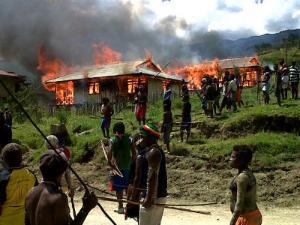
Indonesian military "pacify" a village


The resource extraction companies like Rio Tinto that operate in West Papua are not independent of the security apparatus, there labour practices and environmental destruction including dumping toxic chemicals into the river system

“ The mine reportedly has caused “massive environmental destruction” in West Papua due to the dumping of waste, including toxic metals, into Indonesia’s river system.(16)   According to WALHI, a leading Indonesian environmental group, the mine has already disposed of one billion tons of tailings into the local river system, resulting in copper concentrations in local rivers that are double the Indonesian legal fresh water limit. Over the life of the project, the mine reportedly will dump up to 3.5 billion metric tons of waste, despite the fact that riverine disposal is expressly prohibited under Indonesia’s water quality control regulation.(17)”[2]

Because of human and labour abuses at mining sites company infrastructure has been targeted, a riot in 1996 shut down the Grasberg mine (one of the largest open pit mines in the world) for several days and cost the company several million. In response the mining companies stepped their support for the Indonesian military.

“  In 1996, local people rioted, destroying $3 million in equipment and shutting the facility down for three days.  Shortly thereafter, Freeport-McMoRan, Rio Tinto’s partner, reportedly started providing significant support to the Indonesian government and military to ensure the protection of the mine.(18)   The company reportedly made an initial investment of $35 million in military infrastructure and vehicles and paid at least $20 million to military and police in Papua between 1998 and 2004.(19)

§    Serious human rights violations have reportedly occurred near the Grasberg Mine and Rio Tinto and Freeport-McMoRan have been accused of complicity due to their reliance on the military and police for security at the mine.  According to Indonesia’s National Commission on Human Rights, “in the mid-1990s the Indonesian security forces indulged in indiscriminate killings, torture and disappearances of local people in their safeguarding of the mine operations and their campaigns against West Papuan secessionists.” (20)”[3]


The support that Freeport (the operations company that Rio Tinto owns 40% of) has given to the Indonesian military and police in West Papua is more than the millions of dollars given to the Police and Military. Company support for this armed protection has become so extensive that Indonesian troops and police are barracked on company property, drive company vehicles, and sport company uniforms[4] and receive direct bonuses and are even fed by the company.


“During a recent interview in Jakarta, the respected Amungme traditional leader ('Mama') Yosepha Alomang demonstrated that she did not need to read the New York Times to know that although the government security forces [including police and military] receive three free meals a day from Freeport, they still receive generous "food allowances" and other payments. The payments were recently revealed to the wider world in an exposé by Jane Perlez and Raymond Bonner published in the New York Times. [5]


In return for this generosity the army and police (The distinction seems pretty arbitrary to me) maintain discipline on company sites, keep the area clear of terrorists and on occasion spy on troublesome civil society groups for the company. Indeed when this cosy relationship was exposed in 2005 by the New York Times the Indonesian military fully admitted to the relationship,


“A military spokesman, Major General Kohirin Suganda, said yesterday the military "as an institution" had never benefited from the Freeport payments. He also claimed that individuals did not enrich themselves, rather that the money was spent on the forces in the field. "We have heard that Freeport provides support such as vehicles, fuel and meals directly to the units in the field," Gen Suganda told the Associated Press. "That's the company's policy. It was not done because we requested it."”[6]

This is deplorable but you might be wondering what the point of this is. The abuses and murders being carried out in West Papua are by state institutions; the police and the army. Well for the sake of argument let’s assume that a world revolution took place, inspired by the ideas of right libertarianism, and the state everywhere was overthrown or dissolved, or whatever. Would anything change for the people of West Papua? I realise this is a hypothetical but I don’t believe it would. Rio Tinto, Free Port and the other resource and mining companies would still be there. The metals in the ground would still be there, the market and the capitalist system would still be functioning. So not much has changed, the people of West Papua are being oppressed and a key component of that oppression isn’t even scratched.


Rio Tinto et al aren’t using Indonesian soldiers because they personally oppose the regions secessionism and believe in an Indonesia one and indivisible. They are doing it because they want to keep profits up and costs down.

Since they’ve already shown for decades that they’re prepared to ignore the local population’s needs with their business practices and that they are willing to enforce this  corporate policy through armed force. What’s to stop them from continuing to do so? There using the state army and police, because they were already there. If the army and police go away along with the rest of the state then what’s stopping the companies from building their own security forces? They already employ by proxy Indonesian soldiers so it wouldn’t even be a radical break.

If you’re being menaced by an armed force does it really change anything from your point of view if that force is motivated by a desire to maintain national unity or to get a bonus? If the people are not much happy being beaten by the “people’s stick” would they be much happier being beaten by the “Individuals privately owned stick”?

The simple reality is that both state and capital are oppressive and exploitative institutions so getting rid of one and ignoring the other, leaving aside the question of whether it’s possible won’t stop exploitation or oppression, it simply changes the jargon and uniform logo’s.


[1] http://thediplomat.com/2013/11/asias-palestine-west-papuas-independence-struggle/
[2] http://londonminingnetwork.org/2010/04/rio-tinto-a-shameful-history-of-human-and-labour-rights-abuses-and-environmental-degradation-around-the-globe/
[3] Idib
[4] Leith, Denise. The Politics of Power; Freeport in Suharto's Indonesia. University of Hawai'i Press, 2003.
[5] http://www.downtoearth-indonesia.org/story/illegal-military-payments-freeportrio-tinto
[6] https://www.theguardian.com/world/2005/dec/30/indonesia.johnaglionby

Saturday, 7 March 2015

Those Blueshirts are at it again: Some thoughts on football

https://pbs.twimg.com/media/B-F7RtuIMAI_iai.jpg
Looks like once again the world has cause to be ashamed of a group of men in matching blue shirts. Well okay most of them aren't wearing blue shirts apart from the fat one on the far right but it is team colours so I think I can still getaway with the comparison.


Yep, in an incident shocking no one who actually follows football beyond the telly and an occasional trip to the bookies a group of fans of a football team were discovered being racist. The incident on the Paris Metro involved stopping a Black Parisian from boarding an admittedly crowded train and then celebrating this achievement for the white race by dusting off  a version the old "We're X and that's the way we like it, we like it, we like it". Unsurprisingly there was the usual round of condemnations with the club distancing itself from the dozen or so berks.

British Transport Police (BTP) said officers had received a number of complaints from passengers on the same train.
Detective Sergeant Michael Maher said: "I want to hear from anyone who was on the train, particularly in coach E, around the time it reached Stoke at 10.40pm.
"By the accounts we have received, the group were chanting insults at other passengers, and some of these insults may have been racist."
And then later on some Chelsea fans were caught singing antisemitic songs when they played Tottenham Hotspur. Mind you Tottenham's nickname is the `Yids` since that area has a Jewish community so plenty of other teams and fans have used that word to refer to them as well, so really its more unusual that we don't see more stories about Anti-Semitism in British football. The nickname is quite a problem, not only because its a slur, -most nicknames for rival football teams are- but because it provides quite a bit of cover for good old fashioned Neo-Nazi style anti-Semitism. I don't think most Chelsea fans are Antisemitic even if they sing songs about hating Tottenham, because Roman Abromvich the guy who owns the club is Jewish. Seems to me a rather daft way of having a go at the Jews, singing songs about not liking them whilst giving one of them a lot of money. Trust me supporting a football club isn't cheap. Mind you these are the same type of guys who like to loudly chant in public that they're racist, so maybe they are anti semites and are just really thick who knows?


Now while I really don't like Chelsea (or any of the Premiership level teams to be honest) and think their behaviour to be disgusting I didn't click the New Post button just to join in the Blues bashing, fun though it is. No I'm going to take a broader view and look at modern football in general, because focussing on Chelsea is just scapegoating.

I like football, I'm a season ticket holder and I've been on the odd away day with my team the Mariners AKA Grimsby Town. Admittedly its not a great time for the club we've declined quite a bit since the 90's and early 2000's but I enjoy the matches and the atmosphere at away games. So I'm not one of those lefty snobs who brands football and by extension people who like as dull eyed fish being kept docile by bread and circuses. On the contrary football is a very engaging sport and there's plenty discussion and debate in the grounds and at the neighbouring pubs.

Having said that I and most fans of the game will tell you that there is a lot wrong with the "beautiful game". The presence and use of money is one, and Racism is another. Racism or more accurately the existence of racist fans shouldn't be surprising, given the popularity of Football in Britain there's bound to be some overlap, and of course football supporters form a sort of subculture and tribe, and what is racism if not a form of tribalism? When you in a stand jumping up and down chanting and singing, and swearing you're part of a group with an identity, and that group is being challenged by the "others" the opposition so its naturally to be aggressive against them. Usually its benign, laughing at a striker who misses, jeering a midfielder who concedes a throw in, telling a diver to get up or we'll give them something to cry about. But it can turn really nasty, I remember going to Sincil Bank in Lincoln away and one of the Lincoln fans fell down the concrete steps and had to be stretchered out. They took him past the away end and due to the quite bitter history and the fact we were being hammered (we'd lose 5-0) some fans were out for blood and tried to pelt with plastic bottles and loudly wished he'd die.

Add to that the large number of players who are foreign, its already accepted practice to criticise violently the other team for anything really. Being too good, being too bad, hairy, big, small, bald, so why not because they're black or from France? The principles the same we just react differently to chants of "you fat bastard! you fat bastard!" and "you black bastard! you black bastard!".  Now I disagree with that but it happens, dozens of times I've heard someone getting called out for racist chanting who justifies by saying its just part of the game.

Its not for the faint hearted.Then there's the generation gap, one thing most newspapers and websites have been quick to remind everyone in the wake of the Chelsea incidents is that this isn't as bad as it used to be in the 1970's. If you're not familiar you might be wondering what they mean, well the 70's was the decade were British teams started including black and asian players and quite a lot of fans really didn't like that. There are many stories about black players being abused by both home and away fans, supporters refusing to applaud a goal scored by a black player, throwing bananas on the pitch etc.

Quite horrid, but hasn't happen here for awhile. Unfortunately what's often overlooked is that those fans from the 70's and 80's haven't gone away or if they have they've just moved to another clubs ground. We didn't really change the atmosphere we just added some penalties on top. All that's really happened is that racist fans realise they can't stand up and openly bash a player, they have to hide it. So instead what a lot of them do is wait for a certain player to make a mistake, or just not be very lucky to pounce. Instead of saying something like "Fuck off back to Africa" they'll just say "fuck off" I see a perfect example of this every home game. Three rows in front of me sits a very loud and very annoying man, he hates a certain player called Lenell John-Lewis aka the Shop aka Lennie. Lennie is a striker, and are teams main goal scorer, he's joint fifthed  in the Conference (at time of writing) with 13 goals. Several matches he's been the winning goal scorer, and yet despite this he's the target of incredible levels of abuse, some its frustration, he misses a few chances but so do quite a few town players, Ross Hannah's nickname is off side because he's almost always off side when he scores, and yet he never receives comparable criticism. 

Lennie's black, and Ross is white, now it could be coincidental, but then I remember the same group loudly criticising another black town player for missing a shot at the goal Aristote `Toto` Nsiala. Toto is a defender, you know a player who isn't expected to score a goal, in fact is supposed to do the opposite and prevent goals. The fact he was able to keep control of the ball from one end of the pitch to the other and take on the goalie is to me an achievement. But apparently not

And then there was a similar incident -which I will always remember as Crocoswamp- thankfully not recorded and splashed all over youtube involving some town fans on a train. I went to the Altrincham game with a few mates, it was a good day out though a very late concession turn a great win into a disappointing draw. On the train home we shared the carriage with another group of town fans, about six of them, they were pretty nice and cool at first, and were just chatting amongst themselves. Then one of them lest call him curly started moaning about Remembrance day and how you don't see many Muslims at the cenotaph. Curly then started whining about the local council and `leftists` the rest of the group laughed at him and started chanting Cameron. That annoyed Curly so he got louder and angrier, the rest of the group were trying to shut him up but in doing so they each starting coming out with racist stuff of their own. One let's call him Moe really hated immigrants (shocking) and said the penalty for crimes should be either deportation, execution or thrown in the crocodile swamp*.

It continued on like this going back and forth with them arguing over who amongst them was more racist for a good twenty minutes, getting louder and louder until finally one member of the group who had been silent till that point and shall be known as Shep said that Curly was more racist then he was and then spouted out a list of racial slurs that he claimed he used all the time. So Curly calls him a racist, Shep responds by slamming his fist into the table and screaming at the top of his lungs -and I'm not making this up- "Don't call me a racist you fucking Jew!" he then threw a beer bottle (yes they were drinking heavily) at him. He missed, and then said to they guy "you're my best friend and I love yer, but I'll drag you off this train and fucking end you" to which Curly replied "ex friend mate" Shep lost his temper now and tried to climb over the table to get at Curly whilst Moe and the others tried to hold Shep back and calm him down.

All in all a strange experience but apart from the little details like the crocodile swamp hardly unique in Football supporting circles. So racism isn't quite the fringe sentiment we'd like to believe it is. So whats the solution? well I think there's two practical options available, fans confronting racism in the stands and challenging it, that's a very long term option and may well just get the racist twits to change seats, and it can be dangerous since football related violence is still very much a thing, best to plan ahead and do it in a group if you're considering it. Or option two increase the penalties for racist behaviour, making it much, much harsher. Instead of fines and bans we could send the guilty away to a snake pit, or even banish them to the crocodile swamp.


*Surely you've been on a day out to the crocodile swamp in the Brighton everglades.

Popular Posts