Search This Blog

Showing posts with label Revolutions. Show all posts

Sunday, 3 November 2024

The Resistance Muesuem Tour


This Summer I was in Lisbon with some friends, had a lovely time, a strike by bus drivers ensured we got to see some parts of the city not on the tourguide maps while walking in the sunshine[1]. One day, we were walking into the Marina area after riding on the Metro's Green Line, we found a museum commemorating the downfall of Portugal's brutal dictatorial regime. Its called the Museum of Aljube Resistance and Freedom, and its directly behind Lisbon Cathedral, the Cathedral was closed for repairs but you see into the Cathedral from the windows of the Museum.  

This is a collage, the face of one of Amável Vitorino, one of Estado Novo's victims is created from the prisoner ID photographs of many other victims.

Its a small building with four floors, it makes excellent use of its space. The photos were taken by me, so apologies for the blurriness. From 1926 to 1974 Portugal and its colonial possessions (Goa, Angola, Mozambique, Guinea-Bissau, Cape Verde etc.) were ruled by a dictatorial regime established by Antonio Salazar. The period before 1926 was also marked with military seizures of power and instability. In 1933 Salazar cemented his grip on power by establishing the Estado Novo (New State) which just barely outlived him before crashing down when the military revolted in what is known as the Carnation Revolution.

The Museum outlines the chronology of this brutal state and its many acts of violence and repression against its own populations. One floor is dedicated to the Portuguese Colonial wars as Salazar attempted to keep his colonies under direct control.

The first rooms have information in Portugeuse only, but everything else has English translations available and audio guides are also available for other languages. They also explain just how Portugal could remain under such a brutal regime for so long, they give evidence of Salazar's collaboration with the Allied Powers during WWII despite his Fascistic leanings, and how during the Cold War his regime's fanatical opposition to Communism gained him important allies in the United States. 

One thing I did notice though, is a sort of reticience to acknowledge the political characters of the resistance to Estado Novo, often the groups are named but there was no attempt to explain them beyond their names. I got a sense that the Musuem was trying to depoliticise the revolt against dictatorship. For example the hi-jacking of the passenger ship Santa Maria has a segment of the wall dedicated to it as it was a very important action of the resistance that brought international attention to the often overlooked situation in Portugal. And DRIL (Iberian Revolutionary Liberation Directory) is named but there's no information given beyond the name. Which is a little odd since the website of the Museum does give abit more information.

The Santa Maria action carried out by DRIL

The one exception I can recall was a wall featuring newspapers published within the Portuguese prison system, the groups publishing the papers emboldened their masts with symbols representing the groups and some had taglines about specific political oreintations.

Possibly, I'm being too cynical, the politics of the resistance was confusing and secterian, I remember reading in Impossible Revolution how the Moscow backed Communist Party was attacked more often in 74 by Maoists then the embittered supporters of Estado Novo. Giving this subject the space to make sense of it would be a tricky proposition for a small building. The gift shop was also full of books written by former prisoners and participants of the Carnation Revolution so perhaps it is there that the subject is given more attention.

I'll finish with a handful of photos that didn't turn out too bad.


This is a diagram of methods of torture employed by the political police PIDE


Police attack a demonstration of women and children who were supporting their striking husbands/fathers


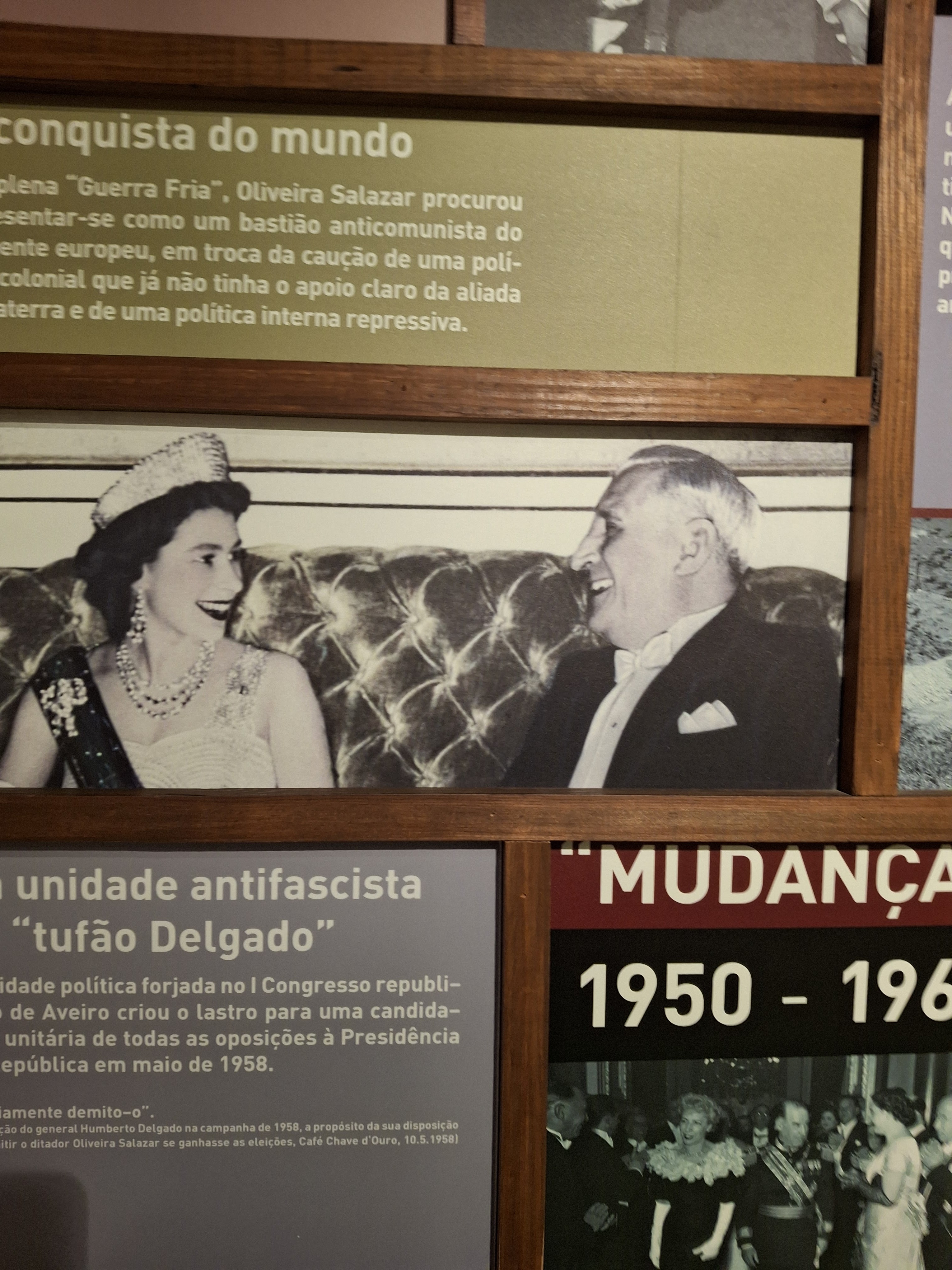
A photograph of Queen Elizabeth II meeting Antonio Salazar in 1957.
_______________________________________________________

1: If like me you have some mobility issues I'd strongly recommend taking a stick with you, Lisbon is built on several hills and most of the streets are cobbled.

Saturday, 28 September 2024

What is to be Done? By Errico Malatesta


 "What is to be done?” is the question that, more or less intensely, always troubles the minds of all men struggling for an ideal, and urgently comes back in moments of crisis, when a failure, a disillusionment induces one to re-examine the tactics adopted, to criticize possible errors and to seek more effective means. Comrade Outcast is right to bring up the question again and invite the comrades to think and decide about what to do.

Today our situation is difficult, and even dreadful in some areas. However, he who was anarchist before, remains anarchist after all; although we have been weakened by many defeats, we have also gained a valuable experience, which will increase our effectiveness, if only we are able to treasure it. The defections occurred on our side, which were actually rare, help us after all, because they rid us of weak and unreliable persons.

So, what is to be done?

I am not going to dwell upon the unrest occurred abroad against the Italian reaction. Certainly we can only expect benefits from anything that helps the proletariat of the world to know about the true conditions of Italy and the incredible infamies that have been committed and keep being committed by the bourgeoisie cops in order to stifle and destroy any emancipatory movement. We just read about an international rally of protest against fascism, that took place in New York on the 18th of the current month — and we are sure that our friends and those who have a sense of freedom and justice will do whatever they can in America, England, France, Spain, etc.

However, we are mainly interested in what is to be done here in Italy, because this is what is to be done by us. Although it is good to take into account all the auxiliary forces, it is very important not to rely too much on others, and seek our well being in ourselves and our own work.

In recent years we have approached the different avantgard parties with a view to joint action, and we have always been disappointed. Must we for this reason isolate ourselves, or take refuge from impure contacts and stand still trying to move only when we have the necessary strength and in the name of our complete programme?

I think not.

Since we cannot make the revolution by ourselves, i.e. our forces alone are not sufficient to attract and mobilize the large masses necessary to win, and since, no matter how long one waits, the masses cannot become anarchist before the revolution has started, and we will necessarily remain a relatively small minority until we can try out our ideas in the revolutionary practice, by denying our cooperation to others and by postponing the action until we are strong enough to act by ourselves, we would practically end up encouraging sluggishness, despite the high-sounding words and the radical intentions, and refusing to get started, with the excuse of jumping to the end with one big leap.

I know very well — if I had not known for a long time I would have learnt recently — that we anarchists are alone in wishing the revolution for good and as soon as possible, except some individuals and groups that champ the bit of the authoritarian parties’ discipline, but remain in those parties in the hope that their leaders will resolve someday upon ordering a general action. However, I also know that the circumstances are often stronger than the individuals’ will, and one day or another our cousins from all different sides will have to resolve upon venturing the final struggle, if they do not want to ignominiously die as parties and make a present to the monarchy of all their ideas, their traditions, their best sentiments. Today they could be induced to that by the necessity of defending their freedom, their goods, their life.

Therefore we should always be prepared to support those who are prepared to act, even if it carries with it the risk of later finding ourselves alone and betrayed.

But in giving others our support, that is, in always trying to use the forces at the disposal of others, and taking advantage of every opportunity for action, we must always be ourselves and seek to be in a position to make our influence felt and count at least in direct proportion to our strength.

To this end it is necessary that we should be agreed among ourselves and seek to co-ordinate and organize our efforts as effectively as possible.

Let others keep misunderstanding and slandering our goals, for reasons we do not want to qualify. All comrades that seriously want to take action will judge what is better for them to do.

At this time, as at any time of depression and stagnation, we are afflicted by a recrudescence of hair-splitting tendencies; some people enjoy discussing whether we are a party or a movement, whether we have to associate into unions or federations, and hundreds of other similar trifles; perhaps we will hear again that “groups can have neither a secretary nor a cashier, but they have to entrust one comrade to deal with the group’s correspondence and another to keep the money”. Hair-splitters are capable of anything; but let practical men see to taking action, and let hair-splitters in good faith, and those in bad faith above all, stew in their own juice.

Let anyone do whatever they like, associate with whoever they like, but let them act.

No person of good faith and common sense can deny that acting effectively requires agreeing, uniting, organizing.

Today the reaction tends to stifle any public movement, and obviously the movement tends to “go underground”, as the Russian used to say.

We are reverting to the necessity of a secret organization, which is fine.

However, a secret organization cannot be all and cannot include all.

We need to preserve and increase our contact with the masses, we need to look for new followers by propagandizing as much as possible, we need to keep in the movement all the individuals unfit for a secret organizations and those who would jeopardize it by being too well-known. One must not forget that the persons most useful to a secret organization are those whose beliefs are unknown to the adversaries, and who can work without being suspected.

Therefore, in my opinion, nothing that exists should be undone. Rather, it is a matter of adding something more; something with such characteristics as to respond to the current needs.

Let nobody wait for someone else’s initiative; let anyone take the initiatives they deem appropriate in their place, in their environment, and then try, with due precautions, to connect their own to others’ initiatives, to reach the general agreement that is necessary to a valid action.

We are in a time of depression, it is true. However, history is moving fast nowadays: let us get ready for the events to come.

Wednesday, 26 July 2023

Bakunin for anti-Imperialists by Arthur Lehning


Author Biography

Paul Arthur Müller-Lehning (1899-2000), born in Utrecht,
the Netherlands, was an anarchist and syndicalist from
the 1920s. Involved in the Anti-Militarist Bureau and the
syndicalist International Workingmen’s Association, he
fled Nazi Germany for the Netherlands in 1933. In 1935, he
helped found the International Institute for Social History
(IISH), which includes the Mikhail Bakunin archives, and
the Karl Marx / Friedrich Engels papers. In 1940, he fled
to Britain when the Nazis invaded. He retained some
influence after his return to Europe. A prolific writer and
editor, his masterwork was the edited works of Bakunin,
published in French in 1976.


The Use of Reading Bakunin for Anti-Imperialists

On imperialism itself, [Mikhail] Bakunin [1814-1876] has nothing specifically
to say. That is not strange, because imperialism in its modern form had not
yet appeared; besides, opposition to imperialism by a revolutionary is a rather
obvious thing. But I think Bakunin’s writings can be useful to anti-imperialists
in several ways. Firstly, on account of the general view held by Bakunin about
the essence of the revolutionary struggle and his conceptions about federalism
and the state. Secondly, on account of his activities in the eighteen forties.


As far as the last point is concerned, it is clear that I don’t wish to stress it too
much. All historical parallels can be abusive. However, it is not abusive to point
out the similarities between various kinds of Nineteenth Century nationalism
and anti-imperialism in our time. This is not only because a great deal of today’s
anti-imperialist fight is carried out on nationalist platforms, but also on account
of the intensity with which the banner of then and that of today monopolise
the attention of men with radical consciousness. In this respect, Bakunin has
important things to say.

Bakunin from Nationalism to Anarchism

Bakunin’s so-called “revolutionary Pan-Slavism” in the 1840s is usually
misunderstood. In his famous Appeal to the Slavs (1848) he advocated a coalition
between the Slavs of Austria, the Hungarians and the democratic Germans in
order to liquidate the Austrian Empire and to coalesce with the Poles for an
independent Poland and a revolution in Russia. He hoped that a Slav Federation
would encourage the Slavs to take part in the struggle the revolution was waging
throughout Europe. The social liberation of the masses and the emancipation
of the suppressed nationalities should, in the view he then held, lead to
a universal federation of European republics.


After the failure of the Polish insurrection [for independence – Ed.] of 1863,
however, Bakunin no longer believed in using the banner of nationalism
for social revolutionary aims. By 1864 he had definitely formulated the
philosophical, political and socialist ideas which are associated with his name.
From then on he would defend social revolution on an international scale, and
reject every form of nationalism. Nationality is not a principle, he wrote, it is
a fact, as legitimate as individuality. But neither peace nor the unification of
Europe would be possible as long as the centralized states continued to exist.

Fighting Imperialism, but not through
Nationalism


The point I wish to make is that yesterday’s nationalist faith, like the anti-
imperialist dedication of many present-day revolutionaries, though deserving
our admiration, can be insidious and lead to dangerously wrong conclusions –
such as that by putting an end to imperialist domination the revolution will be
achieved and the way towards socialism be paved.


No one will deny the importance of analysing modern forms of imperialism,
but it is not less important to be cautious about the methods to be used in this
fight if one wants to prevent replacing imperialist domination by a national
form of exploitation and despotism. This, of course, involves the fundamental
question of what means to employ to achieve the aim of socialism and freedom;
and experience allows us to say that the end of imperialism and the destruction
of capitalism in a given country does not necessarily solve the problem of
oppression.


We may ask meaningfully the capital question whether the instauration of some
kind of revolutionary state brings us any nearer to a real socialist society. I don’t
intend to try to answer it here, only to insist that it is not an academic question
as much as it seems. Few people will deny the fact that in the so-called socialist
countries the state is not withering away, but there might still be some who
think that their regimes may easier pave its way. This, however, may be doubted
in the light of the dominating trend of these countries and in that of the history
of the last five decades.

Imperialism and Statism Versus Socialism


Bakunin’s view has importance also in that it does not see a break between
nationalism and imperialism, state domination inland and abroad. Marx and
the Marxists considered imperialism primarily as a consequence of capitalism,
Bakunin saw it as a consequence of strong states and centralized power.
Obviously, there are imperialist campaigns in the twentieth century that cannot
be explained in terms of economic forces. Although Bakunin agreed with most
of the Marxist analysis of the economic system, he did not believe that socialism
could be achieved by centralizing power, in which hand it ever was.
Modern capitalist production and banking speculation, Bakunin wrote, demand
for their full development, an advanced centralised state apparatus. The modern
state is necessarily a military state in its aims, and a military state is driven on
by the very same logic, to become a conquering state. A strong state can only
have one foundation: military and bureaucratic centralisation. Every state, even
if dressed up in the most liberal and democratic form, is necessarily based upon
domination and violence, that is upon despotism – concealed despotism, but not
less dangerous.


For Bakunin, equality without liberty was an irredeemable fraud, “perpetuated
by deceivers to deceive fools”. Equality must be created by “the spontaneous
organisation of the work and the common property of the manufacturing
associations and by the equally spontaneous federation of the communities,
not by the supreme and paternal activity of the state”. Equality without liberty
meant for him the despotism of the state, and in his opinion the state cannot
survive for a single day without “possessing an exploiting and privileged class:
the bureaucracy”. The conspiracy of Babeuf and all similar attempts to establish
a socialist society were bound to fail, because in all these systems equality
was associated with the power and authority of the state and in consequence
excluded liberty.


The most sinister alliance imaginable would combine socialism and absolutism
– that is to say, the aspirations of the people for economic liberation and material
prosperity with dictatorship and the concentration of all political and social
forces in the state:

“May the future preserve us from the benevolence of despotism, and
may it also save us from the damaging and stultifying consequences of
authoritarian, doctrinaire or institutional socialism. Let us be socialists,
but let us never become sheep. Let us seek justice, complete political,
economic and social justice, but without any sacrifice of liberty. There
can be no life, no humanity without liberty, and a form of socialism
which excluded liberty or did not accept it as a basis and as the only
creative principle, would lead us straight back to slavery and bestiality”.

People’s Power or State Power

For these reasons, Bakunin opposed the belief that a social revolution can be
decreed and organised by a dictatorship or by a constituent assembly set up
by a political revolution. Only after the abolition of the state – the first, the
essential condition for real freedom – can society be reorganized, but not from
above, not according to some visionary plan, nor by decrees spewed forth by
some dictatorial power. This would simply lead, again, to the establishment of
a state and to the formation of a ruling “aristocracy”, i.e. a whole class of people
who have nothing in common with the masses and who will begin to exploit
and suppress the people all over again, under the pretence of acting in the
general interest, or in order to save the state. “The victory of the Jacobins or
the Blanquists [bourgeois and socialist revolutionaries advocating dictatorship
– Ed.] would mean the death of the revolution”.


The Great [French] Revolution, which for the first time in history had proclaimed
the liberty of citizens and men, by making itself the heir of the monarchy which it
had destroyed, revived at the same time this negation of all liberty, centralisation
and omnipotence of the state. “Seventy-five years of sad and harsh experience”,
Bakunin wrote to a Frenchman in 1868:

“spent in sterile tossing between a freedom that was several times
recovered and always lost again, and state despotism ever more victorious,
have proved to France and the world that in 1793 your Girondins were
right against your Jacobins. Robespierre, Saint-Just, Carnot, Couthon,
Cambon and so many other citizens of the Montagne were great
and pure patriots, but it is nonetheless true that they established the
machine of government, that formidable centralisation of the state,
which made the military dictatorship of Napoleon I possible, natural,
necessary, and which, having survived all subsequent revolutions, by no
means diminished but rather preserved, cosseted and developed by the
Restoration and by the July Monarchy as by the Republic of 1848, was
bound to lead ultimately to the destruction of all your liberties”.

Democracy from Below: Collectives, Assemblies,

Delegates, Militias


A radical revolution can only be brought about by an attack on the institutions
and by the destruction of property and its associate, the state. Then it will not
be necessary to destroy people and thereby provoke the inevitable reaction
which the massacre of the people always causes in every society.


That is, for Bakunin, the great secret of revolution. It must begin with the
dissolution of the state; the disbanding of the army and the police; the abolition
of the courts; the burning of all bonds, bills and securities; the repeal of those
bourgeois laws which sanction private property, and their replacement by
expropriation. The entire social capital – including public buildings, raw
materials, the property owned by church and state – should be put in the hands
of the workers’ organizations. At the outbreak of the revolution the community
should be organized by the “Permanent Federation of the Barricades”. The
council of the revolutionary community should consist of one or two delegates
from each barricade, one from each street or suburb; these deputies, with a
binding mandate, should always be responsible, and subject to recall.


Bakunin did not mean that there could be a revolution without violence, but
that this should be directed against institutions rather than against persons.
The revolution should, however, not develop a new authority, i.e. the right to
coerce. Those who carry out the repression will do so with the approval of the
revolutionaries; this is the only legitimation for violence should be short and
not lead to an organization invested with authority to repress. In all his writings
Bakunin rejected the idea of a “revolutionary government”, of “Committees of
Public Safety”, including the so-called “dictatorship of the proletariat”. For such
a new authority, such a “proletarian state”, in theory representing the workers,
would lead in practice to a new ruling class.


Revolution means to overthrow the state, because social revolution must put an
end to the old system of organization based upon violence, giving full liberty to
the masses, groups, communes and associations, and likewise to the individuals
themselves. It would destroy once and for all the historic cause of all violence,
the power and the very existence of the state, the downfall of which will carry
down with it all the iniquities of juridical right and all the falsehoods of the
various religious cults, that simply are the consecration, ideal as well as real, of
all the violence represented, guaranteed and furthered by the state.

The Need for the Revolutionary Idea


Poverty and despondency are not sufficient to provoke a social revolution. They
may lead to local revolts, but are inadequate to arouse whole masses of people.
Only when the people are stirred by a universal idea evolving from the depths
of the folk instinct and clariϐied by events and experience, when people have a
general idea of their rights, revolution can take place.


One cannot aim at destruction without having at least a remote conception of
the new order that should succeed to the one extent; and the more vividly that
future is visualized, the more powerful is the force of destruction. The nearer
such visualization approaches the truth, that is the more it conforms to the
necessary development of the actual social world, the more salutary are the
results of destructive action, determined not only by the degree of its intensity
but also by the means it takes to reach the positive ideal. Exploitation and
oppression are not merely economic and political, and would therefore not be
automatically abolished by a conquest of political power and the organization of
the new economic system. They have one common source: authority.


Bakunin held the view that every dictatorship could have no aim but that of
self-perpetuation and that it could beget only slavery in the people tolerating it.
Freedom can only be created by freedom. The new social organization should
be set up by the free integration of workers’ associations, villages, communes
and regions from below upwards, conforming to the needs and instincts of the
people.

Globalisation from Below


That was what Bakunin meant by federalism. Smaller groups should federate into
greater units. Of course he was well aware that a certain economic centralization
was inevitable, as a consequence of the development of large scale production,
but he rejected the view that these problems could only be solved by political
centralisation. He insisted on the need of collective ownership of property and
argued that if the authoritarian state, with its unnatural centralisation, would
become the basis of social organisation, the unavoidable result would be the
destruction of the liberty of individual man and of smaller groups, and this
would lead to new exploitation and to endless wars.


In Bakunin’s theory, free productive associations, having become their own
masters, would expand one day beyond national frontiers and form one vast
economic federation, with a parliament informed by detailed statistics on
a world scale, that would decide and distribute the output of world industry
among the various countries, so that there would be no longer or hardly ever
industrial crisis, stagnation, disasters and waste of capital: human labour,
emancipation, each and every man would regenerate the world.

Working Class and Peasant Revolution


Contrary to Marx, Bakunin generally regarded the peasants as a revolutionary
force, though historically the essential role belonged to the proletarians of the
cities. In his Letters to a Frenchman, written two months after the outbreak
of the Franco-Prussian war [1870] and in which Bakunin exposed his views
on the way the revolutionary movement had to take, he gave practical advice
how to overcome the antagonism between workers and peasants. Their fatal
antagonism had to be eliminated, otherwise the revolution would be paralysed.
It would be necessary to undermine in fact, and not in words, the authority of
the state.


Bakunin advocated that delegates should be sent to the villages to promote a
revolutionary movement amongst the peasants. Communism or collectivism
should not be imposed on them, even if the workers had enough power to do so,
because such an authoritarian communism would need the regularly organized
violence of the state, and this would lead to the re-establishment of authority
and a new privileged class. The revolutionary authorities – and there should
be as few of them as possible – must promote the revolution not by issuing
decrees but by stirring the masses to action. They must under no circumstances
foist any artiϐicial organisation whatsoever upon the masses. On the contrary,
they should foster the self-organisation of the masses into autonomous bodies,
federated from the bottom upward.

States are not progressive forces


Bakunin differed from Marx and Engels not only with regard to the role of the
Slavs, but also in his appreciation of the political future of Europe, and he was
far from agreeing with them that [Prince Otto von] Bismarck [Prussian founder
of the German Empire – Ed.] and Victor Emmanuel [King of Italy – Ed.] in their
striving towards unification of their respective countries did useful work for
socialism. On 20 July 1870 Marx wrote to Engels: “If the Prussians are victorious
the centralization of state power will be useful to the centralisation of the
German working class”. And a few weeks later Engels replied that Bismarck
now, as in 1866, did “a part of our job”.


National unity with its consequences of political and economic centralisation
was, in the opinion of Marx, a prerequisite of socialism. According to Marxian
dialectics, the capture of the centralised state by a working class organized in
a political party would open up towards socialism and the ultimate “withering
away” of the state. In this context, the predominance of Marx’s theory, that
is his conception of this historical process, became itself an element and a
precondition of this process.


Bakunin understood this basic concept perfectly well but did not agree
with it. “What has made us reject this system”, he wrote, pointing to
revolutionary authorities, liberty directed from above, “is that it leads directly
to the establishment of a new set of great national states, would be separate
and necessarily rivals and hostile to each other, and to the negation of
internationalism”.


Bakunin feared that this development would lead to a new Caesarism [a
militaristic order headed by a strongman, involving a cult of personality – Ed.],
and after the Franco-Prussian War he predicted an era of ceaseless wars and
the danger of a Prusso-Germanisation of Europe. Two years before his death
he wrote: “Bismarckism, that is militarism, the police and financial monopoly
merged into a single whole, namely the modern state, is everywhere victorious.
Conceivably, this powerful and scientific negation of all that is human may
continue triumphant for another ten or fifteen years”.


Certainly, this triumph has been rampant for more than a century, and is still
very much alive.

Mikhail Bakunin Biography

A world-famous revolutionary, Bakunin was involved in
pro-democracy and anti-imperialist movements in the
1840s. Jailed in 1849, he was sentenced to death twice,
in both cases commuted to life imprisonment. After long,
brutal years in various prisons, he was exiled to Siberia.
After a dramatic escape in 1861, he made his way to
Western Europe. Here he was increasingly involved in the
rising workers’ and socialist movement. In the International
Workingmen’s Association, founded 1864, he helped found
the anarchist and syndicalist movement, clashing with
Karl Marx. Bakunin always retained his deep opposition
to imperialism. As an anarchist, however, he insisted it be
combined with a revolutionary class struggle to create a
self-managed, international, free, socialist and stateless
society from below. Otherwise, independence would be
hijacked by local ruling classes, the masses left in chains
and still exploited.


Plain text version created from a pamphlet scanned by Zabalaza.

Tuesday, 15 November 2022

The Road Back


Netflix released another film adaptation of Remarque's novel All Quiet on the Western Front. I don't really like the movie, of the three versions I've seen I think this is the one I'd put at the bottom of the list. It reminded me of the 1930 version, which then reminded me of that version's ill fated sequel that came out in 1937, The Road Back.

The Road Back is a loose version of Remarque's sequel novel of the same name. After learning about it I was intrigued I enjoyed reading All Quiet on the Western Front and liked both film versions, and this time the action is set during the German Revolution. And it was directed by James Whale, whose directorial debut was the British WWI film Journey's End, and he had directed Frankenstein, The Invisible Man, Old Dark House, Bride of Frankenstein etc. So, this is a rare film. Its also notorious as an early example of Hollywood being more than willing to wreck a movie for a chance to score big in a international market, when its studio Universal tried to create an alternative version for the foreign market. That was a problem, because of the market trends in the 1930s the largest foreign consumer of Hollywood movies was Germany. And the movie was released in 1937, which meant that this film had to appease the film board set up by Joseph Goebbels.

This is why the film is barely known outside of film history trivia. As far as I can tell The Road Back never received a home release, though curiously I did find a copyright renewal for the movie in 1965, and copies of the film do show up online on occasion though are also often pulled by takedown request. Also curious for a 1937 film print the copy I saw was in pretty good shape, considering, I've seen worse conditions of films that are readily available. 

Above is a copy I managed to find online right now, I'd recommend ripping it if you want to keep it, just to be save.

Here is the time when I would like to say The Road Back is a lost classic, but honestly aside from novelty I don't think its very good. I suppose its the most substantial treatment of the German Revolution by an English language movie. Granted most of what it has to say about the revolution are jokes about how strange it is that German's with their rigid conformity and worship of procedure are trying to overthrow the established order. The Road Back is a comedy, though its an uneven one, some scenes are supposed to be dramatic and say something of importance but then the next scene will have a couple actors bumble through a comedy routine and it doesn't handle the transitions between them very well. The ending courtroom scene with its appeal for sympathy for traumatised survivors of the war and the raw disgust shown to a character whose a rich boy and son of a war profiteer should fit perfectly into a film like this, but they stick out like sore thumbs. 

And the revolution subplot doesn't really go anywhere conclusive. Most of the scenes involving it are comic, but then you have a small number of scenes involving street clashes and police firing on and killing civilians. One occasion the scene shifts from a joke about the revolution to having civilians shot dead by police with machine guns seconds after jokes were cracked at how silly this is. And then it just stops completely. 

While its depiction was very strange I did like some of the jokes in the revolution scenes, especially the part when the townspeople march on the Mayor and make him host a mass meeting. Its revealed that they do this every single night and make him host a meeting while he complains that he's old and needs to sleep. But most of the other comedy fell flat to me. Especially that provided by Willy played by Andy Devine. He has a braying voice and he sulks through all of his lines. The dialogue is also pretty poor, a lot of what he has to say seems to be on paper to be combative and cocky, but it comes across as whiny. 

Its a bizarre and uneven movie, though this seems to be down to the panic by the studio over its potential loss of investment in Germany they re-edited the film and shot new material to limit the offense caused to the German authorities. It didn't work. Which isn't remotely surprising to me. This was a film based on a book that was banned in Germany by a writer who was denounced as an enemy for his antimilitarist writing. Furthermore it depicts the German revolution, a period that was dominated by the Nazi party's domestic political enemies, Social Democrats, Anarchists, Communists etc. And to cap it off many of the actors demonstrate shell shock and the film is one of the earliest explorations of soldiers Post Traumatic Stress Disorder.

The finished film does undermine and weaken much of the theme's of the story, but they are still present, and of course its still attached to Remarque. It was simply doomed from the outset.

To give a flavour of how impossible appealing to the German cinema authorities was, here's a news clipping from the time.

“The movie, Typhon, based on the comedy by the Hungarian writer Lendengyel, has been banned in Germany. The censorship board justifies this decision by pointing out that in the movie the person whose behaviour is exemplary is Japanese. The white people all behave rather badly. The Japanese, with whom the heroine strikes up a friendship, is an impeccable gentleman. Moreover the movie shows French people and in fact does not deal with Germans. In short, this work is regarded as, by omission, an insult to the Aryan race, whose superiority is not even mentioned.”

From, Against the Racist Delirium by Camillo Berneri.  

 Bolding is mine.

As an added insult, the meddling over the film soured James Whale on directing, he had high expectations for the movie and fought the studio over its cuts and re-shoots. He didn't quit directing immediately after The Road Back but his career did wind down and end a few years later in 1941. 

Taking all this on board it isn't really a surprise the film has languished in the shadows. I get the embarrassment but the refusal to release the film at all and to swipe at bootleg copies nearly a hundred years later speak to some real hostility. I don't believe it'll ever escape the trivia or be held up as a classic, but I think it deserves to be shown and seen. 

Monday, 1 August 2022

The Revolutionary Called Nestor (no not Makhno, the other one)


The Russian revolution catapulted a Ukrainian peasant to world fame. Nestor Makhno the anarcho-communist military leader whose campaigns in Ukraine secured the survival of a federation of collectives across a territory large than England, and a population estimated in the millions. This federation became known as the Free Territory and its been an inspiration and a warning to many revolutionary minded groups and individuals ever since.

This is not that story. No, this is instead a commentary on the other Nestor active during the Russian revolution, Nestor Alexandrovich Kalandarishvili, born in Georgia on the 8th of July 1876, and killed in an ambush on the 6th of March 1922. Nestor Kalandarishvili isn't as well known as Nestor Makhno, but he is not totally forgotten. Wikipedia has an article about his life in several languages, including English. And the Anarchist historian Nick Heath included a short biographical sketch of him in a three part series on former Anarchists who joined the Bolsheviks. 

It was Nick Heath's work where I first discovered this other Nestor. I think his life is deserving of a wider recognition as it may have strong relevance for the movement today. Nestor Kalandarishvili seems to have been a bit of a `joiner` as over a period of 22 years he moved from one revolutionary group or party to another. He appears to have become active in the revolutionary underground of the Russian Empire in 1900 when resuming his studies after completing military service. Initially he fell under the Social Revolutionary party, and then later joined the Georgian Socialist-Federalist Revolutionary Party, before moving onto Anarchism after taking part in Batumi revolt, a local Georgian uprising that was part of the unrest during the 1905 Russian Revolution. Kalandarishvili also took part in an uprising in 1907 in the Gurian republic which was crushed by the Tsar during a campaign to roll back the gains of the 1905 Revolution. Kalandarishvili was imprisoned in Siberia, he would remain in Siberia for the rest of his life.

In 1917 when the February Revolution succeeded in toppling the Tsar an amnesty for political prisoners freed both Nestor Makhno and Nestor Kalandarishvili. Kalandarishvili built a small military unit of Anarchists which defeated a local counter revolutionary force made up of land owners and minor nobility. His forces grew to the equivalent size of a division and was recruited mainly from local peasants and workers and anarchists who had been exiled to Siberia for political crimes. During the civil war Nestor Kalandarishvili's forces operated throughout Siberia, and battle White Army forces led by Semenov, Kappel and Baron Ungern. His many victories made him famous under the nickname Grandpa, though a defeat in late 1918 forced him once to retreat into Mongolia with several hundred men. He was such a thorn that Admiral Kolchak the nominal leader of the White Army put a bounty of 40,000 roubles on his head. In 1919 as Nestor's band moved to the vicinity of Irkutsk and attack White forces in the area local Bolsheviks approached him with offers of an alliance. 

By 1920 this alliance had driven the White Army and their Japanese support out of Irkutsk and established a Soviet administration with the creation of the Far Eastern Republic. In 1921 Nestor Kalandarishvili was invited to a meeting with Vladimir Lenin. After the meeting Kalandarishvili publicly renounced Anarchism and became a Bolshevik, he was at the same time given supreme military command of the Far East Republic with the power to appoint or dismiss officers of the units under his command. He also became head of the Korean War Council, a body that was supposed to be the supreme body for Korean revolutionary fighting groups. He clashed with Korean Anarchist fighting units when they refused to accept officers he had promoted to lead them, including former officers of the White army.

He used his influence to impede and disarmed units that wouldn't accept his authority until his death in an ambush in 1922 while fighting the Yakut rebels, one of the last actions of the civil war. After his death he was elevated into a hero of the Soviet state, many streets and factories and collective farms were named after him.

This ends the brief biography of the life and death of Nestor Kalandarishvili, a fuller account can be found with Nick Heath. 

So, to come back to the present day, I believe that the life and death of Nestor Kalandarishvili is a useful demonstration of the dangers of the popular talking point "Left unity" in practice. Much of the modern discourse at the state of what's commonly called the "left" is a lamentation that unlike the enemies in the right, the left just can't put its differences aside and unite against a common foe. This argument mostly rests on assumptions that have little foundation. For a start I don't believe the right are as united as is commonly believed, the civil war in Austria between the Fascist and Nazi parties, the bloody feud between the Romanian monarchy and the Iron Guard, and the bitter presidential campaigns between Marine Le Pen and Eric Zemmour are just a few brief examples. Furthermore I don't really see how much of the left as its commonly understood can actively work together in a way that doesn't mean many of the constituent parts give up fundamental elements of their theory and practice.

Nestor Kalandarishvili represents this. Its easy to read his conversion to Bolshevism as motivated purely by opportunism, it did coincide with funding, gifts and praise and awards from the Bolshevik government. But even if it was a genuine change in convictions, the effect was the same. This was a conflict where the Anarchists and Bolsheviks had co-operated for over a year, and yet as soon as one faction moved to establish itself as the government in the area it quickly provoked conflict where previously there seemed to have been accord. By appointing Nestor Kalandarishvili supreme commander and establishing military bodies like the Korean War Council all other military organisations lost their autonomy and were functionally rolled into the Bolshevik military and political program. Units that had fought effectively for years against the counter revolution were denied the right to choose their own staff and were expected to accept the promotion of former enemies without complaint. The unity of the Russian revolutionaries effectively died in Siberia the moment the Bolsheviks gained enough strength to assert dominance a phenomena that happened in Ukraine and Georgia at the same time and has been repeated since in Spain, the Greek underground and the post war Hungarian and Czechoslovakian states.

If unity between different groups for a common good is the true desire then I don't believe we would see this clear pattern, that groups in common only seem to be viable while no one group is strong enough to assert itself over the others and once that happens either a civil war erupts as happened in Kronstadt or the other groups cease to function in a way that matters and are subsumed and replaced by the dominant force as happened in the Popular Front government where the other forces were either liquidated or converted with the sole exception being several CNT columns who were too big to risk an open conflict over their continued acts of resistance like giving membership cards to POUM members. 

Monday, 6 June 2022

Albert the Workers Representative


A short video clip from Alexandria Ocasio-Cortez (AOC) popped up on my twitter timeline.


“It’s just really wild to be a person that works in a corrupt institution, which is what Congress is, and to try and be a normal person surrounded by so much decay and moral emptiness, that frankly transcends party, is very difficult.”

AOC is clearly frustrated with the realities of the political system in the United States of America. I sympathise but not really surprised. Curiously, reading the quoted snippet my mind turned to an overlooked pioneer in the history of socialism, Alexndre Martin. Alexandre Martin is better known, though just barely, by the name Albert l'Ouvrier, which in English means Albert the Worker. The Worker, is a reference to the fact that he was the first industrial worker, a mechanic to be precise, to become a Deputy of the National Assembly in France. I've even seen a few sources claim he was the first industrial worker to reach such a station in the world, but I'm unsure of how accurate that is.

As to why he was called Albert instead of Alexandre, I have no idea. Regardless, Albert was born in 1815 and held a series of jobs in the workshops of Paris. He was a participant in the 1830 Revolution which toppled the restored Bourbon monarchy and replaced it with House or Orleans. Initially this new King established a more liberal period, but it didn't take long for the July Monarchy[1] to disillusion segments of the population and sporadic demonstrations and minor insurrections soon broke out. Les Miserables has a fictional account of one of these insurrections, the republican revolt of 1832. 

Albert joined several clubs and secret societies during the July Monarchy's existence. At this time restrictions on openly political organisations and workers associations were extreme, so most of the disaffected students and workers had to organise social clubs and secret meetings to compensate. By 1848 when the July Monarchy collapsed into violent street clashes most republican and socialist politicians had started organising open air banquets to get around bans on open air demonstrations. Albert was arrested during this period on at least one occasion but was soon released. Not much is known about him during this period given his obscurity and clandestine activity, but at some point in 1839 he became a leader of the Nouvelles Saisons (New Seasons) Society. Apart from Albert's connections to the society I haven't been able to find out much on it. There is a Saisons Society active in another failed insurrection in Paris in 1839, this could be the same group or the Nouvelles (New) could be an acknowledgement that it was a successor group. Slightly better documented was Albert becoming the editor for the socialist newspaper L'Atelier (The Workshop) in 1840.

Tensions continued to mount and by 1848 they exploded. In February an insurrection in Paris successfully toppled the July Monarchy and returned France to republican rule. Elections were quickly held and a group of radicals passed through the lists to become Deputies in the new National Assembly. Albert was one of them, and the name Albert the Worker is used extensively in official documentation as well as in the contemporary press. Albert was part of a group of socialist politicians that were loosely led by Louis Blanc. 

Albert and his allies were immediately faced with a question quite similar to what AOC is currently struggling with. How do you govern in the interests of the workers, when the very institutions and forms of governance are in open conflict with that aim? Albert and Blanc initially tried to solve this by essentially running a parallel government through the Luxembourg Commission. The Luxembourg Commission was a six man institution established by the National Assembly after armed workers stormed one of their sessions on the 25th of February demanding that their needs be addressed immediately. Chiefly these demands were for right to organise labour and the right to work. 

The Luxembourg Commissions remit was to investigate social ills like unemployment and propose solutions. But due to opposition from the Assembly's conservative and bourgeois deputies and the popularity the Commission enjoyed from the workers' districts of Paris, including the support of armed militias, the Commission quickly became more active and bypassed the Assembly and ran multiple programs on its own initiative. The Commission's main reform was the establishment of `National Workshops` which were in essence an early example of government work programs.

"The provisional government of the French Republic undertakes to guarantee the existence of the workmen by work. It undertakes to guarantee work for every citizen."

But even with the support of the masses and the backing of armed force this state within a state as some historians have called it ran into a series of issues, the payment for work was low, the availability of work was also in scarce supply. And to even be eligible for support from a National Workshop a worker had to get permits and registration from multiple authorities including their landlords, police and mayor. And furthermore the balance of power kept slipping away from the left wing of the Assembly.

By June of 1848 the Assembly felt strong enough to close down the workshops and further weaken the Commission. In desperation and outrage many workers took up arms in Paris. Albert had lost his faith in the political process and joined demonstrations by the workers along with Louis Auguste Blanqui and Armand Barbes. The rebellion was quickly defeated by General Cavaignac, several thousand were killed and more were exiled to colonies. Albert and Barbes were captured at the Hotel de Ville and both were imprisoned. 

Albert was pardoned as part of a general amnesty in 1859. He seems to have lost his support for socialism, as on release he took a job at a gas works and remained there until his death in 1895. During the Franco-Prussian war he was briefly active on the barricade committees established by the Government of National Defence that was established after the defeat and capture of the Emperor Napoleon III. He also stood twice for election to its National Assembly in 1870, he failed on both occasions. From what I can gather, he appears to have played no part whatsoever in the Paris Commune that was established the following year in 1871, and he was not swept up in the bloody repression of radical workers that followed its defeat.

Since 1848 the global socialist movement has attempted to emulate the example of Blanc and Albert. Workers Representatives have successfully obtained high office under all manner of circumstances, from election wins, abdication crises, civil war and coup d'etat. And we have had proponents of nearly every strand of its vibrant tapestry. There have been republican socialist ministers, Christian socialist prime ministers, Deputies representing Fabianism, Fourier, hundreds of schools of Marxism, a smattering of fellow travellers to Anarchism, and curious hybrids of all the above, and a couple that defy easy categorisation. 

And, yet all of them from the 1800s to this very day have just like Albert ran straight into this dilemma, and have struggled to overcome it. This should be a key question for everyone who wants to end the old state of things. But curiously for many it rarely gets on the radar. Thousands, even millions of dedicated people will just bounce from one vehicle to another with barely any reflection. Momentum and the rest of the Labour left wing in the UK and the Democratic Socialists of America are currently stalled and quite possibly doomed movements because they made the political careers of two politicians, Jeremy Corbyn and Bernie Sanders, the main thrust of their activism and political vision. When both of them failed in their bids for power the movements stopped moving. Despite several years passing these two groups are still struggling to decide what to do now?

But even if these two had succeeded in their quests for power would there be any difference? The plight of Albert is just one of many definitive answers, Non. Partisan allegiance set aside, the socialist movement in its totality is an extremely diverse subject to study. And yet despite it representing the activity and participation of millions of people across the globe and across the centuries, this infinite diversity has yet to provide an example of a Socialist President, or a Communist Parliament, or an Anarchist ministry that means something beyond a label. 

Given Albert's humble background and the context of much of his political development, I'm not surprised he's been regarded as a bit of footnote and trivia. But given that it has been over a hundred years since he made his contributions to socialist politics, and we're still chasing our tails, he might be worth keeping in mind.


___________________________

1: So-called because the 1830 Revolution occurred in July


Wednesday, 4 August 2021

John Reed's Insurgent Mexico


 This edition has a lot of typographical errors which can at times make reading difficult. Overall its an interesting read, its essentially a series of diary entries, so its not very useful for plotting the military campaigns of the Revolution or the wider political context. But on the other hand, it is an excellent introduction to several Mexican revolutionaries as human beings rather than icons.

From ex-peon irregulars up to Pancho Villa and Caranza. In particular, I found the account of Reed's sole meeting with Caranza fascinating, for the first time I've seen evidence of the turbulent emotions the cold and calculating Constitutionalist leader possessed.


 "The killing of Benton was due to a vicious attack on Villa by an enemy of the Revolutionists," roared the First Chief, speaking louder and louder and more rapidly; "and England, the bully of the world, finds herself unable to deal with us unless she humiliates herself by sending a representative to the Constitutionalists; so she tried to use the United States as a cat's paw. More shame to the United States," he cried, shaking his fists, "that she allowed herself to join with these infamous Powers!"

 "I tell you that, if the United States intervenes in Mexico upon this petty excuse, intervention will not accomplish what it thinks, but will provoke a war which, besides its own consequences, will deepen a profound hatred between the United States and the whole of Latin America, a hatred which will endanger the entire political future of the United States!"

 Reed described the countryside and the people vividly, though the political content was surprisingly light, though perhaps that was an unfair impression since the first book by Reed I ever read was Ten Days that Shook the World, his journalistic record of the early days of the Russian Revolution and his constant encounters with committed party men and intellectuals.

 Mainly a series of interesting anecdotes about social conditions, clashes of personality and some occasional combat reports.


Thursday, 20 August 2020

A Rebel in Barcelona: Jack White's first Spanish impressions

A Rebel in Barcelona:
Jack White's first Spanish impressions

(1st pub. November 11th 1936)


I came out to Barcelona as administrator of the second British Red Cross Unit. Two nurses and myself came on in advance to find a site for the hospital of the Unit somewhere on the Teruel front.

Unfortunately the Unit had been cancelled all except four ambulances which are now en route somewhere between Paris and Barcelona. Some of these ambulances are to go, I believe to the first Unit at Grañen. Till they arrive in any case, I am left with no-one to administrate and nothing to do, so a friend in the CNT-FAI has asked me to write my impressions for broadcast or the press.

My first and deepest impression is that of the natural nobility of the Catalan people. I got that impression as early as Port Bou, where we had to spend six hours waiting for the Barcelona train. A bright sun was shining which tempted me to bathe in the bay. After undressing I left my coat, with some 80 English pounds in the pocket, on the rocks close to a frequented path with a sense of its perfect safety. Half an hour in Cataluña and a few conversations in my faulty Spanish had made me feel I was among friends, who appreciated the effort of the British workers and intelligentsia to help their cause. I would not have dared to risk such a large sum of money unguarded at any English watering place. Here I felt it was guarded by the revolutionary solidarity of Cataluña and even of the international solidarity of the working class of which Cataluña is now the bulwark.

This impression of revolutionary honour and revolutionary order has been maintained by all I have seen and experienced during the week I have been in Barcelona. On one occasion after a trying morning rushing round after the necessary passes to go on to Valencia - that was before the cancellation of the unit and I wanted to go on to the front to find a place for our hospital as soon as possible - I inadvertently paid my taxi driver four pesetas more than his fare. He brought it back to me remarking "eso sobra". This happened as I was entering the door of the Regional Committee of the CNT-FAI, the headquarters of those terrible Anarchists of whose misdeeds we read so much in the Capitalist Press now. I am not going to enter into controversy, philosophic or political, I simply record my experiences, without fear or favour. It is a fact, that the Barcelona churches were burnt, and many of them, where roof and walls are still standing, are used to house medical or commissariat stores instead of, as previously, being used by the fascists as fortresses. I suspect their present function is nearer the purpose of a religion based by its founder on the love of God and the Neighbour. However that may be, the destruction of the churches has not destroyed love and honesty in Spain. If they are not based on the love of God, they are based on brotherliness, selflessness and self respect, which have to be experienced to be believed. Never, till I came to revolutionary Barcelona, had I seen waiters and even shoeblacks refuse a tip. Here the refusal of anything in excess of the exact bill or fee is as invariable as the courtesy with which it is done. This very courtesy makes one feel mean for having offered it, a benighted bourgeois, automatically continuing bourgeois habits and unable to grasp the self- respect of the workers now they are so largely in control. My first day taught me my lesson. I never offend now.

You will have heard no doubt about the Dublin Rising of 1916. That rising is now thought of as purely a national one, of which the aims went no further than the national independence of Ireland. It is conveniently forgotten that not only was the manifesto published by the "bourgeois" leaders conceived in a spirit of extreme liberal democracy, but, associated with the bourgeois leaders, was James Connolly, the international socialist, who some regarded as the greatest revolutionary fighter and organizer of his day. In command of the Irish Citizen Army, which I had drilled, he made common cause with the Republican separatists against the common Imperial enemy. It is said that he threatened to come out with the Citizen Army alone, if the bourgeois Republicans shirked the issue.

It was then the middle of the great war. the rising was ruthlessly suppressed by England and sixteen of the leaders were executed. Connolly himself, badly wounded in the Dublin Post Office which was shelled to ruins by a British gun-boat, was strapped in a chair and shot by a firing-squad before he recovered.

Here in Cataluña, the union of the working class and nation starts off under better auspices than were possible in Ireland. In Cataluña the internal socialist reconstruction goes hand in hand with the armed fight against Spanish and international fascism. You are in advance of us in Syndico-Anarchist and Socialist construction. You are advance of us in dealing with the clerico-fascist menace. Again and again in Ireland the revolutionary Republican movement comes a bit of the way towards Socialism, and scurries back in terror when the Roman catholic Church looses its artificial thunder of condemnation and excommunication.

I come of an Ulster Protestant family. There is a saying in Ulster (the north-east province of Ireland) "Rome is a lamb in adversity, a snake in equality and a lion in prosperity". I am glad that in Cataluña you have made Rome into a lamb. In Ireland Rome is still a lion, or rather a wolf in sheep's clothing. The priests inflame the mob and then pretend to deplore the mob-violence which they have instigated. Last Easter Sunday, I had myself to fight for three kilometres against the Catholic actionists, who attacked us on the streets as we were marching to honour the memory of the Republican dead who fell in Easter week 1916. The pious hooligans actually came inside the cemetery and tore up the grave rails to attack us.

In Ireland, as in Spain, it was the priests who started methods of fire and sword against the people. yet they complain bitterly when their own weapons are turned against themselves.

Comrades of Cataluña! In your hour of trial when you hold the barricades not only for yourselves but for us all, I greet you with the voice of revolutionary Ireland, smothered awhile but destined to regain its strength. I hold myself honoured to be among you, to serve if I can in whatever capacity I can be most useful.

J. R. White
CNT-AIT Boletin de Informacion.
No. 15, November 11th 1936.

(donated to KSL by Federico Arcos)

Popular Posts