Search This Blog

Sunday, 26 May 2024

Text of the Soviet acknowledgment of the existence of secret agreements with Nazi Germany


The below text was originally used as an appendix to a longer essay on great power diplomacy in the inter war years. I am reproducing here as a standalone, as experience has taught me that the people who would benefit the most from it seldom bother to get to the end of that work once they realise where it's going.


This is a translation of the official report of the Soviet government into the Molotov-Ribbentrop talks and the agreements signed between the Soviet Union and Nazi Germany. One fact I would stress that this report glosses over is timing, the talks were concluded on the 23rd of August 1939, the German invasion of Poland started on the 1st of September 1939, and the Soviet invasion eastern Poland began on the 17th of September, both operations were planned well in advance, that's a tight deadline for both powers if no serious moves were made in that direction prior to the successful conclusion of the talks, and also interestingly enough before the treaty became legally binding on the Soviet side as the document notes that the 24th of September was the date that the agreement came into force. 

The talks between the Soviet Union, Britain and France which the text does mention ended on the 2nd of August, which also suggests strongly that there were some parallel overtures given the quick turnaround. These talks are written off in popular history due to the low level of delegation presented by Britain and France, we know that Stalin and the Soviet leadership were offended by the conduct of the British and French governments, but the talks continued for some time. The straw that broke the camel's back for the Soviet government was the rejection of their request to station troops in Poland and Romania. Precisely why the Soviet government thought British and French negotiators had the authority to approve that request for nations that they did not represent and were not present for the talks is not clear to me. Regardless, as soon as that was rebuffed, the talks were ended.


CONGRESS OF PEOPLE'S DEPUTIES OF THE USSR
DECISION
of December 24, 1989 N 979-1
ON POLITICAL AND LEGAL EVALUATION
OF THE SOVIET-GERMAN NON-AGGRESSION PACT
FROM 1939
 

1. The Congress of People's Deputies of the USSR takes note of the conclusions of the commission on political and legal evaluation of the Soviet-German non-aggression treaty of August 23, 1939.
 

2. The Congress of People's Deputies of the USSR agrees with the opinion of the Commission that the Non-Aggression Treaty with Germany was concluded in a critical international situation, in the face of increasing danger of aggression by Fascism in Europe and Japanese militarism in Asia, and had as one of its aims to take away from the USSR the threat of an impending war. Ultimately, this goal was not achieved, and the miscalculations associated with the presence of German obligations to the USSR, exacerbated the consequences of treacherous Nazi aggression. At this time, the country was faced with difficult choices.
The obligations under the treaty came into force immediately after its signing, although the treaty itself was subject to approval by the Supreme Soviet of the USSR. The decree of ratification was adopted in Moscow on August 31, and the instruments of ratification were exchanged on September 24, 1939.
 

3. The Congress considers that the contents of that treaty were not incompatible with the rules of international law and the treaty practice of States in making treaty settlements of this kind. But both at the conclusion of the treaty and at its ratification the fact was concealed that simultaneously with the treaty a "secret additional protocol" had been signed, delimiting the "spheres of interests" of the contracting parties from the Baltic Sea to the Black Sea, from Finland to Bessarabia.
The originals of the protocol have not been found in Soviet or foreign archives. However, the graphological, phototechnical and lexical examination of the copies, maps and other documents, the correspondence of the subsequent events to the content of the protocol confirm the fact of its signing and existence.

4. The Congress of People's Deputies of the USSR hereby certifies that the Treaty of Non-Aggression of August 23, 1939, and the Treaty of Friendship and Boundary between the USSR and Germany concluded on September 28th of that year, as well as other Soviet-German agreements, in accordance with the rules of international law, lost force at the moment of the German attack on the USSR, that is June 22, 1941.
 

5. The Congress states that the Protocol of August 23, 1939, and other secret protocols signed with Germany in 1939-1941, both in method of drafting and in content, were a departure from the Leninist principles of Soviet foreign policy. Delimitation of "spheres of interest" of the USSR and Germany and other actions taken in them were from the legal point of view in contradiction with the sovereignty and independence of a number of third countries.
The Congress notes that at that time the relations of the USSR with Latvia, Lithuania and Estonia were regulated by a system of treaties. According to the peace treaties of 1920 and the non-aggression treaties of 1926-1933, their parties undertook to respect each other's sovereignty and territorial integrity and inviolability in all circumstances. The Soviet Union had similar obligations towards Poland and Finland.
 

6. The Congress states that the negotiations with Germany on secret protocols were conducted by Stalin and Molotov in secret from the Soviet people, the Central Committee of the All-Union Communist Party (b) and the entire Party, the Supreme Soviet and the USSR Government, these protocols were excluded from the ratification procedures. Thus, the decision to sign them was, in substance and form, an act of personal power, and in no way reflected the will of the Soviet people, who are not responsible for this conspiracy.
 

7. The Congress of People's Deputies of the USSR condemns the signing of the "secret additional protocol" of August 23, 1939 and other secret agreements with Germany. The Congress recognizes the secret protocols as legally invalid and null and void from the moment of their signing.
The protocols did not create a new legal basis for relations between the Soviet Union and third countries, but were used by Stalin and his entourage to issue ultimatums and exert forceful pressure on other states in violation of the legal obligations undertaken before them.


8. The Congress of People's Deputies of the USSR assumes that awareness of the complex and contradictory past is part of the process of perestroika, designed to provide every people of the Soviet Union with opportunities for free and equal development in an integral, interdependent world and expanding mutual understanding.
Chairman
Chairman of the Supreme Soviet of the USSR
M. GORBACHEV

[Translated from Russian by DeepL, bolding my own]

Monday, 6 May 2024

Iron Front Simulator: Social Democracy vs Fascism


An example of the Social Democratic Party's propaganda between the wars
"Help Protect this house, Republic, Freedom, Give your vote to
the Social Democratic Party!"

"Such a general development cannot be attributed to the false tactics of any single party or to the mistakes of individual leaders. On the contrary, the conduct of individual leaders is determined largely by the sentiments of the people as a whole. It would be erroneous, however, to regard the sentiments of the moment as reflecting the natural make-up and character of the people. They are merely the consequence of the special circumstances which have brought about this profound degradation of the entire nation."

- Karl Kautsky, Hitlerism and Social Democracy, 1934

A friend shared a game they had found on Itch.io Social Democracy: An Alternative History. For brevity and clarity, I'll be referring to the game as SDA. The game's premise is quite intriguing, the year is 1928 and your task is to block the rise of German Fascism through the Social Democratic Party (SPD). The game runs in the browser, loads quickly and works very well on desktop computer and smartphone. I discovered it yesterday and have clocked over ten play throughs, most of which were on normal, but then It tried out easy to explore more paths and options. There is a hard mode which I haven't touched as beating the game on normal is extremely difficult, my one clear win was on easy after figuring out the most likely outcomes of several dead end paths.

 The game is played through text with period photographs, political posters and music recorded at the time, it keeps the User Interface concise and works really well at building atmosphere and immersing you in that world. The game can be played entirely through one tab, though checking its library is recommended both to explain the personalities and factions and to provide you with some feedback on the impact of your actions.

It turns out that even with foreknowledge of the period and the threat posed by Hitler and the Nazi party, stopping them is very difficult. Most of my games ended with Germany plunged into civil war, though I take some comfort that Hitler and Papen are not in total control of Germany, perhaps World War II can still be avoided. The Kautsky quotation at the top pops up at the start of every new game, after several attempts I think it's an excellent opener to the game. Since the player is essentially a time-traveller, the task should be easy, but the "obvious" solutions are off the table, this isn't a Hitler assassination simulation it's a Social Democracy simulation. 

You have to stop Hitler whilst remaining true to the ideology and goals of the SPD in the late 1920s. Yes, there was a time when the SPD took a firm and bloody hand to defend the German Republic from insurrectionary threats, but that was in the early days, the enemies were Communists, Anarchists and former party members and the people tasked with executions and street fighting the Reichswehr and Freikorps no longer reply to the SPD's letters and are fraternising with the SA and Stahlhelm (Paramilitary group for the German Nationalist pro-Kaiser DNVP, and also the first organisation in Germany to adopt the banner of Fascism). For years, the party has pushed for a "normal" bourgeois parliamentary way of doing things. Essentially, the SPD saved itself on Monday, but as a consequence doomed itself on Saturday.

You don't have much room to manoeuvre, yes the SPD has its own security paramilitary the Reichsbanner and then later the Iron Front, but these are dwarfed by the SA, Stahlhelm and Communist RFB (Red Front Fighters), the SPD has control of the Prussian state and has a good chance at joining the government and accessing state ministries, but institutions employ thousands in layers of responsibility and the state administrations are full of the traditional supporters of the German right, relying on them to target your enemies is not a sound strategy.

And that's just at turn one, the Wall Street crash is coming, as is the Presidential elections and a clash over the governorship of Prussia. There are many examples of the special circumstances getting in the way of the best laid plans. Using the typical methods of the SPD in the late 1920s is insufficient as a response to the far right, the only paths that can give a chance at victory are the paths that break heavily with recorded history. Building bridges with the Communist Party helps resist Nazi attacks, as does pursuing a radical restructuring of the party and an ambitious economic intervention program, though there are many barriers on those paths to derail you before the final showdown.

I think SDA is useful at showing the player a more accurate picture of party politics. Amongst the left-wing there is an obsession with the party structure, it's treated like the missing ingredient in an equation, get the party form and program right and the rest falls into place more or less. This is a major factor of the "splitting" phenomenon -though not the only one, as this also afflicts groups that aren't interested in the party form- and why elections in Europe are often contested by multiple parties with similar names, branding and ways of speaking, and why meaningful collaboration between these supposedly similar groups is so rare. They can't work together as equals because they all view each other as fundamentally wrong, and giving ground is compounding the error. And that's looking at the modern day, in the period of the Weimar Republic these parties not only split and rivalled each other over personality and position, they had all in living memory fought each other in pitched battles and street fighting and murder are still common occurrences. 

Building a broad front is extremely difficult, and the paid functionaries of the state have their own agendas and views on how things should be run. And there are factions within the party who must be appeased and convinced, the other parties have their own plans and the international situation is almost completely out of the hands of the party leadership even when they form a government. And that's just for the bourgeois democratic state, looking at the role of the party in building a new state or alternative system and the potential for control and co-ordinated action diminishes further.

Autumn Chen the games' developer has proven that it is on paper possible for a social democratic movement to stop a fascist threat, and at the same time shown that they almost certainly will fail to do so, as to effectively defeat the far right vision of government and society requires that movement to act in a manner that forces it to transform into a new more radical and disruptive form with little in the way of political logic driving that change. Playing SDA reminded me of my time playing Suzerain both in what it was teaching me and the tools it used to create a player experience. I don't do numerical or star scores, but SDA is one of my favourite games of this year.

Tuesday, 23 April 2024

Bartleby; a Tale of Work, a Tale of Life and Individuality


Humour is subjective, but not sure, I'd get along with anyone who found Bartleby hilarious
 

"I would prefer not to"

I finally managed to catch my White Whale. Bartleby, the 2001 film adaptation of Herman Melville's short story about a Wall Street clerk, has been on my watchlist for some time. Bartleby belongs to that category of film that seems like it'd be pretty interesting but never appears on anything, so better hope the bare-bones DVD is still in print. I've been interested in Bartleby ever since I mistook it for a Cohen brothers film, looks like me and Bill Murray have something in common after all.  But unlike Bill I'm glad I was mistaken, Bartleby which was directed and written by Jonathan Parker, and it is a strange miserable vaguely hostile movie about the crushing of the individual by corporate productivity.

I know that doesn't sound like a good time, but the odd thing about Bartleby is that it gets its hooks into you. There were times when I found myself mirroring the confused musings of David Paymer's The Boss, and wanting to figure out this puzzle. I had not read Melville's short story before watching the movie, the reason for that is that I attempted to read Moby Dick and according to my bookmark I have been stuck two hundred or so pages into it for three years now, which dulled my enthusiasm for checking out the rest of his work for a time. I suppose I should finish it, but if you'll forgive the joke, "I would prefer not to".

 So I went in largely blind, the film opens with a brief biography of Herman Melville, it sets the tone for the rest of the film, Herman Melville's more psychological works found few readers, and he was forced to get a job as a scrivener in a customs house, as hard as it is to believe today, he died at the age of 72 in obscurity. Hilarious right? Sorry, I understand from experience that marketing unorthodox products is an impossible task. Just like with Slasher, I understand why movies like this would be stuck in the comedy box. Grumbling about the quote aside, that poster is a good representation of the confusion and isolation at the heart of Bartleby. 

Bartleby is one of those odd ducks that doesn't fit in. I think it's very good with a lot to offer an audience, but I do understand why it failed to leave a massive impression. As a product, it is as awkward and difficult to work with as Bartleby the character. Every part of this movie is dedicated to showing normal life and normal work as slightly hostile but largely indifferent to human beings as human beings and not economic functionaries. The camera angles and lighting make office spaces look sinister, the exterior of the office building is a model of a concrete lump on top of a rock that overshadows the urban sprawl and is so isolated you can't get to it without driving a car, character interactions are defined by friction and cross purposes, it's rare that two characters have a conversation where both participants are on the same page, even something as simple as "how's your day going?" causes tension. Crispin Glover's Bartleby is weird and awkward, but his differences are by degree and not kind. Everyone in this film is odd, it's just that Bartleby is more noticeable, but this isn't much of an issue while Bartleby continues to work it's the value to the company that ultimately matters and The Boss while a little uncomfortable with Bartleby is willing to live with it.

The breaking point comes when Bartleby starts to gradually withdraw his labour, justifying his actions with the phrase "I would prefer not to". Immediately this ratchets up the tension and Bartleby becomes a source of bullying, The Boss doesn't feel right firing such an awkward person so tries to find a justification for doing so, while that goes on Bartleby continues to withdraw, refusing more and more work and to answer questions from his increasingly perplexed and frustrated boss and co-workers. We're never given an answer as to why Bartleby withdraws into himself, the Boss and his co-workers guess that he has some kind of mental illness or learning difficulty Attention Deficit Syndrome* is one of them. But it's clear that whatever is at the root, living and working as a "normal" person is making it much worse. 

The Boss who tries to resolve the problem fails ultimately because all he can offer is work support or a recommendation letter to help him find other work. Since it is work itself and the lifestyle that comes with it that is at issue, these offers are useless. Bartleby ends up being treated like every other person who cannot work, homeless and arrested for vagrancy before being forcibly cast into the gutter. At that point his withdrawal into himself is so complete he can't even interact with the community and customs of the homeless, he starves to death outside a soup kitchen because he can't go inside and the workers their won't go outside and bring him food.

The Boss has been torn throughout the movie between his two selves, The Boss who employs Bartleby and the human who knows Bartleby. As The Boss, he tries to persuade, cajole and compel Bartleby to be a normal worker and when that fails attempts to cut Bartleby off from his life. The human part of him though has a mix of curiosity and pity for Bartleby and tries to get him to conform and be normal for his own sake. He does not take the failure very well, after Bartleby's death he tries to keep him alive by turning his notes on Bartleby into a book, the book is rejected for being too sad and strange. This rejection and his inability to get the publisher to understand the importance of Bartleby pushes him into emulating Bartleby, shouting "I would prefer not to" as the publisher tries to get him out of her office.

Overall, I'm not surprised Bartleby has struggled to find mainstream appeal, but I do wonder if audiences nowadays would be more receptive to Bartleby. Office Space was another movie about how work sucks, it sucks so much that it sucks your essence out of you, it's regarded as a classic now with many memes, but it was a bit of a flop on release in 1999. I remember watching very late at night in the dead air slot in the early 2000s and had to work hard to convince my friends to watch, I only managed to do so by telling them Rachael from Friends was in it. 

If you think about it, "I would prefer not to" is a response HR would have to work really hard to justify disciplinaries over, it's polite and you aren't unambiguously saying no. 
 

We now live in less optimistic times, everyone agrees that work is awful, even senior management at most companies have to waste their time reminding everyone to take care of themselves. Perhaps, the jaded masses of the current year could empathise with Bartleby and his struggles and respect his flawed attempt to take control of his life.


* As someone with ADHD Bartleby doesn't seem the type, apart from occasionally hyperfocusing and I think he might be trying to avoid something given Glover's pained expressions in those scenes he seems more likely to be processing trauma which is made harder by his surroundings and life.

Monday, 15 April 2024

The Agitator 1892


From The Agitator (L'Agitateur) an Anarchist newspaper published in Marseille on the 13th of March 1892. Merci beaucoup to Constance Bantman for sharing this fragment.

 MANIFESTE AN-ARCHISTE 

AN-ARCHIE ne signifie pas « DESORDRE» Le mot « ANARCHIE»  vient de deaux mots grees: «A» Privatif, dont 1e sans est «Absence de» et «Arke» qui vent dire — AUTORITE.
Done, contrairement a Ia definition que se plaisent a downer tous nos adversaires, ANARCHIE est synonyme de -- ABSENCE D'AUTORITE-- et non «chaos, bouleversement, desordre».

Anarchist Manifesto 

AN-ARCHY does not mean "Chaos", the word "Anarchy" comes from the two Greek words "An" the meaning of which is "Absence of" an "Archy" which means AUTHORITY.

Well, contrary to the definition that all our adversaries like to use, ANARCHY us a synonym for - ABSENCE OF AUTHORITY, and not "Chaos, upheaval, disorder".

My French is very limited and tre rusty, so I appreciated the opportunity to exercise a little and combine it with my knowledge of Esperanto. It's said that for over a hundred years, the old communication problem remains. Usually propaganda is the answer to why do so many people equate Anarchy, Anarchism etc, to acts of random and violence. It certainly plays a part, though I am of the opinion the success of this propaganda is down largely to so many people equating freedom to violence and vulnerability. Personally I don't have an issue with equating Anarchy to chaos, but that is because for me chaos is random, change, experience, it can mean danger but so does authority and obedience. But, for many that word means violence, danger, threat exclusively, so I won't argue with the people who ran L'Agitateur. 


Saturday, 13 April 2024

Literal Wargaming notes on War of Heroes

A truck bombing mission


 So, there's a game on the app store that lets you actively support a side in a conflict, literal wargaming.

  Myanmar (still commonly called Burma) is a nation with a very long history of violent conflict, within its borders there are dozens of wars that date back to 1948 if not earlier. Despite that February 2021 is still considered a low point for Myanmar's political stability, this was when the military Junta (Tatmadaw) that has ruled the country for most of its history as an independent nation abandoned its strategy of limited reform and collaboration with civilian politicians and launched a coup to overthrow Aung Saan Su Kyi, since that time opposition spread across the country and due to the open use of military force many opponents started arming themselves, now in 2024 seemingly the entirety of the nation is in the grip of a civil war.

The ethnic minority and regional groups that were already in conflict with the Junta gained new recruits and multiple new factions sprung up, it's a very confusing conflict to keep track of. Just have a look at this map.


Every shade of colour represents territory under the control of a different group and that does not include every force participating, some are operating in areas too remote to be independently verified or are working as part of an umbrella alliance of other groups.

Tatmadaw has been a brutal force in Myanmar for decades, enforced conscription, racketeering, rape, murder, ethnic cleansing, bombing of civilians, slavery, human trafficking, alliances with organised crime, drug trafficking, deals with international conglomerates, and that was before it was faced with this massive wave of resistance. Its response has more bombings, more enforced conscriptions, more murder, more airstrikes on villages and townships. 

The opposition has been forced to get creative, in the early days I saw brief videos of small groups using 3D printed guns to drive-by small police check points, and plant homemade bombs on remote trails to ambush patrols. There's also been an explosion in cultural resistance, Anarchist punk music has exploded in popularity in the country, Rebel Riot is a personal favourite.

And there is also now an official mobile game created by a supporter of the People's Defence Forces (PDFs). It's called War of Heroes (WOH) its available now on IOS and Android. The PDF is an umbrella grouping of resistance to the Tatmadaw it varies in strength, capabilities and tactics throughout much of the nation. The mobile game has the player join the PDF and work their way up the ranks, carrying more and more effective attacks on the Tatmadaw's forces through a series of missions.

It was built out of unity store assets, is available in English and a Myanmar language (my limited knowledge of the country is showing here, I have no idea which language, I just know they have many) the game is free and supported by advertising, it's developed by one individual Ko Toot (not his real name) and playing this game in Myanmar will get you in serious trouble with the Tatmadaw.

Ko Toot was motivated to join the resistance and use his IT skills to develop this game after the army detained several people he knew arbitrarily.

"They had never done a single criminal thing in their lives," said Ko Toot of the couple, who were detained for supporting the pro-democracy movement.

He didn't know what had happened to them. The BBC only recently established the woman was released within a day, but the man was held for about a year and a half.

After their arrest, Ko Toot then heard the military had detained the wife and infant daughter of a pro-democracy activist it had been unable to locate.

"Imagine you are a young child and you grow up inside a dirty, stressful and sadistic prison, and you have no idea what's going on. It made my blood boil."

BBC  

In addition to being a propaganda boost for the resistance by letting players get revenge on their oppressors, the game raises funds for them as well. I have a low opinion of mobile games that use advertising to make money, but I was surprised how restrained WOH was, you watch adverts to get ammunition one ad=30 bullets, these are mostly needed for the battle missions which eat up quite a few rounds on later missions as the number of soldiers explodes.

You and eventually some AI support take on the army in the woods

Apart from battle missions there are also drive-bys, mine ambushes, assassination missions and later (around mission 45) there are some stealth and tank destruction missions. The game gets into a loop of battle mission then another mission then another battle mission for a while. It started to wear thin at mission 33, but then something strange happened, there was a cutscene, and then there were Zombies, zombie soldiers to be exact, so now there were two variations on the battle missions added to the mix. There's also an upgrade system, a login gives a coin (one per day) which can be spent on an attribute like health, reload speed etc.


I don't think this game will win awards for design, though development by one person in an active conflict who is targeted by the ruling government deserves some respect. I first downloaded the game several months ago, and it's been updated and improved regularly. When I first played the game, all light sources had opaque cones of purple, now they're using more natural light effects. There was also an auto aim system for the battle missions that didn't work, that has now been removed. 

And yes this a literal propaganda game raising funds for a side in a conflict, knowing that worries me, in this particular case I don't have any sympathy for the Tatmadaw they've had their reckoning coming for a long time, but it's not a good omen for the future. We've been slowly heading in this direction for some years, militaries around the world have been incorporating games into their outreach and training programs for years, America's Army is an obvious example, a game created to raise the profile of the United States Army and encourage enlistment, I'm not optimistic about the future. WOH seems to be a success, it's managed to stay on the App and Google Play Store in some version or other for a while and according to Ko Toot has raised thousands of dollars for the real PDFs. The Tatmadaw is also losing ground by the day, I discovered WOH by reading the BBC article written in August 2023, since then every week there's been another Tatmadaw defeat, often quite a serious one, in October three powerful armies ended their ceasefire, united in the Three Brothers Alliance, and launched an offensive that within weeks defeated the Myanmar and captured half of Shan state including the border crossings with China and most humiliatingly ceased a city controlled by organised crime families closely aligned with the Junta and freed thousands of slaves and repatriated many of them to their home countries.

Currently, observers claim that the Junta has lost control of 60% of the country, and they keep losing important border crossings and townships. WOH's part in this conflict is small, but it is playing a part. I'm sure others will be paying attention to its success.


Sunday, 31 March 2024

Solidarity on International Day for Palestinian Journalists


Solidarity on International Day for Palestinian Journalists


The Industrial Workers of the World Freelance Journalists Union stands in solidarity with our colleagues in Israeli-occupied Palestine. In the 140 days since October 7, nearly 120 journalists have been killed in Gaza and the West Bank — almost one per day. The increasingly scant resources available to Palestinians has exacerbated the conditions on the ground, making Gaza the most dangerous place in the world to be a journalist.

To celebrate the bravery and critical work being done to cover atrocities by the Israeli military, the IWW FJU is joining the Palestinian Journalists Syndicate and the International Federation of Journalists for an International Day for Palestinian Journalists on Monday, February 26. (Please see below for the original call from the PJS.)

In response to declining financial support for Palestinian journalists and coverage of the ongoing genocide, we advocate that journalists everywhere pitch at least one story about Gaza on February 26, and that our members and supporters continue to contribute to the PJS via the IFJ We echo the call to mobilize your union, newsroom or workplace to join a rally and speak out for the freedom of the press and the rights of all Palestinians.

Solidarity forever!

INTERNATIONAL DAY FOR PALESTINIAN JOURNALISTS

On February 26, everywhere in the world, let's mobilize!

Ramallah, 21 February 2024,

Dear colleagues, Four months after the start of the war in Gaza, the PJS highly appreciate the mobilization and support received by free people, represented in different bodies, all around the world, which has a clear impact in supporting Palestinian journalists knowing that they are not alone and started to mobilize international community in taking actions towards the genocide taking place in Gaza.

Unfortunately, although the number of killed journalists and media workers, which has reached almost 120, is increasing and reaching an unprecedented level, donations through IFJ International Security Fund and other partners to PJS are less regular and much lower than during the first weeks of the conflict.

We know that each of you is mobilized elsewhere, in your representation bodies, but we encourage you to continue your efforts because the needs of journalists have become vital. In the middle of winter, our sisters and brothers and their families lack everything and especially the essentials: clothes, blankets, tents, food, water… The scarcity of these necessities in this small territory 40 km long and 5 km wide results in a surge in prices. And they can no longer afford them. We are also alarmed by the poor international coverage of the conflict, linked to the fact that international media are not authorized by Israel to enter the enclave and report on the reality there. It is the right of citizens to know the reality of the conflict in Gaza which is being violated, both in the region and in the rest of the world.

This is why the PJS in full cooperation with IFJ, the largest global network of journalists across more than 146 countries, invites you to mobilize the members of your union, journalists in editorial offices and media outlets, but also national organizations of workers on Monday, February 26, for what will be the International Day for Palestinian Journalists. Rallies, speeches, public meetings, all opportunities are necessary to remind all citizens that the freedom to inform has a price, in Gaza more than elsewhere. Let us never forget that for four months, it has been journalists from Gaza who have been informing the world because this area of a few square kilometres has been completely closed. From an open-air prison, Gaza has today become a mass grave with tens of thousands of dead, missing and injured.

Finally, around the world at noon, this February 26, 2024, we will all observe a minute of silence for the journalists killed since October 7.

Send your photos, videos, documents published during the day to the communication department at PJS - we will share them through our website. Tag us on the social media so we can relay your actions:

Thank you again for your support. Today, more than ever, it is essential.

Regards,
Nasser Abu Baker
President of Palestinian Journalists Syndicate

Sunday, 4 February 2024

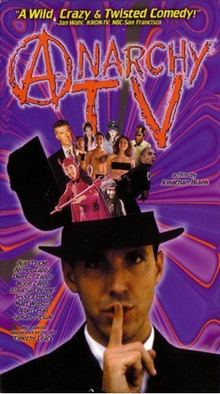
Anarchy TV


Turns out the Revolution will in fact be televised

90s era Anarchists seize control of a public access TV station from its corrupt Televangelist owner and strip naked live on air to protest social conformity and get some ratings for their revolution. Jonathan Blank's independently funded 1998 film was a challenge to find, I discovered its existence looking up the filmography of George Wendt who briefly appears alongside Alan Thicke, Jessica Hecht and the Zappa clan. After finding out about the film and its premise, "Anarchists take control of a public access TV channel to protest a Televangelist and get naked to get viewers" I tried looking it up and could only find a VHS rip.  

From the premise, I was worried I'd be wasting my time with another edgy comedy that littered the 90s indie scene. The kind of film that used shocking behaviour, nudity, sex and swearing as crutches for clever humour and plots that mean things and make consistent sense. I was expecting to waste 90 minutes watching some grainy not quite porn mixed with cheap sets and running joke skits. Luckily, Anarchy TV for all its limitations in budget does not disappoint. It does include nudity, sexuality, swearing and edgy satire, but they all have a point to make and serve the film and are not ploys to get audiences. The VHS rip is quite good considering the age, and I found the film noise and artifacting added to the movie's grungy aesthetics and public access television setting. 

The cast is a bit rough but likeable, I was sympathetic to their plight, and they were refreshingly odd in ways that felt authentic. They're caricatures of 90s American activists, the conspiracy obsessive, the militant sex negative feminist, the free speech crusader who uses jokes and satire as weapons, the survivor of the New Left and civil rights movement who hasn't found their place in the new ideology free 90s. But unlike most caricatures of these types in media, they aren't the objects of scorn and were written and acted by people who were familiar with the real life examples. "Anarchists" and "Anarchy" appear a lot in media, it's just that usually those terms are synonyms for random violence and scary bad things. I was expecting Anarchy TV to be equally sloppy, but again I was proven wrong, these Anarchists might fail the Anarchist tests, they don't quote Bakunin or Emma Goldman, but they're close to the Anarchists that were around in the anti-globalisation fights of the period. They are openly hostile to capitalist society, its values and its power structures, and while they use the common Anarchist dressings and slogans they also make use of more obscure ones, and in ways that are appropriate to the satirical vibes.

Televangelism and business orientated religion is cruel, callous, hypocritical, corrupting, bigoted and reactionary. Anarchy TV makes this point through jokes, but the message is loud and clear. The police are also scum and active participants in repressing non-conformist voices. The TV studio group are arrested after a non-violent protest picket*, the police are openly racist and work with the Televangelist, both because he's in the legal right, and they're being paid by him for some extra muscle. The people that American society treats like trash, the odd balls who find self-expression and meaning through obscure art and performances on TV channels few people watch, sex workers and other criminalised poor people, ethnic minorities etc, can come together, share their depth and talent and value and cause enough disruption to force the proud and powerful to suffer a defeat.

Now for what you've all come for, full-frontal nudity. Yes, there is indeed open and non-simulated nudity in this film. And to this film's credit, it does not fall into that double standard where female nudity is okay and male nudity is taboo, both men and women get naked, and we see everything. Also, the nudity is not actively fetishised, it's quite upfront and honest in how it handles nudity. And as an extra layer, while the nudity is a tactic to get people to tune in and pay attention to their hijacking of the station it is treated as a political act and is shown to have important effects on self-esteem and coming to terms with your own body. Nowadays, nudity is split off into a shocking action of perverts and maladjusted people or gated off in a small cluster of approved and regulated zones like nudist beaches. There was a time when behavioural non-conformity including nudity was considered quite a revolutionary break with societal norms that stifle self-expression and identity. Emile Armand, the French Individualist Anarchist, was an advocate of this tendency "Liberation from one of the main notions on which the ideas of “permitted” and forbidden, of “good” and “evil” are based. Liberation from coquetry, from the conformism to an artificial standard of appearance that maintains the differentiation of classes**." Anarchy TV has the discussion about this tendency and whether it can be a valid form of protest.

The film is not perfect, its jokes hit for me more often than they missed, but I didn't find many of them hilarious, more funny as in clever less funny as in "ha,ha". And there are some 90s context that hasn't aged well. Tamayo Otsuki plays my favourite character Tiffany. She's a sex worker who bounds with the TV crowd and overcomes some of their snobbery over her life, it's her act of solidarity, posting bail that gives the crew their chance to strike back at the man, and it's her openness towards nudity that kicks off the nudity stunt that succeeds in bringing and audience and rallying the community to foil the bad guys. She is depicted as a bit rough compared to Anarchy TV crew and their activist sensibilities, but she isn't stupid nor is she a dupe, she watched their show and is a willing and conscious participant. Unfortunately, as an Asian woman in a 90s comedy, she has one of those joke exaggerated Asian immigrant accents. 

But overall I enjoy the film and believe it deserved a bigger audience. I think the nudity is what cost the film a wider release. As far as I can tell, it never received a DVD release and isn't on any streaming service I can find. The film's distributors were Asylum, yes, that Asylum, the company whose business model is tricking people into buying low effort rip-offs of popular franchises. Qualms about the quality of the final product can't have been the reason for the film's lack of support and distribution, it's far superior to the typical Asylum production. I think this is a rare case of an edgy satire that genuinely went too far for mainstream societies standards and got buried. Nudity, especially male nudity, is still very taboo with few examples outside open pornography.

 *Well, there is actually plenty of violence at the picket line, just that it's the studio staff fighting each other.

** https://theanarchistlibrary.org/library/emile-armand-revolutionary-nudism

Popular Posts