Search This Blog

Friday, 7 October 2016

Jackboots and Phasers


It seems like we have another theory about the sinister message behind Star Trek, this time from the other side. Unlike that weird essay on Star Destroyer.net I think this is mainly tongue in cheek, its a youtube video on a channel called Film Theory. But I honestly struggle to tell, I have seen people with similar presentations and styles say even more ridiculous things only to find out they were being sincere. I mean I thought that Star Destroyer guy was having a joke before I read the whole thing and realised they were being 100% genuine, and I have seen both being used by other people on the internet as the crux of a serious argument, so I think its worth taking sometime to dissect it.


We don't get off to a great start this fellow doesn't seem to understand what Fascism is. He gives a brief introduction on Fascism but aside from name checking Hitler and Mussolini there's nothing really in it that's unique to Fascism. It's just generic authoritarianism. Fascism is a word that's become incredibly overused and misused over time, probably more so then Communism. It refers to a specific ideology but most times when you see or hear the F word its used to describe a thing the person using it doesn't like. Pinochet's regime in Chile was often described as a Fascist regime and while its true the regime was brutal and relied on the police and military for its survival, it can't really be described as Fascist because its economic foundation was unrestricted capitalism (well until they needed the state to prop them up) and that's pretty much the opposite of Fascist economics. And later on the author (video star?) claims that Fascism hated capitalism, this ahistorical nonsense. His only support for this assertion is one quote from Hitler.


Now there are a number of problems with this, its considered bad practice to rely on quotations devoid of context. Especially when dealing with politicians who lie, exaggerate and in some cases are being sincere in their wishes but find once their in power will have to make some sort of compromise. A good example of this is President Nixon. Nixon is remembered as a war monger and a lying crook but in the 1968 election where he became president he ran on a fairly peacenik friendly campaign, well friendly compared to his image anyway. He claimed he would end the draft (which he did, but in 1973 during his second term) and be a better negotiator then LBJ and Hubert Humphrey.


WINNING THE PEACE
''Every American wants peace in Viet Nam. The question is what kind of peace. The war must be ended, but in a way that does not encourage aggression and thereby sow the seeds of future wars.
''Beyond this, we need a new diplomacy -- one that looks past Viet Nam to the prevention of future wars, and one that enlists other nations more fully in their own defense.
"In Korea, and again in Viet Nam, America furnished most of the money and most of the arms -- and most of the men.
"America is a big country. But there are only 200 million Americans, and there are more than 2 billion people who live in the free world. We need a new diplomacy that will get other nations with a stake in the defense of peace and freedom to bear their share of the burden. And we need a new diplomacy that will insure that, if the people of a friendly nation again are threatened, we help them fight the war but we don't fight the war for them."
 Of course Nixon didn't really end on his watch, if anything the war escalated and spilled over into neighbouring countries. Nixon did eventually make good on his promises to pull US troops out of Vietnam and set up negotiations but most of that happened in his second term after his creditability on the war was already wrecked.


Now what's the relevance here? Well its because the evidence in the video is far from compelling. Hitler and the Nazi party did indeed criticise capitalism (the Nazi version of Titanic film blames British Capitalists for the disaster to pick a random example) but the context gives a different picture. Many of the disparaging comments directed at capitalism by Hitler and his gang revolved around the perceived damaging effects to the nation inflicted by self interested businessmen.


The video actually quotes Hitler's speech in 1927 were he declares the Nazi party to be socialists. Though thankfully he's only interested in the bit at the very end of the passage were he talks about his determination to destroy capitalism under all conditions. This speech is actually quite well known it gets used a lot by right wing types all over the internet to paint the Nazi's as socialists. And it's understandable if your naive enough to take a politician at his word. Remember Hitler also publicly  stated that he wished to be a man of peace, and allied with the Soviet Union for a couple of years after murdering German communists and spending decades warning anyone who would listen that the USSR was a direct threat to the Western world and the German race.


But this particular case is quite egregious, you see the date of the speech was 1927 when the Nazi party was doing rather badly, but the Social Democrats and the Communist party were both on the up. The mid to late 20's are seen as a period of desperation by the Nazi party as it struggled to stay relevant and break out of its 2-3% vote share. Part of this strategy was to try an nick some members from the SPD and KPD which didn't really work, of the three they always came a distant third amongst working class Germans. Another part was to provoke the other two into violent outbursts and frame the Nazi party as the only real opposition to the Reds, which did work, after the press reported the street fighting membership applications went up. But it's important to remember that even when Hitler and Goebbels tried to appeal to the left that they never deviated from their racist core.

For example the "We are socialists" speech was actually about how important Lebensraum, the colonisation of the East was to German survival.

And later on when the Nazi party lost its interest in attracting German workers to it, Hitler made multiple speeches and paragraphs in Mein Kampf talking about a need for a disciplined capitalism.

“We concede that capitalism itself is not the enemy; but rather it is capitalist excess and irresponsibility, such as Jewish Finance Capitalism and the destruction of profiteering from interest, that we must strive ruthlessly against....We do not seek to replace the capitalist system, but to harness its productive capacity for the betterment of the German Nation."


There was also another factor, Hitler believed very strongly that financial and international capitalism was dominated by the Jews, and was one of the two means the Jews had for attacking and dominating the human race, the other being of course "Bolshevism".


The Jewish train of thought is, moreover, clear. The 
bolshevization of Germany, i.e., the extermination of the 
national folkish intelligentsia and the exploitation of Ger- 
man labor power in the yoke of world Jewish finance facili- 
tated thereby, is thought of solely as a preliminary to a 
further extension of this Jewish tendency to conquer the 
world.
Indeed he was so focussed on resisting Jewish financial capitalism that he dedicated one of the later chapters of Mein Kampf "The Will to destruction of Jewish Finance" to the subject.

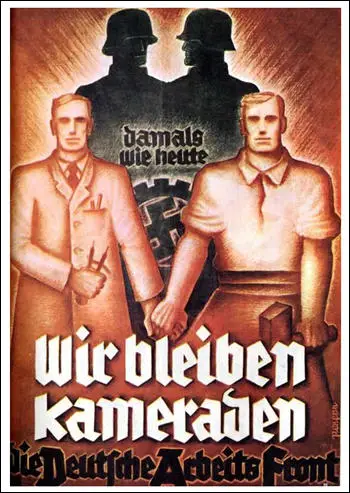
But beyond speeches, the reality of the Fascist regimes shows how shallow the anti-capitalism of big business really is. See Fascist economics in theory is based on class collaboration and mediation. Labour and Capital are viewed as competing, sectional and at times selfish interests and if the two are in open conflict or one side dominates completely the nation in its entirety suffers. So in order to balance the two, the Fascist party (representing the entire national community) will act as a mediator and moderating force on the two to ensure the best possible outcome for both sides. The Deustche Arbeits Front (DAF) the main organisation for German labour would support wage increases and holidays and other benefits on occasion, in order to ensure high productivity. But on others they would support employers in preventing wages from rising beyond a certain point, make sure the workers would work long shifts, and assisted in the transfers of workers to strategic industries.


In addition the Nazi party provided German industry with thousands of slave labourers. Even in the concentration camps factories and workshops owned by private companies could be found. IG Farben the chemical giant that produced the pesticide Zyklon B operated in Auschwitz


The history of the founding of the camp is connected with the initiative by the German chemical concern IG Farbenindustrie A.G. to build its third large plant for synthetic rubber and liquid fuels. The new camp was to be located in Silesia, beyond the range of Allied bombers at the time. Among the several sites proposed in December 1940/January 1941, the final choice fell on the flat land between the eastern part of Oświęcim and the villages of Dwory and Monowice. The decision was justified by the favorable geological conditions, access to railroad lines, water supply (the Vistula), and the availability of raw materials: coal (the mines in Libiąż, Jawiszowice, and Jaworzno), lime (Krzeszowice), and salt (Wieliczka). Furthermore, the belief that it would be possible for the firm to employ prisoners from the nearby Auschwitz concentration camp was by no means a trivial consideration, and may in fact have been decisive in the choice of the project.

IG Farben put the pieces of the deal in place between February and April 1941. The company bought the land from the treasury for a knock-down price, after it had been seized from its Polish owners without compensation; their houses were vacated and demolished. At the same time, the German authorities expelled the Jews from Oświęcim (resettling them in Sosnowiec and Chrzanów), confiscated their homes, and sold them to IG Farben as housing for company employees brought in from Germany. Some local Polish residents were dispossessed in the same way. Finally, IG Farben officials reached an agreement with the concentration camp commandant on hiring prisoners at a preferential rate of 3 to 4 marks per day for the labor of auxiliary and skilled construction workers. In a letter to his colleagues about the negotiations, IG Farben director Otto Ambros wrote that “our new friendship with the SS is very fruitful.”


And this is just one example, a far more complete list of German firms taking advantage of slave labour in the camps can be found here.

So no matter what Hitler thought about the pursuit of money, the reality is that his Fascist regime was heavily dependent on capitalist enterprises to function, and it worked to support them to ensure the needs of both state and capital were met.


But let's move on now, what about the rest of his statements? Do his other claims about the Federation stand the test of scrutiny? Well not really.


POV:

The viewer is told that we only ever see the viewpoint of the Federation, and that just isn't true. Throughout the franchise we get alternative views. DS9 is the best in this regard, by the time season seven ends we know just as much about the Ferengi, Bajorans and Cardassians as we do the Federation, if not more. We also see different points of view from within the Federation, that's actually an important subplot in early DS9, the Maquis are group of extremely disgruntled colonists are highly critical of the Federation.


But its not just DS9, in TNG and TOS we do get the Klingon and Romulan side of the story in several episodes. Even Voyager tried to do this with its long running villains the Kazon, Hirogen and Borg. Its just that they weren't very good at it.


Conquest and colonisation:


He also says the Federation is a colonising power, which it undeniably is, we spend many episodes at Federation colonies. But then he links it to human colonisation on earth. The destruction of the American Indian societies, the scramble for Africa etc. That is in a word bizarre, see all those colonies are on worlds that had no intelligent life, and the only way to join the Federation is through mutual consent. We see episodes were the Enterprise encounters primitive planets and the crew is supposed to leave them alone. But if they were only interested in empire building and resource gobbling they would love these planets, they would be very easy to dominate and exploit.


The Prime Directive, Star Fleets most important rule, so important that we're told that a Captain is prepared to give his life and the lives of his entire crew to uphold, states this, civilisations that don't have warp technology are to be left alone.


I can think only one episode where the Federation tried colonising a planet that was already inhabited by intelligent creatures (TNG Home Soil). But that was because they didn't know it was there. The species was a form of intelligent crystal,  and once they find out the crystals are intelligent and alive they call the operation off.


Monopolies


Now we getting into familiar ground, much is made of how we don't see ships that don't belong to Star Fleet even though we do. Remember the Maquis? Well they were so critical of the Federations policy that they went rogue and started turning their own ships into a sort of attack fleet. Also Sisko dates and marries and independent freighter captain. There is also quite a few references to individual Federation planets having their own fleets and ship designations.

A combat vessel knocked up by farmers


Communications, its often brought up that the Federation owns a monopoly on interstellar communications. Every time I hear this I think do they? Because there doesn't really appear to be any difference which communicator you other then the prop frame. You can ring up Romulus or use a Klingon hand communicator to hail the Enterprise, the only restrictions seem to be on whether the bad guys can track the signal or if the person your calling is out of range or in some space anomaly that interferes with communications.


Basically what I'm getting at is that they don't really develop their communications technology on the show. Like the transporters its just a means of plot convenience. You can use something the size of a smart phone to alert the flagship of an alien plot with little issue, unless the episode is about the crew overcoming whatever was preventing them from making a call.


A bit later on the author gets back to the point by taking Trek philosophy "The needs of the many" and mirroring it to what he claims are Fascist philosophical pillars, but are mostly just generic collectivist sayings. Like Hitlers "Society's needs come before the individuals'" though to be fair in this section he does get the Fascist idolisation of the state right. And he is correct with  the Italian Fascist symbol being a bundle of sticks with an axe blade. However that was the symbol for ancient Rome, from the time of Roman kings to the Republic era and survived into the Imperial period. Mussolini talk a lot about rebuilding the Roman Empire apart from deliberate evoking of Roman imagery the two societies simply aren't comparable.

 However he draws the connection by linking it to the bundle of sticks proverb and not a representation of the Fasces. The problem here is that the Fasces were a direct reference to the proverb which comes from one of Aesop's fables,

An old man had a set of quarrelsome sons, always fighting with one another.  On the point of death, summoned his sons around him to give them some parting advice. He ordered his servants to bring in a bundle of sticks wrapped together. To his eldest son, he commanded, "Break it." The son strained and strained, but with all his efforts was unable to break the bundle. Each son in turn tried, but none of them was successful. "Untie the bundle," said the father, "and each of you take a stick." When they had done so, he called out to them: "Now, break," and each stick was easily broken. "You see my meaning," said their father. "Individually, you can easily be conquered, but together, you are invincible. Union gives strength."
There's also a similar story about the Bulgar king Khan Kubrat, the Bulgarian national motto (Union gives strength) is a reference to that tale.

 And the proverb was used by the Shawnee Chief Tecumseh while he rallied his people to fight in the war of 1812. So what's happened here is a case of disingenuous, the author has taken something Fascists use to argue that the source they  used and by definition all other usage and allusions by others is automatically  fascist. This would be like claiming Hindu religious rituals are fascist because a lot of them involve drawing some form of Swastika.

That's really the crux of his argument, what's left is a bit where he uses Kirk being punished for mutiny as an example, but unless he's claiming military discipline is inherently Fascist as too, is just another out of context fallacy. He ends comparing the relationship between the Federation and the Klingons, Romulans, Cardassians etc to the Holocaust (no seriously its at 12:10 in the video). Not only is that in very poor taste, it's not remotely true. The Federation doesn't demonise its enemies, at every turn it tries to make peace. They never conquer any of their major enemies, they turn the Klingons into allies, and gave up settlements in disputed space with the Cardassians, and agreed to neutral zone between them and the Romulans, and promised not to build cloaking devices.

The only time we ever encounter a Federation member demonise and entire species, like Captain Maxwell in TNG's the Wounded, or Picard and the Borg, or Section 31 in Deep Space Nine, their shown negatively, with their motives being challenged and explained. Maxwell lost his family in the war with the Cardassians and couldn't let go. Picard also had trouble putting what happened to him at the hands of the borg, but in the episode I Borg he realises he has issues and works to overcome, them. And Section 31, well their incredibly paranoid and have their plans to commit genocide thwarted by the series main cast.

Point is, as a joke this video isn't funny, as a serious argument its a joke.

Monday, 22 August 2016

The RCP's Current Solution to the Gay Question

I first started writing about the American Revolutionary Communist Party (RCP) and its really toxic attitude to homosexuals three years ago. I meant to submit this final bit on the current RCP shortly after the last one (I guess we know why that free lancing gig didn’t work out for me hey?). I’ve been busy with many other things but the sad truth is I have actual tried to complete this piece half a dozen times only to scrap it all half way through.

The current official attitude of the RCP to homosexuals is detailed in the grandly titled “On the Position on Homosexuality in the New Draft Programme” or DP for short. This position paper was finished in 2001 and hasn’t been updated in the fifteen years since first publication. The document is very long 34 A4 pages, but what does it actually say, well at the very end it says that homosexuals can now become members of the party. And I mean at the end it only comes up in the second to last section of the paper.
Quote:
Can homosexuals be progressive revolutionary allies and even revolutionary communists and members of the revolutionary vanguard party? The answer on both counts is yes.
So end of the story? Well if you’re an RCP member looking to defend its reputation yes it is, but the DP shows a few severe problems with this attempt to show that the party has really changed. And I’m going to briefly go over them.

The main issue is that the DP is dishonest. It doesn’t apologise for the really nasty stuff the party did to its own members before this change. Indeed it doesn’t acknowledge it even happened. The only mea culpa here is for the 1988 line on homosexuality. This is important because the 1988 line was considered a compromise line implying that its at least a little better than the previous positions. So all the DP is doing is making excuses for having a party position that in their words wasn’t correct. I eventually found copies of all the RCP positions on homosexuality (there were quite a few) thanks to a blogpost by a former RCP member who had drafted a few of them in his past. Its worth reading his account as it goes into detail about the attitude of the party leadership (AKA Bob Avakian). I’ve added the lines as an appendix at the bottom of the page.

The party’s position on the gay question and why it is imperative to solve it has gone through many permutations. In the seventies homosexuality was on the level of prostitution and drug addiction, and a bourgeois plot to enslave the masses. By 1988 the gays were supporting women’s oppression somehow. In 2001? Well according to every other section of the DP the Gays are still colluding in women’s oppression but now it’s not true of all of them. There are some gays and Bi’s who want to end all oppression and one way to tell the difference is whether or not they want to join the RCP.
Quote:
“The Party must constantly bring forward into its ranks those who dedicate themselves to the cause of the international proletarian revolution, who seriously take up the weapon of Marxism-Leninism-Maoism [MLM] and carry out the Party's line and tasks among the masses. The members the Party must attract are those whose dedication is not to narrow and personal interests, but to the historic mission of communism.”
The second to last section opens up membership of the party to homosexuals, the last section is an attempt to bury criticism of the party’s history with the LGBTQ crowd, most of the other sections though are written to try and make it look like the RCP was kinda right about the negative relationship between homosexuality and women oppression. I’m only going to quote just one example here, but I’m not kidding when I say the majority of the paragraphs in this 34 page document are like this.
Quote:
“Historically, lesbian relationships and networks have encouraged and provided support for some women to exist and function outside of traditional roles or as a safe haven from male/women relationships that have been physically or emotionally abusive. But while this may be an individual improvement for some women, it is also true that, as we pointed out in our 1988 article, the larger relations in society still get reflected in lesbian relations to one degree and in one way or another. And more fundamentally, the practice of lesbianism does not solve the overarching problem of the oppression of women as a whole, in U.S. society and throughout the world.”
This particular passage in a vacuum may seem a fairly blunt rebuttal to what’s called identity politics but the majority of the section and the rest of the DP is dedicated to reiterations on these two themes. Same sex couples are just as susceptible to societies ideology (though why this means they seem to exclusively be an obstacle to women’s liberation, rather aiding in all the other oppressions and exploitations of bourgeois society is not explained or even addressed) and that same sex couples don’t on their own represent a rejection of class based society. The last part is true, but that’s true many other things like heterosexual relationships that the RCP either has no problem with (there is no position on heterosexuality in the party’s history) or actively champions.

The repetition of this argument and the layout of the document is designed so that anyone wishing to know about the RCP’s policy on gay members has to read through its self-justification before it gets to the answer. This paper isn’t a product of self-criticism, it’s a compromise and attempt to save face. Any homosexual who attempts to join the party must do so having swallowed the party’s bizarre line that by existing as a homosexual they are probably participating in the oppression of women, and must prove themselves by forgiving the party for writing a bad article in the eighties that it still largely stands by and in general a strict adherence to party doctrines.

So in conclusion, the RCP is still homophobic, (incidentally the only time the word homophobia appears is in the title of a book cited in the footnotes) and unapologetic for its worst behaviour on this issue. It’s moved a little, but there’s merely because of the sustained opposition its received over the decades.


Appendix


From Programme And Constitution of the Revolutionary Communist Party USA (1975)
Socialist society will wipe out the decadence of capitalism in all spheres. Prostitution, drug addiction, homosexuality and other practices which bourgeois society breeds and the bourgeoisie promotes to degrade and enslave the masses of people, will be abolished. The prostitutes, drug addicts and others who are caught in these things will be re-educated to become productive members of society, with working class consciousness. The shame connected with these practices will be taken from the shoulders of these victims and the guilt will be placed where it belongs—on the bourgeoisie.
(page 43)

From New Programme And New Constitution of the Revolutionary Communist Party, USA (Draft for Discussion) (1980)
The twisted outgrowths of this society, such as pornography and prostitution, will be forcibly abolished right off the bat and their re-emergence will not be tolerated. As for the prostitutes and others victimized by this capitalist degeneracy, they will be given productive work, politically educated and freed from the immediate source of their oppression, while education will also be carried out broadly in society to expose capitalism as the source of this degradation and to remove the tendency to blame or look down on the victims.

As for homosexuality, this too, is a product of the decay of capitalism, especially of the increased ripping apart of the family, which is inevitably taking place under capitalist conditions, especially as it sinks into deeper crisis. In particular it stems from the distorted, oppressive man-woman relations capitalism produces. Once the proletariat is in power, no one will be discriminated against in jobs, housing and the like merely on the basis of being a homosexual. But at the same time education will be conducted throughout society on the ideology behind homosexuality and its material roots in capitalist society, and struggle will be waged to eliminate it and reform homosexuals.
(page 67)

From New Programme And New Constitution of the Revolutionary Communist Party, USA (1981)

The twisted outgrowths of this society, such as pornography and prostitution, will be forcibly abolished right off the bat and their re-emergence not tolerated. As for the prostitutes and others victimized by this capitalist degeneracy, they will be given productive work, politically educated and freed from the immediate source of their oppression, while education will also be carried out broadly in society to expose capitalism as the source of this degradation and to remove the tendency to blame or look down on the victims.
As for homosexuality, this too, is perpetuated and fostered by the decay of capitalism, especially as it sinks into deeper crisis. This is particularly the case because of the distorted, oppressive man-woman relations capitalism promotes. Once the proletariat is in power, no one will be discriminated against in jobs, housing and the like merely on the basis of being a homosexual. But at the same time education will be conducted throughout society on the ideology behind homosexuality and its material roots in exploiting society, and struggle will be waged to eliminate it and reform homosexuals.
(page 77)

Friday, 19 August 2016

The Olympic games show the fraudulent liberty of right wing Libertarianism


The Olympics are on again, and while the physical achievements of the athletes are quite impressive I’m not really that fussed about who wins medals and who got disqualified for nudging a bar. Even if I was the corruption, security crackdowns and forced relocations of thousands of locals that always seem to accompany these global events would sour me on the topic. It does provide some interesting lessons about government priorities, corporate ethics and culture clash. And very occasionally there will be a very important symbol of protest.

A bit of trivia that I learned about the 2012 Olympics provides an example of why right Libertarian types (Anarch Capitalists, the Watchmen state types, and the Ron Paul style Libertarians of the USA etc.) vision of a perfect society is basically a fraud. The main fixture of the Olympics is of course the medals, and how many medals one nation can accrue. For the 2012 games the precious metals supplied for the shiny medals was supplied by a global mining giant called Rio Tinto. Rio Tinto has stretched across the globe in the US, Canada, Australia, Madagascar and Indonesia. They have a very murky record in practically every operation they run. One part of Indonesia that is of particular interest to Rio Tinto and other mining conglomerates is West Papua, an area that has suffered over fifty years of martial law and is under the direct control of the Indonesian military. If you wish to visit West Papua legally, you require a permit with the signatures of 18 heads of different ministries, and the conflict is estimated to have killed between 100-500,000 people[1].


Indonesian military "pacify" a village


The resource extraction companies like Rio Tinto that operate in West Papua are not independent of the security apparatus, there labour practices and environmental destruction including dumping toxic chemicals into the river system

“ The mine reportedly has caused “massive environmental destruction” in West Papua due to the dumping of waste, including toxic metals, into Indonesia’s river system.(16)   According to WALHI, a leading Indonesian environmental group, the mine has already disposed of one billion tons of tailings into the local river system, resulting in copper concentrations in local rivers that are double the Indonesian legal fresh water limit. Over the life of the project, the mine reportedly will dump up to 3.5 billion metric tons of waste, despite the fact that riverine disposal is expressly prohibited under Indonesia’s water quality control regulation.(17)”[2]

Because of human and labour abuses at mining sites company infrastructure has been targeted, a riot in 1996 shut down the Grasberg mine (one of the largest open pit mines in the world) for several days and cost the company several million. In response the mining companies stepped their support for the Indonesian military.

“  In 1996, local people rioted, destroying $3 million in equipment and shutting the facility down for three days.  Shortly thereafter, Freeport-McMoRan, Rio Tinto’s partner, reportedly started providing significant support to the Indonesian government and military to ensure the protection of the mine.(18)   The company reportedly made an initial investment of $35 million in military infrastructure and vehicles and paid at least $20 million to military and police in Papua between 1998 and 2004.(19)

§    Serious human rights violations have reportedly occurred near the Grasberg Mine and Rio Tinto and Freeport-McMoRan have been accused of complicity due to their reliance on the military and police for security at the mine.  According to Indonesia’s National Commission on Human Rights, “in the mid-1990s the Indonesian security forces indulged in indiscriminate killings, torture and disappearances of local people in their safeguarding of the mine operations and their campaigns against West Papuan secessionists.” (20)”[3]


The support that Freeport (the operations company that Rio Tinto owns 40% of) has given to the Indonesian military and police in West Papua is more than the millions of dollars given to the Police and Military. Company support for this armed protection has become so extensive that Indonesian troops and police are barracked on company property, drive company vehicles, and sport company uniforms[4] and receive direct bonuses and are even fed by the company.


“During a recent interview in Jakarta, the respected Amungme traditional leader ('Mama') Yosepha Alomang demonstrated that she did not need to read the New York Times to know that although the government security forces [including police and military] receive three free meals a day from Freeport, they still receive generous "food allowances" and other payments. The payments were recently revealed to the wider world in an exposé by Jane Perlez and Raymond Bonner published in the New York Times. ”[5]


In return for this generosity the army and police (The distinction seems pretty arbitrary to me) maintain discipline on company sites, keep the area clear of terrorists and on occasion spy on troublesome civil society groups for the company. Indeed when this cosy relationship was exposed in 2005 by the New York Times the Indonesian military fully admitted to the relationship,


“A military spokesman, Major General Kohirin Suganda, said yesterday the military "as an institution" had never benefited from the Freeport payments. He also claimed that individuals did not enrich themselves, rather that the money was spent on the forces in the field. "We have heard that Freeport provides support such as vehicles, fuel and meals directly to the units in the field," Gen Suganda told the Associated Press. "That's the company's policy. It was not done because we requested it."”[6]

This is deplorable but you might be wondering what the point of this is. The abuses and murders being carried out in West Papua are by state institutions; the police and the army. Well for the sake of argument let’s assume that a world revolution took place, inspired by the ideas of right libertarianism, and the state everywhere was overthrown or dissolved, or whatever. Would anything change for the people of West Papua? I realise this is a hypothetical but I don’t believe it would. Rio Tinto, Free Port and the other resource and mining companies would still be there. The metals in the ground would still be there, the market and the capitalist system would still be functioning. So not much has changed, the people of West Papua are being oppressed and a key component of that oppression isn’t even scratched.


Rio Tinto et al aren’t using Indonesian soldiers because they personally oppose the regions secessionism and believe in an Indonesia one and indivisible. They are doing it because they want to keep profits up and costs down.

Since they’ve already shown for decades that they’re prepared to ignore the local population’s needs with their business practices and that they are willing to enforce this  corporate policy through armed force. What’s to stop them from continuing to do so? There using the state army and police, because they were already there. If the army and police go away along with the rest of the state then what’s stopping the companies from building their own security forces? They already employ by proxy Indonesian soldiers so it wouldn’t even be a radical break.

If you’re being menaced by an armed force does it really change anything from your point of view if that force is motivated by a desire to maintain national unity or to get a bonus? If the people are not much happy being beaten by the “people’s stick” would they be much happier being beaten by the “Individuals privately owned stick”?

The simple reality is that both state and capital are oppressive and exploitative institutions so getting rid of one and ignoring the other, leaving aside the question of whether it’s possible won’t stop exploitation or oppression, it simply changes the jargon and uniform logo’s.


[1] http://thediplomat.com/2013/11/asias-palestine-west-papuas-independence-struggle/
[2] http://londonminingnetwork.org/2010/04/rio-tinto-a-shameful-history-of-human-and-labour-rights-abuses-and-environmental-degradation-around-the-globe/
[3] Idib
[4] Leith, Denise. The Politics of Power; Freeport in Suharto's Indonesia. University of Hawai'i Press, 2003.
[5] http://www.downtoearth-indonesia.org/story/illegal-military-payments-freeportrio-tinto
[6] https://www.theguardian.com/world/2005/dec/30/indonesia.johnaglionby

Saturday, 9 July 2016

Cops, Dirty Harry, And Junious Poole: By Hal Draper


 The response to a sniper in Dallas targeting police officers has been rather mixed, I seen some tweets and FB status and forum comments outraged, alarmed, attempting neutrality, and few being quite giddy. In response to the latter a friend shared this 1972 address by Hal Draper from the Marxist Internet Archive.

 
And I'm sharing it here because I think the topic of urban terrorism in response to police repression and societal indifference is arguably just as relevant today as it was when first given. 


I am going to talk about Dirty Harry and Junious Poole, and about your responsibility for both.
Dirty Harry, as you may have found out by now, is a well-made right-wing movie, virtually a Birchite propaganda film, made with the cooperation of the great liberal mayor of San Francisco and his great liberal Police Department. Harry, a San Francisco police detective, is a mad-dog sadist killer in plain clothes, with a badge, who hates people, blacks, browns, and himself (more or less in that order) and who is shown to be a great hero who rescues civilization from a crazy killer, who is also in plain clothes but minus a badge. This crazy – I mean the second crazy – is a pathological sniper who is likely to get YOU if you don’t watch out. And so the audience is set up to root for Dirty Harry as he denounces the Supreme Court decisions as soft on crime, and indicts the civilian bleeding-hearts who release an insane murderer to kill more people just because their civil-libertarian do-gooders. This enlightening film even shows you that this mad dog (I mean the sniper) gets himself beat up deliberately in order to accuse Dirty Harry of doing it – so who can believe any stories about police brutality now? The victim probably paid someone to get beat up himself ...
That’s the way it goes, and it sets you up to nod your head as the scriptwriter, on the basis of fraudulent claims of how the rad-libs tie the hands of the cops from protecting you and me – the scriptwriter shows how you need touch cops, free-shooting cops, violence-loving cops; in fact, he shows how you need mad-dog types on the police force in order to protect you against the mad dogs who are not on the police force.

That’s Dirty Harry. Now who is Junious Poole?
Last Monday, in San Francisco, Junious Poole, a black man who was high on liquor and benzedrine, and low on money and hope, took up a rifle in the street and leveled it at two random policemen who happened to be walking along, emptied its bullets at them in a blur of hatred of something, wounding both of them. What he told newspaper reporters reads like an imitative movie script of what a poor devil like him is supposed to say: “It all came down on me,” he said. “No income. My wife collecting welfare, two babies ... I felt disgusted with the whole world and the situation. You can be a fool for so long, man, and then you just begin to see it in front of you,” he said.

Well, this poor casualty of society, who had been a fool for so long: what did he begin to see in front of him? Here’s what he also said: “I saw all the background that I have been told when I saw these two policemen walking down the street.” That’s Poole, verbatim.

What was “all the background” he had been told – what did he see when he saw these two policemen walking down the street? He saw the signs scrawled on walls: “Off the pig!” and similar enlightening political messages about making the revolution in the streets, and picking up the gun to Get the Man. That on the one side. On the other side, he saw all the Dirty Harries in uniform who had roughed up and beaten up blacks in the ghetto areas.

And what did the two policemen see? They saw that Dirty Harry was right: give it to ’em before they give it to you – knee in the groin, bullet in the head, get tough because your life is on the line.
So Dirty Harry produces Junious Poole; and Junious Poole produces more Dirty Harries; and you have a fine old war between the Cops and the Crazies, the Crazies and the Cops – till you can’t tell who’s the cop and who’s the crazy, and moreover it hardly matters.
Now my target in all this is neither Dirty Harry nor Junious Poole. I have no wish to spend any time turning cops into vegetarians or flower children or mourning over their lost souls. I was brought up in a Marxist movement where it was an axiom that a man in this society who put a policeman’s uniform on him and took his club in hand was, until evidence to the contrary, nothing but scum. But, by the same token, I learned a very long time ago not to confuse the ruling powers of society with the scum in their employ.

My target is also not the poor fool, aching with his miseries, who picked up the rifle and might just as well have shot himself in the head as those policemen. My target is the people who told him “all that background.” I refer to the self-styled radicals who, for some years now, have been burbling over with their rhetoric about “offing the pig,” and “picking up the gun,” and “revolution in the streets,” and “urban guerrillas,” and cheering every time somebody else bombs the window of a Bank of America branch, or terrorizes a PG&E power line, or incubates a revolution in a safety-deposit vault, or otherwise takes direct action in terrorism according to the most fashionable doctrines of 1890. Because it has been these bumpkin-blowhards of the Big Bang theory of revolution who have been very successful not in tearing apart the System, but in tearing apart what there was of a radical movement that was aborning.

In the whole history of movements of social dissent, in this or any other country, I doubt whether there was ever an emptier and more self-defeating theory of revolutionary action than this trend in our recent years which made “offing the pig” its main slogan, and orated about making the “revolution in the streets.” Of course, the two come down to the same thing, because if you sally out into the streets to make the revolution, it’s the pigs you’re going to meet. You are not going to run into the Board of Directors of General Motors in this your chosen battlefield, nor into the Cabinet, nor even the office boys of the Powers That Be: the enemy you meet “in the streets” is the hired scum, that’s all. And the cream of the jest is that, for every cop that is killed by some self-styled revolutionary bravo, not a hair is mussed on the head of the ruling class, who have a right to laugh themselves to death over these pseudo-revolutionary antics while, in public, they make a horrified outcry about the crimes of the subversives.

It should be understood that the police are the paravanes of the capitalist state power. That implies a comparison with (say) a minesweeper. It is in mined waters, and any direct contact with a mine will blow a hole in its side. Its whole strategy, therefore, is to avoid any direct contact, but to interpose its own buffers – one or more layers of buffers – which any explosive force has to get through before it can even confront the real core of power. The minesweeper’s paravanes are most useful the further they are removed from the real center that has to be defended. A paravane makes contact with an explosive mine, and it is blown up: the paravane is destroyed, but the ship itself is safe because it has been destroyed.

The police act as the paravanes of the system. They are there, way out in the open, as the first contact with potentially explosive social material. If a cop is killed, or merely attacked, the state power makes a big hue and cry, and can draw a long breath of relief. It can use the incident for arousing public opinion against dissenters; it can use it for escalating repression; it can use it for deepening reaction; and in exchange, all it pays is a pension to the cop’s widow, if that. But not a hair on its own head is hurt. The transaction is so beautifully cheap, for the state, that it could not be better if it had been planned by itself; and you never know whether it was or not. There is a big misunderstanding about the question of telling the difference between police provocateurs and plants, on the one hand, and sincere if stupid Weatherman types, on the other. The misunderstanding is this: that it makes much difference whether you can tell them apart. In the history of terrorism, some waves of reaction have been launched by governments which produced a terroristic incident to order, and some by governments that simply waited for some obliging chucklehead to do it for them. And in some cases, to this day it has not been possible to determine which was which.

I remember vividly an interview that TV newsman Mike Wallace (I think it was he) held with Eldridge Cleaver in Algeria, the first interview he gave after fleeing there, I think. It was broadcast after the first wave of police assaults on the Black Panthers, and, if I’m not mistaken, at the time Huey Newton’s life was hanging in the balance in the courts. In the midst of this lynch atmosphere, which was based on the proposition that the Panthers were nothing but terroristic assassins, Cleaver calmly told his interviewer that sure, it would be a good idea if President Nixon were assassinated.
Now, could Cleaver have done any better to help the lynch movement against the Panthers if he had been paid to do his stuff by the FBI? As it happens, I have no doubts about Cleaver’s sincerity in this case; this political ignoramus and half-baked Theoretician of the Absurd has been a disaster for the Panthers just as he was a disaster for the Peace and Freedom Party, which he knifed in the back after being named its presidential candidate. A police spy would probably be cleverer. But what difference does it make whether the FBI gets his help free or on salary, as this great revolutionary Thinker keeps on sending his advice, from Algeria, on how the radical movement here can get its head chopped off?
This whole movement of sick-radicalism, as represented by these terroristic elements or Weatherman types, counts on something to puff it up from the nullity it really is. They count on you. That is, they count on their mischievous antics meeting with a certain amount of unspoken sympathy from the liberal and radical public, because their intentions are so good, or because they are regarded as being real free-wheeling revolutionaries. That is pure bull-bleep. These elements have nothing in common with a serious revolutionary movement. These types are really middle-class liberals in a frenzy. In fact, some of them act this out by alternating between supporting Democratic Party left-fakers on the one hand and writing articles, on the other, about the chemistry of pipe bombs.

A long time ago, my friend Karl Marx had their number. In 1850 he wrote a review of a couple of books by French police spies on the conspiratorial secret societies of the day – the Weathermen of the day. In this piece, Marx took them down and shook them out as never before. Here are a couple of sentence from Marx’s review, for example:
“Their job indeed consists in forestalling the process of revolutionary development, pushing it artificially into crises, making a revolution on the spur of the moment without the conditions for a revolution. For them the only condition for the revolution is a sufficient organization of their conspiracy. They are the alchemists of the revolution, and wholly share the confusion of ideas and the limitation to fixed notions of the old alchemists. They go eagerly for invented devices to achieve the revolutionary miracle: incendiary bombs, explosive contraptions with magical powers, riots, whose effects are sure to be all the more miraculous and awesome the less they have any rational basis. Busy with such plot-mongering, they have no other aim than the next overthrow of the existing government, and look with deepest disdain on a more theoretical clarification of the workers as to their class interests.”
So much for Karl Marx. But of course Marx is out of date for these bomb-bumblers, whose theories were mildewed with age before Marx was born. These theories, now dressed up with new terms like “urban guerrillaism” or others, have always been the rediscoveries of people overcome by their own impotence, frustrated by their own lack of any really revolutionary perspective, giving out with their last shriek of liberal rage just before going back to “make it” inside the system or to back the latest capitalist politician who uses the latest phrases of the left. Above all, as Marx already said, they have the deepest disdain for the tasks of theoretical education and long-term class-struggle organization of the mass of working people in this country, who in turn have the deepest contempt for them, and rightly so.

Leave these types to their games of Cops and Crazies. That is not the way.

Tuesday, 28 June 2016

Turns out it Wasn't Jezza's Fault After All


Yes it seems that Brexit wasn't the fault of Jeremy Corbyn or decades of scaremongering about immigrant hordes. No the real culprit here was..... Gay Marriage!

Well according to the Daily Mail anyway,


The proposal, which had not been in the Tories’ 2010 election manifesto, was vehemently opposed by about half of his parliamentary party — who happened also to be the most Eurosceptic — and appalled countless members of local Conservative associations.
This was seized on by Nigel Farage. I had lunch with Ukip’s leader at that time and I recall two things above all from it.
First, how disgusted he was that I did not want to have a drink before sitting down; and second, how gleeful he was at the way the gay marriage row was sending shire Tories in droves to switch to Ukip membership. 
Though Farage himself is a libertarian, and definitely no moralist, he exploited this to the full.

This and the full part of the article is in a word bollocks. The only part of the narrative being peddled by Charles Moore that's even remotely accurate is that Same sex marriage was divisive within the Tory party. Everything else is simply misrepresented.

For starters David Cameron had already taken steps to appease his Eurosceptic base before Same sex marriage became a talking point in 2013. In 2009 back when Cameron was just a party leader he took the Conservative party out of the European Peoples Party, the EPP is the main coalition of right wing parties in the European Union. Many of whom like Germany's CDU are staunchly pro EU, and the group as a block opposed a referendum on the Lisbon Treaty which the Conservative party were campaigning for. Instead he took the Tory's into a coalition called the European Conservatives and Reformists, working together with parties such as the homophobic Law and Justice Party in Poland, the National expansionist Bulgarian National Movement which is hostile to minorities and dreams of a "Greater Bulgaria" annexation of other territories like Macedonia.

This was clearly a move designed to appease the Eurosceptics as it diminished the Conservative parties influence in the EU and allied them to some very strange and extreme parties. At the same time the Tory party was also building up opposition to the Lisbon treaty, though it was ratified in parliament.

But what about 2016 and Brexit/Bremain? Well its true that the same sex marriage vote split the Conservative party who voted 126 for to 134 against, but that doesn't mean that same sex marriage killed the UK's EU membership. All this shows is that the issue widened a rift within a party, we're currently seeing the same thing happening in the Labour party over Jeremy Corbyn. There were many options open to Cameron, including give a referendum on the EU and fight a winning campaign. What cost Cameron his job and his victory were his own failings.

The victorious leave campaign was based on two platforms, immigration, and austerity, remember the £350 million going to the EU that could go the NHS slogan? The one leavers have already backtracked on, IDS, and Farage. Both problems were the governments making, Cameron's government's spending cuts and refusal to either take steps to lower immigration, or educate the population on the realities of migration other six years gave his opposition free movement to whip up the mood against him. Hell he announced this referendum in 2013, that's three years head start he gave himself, and squandered.


Hell this one combines both slogans


Gay marriage wasn't even a bullet point on the leave list.

So no Gay marriage did not kill Britain's EU membership and Cameron's "legacy", he did with his own poor decisions and inability to fight a winning campaign.

Monday, 20 June 2016

Politics Makes Strange Bedfellows: Karl Marx and the Young Republican Party

Sadly this is a mock up I found on the web, but it neatly illustrates the topic.


History is full of strange occurrences, chance meetings and weird common interests. The Paris Commune for example united for a time the Anarchists (under the Proudhon faction) the Communists (Under the leadership of Blanqui's supporters) the lefty republicans and the Free Masons.

Here's another strange coincidence in the life of Karl Marx. Marx after leaving the University of Berlin with a background in philosophy he wandered for a bit ultimately becoming a journalist in Cologne.

He had also written some play scripts and even a comedic novel. But his main source of work and income in the early 1840's was journalism writing for and editing the Rhineland News. The News was explicitly political and of a left wing persuasion mainly criticising the Rhineland Diet. While writing for the Newspaper Marx started corresponding with German exiles in France and learned about their new socialist ideas taking root in French working class districts. One of those ideas went by the name of Communism a name popularised by Auguste Blanqui and of course would be taken up by Karl Marx. Communism soon supplanted Karl Marx's early German republicanism though not immediately, it seems the suppression of the Rhineland News in 1843 pushed Karl to make his break with constistutionalism. 

In 1847 the first Communist party, the Communist League* was established with Marx and his close friend and collaborator Friedrich Engels as major members. The Manifesto of the Communist Party was written on behalf of the Communist League and was an explanation of the groups beliefs, strategies and actions. Marx and the League also published a new paper in the Rhineland under the name of New Rhenish News but that didn't last very long either.

The Revolution of 1848 swept over Prussia and the smaller German states, the Communist League was supportive but unable to play any effective role. Though that didn't stop the League and Marx getting a lot of blame for causing it anyway.

Marx was exiled in 1843(he would return to Cologne in 1847) after the collapse of the Rhineland News and moved to Paris were he again found work co-editing a Leftist newspaper The German-French Annals. He and his wife and children had to keep moving around western europe until the fall out of the 1848 Revolutionary wave forced his family to seek shelter in London where he spent the rest of his days.

Whilst in London Marx ran out of money, and was desperately in need of work. An offer of work came from a surprising source, a newspaper published in New York, known as the New York Daily Tribune. The Tribune was founded in 1841 by Horace Greeley as a pro Whig party publication. In October 25th 1851 the paper boasted of acquiring some new foreign correspondents of great knowledge and insight

“a letter from Madame Belgioioso, upon the daily and domestic life of the Turks, and another upon Germany by one of the clearest and most vigorous writers that country has produced—no matter what may be the judgment of the critical upon his public opinions in the sphere of political and social philosophy.”
The clearest and most vigorous writer of Germany (even though it wouldn't exist for another twenty years) was Karl Marx, his first article was on the aftermath of 1848

 “The first act of the revolutionary drama on the Continent of Europe has closed...The ‘powers that were’ before the hurricane of 1848, are again the ‘powers that be.’ ”
 This relationship would continue for nine years until 1861. For his services Karl Marx was paid an average of $5 a week, which was just enough to keep his family in home, but not much beyond that. He would become the paper's global correspondent writing on events and conditions all over the world.  It wasn't a happy relationship, the paper refused all requests for a pay increase and Engels had to assist the Marx family financially from time to time. However the steady payments and research conducted for the Tribune would pay off for Marx's passion the development of his political understanding. Without the Tribune Marx probably would not have finished the first volume of Capital (some of his articles were reproduced in it) or any of his other post 1840's work.

So where does the GOP come into this? Well the Tribune supported the Whig party, however the Whigs collapsed in the 1850's with most members and supporters joining the newly created Republican Party. Horace Greeley was one such new member and he took his newspaper with him. This means that for several years Karl Marx's political ideas were being subsidised by the main journalistic arm of the Republican party. How's that for strange bedfellows?

But it goes a bit deeper Karl Marx was well aware of the American political developments and preferred the Republican party to the Democratic party. When the Civil War broke out Marx backed the Union, one of his last articles for the Tribune was about the public opinion of England (Britain) to the political instability in January 1861 (open war wouldn't happen until April) and warning and criticism of the Cotton importers and textile mill owners whom were trying to pressure the British Empire to side with the rebelling south.

The only war meeting convened on the arrival of the La Plata, in the cotton salesroom of the Liverpool Stock Exchange, was a corner meeting where the cotton jobbers had it all to themselves. Even at Manchester, the temper of the working classes was so well understood that an insulated attempt at the convocation of a war meeting was almost as soon abandoned as thought of.

And in 1864 the International Working Men's Association, of which Marx was a leading member wrote a letter congratulating him on his re-election and upon his resistance to the slave power of the Southern plantation owners. Marx was on of the signatures.


We congratulate the American people upon your re-election by a large majority. If resistance to the Slave Power was the reserved watchword of your first election, the triumphant war cry of your re-election is Death to Slavery.
From the commencement of the titanic American strife the workingmen of Europe felt instinctively that the star-spangled banner carried the destiny of their class. The contest for the territories which opened the dire epopee, was it not to decide whether the virgin soil of immense tracts should be wedded to the labor of the emigrant or prostituted by the tramp of the slave driver?

When an oligarchy of 300,000 slaveholders dared to inscribe, for the first time in the annals of the world, "slavery" on the banner of Armed Revolt, when on the very spots where hardly a century ago the idea of one great Democratic Republic had first sprung up, whence the first Declaration of the Rights of Man was issued, and the first impulse given to the European revolution of the eighteenth century; when on those very spots counterrevolution, with systematic thoroughness, gloried in rescinding "the ideas entertained at the time of the formation of the old constitution", and maintained slavery to be "a beneficent institution", indeed, the old solution of the great problem of "the relation of capital to labor", and cynically proclaimed property in man "the cornerstone of the new edifice" — then the working classes of Europe understood at once, even before the fanatic partisanship of the upper classes for the Confederate gentry had given its dismal warning, that the slaveholders' rebellion was to sound the tocsin for a general holy crusade of property against labor, and that for the men of labor, with their hopes for the future, even their past conquests were at stake in that tremendous conflict on the other side of the Atlantic. Everywhere they bore therefore patiently the hardships imposed upon them by the cotton crisis, opposed enthusiastically the proslavery intervention of their betters — and, from most parts of Europe, contributed their quota of blood to the good cause.

While the workingmen, the true political powers of the North, allowed slavery to defile their own republic, while before the Negro, mastered and sold without his concurrence, they boasted it the highest prerogative of the white-skinned laborer to sell himself and choose his own master, they were unable to attain the true freedom of labor, or to support their European brethren in their struggle for emancipation; but this barrier to progress has been swept off by the red sea of civil war.

The workingmen of Europe feel sure that, as the American War of Independence initiated a new era of ascendancy for the middle class, so the American Antislavery War will do for the working classes. They consider it an earnest of the epoch to come that it fell to the lot of Abraham Lincoln, the single-minded son of the working class, to lead his country through the matchless struggle for the rescue of an enchained race and the reconstruction of a social world. 

Signed on behalf of the International Workingmen's Association, the Central Council:
Longmaid, Worley, Whitlock, Fox, Blackmore, Hartwell, Pidgeon, Lucraft, Weston, Dell, Nieass, Shaw, Lake, Buckley, Osbourne, Howell, Carter, Wheeler, Stainsby, Morgan, Grossmith, Dick, Denoual, Jourdain, Morrissot, Leroux, Bordage, Bocquet, Talandier, Dupont, L.Wolff, Aldovrandi, Lama, Solustri, Nusperli, Eccarius, Wolff, Lessner, Pfander, Lochner, Kaub, Bolleter, Rybczinski, Hansen, Schantzenbach, Smales, Cornelius, Petersen, Otto, Bagnagatti, Setacci;
George Odger, President of the Council; P.V. Lubez, Corresponding Secretary for France; Karl Marx, Corresponding Secretary for Germany; G.P. Fontana, Corresponding Secretary for Italy; J.E. Holtorp, Corresponding Secretary for Poland; H.F. Jung, Corresponding Secretary for Switzerland; William R. Cremer, Honorary General Secretary.

Honestly now can you imagine such a thing happening today?

Further reading:

http://www.freerepublic.com/focus/news/2780892/posts


* By which I mean an explicitly Communist political party. Prior to the leagues founding early Communists were either members of other radical parties usually Republican, or like Blanqui's followers a clandestine network of supporters.


Thursday, 2 June 2016

Metropolis and Yellow Socialism


One of my favourite films is Metropolis, I'd seen a grainy version of it as a kid on a soggy morning while watching the Sci Fi channel. Like most viewers it left an impression on me with herds of workers marching, and of course the introduction of the robot Maria. It would be over ten years before I saw it again.

I read in a magazine that they'd found a mostly intact cut of the film in Argentina and were busy restoring it. I grabbed the DVD as soon as it was released and watched it that very night. It's simply a joy to watch, the effects the music, the plot are all interesting and attention grabbing. Though the film has a pretty dark agenda and I don't mean the scheming of the factory boss dad.

SF Debris has reviewed the film, its very informative and quite meaty, both on the film and the background of early German cinema. However there's a very serious flaw within it. At around the 12 minute mark of part one (below) Chuck talks about the films writer Thea von Harbou and her influences when drafting both the script and the novelization. Chuck states correctly that Thea von Harbou became sympathetic to the Nazi party, he then incorrectly states that this prompted her to build the script around Socialist themes.


This is incorrect on three counts; first the Nazi party would not care for Socialist themes in the film since they attacked and destroyed Socialist and Communist films and influence in German media because they believed them to be a source of cultural corruption. Two, Metropolis doesn't actually contain any socialist themes at all, quite the opposite in fact. While Metropolis isn't a Manifesto the politics it does push are Fascist Class Collaboration, not Socialist Class Conflict.

A "Red" reading of Metropolis is uncommon but not unheard of. Chuck actually goes onto explain the root cause of this nonsense unwittingly. He calls it a film about the decadence of a capitalist pig* and the plight of the workers. And yes there are many scenes about systemic violence against the workers of this future city like:

The march of the downtrodden and oppressed


And in the scene where Freder sees the factory for the first time, he hallucinates that he's in hell.


But all you convey when you show economic misery like this is that you don't agree with that kind of treatment. That is not in and of itself Socialism, plenty of staunch capitalists have expressed regret and disagreement with extreme uses of labour. The abolitionist Frederick Douglass even went so as to accept that the concept of wage slavery was real and that it could get fairly close to conditions of chattel slaves in extreme circumstances. Dickens too was a famous campaigner for reforms and improvements for the poor, but in his novel Hard Times he attacks socialism even the concept of Unions alongside the Capitalists.

 If you watch Metropolis and don't feel sympathy for these abused Proles regardless of your own political views then I'm honestly shocked, it lays it on pretty thick. What would make Metropolis a Socialist film is if these images of brutality and desperation were used to agitate for a Socialist critique or solution i.e. revolution. But that just isn't the case in Metropolis, the uprising of the workers is lamented not celebrated. The critique and solution presented such as they are, are Fascistic.

The repeated message of the film is that the workers and the wealthy are the same family, Maria takes a group of workers children to the pleasure gardens, and literally points at the rich kids and says just that. "Das sind Eure Brüder!" "These are your brothers - your sisters!"


Young Freder the idealistic rich boy who goes where he shouldn't is appalled at what he witnesses,but he specifically says that the source of his sympathy is that these workers are his brothers

"Ich wollte den Menschen in die Gesichter sehen, deren kleine Kinder meine Brüder, meine Schwestern sind ..." [I wanted to look into the faces of the people whose small children are my brothers and sisters ...]

So what's the problem here? Well from the Socialist view its false conciousness i.e. nonsense, the employing class and the labouring class have nothing in common. Indeed according to Socialism all other distinctions, race, nation, sex, religion, are artificial and the only real dividing line is class. A Geordie Joiner from Newcastle has more in common with a Thai seamstress in Bangkok then he does his own boss even if his boss is his best mate and neighbour for more than twenty years.

From the Preamble to the Constitution of the Industrial Workers of the World.

The working class and the employing class have nothing in common. There can be no peace so long as hunger and want are found among millions of the working people and the few, who make up the employing class, have all the good things of life.
Between these two classes a struggle must go on until the workers of the world organize as a class, take possession of the means of production, abolish the wage system, and live in harmony with the Earth.

But shortly after Freder has declared his familial bond to the Proles he angrily takes his dad to task for what he's been doing.

 "Es waren ihre Hande, die unsere Stadt aufgebaut haben, Vater." "It was their hands that built this city of ours, father." 

This is exchange between father and son has a bit more going on but it still doesn't meet the criteria for socialism. All young Freder is doing is chastising his father for his unfairness and ingratitude to his employee's. Had he ended his moralising with "They built the city, so they should own and run it for themselves" that would be socialism. But this is just moral tongue lashing. He does end with these statements from Young Freder.


"I am going to prove to my father that the world is not made for one man - nor for a thousand - but for all Mankind." 

  "I will not live any longer on the sweat of other men." 

 "I have far to go today - alone, into the depths - to my brothers." 

 "Ich habe heute einen weiten Weg vor mir. Ich will hinunter zu meinen Brüdern." 

Again, this may seem like socialism to some, but all that's been stated here is a belief that's actually quite common to many different views on the political spectrum, and a declaration that Young Freder is dropping out of the Capitalist class and intending to live off his own labours. A sentiment which is common to socialists, but also to Ayn Rand style capitalists, and of course survivalists. The first statement "for all mankind" could be found in a socialist pamphlet or on a poster but it would have to have more added to it. Socialists do not just beleive that the world was built for all mankind, but for all mankind in common ownership and mutual responsibility.

A Liberal could make the same statement (and many did in the days when Monarchies dominated the globe) but mean that everyone has the same inalienable rights. A Conservative could say the same thing and mean a right to life and participation. Indeed of all the political currents I know of the only groups that wouldn't say something like this in any context (well except lying) would be Feudalists and those strange eugenicists.

Skipping ahead to the very end, after a fight between Rotwang and Young Freder on top of the Cathedral, we have a scene that is literally a Fascist economics slogan. Freder goes up to his father and Grot the foreman of the workers, the representatives of Capital and Labour, takes both men's hands linking the two through him, and then for the finale makes them join hands, themselves in kinship.


Freder the son of the wealthy and friend to the workers, with experience and knowledge of both is linking the two groups. He is the personification of mediation, the cornerstone of Fascist economics, under the concept of mediation the Fascist party balances between the two classes, able to look beyond the two's "sectional" interests for the greater good of the nation and achieves greater harmony through a rational middle or third way. Indeed when Fascism was created it propagandise on the claim that it was a compromise between communism and capitalism, that's how important this concept to Fascism, its at the very core of the ideology.

Hitler decreed a law bringing an end to collective bargaining and providing that henceforth "labour trustees", appointed by him, would "regulate labour contracts" and maintain "labour peace". Since the decisions of the trustees were to be legally binding, the law, in effect, outlawed strikes. Ley promised "to restore absolute leadership to the natural leader of a factory - that is, the employer... Only the employer can decide."
Of course in reality the Fascist mediators often sold out to the employers, and only gave into workers demands when the workers continued resisting, or when World War II broke out and the Nazi's feared poor living standards would provoke internal unrest, as it did in World War I.

The intertitle before this scene even calls Freder a Mediator.


And this is the final screen before THE END card.


Oh and speaking of Head and Hands


Indeed it's rather telling that the films capitalist is described as the "Head" the nickname for workers who use their intellectual capacity e.g. teachers, researchers, etc. That simply isn't done in Socialist agitation, the word for a capitalist is Parasite, not head or brain. To quote Solidarity Forever the anthem of the global labour movement:

They have taken untold millions that they never toiled to earn
But without our brain and muscle not a single wheel can turn

If Freder were really a representation of Socialism, then this scene would have ended with  him holding his fathers arms behind his back, while the workers (not Grot who was a spy and a sell out) force him to agree to turn over control of the city. But of course if the film really were about socialism Metropolis would have been paralysed by a general strike and Robo-Maria would have been sidelined for a strike committee.


*Not really,  the city master and factory boss is brutal and controlling, but he does seem to devote every waking hour to his work, if anyone's being decadent and flippant it would be Young Freder and he's portrayed very sympathetically.

Popular Posts