
 Posts
Posts


Other oases of electricity burning from dusk till dawn: the
Committees. Committees of Three, of Five, of Seven, of Nine, the
Enlarged Committees, the Extraordinary Committees, the Permanent, the
Temporary, Special Subaltern, Superior, Supreme Committees deliberating
on the problem of nails, on the manufacture of coffins, on the education
of preschool children, on the slaughter of starving horses, on the
struggle against scurvy, on the intrigues of the anarchists, on
agitation and propaganda, on road transport, on the stocking of women’s
hats after the nationalization of small business, on the consequences of
the Treaty of Versailles, on the infraction of discipline committed by
Comrade N., on the famine … So much thought straining and working
everywhere in these messy rooms under the same portraits, in the same
atmosphere of neglect characteristic of conquered places where people
are always rushing in and out! New dangers were appearing at every turn.
The thaw was approaching. Piles of filth hardened by the cold filled
the courtyards of buildings and the floors of whole rooms which would be
transformed into cesspools with the first warm days. The water conduits
had broken in many areas: they would soon be infested with disease.
Typhus was already present; it was necessary to head off cholera, to
clean up a huge enfeebled city within a few weeks. Kirk proposed to the
Executive the formation of an extraordinary Committee of Three with
unlimited powers. Kirk telephoned the Urban Transportation Committee: “I
need four hundred teams…” At the other end of the wire Rubin answered:
“I’ll give you thirty and you’ll feed the horses yourself.” Kirk
requisitioned the old retired tramway cars and posted notices declaring
that “persons belonging to the wealthy classes, aged 18-60,” were
drafted into sanitation duty. Formed into teams supervised by the Poor
People’s Committees, this workforce would clean up the city. Only 300
disinherited ex-rich people were to be found among the 750,000
inhabitants. Kirk, swearing in English into his stained moustache,
ordered roundups in the centre of the city and had the trams stopped in
the streets to pull off well-dressed people who were adjudged
ex-bourgeois by their appearance and sent off to sanitation duty with no
further discussion.
Frumkin had no workers to unload trains of foodstuffs; as a result
there was a shortage of cars, and the cars in the stations were being
pillaged. He announced an obligatory registration of former employees
and unemployed functionaries, picked up nine hundred naïve fellows at
the unemployment office, and sent them off to the stations escorted by a
Communist battalion; but one third of them melted away en-route and
another third on arriving. The flour sacks, unloaded with unheard-of
slowness and clumsiness by the remaining three hundred petits bourgeois,
were left under the snow along the tracks: a good part of them went
rotten. The black markets were inundated with flour for several days.
The great writer, Pletnev, and the brilliant tenor, Svechin, having
learned that professors, men of letters, and gracious lawyers who, under
the old regime, had brilliantly defended the Revolutionaries, were
being drafted for these “Public Works,” protested to the President of
the Soviet against these proceedings, which were “unworthy of a
civilized people” and would “end up dishonouring the Revolution.” The
President had just received a stock inventory from the Town Council
indicating that in three days there would be no more food; and from the
Railway Commissariat a telephone message begging him to take urgent
actions aimed at supplying combustible materials for the lines and
raising discipline among yje railwaymen; otherwise all traffic would
probably halt in less than a week. Kondrati had just announced to him
that a strike was brewing at the great Works. He gazed at the great
writer and brilliant tenor with polite indifference.
“I’ll look into it, I’ll look into it; we’re swamped…. Do you need anything?”
Naturally , they were in need of many things, despite the fact that the
whole city envied their opulence, which was of course exaggerated by
gossips.
“I’ll have two sacks of flour sent over to you, Simeon Gheorghievich…”
The brilliant tenor lowered his chin as a sign of thanks; in this way
his thank you was no more than a silent acquiescence masking both
disdain and servility. Pletnev, whose greatest pleasure-all the while
feigning indifference- was to discover the hidden inner man (“the true
brute, the vain, hypocritical madman, who nonetheless has created God in
his image..”) beneath the masks of social man, noted this movement,
which was worthy of a flunky taking huge tip. The President took him
affectionately by the arm.
“Vassili Vassilievich, look at these charts: I thought of having them sent to you.”
green triangles, connected by straight lines to pink circles, blue
rectangles, and violet ovals, each inscribed with figures and % symbols
of percentages, dancing around them like air bubbles in clear water full
of aquatic plants, described the progress of public education over the
past year.
“What a thirst for learning!” exclaimed the President. “Look: the number
of teaching establishments has grown by 27%, not counting adult
courses, preschool, and the Remedial Service for Deprived Children;
altogether, it adds up to 64%, 64%!”
Pletnev, tall, stooped, grey-headed, wearing a grey sweater under an
old English jacket with wide grey stripes, shook his low, wrinkled
forehead, sniffed the warm air of the room with his mujik nostrils,
brought his hostile glance back from the green triangles to the pale,
flabby, sad, self-satisfied face of the dictator and said evasively:
“Mmm. Yes. Great progress. Hum. Hum.” He cleared his throat. “I really
must discuss the school problem with you one of these days; quite
right.”
How to make these confounded great men understand that the audience had
gone on long enough! The President’s fingers snatched a piece of paper
just handed to him through the half-opened door. A decoded message:
“According to agent K.: Major Harris back in Helsingfors. Stop.
Negotiations resumed. Offensive nearing Finland. Informed circles think
agreement likely.” If an agreement is likely, that means our existence
becomes rather unlikely.
“Harrumph” said Pletnev, restraining the hoarse sounds ready to
burst out of his hollow chest, with the strange coyness of an old
consumptive who had been holding on for twenty years, “ you know some
funny things are going on in the schools…”
he finally vented his spleen with a short growl:
“I know of one high school where four students were found pregnant last
month. Of course the old directress is in prison, no one could quite
tell me why…”
Finally they left, the one after the other, colliding in the narrow
opening of the doorway: the tenor, still elegant in his long overcoat
lined with monkey fur, the writer extraordinarily erect, his stiffness
accentuating his thinness, a sly expression on his face. Fleischman
brushed past them without recognising them. Tenors and writers were the
last thing he could be bothered with at that moment anyhow! He burst
into the huge presidential office, with ts soft atmosphere of carpets
and leather furniture, bringing with him the street, the wind, the old,
dry mud clinging to soldiers’ boots. Muddy and booted himself, sheathed
in black leather, pockets stuffed, chest crisscrossed with rust-coloured
straps, his face the face of an inexhaustible old Jew, he
unceremoniously picked up the thread of a conversation begun the
previous night by direct wire from the front.
“We’ve got to put a stop to these outrages…”
These were not the same outrages, but they had just cost the lives of
forty soldiers who had frozen to death near Dno while the overcoats
being sent to them were held up in a railroad station because the
shipping order hadn’t been filled out according to regulations. Varvara
Ivanovna Kossich, the heroine of the trial of the 206 (1877), had sent
an indignant letter to the President of the Soviet of People’s
Commissars of the Federated Republic demanding an end to the same
excesses denounced by Pletnev and Svechin. The letter ended with these
lines: “I warn you: you will be held responsible by future generations.”
The President of the Soviet of People’s Commissars was more concerned,
under the circumstances, about his present responsibilities. He thanked
Varvara Ivanovna for having pointed out abuses of which he was well
aware and had her letter sent on to the President of the Soviet of
People’s Commissars of the Northern Commune. The Party Control
Commission was informed about it. Meanwhile, the Poor People’s
Committtees and the population had more or less finished the job of
cleaning up the city by dumping most of the garbage into the canals.
Public Health reported the first cases of poisoned water. Kirk and
Frumkin were about to be censured by the Control Commission when the
affair was suddenly forgotten. A bunch of sailors, whom some described
as drunk and others as anarchists, had just shot down three militiamen
during a brawl. The Wahl Factory had stopped work and demanded two weeks
paid leave for all workers to go to the country and replenish their
food supplies individually. The strike, inspired by Menshevik agitators
whom no one dared arrest, threatened to become general. That same night
the Special Commission incarcerated seventeen Social Democratic
intellectuals, most of whom were strangers to the movement. Among them
was Professor Onufriev, the author of the authoritative History of
Chartism. During the search of his house, a manuscript study on
Democratic Freedoms in England at the Beginning of the Nineteenth
Century, which Commissar Babin mistook for a counterrevolutionary satire
was seized and lost. Several days later a few odd pages were found in a
public garden.
Pletnev, the great writer and Svechin, the admirable tenor, once
again presented themselves at the office of the President of the Soviet.
A harsh article by Pletnev on “The Tragedy of the Intellectuals” was
turned down by the official newspapers. This created a fresh incident
which was greeted with malicious joy by the foreign press. Professor
Onufriev had only been freed for a short while when he died of
dysentery. The President of the Special Commission, who drank too much,
was replaced by Frumkin. The ruble declined disastrously.
The Commission on Workers’ Housing, whose seventeen members received
the same food rations as members of the Executive, put the finishing
touches on its grand plan for rebuilding the slums. It called for an
initial delay of three years and a hundred million rubles credit. The
painter Kichak showed a full length portrait of the President, his hair
blowing in the wind, his hand extended in a vague but eloquent gesture
which looked as if he wanted to see if it were raining, to bless a
crowd, or to politely approve a takeover. In the background there was an
armoured train so beautiful that no one had ever seen any like it. He
charged admission.
The newspapers announced the coming visit of the old French
revolutionary, Durand-Pepin, author of a Plan for the organisation of
Socialist Society in 2,220 articles. Pravda (The Truth) announced that
the situation at the front was improving. The next day it was learned
that a catastrophe had taken place near Narva, which was overrun by the
Whites. The problem of the front was thrust forward before the problem
of nails could be resolved, before boots could be found for workers in
the factories. Typewriters crackled ceaselessly: ORDER. ORDER. ORDER.
MANDATE. EDICT. DECREE No. XXX. DECREE No. XXXX. DECREE No. XXXXX.
DECREE… Cancelling DECREE No.XXX… From the Kremlin, by direct wire, the
Soviet of People’s Commissars of the R.F.S.S.R. implored the Soviet of
People’s Commissars of the Northern Commune to execute the measures
decreed by the central government. The Northern Commune replied:
“Impossible. Situation getting worse and worse.”
From dusk to dawn, the Comittees of Three, of Five, of Seven, of Nine,
the Enlarged Committees, the Extraordinary Committees, Permanent,
Temporary, Special Subaltern, Superior, Supreme Committees deliberated,
planned, ordered, decreed….
“The meeting is called to order” said Fanny.
her wrinkled face bore the imprint of contradictory forces: vanquished
diseases, hidden pride (the stubborn forehead, the sounding glance like a
plumb line, the inner shock one felt on first contact with her),
warmth, suspicion, and somewhere deep inside a secret instability,
perhaps a noble madness, perhaps a half repressed hysteria.
A brass plaque alongside the door: S.T. ITIN, CERTIFIED DENTIST.
Cardboard, on the door itself: LABOUR’S RIGHTS CLUB. Crumbling corridors
smelling of piss and sweepings; old papers under a coat rack, the
surprise of a large mirror in one corner, piles of newspapers tied to
with twine and covered with a layer of dust, stifling heat; the
desolation of a young bride’s smiling portrait left hanging over a
chimney, of this tiny room itself, furnished with a camp bed, a mahogany
table covered with ring marks from glasses, and a broken down couch.
Cigarette smoke, steamed-up windows. Seven heads, so close they nearly
touch at times, emerging and receding into the shadows; grave,
undistinguished, austere heads; one of them charming, like a black
flower fallen from a Persian poet’s paradise.
“Goldin has the floor,” said Fanny.
He had come from the Ukraine by way of the Volga: Czaritsin under siege,
Yaroslav in ruins, starving Moscow, forty-seven days on the road,
leaving behind him the shades of two brothers-in-arms, one hanged by the
Whites at Kiev, the other shot by Reds in Poltava. He had slept in the
vermin infested straw of the cattle cars along with typhus-ridden
refugees, wounded men miraculously rescued from unknown battlefields,
with raped Jewesses escaping from pogroms, and pregnant peasant women
who hid foodstuffs over their bellies and paid for their corner at night
by giving themselves standing to the men who ruled the roost. He
brought back with him a bullet lodged in his flesh, at the back of his
chest, against the spinal column, expressly to provoke the admiration of
the surgeons (“You’re sure hard to kill!”), a pure and delicious love
rent by pride- pride is sometimes only the noble side of egotism- some
letters of the young Korolenko discovered in a country house during a
guerrilla battle, and the secret correspondence of the vanquished party:
five cigarette papers covered with ciphers hidden inside his metal
tunic buttons.
He emanated power, a bitter power somewhat drunk with itself, yet
capable of sweeping others along. His style of talking was deliberately
unadorned, yet vibrant with heat; its seductive power came as much from a
veiled lyricism as from its firm dialectic. He was dark and bony with a
thick head of hair, burning eyes, a prominent nose, and an ardent
mouth. He wiped out all those faces surrounding him- insignificant for
him except for the one which was feminine and beautiful- by pronouncing
the single word “Comrades” in a warm voice which conveyed the strength
of his formidable brother. Fanny was watching him from the side and
judging him severely within her soul: too eager for exploits, not
devoted enough to the Party to perform mundane tasks and remain in the
ranks. Adventuristic. He brought the six heads surrounding him back to a
life as strained and imperious as the health of the Revolution.
Balance sheet: hatred and famine in the countryside, ready to march on
the cities armed with nail studded clubs as in the Middle Ages. A
despairing decimated Proletariat. Paper decrees- impotent, annoying-
dropping from the Kremlin towers onto the masses paralyzing the last
living strength of the Revolution. The Regular Army, built at the hands
of old generals, steamrollering over the partisans, the true people’s
army. Opportunists and bureaucrats eliminating enthusiasts. A monstrous
state rising from the ashes of the Revolution. “This Robespierrism will
devour us all and open the gates to counterrevolution. We haven’t an
hour left to lose.”
The head which was beautiful as a black flower murmured softly: “Reconstitute the fighting organization.”
“You’re crazy!” Fanny cut in sharply. “And you don’t have the floor.”
Timofei, of the Great Works, rose, filling the tiny room with his
shadow. He had large, sky blue eyes set in a craggy face like a clenched
fist.
“Department B wants a strike; Department A is hesitant but will go
along. The best of them are with us, the rest are worthless anyway.
Morale among the women is excellent. They’d be ready to smash up all the
cooperatives in a single morning. Liaison with the Wahl Factory has
been established.”
Kiril, who had gone through the experience of the 1914 strikes and of
three years in the mining towns of Northern France, advised caution
don’t commit the military organisation, which was still weak, until the
strike movement became generalised. Formulate clear demands: Down with
the despotism of the Commissars, free elections, continuation of the
Revolution. Discriminate carefully between the masses’ legitimate revolt
against rule by decree and their weariness, their despair and counter-revolutionary bitterness. Don’t give ourselves illusions: perhaps
the masses are not yet ready for a new upsurge.
Fanny nodded approval. – Who do we send to the Great Works? Kiril, with
his firm moderation, based on self-assured strength, his intuitive
understanding of the feeling of crowds, his temperament of a forty year
old worker little inclined toward empty gestures and phrase mongering?
Better Goldin, with his intelligent passion, his eagerness for exploits.
You have to throw a man into certain assemblies as you would throw a
torch into dry wood.
“The meeting is called to order,” said the dictator.
A dozen people were seated around the big green table. Bare walls
painted white, bright lights hanging in frosted glass globes; faces,
silhouettes, papers on the table, everything sharp with the stark bright
clarity of an operating room. Karl Marx, flowing beard, vague Olympian
smile, framed in black, a red ribbon on one of the upper corners of the
frame… The windows open over the river, at present undistinguishable
from its banks in the whiteness and the fog.
Agenda:(1) the situation at the front; (2) supplies; (3) the Wahl
Factory affair; (4) the situation at the Great Works; (5)nominations.
Present: eleven names. Excused: two names. The recording secretary fills
in the blanks of a form divided into two columns: Reports heard,
Decisions taken. The catastrophe of Narva is recorded here, following
Fleischman’s laconic report, in terms as incomprehensible as the
scientific names of diseases are to the laymen in a hospital room. “Make
note of the negligence in Transport and the incompetence of the
leadership. Replace the political cadres in the Xth Division. Intensify
agitation among the troops. Demand that Supply deliver fresh equipment
within the week. Give Comrade Fleischman the responsibility for carrying
out the measures decided.”
Maria Pavlovna, in a black blouse, a high collar, an elderly school
teacher’s complexion, old fashioned pince-nez with tiny lenses, and a
severe mouth, had only one word to say about the nominations. “I’m
against promoting Kirk. He’s been a Party member for only a year.”
(Since the night before he and his sailors smashed open the gates of the
Winter Palace.) His nomination was set aside. Garina, tiny, wizened,
her glance amazingly young, infectious laughter constantly lurking in
the depths of her eyes, a round nose, hair always a little wild, also
had only one word to say – about the Wahl Factory:
“At the end of the resolution, instead of “We will not hesitate to use
compulsion,” put: “We will not hesitate to use the most energetic
pressure…”
And she explained, giggling in the ear of her neighbour, Kondrati: “For in reality we no longer have the means of compulsion.”
The men all looked drab in this operating room lighting, with two
exceptions: the President –prominent head, blue cheeks, abundant hair,
the well sculpted yet slightly flabby features of a young Roman Emperor
or a Smyrna merchant, a deep voice which ran to falsetto when got
excited, an appearance of heaviness, nonchalance and mastery, fatigue
and intrigue, established greatness and hidden mediocrity; and the
committee secretary, Kondrati – light complexion, golden curls at his
temples, a fine featured yet rugged face, Scandinavian blood and Mongol
blood. All interchangeable: around this table, in this city, this
country, at the front, before the task and before death itself; each
head here being but one head of that eleven headed being (this evening)
called the Committee, each merging his intelligence and his will with
those – anonymous, impersonal, sovereign, and superior- of the
Committee, each knowing himself to be powerful and invulnerable through
the Party yet insignificant and defeated in advance without the Party;
each refusing to exist for himself other than through the fulfilment of a
prodigious will in which his own will was lost, a useful drop in the
ocean.
“Whom do we send to the Great Works?”
A single head inside eleven skulls weighed the problem maturely. Osipov?
He was there; chin in hand, with the long face of a seminarist or a
convict. Osipov had led the proletariat of the Great Works into battle
during the great decisive days. No, no, too idealistic, too inclined
toward self-sacrifice, incapable of understanding the masses when they
sink, discouraged, back into the passive desire to live in peace, even
if it is barely living…. Rubin? A good organiser but too hidebound.
Kondrati? Too early… If things go really badly, to prevent or see
through a disaster, but not before. Garina? A woman wouldn’t be right
for the job; and in any case her subtle theoretical mind made her a
first-class propagandist but a very poor agitator. Saveliev? Worn down
by the workers’ problems, tormented by scruples (“Look at what the
worker eats since he took power!”), capable of losing his head. No, no….
Several voices said:
“Antonov”
Antonov. Naturally. Nobody could be better. What a voice, Antonov! Made
for covering the tumult of a railroad station. And character. Stubborn.
Not intelligent. Not Stupid. Disciplined. Not many, ideas, guts. Vulgar.
Tactful.
“Antonov. You give him instructions Kondrati,” said the President.
The rest of the meeting was taken up in the reality by intrigue.
Kondrati’s coterie was contesting for some positions against that of the
President, whom they suspected of trying to squeeze them out. A
confused argument in which no one said what he was thinking took place
over the nomination of some district secretaries. A compromise was
finally agreed on: the positions were shared. A slight advantage for
Kondrati.
“We’re making progress,” murmured Fleischman.
Osipov voted mechanically with the others, for at every vote unanimity
was re-established. We’ve come to that, he thought. The Great Works
against us! Hemmed in by hunger, picking up all the old weapons of
power… What can we promise these workers if they no longer want to die
for the Revolution?
Previous Chapter
Next Chapter.
Index
Wednesday, 19 November 2014


Tuesday, 18 November 2014
The Cross and the Swastika
You know I've said before that the Nazi relationship with organised religions that weren't Jewish was quite complex and at times weirdly tolerant. But its with the Christian churches within German that the relationship with God really got weird.
Nowadays in the age of the internet there are two sides to the issue of Hitler's faith, certain quite dishonest Christians claim he was an atheist and they really have no evidence for that. On the other hand you have dishonest atheists claiming he was a devout Catholic. They have some evidence at least, the references to God in Mein Kampf and the Concordat between the Nazi party and German Catholic Church, but what they forget is that not only was this a political arrangement between NSDAP and the Zentrum party (Catholic) but much more importantly that Hitler broke the Concordat, he destroy all Catholic organisations just like all other non Nazi groups and was quite happy to lock up Catholic priests and Bishops in the concentration camps:
Dachau became the camp where 2,720 clergymen were sent, including 2,579 Catholic Priests. The priests at Dachau were separated from the other prisoners and housed together in several barrack buildings in the rear of the camp. There were 1,780 Polish priests and 447 German priests at Dachau. Of the 1,034 priests who died in the camp, 868 were Polish and 94 were German.Personally speaking I find Hitler's religious views if any to be completely irrelevant, what interests me is the attitude of the Nazi regime as a whole. And for me the most interesting part was the Nazi regimes attempt to co-opt and control the many Protestant churches in German. The main thrust of this policy was the establishment of an umbrella organisation The German Evangelical Church, more commonly known as the National Reich Church (NRC).

At first glance it doesn't seem to exceptional, the Nazi's were a Totalitarian regime so it makes sense that they'd which to keep a tight leash on anything capable of independent organisation even if that organising is unlikely to be overtly hostile.
But the really interesting and strange thing is in how this organisation grew into an experiment into creating a "Pure" Church for the new German state. Not content to keep priests and bishops on message they started trying to build a church to replace the old Protestant ones and fill them with Nazi Iconography and a crusader like mindset. Most infamously replacing the Bible with Mein Kampf (or giving them an equal place) and the Crucifix with the Sword and Swastika.

The experiment was effectively a failure, the only attendants were already committed Nazi's and the party seems to have lost interest quite quickly by 1937. But they didn't half arse this, they really put a lot of thought and effort into building this Nazi church. They had a Reichs Bishop Ludwig Muller. Muller a little known pastor whom joined the Nazi's in 1931.
And the foundations for this theological nightmare were laid down and could easily have been revived after the war with renewed interest. Here's the 30 point program of the National Reich Church written I believe by Alfred Rosenberg.
Reading them all together makes me wonder how this National Reich Church could even be called a Church if they were all put into practice, it starts quite obvious outline the role of the NRC as a tool of control and propaganda, but it keeps on going to gut all recognisable aspects of Christianity.

1. The National Reich's Church of Germany categorically claims the exclusive right and the exclusive power to control all churches within the borders of the Reich; it declares these to be national churches:
2. The German people must not serve the National Reich Church. The National Reich Church is absolutely and exclusively in the service of but one doctrine: race and nation.
3. The field of activity of the National Reich Church will expand to the limits of Germany's territorial and colonial possessions.
4. The National Reich Church does not force any German to seek membership therein. The Church will do everything within its power to secure the adherence of every German soul. Other churches or similar communities and unions particularly such as are under international control or management cannot and shall not be tolerated in Germany.*
5. The National Reich Church is determined to exterminate irrevocably and by every means the strange and foreign Christian faiths imported into Germany in the ill-omened year 800.
6. The existing churches may not be architecturally altered, as they represent the property of the German nation, German culture and to a certain extent the historical development of the nation. As property of the German nation, they are not only to be valued but to be preserved.
7. The National Reich Church has no scribes, pastors, chaplains or priests but National Reich orators are to speak in them.**
8. National Reich Church services are held only in the evening and not in the morning. These services are to take place on Saturday's with solemn illumination.
9. In the National Reich Church German men and women, German youths and girls will acknowledge God and his eternal works.
10. The National Reich Church irrevocably strives for complete union with the state. It must obey the state as one of its servants. As such, it demands that all landed possessions of all churches and religious denominations be handed over to the state. It forbids that in future churches should secure ownership of even the smallest piece of German soil or that such be ever given back to them. Not the churches conquer and cultivate land and soil but exclusively the German nation, the German state.***
11. National Reich Church orators may never be those who today emphasize with all tricks and cunning verbally and in writing the necessity of maintaining and teaching of Christianity in Germany; they not only lie to themselves but also the German nation, goaded by their love of the positions they hold and the sweet bread they eat.
12. National Reich Church orators hold office, government officials under Civil Service rules.
13. The National Reich Church demands immediate cessation of the publishing and dissemination of the Bible in Germany as well as the publication of Sunday papers, pamphlets, publications and books of a religious nature.****
14. The National Reich Church has to take severe measures in order to prevent the Bible and other christian publications being imported into Germany.
15. The National Reich Church declares that to it, and therefore to the German nation, it has been decided that the Fuhrer's "Mein Kampf" is the greatest of all documents. It is conscious that this book contains and embodies the purest and truest ethics for the present and future life of our nation.
16. The National Reich Church has made it its sacred duty to use all its energy to popularize the coeternal "Mein Kampf" and to let every German live and complete his life according to this book.
17. The National Reich Church demands that further editions of this book, whatever form they may take, be in content and pagination exactly similar to the present popular edition.*****
18. The National Reich Church will clear away from its altars all crucifixes, Bibles and pictures of Saints.
19. On the altars there must be nothing but "Mein Kampf", which is to the German nation and therefore to God the most sacred book, and to the left of the altar a sword.
20. The National Reich Church speakers must during church services propound this book to the congregation to the best of their knowledge and ability.
21. The National Reich Church does not acknowledge forgiveness of sins. It represents the standpoint which it will always proclaim that a sin once committed will be ruthlessly punished by the honorable and indestructible laws of nature and punishment will follow during the sinner's lifetime.******
22. The National Reich Church repudiates the christening of German children, particularly the christening with water and the Holy Ghost.
23. The parents of a child (or if a new born child) must only take the German oath before the altar which is worded as follows: The man: "In the name of God I take this Holy oath that I the father of this child, and my wife, are of proven Aryan descent. As a father, I agree to bring up this child in the German spirit and as a member of the German race". The women: "In the name of God I take this Holy oath that I (name) bore my husband a child and that I its mother am of proven Aryan descent. As a mother, I swear to bring up this child in the German spirit and as a member of the German race". The German diploma can only be issued to newly born children on the strength of the German oath.
24. The National Reich Church abolishes confirmation and religious education as well as the communion the religious preparation for the communion. The educational institutions are and remain the family, the schools, the German youth, the Hitler youth, and the Union of German girls.
25. In order that school graduation of our German youth be given an especially solemn character, all churches must put themselves at the disposal of German youth, the Hitler youth and the Union of German girls on the day of the state's youth which will be on the Friday before Easter. On this day the leaders of these organizations exclusively may speak.
26. The marriage ceremony of German men and women will consist of taking an oath of faithfulness and placing the right hand on the sword. There will not be any unworthy kneeling in National Reich Church ceremonies.
27. The National Reich Church declares the tenth day before Whit Sunday to be the national holiday of the German family.
28. The National Reich Church rejects the customary day of prayer and atonement. It demands that this be transferred to the holiday commemorating the laying of the foundation stone of the National Reich Church.
29. The National Reich Church will not tolerate the establishment of any new clerical religious insignia.
30. On the day of its foundation, the Christian cross must be removed from all churches, cathedrals and chapels within the Reich and its colonies and it must be superseded by the only unconquerable symbol of Germany the "Hakenkreuz" (swastika).
*It should be remembered that both the Jehovah's Witnesses and small Mormon population were also deemed dangerous and sent to extermination camps.
** Loyal Nazi party members instead of a separate clergy. Confirmed in point 12.
*** Basically an attempt to break the financial backs of churches to make sure they are dependent on the Nazi state
**** Yes the NRC wants the bible to be suppressed, this is because it found most versions of the bible to be Pacifist and didn't want alternative version to contradict its edited more militant message.
***** 15, 16, 17, and 19 make it clear (as if it were ever in doubt) that the NRC main task is to be another platform for Nazi propaganda.
****** I shouldn't be surprised but I wasn't expecting a threat to be written into a Churches founding principle.
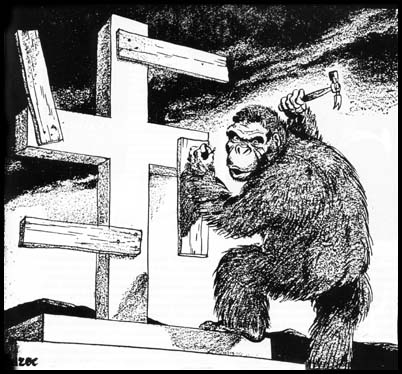
Despite the almost surreal weirdness the NRC does give us crystal clear example of the dangers of State religions and the role theologians can play in pushing explicit political ideology. It's easy to laugh and write off this bizarre experiment but there are plenty of cases of this kind of thing - minus the Nazi specifics- being successful. Iran, Saudi Arabia, even the mild Church of England. So its something that warrants being treated seriously.
Monday, 17 November 2014
Chapter 4
I, too, sometimes crossed the frozen river on those Arctic nights.
The pathway was silent underfoot. It was like moving through the void. I
reflected that only yesterday we were nothing. Nothing: like the
nameless men of the forgotten village which had vanished from these
banks. Between that yesterday and the present centuries seemed to have
passed, or between the times of those men and our own. Only yesterday
countless lights were burning along these banks inside rooms where the
power, the wealth, and the pleasure of others reigned. We put out those
lights, brought back primordial night. That night is our work. That
night is us. We have entered it in order to destroy it. Each of us has
entered it, perhaps never to leave it So many harsh, terrible tasks must
be done; tasks which demand the disappearance of their performers. Let
those who come after us forget us. Let them be different from us. Thus
what is best in us will be reborn in them.
Yesterday, we only counted as statistics: labor force, emigration, death rate, crime rate, suicide rate. The best of us also counted In the records: file B, wanted lists, political police, reports, prison rolls. This is no metaphysical void! No commodity is more common and more depreciated than man. Is he even worth the weight of his flesh? They wouldn’t let a draft animal starve in the gray autumn fields. But a man in a big city? As far back as I search in my memory, I find not theories but images, not ideas but impressions, brutally imprinted in my nerves and soul, reminding me that we were nothing. Childhood moments in London. There are two of us kids: one will later more or less starve to death. We are playing in the lamplight at building an Angkor Temple. Strident whistle blasts explode in the street, like lightning flasbing in all directions in the darkness, crisscrossing through the sky. Because a dark shape, more furtive than a shadow, had spun past the window. The street is an abyss, the windows of the poor open onto infinity. Downstairs some bobbies, carefully avoiding getting bloodstains on their trouser cuffs, are bending over a pile of old rags and flesh. “It’s nothing, children. Be still now!” But we had overheard whispering, we discovered a dark infinity in the windows, we sensed the profundity of the silence.
... And that hunted Jewish couple, in another city, with whom the child died on a happy June evening. There were no more candles, there was no more money, the room was bare. We had gone without eating in order to pay for the doctor’s useless final visit. Reflected light from a café across the street projected the backward silhouette of a sign on the ceiling.
We don’t need gas explosions burying miners, communiqués from quiet sectors where thirty men spill out all the blood of their bodies (nothing worth reporting), memories of executions, the history of crushed insurrections, memoirs of deportees and prisoners, we need no naturalist novels to understand our nothingness. But b of us has all that behind him.
The snow track faded on the river bordered by dark granite. The dark shape of the Winter Palace stood out vaguely among the shadows. In that corner – I knew without thinking – between two bay windows dominating a wide panorama of river and town, stood the Autocrat’s desk, on which his cigarette holder was lying.
A buddy’s jibe: “Man. The thinking reed! They taught him to stop thinking years ago. Today they dry him out; soften him up~ and weave baskets out of him for every use, my friend, including the least appetizing. Pascal didn’t think of that?”
Now things will change. Now we are all: dictatorship of the proletariat. Dictatorship of those who were nothing the day before. I break out laughing, alone in the dark, to think that my papers are in order, that I am using my name – that in my pocket I have an order in the name of the Federated Republic enjoining
“all revolutionary authorities to lend aid and assistance to Comrade —— in the performance of his functions.”
and that I am a member of the governing party which openly exercises a monopoly of power, unmasks every lie, holds the sword unsheathed, ideas out in the open.
I laugh climbing the hard snowbank up to the embankment. I trip over black potholes which I know to be white – thus black and white can be one and the same.
A harsh voice, piercing the night hails me:
“Hey, there! Come out in the open!”
Then, more slowly, as I approach the invisible shouter:
“What do you think you’re doing here?”
A ruddy glow spills out from behind the sharp corner of a woodpile. I perceive a heap of glowing coals and, near the coals, a soldier freezing in his long overcoat, which skirts the ground. The man is standing guard over this precious wood, which people come to steal, log by log, from the riverside.
“You got a permit to go around at night?”
I have one. He examines it. Either he doesn’t care or can’t read. It is a typewritten permit. The typist mistakenly put her carbon wrong side up, and the writing on the back is illegible. It suddenly reminds me of those advertising handbills which, folded, look like halves of bank notes. If I closed my eyes, I could see a piece of the sidewalk at the corner of the Place de la République and Boulevard du Temple again. The soldier hands me back my paper. We are cold. We are both dressed in the same rough gray cloth which looks so much like the Russian soil. We are the dictatorship of the proletariat.
He says:
“They steal the wood; it’s incredible how they steal. I’m sure that if I walked around the stock, I’d find somebody on the other side handing logs down to the Neva. There’s a hole on the ice out there. A while ago the man on guard finally fired a shot, to scare the thief. He was a twelve-year-old kid, whose mother sent him out every night She waited for him under one of the gates on the embankment, No. it The kid got scared. He fell right into the hole with a log on his head. He was never seen again. I pulled the log out when I got there. I found a wood-soled shoe at the edge of the hole. Look.”
There, in the snow turned gold by the glow of the coals, was the dark print of a little schoolboy’s foot.
“There’s always a strong current under the ice,” said the soldier.
*
He had taken me for another wood thief at first. I could have been one. People steal the wood that belongs to everyone, in order to live. Fire is life, like bread. But I belong to the governing party and I am “responsible,” to use the accepted term, that is to say, when all is said and done, in command. My ration of warmth and bread is a little more secure, a little larger. And it’s unjust I know It And I take it It is necessary to live in order to conquer; and not for me, for the Revolution. A child was drowned today for the equivalent of my ration of warmth and bread. I owe him its full measure in human weight: flesh and consciousness. All of us alike. And he who is dishonest with himself, who takes it easy, holds back, or takes advantage, is the lowest of swine. I know some. They an useful, nonetheless. They also serve. Perhaps they even serve better, with their oblivious way of profiting from the new inequality, than those who feel guilty. They pick out furniture for their offices; they demand automobiles, for their time is precious; they wear Rosa Luxembourg’s picture on medallions an their lapels. I console myself by thinking that history naturally turns these people, despite themselves, into martyrs quite as good as the others. When the Whites capture Reds, they hang the phonies from the same limbs as the genuine articles.
I move on through the night: on the left I should soon see, through this crosshatching of spindly branches, the vast horseshoe of Uritski Square with its granite column and its four-home chariot surging forward atop Headquarters Arch in a motionless gallop. I think about those bronzes in the same way as I would place my hand on them, to refresh my soul. I too need all my lucidity in order to find my own way through another darkness. On the right, pale lights flicker under a row of high windows, glimpsed slantwise between white columns. The Special Commission works day and night. That is us too. The implacable side of our face we turn to the world. We, the destroyers of prisons, the liberators, freedmen, yesterday’s convicts, often marked indelibly by our chains, we who investigate, search out, arrest we, judges, jailers, executioners, we!
We have conquered everything and everything has slipped out of our grasp. We have conquered bread, and there is famine. We have declared peace to a war-weary world, and war has moved into every house. We have proclaimed the liberation of men, and we need prisons, an “iron” discipline – yes, to pour our human weakness into brazen molds in order to accomplish what is perhaps beyond our strength – and we are the bringers of dictatorship. We have proclaimed fraternity, but it is “fraternity and death” in reality. We have founded the Republic of Labor, and the factories are dying, grass is growing in their yards. We wanted each to give according to his strength and each to receive according to his needs; and here we are, privileged in the middle of generalized misery, since we are less hungry than others!
Will we succeed in overthrowing the ancient law which bends us to its will at the very moment when we believe we are escaping it?
The Gospel said “Love one another” and “I have not come to bring peace, but a sword.” Nothing but the sword is left under the crucifix. “Whoever would save his soul will lose it ...” Well, I’ll be glad to lose my soul. Who cares? It would be a strange luxury to worry about it today. Old texts, old, old inner captivity. What haven’t they built on the Gospel! Destroy! Destroy! The main thing is to destroy thoroughly.
To be afraid of words, of old ideas, of old feelings, those feelings that are so firmly riveted into our beings, by which the old world still holds us. A poor fighter he who holds back thinking, when it is necessary to reload your rifle and shoot with the greatest concentration – like shooting at dummies on a rifle range – at the men climbing that hill over there. Simple truths, sure, hard as granite, formulated with algebraic clarity; that is what we need. We are millions: the masses. The class which, owning nothing, has nothing to lose but its chains. The world must be made over. For this: conquer, hold on, survive at any cost. The tougher and stronger we are, the less it will cost. Tough and strong toward aura selves first. Revolution is a job that must be done without weakness. We are but the instruments of a necessity which carries us along. drags us forward, lifts us up, and which will doubtless pass over our dead bodies. We are not chasing after some dream of justice – as the young idiots who write in little magazines say-we are doing what must be done, what cannot be left undone. The old world dug its own grave: it is now falling in. Let’s give it a little shove. Millions of men who were nothing are rising into life: they are unable not to rise. We are those millions. Our only choice is to understand this and to accomplish our task with our eyes open. Through this consent, through this clear-sightedness, we escape from blind fate. All that was lost will be found again.
The square is lined with dark old palaces. At the bottom, the Maria Palace, that low edifice with an ill-defined shape. The Imperial Council used to meet there. There’s a big Repin painting showing that council: busts of bemedaled old men posing around a semicircular table. They appear through a yellow-green aquarium light which makes them all look dead. At the center, the Emperor, the portrait of an obliterated face. Those thick necks resting on embroidered collars have all been smashed by bullets. If any one of these great dignitaries still escapes us, it is probably that old man with the big bony nose drooping over flabby lips who sells his daughters’ old shawls in the mornings at the Oats Market ... Thick peasant fingers test and fondle the beautiful cashmeres.
On the right in the indistinct light falling from the windows of the Astoria, the former German Embassy stands behind its massive columns which support no pediment. There used to be some bronze horses on top. During the first days of the war, furious crowds toppled these statues, threw them down to the pavement from their high granite perch, and dragged them to the neighboring canal where they are still under the ice. Behind the embassy’s barred windows there remains only the simple desolation of places long since plundered. Bandits get in through the courtyards and live there, careful that no light can be seen from outside to betray their presence. They play cards, drinking old cognac swiped from the cellars of great houses or fiery brandy fabricated in secret stills on the outskirts of town. Girls with lips painted fiery red, with names like Katka-Little-Apple, Dunya-the-Snake, Shura-Slant-Eyes (also known as The Killer), and Pug-Nose-Maria-Little-Cossack, who wear luxurious dirty underwear and dresses by the great couturiers, taken from empty apartments, sometimes peer out, invisible, from behind the dark windows of the great hail of the embassy, at our lighted windows across the way.
“The commissars live good,” says Katka.
“They sure live it up,” says Dunya, “with their short-haired whores, partying every night of the week.”
“I know one of them,” says Shura, “what a pervert.”
Her bitter laughter flashes through the darkened hail. A thin ray of light slides across the floor. A triumphantly masculine voice calls out:
“Hey, girls, we’re waiting!”
Another voice, a bass, is humming Stenka Razin’s Complaint.
There is also the huge dark mass of St. Isaac’s with its massive columns, its enormous archangels spreading their wings at each corner to the four corners of the earth, its steeples, its gold-plated cupola visible from far out at sea ...
The windows of the Astoria burn until dawn. They are the only lighted ones in town, along with those of the Special Commission and the Committees. Nocturnal labor, danger, privilege, power. The powerful façade repels the darkness like a shell of light. People crossing the square in the evening on the way back home to their airless hovels cast hate-filled looks at the hotel of the commissars (“naturally most of them Jewish”) where it is warm and light and where there is food to eat, it’s certain, where no one fears house searches, where no one’s heart leaps into his mouth at the first sound of a doorbell ringing at night, where no one ever hears rifle butts falling on the doorsteps ... Passers-by murmur: “A fine trap. You could catch the whole lot of them at once!”
First House of Soviets. I push through the revolving door. From the hotel desk the single eye of a machine gun fixes its infinite black gaze on me. The machine gunner dozes, his sheepskin hat pulled down to his eyes.
This is the threshold of power. All who cross over this doorstep know what they want, what is necessary, and feel themselves under the great shadow of the Revolution; armed, carried forward, disciplined, by the structure of the Party. Droning voices trail out from the guardroom. A gilded plaque fastened to the open door reads (in French): Coiffeur à l’entresol. Another sign in black ink: Present your papers when requesting your pass. You need a pass, which you return on the way out, to get in to the people who live in this building; these little papers are then sent on to the Special Commission. Somebody collects them. Somebody has to know who comes to see me at what time. We must not be allowed to be killed with impunity; we must not be allowed to destroy, we must not be allowed to know strangers, for we have power, and the power belongs to the Revolution.
“Evening, Ryjik.”
He comes out to meet me, carefully carrying his tin teapot from which scalding steam is escaping. Ruddy stubble covers his face up to his eyes. He is in slippers: the broad folds of a magnificent pair of cavalry breeches (raspberry colored) float around his hips. Why do they call these breeches gallifets? Ryjik wears a satisfied smile.
“You’re looking at my gallifets? What material! Take a look, feel it. A real find, eh? And a love letter in the pocket my friend ... Come up to my room, you’ll see Arkadi: I have your newspapers.”
Red carpets muffle our steps. This is a huge stone ship, am pointed like a luxury liner anchored in the polar city. Wide corridors, oak doors marked with discreet gold numbers. The calm is profound, the warmth – after the nocturnal cold – like a hothouse. Isn’t one of these doors going to open on a haughty couple? She, shapely in furs crackling with electricity, her mouth a purple-blue line; he, slender, high cheekboned, a flash of light dancing off his monocle.
... A champagne bucket behind then in the room leaves a silver glow. They pass like phantoms: I wouldn’t even turn around ... A door has opened quietly, the phantoms vanish.
“Come on in,” says Ryjik, appearing in the doorway.
I can already see Arkadi’s oriental profile in a mirror. Shapely in his close-fitting black uniform, his waist cinched by narrow Montagnard belt with sculptured silver pendants, a large metal insignia – silver and red – on his right breast, like a commander’s star; he is smoking, leaning back on the divan. Without smiling, he shows his handsome white teeth. Ryjik pours us tea.
“Here are your newspapers,” Arkadi says to me. “From now on they’ll be a hundred and twenty rubles a copy.”
(A hundred and twenty czarist rubles, out of circulation.)
“Your smugglers are too much. It was eighty three weeks ago.”
The package, tied with heavy twine, smells of printers’ ink. L’Intransigent, Le Matin, the Manchester Guardian, Corriere della Sera, bought in Vyborg ... Men, eyes peering out of white furs, ears straining to hear the slightest crackle of branches, cross the front lines bent under the weight of these bundles. Sometimes explosions shatter the absurd silence around them; running, they pull long-range Mausers out of their frozen wooden holsters and crouch even closer to the snow; inside their chests, startled-beast terror changes into the will to kill, and an extraordinary lucidity bursts inside their skulls.
“They’re still expensive,” I say.
“They say two of their men got killed during the past two weeks: that’s certainly worth two raises of twenty rubles a copy. And it’s true. Jurgensohn knows that two bodies were picked up in the zone. The place is getting hot.”
Ryjik says:
“They haven’t delivered any bread for the last three days in the Moscow-Narva district. Ataev claims that the trains take twenty days to reach us instead of eight Nothing to burn. There’s gonna be trouble in the factories.”
“Rather!” snapped Arkadi between his white teeth.
“I think we should put out emergency calls for special conferences of non-Party people, or the discontent will break out by itself. I suggested it at Smolny.”
“... better lock up the Left Social Revolutionaries first ... According to our informers, they’re cooking up something. Goldin has arrived, it must be for a putsch.”
“Indeed,” I say, “I’d like to see him.”
“He’s staying here, Room 120.”
The comrade who’s preparing a putsch against us is right downstairs. Handsome, daring, and sensual, he seems to have been playing with death – his own and other people’s – for years.
“I suggested,” resumed Arkadi, “arresting him tonight if not sooner: better before than afterward. The Commission wouldn’t hear of it. Misplaced scruples.”
The conversation breaks off. Three o’clock sounds. Ryjik wipes his lips with the back of his hand and asks:
“Do you know how people in town spell out S.B.N.E. [Supreme Board for National Economy]?”
A great guffaw is already stretching his jolly red cheeks.
“No? Well, it seems it stands for ‘Slave But Never Eat.’ Not bad, eh?”
We laugh. Arkadi yawns. He spends his days and part of his nights at the Special Commission. He does everything himself, with precise movements, a clipped voice designed for command, and shining teeth. Difficult raids, arrests of men who must be taken by surprise before they can fire their Browning; complicated investigations, and probably also automobile rides through the rising mist at dawn down lanes lined with dark pines and spindly bushes fleshed with white, toward that little wood located seven vents out on the Novgorod road where ... In the back seat of the Renault, opposite two silent Latvians, sit two pale handcuffed passengers chain-smoking – impatiently lighting a fresh cigarette with slightly trembling bands from the dying one as if it were essential that this infinite dying fire should be kept going ... An aura surrounds them. Their sprouting beards (depending on which way the shadows fall) give them faces like evil Christs or pure-browed criminals. They say that it’s cold; they converse about indifferent matters in hoarse cracking voices ... Back in his room – a room identical to this one, except for a portrait hanging above the couch: Liebknecht’s head [1], thrown back with a horrible red carnation blooming at the temple – Arkadi pours himself a big glass of confiscated samogon (Russian “moonshine”), a fiery brew that rasps the throat and numbs the brain. And so he will be able to sleep until it’s time for interrogations. He has the regular features, narrow, fleshy eagle nose, and green eyes flecked with yellow and white of a falconer of Adjaristan, his native land. Adjaristan wit its hot rains pelting the red earth with liquid hail. Adjaristan with its mimosas blooming in the damp shadows, its tea bushes on pyramidal hills, the palm-lined walks of Batum, its little Greek cafés, rows of scorched mountains, white minarets towering over flat roofs, brown tobacco leaves drying on racks; Adjaristan with its veiled women who are submissive, beautiful, and industrious.
I open the newspapers: Le Journal, wire dispatch in Le Matin: Tragedy on Rue Mogodor: “She was cheating on him; he kills her and then commits suicide.” Do they think they’re alone in the world? Rue du Croissant at this hour: presses rolling breathlessly in the print shops; bicycle delivery men brush past night revelers as they slip away on their silent machines. Old Fernand, the good, melancholy hobo, wanders along the sidewalk headed God knows where ... Terror in Petrograd. “Bolshevism is at bay; only its Chinese praetorians still defend it ...” Arkadi! Ryjik! Listen to what they are saying about us! Apoplectic Socialists, seeing the inadequacy of the blockade, whose inhumanity they condemn, pronounce themselves, with words of triple meaning, in favor of military intervention, on the condition (for Woodrow Wilson is a prophet) that the sovereignty of the Russian people will not be impaired ... They dream of bayonets which respect the law. We sense fear, stupidity, hatred sweating through these printed lines. How they long for our death back there, for the death of the Republic whose insignia you wear on your chest, Arkadi, for which we do every sort of job, which we want to see survive because it is still the greatest hope, the birth of a new kind of justice, honesty in deeds and words – implacable deeds and truthful words! – the work of those who have always been vanquished, always duped first and then massacred, who were nothing yesterday, who are still nothing in the rest of the world!
Footnote
1. Karl Liebknecht (1871-1919), German revolutionary and martyr. He was the only member of the Reichstag to vote against the war in 1914 and was jailed for pacifism in 1916. Freed in 1918, he founded the Spartacus League and was shot in the head during the workers’ uprising of 1919, along with his collaborator, Rosa Luxembourg. – Trans.
Previous Chapter
Next Chapter.
Index
Yesterday, we only counted as statistics: labor force, emigration, death rate, crime rate, suicide rate. The best of us also counted In the records: file B, wanted lists, political police, reports, prison rolls. This is no metaphysical void! No commodity is more common and more depreciated than man. Is he even worth the weight of his flesh? They wouldn’t let a draft animal starve in the gray autumn fields. But a man in a big city? As far back as I search in my memory, I find not theories but images, not ideas but impressions, brutally imprinted in my nerves and soul, reminding me that we were nothing. Childhood moments in London. There are two of us kids: one will later more or less starve to death. We are playing in the lamplight at building an Angkor Temple. Strident whistle blasts explode in the street, like lightning flasbing in all directions in the darkness, crisscrossing through the sky. Because a dark shape, more furtive than a shadow, had spun past the window. The street is an abyss, the windows of the poor open onto infinity. Downstairs some bobbies, carefully avoiding getting bloodstains on their trouser cuffs, are bending over a pile of old rags and flesh. “It’s nothing, children. Be still now!” But we had overheard whispering, we discovered a dark infinity in the windows, we sensed the profundity of the silence.
... And that hunted Jewish couple, in another city, with whom the child died on a happy June evening. There were no more candles, there was no more money, the room was bare. We had gone without eating in order to pay for the doctor’s useless final visit. Reflected light from a café across the street projected the backward silhouette of a sign on the ceiling.
We don’t need gas explosions burying miners, communiqués from quiet sectors where thirty men spill out all the blood of their bodies (nothing worth reporting), memories of executions, the history of crushed insurrections, memoirs of deportees and prisoners, we need no naturalist novels to understand our nothingness. But b of us has all that behind him.
The snow track faded on the river bordered by dark granite. The dark shape of the Winter Palace stood out vaguely among the shadows. In that corner – I knew without thinking – between two bay windows dominating a wide panorama of river and town, stood the Autocrat’s desk, on which his cigarette holder was lying.
A buddy’s jibe: “Man. The thinking reed! They taught him to stop thinking years ago. Today they dry him out; soften him up~ and weave baskets out of him for every use, my friend, including the least appetizing. Pascal didn’t think of that?”
Now things will change. Now we are all: dictatorship of the proletariat. Dictatorship of those who were nothing the day before. I break out laughing, alone in the dark, to think that my papers are in order, that I am using my name – that in my pocket I have an order in the name of the Federated Republic enjoining
“all revolutionary authorities to lend aid and assistance to Comrade —— in the performance of his functions.”
and that I am a member of the governing party which openly exercises a monopoly of power, unmasks every lie, holds the sword unsheathed, ideas out in the open.
I laugh climbing the hard snowbank up to the embankment. I trip over black potholes which I know to be white – thus black and white can be one and the same.
A harsh voice, piercing the night hails me:
“Hey, there! Come out in the open!”
Then, more slowly, as I approach the invisible shouter:
“What do you think you’re doing here?”
A ruddy glow spills out from behind the sharp corner of a woodpile. I perceive a heap of glowing coals and, near the coals, a soldier freezing in his long overcoat, which skirts the ground. The man is standing guard over this precious wood, which people come to steal, log by log, from the riverside.
“You got a permit to go around at night?”
I have one. He examines it. Either he doesn’t care or can’t read. It is a typewritten permit. The typist mistakenly put her carbon wrong side up, and the writing on the back is illegible. It suddenly reminds me of those advertising handbills which, folded, look like halves of bank notes. If I closed my eyes, I could see a piece of the sidewalk at the corner of the Place de la République and Boulevard du Temple again. The soldier hands me back my paper. We are cold. We are both dressed in the same rough gray cloth which looks so much like the Russian soil. We are the dictatorship of the proletariat.
He says:
“They steal the wood; it’s incredible how they steal. I’m sure that if I walked around the stock, I’d find somebody on the other side handing logs down to the Neva. There’s a hole on the ice out there. A while ago the man on guard finally fired a shot, to scare the thief. He was a twelve-year-old kid, whose mother sent him out every night She waited for him under one of the gates on the embankment, No. it The kid got scared. He fell right into the hole with a log on his head. He was never seen again. I pulled the log out when I got there. I found a wood-soled shoe at the edge of the hole. Look.”
There, in the snow turned gold by the glow of the coals, was the dark print of a little schoolboy’s foot.
“There’s always a strong current under the ice,” said the soldier.
*
He had taken me for another wood thief at first. I could have been one. People steal the wood that belongs to everyone, in order to live. Fire is life, like bread. But I belong to the governing party and I am “responsible,” to use the accepted term, that is to say, when all is said and done, in command. My ration of warmth and bread is a little more secure, a little larger. And it’s unjust I know It And I take it It is necessary to live in order to conquer; and not for me, for the Revolution. A child was drowned today for the equivalent of my ration of warmth and bread. I owe him its full measure in human weight: flesh and consciousness. All of us alike. And he who is dishonest with himself, who takes it easy, holds back, or takes advantage, is the lowest of swine. I know some. They an useful, nonetheless. They also serve. Perhaps they even serve better, with their oblivious way of profiting from the new inequality, than those who feel guilty. They pick out furniture for their offices; they demand automobiles, for their time is precious; they wear Rosa Luxembourg’s picture on medallions an their lapels. I console myself by thinking that history naturally turns these people, despite themselves, into martyrs quite as good as the others. When the Whites capture Reds, they hang the phonies from the same limbs as the genuine articles.
I move on through the night: on the left I should soon see, through this crosshatching of spindly branches, the vast horseshoe of Uritski Square with its granite column and its four-home chariot surging forward atop Headquarters Arch in a motionless gallop. I think about those bronzes in the same way as I would place my hand on them, to refresh my soul. I too need all my lucidity in order to find my own way through another darkness. On the right, pale lights flicker under a row of high windows, glimpsed slantwise between white columns. The Special Commission works day and night. That is us too. The implacable side of our face we turn to the world. We, the destroyers of prisons, the liberators, freedmen, yesterday’s convicts, often marked indelibly by our chains, we who investigate, search out, arrest we, judges, jailers, executioners, we!
We have conquered everything and everything has slipped out of our grasp. We have conquered bread, and there is famine. We have declared peace to a war-weary world, and war has moved into every house. We have proclaimed the liberation of men, and we need prisons, an “iron” discipline – yes, to pour our human weakness into brazen molds in order to accomplish what is perhaps beyond our strength – and we are the bringers of dictatorship. We have proclaimed fraternity, but it is “fraternity and death” in reality. We have founded the Republic of Labor, and the factories are dying, grass is growing in their yards. We wanted each to give according to his strength and each to receive according to his needs; and here we are, privileged in the middle of generalized misery, since we are less hungry than others!
Will we succeed in overthrowing the ancient law which bends us to its will at the very moment when we believe we are escaping it?
The Gospel said “Love one another” and “I have not come to bring peace, but a sword.” Nothing but the sword is left under the crucifix. “Whoever would save his soul will lose it ...” Well, I’ll be glad to lose my soul. Who cares? It would be a strange luxury to worry about it today. Old texts, old, old inner captivity. What haven’t they built on the Gospel! Destroy! Destroy! The main thing is to destroy thoroughly.
To be afraid of words, of old ideas, of old feelings, those feelings that are so firmly riveted into our beings, by which the old world still holds us. A poor fighter he who holds back thinking, when it is necessary to reload your rifle and shoot with the greatest concentration – like shooting at dummies on a rifle range – at the men climbing that hill over there. Simple truths, sure, hard as granite, formulated with algebraic clarity; that is what we need. We are millions: the masses. The class which, owning nothing, has nothing to lose but its chains. The world must be made over. For this: conquer, hold on, survive at any cost. The tougher and stronger we are, the less it will cost. Tough and strong toward aura selves first. Revolution is a job that must be done without weakness. We are but the instruments of a necessity which carries us along. drags us forward, lifts us up, and which will doubtless pass over our dead bodies. We are not chasing after some dream of justice – as the young idiots who write in little magazines say-we are doing what must be done, what cannot be left undone. The old world dug its own grave: it is now falling in. Let’s give it a little shove. Millions of men who were nothing are rising into life: they are unable not to rise. We are those millions. Our only choice is to understand this and to accomplish our task with our eyes open. Through this consent, through this clear-sightedness, we escape from blind fate. All that was lost will be found again.
The square is lined with dark old palaces. At the bottom, the Maria Palace, that low edifice with an ill-defined shape. The Imperial Council used to meet there. There’s a big Repin painting showing that council: busts of bemedaled old men posing around a semicircular table. They appear through a yellow-green aquarium light which makes them all look dead. At the center, the Emperor, the portrait of an obliterated face. Those thick necks resting on embroidered collars have all been smashed by bullets. If any one of these great dignitaries still escapes us, it is probably that old man with the big bony nose drooping over flabby lips who sells his daughters’ old shawls in the mornings at the Oats Market ... Thick peasant fingers test and fondle the beautiful cashmeres.
On the right in the indistinct light falling from the windows of the Astoria, the former German Embassy stands behind its massive columns which support no pediment. There used to be some bronze horses on top. During the first days of the war, furious crowds toppled these statues, threw them down to the pavement from their high granite perch, and dragged them to the neighboring canal where they are still under the ice. Behind the embassy’s barred windows there remains only the simple desolation of places long since plundered. Bandits get in through the courtyards and live there, careful that no light can be seen from outside to betray their presence. They play cards, drinking old cognac swiped from the cellars of great houses or fiery brandy fabricated in secret stills on the outskirts of town. Girls with lips painted fiery red, with names like Katka-Little-Apple, Dunya-the-Snake, Shura-Slant-Eyes (also known as The Killer), and Pug-Nose-Maria-Little-Cossack, who wear luxurious dirty underwear and dresses by the great couturiers, taken from empty apartments, sometimes peer out, invisible, from behind the dark windows of the great hail of the embassy, at our lighted windows across the way.
“The commissars live good,” says Katka.
“They sure live it up,” says Dunya, “with their short-haired whores, partying every night of the week.”
“I know one of them,” says Shura, “what a pervert.”
Her bitter laughter flashes through the darkened hail. A thin ray of light slides across the floor. A triumphantly masculine voice calls out:
“Hey, girls, we’re waiting!”
Another voice, a bass, is humming Stenka Razin’s Complaint.
There is also the huge dark mass of St. Isaac’s with its massive columns, its enormous archangels spreading their wings at each corner to the four corners of the earth, its steeples, its gold-plated cupola visible from far out at sea ...
The windows of the Astoria burn until dawn. They are the only lighted ones in town, along with those of the Special Commission and the Committees. Nocturnal labor, danger, privilege, power. The powerful façade repels the darkness like a shell of light. People crossing the square in the evening on the way back home to their airless hovels cast hate-filled looks at the hotel of the commissars (“naturally most of them Jewish”) where it is warm and light and where there is food to eat, it’s certain, where no one fears house searches, where no one’s heart leaps into his mouth at the first sound of a doorbell ringing at night, where no one ever hears rifle butts falling on the doorsteps ... Passers-by murmur: “A fine trap. You could catch the whole lot of them at once!”
First House of Soviets. I push through the revolving door. From the hotel desk the single eye of a machine gun fixes its infinite black gaze on me. The machine gunner dozes, his sheepskin hat pulled down to his eyes.
This is the threshold of power. All who cross over this doorstep know what they want, what is necessary, and feel themselves under the great shadow of the Revolution; armed, carried forward, disciplined, by the structure of the Party. Droning voices trail out from the guardroom. A gilded plaque fastened to the open door reads (in French): Coiffeur à l’entresol. Another sign in black ink: Present your papers when requesting your pass. You need a pass, which you return on the way out, to get in to the people who live in this building; these little papers are then sent on to the Special Commission. Somebody collects them. Somebody has to know who comes to see me at what time. We must not be allowed to be killed with impunity; we must not be allowed to destroy, we must not be allowed to know strangers, for we have power, and the power belongs to the Revolution.
“Evening, Ryjik.”
He comes out to meet me, carefully carrying his tin teapot from which scalding steam is escaping. Ruddy stubble covers his face up to his eyes. He is in slippers: the broad folds of a magnificent pair of cavalry breeches (raspberry colored) float around his hips. Why do they call these breeches gallifets? Ryjik wears a satisfied smile.
“You’re looking at my gallifets? What material! Take a look, feel it. A real find, eh? And a love letter in the pocket my friend ... Come up to my room, you’ll see Arkadi: I have your newspapers.”
Red carpets muffle our steps. This is a huge stone ship, am pointed like a luxury liner anchored in the polar city. Wide corridors, oak doors marked with discreet gold numbers. The calm is profound, the warmth – after the nocturnal cold – like a hothouse. Isn’t one of these doors going to open on a haughty couple? She, shapely in furs crackling with electricity, her mouth a purple-blue line; he, slender, high cheekboned, a flash of light dancing off his monocle.
... A champagne bucket behind then in the room leaves a silver glow. They pass like phantoms: I wouldn’t even turn around ... A door has opened quietly, the phantoms vanish.
“Come on in,” says Ryjik, appearing in the doorway.
I can already see Arkadi’s oriental profile in a mirror. Shapely in his close-fitting black uniform, his waist cinched by narrow Montagnard belt with sculptured silver pendants, a large metal insignia – silver and red – on his right breast, like a commander’s star; he is smoking, leaning back on the divan. Without smiling, he shows his handsome white teeth. Ryjik pours us tea.
“Here are your newspapers,” Arkadi says to me. “From now on they’ll be a hundred and twenty rubles a copy.”
(A hundred and twenty czarist rubles, out of circulation.)
“Your smugglers are too much. It was eighty three weeks ago.”
The package, tied with heavy twine, smells of printers’ ink. L’Intransigent, Le Matin, the Manchester Guardian, Corriere della Sera, bought in Vyborg ... Men, eyes peering out of white furs, ears straining to hear the slightest crackle of branches, cross the front lines bent under the weight of these bundles. Sometimes explosions shatter the absurd silence around them; running, they pull long-range Mausers out of their frozen wooden holsters and crouch even closer to the snow; inside their chests, startled-beast terror changes into the will to kill, and an extraordinary lucidity bursts inside their skulls.
“They’re still expensive,” I say.
“They say two of their men got killed during the past two weeks: that’s certainly worth two raises of twenty rubles a copy. And it’s true. Jurgensohn knows that two bodies were picked up in the zone. The place is getting hot.”
Ryjik says:
“They haven’t delivered any bread for the last three days in the Moscow-Narva district. Ataev claims that the trains take twenty days to reach us instead of eight Nothing to burn. There’s gonna be trouble in the factories.”
“Rather!” snapped Arkadi between his white teeth.
“I think we should put out emergency calls for special conferences of non-Party people, or the discontent will break out by itself. I suggested it at Smolny.”
“... better lock up the Left Social Revolutionaries first ... According to our informers, they’re cooking up something. Goldin has arrived, it must be for a putsch.”
“Indeed,” I say, “I’d like to see him.”
“He’s staying here, Room 120.”
The comrade who’s preparing a putsch against us is right downstairs. Handsome, daring, and sensual, he seems to have been playing with death – his own and other people’s – for years.
“I suggested,” resumed Arkadi, “arresting him tonight if not sooner: better before than afterward. The Commission wouldn’t hear of it. Misplaced scruples.”
The conversation breaks off. Three o’clock sounds. Ryjik wipes his lips with the back of his hand and asks:
“Do you know how people in town spell out S.B.N.E. [Supreme Board for National Economy]?”
A great guffaw is already stretching his jolly red cheeks.
“No? Well, it seems it stands for ‘Slave But Never Eat.’ Not bad, eh?”
We laugh. Arkadi yawns. He spends his days and part of his nights at the Special Commission. He does everything himself, with precise movements, a clipped voice designed for command, and shining teeth. Difficult raids, arrests of men who must be taken by surprise before they can fire their Browning; complicated investigations, and probably also automobile rides through the rising mist at dawn down lanes lined with dark pines and spindly bushes fleshed with white, toward that little wood located seven vents out on the Novgorod road where ... In the back seat of the Renault, opposite two silent Latvians, sit two pale handcuffed passengers chain-smoking – impatiently lighting a fresh cigarette with slightly trembling bands from the dying one as if it were essential that this infinite dying fire should be kept going ... An aura surrounds them. Their sprouting beards (depending on which way the shadows fall) give them faces like evil Christs or pure-browed criminals. They say that it’s cold; they converse about indifferent matters in hoarse cracking voices ... Back in his room – a room identical to this one, except for a portrait hanging above the couch: Liebknecht’s head [1], thrown back with a horrible red carnation blooming at the temple – Arkadi pours himself a big glass of confiscated samogon (Russian “moonshine”), a fiery brew that rasps the throat and numbs the brain. And so he will be able to sleep until it’s time for interrogations. He has the regular features, narrow, fleshy eagle nose, and green eyes flecked with yellow and white of a falconer of Adjaristan, his native land. Adjaristan wit its hot rains pelting the red earth with liquid hail. Adjaristan with its mimosas blooming in the damp shadows, its tea bushes on pyramidal hills, the palm-lined walks of Batum, its little Greek cafés, rows of scorched mountains, white minarets towering over flat roofs, brown tobacco leaves drying on racks; Adjaristan with its veiled women who are submissive, beautiful, and industrious.
I open the newspapers: Le Journal, wire dispatch in Le Matin: Tragedy on Rue Mogodor: “She was cheating on him; he kills her and then commits suicide.” Do they think they’re alone in the world? Rue du Croissant at this hour: presses rolling breathlessly in the print shops; bicycle delivery men brush past night revelers as they slip away on their silent machines. Old Fernand, the good, melancholy hobo, wanders along the sidewalk headed God knows where ... Terror in Petrograd. “Bolshevism is at bay; only its Chinese praetorians still defend it ...” Arkadi! Ryjik! Listen to what they are saying about us! Apoplectic Socialists, seeing the inadequacy of the blockade, whose inhumanity they condemn, pronounce themselves, with words of triple meaning, in favor of military intervention, on the condition (for Woodrow Wilson is a prophet) that the sovereignty of the Russian people will not be impaired ... They dream of bayonets which respect the law. We sense fear, stupidity, hatred sweating through these printed lines. How they long for our death back there, for the death of the Republic whose insignia you wear on your chest, Arkadi, for which we do every sort of job, which we want to see survive because it is still the greatest hope, the birth of a new kind of justice, honesty in deeds and words – implacable deeds and truthful words! – the work of those who have always been vanquished, always duped first and then massacred, who were nothing yesterday, who are still nothing in the rest of the world!
Footnote
1. Karl Liebknecht (1871-1919), German revolutionary and martyr. He was the only member of the Reichstag to vote against the war in 1914 and was jailed for pacifism in 1916. Freed in 1918, he founded the Spartacus League and was shot in the head during the workers’ uprising of 1919, along with his collaborator, Rosa Luxembourg. – Trans.
Previous Chapter
Next Chapter.
Index
Sunday, 16 November 2014
Chapter 3
You had to wander for a long time through the corridors of the
university before finding, in the end, the room where Professor Vadim
Mikhailovich Lytaev still came on certain evenings to teach his class.
It was like being in a city of another time, in the middle of a sort of
abandoned monastery. The night and the cold penetrated even here. Hard
rectangles of night pressed in through the white frost-ferns on the
windows. The blackboard seemed a bay window open on the night. The
professor kept his fur cloak On; his students urged him not to remove
his hat so that his high, gray brow with its strands of white hair
should not be too defenseless against the icy darkness waiting to
envelop men. The audience listened, frozen, in their coats. From the
height of his lectern, which was dimly lighted by a green-shaded lamp
(the only one in the room), the professor could make out only a dozen
indistinct forms from which a few sketchy faces emerged, as through a
fog. He could be seen a little more clearly. He was an old man of about
sixty, thin, erect, and sturdy. Sunken cheeks, parchment lips. Wrinkles
surrounded his eyes which, when lowered, were those of the statue of an
ascetic, but when raised showed themselves to be warm and brown. You
noticed at such moments the delicacy of the nose, which was straight
despite its high bridge, the regular mouth, the unruly, graying beard,
and that this combination of features formed one of those faces, of
somber aspect and luminous expression, which the Novgorod icon painters
usually gave to their saints, not out of fidelity to a mystical type but
much more probably through the sanctification of some ancient Greek
portraits.
The professor spoke of the reforms of Peter I with a passion so sure of itself that it was almost subdued. You had to say Peter I now instead of Peter the Great Most often Lytaev said simply Peter, emphasizing the strength of the man in the mighty Czar. When his class was over, Vadim Mikhailovich Lytaev entered a present night as vast as that of the past. He followed a path of ice on the Neva, crossing the wide river obliquely toward the Winter Palace. Parfenov usually accompanied him, for they both lived In the center of town. Parfenov walked alongside the master with an even tread which was absolutely silent as if non-existent With his felt boots, fox fur coat, and fox hat whose long earflaps hung down over his chest and his heavy shapeless face, he appeared to be only a shadow, huge and light From a few paces off, you would have taken him for a bear.
The moonlight was diluted by a light, icy mist which allowed only an intense, gray, diffuse phosphorescence to shine through. From the middle of the Neva limitless landscapes were visible. The shapes of palaces appeared dimly above the two circular banks as if on the edge of a lunar crater – black but fluid, shimmering in an atmosphere like an ocean floor. Somewhere to the right, beyond the high granite rampart of the embankment. In the middle of a colonnaded square, a giant reared his horse atop a rocky crag, crushing; without seeing it, a serpent bronze like himself. His hand reached out toward the sea, the north, the pole. Peter: a broad face of power with little insignificant mustaches.
Vadim Mlkhailovich was carrying home his scholar’s rations, which he had received at the university after waiting two sullen hours among academicians: one pound of herrings, one pound of posts, two pounds of millet, two packs of cigarettes (second quality). He shifted the sharp straps of his knapsack on his shoulders and said:
“Look, Parfenov. We are outside of time. The night was the same on this river centuries ago. Centuries will pass, night will he the same. Two hundred twenty years ago, before Peter came, there were five thatched hub made of logs lost somewhere out there on these banks. Seven men scratched for a living here – for they only counted the males – with their females and their young. Seven men identical to their unknown ancestors who had conic from the east. That village was called Ienissari.”
“But Peter came,” said Parfenov. “And now we have come. flow happy men will be in a hundred years! Sometimes it makes me dizzy to think of it. In fifty years, in twenty years, maybe in ten years ... yes! Give us ten years and you’ll see! The cold, the night, everything ...”
(Everything? What did he mean by that vague word, vaster than the cold and the night?)
“... everything will be conquered.”
They walked a moment in silence. The other bank got imperceptibly closer.
... This Parfenov, what an enthusiast! Lytaev smiled in the darkness at the myths that drive men through history.
“Parfenov, you are right to believe in the future. It is the new God, the reincarnation of the oldest divinities, which makes the present bearable. I believe in it too, but differently, for the future is an endless spiral ... Are you satisfied at the factory. Parfenov?”
“No. In fact I’ve had about enough. Vadim Mikhailovich, I’m getting ready to leave you. I have requested permission to leave for the front; the branch secretary is supporting me. I’ll get it.”
He needed to talk. And Lytaev listened with a kind of vague joy to that young male voice filtered through the harsh sounds of the day. The walk through the darkness on the ice in the midst of this solitude made it possible for the two men to understand each other far beyond the precise meaning of words.
“The factory? It takes us a week to produce what we produced in a day last year. I bad to reintroduce the practice of searching the workers on the way out: they steal everything. They came and cursed me: ‘Policeman! Have you no shame! You yourself protested against searching in ’17, an indignity you said it was! Just wait a little, Commissar, your turn will come ...’ The worst part of it is that searching doesn’t help very much. They tie up packages and throw them out the window. The women workers carry out tlread between their legs and linings rolled around their stomachs. I can hardly ask the men on the door to pinch their asses! They thumb their noses at me.”
Lytaev replied softly. “Parfenov, they’ve got to make a living.”
“Yes that’s the worst of it. So they steal. With the cloth from the tunics they make slippers that sell for forty rubles on the market. The workers have got to live, but the Revolution must not be killed. When I tell them this, some of them answer me: ‘Isn’t It killing us?’ Some of them have no consciousness at all, Vadim Mikhailovich.”
“... And it’s with that blind force, Parfenov, that you want to change the world?”
“With them and for them. Otherwise, they will never be men. Despite them, if necessary. ‘Policeman?’ I told them. ‘Okay, I’m not afraid of words. Insult me as much as you like, I’m your comrade and your brother, maybe that’s what I’m hue for: but I will defend against you what belongs to the Republic. If someone has to get killed, I don’t mind getting killed, with you, as long as the Revolution can live...’”
“Do they understand you, Parfenov?”
Parfenov meditated. “It’s hard to express. It seems to me they hate me. It seems like I could get killed. They write in the toilets that I’m a Jew, that my real name is Schmoulevich, Yankel. And nothing can be done about the stealing because it is the hands of hunger that steal. But under all their hate I believe they still understand me, they know I’m right; that’s why they haven’t yet knocked me off, even though I walk home alone every night.”
*
The main entrance to the house had been closed for months as a precaution. Lytaev went in through the wicket gate at the carriage entrance. An old lady, on guard duty, stared at him in the dark. Her response to his greeting was a nod of calculated dignity, which he didn’t see, for she disapproved of the idea of such a respectable man consenting to teach under a government of bandits. Having crossed the courtyard, Lytaev felt his way carefully up a narrow stairway smelling of damp and of garbage and knocked heavily at the double door of what had once been a kitchen. He had to identify himself before the servant woman inside would raise the iron bar and unhook the safety chain. “It’s me, Agrafena, me ...”
A gentle warmth reigned in the study where they were now living around a cast-iron stove and an oil lamp. For thirty years the same feminine face had appeared in front of Vadim Mikhailovich at the calm hour of midnight tea, just before rest; he had watched that face climb through the full light of life, then decline, fade, wane, without losing the clarity of its gaze, the only youth that lasts; he knew that face so well that he forgot it, that he saw it without see- big It that he rediscovered it at times in his memory with helpless astonishment – Here we are, old people ... What, then, what is life? – The same hands, at first tapered with rosy polished nails, hands he compared to flowers and which he sometimes covered with kisses; then little by little faded, wrinkled, slightly thickened, with ivory hues, placing the same silver service before him. The same voice, imperceptibly changed like the hands, talked to him of the day, which was now over. This evening the hands placed thin slices of black bread and marinated herring in the circle of light they passed the sugar bowl in which the sugar was frugally broken into tiny crumbs. The voice said:
“Vadim, we’re going to have butter. They promised me fourteen pounds in exchange for the Scotch plaid.”
Perhaps an image passed rapidly, from very far away, through the two minds or between them (so rapidly, from so far, that they didn’t notice it): the image of a couple in a blue brougham, the Scotch plaid on their bees; and the white peaks, the pines, the torrents, the green valleys dotted with steeples, the feudal towns of the Tyrol fled as youth and life had fled.
“Vadim, they conducted a search last night at the Stahls’ and made off with a gold watch ... Vadim, Pelagueya Alexandrovna received a letter saying that her son died at Bugulma ... Vadim, milk is up to thirty rubles ... Vadim, my backaches have started up again ...”
Vadim listened to these remarks, always the same, and let himself sink into a feeling of sad contentment This warmth was certain and that other life, that other part of his life, tremendously foreign, tremendously dose. He answered softly, distractedly, but with an attentive air, giving the right replies. Relieved of the weight of another day, his mind wandered off to grapple with the usual great worry. “Thank you, Marie,” he said, as he had said thirty years earlier, and yet very differently. “I’m going to work for a while.” After moving the lamp behind the screen that separated off his nook, he sat down over a needlessly opened book, reached for one of those unfolded old envelopes on the backs of which he took his notes, and began to draw patiently with his pencil: geometric designs in the manner of Arab artists, childlike faces, bits of landscape, animal silhouettes. During these moments of meditation he was always bothered by the temptation to sketch the faces of women with huge eyes and long lashes; but he repressed it with some shame, not really knowing if he was ashamed of the temptation or ashamed of himself for not giving in ... He remained there for an hour face to face with his thoughts, no longer expressed in words, like blind men locked into an irregularly shaped room, more worries than thoughts.
Another worry raised its voice at last behind him in the semi-darkness.
“Vadim, you ought to go to bed. You tire yourself too much. The stove has gone out.”
“Yes, dear.”
The cold had begun to penetrate his motionless arms and legs. He got undressed, slowly, dreamily, blew out the lamp, slipped shivering between the sheets, and stretched out as if “for eternity.” And now his mind began to give birth to clear sentences forming, all by themselves, into paragraphs which would have made good sections of articles. “The death rate in Petrograd this year was higher than in the Punjab during the great plague of 1907!!!” “Peter I’s great reform seemed to some of the best minds of old Russia the beginning of the reign of the Anti-Christ ...” “At the time of Peter I’s death, the Empire had been depopulated ...” But no, that wasn’t it History explained nothing. What if, in order to understand, it was necessary to think less, to know less? What if things were much simpler than they seemed? A title for a work: The Fall of the Roman Empire. What could be clearer? No explanation. What’s to explain? The Fall of Christian Civilization. No, not Christian, European. Not right either. The Fall of Capitalist Civilization. If the newspapers were telling the truth, if you could believe the posters in the streets, the speeches at the assemblies, if ...?
He remembered Parfenov, asleep at this hour on some makeshift cot not far from here, in an unknown house, sure of the greatness of men in ten years, twenty years, provided this necessary night could be got through. “They don’t know history. but they are making it ... But what are they making, what are they making?”
Previous Chapter
Next Chapter.
Index
The professor spoke of the reforms of Peter I with a passion so sure of itself that it was almost subdued. You had to say Peter I now instead of Peter the Great Most often Lytaev said simply Peter, emphasizing the strength of the man in the mighty Czar. When his class was over, Vadim Mikhailovich Lytaev entered a present night as vast as that of the past. He followed a path of ice on the Neva, crossing the wide river obliquely toward the Winter Palace. Parfenov usually accompanied him, for they both lived In the center of town. Parfenov walked alongside the master with an even tread which was absolutely silent as if non-existent With his felt boots, fox fur coat, and fox hat whose long earflaps hung down over his chest and his heavy shapeless face, he appeared to be only a shadow, huge and light From a few paces off, you would have taken him for a bear.
The moonlight was diluted by a light, icy mist which allowed only an intense, gray, diffuse phosphorescence to shine through. From the middle of the Neva limitless landscapes were visible. The shapes of palaces appeared dimly above the two circular banks as if on the edge of a lunar crater – black but fluid, shimmering in an atmosphere like an ocean floor. Somewhere to the right, beyond the high granite rampart of the embankment. In the middle of a colonnaded square, a giant reared his horse atop a rocky crag, crushing; without seeing it, a serpent bronze like himself. His hand reached out toward the sea, the north, the pole. Peter: a broad face of power with little insignificant mustaches.
Vadim Mlkhailovich was carrying home his scholar’s rations, which he had received at the university after waiting two sullen hours among academicians: one pound of herrings, one pound of posts, two pounds of millet, two packs of cigarettes (second quality). He shifted the sharp straps of his knapsack on his shoulders and said:
“Look, Parfenov. We are outside of time. The night was the same on this river centuries ago. Centuries will pass, night will he the same. Two hundred twenty years ago, before Peter came, there were five thatched hub made of logs lost somewhere out there on these banks. Seven men scratched for a living here – for they only counted the males – with their females and their young. Seven men identical to their unknown ancestors who had conic from the east. That village was called Ienissari.”
“But Peter came,” said Parfenov. “And now we have come. flow happy men will be in a hundred years! Sometimes it makes me dizzy to think of it. In fifty years, in twenty years, maybe in ten years ... yes! Give us ten years and you’ll see! The cold, the night, everything ...”
(Everything? What did he mean by that vague word, vaster than the cold and the night?)
“... everything will be conquered.”
They walked a moment in silence. The other bank got imperceptibly closer.
... This Parfenov, what an enthusiast! Lytaev smiled in the darkness at the myths that drive men through history.
“Parfenov, you are right to believe in the future. It is the new God, the reincarnation of the oldest divinities, which makes the present bearable. I believe in it too, but differently, for the future is an endless spiral ... Are you satisfied at the factory. Parfenov?”
“No. In fact I’ve had about enough. Vadim Mikhailovich, I’m getting ready to leave you. I have requested permission to leave for the front; the branch secretary is supporting me. I’ll get it.”
He needed to talk. And Lytaev listened with a kind of vague joy to that young male voice filtered through the harsh sounds of the day. The walk through the darkness on the ice in the midst of this solitude made it possible for the two men to understand each other far beyond the precise meaning of words.
“The factory? It takes us a week to produce what we produced in a day last year. I bad to reintroduce the practice of searching the workers on the way out: they steal everything. They came and cursed me: ‘Policeman! Have you no shame! You yourself protested against searching in ’17, an indignity you said it was! Just wait a little, Commissar, your turn will come ...’ The worst part of it is that searching doesn’t help very much. They tie up packages and throw them out the window. The women workers carry out tlread between their legs and linings rolled around their stomachs. I can hardly ask the men on the door to pinch their asses! They thumb their noses at me.”
Lytaev replied softly. “Parfenov, they’ve got to make a living.”
“Yes that’s the worst of it. So they steal. With the cloth from the tunics they make slippers that sell for forty rubles on the market. The workers have got to live, but the Revolution must not be killed. When I tell them this, some of them answer me: ‘Isn’t It killing us?’ Some of them have no consciousness at all, Vadim Mikhailovich.”
“... And it’s with that blind force, Parfenov, that you want to change the world?”
“With them and for them. Otherwise, they will never be men. Despite them, if necessary. ‘Policeman?’ I told them. ‘Okay, I’m not afraid of words. Insult me as much as you like, I’m your comrade and your brother, maybe that’s what I’m hue for: but I will defend against you what belongs to the Republic. If someone has to get killed, I don’t mind getting killed, with you, as long as the Revolution can live...’”
“Do they understand you, Parfenov?”
Parfenov meditated. “It’s hard to express. It seems to me they hate me. It seems like I could get killed. They write in the toilets that I’m a Jew, that my real name is Schmoulevich, Yankel. And nothing can be done about the stealing because it is the hands of hunger that steal. But under all their hate I believe they still understand me, they know I’m right; that’s why they haven’t yet knocked me off, even though I walk home alone every night.”
*
The main entrance to the house had been closed for months as a precaution. Lytaev went in through the wicket gate at the carriage entrance. An old lady, on guard duty, stared at him in the dark. Her response to his greeting was a nod of calculated dignity, which he didn’t see, for she disapproved of the idea of such a respectable man consenting to teach under a government of bandits. Having crossed the courtyard, Lytaev felt his way carefully up a narrow stairway smelling of damp and of garbage and knocked heavily at the double door of what had once been a kitchen. He had to identify himself before the servant woman inside would raise the iron bar and unhook the safety chain. “It’s me, Agrafena, me ...”
A gentle warmth reigned in the study where they were now living around a cast-iron stove and an oil lamp. For thirty years the same feminine face had appeared in front of Vadim Mikhailovich at the calm hour of midnight tea, just before rest; he had watched that face climb through the full light of life, then decline, fade, wane, without losing the clarity of its gaze, the only youth that lasts; he knew that face so well that he forgot it, that he saw it without see- big It that he rediscovered it at times in his memory with helpless astonishment – Here we are, old people ... What, then, what is life? – The same hands, at first tapered with rosy polished nails, hands he compared to flowers and which he sometimes covered with kisses; then little by little faded, wrinkled, slightly thickened, with ivory hues, placing the same silver service before him. The same voice, imperceptibly changed like the hands, talked to him of the day, which was now over. This evening the hands placed thin slices of black bread and marinated herring in the circle of light they passed the sugar bowl in which the sugar was frugally broken into tiny crumbs. The voice said:
“Vadim, we’re going to have butter. They promised me fourteen pounds in exchange for the Scotch plaid.”
Perhaps an image passed rapidly, from very far away, through the two minds or between them (so rapidly, from so far, that they didn’t notice it): the image of a couple in a blue brougham, the Scotch plaid on their bees; and the white peaks, the pines, the torrents, the green valleys dotted with steeples, the feudal towns of the Tyrol fled as youth and life had fled.
“Vadim, they conducted a search last night at the Stahls’ and made off with a gold watch ... Vadim, Pelagueya Alexandrovna received a letter saying that her son died at Bugulma ... Vadim, milk is up to thirty rubles ... Vadim, my backaches have started up again ...”
Vadim listened to these remarks, always the same, and let himself sink into a feeling of sad contentment This warmth was certain and that other life, that other part of his life, tremendously foreign, tremendously dose. He answered softly, distractedly, but with an attentive air, giving the right replies. Relieved of the weight of another day, his mind wandered off to grapple with the usual great worry. “Thank you, Marie,” he said, as he had said thirty years earlier, and yet very differently. “I’m going to work for a while.” After moving the lamp behind the screen that separated off his nook, he sat down over a needlessly opened book, reached for one of those unfolded old envelopes on the backs of which he took his notes, and began to draw patiently with his pencil: geometric designs in the manner of Arab artists, childlike faces, bits of landscape, animal silhouettes. During these moments of meditation he was always bothered by the temptation to sketch the faces of women with huge eyes and long lashes; but he repressed it with some shame, not really knowing if he was ashamed of the temptation or ashamed of himself for not giving in ... He remained there for an hour face to face with his thoughts, no longer expressed in words, like blind men locked into an irregularly shaped room, more worries than thoughts.
Another worry raised its voice at last behind him in the semi-darkness.
“Vadim, you ought to go to bed. You tire yourself too much. The stove has gone out.”
“Yes, dear.”
The cold had begun to penetrate his motionless arms and legs. He got undressed, slowly, dreamily, blew out the lamp, slipped shivering between the sheets, and stretched out as if “for eternity.” And now his mind began to give birth to clear sentences forming, all by themselves, into paragraphs which would have made good sections of articles. “The death rate in Petrograd this year was higher than in the Punjab during the great plague of 1907!!!” “Peter I’s great reform seemed to some of the best minds of old Russia the beginning of the reign of the Anti-Christ ...” “At the time of Peter I’s death, the Empire had been depopulated ...” But no, that wasn’t it History explained nothing. What if, in order to understand, it was necessary to think less, to know less? What if things were much simpler than they seemed? A title for a work: The Fall of the Roman Empire. What could be clearer? No explanation. What’s to explain? The Fall of Christian Civilization. No, not Christian, European. Not right either. The Fall of Capitalist Civilization. If the newspapers were telling the truth, if you could believe the posters in the streets, the speeches at the assemblies, if ...?
He remembered Parfenov, asleep at this hour on some makeshift cot not far from here, in an unknown house, sure of the greatness of men in ten years, twenty years, provided this necessary night could be got through. “They don’t know history. but they are making it ... But what are they making, what are they making?”
Previous Chapter
Next Chapter.
Index
Friday, 14 November 2014
Chapter 2
Each day the sun rose slowly, late, at an hour when in other cities
of the world, of whose existence people here were abstractly aware, the
pulse of life was already beating ardently. London, Paris, Berlin,
Vienna. Did they really exist? London Bridge with its river of humanity
crossing the Thames furrowed in the fog by dark tugboats with lingering,
hoarse whistles? Was it possible? Were there still crowds in Piccadilly
as in the old days, crowds on the corner of the Rue du Faubourg
Montmartre, armies of ants going about their mysterious business around
the Porte St. Denis, on the Alexanderplatz – long since washed clean of
the blood of the Spartacists – in the great Gothic shadow of St.
Stephen’s and the despair of Austria! Phantom capitals belonging to the
past and to another world which could only be glimpsed through the new
prisms of this city: expected uprisings, outcome always in suspense,
dispatches, stunning as blows, from the Rosta win services proclaiming
endless crises, the collapse of old nations, thrilling upheavals. Gaudy
posters attacked the counterrevolutionary alliances: Lloyd George and
Clemenceau, potbellied, wearing top hats, personally aiming battleship
deck guns at the Revolution. Night came, merging bit by bit into the
stones, the dwellings, the great empty courtyards, the cellars, leaving
imperceptible traces of shadow behind; and on the walls gray sheets of
newsprint announcing:
Leaving or entering the city without speclal permission prohibited.
Cloth coupons to be distributed in the near future: one for every 8 people.
Extra requisition of matresses for the Red Army.
Nationalization of bathhouses. (Closed, in any case, for lack of fuel)
Mobilization of Latvian Communists.
NO ONE WILL ESCAPE
THE INEVITABLE
“... verdict of history, verdict of the masses ... riots in Milan ... Today Italy, tomorrow France, the next day the universe ... (A white flame of unstuck paper flapped against the wall in the cold wind.) Signed, Kuchin.
Dance Lessons, from 4 to 8. Modern interpretive and ballroom dancing, waltz in a few days. Moderate prices. Tel. 22.76. Madame Eluse, certified graduate.”
The street ran straight, all white. Night stretched out over damp-stained building façades and lingered in dark windowpanes. People still stood guard in doorways. They were mostly women, hands buried inside the sleeves of old cloaks, wizened faces wrapped in woolen scarves. Some of them emerged from the stones and moved slowly through the snow like little old ladies in paintings by the elder Breughel, feet laden by rubber boots, toward Communal Store No.12. There they gathered like woodlice in a hole.
Around ten o’clock the street took on a feeble animation. People suddenly rushed by on urgent necessary, imperious, deadly tasks. They moved quickly, similar in their diversity – uniforms and black leather – men and women alike, young or ageless, carrying overstuffed briefcases under their arms: dossiers, decrees, transcripts, theses, orders, mandates, absurd plans, grandiose plans. senseless paperwork and the quintessence of will, intelligence, and passion, the precious first drafts of the future, all this traced in little Remington or Underwood characters, all this for the task, for the universe; plus two potato pancakes and a square of black bread for the man carrying these burdens. This was also the hour when those who had accomplished the tasks of the previous night returned homeward, chilly and agitated with oddly wrinkled yellowed faces, yet feeling a final rush of energy mixed with their fatigue.
*
This was the hour when Xenia went home. She found an old woman, in a room filled with bitter smoke, kneeling on a floor covered with scraps of bark, ashes, and wood. A square stove of freshly laid unfaced bricks, which occupied the whole middle of the room, proclaimed the intrusion of primitive poverty into this ravaged household. Unmade bedding had been left lying on the couch. The old woman half rose and turned toward the tall blond girl with a fresh, erect body who came in from the night, from the committee, from the unknown, with revolting words on her lips and criminal theories under her high forehead. (Only yesterday, it seemed, that brow had shown between the twin ornaments of flaxen braids.)
“Well, well, well, look at your mother, look at her, kneeling in ashes and filth, hands all black, eyes watering from smoke. The chimney won’t draw, can’t you see? And you won’t be able to make it work with all your ideas about the new life! Lovely, the new life. Filimochka won’t take money for his milk any more; ‘I’ve got a trunkful,’ he says, ‘of those worthless bills. I’m going to have my isba wallpapered with ‘em,’ he says, ‘give me some cloth.’ ... Well, answer me, answer, Won’t you!”
Mother and daughter stared at each other, enemies; the one, her gentle face distorted by desperate anger, the other turned in on herself, feeling the excitement of her walk through the snow suddenly fall away from her and fatigue weigh down her thoughts. (Inside her mind a little voice, clear, yet barely audible, was whispering: “I see you dearly enough. You are my mother and you are nothing; and I am nothing. You are incapable of understanding us, you are blind. You can’t see that the Revolution is a flame, and the flame will burn us – you: full of pain and spite in this misery; me: anywhere, happy and consenting.”)
She said:
“Let me help you, Mama, I’m not tired ...”
Then, sharply:
“... And you know, if this is new for you, it’s because we were privileged. Millions of women have never known any other life?”
The mother kept silent, blowing on the fire, in the age-old pose of women before the hearth. Heavy blue curls of smoke floated through the room, as in a nomad’s tent when the wind is bad. A breath of frozen air came in from above the window through a vent which opened out on a morning as vast as a steppe.
Undressed and in bed, the girl once more became the smooth-browed child she had always been; her close-cropped hair added a bright touch. The mother brought her a bowl of warm milk and watched her drink, softened, recognizing the greedy pout of lips that used to take her breast.
Xenia listened to the noises of the house dying away inside her. The fire caught at last, the window was pulled shut. Someone knocked. It was the secretary of the Poor People’s Committee of the House; he asked for Andrei Vassilievich: another registration of ex-officers bad been posted.
With the communicating door open you could just hear Andrei Vassilievich’s bass voice arguing, in the next room, with his habitual visitor, Aaron Mironovich, who also wore a beard but was round-shouldered, fat, and smiling. The secretary of the Poor People’s Committee was speaking too softly. “Speak louder,” said AndreI Vassilievich, “she’s asleep. She came home exhausted?” “All right. So yesterday we moved out the general’s furniture; the clubroom of the house is being set up in his place?” “And the comrades stole everything, eh?” Andrei Vassilievich asked gleefully. “No, not everything, for the sailor from the Vulture stayed until nightfall. But I can sell the old oak dining-room set: Grichka took the Karelian birchwood bed ...” The muffled laughter, muffled perhaps by the sleep weighing on these voices, drifted slowly off. These scum should have been arrested a long dine ago, and Uncle Andrei with them ...
“How much?”
“Six thousand?”
They were seated around the samovar, huddled in their furs, sipping tea through tiny pieces of sugar held between their teeth. Happy not to be under arrest, they discussed the news of the day while carrying on business. “Did you read, Aaron Mironovich, that they are nationalizing the news dealers’ business, now that there is no more paper, no more newspapers, and no more business?” Andrei Vassilievich’s hands were holding a miniature composed entirely of hues of blue, gray, and pink – you might have thought it was painted with colors borrowed from the flowers of the field – depicting a young officer. “Come, four hundred; take it, Aaron Mironovich, and I’ll leave you half the butter.” Without us, they told each other, the city would die of hunger: and how many art treasures would be lost! What they call speculation is the heroic struggle of energetic and competent men against famine. What they call looting the national wealth, in this great anarchic looting known as expropriation, is in fact the rescue of the treasures of civilization. Whatever is stolen is saved. Whenever Andrei Vassilievich expressed these ideas in front of Xenia, he would draw himself up in his chair, his voice trembling with bitterness:
“When Razuniuskoe was sacked, the mujiks carried off Chinese vases in their carts because they were handy for salting down cucumbers .... I have seen Mordvins sharing out a chandelier, pendant by pendant I have seen drunken soldiers smash a Gardner porcelain for fun ... And you don’t even know what a Gardner is!”
“We would smash all the porcelains in the world to transform life. You love things too much and men too little ...”
Then he would turn around so thick-necked, so sure of himself, that his power nearly cut into the other truth:
“Men? But look what you’re doing to them ...”
(It is necessary to burn. Burn. That’s what he can’t understand.)
“You love men too much, men and things, and Man too little?”
*
The previous year, before the Austrian socialist leader had disappointed two revolutions, the old Horse Guards Street had been called Friederick Adler Street. Few people knew its present name, Barricades Street; the habit of a century was too heavy for it.
Number 12 was a tall commonplace dwelling with crumbling court. yards, crushed under the desperate grayness of old apartment buildings. There, for sixty years, meticulous lives had followed their inconspicuous courses. They kept the saints’ days there. They ate well there. They slept warmly there under feather beds. There money flowed quietly in from the countryside, from factories, from unknown obscure offices through underground rivulets like sewers. On a blue enamel plaque screwed over the main archway was written: Property of the Insurance Building Corp. By order of the Soviet of the and District, a sailor from the Vulture had come one December evening and tacked a handwritten paper bearing the seal of the Poor People’s Committee lower down on the door: “... has been proclaimed national property.” Sad-faced businessmen in worn overcoats – the type seen prowling around the consulates carrying property deeds as obsolete as sixteenth-century patents of nobility – still sold and resold that building every two weeks in Helsingfon restaurants, it still brought a fairly good price, but in czarist rubles, which were out of circulation everywhere except among smugglers and traitors.
On the ground floor the frosted glass store windows, now covered with dust and frost, half revealed tarnished mirrors. Celine, modes parisiennes. These words were written in gilt script flaring to a flourish at the bottom. Piss-stained curtains were hanging above the bright metal stands designed to show off the latest model hats imported from the Rue de la Paix. A Jewish family was living there. Sometimes, though a crack in the curtain, you could see a dark graceful eight-year-old slip of a girl rocking a bizarre rag doll with a beautifully painted face. An old man emerged every morning; you could only make out a long, drooping profile, flaccid cheeks, and rheumy eyes under his winter cap. He went to sell God knows what in a market place.
The other shopwindow, which used to be a bootmaker’s, now belonged to a half-deserted grocery: little tubes of saccharine, flower tea wrapped to look more or less like the genuine Kuznetzov tea of old, coffee made of some kind of anonymous evil-tasting beams. A few sprouting potatoes placed on a porcelain plate attracted the eye like rare out-of-season fruits. What kind of phantom commerce was bidden behind this shadowy merchandise? The Vulture sailor talked to the Poor People’s Committee about turning the whole shop inside out, as it was certainly full of stolen sugar and flour. Then the committee secretary, a busy little loudmouth with a limp, who claimed to have been wounded in Carpathia and was surely lying, calmed him down without appearing to by reassuring him that he was personally keeping an eye on “that highly suspicious place.”
Sometimes you could see an extremely old man in a gray greatcoat sweeping the morning snow in the courtyard; and when another old man in an astrakhan hat passed stiffly by with jerky steps, the two old men exchanged a long angry look. The privy councilor couldn’t forgive the regular state councilor for having entered the service of “those bandits” in an office that was certainly run by an illiterate brute. They also met at the Communal Store, where they both went to get their bread ration. The privy councilor, classified in the Fourth Ca gory (non-workers), slowly wrapped his fifty grams of black dough in a cloth which resembled a dirty handkerchief; he waited until the other man, that scum placed in the Third Category (intellectual workers), had picked up his ration, the double, in order to show him, with a sneer which he thought full of irony, the scorn he felt far this traitor’s reward. But the privy councilor’s toothless grin, intended to express sarcasm, hardly changed the habitual grimace on his sagging, swollen face; and the privy councilor’s glance, which fell on the regular state cauncilor’s ration, revealed itself to be charged not with severity but with bleak animal greed.
Punctually at nine o’clock the regular state councilor appeared at the office – Ah! what personnel! – of the district council. He found only the old woman who swept the rooms. The employees came late and the director the latest of all. After going through the newspapers with deep sighs, the regular state councilor opened his files: Municipal Properties: Habitations To Be Razed (firewood) ... Around noon the director, a short fellow with a harsh, blond peasant’s face, had them bring him some tea made of carrot parings and gave his signatures. Since he could barely decipher handwritten script and often got the meaning mixed up, they had to read the propositions written in red ink in the margins of typewritten reports aloud to him. He rarely said no, probably only when he had been paid for it. He almost always signed, with a dissatisfied expression.
“House in good repair,” quietly explained the regular state councilor standing deferentially next to the director’s chair. “Lodging for twelve persons. To be razed in accordance with the decree.”
“I do my duty,” he would sometimes explain to his neighbor Andrei Vassilievicb, in the evening. “I am serving my country. A government, even one composed of madmen and bandits, nonetheless represents the country; and the people who live under it only get what they deserve. We’re tearing down the city, my friend. We’re creating a pickle of a housing shortage for the future, let me tell you! When all this business is over with, I tell you, the value of real estate will triple.”
He was the best expert in the district.
*
The whole house took an interest in the newborn baby in apartment 15. He had emerged from a tired womb in a fireless maternity ward because they hadn’t been able to get rid of him in time; and he had been clinging tenaciously to life for weeks now, contrary to all expectations. He inhaled the ammonia stench of his urine under a heap of old furs. He sucked implacably at the exhausted breast of a woman whose face had the radiance of the dying and who told her visitors, opening her large, slightly croaked eyes over her boy:
“He’s alive, he’s alive! Look at that ...”
People were amazed by this triumphant obstinacy.
People brought logs, grain, and lamp oil to apartment 15. They knew the husband was at the front; and the wife of an officer who was also at the front (but on the other side, so that if these two men met one would kill the other or, a prisoner, would put him coldly to death) went to get the mother’s bread. These two neighbor women read together, with the same anxiety, the names of cities lost or taken.
A little girl in a red beret still went every morning to the ballet school to learn the arts of toe dancing and leaping. The hurricane will pass, no? But the dance will remain; and the child has talent. When the weather permitted, she would read Andersen’s fairy tales on the way, wondering why no magic carpet ever appeared over the bleak housetops. She also read, and carefully repeated when she got home, the penciled notices posted at the Communal Store: “The Third Category will receive two herrings for coupon No.23 on the ration card ...” How sad life is without flying carpets!
Some workers, who were ready to move out at the first alert to avoid having their throats cut in this house where they felt like intruders, occupied the apartment of a lawyer who had disappeared. They had quickly bartered the salable furniture for foodstuffs from some marauding peasants, and they used the rest to keep warm. They had gutted the safe with an oxyacetylene torch but all they found were some ripped-open files from which the sheaves of documents had been torn by the handful. The gaping wound of the safe, which had been turned into a larder, was visible behind the great office desk, on which a lathe operator from the shipyard kept his tools; for as soon as he came home from the factory, where he mostly stood on line for his grain ration, the man fabricated pocket knives out of stolen machine parts which he later bartered for flour. The water pipes, which froze early in the winter, had burst. Their wives went down two floors to get their water at Professor Lytaev’s; loudly they longed for their warm old wooden cottage in the old neighborhood with its evening streets bathed in the yellow light of tavern windows. “That was the good life,” they said bitterly. “We’ll all croak, you’ll see. Hard times,” they added.
*
A poster announced that the Poor People’s Committee was opening the house clubroom with a lecture on the Paris Commune. A blue Vendôme column, broken in half, was falling into scarlet flames. DANCING WILL FOLLOW!!! The lecturer sent by the Central Club Service, a thin archivist with a faded goatee, spoke for an hour without raising his voice, which fell like a fine rain.
The poor man dealt with the history of “all that political butchery pitiably rewritten to suit the mood of the times, only because it fed him, and with him an ugly wife who suffered with rheumatism.
It didn’t interest him any more than had, formerly, the genealogical research he did for new-rich families. And he sometimes had to restrain himself so as not to suddenly break out of this obstinate bad dream, wake up, interrupt himself, and say in a rejuvenated voice with the weight of twenty years lifted from his brow:
“... But let us leave all these terrible and futile things. The work of a poet is much more precious to humanity than all these massacres! Let us speak then of Pushkin’s youth ...”
At these moments he blinked his eyes strangely, like a dazzled man emerging from the dark; he was afraid of himself and searched the audience for some enemy face in order to surrender to it. Suppressed, his voice rose an octave for no apparent reason: “... the evacuation of the Fort of Vanves ...”
The hall was a ravaged former drawing room, ornamented in the corners by fat-cheeked cherubs made of gilded plaster holding candelabra, and furnished with leather armchairs, prettily fluted and embroidered boudoir chairs, and heavy dirty wooden benches from the neighboring barracks, On the walls hung photographs of the leaders, as they did everywhere. One appeared to be squinting: beneath his huge, balding forehead appeared a crafty, vaguely cruel expression, due to the photographer who, unable to comprehend his real greatness, had tried to give this simple man what he imagined to be the face of a statesman. (“... It wasn’t easy, I assure you,” this former court photographer repeated long afterward.) Another darted a brilliant glance into the abstract, through his rimless glasses; and this head, despite its gracious smile and the impression of irony created by its strong lips, thick mustache, and comma-like goatee, made you think of Draconian orders, of telegrams announcing victories, of proscriptions, of a conquering, exalting, and implacable discipline. There was also the unruly hair and flabby smile of a clean-shaven dictator who still appeared slightly overweight through these famine times. There were only a dozen people in this room, but a good wood fire gave it a feeling of well-being that evening. When the lecturer had finished, the Vulture sailor asked if anyone in the audience had questions to ask the reporter? As the hour for the dance was near, the hall was filling bit by bit. Heads turned toward the harmonica player who was sitting near the door with his instrument on his knees. But a soldier who looked like a clay figure from a shooting gallery rose heavily from his leather armchair at the back of the hail. His commanding voice could be heard very easily as he murmured:
“Tell the story of Dr. Millière’s execution?”
Standing massively with his head bowed, so that all you could see of his face were his heavy bearded cheeks, his sullen lips, and his wrinkled bumpy forehead (he resembled certain masks of Beethoven), he listened to this story:
... Dr. Millière, in a dark blue frock coat and a top hat, dragged through the streets of Paris under the rain, forced to kneel on the steps of the Pantheon, crying, “Long live humanity!” The remark of the Versailles guard leaning on the grill a few steps away: “We’ll give you humanity up the ass ...”
In the dark night out in the lightless street the clay figure joined the lecturer. The sounds of the harmonica faded behind them, devoured by the darkness.
“Here, you must be hungry.”
The archivist felt a hard package being thrust into his hands.
“They’re English biscuits I brought back from Onega. Those bastards eat, it’s not like us?”
The archivist took the biscuits. “Thank you. ... So you’ve come from Onega?” He spoke out of politeness. Onega, Erivan, Kamchatka, what difference did it make? But the man who had come from Onega had a secret on his lips. His momentary silence was charged.
“I was also in the government at Perm, last year, when the Kulaks rebelled. They cut open the stomachs of supply commissars and stuffed them with grain.
“On the road I had read Arnould’s pamphlet, The Dead of the Commune. I was thinking of Millière. And I avenged Millière, citizen! It was a beautiful day in my life, and I haven’t had many. Point by point, I avenged him. I shot the richest landowner in the area, on the steps of the church, just like that – I don’t remember his name, and I don’t give a damn!”
After a short silence he added:
“But I was the one who shouted, ‘Long live humanity.’”
“You know,” said the archivist, “basically Millière wasn’t a real Communard. He was only a bourgeois republican.”
“It’s all the same to me,” said the man who had come back from Onega.
Previous Chapter
Next Chapter.
Index
Leaving or entering the city without speclal permission prohibited.
Cloth coupons to be distributed in the near future: one for every 8 people.
Extra requisition of matresses for the Red Army.
Nationalization of bathhouses. (Closed, in any case, for lack of fuel)
Mobilization of Latvian Communists.
NO ONE WILL ESCAPE
THE INEVITABLE
“... verdict of history, verdict of the masses ... riots in Milan ... Today Italy, tomorrow France, the next day the universe ... (A white flame of unstuck paper flapped against the wall in the cold wind.) Signed, Kuchin.
Dance Lessons, from 4 to 8. Modern interpretive and ballroom dancing, waltz in a few days. Moderate prices. Tel. 22.76. Madame Eluse, certified graduate.”
The street ran straight, all white. Night stretched out over damp-stained building façades and lingered in dark windowpanes. People still stood guard in doorways. They were mostly women, hands buried inside the sleeves of old cloaks, wizened faces wrapped in woolen scarves. Some of them emerged from the stones and moved slowly through the snow like little old ladies in paintings by the elder Breughel, feet laden by rubber boots, toward Communal Store No.12. There they gathered like woodlice in a hole.
Around ten o’clock the street took on a feeble animation. People suddenly rushed by on urgent necessary, imperious, deadly tasks. They moved quickly, similar in their diversity – uniforms and black leather – men and women alike, young or ageless, carrying overstuffed briefcases under their arms: dossiers, decrees, transcripts, theses, orders, mandates, absurd plans, grandiose plans. senseless paperwork and the quintessence of will, intelligence, and passion, the precious first drafts of the future, all this traced in little Remington or Underwood characters, all this for the task, for the universe; plus two potato pancakes and a square of black bread for the man carrying these burdens. This was also the hour when those who had accomplished the tasks of the previous night returned homeward, chilly and agitated with oddly wrinkled yellowed faces, yet feeling a final rush of energy mixed with their fatigue.
*
This was the hour when Xenia went home. She found an old woman, in a room filled with bitter smoke, kneeling on a floor covered with scraps of bark, ashes, and wood. A square stove of freshly laid unfaced bricks, which occupied the whole middle of the room, proclaimed the intrusion of primitive poverty into this ravaged household. Unmade bedding had been left lying on the couch. The old woman half rose and turned toward the tall blond girl with a fresh, erect body who came in from the night, from the committee, from the unknown, with revolting words on her lips and criminal theories under her high forehead. (Only yesterday, it seemed, that brow had shown between the twin ornaments of flaxen braids.)
“Well, well, well, look at your mother, look at her, kneeling in ashes and filth, hands all black, eyes watering from smoke. The chimney won’t draw, can’t you see? And you won’t be able to make it work with all your ideas about the new life! Lovely, the new life. Filimochka won’t take money for his milk any more; ‘I’ve got a trunkful,’ he says, ‘of those worthless bills. I’m going to have my isba wallpapered with ‘em,’ he says, ‘give me some cloth.’ ... Well, answer me, answer, Won’t you!”
Mother and daughter stared at each other, enemies; the one, her gentle face distorted by desperate anger, the other turned in on herself, feeling the excitement of her walk through the snow suddenly fall away from her and fatigue weigh down her thoughts. (Inside her mind a little voice, clear, yet barely audible, was whispering: “I see you dearly enough. You are my mother and you are nothing; and I am nothing. You are incapable of understanding us, you are blind. You can’t see that the Revolution is a flame, and the flame will burn us – you: full of pain and spite in this misery; me: anywhere, happy and consenting.”)
She said:
“Let me help you, Mama, I’m not tired ...”
Then, sharply:
“... And you know, if this is new for you, it’s because we were privileged. Millions of women have never known any other life?”
The mother kept silent, blowing on the fire, in the age-old pose of women before the hearth. Heavy blue curls of smoke floated through the room, as in a nomad’s tent when the wind is bad. A breath of frozen air came in from above the window through a vent which opened out on a morning as vast as a steppe.
Undressed and in bed, the girl once more became the smooth-browed child she had always been; her close-cropped hair added a bright touch. The mother brought her a bowl of warm milk and watched her drink, softened, recognizing the greedy pout of lips that used to take her breast.
Xenia listened to the noises of the house dying away inside her. The fire caught at last, the window was pulled shut. Someone knocked. It was the secretary of the Poor People’s Committee of the House; he asked for Andrei Vassilievich: another registration of ex-officers bad been posted.
With the communicating door open you could just hear Andrei Vassilievich’s bass voice arguing, in the next room, with his habitual visitor, Aaron Mironovich, who also wore a beard but was round-shouldered, fat, and smiling. The secretary of the Poor People’s Committee was speaking too softly. “Speak louder,” said AndreI Vassilievich, “she’s asleep. She came home exhausted?” “All right. So yesterday we moved out the general’s furniture; the clubroom of the house is being set up in his place?” “And the comrades stole everything, eh?” Andrei Vassilievich asked gleefully. “No, not everything, for the sailor from the Vulture stayed until nightfall. But I can sell the old oak dining-room set: Grichka took the Karelian birchwood bed ...” The muffled laughter, muffled perhaps by the sleep weighing on these voices, drifted slowly off. These scum should have been arrested a long dine ago, and Uncle Andrei with them ...
“How much?”
“Six thousand?”
They were seated around the samovar, huddled in their furs, sipping tea through tiny pieces of sugar held between their teeth. Happy not to be under arrest, they discussed the news of the day while carrying on business. “Did you read, Aaron Mironovich, that they are nationalizing the news dealers’ business, now that there is no more paper, no more newspapers, and no more business?” Andrei Vassilievich’s hands were holding a miniature composed entirely of hues of blue, gray, and pink – you might have thought it was painted with colors borrowed from the flowers of the field – depicting a young officer. “Come, four hundred; take it, Aaron Mironovich, and I’ll leave you half the butter.” Without us, they told each other, the city would die of hunger: and how many art treasures would be lost! What they call speculation is the heroic struggle of energetic and competent men against famine. What they call looting the national wealth, in this great anarchic looting known as expropriation, is in fact the rescue of the treasures of civilization. Whatever is stolen is saved. Whenever Andrei Vassilievich expressed these ideas in front of Xenia, he would draw himself up in his chair, his voice trembling with bitterness:
“When Razuniuskoe was sacked, the mujiks carried off Chinese vases in their carts because they were handy for salting down cucumbers .... I have seen Mordvins sharing out a chandelier, pendant by pendant I have seen drunken soldiers smash a Gardner porcelain for fun ... And you don’t even know what a Gardner is!”
“We would smash all the porcelains in the world to transform life. You love things too much and men too little ...”
Then he would turn around so thick-necked, so sure of himself, that his power nearly cut into the other truth:
“Men? But look what you’re doing to them ...”
(It is necessary to burn. Burn. That’s what he can’t understand.)
“You love men too much, men and things, and Man too little?”
*
The previous year, before the Austrian socialist leader had disappointed two revolutions, the old Horse Guards Street had been called Friederick Adler Street. Few people knew its present name, Barricades Street; the habit of a century was too heavy for it.
Number 12 was a tall commonplace dwelling with crumbling court. yards, crushed under the desperate grayness of old apartment buildings. There, for sixty years, meticulous lives had followed their inconspicuous courses. They kept the saints’ days there. They ate well there. They slept warmly there under feather beds. There money flowed quietly in from the countryside, from factories, from unknown obscure offices through underground rivulets like sewers. On a blue enamel plaque screwed over the main archway was written: Property of the Insurance Building Corp. By order of the Soviet of the and District, a sailor from the Vulture had come one December evening and tacked a handwritten paper bearing the seal of the Poor People’s Committee lower down on the door: “... has been proclaimed national property.” Sad-faced businessmen in worn overcoats – the type seen prowling around the consulates carrying property deeds as obsolete as sixteenth-century patents of nobility – still sold and resold that building every two weeks in Helsingfon restaurants, it still brought a fairly good price, but in czarist rubles, which were out of circulation everywhere except among smugglers and traitors.
On the ground floor the frosted glass store windows, now covered with dust and frost, half revealed tarnished mirrors. Celine, modes parisiennes. These words were written in gilt script flaring to a flourish at the bottom. Piss-stained curtains were hanging above the bright metal stands designed to show off the latest model hats imported from the Rue de la Paix. A Jewish family was living there. Sometimes, though a crack in the curtain, you could see a dark graceful eight-year-old slip of a girl rocking a bizarre rag doll with a beautifully painted face. An old man emerged every morning; you could only make out a long, drooping profile, flaccid cheeks, and rheumy eyes under his winter cap. He went to sell God knows what in a market place.
The other shopwindow, which used to be a bootmaker’s, now belonged to a half-deserted grocery: little tubes of saccharine, flower tea wrapped to look more or less like the genuine Kuznetzov tea of old, coffee made of some kind of anonymous evil-tasting beams. A few sprouting potatoes placed on a porcelain plate attracted the eye like rare out-of-season fruits. What kind of phantom commerce was bidden behind this shadowy merchandise? The Vulture sailor talked to the Poor People’s Committee about turning the whole shop inside out, as it was certainly full of stolen sugar and flour. Then the committee secretary, a busy little loudmouth with a limp, who claimed to have been wounded in Carpathia and was surely lying, calmed him down without appearing to by reassuring him that he was personally keeping an eye on “that highly suspicious place.”
Sometimes you could see an extremely old man in a gray greatcoat sweeping the morning snow in the courtyard; and when another old man in an astrakhan hat passed stiffly by with jerky steps, the two old men exchanged a long angry look. The privy councilor couldn’t forgive the regular state councilor for having entered the service of “those bandits” in an office that was certainly run by an illiterate brute. They also met at the Communal Store, where they both went to get their bread ration. The privy councilor, classified in the Fourth Ca gory (non-workers), slowly wrapped his fifty grams of black dough in a cloth which resembled a dirty handkerchief; he waited until the other man, that scum placed in the Third Category (intellectual workers), had picked up his ration, the double, in order to show him, with a sneer which he thought full of irony, the scorn he felt far this traitor’s reward. But the privy councilor’s toothless grin, intended to express sarcasm, hardly changed the habitual grimace on his sagging, swollen face; and the privy councilor’s glance, which fell on the regular state cauncilor’s ration, revealed itself to be charged not with severity but with bleak animal greed.
Punctually at nine o’clock the regular state councilor appeared at the office – Ah! what personnel! – of the district council. He found only the old woman who swept the rooms. The employees came late and the director the latest of all. After going through the newspapers with deep sighs, the regular state councilor opened his files: Municipal Properties: Habitations To Be Razed (firewood) ... Around noon the director, a short fellow with a harsh, blond peasant’s face, had them bring him some tea made of carrot parings and gave his signatures. Since he could barely decipher handwritten script and often got the meaning mixed up, they had to read the propositions written in red ink in the margins of typewritten reports aloud to him. He rarely said no, probably only when he had been paid for it. He almost always signed, with a dissatisfied expression.
“House in good repair,” quietly explained the regular state councilor standing deferentially next to the director’s chair. “Lodging for twelve persons. To be razed in accordance with the decree.”
“I do my duty,” he would sometimes explain to his neighbor Andrei Vassilievicb, in the evening. “I am serving my country. A government, even one composed of madmen and bandits, nonetheless represents the country; and the people who live under it only get what they deserve. We’re tearing down the city, my friend. We’re creating a pickle of a housing shortage for the future, let me tell you! When all this business is over with, I tell you, the value of real estate will triple.”
He was the best expert in the district.
*
The whole house took an interest in the newborn baby in apartment 15. He had emerged from a tired womb in a fireless maternity ward because they hadn’t been able to get rid of him in time; and he had been clinging tenaciously to life for weeks now, contrary to all expectations. He inhaled the ammonia stench of his urine under a heap of old furs. He sucked implacably at the exhausted breast of a woman whose face had the radiance of the dying and who told her visitors, opening her large, slightly croaked eyes over her boy:
“He’s alive, he’s alive! Look at that ...”
People were amazed by this triumphant obstinacy.
People brought logs, grain, and lamp oil to apartment 15. They knew the husband was at the front; and the wife of an officer who was also at the front (but on the other side, so that if these two men met one would kill the other or, a prisoner, would put him coldly to death) went to get the mother’s bread. These two neighbor women read together, with the same anxiety, the names of cities lost or taken.
A little girl in a red beret still went every morning to the ballet school to learn the arts of toe dancing and leaping. The hurricane will pass, no? But the dance will remain; and the child has talent. When the weather permitted, she would read Andersen’s fairy tales on the way, wondering why no magic carpet ever appeared over the bleak housetops. She also read, and carefully repeated when she got home, the penciled notices posted at the Communal Store: “The Third Category will receive two herrings for coupon No.23 on the ration card ...” How sad life is without flying carpets!
Some workers, who were ready to move out at the first alert to avoid having their throats cut in this house where they felt like intruders, occupied the apartment of a lawyer who had disappeared. They had quickly bartered the salable furniture for foodstuffs from some marauding peasants, and they used the rest to keep warm. They had gutted the safe with an oxyacetylene torch but all they found were some ripped-open files from which the sheaves of documents had been torn by the handful. The gaping wound of the safe, which had been turned into a larder, was visible behind the great office desk, on which a lathe operator from the shipyard kept his tools; for as soon as he came home from the factory, where he mostly stood on line for his grain ration, the man fabricated pocket knives out of stolen machine parts which he later bartered for flour. The water pipes, which froze early in the winter, had burst. Their wives went down two floors to get their water at Professor Lytaev’s; loudly they longed for their warm old wooden cottage in the old neighborhood with its evening streets bathed in the yellow light of tavern windows. “That was the good life,” they said bitterly. “We’ll all croak, you’ll see. Hard times,” they added.
*
A poster announced that the Poor People’s Committee was opening the house clubroom with a lecture on the Paris Commune. A blue Vendôme column, broken in half, was falling into scarlet flames. DANCING WILL FOLLOW!!! The lecturer sent by the Central Club Service, a thin archivist with a faded goatee, spoke for an hour without raising his voice, which fell like a fine rain.
The poor man dealt with the history of “all that political butchery pitiably rewritten to suit the mood of the times, only because it fed him, and with him an ugly wife who suffered with rheumatism.
It didn’t interest him any more than had, formerly, the genealogical research he did for new-rich families. And he sometimes had to restrain himself so as not to suddenly break out of this obstinate bad dream, wake up, interrupt himself, and say in a rejuvenated voice with the weight of twenty years lifted from his brow:
“... But let us leave all these terrible and futile things. The work of a poet is much more precious to humanity than all these massacres! Let us speak then of Pushkin’s youth ...”
At these moments he blinked his eyes strangely, like a dazzled man emerging from the dark; he was afraid of himself and searched the audience for some enemy face in order to surrender to it. Suppressed, his voice rose an octave for no apparent reason: “... the evacuation of the Fort of Vanves ...”
The hall was a ravaged former drawing room, ornamented in the corners by fat-cheeked cherubs made of gilded plaster holding candelabra, and furnished with leather armchairs, prettily fluted and embroidered boudoir chairs, and heavy dirty wooden benches from the neighboring barracks, On the walls hung photographs of the leaders, as they did everywhere. One appeared to be squinting: beneath his huge, balding forehead appeared a crafty, vaguely cruel expression, due to the photographer who, unable to comprehend his real greatness, had tried to give this simple man what he imagined to be the face of a statesman. (“... It wasn’t easy, I assure you,” this former court photographer repeated long afterward.) Another darted a brilliant glance into the abstract, through his rimless glasses; and this head, despite its gracious smile and the impression of irony created by its strong lips, thick mustache, and comma-like goatee, made you think of Draconian orders, of telegrams announcing victories, of proscriptions, of a conquering, exalting, and implacable discipline. There was also the unruly hair and flabby smile of a clean-shaven dictator who still appeared slightly overweight through these famine times. There were only a dozen people in this room, but a good wood fire gave it a feeling of well-being that evening. When the lecturer had finished, the Vulture sailor asked if anyone in the audience had questions to ask the reporter? As the hour for the dance was near, the hall was filling bit by bit. Heads turned toward the harmonica player who was sitting near the door with his instrument on his knees. But a soldier who looked like a clay figure from a shooting gallery rose heavily from his leather armchair at the back of the hail. His commanding voice could be heard very easily as he murmured:
“Tell the story of Dr. Millière’s execution?”
Standing massively with his head bowed, so that all you could see of his face were his heavy bearded cheeks, his sullen lips, and his wrinkled bumpy forehead (he resembled certain masks of Beethoven), he listened to this story:
... Dr. Millière, in a dark blue frock coat and a top hat, dragged through the streets of Paris under the rain, forced to kneel on the steps of the Pantheon, crying, “Long live humanity!” The remark of the Versailles guard leaning on the grill a few steps away: “We’ll give you humanity up the ass ...”
In the dark night out in the lightless street the clay figure joined the lecturer. The sounds of the harmonica faded behind them, devoured by the darkness.
“Here, you must be hungry.”
The archivist felt a hard package being thrust into his hands.
“They’re English biscuits I brought back from Onega. Those bastards eat, it’s not like us?”
The archivist took the biscuits. “Thank you. ... So you’ve come from Onega?” He spoke out of politeness. Onega, Erivan, Kamchatka, what difference did it make? But the man who had come from Onega had a secret on his lips. His momentary silence was charged.
“I was also in the government at Perm, last year, when the Kulaks rebelled. They cut open the stomachs of supply commissars and stuffed them with grain.
“On the road I had read Arnould’s pamphlet, The Dead of the Commune. I was thinking of Millière. And I avenged Millière, citizen! It was a beautiful day in my life, and I haven’t had many. Point by point, I avenged him. I shot the richest landowner in the area, on the steps of the church, just like that – I don’t remember his name, and I don’t give a damn!”
After a short silence he added:
“But I was the one who shouted, ‘Long live humanity.’”
“You know,” said the archivist, “basically Millière wasn’t a real Communard. He was only a bourgeois republican.”
“It’s all the same to me,” said the man who had come back from Onega.
Previous Chapter
Next Chapter.
Index
Subscribe to:
Posts (Atom)
Popular Posts
-
 I've been of two minds about the Salvation Army for a number of years, the very concept of a global Evangelical army is abh...
 -
 Sorry its a bit late (it should still be women's day for those of you to the West of me) I was celebrating Shrove Tuesday (pancake day) ...
 -
The US gov has been going on a spree of Imperial overreach lately, branding several non-US groups and individuals sponsors of terrorism, an...
-
 Unfortunately the present situation in Libya is a graphic demonstration of how Revolutions are in a constant state of motion (hence the name...
 -
 This dashing fellow is Nikolay Bauman, in 1905 during the early events of the Russian revolution he was attacked by a monarchist and died...


